
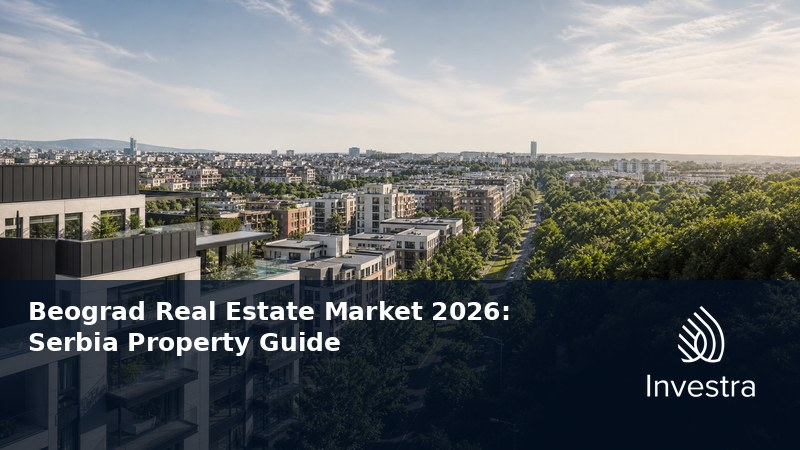
Beograd Real Estate Market 2026: Serbia Property Guide
Beograd Real Estate Market Overview 2026: Why the Serbian Capital Is Turning Heads
Quick Answer: Beograd's real estate market in 2026 remains one of Southeast Europe's most compelling investment destinations, with property prices ranging from €1,200/m² in outer districts to €4,500+/m² in premium central locations — offering a rare combination of affordability, growth potential, and strong rental demand. Investra.io tracks real-time market shifts across Serbia's capital for informed investment decisions.
There's something quietly remarkable happening in Beograd. While European investors have spent years chasing yields in Lisbon, Budapest, and Warsaw, Serbia's capital has been building a real estate story that's hard to ignore — and increasingly difficult to overlook. The city of 1.7 million people sits at the confluence of the Sava and Danube rivers, serving as the economic, cultural, and political engine of the entire Western Balkans region.
What makes 2026 particularly interesting is the convergence of several forces that don't often align simultaneously. Serbia's EU accession talks have gathered pace. The country's GDP grew at approximately 3.8% in 2025, comfortably outpacing the EU average. Foreign direct investment into Serbia reached a record €4.1 billion in 2024, with a significant portion flowing into Beograd's commercial and residential sectors. The city's population continues to grow — partly through internal migration from smaller Serbian towns, and partly through an influx of digital nomads and remote workers who've discovered that a 65 m² apartment in Novi Beograd costs a fraction of what you'd pay in Vienna or Prague.
The reality is that Beograd's real estate market isn't just cheap — it's undervalued relative to its fundamentals. Strong rental demand, improving infrastructure, a growing tech and startup ecosystem anchored in neighborhoods like Savamala and Vračar, and a legal framework that is increasingly foreign-investor friendly all point in the same direction. But smart investing here still requires understanding the nuances, the risks, and the micro-markets within the city itself.
Beograd Property Price Ranges by District in 2026
Quick Answer: Property prices in Beograd vary dramatically by district — from approximately €1,200–€1,800/m² in peripheral areas like Zemun and Rakovica, to €3,500–€4,800/m² in the most desirable central neighborhoods such as Stari Grad and Vračar. New-build apartments in Novi Beograd's premium blocks typically command €2,500–€3,500/m².
Understanding Beograd's price map is genuinely the first step for any serious investor. The city isn't monolithic — it's a patchwork of micro-markets, each with its own supply dynamics, tenant profiles, and growth trajectories. Breaking it down district by district gives you a clearer picture than any citywide average can.
Stari Grad (Old Town) remains the prestige address. Prices for renovated apartments in historic buildings around Knez Mihailova and Skadarlija regularly exceed €4,000/m², with the finest properties touching €5,000/m² or beyond. These properties attract wealthy domestic buyers, expats, and short-term rental operators targeting the booming tourism market. Supply is constrained — you can't build new stock in the old town — which gives existing properties a natural scarcity premium.
Vračar is Beograd's equivalent of a bourgeois intellectual neighborhood: tree-lined streets, excellent schools, proximity to the Temple of Saint Sava, and a vibrant café culture. Prices here typically range from €2,800 to €4,200/m² depending on building quality and exact location. The rental market is exceptionally strong, underpinned by young professionals and university-adjacent demand.
Novi Beograd tells a more complex story. The socialist-era blocks that dominate this district vary enormously in quality. Older panel buildings from the 1970s-80s trade at €1,500–€2,200/m², while modern new-build towers in the Belgrade Waterfront development and surrounding areas push into the €3,000–€4,500/m² range. The Belgrade Waterfront project — a multi-billion dollar urban regeneration scheme — has dramatically changed the perception of Novi Beograd's western riverfront.
Zemun, with its distinct Austro-Hungarian character, offers some of Beograd's most charming streetscapes at more accessible prices: €1,400–€2,400/m² for most properties. Zvezdara and Voždovac sit in the mid-range at €1,600–€2,600/m², popular with middle-class families and offering reasonable rental yields. Palilula and Rakovica represent the more affordable end of the urban spectrum at €1,200–€1,900/m².
What surprised many buyers entering this market in 2025-2026 is how quickly Beograd's mid-tier has appreciated. Districts like Zvezdara and Čukarica, which were largely overlooked five years ago, have seen price increases of 18–25% over the past three years as buyers priced out of Vračar and Stari Grad moved outward.
Belgrade Rental Yields and Income Potential for Investors
Quick Answer: Gross rental yields in Beograd range from 4.5% to 7.5% depending on district and property type, with short-term rentals in tourist-heavy areas potentially generating 8–10% gross returns — making the city one of the higher-yielding European capital markets currently available to foreign investors.
Rental yields are where Beograd's investment case really sharpens into focus. The city's rental market has been transformed over the past five years by three interlocking forces: rapid urbanization as young Serbs migrate to the capital for work, a growing international community of expats and digital nomads, and an explosion in short-term tourism driving Airbnb-style demand in central neighborhoods.
For long-term residential rentals, a well-located 50–70 m² apartment in Vračar or Stari Grad can command monthly rents of €800–€1,400. At purchase prices of around €3,000/m², a 60 m² apartment costing €180,000 might rent for €1,000/month — a gross yield of approximately 6.7%. After factoring in property management fees (typically 8–12% of rental income), maintenance, and Serbia's flat 15% tax on rental income, net yields commonly land in the 4.5–5.5% range for well-managed properties.
The short-term rental market adds another dimension. Central Beograd — particularly Stari Grad and Savamala — has seen explosive growth in tourism numbers. Serbia received over 4 million foreign tourists in 2024, with Beograd accounting for the lion's share. Airbnb occupancy rates in prime central locations run at 70–80% during peak season (April–October), with average daily rates of €60–€120 for a well-presented studio or one-bedroom. Operated professionally, these properties can generate gross annual income representing 8–10% of purchase price. The tradeoff is higher operational complexity and the ever-present risk of regulatory changes targeting short-term rentals — a pattern we've seen across Europe's capitals.
Novi Beograd's business district tells a slightly different story. Corporate rentals targeting employees of multinationals — and there are many, given Beograd's role as a regional HQ city — can achieve €1,200–€2,000/month for quality furnished apartments, with tenants often on 12-24 month contracts. The stability and quality of these tenants compensates somewhat for slightly lower gross yields compared to short-term options. Investors considering this approach would do well to consult resources like Siniša Dagary — Investment Consultant for market-specific income projections and due diligence support.
The Belgrade Waterfront Effect: Urban Regeneration and Property Values
Quick Answer: The Belgrade Waterfront mega-development has been the single biggest driver of property value appreciation in Novi Beograd and surrounding areas, with new-build prices in the project reaching €4,000–€5,500/m² — representing a 40–60% premium over comparable older stock in the same district.
No discussion of Beograd's real estate market is complete without addressing the elephant in the room — or rather, the skyscraper on the river. Belgrade Waterfront is a €3 billion urban development project stretching along the Sava riverfront, developed in partnership with Eagle Hills, a UAE-based developer. Since its first residential phase launched in 2017, it's been one of the most debated projects in the city's history.
What's undeniable is its market impact. The BW Residences towers have set new price benchmarks — luxury units with river views have sold for €5,000–€6,500/m², prices that would have seemed fantastical in Beograd a decade ago. More importantly, the development has catalyzed investment across the entire western Novi Beograd waterfront, with adjacent older properties appreciating significantly as the neighborhood's perception shifted from Soviet-era concrete to aspirational urban living.
The project has also introduced a new buyer profile to Beograd's market. Gulf state investors, attracted partly by cultural and diplomatic ties, have been active purchasers. Russian and Ukrainian buyers — many seeking stable asset preservation following geopolitical upheaval — have found Beograd's premium new-build market to be accessible and legally straightforward. Chinese investors have shown interest in commercial components. This internationalization of demand has fundamentally changed the market's ceiling.
Belgrade Waterfront Phase 3 and Phase 4 continue to add residential towers, retail, and a five-star hotel complex through 2027. Infrastructure improvements connected to the project — including a new tram line and waterfront promenade — are extending their positive effects into neighboring Savamala and parts of Stari Grad. The ripple effect on surrounding property values remains one of the most compelling structural arguments for Beograd investment at the city level.
Legal Framework for Foreign Property Buyers in Serbia
Quick Answer: Foreign nationals from most countries can legally purchase property in Serbia with few restrictions, provided their home country has a reciprocity agreement with Serbia (which covers the vast majority of EU, US, UK, and other Western nations) — though agricultural land purchases by non-EU foreigners remain subject to additional restrictions.
Legal clarity matters enormously when investing in any emerging market, and Serbia's framework for foreign buyers is considerably more straightforward than many expect. The principle of reciprocity governs foreign ownership rights: if Serbia has a bilateral reciprocity agreement with your country — and these exist with all EU member states, the US, UK, Canada, Australia, and many others — you can purchase residential and commercial property on essentially the same terms as a Serbian citizen.
The typical purchase process runs as follows. First, a preliminary purchase agreement (predugovor) is signed, usually accompanied by a 10% deposit. The buyer's lawyer then conducts title searches through the Republic Geodetic Authority (RGA) database — Serbia's land registry system — to confirm ownership and check for encumbrances. Final purchase contracts must be notarized (overa) before a notary public (javni beležnik). The buyer then registers the property at the RGA, a process that typically takes 2–4 weeks once documents are submitted.
Property transfer tax stands at 2.5% of the assessed value for resale properties. New-build purchases from developers are subject to VAT of 10% (included in the advertised price in most cases). Legal fees typically run €500–€2,000 depending on transaction complexity. Agent commissions are generally 3% split between buyer and seller, though this varies.
One area where foreign buyers should exercise particular care is in the verification of planning permissions and legalization status of buildings. A significant proportion of older buildings and extensions in Serbia were constructed without proper permits during the informal construction era of the 1990s and 2000s. Serbia's legalization laws have addressed much of this, but buyers should always verify that a property has been fully legalized (overeni radovi) before proceeding. Engaging a qualified Serbian property lawyer — not merely relying on the developer's or seller's agent — is non-negotiable. The About Siniša Dagary page offers context on the kind of expert guidance investors should seek for Serbia market entry.
Taxes, Costs, and Financial Considerations for Beograd Property Investment
Quick Answer: Total acquisition costs in Serbia typically add 5–8% to the purchase price (covering transfer tax, notary, legal fees, and agent commissions), while ongoing costs include property tax (0.1–0.4% of assessed value annually) and 15% flat tax on net rental income — making Serbia one of Central and Eastern Europe's more tax-efficient real estate investment environments.
Getting the numbers right before you commit is the cornerstone of any successful property investment. Serbia's tax framework, when understood properly, is actually quite investor-friendly — particularly compared to higher-cost EU markets like France or Denmark.
The headline figure to anchor on: all-in acquisition costs for a resale property typically fall in the 5–8% range above the purchase price. Break that down and you've got the 2.5% transfer tax, notary fees of approximately 0.1–0.3% (capped at certain thresholds), legal fees of €500–€2,000, and agent commission of 1.5–3%. For new builds purchased directly from developers, VAT replaces transfer tax, and while the 10% VAT sounds high, it's typically already factored into the advertised price. The practical difference is often less dramatic than it appears.
Annual property tax in Serbia is low by European standards. Rates run from 0.1% to 0.4% of the assessed (not market) value, and assessed values have historically lagged behind market prices, making the effective tax rate even lower. A €200,000 apartment in Beograd might generate an annual property tax bill of €150–€400 — remarkably affordable.
Rental income is taxed at a flat 15% on net income (after a 25% deduction for expenses — meaning effective tax is 15% of 75% of gross income, equating to roughly 11.25% of gross rental income). For investors structured as legal entities, corporate taxation applies instead, and the calculus changes. Serbia's Findes Financial Services and similar cross-border financial advisors can help international investors optimize their holding structure from a tax efficiency standpoint.
Capital gains tax on property sales is 15%, applied to the profit (difference between purchase price and sale price, adjusted for recognized improvements and inflation indexing). Properties held for more than 10 years are exempt from capital gains tax — a meaningful incentive for long-term holders. Serbia has double taxation treaties with over 60 countries, which typically prevent investors from being taxed twice on the same income in both Serbia and their home country.
Infrastructure, Connectivity, and Development Pipeline
Quick Answer: Beograd's infrastructure investment pipeline through 2028 exceeds €8 billion, encompassing the Belgrade Metro (first line due 2028), highway upgrades, airport expansion, and smart city initiatives — infrastructure improvements that historically correlate with 15–25% property value appreciation in affected corridors.
Infrastructure is the unglamorous backbone of property value creation. Beograd's investment pipeline for the 2024–2028 period is genuinely substantial, and investors who understand where infrastructure is heading have a structural advantage in identifying which micro-markets will appreciate most.
The most transformative project is the Beograd Metro — the city's first underground mass transit system. Line 1 runs from Mirijevo in the east through the city center to Novi Beograd and the airport in the west, with a planned opening in 2028. Historical data from comparable CEE cities (Warsaw, Prague, Bucharest) shows consistent property value premiums of 10–20% developing along new metro corridors 3–5 years before opening. Savvy investors have already been positioning in Mirijevo and eastern Zvezdara neighborhoods where current prices remain below the city average but metro exposure is direct.
The Nikola Tesla Airport expansion — adding a new terminal by 2027 — reflects the growth in air connectivity. Beograd now has direct connections to over 70 destinations, and the airport handled 7.2 million passengers in 2024, a number expected to reach 9 million by 2027. This matters for the short-term rental market, keeping tourist flow and occupancy rates structurally supported.
Road infrastructure improvements including the Morava Corridor (connecting Beograd to Niš via Pojate) and upgrades to the E75 European corridor are reducing travel times between Beograd and other Serbian cities, subtly reinforcing the capital's economic dominance. Investors looking at satellite markets should also explore how this connectivity is affecting smaller cities — the Aleksinac Real Estate Market 2026 Southern Serbia Property Guide offers useful context on how Beograd's connectivity ripples outward.
Beograd's Tech and Startup Ecosystem: The Invisible Driver of Property Demand
Quick Answer: Beograd has emerged as one of Southeast Europe's top three technology hubs, with over 3,000 IT companies employing 60,000+ professionals — a highly paid tenant class whose income levels are driving rental price growth in neighborhoods like Savamala, Dorćol, and Vračar well above the broader market average.
There's a story about Beograd that rarely makes international headlines but shapes its property market in ways that pure macroeconomic data doesn't capture. The city has, over the past decade, quietly built one of the most impressive technology ecosystems in the Western Balkans. Serbia's IT sector now generates approximately €2 billion in annual export revenues, most of it concentrated in Beograd.
Companies like NCR, Microsoft, Nordeus (now part of Take-Two Interactive), Levi9, and dozens of homegrown startups have created a class of young, highly paid professionals earning €2,000–€5,000 per month — incomes that are exceptional in the Serbian context and allow a level of housing expenditure that supports premium rental pricing. This demographic overwhelmingly prefers to rent rather than buy, is concentrated in specific neighborhoods, and has very specific quality expectations: fast internet, modern fit-out, proximity to coworking spaces and quality cafes.
Savamala — Beograd's creative and tech district along the Sava riverfront — has undergone a transformation comparable to East London's Shoreditch or Berlin's Mitte in the mid-2000s. Properties here that sold for €1,200/m² a decade ago now trade at €2,800–€3,500/m², and the pipeline of new F&B venues, galleries, and collaborative workspaces shows no signs of slowing. Dorćol, Strahinjića Bana street area, and the stretch between Kalemegdan and Botanička Bašta have similarly gentrified with tech money driving demand.
For investors, the actionable insight is this: buying in neighborhoods with high concentrations of tech workers isn't just a yield play — it's a capital appreciation play, because the quality of tenants drives renovation investment, which in turn lifts the entire neighborhood's price floor. Tracking Serbia's technology sector health is, counterintuitively, one of the best leading indicators of Beograd property market direction. The Business Strategy Blog at SinisaDagary.com covers Serbia's business ecosystem trends that intersect directly with property investment thesis development.
Comparing Beograd to Other Serbian Investment Markets in 2026
Quick Answer: While Beograd offers the deepest market liquidity and strongest rental demand among Serbian cities, smaller regional markets like Novi Sad, Niš, and eastern Serbian cities offer higher gross yields (often 7–9%) at significantly lower entry prices — making portfolio diversification across multiple Serbian cities a strategy increasingly favored by experienced investors.
Beograd doesn't exist in a vacuum. Understanding where it sits in the broader Serbian property landscape helps investors calibrate their strategy — whether concentration in the capital makes sense, or whether geographic diversification within the country offers better risk-adjusted returns.
Novi Sad, Serbia's second city and European Capital of Culture 2022, has benefited enormously from spillover demand and its own tech sector growth. Average prices have risen from €1,400/m² in 2020 to approximately €2,200–€2,800/m² in 2026 — impressive appreciation, with yields slightly higher than Beograd's comparable segments. Niš in southern Serbia remains significantly cheaper at €800–€1,400/m², with yields of 7–9% but lower capital appreciation track record.
Eastern Serbia presents some of the most intriguing value propositions for contrarian investors. Cities like Bor, Zajecar, and Negotin have been undergoing economic transformation driven by mining investment and rural development funding. The Bor Real Estate Market 2026 Eastern Serbia Mining City Property Guide explores how industrial investment is reshaping one of the country's most surprising emerging markets. Similarly, the Zajecar Real Estate Market 2026 Eastern Serbia Property Guide and Negotin Real Estate Market 2026 Zajecar District Property Guide detail markets where entry prices below €500/m² can generate double-digit gross yields.
The Vojvodina region north of Beograd offers yet another investment profile. Industrial logistics hubs like Inđija — explored in the Inđija Real Estate Market 2026 Vojvodina Logistics Hub Property Guide — are attracting warehousing and light manufacturing investment that drives demand for worker housing. Sremska Mitrovica, detailed in the Sremska Mitrovica Real Estate 2026 Srem Region Property Guide, sits on the Trans-European transport corridor and benefits from proximity to both Beograd and the Croatian border.
Smart investors are increasingly treating Serbia as a single investment ecosystem rather than a collection of isolated city markets. Beograd provides the portfolio's liquidity anchor; smaller cities provide the yield engine. The Investra.io provides comprehensive market data and investment guidance.
Can foreigners buy property in Serbia?
EU citizens can buy property freely in Serbia. Non-EU citizens may need to meet specific requirements. Investra.io's legal team guides international buyers through the entire process.
What is the average property price in Beograd?
Property prices in Beograd vary significantly by location and property type. Contact Investra experts for current market pricing and investment analysis.
What rental yields can I expect?
Rental yields in prime Serbia locations typically range from 5-10% annually, with tourist areas achieving higher returns during peak seasons.
What taxes apply to property purchases?
Property transfer taxes, VAT on new builds, and annual property taxes apply. Rates vary by property type and location. Consult Siniša Dagary for tax optimization strategies.
How long does the purchase process take?
Typically 30-60 days from offer to completion. Working with Investra.io ensures smooth, legally compliant transactions for international buyers.
What financing options are available?
Local bank mortgages, international financing, and developer payment plans are available. Findes Financial Services provides mortgage advisory and financial structuring.
Is property management available for rental properties?
Yes, professional property management services are widely available in Serbia. Investra.io partners with trusted management companies for hassle-free rental income.
What are the best areas to invest in Beograd?
Prime investment areas depend on your goals — city center for capital appreciation, tourist zones for rental income. Investra.io's market analysis identifies the best opportunities.
Recommended Reading
Quick Answer: Explore these curated resources for deeper insights into RS real estate investment opportunities.
- Negotin Real Estate Market 2026 Zajecar District Property...
- Bor Real Estate Market 2026 Eastern Serbia Mining City Pr...
- Zajecar Real Estate Market 2026 Eastern Serbia Property G...
- Prokuplje Real Estate Market 2026 Toplica Region Property...
- Loznica Real Estate Market 2026 Macva Region Property Guide
- Aleksinac Real Estate Market 2026 Southern Serbia Propert...
- Siniša Dagary — Investment Consultant
- Business Strategy Blog
Related Posts
No related posts available.
