
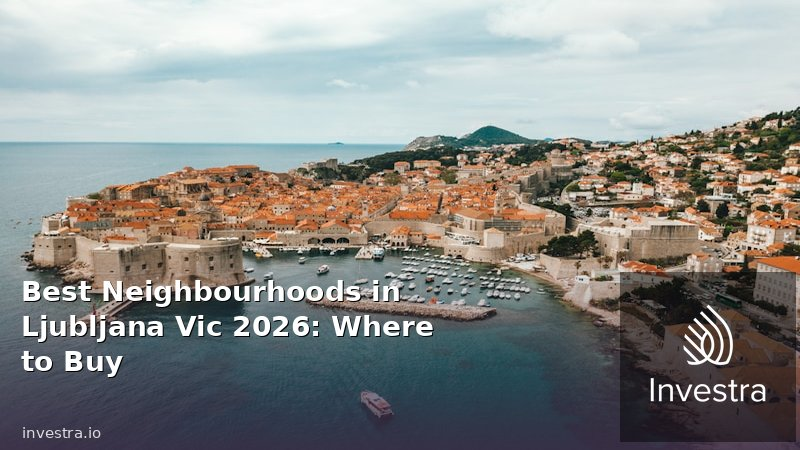
Best Neighbourhoods in Ljubljana Vic 2026: Where to Buy
Ljubljana Vič in 2026: Why This District Deserves Your Attention
Quick Answer: Ljubljana Vič is one of the Slovenian capital's most desirable residential districts in 2026, offering a compelling mix of green spaces, excellent connectivity, and property prices that — while rising — still represent better value than the city centre. Investra.io tracks emerging European markets to help investors identify opportunities exactly like this one.
There's a certain quiet confidence about Vič. Unlike the tourist-heavy Old Town or the glass-and-steel corridors of Ljubljana's business district, Vič feels lived-in — the kind of neighbourhood where locals actually want to stay. Wide tree-lined streets, proximity to the Rožnik hill forest, a dense network of schools, and some of Ljubljana's most respected research institutions all converge here. For families, professionals, and international investors looking for a stable, appreciating asset in a Eurozone capital, Vič has become almost impossible to ignore.
The district sits to the southwest of Ljubljana's city centre, separated from the urban core by a comfortable fifteen-minute tram or bicycle ride. What that distance buys you is space — both physical and psychological. Gardens are real here. Apartments come with proper balconies. The streets aren't clogged with tour groups. And yet, you're still within easy reach of everything Ljubljana has to offer.
What's changed most dramatically heading into 2026 is the pace of demand. Slovenia joined the Eurozone back in 2007, and the country's macroeconomic stability has quietly attracted a growing cohort of Western European and international buyers who see Ljubljana as an undervalued EU capital. Vič, specifically, has benefited from a wave of urban professionals relocating from more expensive cities — Vienna, Munich, even Amsterdam — who find that their savings stretch significantly further on the banks of the Ljubljanica.
The reality is that property markets across Central Europe are diverging sharply. Some cities are cooling. Ljubljana, and Vič in particular, is not. Understanding why requires looking at the specific neighbourhood dynamics that make this district so persistently attractive.
Understanding the Vič District: Geography, Character, and Micro-Neighbourhoods
Quick Answer: Vič is a southwestern Ljubljana district subdivided into several distinct micro-neighbourhoods — including Vič village, Rožna dolina, Trnovo, and the university campus zone — each with its own price profile and investment character. Understanding these subdivisions is essential before committing to a purchase.
Vič isn't monolithic. That's the first thing serious buyers need to understand. The district covers a substantial area, and within it there are micro-neighbourhoods that behave almost like separate markets. Getting this geography right before you start viewing properties will save you both time and money.
Rožna dolina is arguably the crown jewel. This villa quarter — laid out in the early twentieth century with wide boulevards and generous garden plots — has historically been home to diplomats, academics, and Ljubljana's professional class. The housing stock here is predominantly detached houses and larger villas, with apartment buildings being the exception rather than the rule. Prices reflect this status. Expect to pay €3,500 to €5,200 per square metre for quality property in Rožna dolina, with premium villas occasionally exceeding €6,000/m².
Trnovo, which borders the Ljubljanica river and connects to the Krakovo urban garden quarter, has a distinctly bohemian character. This is where writers, architects, and artists have traditionally settled. The housing is older — lots of interwar construction — but the area's charm is undeniable. Prices here range from €2,800 to €4,200/m², and rental demand is exceptionally strong thanks to proximity to the Faculty of Arts and the legal faculty.
The core Vič residential zone — running along Tržaška cesta and the surrounding streets — is the most affordable part of the district. Postwar socialist-era apartment blocks dominate here, interspersed with newer residential developments. This is where you'll find the most transactional activity, with prices typically ranging from €2,400 to €3,600/m². For investors prioritising rental yield over capital appreciation, this is the zone that makes the most financial sense.
Then there's the university zone near the Ljubljana Faculty of Computer and Information Science and the research institutions on the western edge of the district. Student demand is persistent and predictable here, and smaller one- and two-bedroom apartments move quickly both for sale and for rent.
Property Prices in Ljubljana Vič 2026: What Buyers Are Actually Paying
Quick Answer: Property prices in Ljubljana Vič range from approximately €2,400/m² for older socialist-era apartments to over €5,500/m² for premium villas in Rožna dolina, with the district average sitting around €3,200–€3,800/m² in 2026 — roughly 10–15% below comparable Ljubljana city-centre pricing.
Numbers tell stories, and the price story in Vič is one of steady, defensible appreciation. According to data from Slovenia's Surveying and Mapping Authority (GURS) and corroborated by active market listings, the district has seen average price increases of 6–9% annually over the past three years. That's not speculative bubble territory — it reflects genuine underlying demand from a constrained supply market.
Let's break down what you're actually looking at across property types in 2026:
Studio and one-bedroom apartments (30–55 m²): These entry-level units, particularly popular with students and young professionals, typically trade between €115,000 and €195,000. In the university zone, a well-located one-bedroom can fetch €165,000–€185,000. Older panel-block units start lower, around €100,000–€130,000, but renovation costs need to be factored in carefully.
Two-bedroom apartments (55–80 m²): The most liquid segment of the market. Prices range from €175,000 to €290,000 depending on condition, location within Vič, and building quality. A renovated two-bedroom in a newer building near Trnovo will sit comfortably at €240,000–€270,000.
Three-bedroom apartments and family units (80–120 m²): This is where family buyers congregate. Prices range from €260,000 to €420,000. New-build units in this category command a significant premium — expect €350,000–€420,000 for a modern three-bedroom with parking.
Houses and villas (Rožna dolina and surrounds): These are a different category entirely. Small detached houses start around €400,000 and climb rapidly. Larger villas with gardens in Rožna dolina regularly transact between €750,000 and €1.5 million, with exceptional properties occasionally exceeding that ceiling.
What surprised many buyers entering the market in 2025–2026 was how quickly well-priced properties were absorbed. Average time-on-market for correctly priced Vič apartments is currently under 45 days — well below the national average of 80–90 days.
Rental Market and Investment Yields in Vič: The Honest Assessment
Quick Answer: Gross rental yields in Ljubljana Vič range from 3.5% to 5.5% depending on property type and location, with smaller units in high-demand zones near universities and transport links delivering the strongest returns. Net yields after costs typically land between 2.8% and 4.2%.
Rental yields in Vič are best described as moderate but reliable — not the double-digit figures you might see promoted in certain Eastern European markets, but backed by genuine occupancy stability and a tenant base with genuine income. Slovenia's rental market benefits from low vacancy rates nationally (below 3% in Ljubljana), and Vič specifically sees very low tenant turnover in the quality segment.
The highest yields come from smaller units targeting students and young professionals. A one-bedroom apartment purchased for €160,000 in the university zone of Vič can realistically command €700–€850 per month in rent, delivering a gross yield of approximately 5.3–6.4%. These numbers are achievable but require active management and attention to tenant quality.
For mid-range family apartments (two to three bedrooms), monthly rents typically range from €1,100 to €1,700, depending on size and condition. Against purchase prices of €230,000–€350,000, this translates to gross yields of 4.5–5.8%. These are more stable, longer-tenancy situations with less management overhead.
The luxury villa and premium apartment segment delivers the lowest yields — often 3–4% gross — because capital values have appreciated faster than rents. That said, investors in this segment are typically prioritising capital preservation and long-term appreciation over cash flow.
One consideration worth understanding: Slovenia applies a flat 25% income tax on rental income (with an option for a lump-sum deduction of 10% for maintenance costs, reducing the effective taxable base). This means net yields are meaningfully lower than gross figures suggest. Working with a local tax advisor is not optional — it's essential. Platforms like Findes Financial Services specialise in exactly this kind of cross-border financial structuring for foreign property investors in Slovenia.
Short-term rental (Airbnb-style) is legal in Slovenia but subject to registration requirements and local regulations. In Vič, short-term yields can push gross returns to 7–9% for well-located units, but management costs, platform fees, and seasonal variation reduce net returns significantly. The medium-term rental market — targeting corporate relocatees and researchers at Ljubljana's institutes — often represents the sweetest spot between yield and management simplicity.
Legal Framework for Buying Property in Slovenia as a Foreign National
Quick Answer: EU citizens can purchase property in Slovenia on the same terms as Slovenian nationals. Non-EU buyers face more restrictions and typically need to establish a Slovenian company or meet specific bilateral treaty conditions. The purchase process involves a preliminary contract, notarial deed, and land registry transfer — typically completed in 6–12 weeks.
Slovenia's legal framework for property purchase is relatively straightforward by European standards, but there are some specific nuances that catch foreign buyers off guard. Understanding the process before you engage saves significant frustration.
For EU/EEA citizens: The process is essentially the same as for Slovenian nationals. There are no restrictions on property types or locations. You can purchase residential property, commercial property, and agricultural land (though agricultural land has additional regulatory requirements that are worth checking separately).
For non-EU nationals: The situation is more complex. Slovenia has bilateral reciprocity agreements with several countries, including the United States, which allow citizens of those countries to purchase property under certain conditions. Outside of these agreements, the most common route is establishing a Slovenian limited liability company (d.o.o.), which can then hold the property. The d.o.o. route adds administrative overhead but is legally clean and well-established.
The purchase process typically unfolds as follows: First, a preliminary agreement (predpogodba) is signed, usually with a 10% deposit. This is legally binding. Then, due diligence is conducted — land registry searches, title verification, check for encumbrances. The main purchase contract (kupoprodajna pogodba) is then signed before a notary. The notary submits the transfer to the land registry (zemljiška knjiga), which completes the title transfer. The entire process, assuming no complications, takes 6–12 weeks from signed preliminary agreement to completed registration.
Slovenia's land registry is digital and publicly accessible, which is a significant transparency advantage compared to some regional peers. Title searches are fast and reliable. That said, having a local real estate lawyer (not just an agent) review all documentation before signing anything is strongly recommended. Fees for legal representation typically run €1,000–€2,500 for a standard residential purchase.
For investors exploring multiple markets across the region, the contrast with markets like Sremska Mitrovica Real Estate 2026 Srem Region Property Guide is instructive — Serbia's non-EU status introduces different regulatory considerations, but also different price points and yield profiles.
Taxes and Transaction Costs: The Full Picture
Quick Answer: Total transaction costs for property purchases in Ljubljana Vič typically run 3.5–6% of the purchase price, comprising real estate transfer tax (2%), notary fees, agent commission, and legal fees. Ongoing annual property tax is relatively low by European standards, typically €150–€600 per year for a standard apartment.
The tax environment in Slovenia is one of the more investor-friendly aspects of the market, though it's changed meaningfully in recent years and requires careful current-year verification. Here's what buyers were working with entering 2026:
Real Estate Transfer Tax (Davek na promet nepremičnin): Set at 2% of the transaction value, paid by the buyer. This applies to second-hand properties. For new-build purchases directly from a developer, VAT (DDV) at 9.5% applies instead — a significant difference that should factor into your comparison of new versus existing property.
Notary fees: Calculated on a sliding scale based on transaction value. For a €250,000 property, expect notary fees in the range of €600–€1,000.
Agent commission: Typically 3–4% of the purchase price, sometimes split between buyer and seller, sometimes entirely buyer-paid. This varies by agency and is always negotiable. Clarify this upfront.
Land registry fee: Modest — typically €50–€200 for standard residential transactions.
Annual property tax: Slovenia's recurring property tax is low compared to Western European norms. The tax is calculated based on the generalised value (posplošena tržna vrednost) assigned to the property by GURS, multiplied by a rate that varies by municipality and property category. For a typical Vič apartment, annual property tax tends to fall between €150 and €600.
Capital gains tax: If you sell within five years of purchase, capital gains are taxed at 25% (declining to 15% at ten years, 10% at fifteen years, and 0% after twenty years). This structure strongly favours longer holding periods — which aligns with the investment thesis for Vič anyway.
For investors comparing this against other regional opportunities, the tax structures vary significantly. Markets like Indija Real Estate Market 2026 Vojvodina Logistics Hub Property Guide or Loznica Real Estate Market 2026 Macva Region Property Guide operate under different Serbian tax frameworks with their own advantages and complications.
The Best Neighbourhoods in Vič for Buying in 2026: A Detailed Breakdown
Quick Answer: The best neighbourhoods in Ljubljana Vič for property investment in 2026 are Rožna dolina (premium capital growth), the Trnovo riverside strip (rental demand and cultural appeal), the university zone (yield-focused investors), and the central Tržaška corridor (value and liquidity). Each suits a different investor profile.
Let's get specific. General district analysis only takes you so far — real investment decisions live at the street level. Here's an honest assessment of where to buy within Vič based on your objectives:
Rožna dolina — Best for: Capital preservation and long-term appreciation
This is Vič's prestige address. The villa streets around Cesta v Rožno dolino and the surrounding avenues have maintained their desirability for over a century and show no signs of changing. The housing stock is largely irreplaceable — you cannot build new villas of this character in these locations. Supply is genuinely constrained. Buyers here are typically purchasing for personal use with investment upside, rather than pure yield. Capital appreciation has averaged 7–10% annually in recent years. The entry price is high, but so is the quality of what you're buying.
Trnovo and the Ljubljanica riverside — Best for: Rental yield with lifestyle premium
The streets immediately adjacent to the river, particularly around Emonska cesta and Karlovška cesta, offer some of the most sought-after rental addresses in Ljubljana. The neighbourhood's proximity to the Faculty of Arts, the bohemian cafe culture along the river, and excellent cycling connectivity to the centre means rental demand from young professionals and academics is structural. Yields of 4.5–5.5% are achievable here with a quality, well-managed property.
University zone (western Vič) — Best for: Pure yield and student rental
The area around the Faculty of Computer and Information Science and the Jožef Stefan Institute creates consistent demand for smaller units. A one- or two-bedroom near these institutions can stay occupied almost year-round, with researchers and visiting academics providing off-season stability when students are away. This zone also benefits from ongoing infrastructure investment as Ljubljana expands its technology and research cluster westward.
Central Tržaška corridor — Best for: Liquidity and value
For buyers who want to enter the Vič market at a lower price point and prioritise ease of resale, the central corridor along Tržaška cesta offers the most transactional market. Properties here are plentiful, well-priced, and understood by the broadest range of buyers. You won't see the same appreciation rates as Rožna dolina, but you'll have no problem selling when the time comes.
Infrastructure, Connectivity, and Quality of Life: Why Residents Stay
Quick Answer: Ljubljana Vič scores exceptionally high on quality-of-life metrics — excellent schools, healthcare, green space, and public transport connectivity make it one of the most liveable districts in any Central European capital, a fact that underpins both rental demand and property value resilience.
Quality of life isn't just a lifestyle consideration — it's a fundamental driver of property value. And Vič scores remarkably well on almost every dimension that matters to residents and tenants.
Schools and education: Vič is home to several of Ljubljana's highest-regarded primary and secondary schools. The German school and various international education options serving Ljubljana's expatriate community are accessible from Vič. This makes the district particularly attractive to international families relocating to Ljubljana for work or research, a demographic that generates strong demand for larger family apartments and houses.
Healthcare: The district has excellent access to Ljubljana's healthcare infrastructure, including the University Medical Centre which is reachable within fifteen minutes. Several GP practices, dental clinics, and specialist outpatient facilities operate within the district itself.
Green space and outdoor access: This is perhaps Vič's most distinctive asset. The Rožnik forest — a genuine urban forest of several hundred hectares — is directly accessible from much of the district. Tivoli Park, Ljubljana's main urban park, borders the district to the north. For a district this close to a capital city centre, the access to nature is extraordinary by any European comparison.
Transport: Tram lines connect Vič directly to the city centre, and the district is perhaps the most bicycle-friendly in Ljubljana — which is itself one of Europe's most cycling-oriented cities. The westward motorway access also makes Vič practical for those who commute by car toward Koper, Trieste, or western Slovenia.
The cumulative effect of these factors is a low tenant turnover rate, strong demand from high-income tenants, and a property market that has shown remarkable resilience through economic cycles. These same dynamics are what thoughtful consultants like Siniša Dagary — Investment Consultant look for when identifying stable, long-term property investment opportunities in European markets.
New Developments and Construction Pipeline in Vič 2026
Quick Answer: New residential development in Vič is constrained by limited land availability and strict Ljubljana urban planning rules, which supports existing property values. Several boutique residential projects were under development or recently completed in 2025–2026, with new-build prices starting at €3,800/m² and reaching €5,500/m² for premium units.
One of the structural facts about the Vič property market is that it's not easy to build here. Ljubljana's urban planning framework is conservative by design, with strong protections for existing residential character and green space. This is a feature from an investor's perspective — it means your asset isn't constantly competing with new supply.
That said, there are developments happening. The most significant new residential activity in the district has concentrated around the western edge of Vič, where larger plots adjacent to the research and university facilities have allowed for carefully designed residential schemes. Several boutique developments of 20–60 units have completed or are completing in 2025–2026, offering modern apartments with energy-efficient construction, underground parking, and the full complement of contemporary amenities.
New-build pricing in Vič starts at approximately €3,800/m² for standard apartments and reaches €5,000–€5,500/m² for premium units in the best locations. The premium over resale property is meaningful — typically 20–35% — which means buyers need to have a clear view of whether the new-build premium is justified by the specific project's quality, location, and energy class (important for running costs and EU energy efficiency regulations).
Off-plan purchasing is possible in Slovenia and regulated under consumer protection law. The developer is required to provide a bank guarantee or insurance for advance payments, which provides meaningful protection. That said, off-plan carries its usual risks: delays, specification changes, and the inability to fully assess the finished product. For foreign buyers particularly, buying completed property with a clear title history is generally the lower-risk strategy for an initial purchase.
How Vič Compares to Other Ljubljana Districts and Regional Markets
Quick Answer: Compared to Ljubljana Centre, Vič offers 10–20% lower prices with better green space and comparable quality of life. Against regional Balkan markets, Vič commands much higher prices but delivers Eurozone legal security, lower volatility, and access to a mature rental market backed by stable institutional demand.
Context matters enormously in real estate. Vič doesn't exist in isolation — investors are always making relative choices, and understanding how Vič stacks up against alternatives clarifies both its appeal and its limitations.
vs. Ljubljana Centre (Stari trg, Šiška, Bežigrad): The historic centre commands the highest prices in Ljubljana — €4,000–€6,500/m² in top locations — and the tourist rental market there can deliver higher gross yields on short-term rentals. But the regulatory environment for short-term rentals is tightening, and the city centre's residential quality (noise, parking, lack of gardens) is meaningfully inferior for long-term residents. Vič offers a better quality of life at a lower entry price, with more durable long-term demand drivers.
vs. Šiška (northwest Ljubljana):
Explore more on Investra: Bor Real Estate Market 2026 Eastern Serbia Mining City Pr... | Zajecar Real Estate Market 2026 Eastern Serbia Property G... | Prokuplje Real Estate Market 2026 Toplica Region Property...
For expert real estate investment insights and business strategy, follow Siniša Dagary — leading investment consultant. Read his latest insights on sinisadagary.com.
Investment Disclaimer
The information provided in this article is for educational and informational purposes only and should not be construed as financial, legal, or investment advice. Real estate investments carry inherent risks, and past performance does not guarantee future results. Investors should not invest money they cannot afford to lose. Always conduct thorough due diligence and consult with qualified financial and legal advisors before making any investment decisions. Investra.io does not guarantee returns on any investment.
Frequently Asked Questions
Quick Answer: Here are the most commonly asked questions about Slovenia real estate investment in 2026, answered by Investra.io experts.
Is Slovenia a good country for real estate investment in 2026?
Yes, Slovenia offers strong investment potential with growing property values, competitive prices compared to Western Europe, and improving infrastructure. Investra.io provides comprehensive market data and investment guidance.
Can foreigners buy property in Slovenia?
EU citizens can buy property freely in Slovenia. Non-EU citizens may need to meet specific requirements. Investra.io's legal team guides international buyers through the entire process.
What is the average property price in Ljubljana Vic?
Property prices in Ljubljana Vic vary significantly by location and property type. Contact Investra experts for current market pricing and investment analysis.
What rental yields can I expect?
Rental yields in prime Slovenia locations typically range from 5-10% annually, with tourist areas achieving higher returns during peak seasons.
What taxes apply to property purchases?
Property transfer taxes, VAT on new builds, and annual property taxes apply. Rates vary by property type and location. Consult Siniša Dagary for tax optimization strategies.
How long does the purchase process take?
Typically 30-60 days from offer to completion. Working with Investra.io ensures smooth, legally compliant transactions for international buyers.
What financing options are available?
Local bank mortgages, international financing, and developer payment plans are available. Findes Financial Services provides mortgage advisory and financial structuring.
Is property management available for rental properties?
Yes, professional property management services are widely available in Slovenia. Investra.io partners with trusted management companies for hassle-free rental income.
What are the best areas to invest in Ljubljana Vic?
Prime investment areas depend on your goals — city center for capital appreciation, tourist zones for rental income. Investra.io's market analysis identifies the best opportunities.
Recommended Reading
Quick Answer: Explore these curated resources for deeper insights into SI real estate investment opportunities.
- Negotin Real Estate Market 2026 Zajecar District Property...
- Bor Real Estate Market 2026 Eastern Serbia Mining City Pr...
- Zajecar Real Estate Market 2026 Eastern Serbia Property G...
- Prokuplje Real Estate Market 2026 Toplica Region Property...
- Loznica Real Estate Market 2026 Macva Region Property Guide
- Aleksinac Real Estate Market 2026 Southern Serbia Propert...
- Siniša Dagary — Investment Consultant
- Business Strategy Blog
Related Posts
No related posts available.
