
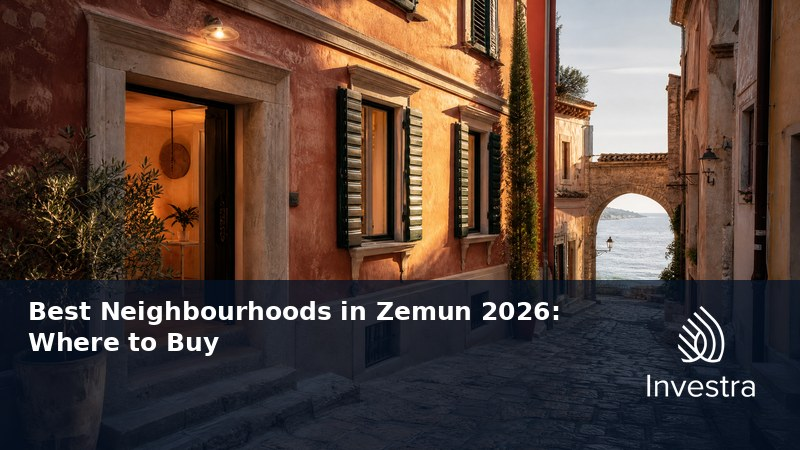
Best Neighbourhoods in Zemun 2026: Where to Buy
Why Zemun Is Capturing Investor Attention in 2026
Quick Answer: Zemun is one of Belgrade's most compelling real estate markets in 2026, offering a rare combination of historic charm, riverside appeal, and significantly lower prices than central Belgrade — making it a top destination for both local and international property buyers. Investra.io tracks the latest market data to help investors identify the right neighbourhoods before prices climb further.
There's a moment every emerging real estate market has — that window between "discovered by insiders" and "priced out for everyone else." Zemun, the historic municipality on the left bank of the Danube just west of Belgrade's city centre, is squarely in that window right now. In 2026, property prices here remain measurably below comparable Belgrade neighbourhoods, yet the quality of life, architectural character, and infrastructure improvements are narrowing that gap with remarkable speed.
What surprises many first-time visitors is how distinctly different Zemun feels from the rest of Belgrade. Once a separate Austro-Hungarian town, it retains a Central European architectural identity — baroque facades, cobbled laneways, a stunning riverside promenade called the Kej. It's the kind of place where residents have strong neighbourhood loyalty, and where demand for quality housing has been quietly outstripping supply for several years running.
Officially part of the City of Belgrade since 1934, Zemun today is home to approximately 168,000 residents and spans a diverse range of micro-neighbourhoods, from the heritage-listed Old Town core to newer residential developments pushing toward Novi Beograd's border. This diversity is precisely what makes it so interesting for investors — there's something here for every strategy, budget, and risk appetite.
The municipality sits at a geographic crossroads too. It borders Novi Beograd to the east (Belgrade's commercial powerhouse), has direct access to the A1 motorway toward Novi Sad, and sits adjacent to Belgrade's Nikola Tesla Airport to the northwest. For international investors, that airport proximity alone is a significant quality-of-life differentiator. For rental yield hunters, it means a consistent pool of business travellers, expats, and short-term renters who need accommodation near the capital without paying central Belgrade prices.
The broader Serbian property market has shown resilience through 2025 and into 2026, with Belgrade recording year-on-year price increases of 8–12% in key zones. Zemun has tracked slightly below this in established areas but has outperformed in riverside and transitional neighbourhoods where development activity is intensifying. The fundamentals here are genuinely strong — and this guide will walk through exactly which neighbourhoods deserve your attention, and why.
Understanding Zemun's Neighbourhood Geography
Quick Answer: Zemun is divided into several distinct micro-neighbourhoods, each with its own character, price point, and investment dynamic — ranging from the premium Old Town (Stari Grad) along the Danube to more affordable inland areas like Gornji Grad and Altina. Understanding this geography is the essential first step for any buyer.
Zemun isn't a monolithic neighbourhood — it's a municipality containing dozens of distinct micro-communities, and treating it as a single market would be a mistake. Think of it like arrondissements in Paris or quarters in Vienna: each zone has its own micro-economy, demographic profile, and investment trajectory.
At the top of the hierarchy sits the Stari Grad (Old Town) core, which runs along the Danube riverfront and climbs up toward Gardoš Hill. This is Zemun's most recognisable face — the one on the postcards, the one that draws weekend visitors from across Belgrade. Property here commands premium prices precisely because supply is permanently constrained by heritage protection regulations. You don't build new in Zemun's Old Town; you renovate, restore, and preserve.
Moving slightly inland and upward, Gornji Grad (Upper Town) occupies the terrain above the Old Town. It's quieter, more residential in character, and home to a mix of pre-war villas, socialist-era apartment blocks, and newer boutique developments. Prices are meaningfully lower than the Kej frontage but the lifestyle quality — green streets, proximity to the riverside without the tourist activity — is genuinely high.
Then there's the transitional belt that connects Zemun to Novi Beograd: areas like Zemun Polje, parts of Altina, and the Batajnica road corridor. These are working-class residential zones undergoing quiet gentrification. Infrastructure investment, new school construction, and improving transport links are pulling these areas up the value ladder — though they remain the most affordable entry points in the municipality.
Finally, the northern zones toward Ugrinovci and the airport corridor represent a different kind of opportunity: logistics, light commercial, and longer-term speculative plays rather than lifestyle purchases. These aren't neighbourhoods you'd buy to live in, but for industrial or mixed-use investors, they deserve a place on the radar.
What we've seen in similar European cities — think Bratislava's Old Town vs. Petržalka, or Vienna's 19th district vs. its 10th — is that riverside heritage zones maintain value through every market cycle. Zemun's Old Town is no different. The smart money understands that geography here is destiny.
Property Prices in Zemun 2026: Neighbourhood-by-Neighbourhood Breakdown
Quick Answer: Zemun property prices in 2026 range from approximately €1,400/m² in outer residential zones to €3,200/m² for prime riverside and renovated Old Town properties, with the municipal average sitting around €1,900–2,100/m² — roughly 15–25% below comparable Belgrade Stari Grad prices.
Hard numbers matter. So let's get specific about what buyers are actually paying across Zemun's different neighbourhoods in 2026.
The Kej (Danube Riverfront) remains the price leader, with renovated apartments and townhouses commanding €2,600–3,200/m² for premium units with river views. New construction here is essentially non-existent due to heritage restrictions, so this price band reflects the scarcity premium on quality renovated stock. A 60m² two-bedroom apartment on the Kej with direct river views would typically list at €160,000–190,000.
The Gardoš neighbourhood — centred on the iconic Millennium Tower — runs €2,000–2,700/m² for quality properties. The mix here is diverse: Ottoman-era houses in various states of renovation, Austro-Hungarian-era apartment buildings, and the occasional contemporary boutique project tucked between heritage buildings. Properties at the high end of this range are typically well-renovated with period features intact.
In Gornji Grad, prices settle into the €1,700–2,200/m² range. New-build apartments in this zone — and there's been active development here — come in around €1,900–2,100/m². This is arguably where the best value/quality ratio sits in all of Zemun. You're paying less than the riverfront premium but you're getting modern finishes, proper amenities, and a genuinely pleasant residential environment.
Altina, the large residential estate to the northwest, is a different story. Built predominantly in the socialist-era, it offers large apartments at €1,400–1,700/m². Families dominate here, attracted by green space, schools, and a slower pace. For investors, the rental yield story is actually more compelling than in the premium zones — rents haven't kept pace with the price appreciation elsewhere, but in Altina, the yield-to-price ratio remains attractive.
Zemun Polje and areas toward Batajnica represent the entry-level end of the market: €1,200–1,500/m² for older stock, with new developments coming in slightly higher at €1,500–1,800/m². These zones have the highest capital growth potential over a 5–10 year horizon precisely because they're starting from a low base with improving infrastructure.
It's worth comparing these numbers to broader Serbian markets. The Zajecar Real Estate Market 2026 Eastern Serbia Property Guide shows prices of €600–900/m² in that eastern city — illustrating how significant the Belgrade metro premium is, and why investors seeking higher yields often look beyond the capital.
Stari Grad Zemun and the Gardoš Area: The Premium Heritage Quarter
Quick Answer: Zemun's Stari Grad and Gardoš area is the municipality's most prestigious address, combining UNESCO-adjacent heritage architecture with Danube views and genuine scarcity value — making it the safest long-term store of value for conservative investors despite carrying the highest entry prices.
If you ask a Belgrade real estate professional where they'd put their own money in Zemun, the Gardoš-Stari Grad axis comes up repeatedly. There's a reason for that — and it goes beyond aesthetics.
The protected status of Zemun's Old Town effectively places a permanent cap on supply. You cannot demolish heritage-listed buildings to construct modern apartment towers. What exists today is more or less what will exist in twenty years. In a world of infinite new construction driving down values elsewhere, this supply constraint is extraordinarily valuable.
Gardoš Hill itself is the neighbourhood's centrepiece — a promontory rising above the Danube confluence where Belgrade's Sava meets the Danube, offering views that frankly rival anything in Central Europe. The Millennium Tower (Kula Sibinjanin Janka) at the peak serves as both landmark and neighbourhood anchor. The streets radiating from the hill — Grobljanska, Gardoška, Cara Dušana — contain some of Serbia's most characterful residential architecture.
What's happening to this market right now? International buyers are arriving in genuine numbers. We've seen buyers from Germany, Austria, Slovenia, and increasingly from further afield — the UK, US, and Gulf states — identifying Zemun's heritage zone as a European lifestyle play that happens to still be affordable compared to equivalent properties in Budapest, Krakow, or Tallinn. A renovated Gardoš apartment with original architectural features that would cost €400,000+ in Budapest lists here for €180,000–250,000.
The renovation ecosystem matters too. Zemun has developed a cluster of skilled craftsmen, architects, and project managers who specialise in heritage renovation — keeping costs manageable and quality high. Budget roughly €600–900/m² for quality renovation work, meaning a 70m² Gardoš apartment purchased for €120,000 in need of full renovation can be transformed for a total all-in cost of around €165,000–185,000, with a market value post-renovation of €185,000–210,000. Tight margins, but the rental income picture is more compelling — quality furnished rentals in this area achieve €700–1,100/month, yielding 4.5–6% net.
For strategic investment guidance in this space, the Siniša Dagary — Investment Consultant platform offers frameworks for evaluating heritage property investments specifically in Serbian markets.
The Kej (Danube Riverfront): Zemun's Most Sought-After Address
Quick Answer: The Kej riverfront promenade commands Zemun's highest property prices at €2,600–3,200/m², driven by permanent scarcity, irreplaceable views, and strong short-term rental demand — making it ideal for premium buy-to-let strategies despite lower gross yields compared to inland zones.
The Kej is one of those rare streets that doesn't need explaining to anyone who has walked it. The wide promenade, lined with restaurants and cafes on one side and the broad Danube on the other, the Gardoš tower visible on the hill above — it's simply one of the finest urban riverfront experiences in Southeast Europe. And people pay for it.
Properties directly on or immediately adjacent to the Kej represent Zemun's most liquid asset class. They are consistently in demand from three distinct buyer pools: wealthy Serbian professionals seeking a lifestyle property, foreign buyers wanting a European river-city apartment, and investors targeting the high end of the short-term rental market. This tri-demand structure means the Kej never really sees distressed sales — even in market downturns, there's always someone who wants to own a piece of this address.
The short-term rental performance here is particularly strong. A well-presented two-bedroom Kej apartment listed on Airbnb or Booking.com achieves average daily rates of €80–130 during peak season (May–October) and €50–70 in the off-season. Annual occupancy for well-managed properties runs 65–75%, generating gross rental income of €18,000–27,000 per year. At a purchase price of €180,000–220,000, that represents gross yields of 8–12% before platform fees and management costs — unusually strong for a premium European riverfront address.
The catch? Most properties here are older and have seen varying levels of maintenance. Buyers need to be prepared for detailed technical due diligence — particularly around building systems, structural condition, and compliance with heritage regulations. Engaging a qualified local architect before purchase, not after, is simply non-negotiable in this zone. Management costs are also higher here than in standard apartment markets, given the customer expectations of short-term rental guests at this price point.
The technology enabling all of this is increasingly sophisticated. As explored in the Serbia Proptech 2026: How Technology Is Changing Real Estate article, digital property management platforms are making it viable for international owners to run Kej rentals remotely with minimal friction.
Gornji Grad: The Savvy Investor's Sweet Spot
Quick Answer: Gornji Grad (Upper Zemun) offers the municipality's best value-to-quality ratio in 2026, with new-build apartments at €1,900–2,200/m² in a genuinely pleasant residential environment — delivering solid rental yields of 5–7% and meaningful capital appreciation potential as the neighbourhood continues its upward trajectory.
Ask experienced Belgrade property investors which Zemun zone they're quietly accumulating in, and Gornji Grad comes up more often than the headline-grabbing riverfront. The reality is that the Kej and Gardoš get all the glamour, but Gornji Grad is where the numbers actually work for income-focused investors.
Geographically, this is the elevated residential belt between the Old Town's heritage core and the more suburban zones to the north. The topography creates genuine character — streets climb, views open up toward the Danube, and the pace is unmistakably residential rather than touristic. This is where people actually live in Zemun, not just visit.
The development activity here has been concentrated and quality-conscious. Several mid-scale developers have completed projects in the 2022–2025 period that offer modern apartments — typically 40–90m² — with good specifications, underground parking, and communal amenity spaces. These developments have absorbed demand from young professional couples and families priced out of central Belgrade but unwilling to sacrifice urban convenience entirely.
Rental demand in Gornji Grad is steady and diverse: long-term tenants (12+ month leases) include professionals working in Novi Beograd's business park who prefer Zemun's residential character, families appreciating the school options and parks, and the growing community of digital nomads who've discovered that Zemun's combination of internet infrastructure, cafe culture, and pricing makes it one of Europe's underrated remote work bases. A furnished 65m² apartment here rents for €650–850/month on a long-term basis, translating to net yields of 5–6.5% on purchase prices of €130,000–155,000.
Capital appreciation in Gornji Grad has run at 7–10% annually over 2022–2025 in new-build stock. That momentum shows no signs of reversal with continued development activity and the spill-over demand from priced-out central Belgrade buyers still very much intact.
Altina and Zemun Polje: Value Plays for Long-Term Investors
Quick Answer: Altina and Zemun Polje offer Zemun's most affordable entry points at €1,200–1,700/m², with improving infrastructure and strong family rental demand making them compelling long-term value plays — particularly for investors with 7–10 year horizons willing to accept more modest near-term yields in exchange for higher capital growth potential.
There's a certain type of investor who actively seeks out the least glamorous parts of a rising market — and in Zemun, that investor is looking at Altina and Zemun Polje. These aren't aspirational neighbourhoods in the conventional sense. They don't have riverside cafes or baroque architecture. What they have is space, affordability, strong community infrastructure, and a trajectory that's been consistently upward for a decade.
Altina is Zemun's largest residential zone, developed predominantly in the 1970s–1990s as socialist-era housing estates. The architecture is utilitarian — tower blocks, prefabricated panels, the aesthetic of every Soviet-influenced housing programme across Eastern Europe. But Altina has been systematically upgraded. Facades have been insulated and renovated under city improvement programmes. Green spaces have been maintained and enhanced. Schools are well-regarded. The demographic is stable, working-class to lower-middle-class families who have deep roots here.
What this means for investors: low entry prices (€1,400–1,700/m² for older stock in good condition), reliable long-term tenants, and a fundamental housing shortage in the zone that supports stable occupancy. Gross yields run 5.5–7% in Altina — actually higher than some premium zones — because rents haven't been compressed as dramatically as prices have in the heritage quarter.
Zemun Polje, further north, is even more affordable and earlier in its improvement cycle. The Indija Real Estate Market 2026 Vojvodina Logistics Hub Property Guide shows interesting parallels — industrial-corridor adjacent residential zones across Serbia are performing above average as employment in logistics and manufacturing expands. Zemun Polje benefits from proximity to the Nikola Tesla airport's employment catchment and the industrial zones along the Batajnica corridor.
The risk in these zones is straightforward: if the broader Belgrade market softens, outer residential zones are typically first to feel it. These are not defensive investments. They're growth plays requiring patience and a long enough time horizon to ride through any near-term volatility.
Rental Yields and ROI: What Investors Are Actually Earning
Quick Answer: Zemun rental yields range from 4.5–5% net in prime riverfront properties to 6–8% gross in mid-range and outer residential zones, with short-term rental strategies on the Kej and in Gornji Grad delivering the strongest overall returns when management costs are factored into a realistic ROI model.
Let's cut through the optimistic projections and look at what investors are actually earning in Zemun in 2026. The numbers are genuinely encouraging, but they require honest calibration.
For long-term residential rentals, the yield picture looks like this by zone. Kej frontage properties: gross yields 4–5.5%, net yields 3.5–4.5% after management fees (typically 8–12% of rent), maintenance provisions, and vacancy allowance. Gardoš area: gross 5–6.5%, net 4–5.5%. Gornji Grad new-build: gross 5.5–7%, net 4.5–6%. Altina older stock: gross 6–8%, net 5–7%. These are solid numbers for European real estate — comparable to or better than most Western European markets where equivalent properties yield 2–4% net.
For short-term rental strategies, the math changes significantly. A well-managed Kej apartment doing 70% annual occupancy at average daily rates of €90 grosses approximately €23,000/year. After Airbnb/Booking fees (15–20%), cleaning costs, management (15–20%), and maintenance, net income lands around €14,000–16,000. On a €200,000 purchase, that's a 7–8% net yield — remarkable for a prime European riverfront address.
The total ROI picture improves when capital appreciation is factored in. Zemun has delivered 7–12% annual price appreciation in quality zones over 2020–2025. Even a conservative 6% appreciation assumption on top of 5% net yield gives investors an 11% total annual return — placing Zemun firmly in the top tier of European real estate markets on a risk-adjusted basis.
What reduces these returns? Primarily: transaction costs (property transfer tax of 2.5%, notary fees, agency commissions of 2–4%), currency risk for non-euro investors (Serbia uses the dinar, though most property transactions are effectively EUR-denominated), and the operational friction of managing a property in a market where your legal and financial infrastructure may be less familiar. Working with established platforms like Findes Financial Services helps international investors structure these investments efficiently from a financial planning perspective.
For context on what comparable returns look like in other Serbian markets, the Sremska Mitrovica Real Estate 2026 Srem Region Property Guide documents yields of 7–9% in that Vojvodina city — higher gross yields than Zemun, but with lower capital appreciation potential and more liquidity risk on exit.
Legal Process for Foreign Buyers in Zemun
Quick Answer: Foreign nationals from EU countries and many others can purchase freehold property in Serbia with full ownership rights, through a relatively straightforward notarised sale process — though reciprocity requirements and the need for local representation make professional legal guidance essential for international buyers.
Serbia's property purchase process is more accessible for foreign buyers than many first-time investors expect. The country operates a reciprocity-based system — if Serbian citizens can buy property in your home country, you can buy in Serbia. This covers most EU nationals, Americans, Canadians, Australians, and many others. Citizens from countries without reciprocity agreements need to establish a Serbian company to hold the property, which adds complexity but is a well-trodden route.
The purchase process itself follows a clear sequence. First, a preliminary agreement (predugovor) is signed with a 10% deposit — this is legally binding and sets out all material terms. Second, title search and legal due diligence is conducted through the Republic Geodetic Authority (RGA) cadastre system, which has been digitalised and is genuinely reliable by regional standards. Third, the final sale agreement (ugovor o kupoprodaji) is executed before a notary (javni beležnik), who verifies the transaction and registers the title transfer.
Foreigners absolutely need a local lawyer (advokat) who specialises in property transactions. The fee is typically 0.5–1% of the purchase price — a small cost for the protection it provides. Key due diligence items: verify that the seller holds clear title (uknjižena nepokretnost), check for any mortgages or encumbrances, confirm planning status and any heritage restrictions, verify that utility connections
For expert real estate investment insights and business strategy, follow Siniša Dagary — leading investment consultant. Read his latest insights on sinisadagary.com.
Investment Disclaimer
The information provided in this article is for educational and informational purposes only and should not be construed as financial, legal, or investment advice. Real estate investments carry inherent risks, and past performance does not guarantee future results. Investors should not invest money they cannot afford to lose. Always conduct thorough due diligence and consult with qualified financial and legal advisors before making any investment decisions. Investra.io does not guarantee returns on any investment.
Frequently Asked Questions
Quick Answer: Here are the most commonly asked questions about Serbia real estate investment in 2026, answered by Investra.io experts.
Is Serbia a good country for real estate investment in 2026?
Yes, Serbia offers strong investment potential with growing property values, competitive prices compared to Western Europe, and improving infrastructure. Investra.io provides comprehensive market data and investment guidance.
Can foreigners buy property in Serbia?
EU citizens can buy property freely in Serbia. Non-EU citizens may need to meet specific requirements. Investra.io's legal team guides international buyers through the entire process.
What is the average property price in Zemun?
Property prices in Zemun vary significantly by location and property type. Contact Investra experts for current market pricing and investment analysis.
What rental yields can I expect?
Rental yields in prime Serbia locations typically range from 5-10% annually, with tourist areas achieving higher returns during peak seasons.
What taxes apply to property purchases?
Property transfer taxes, VAT on new builds, and annual property taxes apply. Rates vary by property type and location. Consult Siniša Dagary for tax optimization strategies.
How long does the purchase process take?
Typically 30-60 days from offer to completion. Working with Investra.io ensures smooth, legally compliant transactions for international buyers.
What financing options are available?
Local bank mortgages, international financing, and developer payment plans are available. Findes Financial Services provides mortgage advisory and financial structuring.
Is property management available for rental properties?
Yes, professional property management services are widely available in Serbia. Investra.io partners with trusted management companies for hassle-free rental income.
What are the best areas to invest in Zemun?
Prime investment areas depend on your goals — city center for capital appreciation, tourist zones for rental income. Investra.io's market analysis identifies the best opportunities.
Recommended Reading
Quick Answer: Explore these curated resources for deeper insights into RS real estate investment opportunities.
- Negotin Real Estate Market 2026 Zajecar District Property...
- Bor Real Estate Market 2026 Eastern Serbia Mining City Pr...
- Zajecar Real Estate Market 2026 Eastern Serbia Property G...
- Prokuplje Real Estate Market 2026 Toplica Region Property...
- Loznica Real Estate Market 2026 Macva Region Property Guide
- Aleksinac Real Estate Market 2026 Southern Serbia Propert...
- Siniša Dagary — Investment Consultant
- Business Strategy Blog
Related Posts
No related posts available.
