
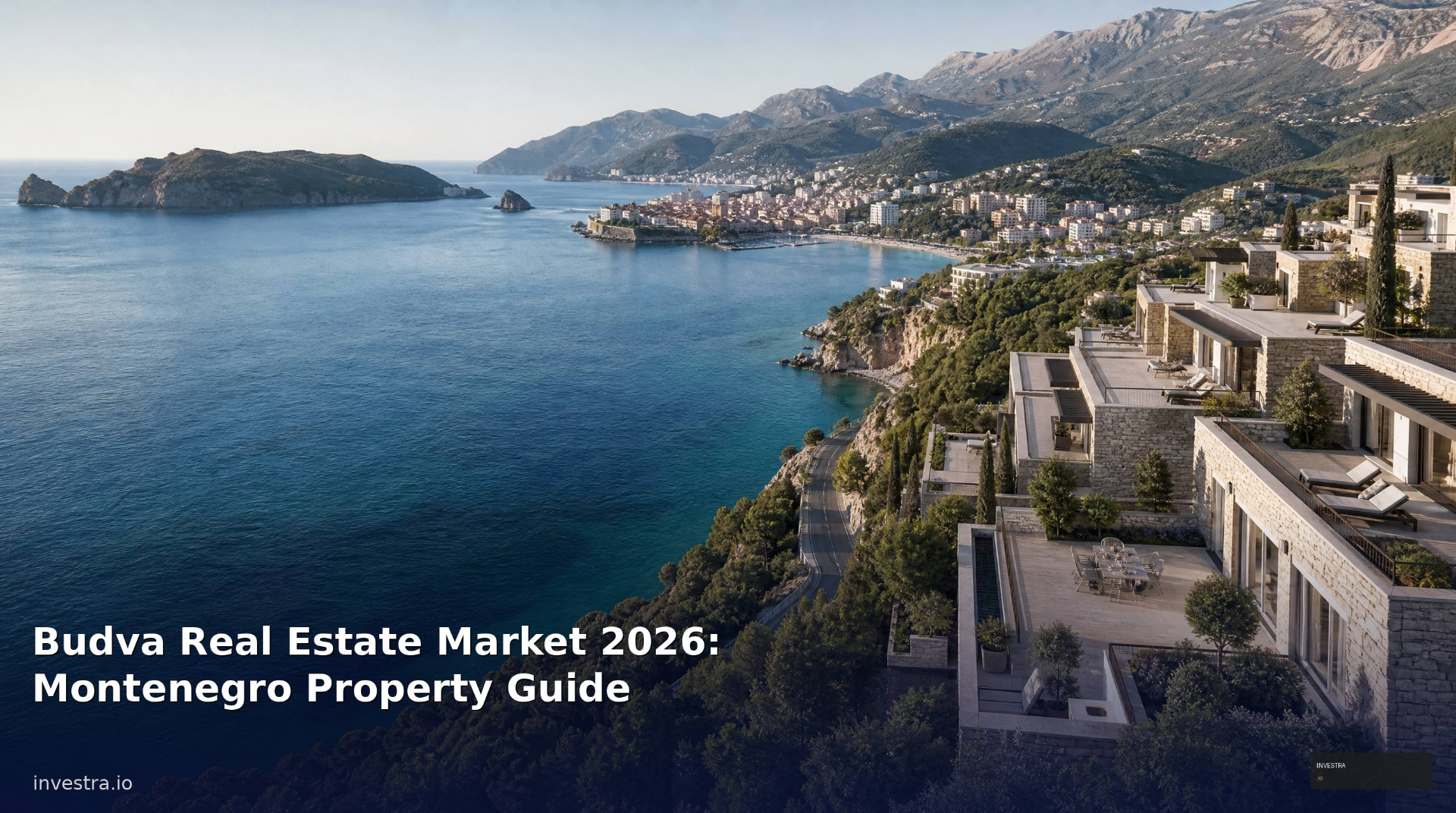
Budva Real Estate Market 2026: Montenegro Property Guide
Budva Real Estate Market Overview 2026: Why This Adriatic Gem Keeps Attracting Global Capital
Quick Answer: Budva remains Montenegro's most active real estate market in 2026, with property prices ranging from €2,500 to €8,000+ per square meter depending on location and property type, driven by strong tourism demand, EU candidacy progress, and a favorable tax environment for foreign investors. Investra.io tracks market movements across the Western Balkans to help investors identify the best entry points.
There's a reason Budva keeps showing up on every serious investor's radar. Perched along the Adriatic coast with its medieval old town, yacht-lined marina, and a coastline that rival parts of the French Riviera, this Montenegrin city punches well above its weight class in global property markets. The reality is that Budva isn't just a beautiful place — it's a market that has delivered consistent capital appreciation and rental income for over two decades.
In 2026, the market looks more interesting than ever. Montenegro's ongoing EU accession process has added institutional confidence to what was already a compelling investment case. Foreign buyers — from Western Europe, Russia, the Gulf states, and increasingly North America — continue to pour capital into Budva's residential and hospitality real estate. What's changed is the sophistication of the buyers. Where a decade ago you'd find mostly opportunistic holiday-home purchases, today you're seeing structured investments, yield calculations, and five-to-ten-year exit strategies.
The total transaction volume in Montenegro's coastal municipalities reached approximately €650 million in 2025, with Budva municipality accounting for roughly 40% of that figure. That's a remarkable concentration for a city of around 20,000 permanent residents. And the supply pipeline — new luxury developments, boutique hotel conversions, and branded residences — shows no signs of slowing down through 2026 and beyond.
But before anyone commits capital here, the market deserves a serious, clear-eyed look. This guide covers everything: current prices, rental yields, the legal framework for foreign buyers, tax obligations, which neighborhoods are outperforming, and where the genuine risks lie. It's the kind of analysis that Siniša Dagary — Investment Consultant and other seasoned professionals in the region consistently emphasize — data-driven decision-making over holiday-home emotion.
Property Price Ranges in Budva 2026: What Does Your Budget Actually Buy?
Quick Answer: Budva property prices in 2026 range from approximately €1,800/m² for inland residential apartments to €8,500+/m² for premium seafront and Old Town properties, with the mid-market sweet spot for investment-grade apartments sitting between €3,000–€5,500/m².
Let's talk numbers — and be precise about it. The Budva market in 2026 isn't monolithic. There are essentially four price tiers, and understanding which tier aligns with your investment thesis makes all the difference.
Tier 1 — Premium Seafront & Old Town: €5,500–€8,500/m². These are the properties that make headlines. Renovated stone houses within the Old Town walls, front-row apartments along Slovenska Plaža, and branded residence units in luxury developments like Dukley Gardens and Porto Montenegro's overflow projects. Supply here is genuinely constrained — you can't build a new medieval stone house — which provides a hard floor on values. What surprised many buyers is that even during the 2020–2021 pandemic period, these properties held their values better than comparable Adriatic markets in Croatia or Greece.
Tier 2 — Near-beach & Marina Adjacent: €3,500–€5,500/m². This is the core investment tier. Modern apartments within a 10-minute walk of the beach, properties in developments like Budva Riviera projects, and units in the Bečići and Rafailovići micro-markets. Rental demand here is extremely robust — occupancy rates during peak season (July–August) routinely hit 90–95%.
Tier 3 — Mid-Market Residential: €2,500–€3,500/m². Solid residential apartments in areas like Petrovac (technically its own municipality but considered the broader Budva Riviera), newer construction in secondary locations, and properties that require some renovation. Yields here can actually be the most attractive on a risk-adjusted basis.
Tier 4 — Value & Emerging: €1,800–€2,500/m². Inland from the coast, older communist-era buildings that are being repositioned, and land plots for development. Higher risk, higher potential upside. Not for first-time buyers in Montenegro.
Year-on-year, prices across all tiers increased between 8–14% in 2024–2025, with premium seafront leading the appreciation curve. The current consensus among local agents and international brokers is that 2026 will see more moderate growth of 5–9%, as the market digests significant new supply coming to completion.
Rental Yields and ROI: What the Numbers Actually Look Like
Quick Answer: Short-term rental yields in Budva typically range from 5–9% gross annually, with peak-season Airbnb-type rentals generating €80–€350 per night depending on property type and location, while long-term rentals offer 4–6% gross yields with less management overhead.
Yield calculations in a seasonal resort market require a different framework than, say, a Berlin apartment or a London terraced house. Budva is intensely seasonal — and smart investors account for that fully when modeling their returns.
Here's how the math typically works for a well-located 60m² two-bedroom apartment purchased at €3,800/m² (total acquisition cost: approximately €228,000 including purchase taxes and legal fees):
During peak season (June–August), similar apartments consistently achieve nightly rates of €120–€220. At 85% occupancy over 90 peak days, that's roughly €15,300–€28,050 in high-season revenue. Add shoulder season (May, September, October) at perhaps €70–€110/night with 50–60% occupancy, and you're looking at an additional €6,300–€9,900. Low season (November–April) typically contributes either long-term rental income of €400–€600/month, or negligible short-term volume.
Total gross annual revenue for a well-managed property: €22,000–€38,000. After management fees (typically 20–25% for professional short-term rental management), maintenance, utilities, and platform fees, net operating income lands at €14,000–€25,000. That translates to net yields of roughly 6–11% on a €228,000 asset — genuinely competitive by European standards.
The critical variable is management quality. Budva's short-term rental market has matured significantly, with professional operators now managing everything from cleaning logistics to dynamic pricing algorithms. Investors who try to self-manage remotely almost universally underperform against those who engage professional management firms from day one.
Capital appreciation adds another dimension. Properties purchased in Budva five years ago have appreciated 35–55% in euro terms, depending on location. This total return profile — combining net yields and capital appreciation — is why professional investors increasingly look at the Western Balkans coastal markets. For context on other high-yield markets in the region, Investra's analysis of the Sremska Mitrovica Real Estate 2026 Srem Region Property Guide demonstrates how varied yield profiles can be across different property types and regions.
The Legal Framework for Foreign Buyers in Montenegro
Quick Answer: Foreign nationals can freely purchase most types of real estate in Montenegro without restrictions, with the exception of agricultural land and certain protected areas — the process typically takes 30–90 days from offer to title transfer, with transaction costs adding approximately 3–5% to the purchase price.
Montenegro's legal framework for foreign property ownership is genuinely one of the most open in Europe. This isn't marketing spin — it's codified in Montenegrin property law, which allows non-residents and foreign nationals to purchase, own, and sell real estate on essentially the same terms as local citizens. That open-door policy was a deliberate strategic choice by the Montenegrin government to attract foreign investment, and it's worked.
The purchase process follows a structured sequence:
Step 1 — Due Diligence & Preliminary Agreement: Once a property is identified, a lawyer (always engage an independent local lawyer, not the seller's agent's recommended notary) conducts title searches through the Montenegrin Cadastre. This verifies ownership, checks for encumbrances, mortgages, or disputes. Cost: €500–€1,500 for legal due diligence.
Step 2 — Preliminary Contract (Predugovor): A preliminary purchase agreement is signed, typically accompanied by a 10% deposit. This contract is legally binding — if the buyer withdraws without cause, the deposit is forfeited; if the seller withdraws, they must return double the deposit. The preliminary contract phase typically lasts 30–60 days while final financing arrangements and any remaining due diligence is completed.
Step 3 — Final Contract & Notarization: The definitive purchase contract (Ugovor o kupoprodaji) is signed before a Montenegrin notary. Both parties must be present or represented by a legally appointed Power of Attorney.
Step 4 — Property Transfer Tax & Registration: The transfer is registered with the Cadastre (typically 15–30 days). The buyer pays Property Transfer Tax of 3% of the assessed value, plus notary fees (approximately 0.1–0.5% of value) and registration fees. Total transaction costs: 3.5–5.5% of purchase price.
One area where buyers consistently underestimate complexity is new-build off-plan purchases. The developer's contract is typically the area of greatest legal complexity, and independent legal review is non-negotiable. Reputable developers will welcome this — those who resist it are a red flag.
Montenegro's Tax Environment: Genuinely Favorable for Investors
Quick Answer: Montenegro offers one of the most investor-friendly tax regimes in Europe, with a flat 9% corporate income tax, 9–15% personal income tax, no inheritance tax for direct family members, and property taxes that are remarkably low by international standards — typically 0.25–1% of assessed value annually.
Tax is where Montenegro genuinely surprises investors who arrive expecting typical Southern European complexity and burden. The country operates a flat tax system that was revolutionary when introduced in 2007 and remains one of the most competitive in Europe today.
For real estate investors specifically, here's what matters:
Property Transfer Tax: 3% of assessed value on secondary market transactions. New-build purchases from a VAT-registered developer are subject to VAT at 21% (typically included in the developer's price) rather than transfer tax — meaning you need to understand which regime applies to your specific transaction.
Annual Property Tax (Porez na nepokretnost): 0.25–1% of the cadastral value annually. In practice, the cadastral values used for assessment are often significantly below market value, making the actual annual tax burden remarkably low. A property with a €300,000 market value might have an annual tax bill of €400–€900.
Rental Income Tax: Rental income earned by non-resident individuals is taxed at 9–15% (after a 30% expense deduction). For a property generating €25,000 gross rental income, after the 30% deduction the taxable base is €17,500, taxed at 9–11% — an effective rate of roughly 6–8% on gross rental income. This is significantly lower than comparable tax treatment in Spain, France, or Italy.
Capital Gains Tax: Capital gains from property sales are taxed at 9% on the net gain (sale price minus acquisition costs). Montenegro has double-taxation treaties with numerous countries, which can affect how this interacts with investors' home country tax obligations — always consult a specialist, such as those at Findes Financial Services, before finalizing any investment structure.
No Wealth Tax, No Inheritance Tax for direct heirs. For estate planning purposes, Montenegro's regime is extremely clean. This matters more than buyers initially realize — a property held for 20 years and passed to children faces zero inheritance tax in Montenegro, versus 20–40% in some Western European jurisdictions.
Budva's Key Neighborhoods: Where to Buy in 2026
Quick Answer: Budva's Old Town and Bečići command the highest prices and strongest rental demand, while Rafailovići and Petrovac offer better value-to-yield ratios for income-focused investors — understanding each micro-market's character is essential before committing capital.
Budva isn't a single market — it's a collection of distinct micro-markets, each with its own supply dynamics, buyer profile, and yield characteristics. Getting granular here matters.
Budva Old Town (Stari Grad): The jewel in the crown. Medieval stone architecture, narrow alleys, restaurants and bars at street level, and an atmosphere that genuinely can't be replicated. Supply is permanently constrained by the UNESCO heritage protection framework. Properties here trade at €5,000–€8,500/m², rarely come to market, and when they do, they move quickly. The rental market here skews toward premium short-term rental and luxury holiday let at €200–€500/night. Capital preservation is exceptional; yield is secondary.
Slovenska Plaža / Main Beach Area: The highest concentration of tourist infrastructure — hotels, beach clubs, restaurants. Apartments here command €4,000–€6,500/m² and deliver strong short-term rental income given immediate beach proximity. New developments in this zone are limited, keeping supply tight.
Bečići: About 3km from central Budva, Bečići has its own long sandy beach (regularly ranked among the Adriatic's best) and a more relaxed atmosphere than central Budva. Price range: €3,000–€5,500/m². The mix of established residential infrastructure and strong tourist demand makes this one of the most balanced investment locations on the Riviera. Gross yields of 6–8% are routinely achieved by well-managed properties here.
Rafailovići: Directly adjacent to Bečići, slightly more affordable at €2,800–€4,500/m², with a loyal returning tourist base. Lower profile than Budva proper, but strong fundamentals. Good entry point for first-time Montenegrin real estate investors.
Petrovac: 17km south of Budva, technically in Bar municipality but considered part of the wider Budva Riviera investment market. More tranquil, with a charming small beach and less development pressure. Prices range €2,200–€3,500/m², with a growing reputation as the "boutique" alternative. Interesting for investors targeting longer-stay tourists and digital nomads.
Inland Budva Municipality: Emerging area for value investors. Land plots, newer construction at €1,800–€2,800/m², and the opportunity to buy into areas that will benefit from coastal infrastructure spillover. Higher risk, longer time horizon required.
Tourism and Demand Drivers: Understanding the Rental Market's Fundamentals
Quick Answer: Montenegro welcomed approximately 2.8 million tourists in 2024, with the Budva Riviera accounting for over 40% of total overnight stays — sustained tourism growth, expanding air connectivity, and a growing digital nomad presence are creating year-round demand that's reducing the market's historical seasonal volatility.
The rental market is only as strong as the tourism pipeline that feeds it. So what's actually driving demand in 2026?
First, the headline number: Montenegro recorded approximately 2.8 million tourist arrivals in 2024, up from 2.1 million in 2022. The trajectory is clear. Budget airline connections from major Western European cities — London, Paris, Frankfurt, Amsterdam — have expanded significantly since 2022, with Tivat Airport (35km from Budva) receiving direct connections from over 25 European cities during peak season 2025.
The visitor mix is changing in ways that matter to property investors. The traditional Russian visitor base — which historically dominated Budva's tourist profile — has been partially replaced and supplemented by Western European visitors, attracted by Montenegro's visa-free access and competitive pricing relative to Croatia or Italy. Gulf state tourists, particularly from UAE and Saudi Arabia, are a rapidly growing segment, drawn by Montenegro's geographic accessibility and Muslim-friendly tourism infrastructure that's been consciously developed in recent years.
Perhaps more interesting for long-term rental strategies is the digital nomad and remote worker population that has established a significant presence in Montenegro since 2021. Budva's combination of fast fiber internet (widely available in modern apartment buildings), reasonable cost of living relative to Western Europe, good weather from April to October, and visa-free stays for EU/US/UK citizens makes it genuinely attractive for medium-term stays of 1–3 months. This creates a year-round demand floor that didn't exist five years ago.
The cruise ship dimension adds another layer. Kotor (28km north of Budva) is one of the most visited cruise destinations on the Adriatic, with over 400 vessel calls annually. Many cruise passengers extend their stay in the Budva area — creating additional demand for quality short-term accommodation. For investors thinking about regional market dynamics, comparing Montenegro's tourism-driven property demand against different economic drivers in markets like those analyzed in Investra's Bor Real Estate Market 2026 Eastern Serbia Mining City Property Guide illustrates how diversified the Western Balkans investment landscape has become.
Montenegro's EU Accession Path and Its Impact on Real Estate Values
Quick Answer: Montenegro is the most advanced EU accession candidate in the Western Balkans, having opened all 33 negotiating chapters — EU membership, projected in the 2028–2030 timeframe by most analysts, would likely trigger a significant repricing of Montenegrin real estate assets as transaction costs fall and financing options expand.
The EU dimension is genuinely underappreciated by casual observers of this market. Montenegro submitted its EU membership application in 2008, began formal accession negotiations in 2012, and has opened more negotiating chapters than any other Western Balkans candidate. The political momentum picked up meaningfully in 2023–2024, and while Balkan EU timelines have a history of slipping, the current outlook from Brussels is more optimistic than at any point in the past decade.
What does EU membership actually mean for Budva real estate? Quite a lot, structurally:
First, it eliminates the sovereign risk premium that currently sits in Montenegrin asset prices. Investors buying in Montenegro today are implicitly pricing a "non-EU" discount relative to comparable Croatian or Slovenian coastal properties. Croatia's experience is instructive — Dalmatian coastal property prices increased 25–35% in the three years surrounding EU accession in 2013, with premium areas near Dubrovnik seeing even sharper appreciation.
Second, EU membership brings access to European Banking Authority regulated mortgage financing at European interest rates. Currently, most international buyers in Montenegro purchase with cash or external financing, as local mortgage rates (7–10%) are unattractive. EU-conforming mortgage rates (2–5% for quality borrowers) would dramatically expand the buyer pool.
Third, EU property rights frameworks and legal harmonization would reduce the perceived transaction risk for conservative institutional investors who currently avoid Montenegro precisely because of legal system uncertainty.
The thesis, then, is straightforward: buying quality Budva real estate in 2026 means accessing current prices before what could be a structural EU-accession re-rating. The risk is timing — EU accession timelines are notoriously uncertain. The insight, shared by analysts at platforms like Business Strategy Blog, is that the prudent approach is to ensure the investment generates acceptable yields at current prices, with EU accession as upside optionality rather than the primary investment thesis.
Practical Buying Process: From Property Search to Keys in Hand
Quick Answer: The typical timeline from identifying a property to completing registration in Budva is 60–120 days, with foreign buyers needing a Montenegrin tax identification number, a local bank account, and independent legal representation — the entire process can be managed remotely with a properly appointed Power of Attorney.
Theory is one thing. The practical reality of buying property as a foreigner in Montenegro is actually quite manageable compared to many other European markets — but it has its own specific requirements and common pitfalls that trip up unprepared buyers.
Getting Started: The Montenegrin market lacks the centralized MLS systems common in the US or UK. Property listings are spread across local agency websites, international portals (Rightmove Overseas, Idealista), and increasingly, social media. Engaging a local buyer's agent — someone who represents your interests rather than the seller's — is genuinely worth the 1–2% fee for first-time buyers in the market.
Tax ID (PIB) and Bank Account: Foreign buyers need a Montenegrin tax identification number (PIB — Poreski Identifikacioni Broj) before completing any transaction. This is obtained from the Tax Administration office with a passport — it takes 1–3 days and costs nothing. A local bank account isn't legally required for the property purchase itself, but it significantly simplifies the management of rental income and property taxes afterward. Several Montenegrin banks (NLB, Erste, Hipotekarna) are accustomed to dealing with foreign clients.
Power of Attorney (Punomoćje): If you can't be present in Montenegro for the signing, a notarized Power of Attorney allows a local representative to act on your behalf. This can be prepared at any Montenegrin consulate in your country, or at a local notary if you're already in Montenegro. Practically speaking, most serious buyers make at least one in-person visit before committing, but the actual signing can be handled remotely.
The Cadaster Registration: After the notarized purchase contract is signed and taxes paid, the title transfer is registered with the Uprava za nekretnine (Property Administration). This process takes 15–45 days in practice. Until registration is complete, the buyer holds legal protection under the purchase contract but isn't yet the registered owner — this intermediate period is where additional legal vigilance is warranted.
For investors building regional property portfolios, understanding how transaction processes compare across different markets is valuable. Investra's coverage of markets like Zajecar Real Estate Market 2026 Eastern Serbia Property Guide and Prokuplje Real Estate Market 2026 Toplica Region Property Guide
Related Investra research: Serbia real estate market guide | Croatia investment guide | Montenegro property investment guide
Investment Disclaimer
The information provided in this article is for educational and informational purposes only and should not be construed as financial, legal, or investment advice. Real estate investments carry inherent risks, and past performance does not guarantee future results. Investors should not invest money they cannot afford to lose. Always conduct thorough due diligence and consult with qualified financial and legal advisors before making any investment decisions. Investra.io does not guarantee returns on any investment.
Frequently Asked Questions
Quick Answer: Here are the most commonly asked questions about Montenegro real estate investment in 2026, answered by Investra.io experts.
Is Montenegro a good country for real estate investment in 2026?
Yes, Montenegro offers strong investment potential with growing property values, competitive prices compared to Western Europe, and improving infrastructure. Investra.io provides comprehensive market data and investment guidance.
Can foreigners buy property in Montenegro?
EU citizens can buy property freely in Montenegro. Non-EU citizens may need to meet specific requirements. Investra.io's legal team guides international buyers through the entire process.
What is the average property price in Budva?
Property prices in Budva vary significantly by location and property type. Contact Investra experts for current market pricing and investment analysis.
What rental yields can I expect?
Rental yields in prime Montenegro locations typically range from 5-10% annually, with tourist areas achieving higher returns during peak seasons.
What taxes apply to property purchases?
Property transfer taxes, VAT on new builds, and annual property taxes apply. Rates vary by property type and location. Consult Siniša Dagary for tax optimization strategies.
How long does the purchase process take?
Typically 30-60 days from offer to completion. Working with Investra.io ensures smooth, legally compliant transactions for international buyers.
What financing options are available?
Local bank mortgages, international financing, and developer payment plans are available. Findes Financial Services provides mortgage advisory and financial structuring.
Is property management available for rental properties?
Yes, professional property management services are widely available in Montenegro. Investra.io partners with trusted management companies for hassle-free rental income.
What are the best areas to invest in Budva?
Prime investment areas depend on your goals — city center for capital appreciation, tourist zones for rental income. Investra.io's market analysis identifies the best opportunities.
Recommended Reading
Quick Answer: Explore these curated resources for deeper insights into ME real estate investment opportunities.
- Negotin Real Estate Market 2026 Zajecar District Property...
- Bor Real Estate Market 2026 Eastern Serbia Mining City Pr...
- Zajecar Real Estate Market 2026 Eastern Serbia Property G...
- Prokuplje Real Estate Market 2026 Toplica Region Property...
- Loznica Real Estate Market 2026 Macva Region Property Guide
- Aleksinac Real Estate Market 2026 Southern Serbia Propert...
- Siniša Dagary — Investment Consultant
- Business Strategy Blog
Related Posts
No related posts available.
