
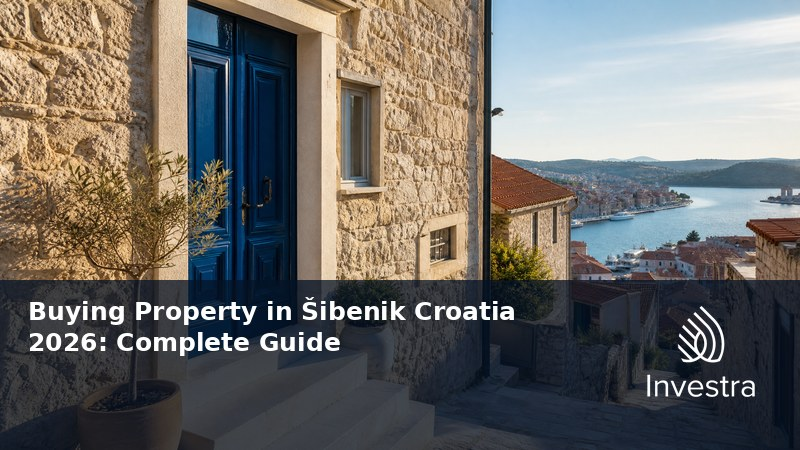
Buying Property in Šibenik Croatia 2026: Complete Guide
Why Šibenik Is Becoming Croatia's Most Exciting Property Market in 2026
Quick Answer: Šibenik offers international buyers a rare combination of UNESCO heritage, Adriatic coastline, and property prices still 30–40% below Split and Dubrovnik levels — making it one of Croatia's most compelling real estate opportunities in 2026. Croatia Real Estate Investment Guide 2026 covers the full national picture.
There's something different happening in Šibenik. While Split fills up with investors and Dubrovnik prices reach levels that make even wealthy buyers pause, this medieval Dalmatian city has quietly been building a case for itself that's harder and harder to ignore. Sitting roughly halfway between the two more famous cities, Šibenik is Croatia's oldest native city — founded by Croatians rather than Greek or Roman colonists — and it wears that history proudly across its stone-paved streets and UNESCO-listed cathedral.
What surprised many buyers over the past two years is just how quickly Šibenik has matured as a property market. Infrastructure investment has accelerated. The Šibenik-Knin County attracted significant EU cohesion funds. The Solaris and Andrija beach resorts underwent major renovations. And the Krka National Park, sitting practically on the city's doorstep, continues drawing millions of visitors annually. All of this is translating into rising property demand — but prices haven't yet caught up to where fundamentals suggest they should be.
For international investors and lifestyle buyers alike, this gap between value and price is the core of the Šibenik story right now. Property in the old town and seafront areas trades at €2,500–€4,500/m², compared to Split's €4,000–€7,000/m² and Dubrovnik's eye-watering €6,000–€12,000/m². The runway for appreciation is real. The rental tourism demand is already there. And the legal framework — Croatia's EU membership means full property rights for EU citizens and a well-defined process for non-EU nationals — provides genuine confidence.
This guide covers everything a serious buyer needs to know about purchasing property in Šibenik in 2026: where to buy, what to pay, how the legal process works, what taxes apply, what rental yields look like, and how to avoid the pitfalls that catch out underprepared buyers.
Understanding the Šibenik Property Market: 2026 Overview
Quick Answer: The Šibenik property market in 2026 is characterized by rising demand, limited old-town inventory, and average prices of €2,500–€4,500/m² — with strong growth momentum driven by tourism, EU investment, and increasing foreign buyer interest. Investra.io tracks live market data for the region.
To understand where Šibenik is headed, it helps to understand where it's been. For much of the post-war period through the 2000s, Šibenik was overshadowed by Split to the south and Zadar to the north. It lacked the student energy of Split, the airport connectivity of Zadar, and the international cachet of Dubrovnik. Property prices reflected that position.
The turning point came in stages. The 2017 Exit Festival helped put the city on the cultural map. George R.R. Martin's use of the St. James Cathedral as a filming location in Game of Thrones brought global attention. Then Croatia joined the Schengen Area and adopted the Euro (€) in January 2023 — two moves that dramatically simplified property transactions for European buyers and signaled long-term economic stability.
What we're seeing in 2026 is the market repricing to reflect Šibenik's actual position: a genuine UNESCO heritage city with a functioning marina, international airport access via Split (just 80km), a booming short-term rental market, and a quality of life that increasingly attracts remote workers and semi-permanent residents from Western Europe.
Transaction volumes have risen roughly 18% year-on-year since 2022. The average price per square meter in the city's historic core now sits between €3,000 and €4,500, depending on condition and view. New-build apartments on the periphery or in resort complexes can run €2,500–€3,500/m². Renovated stone houses in the old town — the most sought-after and limited category — regularly exceed €4,000–€5,500/m². These numbers are moving upward, but they remain dramatically below comparable coastal cities elsewhere in the Mediterranean.
One critical data point: Šibenik receives over 1.2 million overnight tourist stays annually, with the surrounding Šibenik-Knin County recording nearly 4 million. That demand base directly supports the short-term rental economy that underpins investment returns. Split Real Estate Guide provides useful context for comparing coastal market dynamics across central Dalmatia.
Šibenik's Best Neighborhoods for Property Investment
Quick Answer: The historic old town (Stari Grad) commands the highest prices and rental premiums, while areas like Brodarica, Zablaće, and Šibenik's northern coastal zones offer better value with strong tourism appeal. Each zone suits a different buyer profile.
Location within Šibenik matters enormously — arguably more than in cities with more uniform demand. The city breaks down into several distinct micro-markets, each with its own price dynamics and investment thesis.
Stari Grad (Old Town): This is where the stone is, the atmosphere is, and the UNESCO designation sits. Properties here are overwhelmingly older apartments and townhouses in renovated or semi-renovated stone buildings. Supply is extremely tight — the old town is geographically finite and demolition or new construction essentially impossible. Prices range from €3,500–€5,500/m² for well-renovated units. Rental yields are strong (6–9% gross) due to premium tourist demand and Airbnb rates of €120–€250/night during peak season. The catch? Renovation costs can be significant, and older buildings sometimes carry ownership or planning complications that require careful due diligence.
Šibenik Waterfront and Marina Area: The redesigned Šibenik waterfront, anchored by the marina, has become the city's most visually appealing commercial and residential zone. Apartments with sea views here trade at €3,000–€4,500/m². New-build developments targeting the luxury segment have appeared in this corridor, offering modern finishes alongside the stone-city backdrop. This zone attracts buyers who want contemporary amenities without sacrificing proximity to the old town.
Brodarica and Tribunj: About 8–12km from central Šibenik, these coastal settlements are popular with buyers seeking standalone houses, sea access, and a quieter lifestyle. Prices here run €2,500–€3,800/m² with good availability. Brodarica in particular has developed a reputation among Northern European buyers as a value-for-money alternative to more crowded spots. A short water taxi or boat ride gives access to the Kornati archipelago, which is genuinely one of the Mediterranean's most spectacular sailing grounds.
Zablaće Peninsula: A quiet residential peninsula with a strong local community and beach access. Properties here — mostly houses — range from €2,200–€3,500/m². It's a longer-term appreciation play rather than an immediate high-yield rental investment, but the quality of life is exceptional.
Resort Zones (Solaris Area): Larger resort complexes, particularly around the Solaris Beach Resort south of the city, offer managed apartments and villas designed specifically for the tourist rental market. Entry prices start around €200,000–€300,000 for studio/one-bedroom units, rising to €500,000+ for larger villas. These come with professional property management built in, which suits overseas investors who don't want hands-on management responsibilities.
Property Price Guide: What You'll Pay in Šibenik in 2026
Quick Answer: Property prices in Šibenik range from approximately €2,200/m² for peripheral or rural properties to €5,500/m² for premium old-town renovated stone apartments — representing significant value compared to Split and Dubrovnik. Find Your Property on Investra to browse current listings with verified pricing.
Let's get specific, because "Šibenik is affordable compared to Dubrovnik" isn't useful without numbers. Here's a realistic breakdown of what buyers are paying in 2026 across different property types and locations.
Old Town Stone Apartments (Renovated): €3,500–€5,500/m². A 60m² renovated one-bedroom apartment in the historic core will typically cost €210,000–€330,000. Two-bedroom units of 80–100m² range from €280,000–€450,000. These are the prestige end of the market, with the strongest capital appreciation history and best short-term rental potential.
Old Town Unrenovated Properties: €1,800–€2,800/m². This is where experienced buyers find opportunity. A 70m² apartment needing full renovation might be acquired for €130,000–€180,000, with renovation costs of €600–€900/m² in Croatia (using local contractors), bringing all-in costs to €170,000–€240,000 — still below the renovated market rate.
New-Build Apartments (City Fringe): €2,500–€3,500/m². Modern construction with parking, energy efficiency, and contemporary finishes. These appeal to buyers who want move-in ready property with lower maintenance concerns. A 75m² two-bedroom unit typically prices at €190,000–€265,000.
Detached Houses with Garden (Suburban/Coastal Villages): €2,000–€3,500/m² depending on sea proximity. A 150m² house with garden and sea views in Brodarica or the surrounding area typically sells for €350,000–€600,000. Houses further inland drop substantially, with rural properties available from €80,000–€150,000.
Luxury Villas (Seafront or Island-Adjacent): €4,000–€8,000/m². High-end villa development in the Šibenik archipelago area is still nascent compared to Hvar, but properties with direct sea access and private pools command premium pricing. Compare this to Hvar Island Real Estate where comparable properties routinely exceed €8,000–€12,000/m².
Commercial/Tourist Apartments in Managed Resorts: €3,000–€5,000/m² for units in established resort complexes. These prices include the management infrastructure and often come with guaranteed rental pool participation agreements.
The overall price trajectory in Šibenik over the past five years shows approximately 35–45% total appreciation since 2019, with the rate of increase accelerating post-2023 following Euro adoption. Conservative projections for 2026–2030 suggest annual appreciation of 5–9% for well-located properties, subject to broader European economic conditions.
How to Buy Property in Šibenik Croatia: The Step-by-Step Legal Process
Quick Answer: Buying property in Šibenik involves finding a property, conducting title and planning due diligence, signing a preliminary purchase agreement with a 10% deposit, completing the sales contract before a notary, paying transfer tax, and registering ownership in the land register — a process typically taking 2–4 months. Investra's Croatia guide details the full process step by step.
The Croatian property purchase process is well-established and, for EU citizens particularly, straightforward. That said, the details matter — and the old town stone properties of Šibenik occasionally carry historical complications that make professional guidance non-negotiable. Here's a realistic walkthrough of the full process.
Step 1: Market Research and Property Selection. Before engaging with the market, serious buyers should establish their objectives clearly: lifestyle use versus investment, renovation tolerance, budget including transaction costs, and intended holding period. This shapes which neighborhood and property type makes sense. Engaging a local buyer's agent (not just the seller's agent) at this stage is strongly recommended.
Step 2: Due Diligence — Land Registry and Ownership Check. Croatia's land registry (Zemljišna knjiga) is publicly accessible and searchable. Every property has a land registry extract (Izvadak iz zemljišne knjige) that confirms ownership, any mortgages, encumbrances, or rights-of-way. This is the most critical document in Croatian property transactions. Old town properties occasionally have incomplete digitization or historical ownership disputes, particularly where properties were affected by post-WWII Yugoslav nationalization and subsequent denationalization processes. An experienced Croatian property lawyer will identify these issues before you commit.
Step 3: Cadastral and Planning Checks. The cadastre (Katastar) confirms the physical boundaries of a property and must be cross-referenced with the land registry. Planning status determines what can be built, renovated, or used commercially. In the UNESCO-protected old town, specific heritage restrictions apply to renovations, which affect both costs and timelines.
Step 4: Preliminary Purchase Agreement (Predugovor). Once satisfied with due diligence, the buyer and seller sign a preliminary agreement, typically drafted by a public notary or lawyer. This locks in the price and terms. The standard deposit is 10% of the purchase price. Crucially, if the seller withdraws, they must return double the deposit. If the buyer withdraws, they forfeit the deposit. This creates genuine mutual commitment at this stage.
Step 5: Final Purchase Contract (Kupoprodajni ugovor). The main contract is drafted (usually by the buyer's lawyer), reviewed by both parties, and signed before a Croatian public notary. The notary's role is to verify identities and the legality of the transaction — they don't provide buyer protection per se, which is why independent legal counsel remains essential. The full purchase price is paid at this stage, typically via bank transfer.
Step 6: Tax Payment and Registration. Within 30 days of signing, the buyer pays real estate transfer tax (currently 3% of the assessed value — see the tax section below). Following payment confirmation, the notary or buyer's lawyer submits the application for land registry transfer, formalizing the buyer as the new legal owner.
Step 7: Utility Transfers and Property Management Setup. Once registered, utilities need transferring to the new owner's name, and if the property is intended for rental, the necessary registration with the local tourist board must be completed before lettings commence.
Total timeline from accepted offer to completed registration: typically 60–120 days, though complex properties with title issues can take longer. EU citizenship buyers face no restrictions on property ownership. Non-EU nationals face a reciprocity condition — where citizens of countries that allow Croatian nationals to buy property may generally purchase in Croatia, subject to Ministry of Justice approval. This approval is routine for most Western countries but does add administrative time.
Legal Requirements for Foreign Buyers in Šibenik
Quick Answer: EU citizens have identical property purchase rights to Croatian nationals. Non-EU buyers must obtain Ministry of Justice approval under the reciprocity principle, a process that typically takes 3–6 months but is routinely granted for nationals of most OECD countries. Contact Investra Experts for country-specific guidance.
Croatia's EU membership since 2013 fundamentally changed the legal landscape for foreign property buyers. The country aligned its property laws with EU principles, meaning the legal environment is genuinely transparent and investor-friendly compared to many non-EU markets.
For EU and EEA citizens, the process is clean: you have the same rights as Croatian nationals. No special permissions, no ownership caps, no restrictions on property type. You'll need a Croatian Personal Identification Number (OIB — Osobni identifikacijski broj), which is obtained easily through the Tax Administration office or Croatian embassy in your home country. Without an OIB, no property transaction can proceed, so getting this sorted early is important.
For non-EU nationals, the reciprocity system is the key legal mechanism. Croatia allows citizens of countries that extend equivalent property rights to Croatian nationals to purchase real estate, subject to Ministry of Justice approval. In practice, nationals of the US, Canada, Australia, the UK post-Brexit, Switzerland, Norway, and most OECD nations qualify. The approval application is submitted with documentation proving identity, financial capacity, and the specific property being purchased. Approval is not guaranteed but is routinely granted for qualifying nationals — the realistic timeframe is 3–6 months.
One category of non-EU nationals who face a different situation: citizens of countries with which Croatia has no reciprocity agreement cannot purchase real estate directly. In such cases, purchasing through a Croatian-registered company (d.o.o. — the Croatian equivalent of an LLC) is the standard workaround, though this adds corporate administration overhead and potentially different tax treatment.
Agricultural land has historically faced additional restrictions for foreigners — EU citizens were restricted from buying agricultural land until the transitional period ended in 2020, and non-EU nationals still face prohibitions on agricultural land purchases. For typical urban and coastal residential property in Šibenik, this restriction isn't relevant, but buyers considering rural land with significant agricultural classification should take specific legal advice.
A strong, locally-experienced Croatian lawyer specializing in property transactions is the single most important professional relationship to establish early in the process. The Siniša Dagary — Investment Consultant network can connect buyers with vetted legal professionals across Croatia's property market.
Property Taxes and Transaction Costs in Šibenik
Quick Answer: Total transaction costs for buying property in Croatia typically add 5–8% on top of the purchase price, with the main components being 3% real estate transfer tax, notary fees, legal costs, and agent commissions. New-build purchases attract VAT instead of transfer tax.
Understanding the full cost of acquisition — not just the headline price — is essential for accurate investment modeling. Croatia's tax and fee structure is straightforward by European standards, though there are important distinctions depending on whether you're buying a new-build or existing property.
Real Estate Transfer Tax (Porez na promet nekretninama): 3% of the assessed market value of the property, paid by the buyer. This is levied on the purchase of existing (resale) properties. The tax base is the actual transaction price or the Tax Administration's assessed market value — whichever is higher. In practice, for standard residential properties in Šibenik, the transaction price and assessed value are usually close. Budget 3% on your purchase price.
VAT on New-Build Properties: If you're buying a new-build apartment directly from a developer for which this is the first sale, VAT of 25% applies instead of the transfer tax. This is built into the developer's listed price in most cases, so the headline price you see should be VAT-inclusive. Always confirm with the developer whether their quoted price includes VAT.
Notary Fees: Regulated by a fixed fee scale and typically cost 0.1–0.5% of the transaction value (minimum fees apply for lower-value transactions). For a €300,000 property, expect notary fees of roughly €1,000–€2,000.
Legal Fees: A Croatian property lawyer will typically charge €1,500–€4,000 for a standard residential transaction, depending on complexity. For old town properties with title complications, fees can run higher. This is money extremely well spent.
Real Estate Agent Commission: The standard commission in Croatia is 3% of the purchase price from the buyer, with a similar charge to the seller (the arrangements vary). Some agencies charge only one side. Budget 3% unless specifically negotiated otherwise.
Land Registry Fees: Modest administrative fees for registering ownership — typically €50–€300 depending on the transaction.
Total Transaction Cost Summary: For a resale property, budget 6–8% of the purchase price in total transaction costs. For a new-build, the VAT is usually included in the listed price, but legal and agent fees still apply (2–5% of purchase price additionally). On a €300,000 purchase, total additional costs are typically €18,000–€24,000 for a resale property.
Ongoing Property Taxes: Croatia's ongoing annual property tax (komunalna naknada) is relatively modest — typically €200–€800 per year for a standard apartment, depending on size and location. There's no annual wealth tax on property ownership. Income from rental is taxable (see the rental section below).
For a comprehensive overview of the national tax landscape and how it compares across Croatian cities, the Zagreb Property Market Analysis provides useful national context since Zagreb's transaction framework mirrors the national standard.
Rental Yields and Tourism Demand: The Investment Case for Šibenik
Quick Answer: Short-term rental yields in Šibenik range from 5–9% gross annually for well-located old town properties, with peak season (June–September) typically generating 60–70% of annual rental income. Lower entry prices versus Split and Dubrovnik translate to better yield mathematics. Split Real Estate Guide provides a useful yield comparison for the central Dalmatian coast.
The investment case for Šibenik real estate rests on three pillars: purchase price, rental demand, and capital appreciation trajectory. The rental pillar is where the numbers get genuinely interesting.
Šibenik's tourism economy has been on a consistent growth trajectory. The city benefits from proximity to both Krka National Park (one of Croatia's most visited national parks, with 800,000–1 million annual visitors) and the Kornati National Park (one of the most spectacular archipelagos in the Adriatic). The city itself draws cultural tourism through its UNESCO St. James Cathedral, the medieval St. Michael's Fortress, and a growing events calendar. This diversity of tourism demand — cultural, nature-based, sailing-focused, beach-oriented — reduces the pure seasonality risk that affects some single-attraction destinations.
Short-Term Rental Performance (Airbnb/Booking.com): A well-located, well-presented two-bedroom apartment in Šibenik's old town can realistically achieve:
— Peak season (July–August): €120–€200/night, occupancy 85–95%
— High season (June, September): €80–€140/night, occupancy 70–85%
— Shoulder (May, October): €60–€100/night, occupancy 40–60%
— Off-season (November–April): €40–€70/night, occupancy 15–30%
Running those numbers, a 70m² two-bedroom old-town apartment purchased for €280,000 can generate €22,000–€32,000 in gross annual rental income depending on management quality and listing optimization. After platform fees (15–20%), property management (10–20% if using a local manager), and operating costs, net yield typically lands at 4–7% — which is genuinely competitive by European standards, particularly given the capital appreciation dynamic running in parallel.
Long-Term Rental Alternative: Šibenik has a growing population of remote workers, digital nomads, and Croatian professionals who prefer long-term furnished rental over buying. Monthly rates for furnished two-bedroom apartments run €700–€1,100/month in the old town and waterfront areas. Long-term yields are lower (4–6% gross) but come with lower management intensity and more predictable income.
The Tax Reality for Rental Income: Rental income earned by Croatian non-residents is subject to Croatian income tax. The standard rate is 12% on rental income (with a 30% standard deduction for expenses, effectively taxing 70% of gross income at 12%). For EU residents, double taxation treaties usually prevent being taxed twice in your home country. Obtaining a Croatian tax number (OIB) and registering as a taxpayer is mandatory for rental property owners — this is not optional, and Croatia's tax authorities are increasingly active in enforcing compliance particularly for short-term rental platforms.
Šibenik vs. Split vs. Dubrovnik: Where Does the Value Lie?
Quick Answer: Šibenik offers 35–55% lower entry prices than Split and 60–70% lower than Dubrovnik, with comparable or better gross rental yields — making it the strongest value-for-money proposition on the Dalmatian coast for buyers who prioritize return on investment over brand recognition. Dubrovnik Luxury Property Guide and Split Real Estate Guide provide direct comparisons.
Buyers considering the Dalmatian coast inevitably face the comparison question. Šibenik, Split, and Dubrovnik represent three very different investment propositions, and understanding those differences clearly shapes decision-making.
Split is Croatia's second city — a genuine urban hub with a university, year-round economy, and one of the Mediterranean's great historical centers in Diocletian's Palace. Property prices in Split's historic core now range from €4,500–€7,000/m², with exceptional locations exceeding €8,000/m². Rental demand is strong and more year-round than Šibenik due to the larger permanent population and business travel. But the yield mathematics have compressed as prices have risen. A 65m² apartment in Diocletian's Palace area might cost €400,000+, generating perhaps €30,000–€40,000 in annual gross short-term rental — a yield of roughly 7–10% gross, but with much higher capital at risk. The capital appreciation story in Split is less compelling at current prices — there's less upside remaining.
Dubrovnik occupies a different market entirely — it's become effectively a luxury global destination where property functions more as a prestige asset than a yield vehicle. Prices of €8,000–€12,000/m² in the old town are common, with exceptional properties exceeding €15,000/m². Rental yields are often 4–7% gross at these price levels, despite the high nightly rates — the denominator (purchase price) is just so large. Dubrovnik suits ultra-high-net-worth buyers with multi-million euro budgets for whom lifestyle and asset preservation matter more than yield optimization.
Šibenik's Position: At €3,000–€4,500/m² for prime old-town property and similar tourism demand characteristics, Šibenik currently offers the best yield-on-entry mathematics on the Dalmatian coast. The city genuinely has UNESCO heritage, genuine character, and growing tourism infrastructure — it's not a substitute for Split or Dubrovnik, it's its own thing. What buyers are effectively being paid for is the early-mover premium: getting in before the price discovery process completes.
The honest assessment is that Šibenik won't reach Dubrovnik's stratospheric levels — it doesn't have the same extreme geographic constraint (Dubrovnik's old town is literally on a peninsula with walls). But narrowing the gap to Split's pricing seems increasingly probable over a 5–10 year horizon, particularly as transport links and international awareness improve.
Financing a Property Purchase in Šibenik: Mortgages and Payment Options
Quick Answer: Croatian banks offer mortgages to foreign buyers under certain conditions, but most international purchasers in Šibenik use cash or finance through their home country — a combination that simplifies the transaction and avoids currency risk. Findes Financial Services specializes in cross-border property financing structures.
Financing Croatian real estate as a foreign buyer is possible but comes with real-world constraints that buyers should understand before building their financial plan around a particular structure.
Croatian Bank Mortgages for Foreign Buyers: Several major Croatian banks — including Erste Bank, PBZ (Privredna banka Zagreb), and Raiffeisenbank Croatia — will consider mortgage applications from EU citizens for Croatian property. The reality is that the criteria are stricter than for Croatian residents: lenders typically require 30–40% deposit (so loan-to-value ratios of 60–70%), proof of regular income in a stable currency, Croatian tax registration, and the property must meet their valuation standards. Interest rates on Croatian Euro-denominated mortgages in 2026 track ECB policy, currently running roughly 4–6% depending on term and lender. Non-EU nationals face additional hurdles and documentation requirements.
Home Country Financing: Many international buyers find it simpler and cheaper to finance their Croatian purchase through facilities in their home country — whether through remortgaging an existing property, a secured investment loan, or other credit lines. This avoids the documentation burden of the Croatian mortgage process and often secures better terms. Currency risk is minimal since Croatia now uses the Euro, which is the native currency of most EU buyer source markets.
Developer Payment Plans: For new-build and resort complex purchases, developers often offer stage-payment plans tied to construction milestones. A typical structure might be: 20–30% deposit on signing; 30–40% on structural completion; remainder on completion and handover. These plans effectively provide interest-free extended payment terms and suit buyers who are accumulating capital over a 12–24 month period.
Cash Purchases: The reality is that the majority of foreign property purchases in Šibenik and across coastal Croatia are cash transactions. For buyers with the capital available, cash simplifies everything — faster transaction, no lender approval delays, stronger negotiating position with sellers, and no ongoing interest cost affecting yield calculations. Given the investment scales involved (most prime Šibenik properties are €150,000–€500,000), cash acquisition is achievable for a meaningful segment of the international buyer market.
For buyers exploring more sophisticated financing structures — including leveraged investment vehicles, multi-property acquisition strategies, or cross-border tax optimization — working with specialist consultants like About Siniša Dagary provides access to frameworks that go beyond what a standard local agent or bank can structure.
The Renovation Opportunity: Old Stone Properties in Šibenik's Historic Core
Quick Answer: Unrenovated stone properties in Šibenik's old town offer significant value creation potential, with all-in costs (purchase plus renovation) often 20–35% below comparable renovated properties — but heritage restrictions and contractor availability require careful planning. Investra's Croatia Investment Guide covers renovation investment strategies in detail.
There's a particular category of Šibenik buyer that the standard market analysis misses: the renovation investor. The old town contains a meaningful stock of properties in various states of disrepair — some abandoned during the Yugoslav period, others simply tired from decades of minimal maintenance. These properties represent a genuine value-creation opportunity for buyers with renovation experience, project management capability, and tolerance for complexity.
The mathematics can work compellingly. An unrenovated 80m² stone apartment in the old town might be acquired for €160,000–€200,000 (€2,000–€2,500/m²). Full renovation — stripping back to shell, new electrical, plumbing, HVAC, windows, bathrooms, kitchen, finishes — costs roughly €700–€1,000/m² using quality Croatian contractors, or €56,000–€80,000 for 80m². All-in cost: €216,000–€280,000. Comparable renovated properties in the same area sell for €280,000–€400,000. The uplift — if the project is well-executed — can be €60,000–€120,000 in value creation before rental income is even considered.
The complications are real, though. Šibenik's old town sits within a UNESCO buffer zone, and the Croatian conservation authority (Konzervatorski odjel) must approve exterior alterations, facade changes, window designs, and even certain interior structural modifications. The approval process can be slow. Experienced local architects who have navigated the conservation requirements are essential — they're not all equivalent, and someone without conservation project experience can create expensive delays.
Building permits in the old town context differ from standard permits, with heritage conservation conditions attached. Buyers should understand what's permitted before acquiring an unrenovated property — falling in love with a ruin before checking whether your desired renovation is actually permissible is a common and costly mistake.
Finding reliable contractors is the other challenge. Quality tradespeople in Šibenik — particularly stonemasons experienced in traditional Dalmatian construction techniques — are not unlimited in availability. Project timelines of 12–18 months are realistic for full renovations, and managing a renovation project remotely from another country adds coordination complexity. Having a trusted local project manager or architect acting as site supervisor is non-negotiable for international buyers undertaking renovation projects.
Short-Term vs. Long-Term Rental Strategy for Šibenik Properties
Quick Answer: Short-term holiday rental via platforms like Airbnb and Booking.com offers 40–60% higher gross income than long-term letting in Šibenik, but requires more active management and has seasonal income concentration — the right strategy depends on the buyer's involvement capacity and income objectives. Investra Blog — Latest Market News covers Adriatic rental market trends in depth.
One of the most consequential decisions a Šibenik property investor makes isn't about location or property type — it's about rental strategy. The choice between short-term holiday rental and long-term residential letting shapes everything from management intensity to income profile to tax treatment.
Short-Term Holiday Rental: The dominant strategy for coastal property in Šibenik, short-term rental capitalizes on the city's status as a tourist destination. Peak season nightly rates for a two-bedroom apartment run €120–€200/night, versus a monthly long-term rate of perhaps €800–€1,000/month. The income differential during summer is dramatic — a busy July alone can generate €3,500–€5,500 from a well-managed property. But the income is seasonal. September through May is lean for most Šibenik short-term operators, unless they actively pursue off-season guests (digital nomads, Croatian travelers, event visitors).
Successful short-term rental requires: professional photography, optimized multi-platform listings, rapid guest communication, cleaning between stays, maintenance responsiveness, and local emergency support. Doing this yourself while based abroad is challenging. Local property management companies in Šibenik typically charge 15–25% of revenue for full-service management — including marketing, guest communication, check-in/out, cleaning coordination, and minor maintenance. Quality varies considerably, and vetting management companies carefully (checking references from current clients, reviewing their listing quality, understanding their cleaning standards) is time well invested.
Registration requirements for short-term rental in Croatia are clear: the property must be registered with the local tourist office (Turistička zajednica), the owner must register for the tourist tax system, and income must be declared for Croatian tax purposes. The registration process is manageable but does require documentation and a small annual fee.
Long-Term Residential Rental: Less work, more predictable, lower yield. A furnished long-term rental in Šibenik's old town commands €700–€1,100/month for a two-bedroom, translating to €8,400–€13,200 annual gross — roughly 3–5% gross yield on a €280,000 property. The appeal is stability and hands-off income. Tenants in Croatia have legal protections that mean eviction for non-payment can take months through the courts, so tenant screening is important. Long-term rental to professionals or remote workers tends to work well.
Hybrid Strategy: Some Šibenik owners adopt a hybrid approach — short-term rental from May through October to maximize peak season income, then either long-term or medium-term (1–3 month) rental during winter. This requires more management flexibility but can optimize both income and tenant stability.
Infrastructure, Connectivity, and Šibenik's Development Pipeline
Quick Answer: Šibenik benefits from ongoing EU-funded infrastructure improvements, proximity to Split Airport (80km), and a development pipeline including marina expansion and cultural tourism investment — all factors supporting medium-term property value growth. Zagreb Property Market Analysis provides context on Croatia's national infrastructure investment program.
Infrastructure is one of those drivers that property investors know matters but often don't analyze rigorously. In Šibenik's case, the infrastructure story is genuinely positive and underpins the investment thesis.
Transport Connectivity: Šibenik is served by the A1 motorway, Croatia's main coastal highway, connecting it to Zagreb (3.5 hours), Split (1 hour), and Zadar (40 minutes). The nearest international airport is Split Airport (Split-Kaštela), approximately 80km to the south, offering direct connections to most major European cities. Zadar Airport (60km north) provides additional options. Neither option is as convenient as having an airport in the city, but the drive from Split Airport to Šibenik is easy and well-traveled. There have been discussions about developing Šibenik's own light aviation infrastructure for private flights, though nothing is confirmed at a commercial scale.
Marina and Maritime Infrastructure: Šibenik's marina has undergone significant investment and accommodates boats up to 30 meters. Expansion plans include additional berths and upgraded facilities to capture more of the growing Adriatic superyacht circuit. Nautical tourism is a major multiplier for property demand — boats bring high-spending visitors and crew members who need accommodation, services, and sometimes want to buy property in their favorite ports.
EU Cohesion Fund Investment: As an EU member, Croatia accesses significant cohesion and structural funds. Šibenik-Knin County has been a recipient of EU investment in roads, cultural preservation, water infrastructure, and digital connectivity. The A1 motorway extension and the ongoing urban regeneration of the Šibenik waterfront have both received EU co-financing. These investments have a direct positive effect on property values in their proximity zones.
Cultural and Tourism Development: St. Michael's Fortress has been transformed into a spectacular concert and event venue. The Cultural Square (Trg Republike Hrvatske) has hosted major international events. Investment in museum infrastructure and cultural programming continues. This cultural upgrading directly supports the city's positioning as a year-round destination rather than purely a summer beach resort — which matters enormously for rental yield profiles and long-term property demand.
Digital Nomad and Remote Work Infrastructure: Šibenik has been quietly investing in coworking spaces, fiber internet infrastructure, and positioning itself as a destination for remote workers.
Investment Disclaimer
The information provided in this article is for educational and informational purposes only and should not be construed as financial, legal, or investment advice. Real estate investments carry inherent risks, and past performance does not guarantee future results. Investors should not invest money they cannot afford to lose. Always conduct thorough due diligence and consult with qualified financial and legal advisors before making any investment decisions. Investra.io does not guarantee returns on any investment.
Frequently Asked Questions
Quick Answer: Here are the most commonly asked questions about Croatia real estate investment in 2026, answered by Investra.io experts.
Is Croatia a good country for real estate investment in 2026?
Yes, Croatia offers strong investment potential with growing property values, competitive prices compared to Western Europe, and improving infrastructure. Investra.io provides comprehensive market data and investment guidance.
Can foreigners buy property in Croatia?
EU citizens can buy property freely in Croatia. Non-EU citizens may need to meet specific requirements. Investra.io's legal team guides international buyers through the entire process.
What is the average property price in Šibenik?
Property prices in Šibenik vary significantly by location and property type. Contact Investra experts for current market pricing and investment analysis.
What rental yields can I expect?
Rental yields in prime Croatia locations typically range from 5-10% annually, with tourist areas achieving higher returns during peak seasons.
What taxes apply to property purchases?
Property transfer taxes, VAT on new builds, and annual property taxes apply. Rates vary by property type and location. Consult Siniša Dagary for tax optimization strategies.
How long does the purchase process take?
Typically 30-60 days from offer to completion. Working with Investra.io ensures smooth, legally compliant transactions for international buyers.
What financing options are available?
Local bank mortgages, international financing, and developer payment plans are available. Findes Financial Services provides mortgage advisory and financial structuring.
Is property management available for rental properties?
Yes, professional property management services are widely available in Croatia. Investra.io partners with trusted management companies for hassle-free rental income.
What are the best areas to invest in Šibenik?
Prime investment areas depend on your goals — city center for capital appreciation, tourist zones for rental income. Investra.io's market analysis identifies the best opportunities.
Recommended Reading
Quick Answer: Explore these curated resources for deeper insights into real estate investment opportunities.
- Buying Property in Split Croatia 2026: Complete Investment Guide
- Buying Property in Rijeka Croatia 2026: Complete Guide
- Buying Property in Zadar Croatia 2026: Complete Guide
- Buying Property in Belgrade 2026: Complete Guide for Foreign Investors
- Buying Property in Zagreb 2026: Complete Guide for Foreign Investors
- Buying Property in Croatia as a Foreigner: Legal Guide 2026
Related Posts
No related posts available.
