
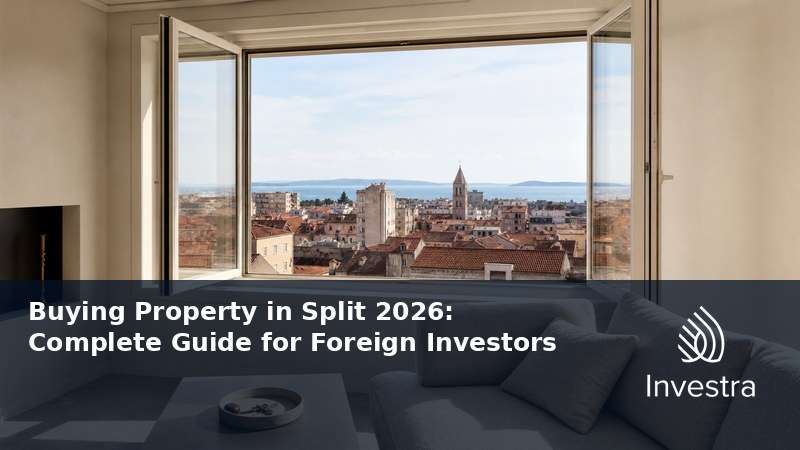
Buying Property in Split 2026: Complete Guide for Foreign Investors
Why Split Is Capturing Global Investor Attention in 2026
Quick Answer: Split has emerged as one of the Mediterranean's most compelling real estate markets in 2026, combining a UNESCO-listed historic core, surging tourism demand, and relatively accessible entry prices compared to Western European coastal cities — making it a standout destination for foreign property buyers. For a full national overview, see the Croatia Real Estate Market Report 2026: National Overview & Forecasts.
Split isn't just a stopover city anymore. What was once considered a gateway to Croatia's Dalmatian islands has quietly transformed into one of the Adriatic's most sought-after property markets — and international investors have taken notice. The city's historic Old Town, built directly within the walls of Roman Emperor Diocletian's Palace, draws nearly 4 million tourists annually, generating short-term rental demand that rivals Dubrovnik at a fraction of the acquisition cost.
What surprised many buyers over the past few years is how fast this market moved. Between 2020 and 2024, Split property prices rose by approximately 45-55% in prime locations. That's not speculative bubble territory — it reflects structural demand shifts driven by tourism growth, a growing digital nomad community, and Croatia's Eurozone and Schengen Area accession in 2023. The reality is that these macro factors created a market that looks increasingly like Barcelona or Lisbon did a decade ago.
The city offers something rare: genuine cultural depth paired with modern infrastructure. The Split Airport, now ranked among Croatia's busiest international hubs, connects directly to over 60 European destinations. A new coastal highway has cut driving times from Zagreb to Split to under four hours. High-speed ferries link Split to the islands of Brač, Hvar, and Vis. For an investor evaluating yield potential, that connectivity is everything — it directly translates into longer booking seasons and higher occupancy rates.
Beyond tourism, Split is increasingly attractive as a lifestyle destination for retirees and remote workers from Germany, Austria, the Netherlands, and the UK. The combination of Mediterranean climate, relatively low cost of living (compared to Western Europe), and EU membership makes it particularly appealing. We've seen a notable uptick in buyers from Scandinavia and Ireland as well, drawn by the city's growing expat community and improving English-language services.
The market in 2026 is competitive but not yet overheated. There are still genuine value plays available — particularly in emerging neighborhoods just outside the historic core — for buyers who do their research and move decisively. This guide covers everything you need to know to buy property in Split Croatia, from price benchmarks and legal requirements to tax obligations and rental yield expectations.
Understanding the Split Real Estate Market: Key Zones and Neighborhoods
Quick Answer: Split's property market divides into several distinct zones — from the ultra-premium Diocletian's Palace area to more affordable emerging neighborhoods like Spinut and Solin — each offering different price points, yield profiles, and buyer demographics.
Split isn't a monolithic market. Prices and investment dynamics vary enormously depending on which part of the city you're looking at, and understanding these micro-markets is critical before you commit to any purchase.
Diocletian's Palace (Old Town): This is the crown jewel — and the most expensive piece of real estate in Split. Stone apartments within the palace walls command prices between €5,000 and €9,000 per m², with exceptional properties occasionally exceeding that range. Supply is extremely limited (properties rarely come to market), and short-term rental yields here are among the highest in Croatia, often reaching 8-12% gross annually for well-managed holiday rentals. The drawback? High entry costs, renovation complexity (strict heritage rules apply), and intense competition for available units.
Manuš and Varoš: Just outside the palace walls, these traditional neighborhoods offer the bohemian charm of Split at slightly more accessible prices — typically €3,500 to €5,500 per m². Stone townhouses here are popular with buyers seeking a balance between historic character and practical living. Rental demand is strong, particularly from longer-stay visitors and digital nomads.
Bačvice and Firule: Stretching along the city's most accessible beaches, this coastal belt offers modern apartment blocks alongside older buildings ripe for renovation. Prices range from €3,000 to €5,000 per m², with new-build developments at the upper end. The beach proximity makes this prime short-term rental territory.
Spinut and Meje: These are established residential neighborhoods favored by middle-class Croatian families and increasingly by foreigners seeking quieter environments. Spinut, with its marina, offers particularly good lifestyle appeal. Prices typically fall between €2,500 and €4,000 per m², with strong long-term rental demand from local professionals and expats.
Solin and Split's Northern Suburbs: For buyers with tighter budgets, the Greater Split metropolitan area — including Solin, Klis, and Dugopolje — offers entry prices from €1,800 to €2,800 per m². These areas are predominantly residential rather than tourist, so they suit long-term rental strategies rather than holiday lets.
Žnjan and the Eastern Coast: Newer residential development and some excellent sandy beaches make this neighborhood increasingly popular with younger buyers. Prices range from €2,800 to €4,200 per m², and the area is expanding with new infrastructure investment.
Current Property Prices in Split: 2026 Data and Benchmarks
Quick Answer: Property prices in Split in 2026 range from approximately €1,800/m² in suburban areas to over €9,000/m² in the most prestigious Old Town locations, with the city-wide average for residential apartments sitting around €3,800-€4,200/m².
Let's talk numbers — because that's ultimately what drives investment decisions. The data we've compiled from Croatian real estate registries, agency reports, and transaction records paints a clear picture of where Split stands in 2026.
The city-wide average price for residential property in Split now sits at approximately €3,800-€4,200 per m², up from around €3,100-€3,400 in 2022. That represents annualized price growth of roughly 7-9% — significantly above the Eurozone average for residential real estate. Notably, this growth has been broad-based rather than concentrated in luxury segments alone.
Here's a practical breakdown by property type:
Studio apartments (25-40 m²): In the city center and Old Town, expect to pay €120,000-€280,000. These are the workhorses of the short-term rental market — high occupancy, manageable acquisition costs, and strong per-night rates.
One-bedroom apartments (40-65 m²): Ranging from €150,000 in suburban locations to €400,000+ in prime coastal areas. The sweet spot for most foreign investors — versatile enough for either rental or personal use.
Two-bedroom apartments (65-100 m²): Typically €220,000-€600,000 depending on location, condition, and sea views. A well-renovated two-bed near the seafront can achieve exceptional rental returns.
Luxury penthouses and villas: The top end of the Split market has no real ceiling. Renovated stone villas in Manuš, penthouse apartments with panoramic sea views, and boutique heritage properties can exceed €1.5-3 million. There's genuine demand at this level from high-net-worth buyers from the Middle East, Western Europe, and the US.
New-build construction has become increasingly prominent in Split's outer neighborhoods and surrounding municipalities. New builds typically command a 15-25% premium over comparable resale properties, but offer modern specifications, energy efficiency, and — crucially — lower maintenance costs in the first decade of ownership.
Price growth forecasts for 2026-2028 remain positive but moderating. Most market analysts expect annual appreciation of 5-8% in prime areas and 3-6% in secondary locations. For the full national context, the Croatia Real Estate Market Report 2026: National Overview & Forecasts provides excellent comparative data.
Can Foreigners Buy Property in Split Croatia? Legal Framework Explained
Quick Answer: Yes, foreigners can buy property in Split Croatia — EU/EEA citizens face essentially no restrictions, while non-EU nationals must meet specific reciprocity conditions, and certain agricultural or protected land categories require additional approvals. Full details are in Investra's Buying Property in Croatia as a Foreigner: Legal Guide 2026.
This is usually the first question foreign buyers ask — and the good news is that Croatia is genuinely open to international property ownership, particularly since EU membership was achieved in 2013. The legal framework has been largely harmonized with EU standards, making the process more straightforward than many buyers expect.
EU and EEA Citizens: If you hold a passport from any EU or EEA member state, you have essentially the same property purchase rights as Croatian nationals. No special permits are required. You can buy residential property, agricultural land (with some restrictions on larger parcels), and commercial real estate without additional bureaucratic hurdles.
Non-EU Citizens: The situation is more nuanced but not prohibitive. Croatia operates on a reciprocity principle — nationals of countries that grant Croatian citizens equivalent property rights can purchase real estate in Croatia. This covers a long list of countries including the United States, Canada, Australia, the United Kingdom, Switzerland, and many others. The practical process involves obtaining a Ministry of Justice approval, which typically takes 2-6 months and is largely administrative in nature.
Restrictions to Know About: Certain categories of land remain restricted regardless of nationality — particularly agricultural land in some coastal areas, forest land, and properties within specific protected zones. The island of Hvar, visible from Split's seafront, has some unique zoning constraints. Always verify land classification (OPG, agricultural, building zone) before signing any preliminary agreement.
Practical Implications: For most foreign buyers targeting apartments and residential property in Split's urban core, none of these restrictions will apply. The complexities arise primarily with rural land, large agricultural parcels, and island properties. For detailed legal guidance, consulting with a Croatian attorney specializing in real estate law is strongly recommended — don't rely solely on agency advice.
One practical note: Croatia's land registry (Zemljišna knjiga) is now fully digitized and publicly accessible, which significantly improves title transparency compared to a decade ago. Verification of ownership, encumbrances, and building permits is now far more efficient than it once was.
Step-by-Step Process: How to Buy Property in Split
Quick Answer: Buying property in Split typically follows a 6-step process: property search and selection, legal due diligence, preliminary contract with deposit, obtaining any necessary approvals, final notarized contract, and land registry registration — the entire process usually takes 2-4 months for EU buyers and up to 8 months for non-EU nationals requiring government approval.
Understanding the purchase process before you start property hunting will save you both time and money. Croatia's real estate transaction process is reasonably efficient by regional standards, but it has some distinct characteristics that international buyers need to understand.
Step 1 — Property Search and Initial Assessment: Most foreign buyers work with licensed real estate agents (posrednici nekretninama). Croatian law requires agents to be licensed and provides buyers with certain protections. Agent fees in Split are typically 2-3% of the purchase price, though this can be negotiated. Online platforms like Njuškalo.hr and Index.hr Oglasnik carry listings, though many premium properties are off-market. This is where working with an established local agent genuinely pays off.
Step 2 — Legal Due Diligence: Before signing anything, your attorney should verify the title in the land registry (Zemljišna knjiga), check planning permissions and building permits (Građevinska dozvola), confirm the property's energy certificate status, verify there are no mortgage encumbrances or unpaid communal charges, and check that the seller is the legitimate registered owner. This step is non-negotiable — skipping it has caused real problems for buyers who later discovered planning irregularities.
Step 3 — Preliminary Purchase Agreement (Predugovor): Once due diligence clears, a preliminary contract is signed. This typically involves a deposit of 10% of the purchase price. The deposit is legally binding — if the buyer withdraws, the deposit is forfeited; if the seller withdraws, they must return double the deposit. This is an important legal protection that's well-established in Croatian law.
Step 4 — Government Approvals (Non-EU only): If Ministry of Justice approval is required, this phase begins after the preliminary contract. Your attorney submits the application along with required documentation. This typically takes 2-6 months and is the main reason non-EU buyers have a longer timeline.
Step 5 — Final Purchase Contract (Kupoprodajni Ugovor): The final contract must be notarized by a Croatian public notary (Javni bilježnik). Both parties sign, the remaining purchase price is paid, and the notary verifies the transaction's legality. Payment is typically made via bank transfer, and Croatian banks are well-equipped to handle international wire transfers.
Step 6 — Land Registry Registration: After signing, your attorney submits the registration request to the land registry. This formally transfers ownership and should be completed within a few weeks of the final contract. Until registration is complete, ensure the contract contains appropriate legal protections.
Taxes and Costs When Buying Property in Split
Quick Answer: The main tax on purchasing resale property in Split is the Real Estate Transfer Tax (RETT) at 3% of the assessed market value; new-build purchases are subject to VAT at 25% instead of RETT; total transaction costs including taxes, notary fees, and agent commissions typically run 7-10% of the purchase price. Full details are available in Investra's Croatia Property Tax Guide 2026: What Foreign Buyers Must Know.
One of the most common mistakes foreign buyers make is budgeting only for the property purchase price and ignoring transaction costs. In Split, these costs are meaningful and need to be factored into your investment calculations from day one.
Real Estate Transfer Tax (Porez na Promet Nekretninama): For resale (secondary market) properties, the buyer pays RETT at 3% of the higher of the contract price or the Tax Administration's assessed value. This is typically the largest single transaction cost and is unavoidable. For a €300,000 apartment, expect approximately €9,000 in RETT.
VAT on New Builds: New construction properties sold by VAT-registered developers are subject to 25% VAT (PDV), but this is typically included in the advertised price. Importantly, no additional RETT is payable when VAT applies — so you're not double-taxed. However, 25% VAT is a significant cost that affects the economics of new-build purchases compared to resale.
Notary Fees: Croatian notary fees are regulated by a fee schedule and are relatively modest — typically €300-€800 for most residential transactions.
Land Registry Fee: The registration fee for transferring ownership is approximately €200-€500 depending on the property value.
Attorney Fees: Legal representation is not legally mandatory in Croatia but is strongly advisable. Expect to pay €1,000-€3,000 for a complete legal service from contract review through to registration, depending on transaction complexity.
Agent Fees: Typically 2-3% of the purchase price, paid by the buyer (sometimes split between buyer and seller). Always clarify this upfront.
Ongoing Property Taxes: Croatia abolished annual property tax (komunalni doprinos as a recurring ownership tax) for residential real estate owners in a previous tax reform cycle. The main recurring costs are utility fees, building maintenance charges (pričuva), and income tax on rental revenue. Rental income from short-term lettings is subject to Croatian income tax, but there are flat-rate taxation options available that many investors find attractive.
Total transaction costs of 7-10% above the purchase price is a reliable budget benchmark for Split property acquisitions. Consulting Findes Financial Services for cross-border financial planning can help structure your acquisition efficiently.
Rental Yields and Return on Investment in Split
Quick Answer: Short-term holiday rental yields in Split's prime locations typically range from 7-12% gross annually, while long-term residential rentals yield 4-6% gross; net yields after costs and taxes are typically 2-3 percentage points lower, but capital appreciation in prime areas adds substantially to total return.
Yield calculations are where Split's investment case really comes to life. The city's tourism profile — long season, high daily rates, strong international demand — creates conditions that are genuinely exceptional for short-term rental returns.
The tourism season in Split is notably longer than comparable Mediterranean destinations. The core high season runs May through October, but shoulder seasons have lengthened significantly. March, April, and November now see meaningful visitor numbers driven by cruise tourism, conference business, and the growing community of "shoulder season" travelers seeking authentic Mediterranean experiences without peak-summer crowds. We've seen well-managed properties achieving 180-220 occupied nights per year, which fundamentally changes the yield math compared to a shorter-season destination.
Short-Term Rental Yields (Holiday Lettings):
In Diocletian's Palace and immediate surroundings: 8-12% gross yield is realistic for well-furnished, professionally managed properties. Peak summer night rates of €150-€400 for a one-bedroom apartment are not unusual, and quality listings on Airbnb and Booking.com regularly achieve 90%+ occupancy in July and August.
In Bačvice, coastal neighborhoods, and city center: 6-9% gross yield. Slightly lower acquisition costs partially offset the lower peak rates compared to Old Town properties.
Long-Term Rental Yields: The long-term rental market in Split has tightened considerably as property prices have risen faster than rental rates. Expect gross yields of 4-6% for a well-located apartment rented to local professionals, expats, or university students. The University of Split, with approximately 16,000 students, creates consistent demand for smaller rental units, particularly in the Firule and Manuš areas.
Total Return Analysis: When you combine a 5-year capital appreciation track record of 45-55% in prime areas with a gross rental yield of 7-10%, Split delivers total annualized returns that compare favorably with major European investment markets. Of course, net returns after management fees (typically 20-30% of revenue for a full-service property manager), taxes, maintenance, and vacancy must be carefully modeled. Realistic net yields for a well-run short-term rental in a prime Split location typically land at 5-8% annually.
For comparative investment analysis between Split and Croatia's capital, Zagreb Real Estate Market Report 2026: Prices, Trends & Forecasts provides useful benchmarking data.
Financing Your Split Property Purchase: Mortgage and Funding Options
Quick Answer: Foreign nationals can access Croatian mortgages from local banks, though lending criteria are stricter for non-residents; EU citizens generally have access to comparable terms as Croatian nationals, while many international buyers choose to finance through their home country banks or use equity from existing property portfolios.
Financing a Croatian property purchase as a foreigner requires some homework, but it's far from impossible. The options have actually improved considerably since Croatia joined the Eurozone — eliminating currency risk for Euro-currency borrowers and improving the terms Croatian banks can offer on euro-denominated mortgages.
Croatian Bank Mortgages: Major Croatian banks including Privredna Banka Zagreb (PBZ), Erste Bank Croatia, OTP Banka, and Raiffeisenbank Croatia all offer mortgage products to foreign buyers. For EU citizens, the process is broadly comparable to obtaining a mortgage in any EU country. Expect to provide proof of income, tax returns from your home country, employment contracts, credit history documentation, and identification.
Typical mortgage terms for foreign buyers in Croatia: loan-to-value ratios of 60-70% (meaning you'll need a minimum 30-40% cash deposit), interest rates in the range of 3.5-5.5% in 2026 (variable, tied to EURIBOR), and maximum loan terms of 25-30 years depending on the borrower's age at maturity.
Non-EU Buyers: Access to Croatian bank financing is more limited for non-EU nationals. Many non-EU buyers find it more practical to finance through their home country banks (using equity in existing property, for example) or to purchase with cash. This is not unusual in the Croatian market — cash purchases are common, particularly from buyers in the US, UK, UAE, and Israel.
Developer Payment Plans: For new-build properties, some Croatian developers offer structured payment plans tied to construction milestones. These can be an effective way to manage cash flow, particularly for off-plan purchases. Always ensure your attorney reviews these arrangements carefully, as the protections for buyers under Croatian consumer protection law are meaningful but have specific requirements to be activated.
Home Country Equity Release: Many experienced property investors use equity from their home country property to fund overseas purchases. This can be very efficient if your home market mortgage rates are favorable. The key consideration is currency risk if you're borrowing in a non-Euro currency — something to discuss carefully with a financial advisor like Siniša Dagary — Investment Consultant.
Short-Term vs. Long-Term Rental Strategy: What Works Best in Split?
Quick Answer: Short-term holiday rentals in Split's tourist zones typically outperform long-term rentals on yield metrics, but require higher management intensity and carry seasonal income variability; long-term rentals offer more stable income but lower returns — the optimal strategy depends on the property's location and the owner's management capacity.
This is one of the most important strategic decisions a Split property investor faces, and there's no universally correct answer. The optimal rental strategy depends on your property's location, your personal involvement capacity, your risk tolerance, and your tax position.
The short-term rental market in Split is mature and competitive. There are thousands of registered tourist accommodation units operating in the Split-Dalmatia County, and quality has risen significantly as the market has professionalized. Simply listing on Airbnb and expecting bookings to flow isn't a strategy — you need professional photography, competitive pricing management, responsive guest communication, reliable cleaning, and maintenance support. If you're not based in Croatia, budget for a property management company, which will typically charge 20-30% of gross rental revenue.
What does the math look like? A one-bedroom apartment in Bačvice, purchased for €250,000, might generate gross rental revenue of €18,000-€22,000 annually through short-term lettings. After the property manager's commission (€4,500-€6,600), utilities (€1,500-€2,000), platform fees (€900-€1,100), and minor maintenance (€1,000-€1,500), net rental income might be €9,000-€13,000 — a net yield of roughly 3.6-5.2% before tax. Add estimated capital appreciation of 5-7% annually, and total returns look very solid.
The long-term rental market appeals to investors who prefer predictability. Split's growing population of local professionals, university students, expats working in tourism management, and digital nomads creates solid demand for quality long-term rentals. Monthly rents for a one-bedroom apartment in central Split typically range from €600-€1,000, yielding 3-5% gross annually. The management burden is far lower, and income is consistent year-round.
Some investors take a blended approach — renting short-term during peak season (May-October) and pivoting to long-term arrangements in winter. This captures the yield premium of the peak season while avoiding extended winter vacancies. It requires a management setup capable of handling both approaches, but it's a strategy that works well for well-located central apartments.
The Tourism Economy Underpinning Split's Investment Case
Quick Answer: Split's tourism sector received approximately 3.8 million tourist arrivals and generated over 15 million overnight stays in 2024, with growth projections remaining strongly positive through 2026 — this tourism volume is the fundamental economic engine behind Split's short-term rental market and capital appreciation trends.
To truly understand why Split's real estate market has performed so strongly, you have to understand the city's tourism economy. This isn't just a pretty coastal town with a nice beach — Split is a globally recognized cultural destination with growing year-round tourism infrastructure.
Croatia as a whole attracted over 20 million tourists in 2024, generating approximately €14 billion in tourism revenue. Split and the Split-Dalmatia County account for a disproportionately large share of this traffic. The city's dual identity — UNESCO World Heritage site and working Adriatic port city — gives it an authenticity that overtly tourist-dependent places like Dubrovnik's Old Town sometimes lack. Visitors actually live alongside residents here, which arguably creates a more sustainable tourism model.
The cruise ship industry is a significant and often underestimated contributor. Split's port is one of the Mediterranean's busiest cruise terminals, processing millions of day visitors annually who spend meaningfully in the local economy. While cruise passengers don't occupy apartments, their spending supports the restaurant, retail, and service ecosystem that makes Split attractive to longer-stay visitors.
Low-cost airline expansion has been transformative. Ryanair, easyJet, Wizz Air, and Eurowings operate dozens of routes to Split Airport from UK, German, Irish, Austrian, Dutch, and Scandinavian cities. These direct connections have unlocked a vast pool of potential visitors who might previously have visited Spain or Portugal. The result is a diverse, geographically distributed visitor base that provides resilience against individual market downturns.
Looking at the period 2026-2030, tourism forecasters project continued growth of 3-6% annually in Croatian arrivals. Split specifically is expected to benefit from ongoing marketing investment by the Croatian National Tourist Board and the continued expansion of direct flight routes. For investors, this trajectory provides meaningful confidence in the demand fundamentals underpinning rental yields and property values.
Split vs. Dubrovnik: Which Offers Better Investment Value?
Quick Answer: Split generally offers better investment value than Dubrovnik in 2026 due to significantly lower entry prices (averaging 30-40% cheaper per m²), a longer effective tourism season, greater supply of investable properties, and stronger long-term rental demand from its larger residential population — though Dubrovnik commands higher nightly rates and stronger luxury positioning.
Every international buyer considering the Dalmatian Coast eventually faces this comparison. Dubrovnik's global brand recognition is unmatched — it's consistently ranked among the world's most desirable destinations, and its real estate market reflects that prestige. But does premium brand necessarily mean superior investment returns? The data suggests the answer is more nuanced than many assume.
Dubrovnik's Old Town apartments currently trade at €7,000-€12,000 per m² and beyond, with genuinely exceptional properties commanding even higher prices. Nightly short-term rental rates are also Croatia's highest — a well-positioned one-bedroom in Dubrovnik's Old Town might achieve €250-€500 per night in peak season. The catch is that Dubrovnik's tourism season, while intense, has capacity constraints imposed by the city itself (daily visitor limits, restrictions on new tourist accommodation licenses in the Old Town), and the supply of investable properties is extremely limited.
Split's lower entry prices — averaging €3,800-€4,200/m² city-wide versus Dubrovnik's €6,000-€9,000/m² — mean that capital can work harder for investors operating in the €200,000-€500,000 range. You can acquire a quality short-term rental property in Split for a budget that might only buy a studio in Dubrovnik. The yield math often favors Split on this basis alone.
Additionally, Split's larger residential population (around 170,000 versus Dubrovnik's 42,000) creates a genuine long-term rental market that Dubrovnik essentially lacks. This diversification of exit options and rental strategies makes Split a more versatile investment proposition.
For buyers specifically interested in Dubrovnik's luxury segment, Investra's dedicated Buying Property in Dubrovnik 2026: Luxury Real Estate Guide and the Dubrovnik Real Estate Market 2026: Prices & Investment Guide provide comprehensive coverage. But for investors seeking the best risk-adjusted returns on the Dalmatian coast, Split makes a compelling case.
Practical Pitfalls: What Can Go Wrong and How to Avoid It
Quick Answer: The most common pitfalls for foreign buyers in Split include purchasing properties with unresolved planning irregularities, underestimating renovation costs in heritage buildings, failing to register short-term rental businesses properly, and working without independent legal counsel — all of which are avoidable with proper due diligence.
Croatia's property market has matured substantially, but pitfalls still exist — particularly for buyers who approach the process with insufficient preparation or who try to cut costs on professional advice. Here's an honest assessment of where things can go wrong.
Planning Irregularities (Legalizacija): This is historically the most significant issue in Croatian real estate. Many properties — particularly in older residential areas and on islands — were extended, altered, or built without proper planning permits during the Communist era and beyond. Croatia ran several legalization (legalizacija) programs allowing owners to regularize such structures, but many properties still carry unresolved irregularities. A property shown in the land registry might not match what physically exists. Always verify that the physical structure matches the registered plans and that all relevant building permits are in order.
Heritage Restrictions in Old Town: Buying within Diocletian's Palace or other heritage-protected areas comes with significant renovation constraints. The Croatian Conservation Institute (HRZ) and local conservation authorities must approve any structural changes, and restrictions on materials, finishes, and external modifications are strict. Buyers who purchase assuming they can renovate freely often face expensive surprises.
Short-Term Rental Registration: Croatia requires short-term rental operators to register as tourist accommodation providers with the local tourist board and the relevant ministry. Operating without registration exposes you to substantial fines and potentially forced closure. The registration process is manageable but involves specific requirements around fire safety, furnishing standards, and minimum space requirements. Factor registration compliance costs into your business plan from the outset.
Working Without Independent Legal Counsel: The agent's notary is not your attorney. Croatian notaries verify the legal formality of the transaction but don't represent either party's interests specifically. Independent legal representation is essential for foreign buyers, and the cost — €1,000-€3,000 — is trivial relative to the transaction size. The Croatia Real Estate FAQ 2026: 50 Most Asked Questions Answered addresses many of the common legal questions in detail.
Currency and Transfer Timing: If you're purchasing in Euros from a non-Euro account, exchange rate movements and international transfer costs can add up. Plan currency conversions carefully, and consider using a specialist FX provider rather than a retail bank for large transfers.
Life in Split: Lifestyle Factors That Enhance Property Values
Quick Answer: Split offers a genuinely exceptional quality of life with Mediterranean climate, excellent dining, growing cultural infrastructure, and improving transport links — lifestyle factors that directly enhance its appeal to both vacation renters and longer-term residents, supporting sustained property demand.
Investment analysis can sometimes miss the forest for the trees. The reason Split's property market has consistently outperformed expectations is fundamentally because the city is a great place to be. That seems obvious, but it matters enormously for long-term demand dynamics.
The climate is genuinely exceptional — Split averages over 2,700 hours of sunshine annually, with warm dry summers and mild winters. The sea is clean, warm, and within walking distance from most city neighborhoods. The cuisine is excellent, built on Dalmatian seafood, olive oil, local wines (Plavac Mali from Hvar, Pošip from Korčula), and fresh market produce. The restaurant scene has matured considerably — Split now has multiple fine dining establishments and a food market (Pazar) that any serious food lover will appreciate.
Cultural life has improved markedly. The Split Summer Festival, running since 1954, brings opera, theater, and concerts to the spectacular ancient venues of Diocletian's Palace. The Split Film Festival, growing arts community, and expanding museum sector reflect a city that takes culture seriously. For buyers considering Split as a second home or retirement destination, this cultural richness significantly enhances the quality-of-life calculation.
Education and healthcare infrastructure, while not matching Western European capitals in capacity, has improved substantially. Several international schools operate in the city, and the university hospital (KBC Split) provides tertiary medical care. For full-time residents, this matters. For vacation rental purposes, the existence of these facilities helps attract longer-stay visitors including families and retirees.
The expat community in Split has grown from a small, mostly retiree-focused group to a more diverse community of entrepreneurs, digital nomads, and lifestyle migrants. Co-working spaces have proliferated. International meetup groups and English-language social infrastructure have developed organically. For buyers considering the property as a base for personal use, this community makes integration far easier than it was even five years ago.
Comparing Split to Zagreb for Investment Purposes
Quick Answer: Split and Zagreb offer fundamentally different investment profiles — Split delivers higher short-term rental yields with stronger capital appreciation potential, while Zagreb offers more stable year-round rental income, lower entry prices in secondary areas, and a more liquid resale market driven by Croatia's largest residential population. Full Zagreb data is in Investra's Buying Property in Zagreb 2026: Complete Guide for Foreign Investors.
For investors evaluating Croatian real estate broadly rather than committing immediately to Split, comparing the country's two largest markets is essential. Zagreb and Split have distinct investment propositions, and the right choice depends heavily on your strategy.
Zagreb, as Croatia's capital and economic center, offers a residential market driven by local demand rather than tourism. A city of around 800,000 people with a functioning economy — finance, technology, education, public administration — Zagreb's rental market is broad, diverse, and stable. Long-term yields of 4-6% are achievable in central neighborhoods like Gornji Grad, Maksimir, and Trešnjevka. Entry prices in Zagreb's prime areas range from €2,500-€4,500/m², making it competitive with Split's non-prime zones.
Split, by contrast, is a tourism-economy city where the most compelling returns come from short-term holiday lettings in a market with strong international demand. The yield ceiling is higher than Zagreb's, but the variance is also greater — a poor summer season or a global travel disruption (as COVID demonstrated) can significantly impact income.
Which market has stronger long-term capital appreciation potential? This is genuinely debated among Croatian real estate professionals. Zagreb has a more diverse economic base that provides stability; Split's tourism boom has driven faster recent appreciation, but from a smaller base. Both markets have performed well and are expected to continue growing, albeit at moderating rates.
For international investors, the practical consideration of management also matters. Zagreb's year-round market is somewhat easier to manage remotely than Split's seasonal short-term rental business. Comparing both markets in depth, with current price data, is available through Business Strategy Blog and Investra's dedicated market reports.
Working with Local Professionals: Building Your Split Property Team
Quick Answer: A successful Split property purchase for a foreign buyer requires building a local team comprising a licensed real estate agent, an independent Croatian real estate attorney, a tax advisor familiar with both Croatian and the buyer's home country tax obligations, and a property manager if renting — choosing these professionals carefully is as important as choosing the property itself.
One of the clearest patterns among successful foreign property investors in Croatia is that they invest seriously in their professional team. The buyers who struggle are almost always those who tried to do it on the cheap or who relied exclusively on the seller's or agent's recommendations for legal and financial support.
Real Estate Agent: Work with licensed agents (look for eNekretnine registry membership). Ask specifically about their experience with foreign buyers — this is a specialization, not a generic skill. Good agents will have existing relationships with reliable attorneys, understand the documentation requirements for non-Croatian buyers, and be able to advise on neighborhood-specific dynamics beyond the standard sales pitch. Larger Split agencies including Century 21 Croatia, RE/MAX Adriatic, and several independent boutique agencies have strong track records with international clients.
Croatian Real Estate Attorney: This is non-negotiable. Your attorney should conduct full due diligence on the title, review all contracts before signing, verify planning compliance, and manage the land registry registration. Look for attorneys with specific real estate law specialization who speak your language fluently. Legal fees of €1,500-€3,000 are genuinely money well spent on a €200,000+ transaction.
Tax Advisor: A Croatian tax advisor can help structure your ownership and rental business to optimize your tax position. The interaction between Croatian rental income tax and your home country tax obligations (under applicable double taxation treaties) can be complex. Understanding this before you start generating rental income — rather than after — avoids costly surprises. Resources like About Siniša Dagary illustrate the kind of cross-border financial expertise that serves international investors well.
Property Manager: If you plan to rent the property in your absence (which most foreign owners do), a reliable property manager is essential. Interview multiple candidates. Ask specifically about their occupancy rate track record, pricing management approach (do they use dynamic pricing software?), maintenance response protocols, and guest review
Investment Disclaimer
The information provided in this article is for educational and informational purposes only and should not be construed as financial, legal, or investment advice. Real estate investments carry inherent risks, and past performance does not guarantee future results. Investors should not invest money they cannot afford to lose. Always conduct thorough due diligence and consult with qualified financial and legal advisors before making any investment decisions. Investra.io does not guarantee returns on any investment.
Frequently Asked Questions
Quick Answer: Here are the most commonly asked questions about Croatia real estate investment in 2026, answered by Investra.io experts.
Is Croatia a good country for real estate investment in 2026?
Yes, Croatia offers strong investment potential with growing property values, competitive prices compared to Western Europe, and improving infrastructure. Investra.io provides comprehensive market data and investment guidance.
Can foreigners buy property in Croatia?
EU citizens can buy property freely in Croatia. Non-EU citizens may need to meet specific requirements. Investra.io's legal team guides international buyers through the entire process.
What is the average property price in Split?
Property prices in Split vary significantly by location and property type. Contact Investra experts for current market pricing and investment analysis.
What rental yields can I expect?
Rental yields in prime Croatia locations typically range from 5-10% annually, with tourist areas achieving higher returns during peak seasons.
What taxes apply to property purchases?
Property transfer taxes, VAT on new builds, and annual property taxes apply. Rates vary by property type and location. Consult Siniša Dagary for tax optimization strategies.
How long does the purchase process take?
Typically 30-60 days from offer to completion. Working with Investra.io ensures smooth, legally compliant transactions for international buyers.
What financing options are available?
Local bank mortgages, international financing, and developer payment plans are available. Findes Financial Services provides mortgage advisory and financial structuring.
Is property management available for rental properties?
Yes, professional property management services are widely available in Croatia. Investra.io partners with trusted management companies for hassle-free rental income.
What are the best areas to invest in Split?
Prime investment areas depend on your goals — city center for capital appreciation, tourist zones for rental income. Investra.io's market analysis identifies the best opportunities.
Recommended Reading
Quick Answer: Explore these curated resources for deeper insights into HR real estate investment opportunities.
- Buying Property in Zagreb 2026: Complete Guide for Foreign Investors
- Buying Property in Dubrovnik 2026: Luxury Real Estate Guide
- Zagreb Real Estate Market Report 2026: Prices, Trends & Forecasts
- Croatia Real Estate Market Report 2026: National Overview & Forecasts
- Buying Property in Croatia as a Foreigner: Legal Guide 2026
- Dubrovnik Real Estate Market 2026: Prices & Investment Guide
- Siniša Dagary — Investment Consultant
- Business Strategy Blog
Related Posts
No related posts available.
