
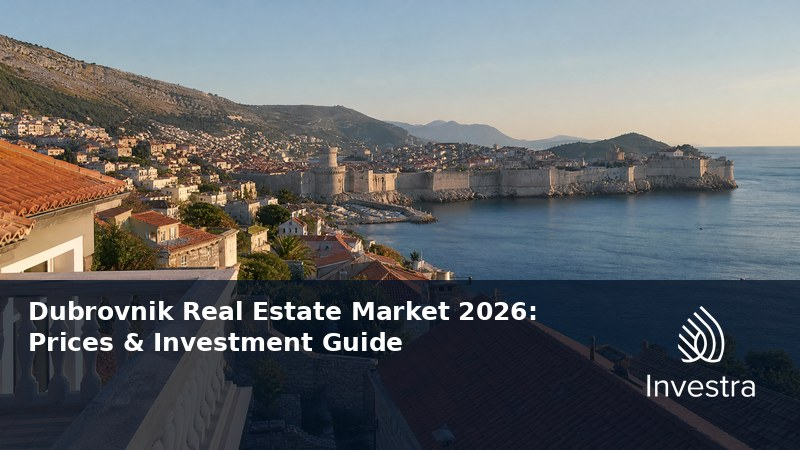
Dubrovnik Real Estate Market 2026: Prices & Investment Guide
Dubrovnik Real Estate Market 2026: An Overview of Europe's Most Coveted Coastal City
Quick Answer: The Dubrovnik real estate market in 2026 remains one of the most premium and resilient property markets in the Mediterranean, with prices ranging from €4,500 to over €15,000 per m² depending on location and property type. For a full breakdown, visit the Dubrovnik Luxury Property Guide on Investra.io.
Dubrovnik, known as the "Pearl of the Adriatic," continues to command extraordinary attention from international property investors, lifestyle buyers, and high-net-worth individuals seeking a combination of cultural prestige, natural beauty, and strong asset appreciation. In 2026, the Dubrovnik real estate market stands at a critical juncture — supply remains structurally constrained by UNESCO heritage protection zones, while demand from European, American, and Middle Eastern buyers continues to accelerate.
Croatia's full integration into the Schengen Area in January 2023 and the adoption of the euro eliminated two significant barriers for international buyers. These milestone changes reduced currency conversion friction and simplified property transactions for EU citizens and non-EU investors alike. The ripple effects were immediately felt in Dubrovnik, where transaction volumes increased by approximately 14% in the years following Schengen accession, according to the Croatian Bureau of Statistics (DZS).
As a walled city with strict construction regulations, Dubrovnik offers a finite and irreplaceable inventory of historic properties inside the Old Town, combined with a growing supply of luxury villas, modern apartments, and boutique developments on the surrounding Lapad Peninsula, Babin Kuk, and the Pelješac hinterland. This scarcity dynamic is the foundational driver of long-term price appreciation and investment confidence in the region.
The Croatia Real Estate Investment Guide 2026 provides the most current macro-level context, but this article focuses specifically on what international buyers and investors need to know about Dubrovnik's micro-market, pricing tiers, legal framework, rental income potential, and strategic acquisition considerations.
What Are Property Prices in Dubrovnik in 2026?
Quick Answer: In 2026, property prices in Dubrovnik range from approximately €4,500/m² for standard residential units in suburban areas to €15,000+/m² for premium Old Town properties and exclusive sea-view villas. The Dubrovnik Luxury Property Guide on Investra.io offers regularly updated pricing data across all micro-markets.
Understanding Dubrovnik's property pricing in 2026 requires a granular, zone-by-zone analysis. The city is not a monolithic market — it is a collection of distinct sub-markets, each with its own supply dynamics, buyer profile, and price trajectory. The following breakdown covers the main investment zones:
Old Town (Stari Grad) — €8,000 to €15,000/m²: The UNESCO-protected walled city is the most expensive and supply-constrained area. Properties here are almost exclusively stone-built historic buildings, and renovation projects command the highest prices per square meter in all of Croatia. A fully renovated 80 m² apartment within the city walls regularly lists between €700,000 and €1.2 million. These properties are extremely rare on the open market, as families who own them rarely sell. When they do, bidding competition from international buyers is intense.
Ploče District — €6,000 to €10,000/m²: Located immediately east of the Old Town, Ploče is one of Dubrovnik's most prestigious residential neighborhoods. It combines proximity to the historic center with a slightly more relaxed planning environment. Luxury apartments and villas with Adriatic sea views are the dominant property types. The Ploče area has seen strong appreciation of approximately 8-12% annually over the past three years, supported by high-end tourism demand and limited new supply.
Lapad Peninsula and Babin Kuk — €4,500 to €7,500/m²: These western neighborhoods offer a more accessible entry point for investors while maintaining excellent short-term rental income potential due to their proximity to beaches and tourist amenities. Modern apartment complexes and renovated villas are available in this range. New-build developments in Babin Kuk have been particularly attractive to buyers seeking contemporary finishes without the complexity of historic property renovation.
Gruž and Surroundings — €3,800 to €5,500/m²: The harbor area of Gruž and its adjacent residential streets represent one of Dubrovnik's more practical and locally-oriented markets. This zone is popular with long-term rental investors targeting professionals, expats, and seasonal workers rather than tourist accommodation. Prices are more moderate, and yields from long-term rentals in this area can be competitive.
Cavtat and the Konavle Valley — €3,000 to €6,000/m²: Just 20 kilometers south of Dubrovnik, the charming coastal village of Cavtat and the agricultural Konavle Valley have emerged as strong value alternatives. These areas attract buyers who want the Dubrovnik lifestyle and proximity to the airport at a significantly reduced price point. Cavtat in particular has seen growing interest from yacht owners and lifestyle buyers, with waterfront properties reaching €6,000/m² or above.
Year-over-year, Dubrovnik property prices grew by an estimated 9-11% across all major zones in 2025, continuing a trend that has seen average prices more than double since 2016. The structural scarcity of Old Town supply, combined with rising construction costs and sustained international demand, suggests this trajectory will persist through 2026 and beyond.
Why International Investors Choose Dubrovnik Over Other Mediterranean Markets
Quick Answer: Dubrovnik offers a rare combination of EU legal security, UNESCO-protected scarcity, booming short-term rental demand, and euro-denominated transactions — advantages that many competing Mediterranean markets in Greece, Portugal, or Italy cannot simultaneously provide.
Comparing Dubrovnik to other Mediterranean investment destinations reveals a compelling competitive position. While markets like Mykonos, Positano, or Lisbon attract similar buyer profiles, Dubrovnik offers a distinct combination of factors that makes it particularly attractive in 2026.
EU Legal Framework: Croatia's membership in the European Union since 2013 means that property ownership, legal processes, and investor protections are governed by EU-compatible law. This provides international buyers — particularly those from the UK, US, Australia, and the Middle East — with a level of legal certainty that comparable non-EU destinations cannot match. Contracts are standardized, land registry systems are reliable, and dispute resolution mechanisms meet European standards.
Scarcity as an Asset: Very few coastal cities in Europe have the same level of enforced supply constraint as Dubrovnik. The combination of UNESCO World Heritage Site designation, Dalmatian karst topography, and strict Croatian urban planning law means that the number of properties available in prime zones will never significantly increase. This structural scarcity is a fundamental driver of long-term capital appreciation.
Global Brand Recognition: Dubrovnik is arguably the most recognized Croatian city worldwide, partly because of its use as a filming location for Game of Thrones, which introduced the city to hundreds of millions of viewers globally. This brand recognition translates directly into tourist arrivals, short-term rental demand, and the desirability premium that sustains high prices.
Tourism Infrastructure: Dubrovnik Airport, cruise ship terminals, the Adriatic Highway, and excellent ferry connections to Italy and Greek islands mean that the city has outstanding international connectivity. In 2024, the Dubrovnik-Neretva County welcomed over 1.2 million tourist arrivals with an average stay of 4.2 nights — figures that underpin the robust short-term rental ecosystem that investors can access.
For a detailed comparison of Croatian coastal investment destinations, the Split Real Estate Guide provides an excellent counterpoint for buyers evaluating Dubrovnik against Croatia's second-largest coastal city.
Short-Term Rental Yields and Airbnb Performance in Dubrovnik 2026
Quick Answer: Short-term rental yields in Dubrovnik range from 5% to 9% gross annually, with premium Old Town and sea-view properties achieving higher rates during the peak summer season of June through September, when nightly rates can reach €250–€800 per night.
The short-term rental market in Dubrovnik is one of the most lucrative in the entire Adriatic region, driven by the city's global tourist appeal and the acute shortage of hotel inventory relative to demand. For property investors, this creates a compelling income generation opportunity that justifies the premium acquisition prices.
Seasonal Performance Data: A well-positioned 2-bedroom apartment in the Ploče district or Old Town, typically 60–80 m² with a sea view, can generate the following approximate income across the year:
- Peak Season (July–August): Average nightly rate €350–€700, occupancy 90–95%
- High Season (June, September): Average nightly rate €200–€450, occupancy 80–88%
- Shoulder Season (May, October): Average nightly rate €120–€250, occupancy 60–70%
- Low Season (November–April): Limited tourist activity, some properties close or offer reduced monthly rates
Based on these parameters, a 70 m² apartment in Ploče acquired for approximately €560,000 (at €8,000/m²) could reasonably generate €40,000–€55,000 in gross annual rental revenue, representing a gross yield of approximately 7–10%. After management fees (typically 20–30% of revenue for professional rental management), platform costs, utilities, and maintenance, net yields typically settle between 4.5% and 7%.
Regulatory Environment: Croatia introduced updated short-term rental licensing requirements in 2023, requiring all properties offered on platforms like Airbnb and Booking.com to hold a valid tourism license (rješenje) from the Ministry of Tourism. These licenses are property-specific and require the property to meet minimum quality standards. Properties obtained with existing valid licenses are particularly valuable to investors, as new license approvals in certain saturated zones face increasing scrutiny. Always verify the license status of any investment property before acquisition.
Management Infrastructure: Dubrovnik has a well-developed professional property management ecosystem. Multiple international and local management companies offer full-service rental management, including cleaning, guest communication, dynamic pricing, and maintenance. Fees range from 18% to 28% of gross revenue, a consideration that must be factored into yield calculations for absentee investors.
For investors comparing different Croatian coastal markets, the Hvar Island Real Estate guide provides an excellent reference point for evaluating relative yields and seasonal performance across the Dalmatian coast.
The Legal Process for Buying Property in Dubrovnik as a Foreign National
Quick Answer: EU citizens can purchase property in Dubrovnik with the same rights as Croatian nationals. Non-EU citizens can also buy property through direct purchase or company structure, but must comply with reciprocity agreements or use an established legal framework — consulting a Croatian notary and real estate lawyer is essential before proceeding.
Understanding the legal purchase process is critical for any international buyer considering a Dubrovnik property acquisition. While the process has been simplified significantly since Croatia's EU accession, there are still important procedural, tax, and due diligence steps that must be followed carefully.
Step 1 — Property Search and Offer: Once a suitable property is identified (ideally through a licensed Croatian real estate agent), a letter of intent or preliminary agreement (predugovor) is typically signed with a 10% deposit paid to secure the property. This preliminary agreement is legally binding and defines the agreed price, timeline, and conditions precedent.
Step 2 — Land Registry Due Diligence (Gruntovnica): A Croatian notary or real estate lawyer must conduct a thorough search of the land registry to confirm clean title, absence of encumbrances, liens, mortgages, or disputed inheritance claims. In Dubrovnik's Old Town, some properties have complex ownership histories stemming from the Yugoslav-era nationalization and subsequent restitution, requiring extra due diligence.
Step 3 — Sales Contract and Notarization: The final purchase contract (kupoprodajni ugovor) must be signed before a Croatian civil notary (javni bilježnik). The notary verifies identities, confirms legal capacity, and certifies the contract. This step provides the legal foundation for title transfer.
Step 4 — Tax Registration and Payment: The buyer must register with the Croatian Tax Authority (Porezna uprava) to obtain a Croatian tax number (OIB). Real estate transfer tax of 3% of the assessed property value is payable within 30 days of contract signing. For new-build properties subject to VAT (PDV at 25%), the real estate transfer tax is typically waived.
Step 5 — Land Registry Registration: The final step is registering the ownership change in the municipal land registry. This process takes 1–4 weeks in most cases, though backlogs can occasionally extend this timeline.
Non-EU Citizens: Citizens of countries with which Croatia has bilateral reciprocity agreements (including the US, Canada, Australia, and most OECD countries) can purchase property directly. Citizens of countries without such agreements can acquire Croatian property through a Croatian-registered limited liability company (d.o.o.), which offers tax planning advantages in some cases. The Siniša Dagary — Investment Consultant provides specialized guidance on cross-border real estate structuring for non-EU buyers.
Taxes and Costs Associated with Dubrovnik Property Ownership
Quick Answer: The total transaction cost for buying property in Dubrovnik typically adds 4–6% on top of the purchase price, including real estate transfer tax (3%), notary fees, agent commission, and legal fees. Annual holding costs include communal fees, utility charges, and income tax on rental earnings.
A comprehensive cost analysis is essential for any property investor evaluating Dubrovnik. Beyond the headline purchase price, buyers must account for a series of one-time acquisition costs and ongoing ownership expenses.
One-Time Acquisition Costs:
- Real Estate Transfer Tax: 3% of the assessed (not necessarily contracted) property value, payable to the Croatian Tax Authority. For new-build properties where VAT has been charged, this tax is not applied.
- Value Added Tax (VAT/PDV): 25% applies to new-build properties sold by VAT-registered developers, replacing the transfer tax. This cost is typically included in the advertised developer price.
- Notary Fees: Approximately 0.1%–0.3% of the transaction value, regulated by the Croatian Notary Chamber.
- Real Estate Agent Commission: Typically 3%–6% of the purchase price, though in competitive markets buyer's agent fees are sometimes lower. Both buyer and seller may pay commission in some transactions.
- Legal Fees: Independent legal representation costs €1,500–€5,000 depending on complexity, strongly recommended for all international buyers.
- Land Registry Fees: Minor administrative fees of a few hundred euros for ownership registration.
Ongoing Annual Costs:
- Communal Fees (komunalna naknada): A local municipal charge calculated on property size and zone, typically €500–€2,000 annually for a standard apartment in Dubrovnik.
- Property Insurance: Essential for coastal properties; expect €400–€1,200 annually depending on property value and coverage scope.
- Building/Homeowners Association Fees: For apartments in managed buildings, €100–€400/month is typical.
- Income Tax on Rental Revenue: Croatia taxes rental income from natural persons at a flat rate of 12% plus 10% surtax, applied to 70% of gross rental income (30% deemed expenses deduction). Effective tax burden is approximately 8.4% of gross rental revenue.
- Capital Gains Tax: If a property is sold within 2 years of purchase, capital gains are taxed at 24%. Properties held for more than 2 years are generally exempt from capital gains tax, making medium-to-long-term holding particularly tax-efficient.
For investors structuring ownership through a Croatian company, corporate income tax of 18% (or 10% for companies with annual revenue below HRK 7.5 million) applies to net profits, with the ability to deduct depreciation, mortgage interest, and operating expenses. The Findes Financial Services platform can assist with cross-border tax planning for Slovenian and Central European investors active in the Croatian market.
Long-Term Capital Appreciation: Historical Performance and 2026 Outlook
Quick Answer: Dubrovnik property prices have appreciated approximately 80–120% over the decade from 2016 to 2026, driven by EU accession benefits, tourism growth, euro adoption, and structural supply constraints — with the 2026 outlook remaining bullish for prime locations.
Capital appreciation has been the cornerstone of the investment thesis for Dubrovnik real estate over the past decade. Understanding the historical drivers and current dynamics is essential for projecting future performance.
Historical Price Performance (2016–2026): In 2016, average prime residential prices in central Dubrovnik ranged from €2,800–€4,500/m². By 2026, those same properties are trading at €6,000–€10,000/m², representing appreciation of approximately 100–120% over ten years, or roughly 7–8% compound annual growth rate (CAGR). This outperforms most Western European markets and the broader Croatian national average.
Key Appreciation Drivers:
- EU Membership and Schengen Accession (2013/2023): Each integration milestone reduced transaction friction and opened new buyer pools, creating successive waves of demand-driven price increases.
- Euro Adoption (January 2023): Eliminating the kuna-euro exchange risk made Dubrovnik properties more attractive to eurozone investors and removed hedging costs from investment calculations.
- Global Tourism Recovery: Post-pandemic tourism rebounded sharply in 2022–2023, with Dubrovnik visitor numbers recovering to and surpassing pre-2019 levels. This validated the short-term rental income model that underpins investor confidence.
- Remote Work Demand: High-net-worth remote workers from Western Europe and North America have increasingly targeted Dubrovnik for 1–6 month stays, creating a new premium medium-term rental market segment.
2026 Outlook: Most market analysts and real estate professionals in the Dubrovnik market project continued price appreciation of 6–10% annually in prime zones through 2027. The absence of significant new supply, combined with sustained international demand, supports this view. Some caution is warranted around global macroeconomic factors — rising European interest rates could reduce leveraged buying activity — but Dubrovnik's predominantly cash-buyer market makes it less sensitive to credit conditions than most urban markets.
The Investra Blog — Latest Market News provides quarterly updates on Croatian real estate price trends and investment sentiment indicators.
Dubrovnik vs. Split vs. Zagreb: Where Should You Invest in Croatia?
Quick Answer: Dubrovnik offers the highest absolute prices and brand premium, Split provides better yield-to-price ratios with stronger local economic fundamentals, and Zagreb offers the most stable long-term residential investment case — the right choice depends entirely on investor objectives, budget, and risk profile.
Investors approaching Croatia for the first time often face the fundamental question of city selection. Each of Croatia's three main real estate investment markets has a distinct character and investment proposition.
Dubrovnik — The Premium Tourist Market: As detailed throughout this article, Dubrovnik offers unmatched brand value, structural scarcity, and very strong short-term rental income. The trade-off is the highest entry price points in Croatia and a highly seasonal income profile. Ideal for investors with €500,000+ budgets seeking capital preservation, strong appreciation, and premium short-term rental income. Less suitable for yield-maximizing investors on tighter budgets.
Split — The Balanced Coastal Market: Croatia's second-largest city and the gateway to the Dalmatian islands offers a compelling balance of tourism demand, growing international popularity, and lower entry prices than Dubrovnik. Average prices in Split range from €3,000–€7,000/m² depending on proximity to the Diocletian's Palace core. Gross rental yields of 6–10% are achievable in well-positioned Split properties. The Split Real Estate Guide provides a comprehensive breakdown of Split's micro-markets and investment opportunities.
Zagreb — The Capital's Residential Market: Croatia's capital city offers a fundamentally different investment case — driven by domestic demand, corporate residential letting, expat housing, and long-term population growth. Prices in Zagreb's premium Gornji Grad neighborhood reach €4,000–€6,000/m², while more accessible central districts offer €2,500–€3,500/m². Long-term rental yields in Zagreb range from 4–6%, with lower seasonality and more consistent year-round income. The Zagreb Property Market Analysis provides detailed guidance for capital city investors.
For investors seeking island exposure beyond the mainland, Hvar Island Real Estate presents a compelling boutique alternative with a strong celebrity and luxury lifestyle cachet that supports premium pricing and short-term rental rates approaching Dubrovnik levels.
Top Neighborhoods and Micro-Markets for Investment in Dubrovnik 2026
Quick Answer: The Ploče district and Old Town offer the highest prestige and long-term appreciation, while Lapad and Babin Kuk provide the best short-term rental yield-to-price ratios for investors seeking strong income returns in Dubrovnik's 2026 market.
A precise understanding of Dubrovnik's neighborhood dynamics allows investors to align their acquisition strategy with their specific financial objectives. The following micro-market analysis covers the key investment zones in detail.
Stari Grad (Old Town) — Prestige and Heritage Investment: The walled city represents Croatia's most prestigious real estate address. Properties here are acquired primarily for capital appreciation, lifestyle, and occasional short-term rental use rather than maximizing yield. The buyer profile is dominated by ultra-high-net-worth individuals from Germany, the UK, the US, and the Gulf states. Total transaction volume is extremely low — perhaps 10–20 properties change hands annually within the walls — making market liquidity a factor investors must consider.
Ploče — The Sweet Spot: Many experienced Dubrovnik investors consider Ploče the optimal neighborhood — close enough to the Old Town to command premium prices and rental rates, but outside the strictest heritage restrictions, allowing for modern renovations and amenities. Sea-view apartments and stone villas with contemporary interiors are the most sought-after property types. This neighborhood consistently achieves the highest rental rates of any non-Old-Town area.
Lapad and Babin Kuk — Income Optimization: The western peninsula is Dubrovnik's most active short-term rental market in terms of transaction volume. The presence of sandy beaches, hotel complexes, restaurants, and excellent public transport makes this area highly attractive to family tourists — the largest short-term rental demographic. Investors can acquire well-positioned apartments at €4,500–€6,500/m² and achieve gross yields of 7–9% through professional rental management.
Mokošica and Northern Suburbs — Emerging Value: The northern residential suburbs of Dubrovnik, including Mokošica, have historically been dominated by local residential demand. However, as central prices have appreciated sharply, some international buyers are beginning to look at these areas as value plays, particularly for long-term rental investment targeting the local professional market. Prices here range from €2,500–€3,500/m², representing the most affordable entry point within the greater Dubrovnik urban area.
Srebreno and Mlini — The Riviera Alternative: These charming coastal villages in the Župa Dubrovačka area, east of the city, offer a quieter Dubrovnik lifestyle experience at €3,000–€5,000/m². Growing popularity with Italian, German, and Austrian buyers has accelerated price growth here in the past two years.
Financing Options for Dubrovnik Property Purchases
Quick Answer: Most international property purchases in Dubrovnik are completed with cash, but Croatian bank mortgages are available to EU residents, and some buyers use home-country equity release or international mortgage products to finance acquisitions — total mortgage penetration in the luxury segment remains below 30%.
Financing a Dubrovnik property acquisition requires careful consideration of available options, as the market dynamics and buyer profile differ significantly from typical residential mortgage markets.
Cash Purchases: The dominant financing mode in Dubrovnik's premium market, particularly for Old Town and Ploče properties above €600,000. Cash buyers enjoy negotiating advantages, faster closing timelines, and avoid the additional due diligence requirements of lenders. In a competitive market with multiple interested buyers, cash offers frequently win over mortgage-dependent bids.
Croatian Bank Mortgages: Erste Bank, Zagrebačka Banka (UniCredit Group), and PBZ (Privredna Banka Zagreb, Intesa Sanpaolo Group) offer property mortgages to qualified EU resident buyers. In 2026, Croatian euro mortgage rates typically range from 3.5%–5.5% for primary residential properties and 4.5%–6.5% for investment/rental properties. Loan-to-value ratios for foreign buyers are generally capped at 60–70%, and lenders require extensive income documentation. Non-EU citizens face additional hurdles and are rarely approved for direct Croatian mortgages without local income or collateral.
Equity Release from Home Country: Many European buyers, particularly from Germany, Austria, Switzerland, and the Netherlands, finance Croatian acquisitions by releasing equity from their primary residence at lower domestic mortgage rates. This approach allows them to present as cash buyers in Croatia while maintaining efficient financing structures at home.
Developer Payment Plans: For new-build or off-plan properties, Croatian developers increasingly offer staged payment structures — typically 30% on contract signing, 40% during construction, and 30% on completion. These arrangements can reduce the immediate capital requirement and provide some inflation hedge during the construction period.
For personalized financing strategy and investment structuring advice, the About Siniša Dagary page provides information about how this investment consultant works with clients on cross-border property acquisitions in Southeast Europe.
Renovation and Development Opportunities in the Dubrovnik Market
Quick Answer: Renovation projects in Dubrovnik's Old Town and historic neighborhoods offer the highest potential for value creation, but require specialized heritage approval processes, experienced local contractors, and significantly longer timelines than standard refurbishment projects — typical renovation costs range from €800 to €2,500/m² depending on scope.
For investors willing to accept additional complexity and timeline risk, Dubrovnik's renovation market offers some of the most compelling value-add opportunities in the entire Mediterranean region. The gap between distressed and prime property values is significant, and skilled investors can generate substantial equity through strategic renovation programs.
Old Town Heritage Renovation: Properties within the city walls requiring renovation are subject to oversight by the Croatian Conservation Department (Konzervatorski odjel). All exterior changes, including window replacements, door designs, roof tiles, and façade materials, must be approved to preserve the historic character of the UNESCO-protected zone. Interior renovations have more freedom but must still respect structural heritage constraints. The approval process adds 3–12 months to project timelines but does not fundamentally change the economics for patient investors.
Renovation Cost Ranges:
- Basic renovation (new bathrooms, kitchen, flooring, painting): €600–€900/m²
- Mid-range renovation (full interior replacement, new systems, quality finishes): €900–€1,500/m²
- High-end/luxury renovation (architectural design, premium materials, smart home systems): €1,500–€2,500/m²
- Heritage structural restoration (stone repointing, vault repair, historic materials): €2,000–€3,500/m² and above
Value Creation Potential: A dilapidated 100 m² stone property in the Old Town might be acquired at €5,000/m² (€500,000 total), renovated for €1,500/m² (€150,000 in renovation costs), bringing total investment to €650,000. A fully renovated equivalent in the same location might command €10,000–€12,000/m², implying a completed value of €1,000,000–€1,200,000 — representing potential equity creation of €350,000–€550,000 or 54–85% return on total investment before transaction costs and taxes.
These projects are not for inexperienced investors. Reliable local contractors, bilingual project managers, heritage architects, and legal specialists are all required components of a successful Dubrovnik renovation project. However, for those with the right team and risk appetite, the returns can be exceptional.
Tourism Trends and Their Impact on Dubrovnik's Rental Market
Quick Answer: Dubrovnik received over 1.2 million tourist arrivals and approximately 5 million overnight stays in the Dubrovnik-Neretva County in 2024, with the city actively managing tourist flows through crowd-control measures that indirectly protect the short-term rental market from oversaturation.
Tourism is the engine that drives Dubrovnik's rental property market, and understanding the tourism landscape is essential for accurate income projections and investment planning.
Tourist Arrival Statistics: The Dubrovnik-Neretva County tourism board reported 1.27 million arrivals and 5.1 million overnight stays in 2024, a 6% increase over 2023. International visitors dominate, with the largest source markets being Germany (18%), the United Kingdom (14%), the United States (12%), Austria (8%), and Scandinavia (7%) collectively. The US market has grown particularly rapidly, driven by direct transatlantic flight connections and the Game of Thrones destination tourism phenomenon.
Cruise Tourism Dynamics: Dubrovnik is one of the most visited cruise ports in the Mediterranean, with the city implementing limits on the number of simultaneous cruise passengers (capped at 5,000 at any given time since 2019). While cruise tourists contribute limited direct rental demand — most return to their ships — they generate significant restaurant, retail, and attraction revenue that contributes to the city's overall economic vitality.
The "Detouristification" Debate: Dubrovnik authorities have been implementing progressive measures to manage over-tourism, including tourist flow monitoring, timed entry systems for the Old Town, and restrictions on new short-term rental licenses in certain zones. Counter-intuitively, these restrictions benefit existing rental property owners by reducing competition and maintaining the destination's premium appeal. Investors holding existing licensed properties are effectively protected by these regulatory barriers to new entry.
Emerging Tourism Segments: Beyond traditional summer beach tourism, Dubrovnik is successfully developing shoulder-season demand through film tourism (Game of Thrones tours remain enormously popular), cultural events (the Dubrovnik Summer Festival is a UNESCO-recognized event), and premium wellness/yachting tourism. These trends are extending the rental income season and reducing the extreme seasonality that characterized the market a decade ago.
New Developments and Off-Plan Opportunities in the Dubrovnik Region 2026
Quick Answer: While new development within Dubrovnik city limits is severely restricted, several notable luxury residential projects are being developed in the broader region — including Cavtat, the Pelješac Peninsula, and the Konavle Valley — offering off-plan investment opportunities at pre-completion discounts of 10–20%.
The paradox of investing in Dubrovnik is that its most desirable characteristic — limited supply — also constrains opportunities for new-build investment within the city. Investors seeking off-plan exposure must look to the wider Dubrovnik-Neretva region for development opportunities.
Cavtat Marina Residences: Several luxury residential projects near Cavtat's expanding marina have launched in 2025–2026, targeting yacht owners and lifestyle buyers. These developments offer modern finishes, private mooring rights, and sea views at €4,500–€6,500/m², representing a significant discount to equivalent Dubrovnik product. Pre-completion buyers in 2024 have already seen 8–12% paper appreciation as projects approach delivery.
Pelješac Peninsula Development: The opening of the Pelješac Bridge in 2022 transformed connectivity for this wine-producing peninsula north of Dubrovnik. New boutique resort developments are emerging along the Pelješac coastline, and investor interest has accelerated sharply. Entry prices of €3,000–€5,000/m² with strong vineyard-lifestyle appeal and growing short-term rental demand make this one of the most interesting emerging markets adjacent to Dubrovnik.
Konavle Valley Eco-Tourism Projects: The agricultural hinterland south of Dubrovnik near the Montenegrin border is attracting development investment focused on agro-tourism, wellness retreats, and eco-lodges. These niche developments offer lower absolute price points (€1,500–€3,000/m² for land and rustic conversion projects) with growing appeal to the experiential tourism market.
For investors seeking the broadest view of Croatian off-plan and development opportunities, the Investra Property Investment Articles section regularly publishes analysis of new project launches across the Croatian market.
Working With Real Estate Agents and Advisors in Dubrovnik
Quick Answer: The Dubrovnik real estate market is served by a mix of local Croatian agencies and international portals — buyers should work exclusively with licensed agents (ovlašteni posrednik) and always engage an independent Croatian property lawyer, as agent loyalty can sometimes favor sellers in this high-demand market.
Navigating a foreign real estate market requires assembling the right professional team. Dubrovnik's market has particular characteristics that make professional guidance more important than in many other European markets.
Licensed Real Estate Agents: All Croatian real estate agents must hold a valid license from the Croatian Ministry of Economy. Buyers should verify agent credentials through the official Croatian chamber of real estate agents (HGK — Hrvatska Gospodarska Komora). In Dubrovnik, both local specialist agencies and the Croatian franchises of international brands (Engel & Völkers, RE/MAX, Coldwell Banker) operate in the luxury segment. Agent commissions are negotiable but typically range from 3%–6%.
Independent Legal Representation: This is non-negotiable for international buyers. A Croatian real estate lawyer (odvjetnik) who specializes in property law should conduct independent title due diligence, review all contracts, advise on tax optimization, and verify tourism license status. Legal fees typically range from €2,000–€5,000 for a standard transaction. Attempting to complete a Dubrovnik property purchase without independent legal representation is a significant risk, particularly given the complex ownership histories of historic properties.
Certified Valuers: For larger transactions, particularly historic properties, an independent RICS-qualified or Croatian Certified Property Valuer (ovlašteni procjenitelj nekretnina) valuation provides essential price benchmarking and lender compliance if financing is involved.
Tax Advisors and Accountants: For investors intending to generate rental income, a Croatian tax accountant (porezni savjetnik) can optimize the tax structure, manage quarterly income declarations, and ensure compliance with Croatian rental income regulations. The Business Strategy Blog by Siniša Dagary offers useful perspectives on structuring real estate investments across Southeast European markets.
The Contact Investra Experts page connects international investors with vetted local professionals, market analysts, and property advisors across all Croatian markets, including Dubrovnik.
Practical Due Diligence Checklist for Dubrovnik Property Buyers
Quick Answer: A thorough Dubrovnik property due diligence process should cover land registry verification, tourism license confirmation, building permit compliance, utility connections, HOA financial health, and — for heritage properties — conservation department approval status. Skipping any of these steps creates material legal and financial risk.
Experienced investors in Dubrovnik real estate consistently emphasize the importance of comprehensive due diligence. The following checklist distills the most critical verification points for any prospective buyer.
Ownership and Title Verification:
- Confirm all owners are correctly listed in the land registry (gruntovnica/ZK uložak)
- Verify no encumbrances, mortgages, or liens are registered against the property
- Check for pending inheritance disputes or co-ownership complications
- For properties in restitution zones, verify any nationalization/restitution claims have been legally resolved
Planning and Building Compliance:
- Confirm the property was built with
Investment Disclaimer
The information provided in this article is for educational and informational purposes only and should not be construed as financial, legal, or investment advice. Real estate investments carry inherent risks, and past performance does not guarantee future results. Investors should not invest money they cannot afford to lose. Always conduct thorough due diligence and consult with qualified financial and legal advisors before making any investment decisions. Investra.io does not guarantee returns on any investment.
Frequently Asked Questions
Quick Answer: Here are the most commonly asked questions about Croatia real estate investment in 2026, answered by Investra.io experts.
Is Croatia a good country for real estate investment in 2026?
Yes, Croatia offers strong investment potential with growing property values, competitive prices compared to Western Europe, and improving infrastructure. Investra.io provides comprehensive market data and investment guidance.
Can foreigners buy property in Croatia?
EU citizens can buy property freely in Croatia. Non-EU citizens may need to meet specific requirements. Investra.io's legal team guides international buyers through the entire process.
What is the average property price in Dubrovnik?
Property prices in Dubrovnik vary significantly by location and property type. Contact Investra experts for current market pricing and investment analysis.
What rental yields can I expect?
Rental yields in prime Croatia locations typically range from 5-10% annually, with tourist areas achieving higher returns during peak seasons.
What taxes apply to property purchases?
Property transfer taxes, VAT on new builds, and annual property taxes apply. Rates vary by property type and location. Consult Siniša Dagary for tax optimization strategies.
How long does the purchase process take?
Typically 30-60 days from offer to completion. Working with Investra.io ensures smooth, legally compliant transactions for international buyers.
What financing options are available?
Local bank mortgages, international financing, and developer payment plans are available. Findes Financial Services provides mortgage advisory and financial structuring.
Is property management available for rental properties?
Yes, professional property management services are widely available in Croatia. Investra.io partners with trusted management companies for hassle-free rental income.
What are the best areas to invest in Dubrovnik?
Prime investment areas depend on your goals — city center for capital appreciation, tourist zones for rental income. Investra.io's market analysis identifies the best opportunities.
Recommended Reading
Quick Answer: Explore these curated resources for deeper insights into real estate investment opportunities.
- Niš Real Estate Market 2026: Serbia's Second City Investment Guide
- Slavonia Real Estate Market 2026: Eastern Croatia Investment Guide
- Belgrade Real Estate Market Report 2026: Prices, Trends & Forecasts
- Serbia Real Estate Market Forecast 2026-2030: Prices & Trends
- Belgrade Waterfront Real Estate: Luxury Apartments & Investment Guide
- Novi Beograd Real Estate 2026: Prices, Blocks & Investment Potential
Related Posts
No related posts available.
