
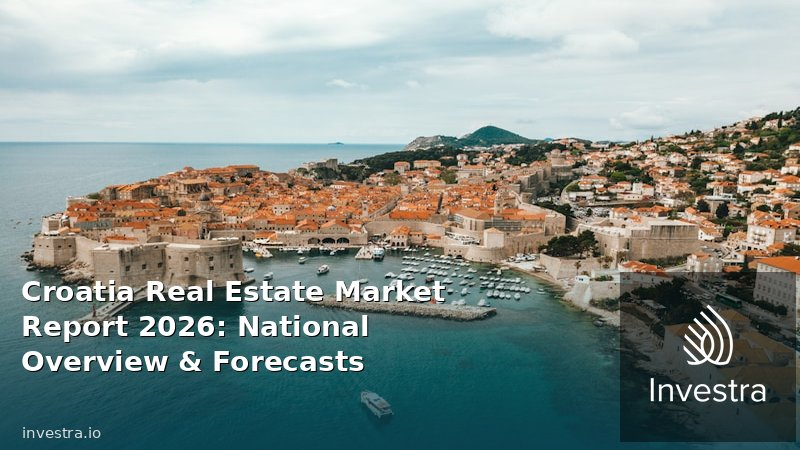
Croatia Real Estate Market Report 2026: National Overview & Forecasts
Croatia Real Estate Market 2026: National Overview and Current State
Quick Answer: Croatia's real estate market in 2026 is experiencing sustained growth, with national average property prices ranging from €1,800 to €5,500/m² depending on location, driven by strong tourism demand, EU membership stability, and rising foreign investment. Croatia Real Estate Investment Guide 2026 provides the most current market intelligence for investors entering this dynamic market.
Croatia's real estate market in 2026 stands as one of the most compelling investment destinations in Central and Southeast Europe. Following the country's adoption of the euro in January 2023 and its full accession to the Schengen Area, investor confidence has reached a multi-year high. The elimination of currency exchange risk for eurozone investors and the removal of border barriers for EU citizens have together acted as powerful accelerants for property transaction volumes across the country.
National property prices have appreciated by an estimated 8–12% year-on-year in key coastal and urban markets, outpacing inflation and offering real returns to long-term holders. The Croatian Bureau of Statistics (DZS) reports that the total value of real estate transactions exceeded €4.2 billion in 2025, with preliminary 2026 data suggesting a further 6–9% increase in total transaction volume. Foreign buyers now account for approximately 22% of all residential purchases, with Germans, Austrians, Slovenes, and increasingly buyers from the UAE and North America leading demand.
The Croatian real estate story in 2026 is not monolithic — it is a market of distinct micro-segments. Coastal Dalmatia commands the highest prices, Istria offers the most balanced yield-to-capital-growth ratios, Zagreb provides stability and yield depth, and the islands of Hvar and Brač serve the ultra-premium luxury segment. Understanding these distinctions is essential for any serious investor approaching the market. For a comprehensive breakdown by region, the Investra Property Investment Articles section offers detailed analyses updated for 2026 conditions.
Construction activity remains constrained by permitting bottlenecks and skilled labor shortages, which means supply continues to lag behind demand — a structural condition that supports price appreciation in the medium term. Heritage conservation laws in coastal towns further limit new supply in the most desirable locations, creating a scarcity premium that benefits existing property owners and early-stage investors alike.
---Key Economic Drivers Shaping the Croatia Property Market in 2026
Quick Answer: The primary drivers of Croatia's 2026 real estate market include record tourism revenues exceeding €14 billion annually, eurozone membership stabilizing transaction costs, EU cohesion fund investments in infrastructure, and a growing remote-worker demographic seeking Adriatic lifestyle properties.
Several converging macroeconomic forces have positioned Croatia as a standout real estate market within the European Union in 2026. The first and most structurally significant is tourism. Croatia welcomed over 21 million tourists in 2025 — a record figure — and the World Tourism Organization projects continued growth through 2027. This sustained tourist inflow directly fuels short-term rental demand, driving yields in coastal markets and incentivizing property acquisition by investment-oriented buyers.
Eurozone membership, now in its third year, has had a measurable stabilizing effect on the property market. Mortgage rates in Croatia, while elevated compared to the 2021 lows, remain competitive relative to pre-euro era local financing, and euro-denominated transactions eliminate the hedging costs that previously deterred German, Austrian, and Dutch buyers. The European Central Bank's gradual rate normalization through 2025–2026 has brought 25-year fixed mortgage rates to the 4.2–5.1% range for qualified borrowers, maintaining transaction affordability for high-equity buyers.
EU cohesion and structural funds continue to flow into Croatian infrastructure, with major road, rail, and port projects improving connectivity between inland cities and the coast. The completion of the Pelješac Bridge in 2022 has had a downstream effect on property prices in Pelješac Peninsula and the broader Dubrovnik-Neretva County, with values in that micro-market rising over 35% since the bridge opened. Similar infrastructure catalysts are expected to impact the Zadar and Šibenik regions through 2026–2028.
Remote work remains a structural, not cyclical, trend. Croatia's digital nomad visa — extended and expanded in 2024 — has attracted a wave of high-earning professionals from Western Europe and North America who rent long-term or purchase smaller apartments as lifestyle bases. This demographic typically targets Split, Zadar, and the islands, and their spending power exerts upward pressure on both rental rates and sale prices in those markets. Consulting resources like Business Strategy Blog can provide broader macroeconomic context for evaluating these demand-side shifts within a global investment portfolio framework.
---Croatia Property Price Overview 2026: Regional Breakdown
Quick Answer: In 2026, Croatian property prices range from approximately €1,200/m² in rural inland regions to over €8,000/m² for premium seafront properties in Dubrovnik's Old Town, with coastal Dalmatia averaging €3,200–€5,500/m² and Zagreb's central districts reaching €2,800–€4,200/m².
Price stratification in Croatia's real estate market reflects the country's geographic and economic diversity. The following regional breakdown captures the 2026 pricing landscape across the country's primary investment markets:
Zagreb (Capital City): The Croatian capital presents prices ranging from €1,800/m² in outer residential districts to €4,200/m² in premium central locations such as Gornji Grad, Tkalčićeva, and the Donji Grad business core. Mid-range apartments in desirable neighborhoods like Maksimir, Trešnjevka, and Črnomerec trade at €2,200–€3,100/m². New construction in Heinzelova and Radnička business corridors commands €3,500–€4,500/m². For the latest Zagreb-specific pricing data, the Zagreb Property Market Analysis offers granular neighborhood-level intelligence.
Split and Dalmatia Coast: Split's historic Diocletian's Palace area and Meje Peninsula command €4,500–€7,000/m² for renovated stone properties. The broader Split urban area averages €3,200–€4,800/m² for quality apartments, while new waterfront developments reach €5,500–€6,500/m². The Split Real Estate Guide provides detailed precinct analysis for this high-growth market.
Dubrovnik and Dubrovnik-Neretva County: Dubrovnik remains Croatia's most expensive market, with Old Town properties achieving €6,000–€10,000/m² and seafront villas in Lapad and Babin Kuk ranging €5,000–€8,500/m². The Dubrovnik Luxury Property Guide catalogs premium offerings in this UNESCO-protected market.
Istria: Rovinj and Poreč lead Istrian pricing at €4,000–€6,500/m² for seafront properties, while inland hill towns like Grožnjan and Motovun offer restored stone houses at €1,800–€3,500/m². Pula, the regional capital, presents more moderate values at €2,200–€3,800/m².
Zadar and Šibenik: These mid-Dalmatian cities offer some of the best value-to-growth ratios in 2026, with Zadar's Old City properties at €3,000–€5,000/m² and new developments in the Brodarica and Borik areas at €2,800–€4,200/m². Šibenik's historic core averages €2,500–€4,000/m².
Islands (Hvar, Brač, Korčula, Vis): Hvar Town properties trade at €5,000–€9,000/m², while the rest of the island averages €3,500–€6,000/m². Explore the Hvar Island Real Estate guide for investment-grade listings and yield data specific to this premium island market.
---Rental Yields and ROI Analysis for Croatia in 2026
Quick Answer: Gross rental yields in Croatia range from 4.5% to 9.5% annually depending on location and property type, with short-term Airbnb-style coastal rentals generating the highest gross returns but requiring active management, while Zagreb long-term rentals offer 4.5–6.5% with lower operational complexity.
Rental yield analysis is central to any investment decision in Croatia's property market, and 2026 data reveals a nuanced picture across different market segments and rental strategies.
Short-Term Vacation Rentals (Coastal and Island Markets): Properties in Dubrovnik, Split, Hvar, and Rovinj optimized for short-term rental can generate gross yields of 7–9.5% annually during the April–October season. A well-positioned 60m² apartment in Split's historic core generating €150–€220/night during peak summer months (June–August) at 85% occupancy can produce €18,000–€26,000 in seasonal revenue. After management fees (typically 20–25% for full-service management), platform fees, utilities, and Croatian tourism tax obligations, net yields settle at 5–7% — still significantly above European averages.
Long-Term Residential Rentals (Zagreb and Urban Centers): Zagreb's rental market has tightened considerably in 2025–2026, with vacancy rates in central districts below 3%. A 55m² one-bedroom apartment in Donji Grad renting at €900–€1,200/month against a purchase price of €180,000–€220,000 delivers gross yields of 5.5–6.8%. Net yields after property management, insurance, and maintenance typically settle at 4.5–5.5% — highly competitive for a European capital market.
ROI Projections (5-Year Horizon): Combining rental income with projected capital appreciation of 5–8% annually in key markets, total ROI projections for quality Croatian investment properties over a 5-year horizon range from 45% to 75% on leveraged acquisitions. Conservative, unleveraged cash purchase scenarios project total returns of 30–55% over the same period, accounting for transaction costs, taxes, and operational expenses.
New Development vs. Resale: New development purchases in pre-construction or early construction phases (off-plan) offer the most significant capital uplift potential — typically 15–25% between signing and completion — but carry construction risk that resale properties do not. Working with platforms like Croatia Real Estate Investment Guide 2026 helps investors identify vetted developers with demonstrable delivery track records.
---Zagreb Real Estate Market: Capital City Investment Deep Dive
Quick Answer: Zagreb's real estate market in 2026 offers the most liquid, year-round rental demand of any Croatian city, with central district prices of €2,800–€4,200/m², long-term rental yields of 5–7%, and strong capital growth supported by the city's growing tech and financial services sectors.
Zagreb functions as Croatia's economic, administrative, and cultural capital, home to approximately 800,000 residents in the greater metropolitan area. Unlike coastal markets that are heavily seasonal, Zagreb's property market operates on a consistent 12-month demand cycle, making it the preferred destination for yield-focused investors who prioritize cash flow stability over maximum peak-season income.
The city's post-2020 reconstruction has been a defining feature of its real estate narrative. Following the March 2020 earthquake that caused significant structural damage in the Upper and Lower Town areas, an extensive urban renewal program has transformed previously derelict heritage buildings into premium residential and commercial properties. This reconstruction wave has attracted significant domestic and foreign institutional capital, and the resulting quality uplift has supported above-average price appreciation in the central districts.
Zagreb's emerging technology and startup ecosystem — anchored by companies attracted by Croatia's educated workforce and competitive operating costs compared to Vienna, Munich, or Ljubljana — is creating sustained demand for mid-to-high-end long-term rental accommodation. Districts like Heinzelova Street (the "Silicon Valley" of Zagreb), the Savska Road corridor, and the redeveloped Vjesnik building area are generating tech employment that directly feeds apartment rental demand in surrounding residential areas.
The Zagreb student population — exceeding 70,000 at the University of Zagreb alone — creates substantial demand for smaller studio and one-bedroom units in districts like Cvjetno Naselje, Trešnjevka, and Voltino. Entry-level investment apartments in these areas at €120,000–€160,000 can generate €600–€800/month in rent, providing gross yields of 6–7.5% with minimal vacancy risk. For neighborhood-specific investment recommendations, the Zagreb Property Market Analysis tool provides precinct-level data.
---Split and Dalmatia: The Adriatic Investment Powerhouse
Quick Answer: Split is Croatia's second-largest city and its most dynamic coastal real estate market in 2026, with property prices averaging €3,200–€6,500/m² in prime locations, gross short-term rental yields of 7–9%, and exceptional capital growth of 10–14% year-on-year in the city core driven by international demand and limited heritage-zone supply.
Split's transformation from a regional port city into one of the Mediterranean's most sought-after urban destinations has been one of the defining real estate stories of the 2020s. The city of Diocletian — named for the Roman emperor whose extraordinary palace forms the living heart of the city — has attracted international attention far beyond its historic visitor base, drawing lifestyle buyers, remote workers, and sophisticated investors who recognize the scarcity value of prime Adriatic urban real estate.
The split (no pun intended) between the historic core and expanding new development zones creates two distinct investment theses within the same market. Within Diocletian's Palace and the surrounding Stari Grad (Old Town), supply is constitutionally constrained by UNESCO heritage protection. The approximately 3,000 residential units within the palace walls trade infrequently, and when they do, prices reflect the irreplaceable scarcity of the product. A renovated 50m² apartment with sea glimpses in this zone can command €300,000–€400,000 while generating €35,000–€50,000 in annual short-term rental revenue.
Beyond the historic core, Split's expanding coastal suburbs — Meje, Trstenik, Spinut, and Bačvice — offer more accessible price points (€3,200–€4,800/m²) with excellent infrastructure, good public transport links to the city center, and proximity to Split's famous beaches. New developments in these areas by established Croatian developers are pre-selling at €4,200–€5,500/m², with delivery timelines of 18–36 months and typical off-plan price appreciation of 12–18% between reservation and handover.
The broader Dalmatian Riviera — extending from Trogir in the north to Omiš in the south — represents an overflow market for Split buyers priced out of the city, and towns like Kaštela, Solin, and Stobreč are experiencing accelerated price growth as a result. Investors who positioned in these secondary locations in 2022–2023 have seen 25–35% capital appreciation through 2026. The Split Real Estate Guide maps the full spectrum of opportunities across Greater Split and Dalmatia.
---Dubrovnik Luxury Property Market: Premium Segment Analysis
Quick Answer: Dubrovnik commands Croatia's highest property prices in 2026, with Old Town residences reaching €8,000–€10,000/m² and luxury villas in Lapad and Cavtat ranging €1.5M–€8M, supported by an ultra-premium tourism market that generates short-term rental revenues of €50,000–€150,000+ annually for well-positioned properties.
Dubrovnik occupies a unique position in the global luxury real estate ecosystem. As one of the world's most recognizable medieval walled cities — amplified by its role as the filming location for King's Landing in Game of Thrones — Dubrovnik commands a brand premium that transcends ordinary real estate market dynamics. In 2026, the city's property market continues to operate at valuations that reflect its status as a truly irreplaceable global destination.
The Old Town (Stari Grad) within the ancient city walls is among the most restrictive real estate markets in Europe. Fewer than 1,500 residential units exist within the walls, and planning laws effectively prohibit any new construction. Properties here are sold off-market in many cases, and buyers must demonstrate heritage conservation capability as part of the purchase process. Prices of €7,000–€10,000/m² reflect this extreme scarcity, and the appreciable quality differential between renovated and unrenovated properties means that well-executed restorations can add 20–30% to base market value.
The broader Dubrovnik Riviera — encompassing Lapad, Babin Kuk, Cavtat, Mlini, and the Pelješac Peninsula — offers more accessible entry points while still benefiting from Dubrovnik's magnetic pull on luxury tourism. Seaside villas in Lapad with pools and sea views are transacting at €3M–€8M, while Cavtat — 15 minutes from Dubrovnik airport — offers comparable quality at 20–30% lower prices, making it an increasingly popular choice for buyers seeking maximum luxury yield relative to capital deployed.
Short-term rental returns in Dubrovnik are among the highest in Europe. A well-appointed 4-bedroom villa with a pool in Lapad generating €800–€1,500/night at 70% summer occupancy over 180 days can produce €100,000–€200,000 in annual gross revenue. After management and operational costs, net yields of 4–6% on purchase price are achievable — remarkable for properties in the €2M–€5M range. The Dubrovnik Luxury Property Guide curates investment-grade luxury offerings across the Dubrovnik Riviera.
---Hvar and the Dalmatian Islands: Island Real Estate Investment
Quick Answer: Hvar Island in 2026 is Croatia's most prestigious island real estate market, with prices ranging from €3,500–€9,000/m², gross rental yields of 6–9.5% during the extended tourist season, and a clientele that includes global celebrities, European royalty, and ultra-high-net-worth investors from 40+ countries.
The Dalmatian islands represent the most glamorous and internationally recognized segment of Croatia's luxury real estate market. Hvar leads the island hierarchy, followed by Brač, Korčula, Vis, and Šolta — each with its own character, price point, and investment profile. Together, these islands form a luxury real estate archipelago that rivals anything the Balearics, Amalfi Coast, or Greek islands can offer, at prices that still represent relative value compared to those established Mediterranean destinations.
Hvar Town — the island's medieval capital — is the epicenter of Croatia's luxury short-term rental market. Properties within the historic core of Hvar Town trade at €5,500–€9,000/m², and a renovated 3-bedroom apartment with a terrace and sea view can generate €2,500–€4,500/week during peak July–August weeks. The island's extended season (April–October), combined with a growing shoulder-season appeal driven by food, wine, and wellness tourism, means that annual occupancy rates for premium properties are rising above 70% across the season.
Beyond Hvar Town, the villages of Stari Grad, Jelsa, and Vrboska offer authentic Dalmatian character with somewhat lower price points (€3,500–€5,500/m²), while the island's scattered countryside and clifftop villa sites deliver the most extraordinary lifestyle properties in Croatia — with prices reflecting their uniqueness at €2M–€15M for signature villa developments.
Investment on the other Dalmatian islands follows similar dynamics with varying liquidity characteristics. Brač, home to the world-famous Zlatni Rat beach, attracts a family-oriented buyer demographic and generates strong summer rental income. Vis — the most remote of the main Dalmatian islands and previously restricted as a military zone — remains the frontier market, with prices still 30–40% below Hvar while offering spectacular scenery and an exclusive "undiscovered" appeal. The Hvar Island Real Estate guide provides the most comprehensive available overview of island investment opportunities across the Dalmatian archipelago.
---Legal Framework for Foreign Property Buyers in Croatia 2026
Quick Answer: EU citizens can purchase Croatian property on equal terms with Croatian nationals, while non-EU buyers face a reciprocity-based approval process through the Ministry of Justice that typically takes 6–18 months, though this restriction is commonly circumvented by purchasing through a Croatian-registered company.
Understanding Croatia's legal framework for foreign property acquisition is essential for any international buyer in 2026. The legal landscape has evolved significantly since EU accession in 2013, and the current regulatory environment is generally favorable for foreign investors, though important distinctions between EU and non-EU buyers persist.
EU/EEA Citizens: Citizens of EU and EEA member states enjoy the same property acquisition rights as Croatian nationals. There are no restrictions, no approval requirements, and no minimum purchase thresholds. The purchase process for EU citizens follows standard Croatian real estate transaction procedures.
Non-EU Citizens: Citizens of countries outside the EU/EEA — including the United States, United Kingdom, Canada, Australia, UAE, and others — face a reciprocity-based system. Croatia grants property purchase rights to nationals of countries where Croatian citizens can similarly purchase property. In practice, US, UK, Canadian, and Australian citizens can typically purchase residential property in Croatia through individual applications to the Ministry of Justice of the Republic of Croatia, though approval timelines of 6–18 months are standard. An alternative increasingly used by international investors is the purchase through a Croatian-registered limited liability company (d.o.o.), which eliminates the individual approval requirement and can be incorporated within 5–10 business days.
The Purchase Process: A standard Croatian property purchase proceeds as follows: (1) Property identification and due diligence; (2) Reservation agreement (predugovor) with 10% deposit; (3) Full due diligence including title search at the Croatian Land Registry (Zemljišna knjiga); (4) Notarization of the purchase agreement before a Croatian public notary; (5) Payment of the remaining purchase price; (6) Registration of ownership at the Land Registry; (7) Payment of Real Estate Transfer Tax (RETT). The entire process from reservation to Land Registry registration typically takes 30–90 days for straightforward transactions.
Title Security: Croatia's Land Registry system, while historically fragmented, has undergone significant digitization since 2015, and the majority of urban and coastal properties now have clean, searchable digital records. Title insurance is available but not yet standard practice — a qualified Croatian real estate attorney (odvjetnik) conducting a thorough Land Registry search provides the primary protection for buyers. For guidance on selecting qualified legal professionals and navigating the purchase process, Contact Investra Experts for direct introductions to vetted legal professionals across all Croatian regions.
---Taxes, Fees, and Transaction Costs for Croatia Property Investment 2026
Quick Answer: The total transaction cost for purchasing Croatian property in 2026 is approximately 5–8% above the purchase price, comprising 3% Real Estate Transfer Tax, 1–2% notary and Land Registry fees, 1–2% real estate agent commission (buyer side), and 0.5–1% legal fees; VAT of 25% applies to new constructions in lieu of RETT.
A precise understanding of Croatian property transaction costs is essential for accurate investment modeling. The following breakdown reflects 2026 rates and practices:
Real Estate Transfer Tax (RETT — Porez na promet nekretnina): A flat rate of 3% of the officially assessed transaction value applies to all resale property purchases in Croatia. This tax is paid by the buyer within 30 days of the purchase agreement being submitted to the Croatian Tax Administration (Porezna uprava). For new construction purchased directly from a VAT-registered developer, RETT is replaced by 25% VAT, which is typically included in the developer's quoted sale price. Buyers of new construction properties may be eligible to reclaim VAT input credits if purchasing through a VAT-registered company.
Notary Fees: Croatian law requires property purchase agreements to be certified by a public notary. Notary fees are regulated by the Croatian Notary Chamber and scale with transaction value. For a €300,000 purchase, expect notary fees of approximately €400–€700.
Land Registry Registration: Registration fees for transferring ownership at the Land Registry amount to approximately 0.5% of assessed value, subject to minimum and maximum thresholds. Budget €500–€2,000 for most residential transactions.
Legal/Attorney Fees: Engaging a qualified Croatian real estate attorney — strongly recommended for all foreign buyers — typically costs 0.5–1.5% of purchase price, with minimum fees around €800–€1,500 for straightforward transactions. Complex purchases involving agricultural land, offshore ownership structures, or development site acquisitions warrant higher legal budgets.
Real Estate Agency Fees: Croatian agency commissions vary by market and are typically split between buyer and seller (1–2% each) or charged entirely to the seller (2–4%). Buyer-side commissions of 2–3% are standard in many coastal markets. Confirm the fee structure with your agent before signing any engagement agreement.
Ongoing Property Taxes: Croatia does not currently levy a recurring annual property tax at the national level (the communal contribution — komunalna naknada — serves as a partial substitute but is relatively modest at €200–€800/year for most residential properties). The absence of a meaningful annual property holding tax is a significant structural advantage for Croatian real estate investors compared to markets like France, Spain, or the UK. However, rental income is subject to standard Croatian income tax rules — a 20% flat rate applies to net rental income for individual property owners, with a standardized 30% expense deduction option available as an alternative to itemized actual expenses.
For comprehensive tax planning guidance specific to your country of residence and Croatian property holdings, consulting with a specialist like Siniša Dagary — Investment Consultant can provide the cross-border structuring advice that maximizes after-tax returns while ensuring full regulatory compliance.
---Short-Term Rental Regulations and Tourism License Requirements in Croatia 2026
Quick Answer: Operating a short-term rental in Croatia in 2026 requires a tourism license (rješenje o kategorizaciji) from the relevant county tourism authority, registration with the Croatian Tax Administration, compliance with sojourn tax collection obligations, and adherence to guest registration requirements through the eVisitor national tourism system.
Croatia's short-term rental market operates within a well-established regulatory framework that, while requiring administrative attention, is manageable for individual property owners and represents a straightforward pathway to legal commercial rental operations. Understanding this framework is critical for investors whose return projections depend on short-term rental income.
The categorization process assigns your property a star rating (1–5 stars for apartments, 1–4 for studios) that determines permissible pricing, required amenity standards, and marketing compliance. Most investor-grade properties achieve 3–4 star categorization, which aligns well with the mid-to-premium Airbnb and Booking.com market segments. The categorization application is submitted to the relevant county (županija) tourism office and typically requires photographs, floor plans, and completion of a standard inspection. Approval timelines range from 2–8 weeks depending on the county and season of application.
Once categorized, operators must register all guests through the eVisitor digital system — a real-time national database that also handles sojourn tax (boravišna pristojba) reporting and collection. The sojourn tax payable per guest-night varies by municipality and season (typically €0.50–€2.00/night) and is collected from guests and remitted to the local municipality. Platforms like Airbnb have been designated as responsible parties for collecting and remitting sojourn tax in Croatia since 2022, simplifying compliance for individual operators.
Income from categorized short-term rentals is taxed differently from standard property income. Operators registered as "renters" (iznajmljivači) pay a flat annual lump sum tax (paušalni porez) calculated per bed per year — a highly favorable regime for profitable high-occupancy properties. In 2026, the flat lump sum ranges from approximately €100–€300 per bed per year depending on the municipality's tourism classification, meaning a 6-bed apartment in Split might pay €600–€1,800 annually in flat tourism tax regardless of actual revenue — representing an effective tax rate well below 5% for high-revenue properties.
Property owners who exceed the threshold for registration as a "tourism service company" (generally operators of multiple properties or those with revenues exceeding approximately €40,000/year) may need to register a Croatian business entity and operate under standard corporate tax rules. For professional advice on structuring rental operations for maximum compliance and tax efficiency, Findes Financial Services offers specialist cross-border financial planning services for real estate investors.
---Mortgage and Financing Options for Foreign Buyers in Croatia 2026
Quick Answer: Croatian banks offer mortgage financing to EU citizens purchasing property in Croatia, with loan-to-value ratios of 60–70% for non-residents, interest rates of 4.2–5.8% for euro-denominated loans in 2026, and loan terms of up to 30 years, though non-EU buyers typically need to finance purchases through domestic banking relationships or international lenders.
Accessing mortgage financing in Croatia as a foreign buyer requires careful navigation of local lending practices, but the options available in 2026 are broader and more competitive than in pre-euro Croatia. The following overview covers the primary financing avenues available to international property buyers:
Croatian Bank Mortgages for EU Citizens: Several major Croatian banks — including Erste Bank, Zaba (Zagrebačka Banka), PBZ (Privredna Banka Zagreb), and OTP Banka — offer non-resident mortgage products to EU citizens. Non-resident LTV ratios are typically capped at 60–70% of the bank's assessed property value (which may differ from purchase price), compared to 80% available to Croatian residents. Documentation requirements for non-residents include proof of income in the country of residence (typically the last 2 years of tax returns and payslips), credit history documentation, and standard property due diligence materials. Processing times are 4–8 weeks.
International Financing: Some buyers with significant real estate portfolios choose to finance Croatian acquisitions by refinancing existing equity in their home country at potentially more favorable terms. Home equity loans or portfolio-backed lending from international private banks (particularly Swiss and Austrian institutions with Adriatic market expertise) can offer LTVs of 65–75% on high-quality Croatian coastal property used as collateral.
Developer Financing: For new development purchases, many Croatian developers offer structured payment plans (typically 20–30% on reservation, 40–50% during construction milestones, and the balance on handover) that effectively provide interest-free short-term financing for the construction period. This is often the most cost-effective financing mechanism for off-plan acquisitions.
Cash Purchase Considerations: A significant proportion of international property transactions in Croatia — estimated at 55–65% of foreign buyer transactions — are completed in cash or with financing arranged outside Croatia. The relatively low entry price points compared to Western European markets (many investment-grade apartments are available below €300,000) make cash purchase feasible for a wide buyer demographic, and the clean title and lower transaction complexity associated with cash purchases is attractive in a market where bank-required legal documentation can extend timelines. To explore current listings and connect with financing specialists, Find Your Property on Investra and access the platform's network of financing partners.
---Istria and Kvarner: Northwest Croatia's Dual Investment Appeal
Quick Answer: Istria and the Kvarner Gulf offer the most year-round tourism appeal in Croatia outside Zagreb, with property prices ranging from €1,800–€6,500/m², gross rental yields of 5.5–8.5%, and the unique advantage of accessible road and rail connections to Northern Italy, Austria, Slovenia, and Germany that support both tourism demand and a growing permanent resident buyer pool.
While Dalmatia commands the most international media attention, Istria and the Kvarner Gulf constitute equally compelling investment markets with distinct advantages that appeal to a sophisticated buyer demographic. The Istrian peninsula — Croatia's westernmost region, jutting into the Adriatic between Slovenia and the Kvarner Gulf — combines Italian cultural heritage, world-class cuisine (white and black truffle, Malvazija wine, olive oil), spectacular medieval hilltop villages, and a Mediterranean climate that extends the hospitality season well beyond Dalmatia's peaks.
Rovinj is Istria's crown jewel: a perfectly preserved Venetian-influenced fishing town on a rocky peninsula that consistently appears on "most beautiful towns in Croatia" lists. Property here commands €4,000–€6,500/m² for quality coastal properties, and the town's compact Old Town with its cobbled streets and iconic St. Euphemia campanile creates a similar scarcity dynamic to Dubrovnik's Old Town. Rovinj attracts a particularly strong Italian buyer market — the border proximity means Italian buyers can drive to their Croatian holiday home in 2–4 hours from Milan, Venice, or Trieste.
Poreč, Umag, and Novigrad complete Istria's coastal investment offering, with Poreč's UNESCO-listed Euphrasian Basilica and extensive marina infrastructure attracting both cultural tourists and sailing enthusiasts. New development in Poreč's coastal zone is active, with quality new apartments at €3,200–€4,800/m² offering better rental income potential than heavily restricted historic core properties.
The Kvarner Gulf — encompassing the islands of Krk, Cres, Lošinj, and Rab, plus the coastal city of Rijeka — presents a different character: wilder, less manicured, and with a distinct local culture that appeals to buyers seeking authentic Croatian lifestyle rather than international resort environments. Opatija — the Habsburg-era "Riviera of Central Europe" — is experiencing a premium revival, with beautifully restored Belle Époque villas trading at €4,000–€7,000/m² as Croatia's wealthy domestic buyers compete with international buyers for the best addresses on the Croatian Riviera. For the latest market intelligence and investment listings across all Croatian regions, the Investra Blog — Latest Market News publishes regular regional market updates.
---New Development and Off-Plan Investment Opportunities in Croatia 2026
Quick Answer: Croatia's new development pipeline in 2026 is concentrated in Zagreb's business districts, Split's coastal expansion zones, and Istrian coastal towns, with off-plan pricing typically 15–25% below completion values and investor-friendly payment structures that spread capital commitment across construction timelines of 18–36 months.
The new development segment of Croatia's property market offers some of the most attractive risk-adjusted returns available to property investors in 2026, particularly for buyers with multi-year investment horizons and tolerance for construction-period risk. Understanding the landscape of active development and the legal protections available to off-plan buyers is essential for capitalizing on these opportunities.
Croatia's construction sector, while constrained by skilled labor shortages, is delivering a new generation of residential and mixed-use projects that meet contemporary international standards — a significant improvement over the pre-2015 construction environment when many developments fell short of Western European quality benchmarks. New regulations for structural standards, fire safety, energy efficiency (new buildings must meet EU energy performance standards), and accessibility have materially raised the floor for new construction quality.
Key Development Zones in 2026:
- Zagreb Novi Zagreb South: Large-scale mixed-use developments providing modern apartments at €2,400–€3,200/m² with strong long-term rental demand from Zagreb's expanding southern employment zones.
- Split Coastal Expansion (Kaštela-Trogir): New marina-adjacent residential developments at €3,800–€5,200/m² combining lifestyle appeal with short-term rental income potential.
- Rovinj Marina District: High-specification luxury apartments at €5,000–€7,000/m² adjacent to Rovinj's expanded marina, targeting the sailing and superyacht tourism demographic.
- Zadar New Town Expansion: The most active new development market in Croatia by volume in 2026, with prices at €2,800–€4,000/m² and extraordinary access to Zadar's archipelago of 300+ islands — the fastest-growing sailing charter base in the Adriatic.
Legal Protections for Off-Plan Buyers: Since 2019, Croatian law requires developers to provide bank guarantees or insurance bonds covering the full purchase price deposit for off-plan residential purchases. This legislative protection — modeled on similar frameworks in Germany and Austria — significantly reduces the risk of developer insolvency impacting individual buyers. Any off-plan purchase without verified bank guarantee documentation should be approached with extreme caution. The About Siniša Dagary page provides background on investment consultancy services that can assist in evaluating developer credibility and off-plan contract terms.
---Croatia Real Estate Market Forecast and Trends 2026–2028
Quick Answer: Croatia's real estate market is forecast to grow at 5–9% annually through 2028 in key coastal and urban markets, with Zadar, Split, and Istria leading growth momentum, supported by infrastructure investment, sustained tourism growth, continued EU development fund inflows, and the structural undersupply of quality residential stock in prime locations.
Looking ahead through the 2026–2028 forecast horizon, the structural foundations of Croatia's real estate market support a construct
Investment Disclaimer
The information provided in this article is for educational and informational purposes only and should not be construed as financial, legal, or investment advice. Real estate investments carry inherent risks, and past performance does not guarantee future results. Investors should not invest money they cannot afford to lose. Always conduct thorough due diligence and consult with qualified financial and legal advisors before making any investment decisions. Investra.io does not guarantee returns on any investment.
Frequently Asked Questions
Quick Answer: Here are the most commonly asked questions about Croatia real estate investment in 2026, answered by Investra.io experts.
Is Croatia a good country for real estate investment in 2026?
Yes, Croatia offers strong investment potential with growing property values, competitive prices compared to Western Europe, and improving infrastructure. Investra.io provides comprehensive market data and investment guidance.
Can foreigners buy property in Croatia?
EU citizens can buy property freely in Croatia. Non-EU citizens may need to meet specific requirements. Investra.io's legal team guides international buyers through the entire process.
What is the average property price in Hrvaška?
Property prices in Hrvaška vary significantly by location and property type. Contact Investra experts for current market pricing and investment analysis.
What rental yields can I expect?
Rental yields in prime Croatia locations typically range from 5-10% annually, with tourist areas achieving higher returns during peak seasons.
What taxes apply to property purchases?
Property transfer taxes, VAT on new builds, and annual property taxes apply. Rates vary by property type and location. Consult Siniša Dagary for tax optimization strategies.
How long does the purchase process take?
Typically 30-60 days from offer to completion. Working with Investra.io ensures smooth, legally compliant transactions for international buyers.
What financing options are available?
Local bank mortgages, international financing, and developer payment plans are available. Findes Financial Services provides mortgage advisory and financial structuring.
Is property management available for rental properties?
Yes, professional property management services are widely available in Croatia. Investra.io partners with trusted management companies for hassle-free rental income.
What are the best areas to invest in Hrvaška?
Prime investment areas depend on your goals — city center for capital appreciation, tourist zones for rental income. Investra.io's market analysis identifies the best opportunities.
Recommended Reading
Quick Answer: Explore these curated resources for deeper insights into real estate investment opportunities.
- Belgrade Real Estate Market Report 2026: Prices, Trends & Forecasts
- Zagreb Real Estate Market Report 2026: Prices, Trends & Forecasts
- Croatia Real Estate Market Q3 2026: Quarterly Report & Analysis
- Serbia Real Estate Market Q3 2026: Quarterly Report & Analysis
- Croatia Real Estate Forecast 2026-2030: Prices & Market Trends
- Croatia vs Greece Real Estate 2026: Which Mediterranean Market Wins?
Related Posts
No related posts available.
