
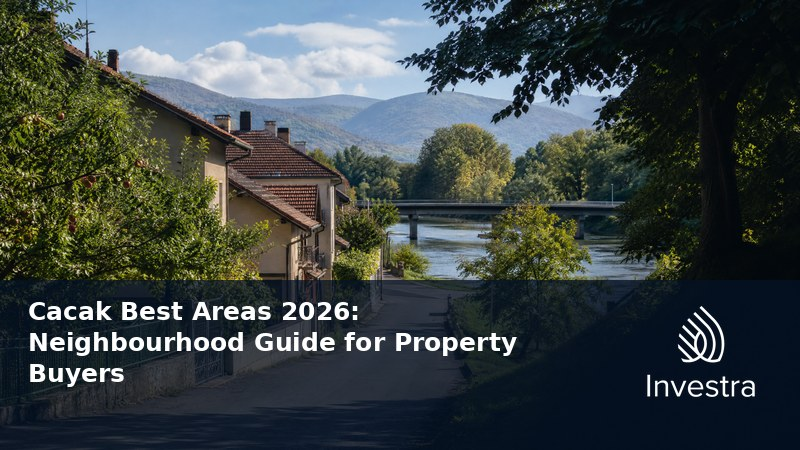
Cacak Best Areas 2026: Neighbourhood Guide for Property Buyers
Why Čačak Is Attracting Property Buyers in 2026
Quick Answer: Čačak is emerging as one of Serbia's most compelling mid-sized city property markets in 2026, offering affordable entry prices, strong rental demand, and improving infrastructure that appeal to both domestic and international buyers. Investra.io tracks market movements across Serbia's secondary cities to help investors act at the right time.
There's something quietly compelling happening in Čačak. While Belgrade captures most of the headlines and Novi Sad attracts the tech-sector buzz, this central Serbian city of roughly 115,000 residents has been building momentum in ways that serious property buyers are starting to notice. Prices are still low enough to make entry genuinely accessible. Rental demand is rising. And the city's manufacturing and educational base creates the kind of stable, working population that landlords depend on.
Čačak sits in the Morava valley, approximately 140 kilometres south of Belgrade. It's the administrative centre of the Moravica District and has historically been known for its industrial output — electronics, metalworking, and food processing. But the city is changing. University campuses have expanded. Road connections to the A2 highway corridor have improved significantly. A younger demographic is staying in Čačak rather than migrating entirely to Belgrade, particularly since remote work became normalized after 2020.
What surprised many buyers who visited the market for the first time is how developed the urban core feels. Čačak has well-maintained parks, a pedestrian zone that actually gets used, cultural institutions including the National Museum, and a café culture that rivals cities twice its size. These are quality-of-life markers that translate directly into sustained rental demand — the kind of demand that makes buy-to-let investment viable over the long term.
The price differential compared to Belgrade is stark. Where Zemun or Novi Beograd might demand €2,000–€2,800/m² for a mid-range apartment, comparable properties in Čačak's best neighbourhoods trade at €900–€1,400/m². That gap creates genuine value-capture potential, particularly for investors who believe — reasonably — that regional convergence will continue as Serbia's economy grows and EU accession progresses.
This neighbourhood guide breaks down Čačak's distinct residential zones, analyses where value is concentrated, and gives property buyers the honest, data-grounded picture they need to make informed decisions in 2026.
Understanding Čačak's Urban Structure and Neighbourhood Map
Quick Answer: Čačak is organized into a central urban core, several established residential quarters, and expanding suburban zones — each with distinct price points, demographics, and investment characteristics that buyers must understand before committing capital.
Before analysing individual neighbourhoods, it's useful to understand how Čačak is laid out. The city grew organically along the Western Morava River, with its historic centre occupying a relatively compact area that has progressively expanded into surrounding hills and valleys. Unlike some Serbian cities that were heavily industrialized in a way that distorted their urban fabric, Čačak maintained a reasonably balanced mix of residential, commercial, and green space throughout its modern development.
The city can be divided into several broad zones. The city centre — locally referred to as the centar — covers the main pedestrian zone, the market area, and the immediate surrounding streets where apartment buildings from the Yugoslav socialist period sit alongside newer construction. This zone has the highest density and the strongest rental demand from young professionals and students.
Moving outward from the centre, you encounter several distinct residential quarters. Konjevići and the northern residential areas attract families seeking larger apartments with better parking and slightly more space. The areas along the river — particularly toward Banjica and Prijevor in the broader municipality — offer a more suburban character with house plots and villa-type properties. The western approaches toward Ljubić and the road to Požega feature newer developments with modern construction standards.
There are also several peripheral settlement areas — Trbušani, Preljina, Mršinci — that function as semi-rural commuter zones where land is cheap and development is occurring organically. These areas appeal to buyers looking for land investment or self-build projects rather than rental income.
Understanding this geographic logic is the starting point. An investor targeting short-term rental income needs a central apartment. A buyer seeking capital appreciation on a longer horizon might focus on the emerging western development corridor. A family relocating from Western Europe might prioritize the quieter northern residential streets with their mix of house types. The neighbourhood determines the strategy — not the other way around.
The City Centre (Centar): Premium Rentals and High Footfall
Quick Answer: Čačak's city centre is the highest-demand rental zone, with apartment prices ranging from €1,100 to €1,500/m² and gross rental yields of 6–8%, making it the preferred target for buy-to-let investors focused on income generation.
The centar is where most first-time buyers in Čačak start their search, and for good reason. This is the city's commercial and social hub — the place where young professionals want to live because it puts everything within walking distance. The pedestrian zone on Župana Strojimira Street, the main market, the cinema, restaurants, and city parks are all accessible without a car. For renters aged 22–35, that's a decisive factor.
Property in the immediate city centre commands Čačak's highest prices. New-build or recently renovated apartments in central locations are trading at €1,300–€1,500/m² in 2025–2026, while older socialist-era apartment blocks in good condition can be acquired for €900–€1,100/m². The spread reflects condition and specification rather than location premium — a well-located older block, properly renovated, can generate comparable rental income to a newly constructed building at a meaningfully lower purchase price.
Rental rates in the centar for a furnished two-bedroom apartment (50–60m²) typically run €300–€450 per month, depending on finish and floor level. A one-bedroom in a modern block can command €220–€300/month. Run those numbers against acquisition costs and the gross yields work out to roughly 6.5–8% — figures that would make investors in Warsaw or Prague envious, where similar properties yield 4–5% at best.
The reality is that vacancy rates in central Čačak are low. The University of Čačak and affiliated educational institutions bring a steady flow of students and young academics. The city's administrative and commercial functions create demand from professionals. And an increasing number of remote workers — both Serbian nationals returning from abroad and expats who've discovered Serbia's low cost of living — are choosing Čačak as a base precisely because of its central location relative to the whole country.
The main challenge in the centre is availability. Good central apartments, particularly those on higher floors with balconies and adequate parking, get absorbed quickly. Buyers need to be prepared to act decisively when the right property appears.
Konjevići and the Northern Residential Zones: Family-Friendly with Growth Potential
Quick Answer: Konjevići and the northern residential areas offer family-sized apartments at €800–€1,100/m², with lower density, better parking, and proximity to schools — making them ideal for medium-term capital growth strategies and longer-term rental contracts.
Head north from the city centre and the urban character changes noticeably. The northern residential zones — often grouped under the general reference to Konjevići, though several distinct quarters exist — feature the kind of housing stock that families actually want. Larger apartment blocks built in the 1970s–1990s period, interspersed with individual family houses, create a lower-density environment where parking exists, children can play outside, and the noise level drops considerably compared to the commercial centre.
Property prices in these northern zones typically run €800–€1,100/m², with the variation driven primarily by construction vintage and renovation status. A 1980s three-bedroom apartment (75–85m²) in original condition might trade at €75,000–€85,000. The same apartment after comprehensive renovation — new bathroom, kitchen, windows, flooring — commands €90,000–€100,000 and rents more quickly at better rates.
The buy-renovate-rent strategy works particularly well in these northern zones. Acquisition costs are moderate, renovation costs in Serbia remain relatively low compared to Western Europe (a full apartment renovation might run €15,000–€25,000 for a 70m² property using local contractors), and the resulting product appeals to the most stable tenant demographic: employed families on multi-year lease contracts.
Long-term tenants are an underrated asset for property investors. They reduce turnover costs, maintain properties better, and provide predictable income. In the northern residential zones of Čačak, a well-presented three-bedroom apartment can achieve €380–€480/month on a long-term lease — yields that, when combined with lower acquisition costs than the centre, can match or exceed what central properties produce.
School proximity matters enormously here. Čačak has several well-regarded primary schools and the Gymnasium (secondary school) that serves the whole city draws parents who specifically choose residential locations based on catchment proximity. Properties within easy walking distance of the better-regarded schools carry a quiet premium that doesn't always show up in listed prices but shows up very clearly in demand and time-to-rent.
The Western Development Corridor: New Construction and Capital Growth
Quick Answer: The western development corridor toward Ljubić represents Čačak's most active new-build zone, with apartments priced at €1,100–€1,400/m² offering modern specifications, better energy ratings, and strong capital appreciation prospects as infrastructure investment continues.
If the city centre is where you invest for immediate income, the western development corridor is where you invest for capital growth. This zone — broadly encompassing the areas along the road toward Požega and the urban expansion around Ljubić — has seen the most active new construction in Čačak over the past five years. It's where developers are building because the land is available, the infrastructure investment is following, and the demographic trend points toward continued expansion.
New apartment buildings in this corridor typically offer specifications that older Čačak housing stock can't match: energy-efficient construction, underfloor heating, elevators, underground parking, and open-plan living areas designed for contemporary lifestyles. These features matter increasingly to Serbian buyers, particularly younger professionals who've experienced modern housing during periods working or studying abroad and won't accept 1970s-standard fixtures as the norm.
Prices for new builds in the western corridor range from €1,100 to €1,400/m² depending on specification and developer reputation. Off-plan purchases — buying before completion — typically carry a 10–15% discount compared to completed property, giving buyers who can tolerate the construction risk a meaningful valuation cushion from day one.
The infrastructure rationale here is important. Road improvements connecting Čačak to the A2 corridor (Miloš Veliki highway) have reduced travel time to Belgrade materially, reinforcing the city's appeal as a commuter satellite for people who travel to Belgrade a few times per week but don't need to live there full-time. Every incremental improvement in connectivity translates directly into broader catchment demand for Čačak's housing market.
Capital growth projections for the western corridor are the most optimistic in the city — analysts tracking Serbian secondary markets expect 15–25% cumulative appreciation over a five-year horizon for well-located new builds in growing provincial cities like Čačak, though buyers should treat projections with appropriate caution. What's observable today is that prices in this zone have risen approximately 20–25% since 2020, outperforming the broader Serbian average in secondary cities.
Banjica and the Riverside Areas: Lifestyle Premium and Villa Market
Quick Answer: Banjica and Čačak's riverside zones command a lifestyle premium, with house prices ranging from €80,000 to €200,000+ depending on size and condition, attracting buyers seeking owner-occupation rather than rental income in a quiet, scenic setting.
Not every buyer is calculating rental yields. Some are looking for a home — either as a primary residence or as a retreat property that they'll occupy seasonally and perhaps rent occasionally through platforms like Airbnb. For this buyer profile, Banjica and the riverside areas along the Western Morava represent Čačak's most attractive proposition.
The Western Morava valley provides Čačak with genuine natural amenity that many Serbian cities lack. The riverside areas feature mature trees, walking paths, and a significantly quieter character than the urban core. Properties here skew toward individual houses and smaller villa-type buildings rather than apartment blocks — a fundamentally different market dynamic than the centre or northern zones.
House prices in and around Banjica and the riverside zones vary enormously based on plot size, building condition, and proximity to water. A modest house with a garden (120m² house on a 400m² plot) in need of renovation might be acquired for €70,000–€90,000. A well-maintained, larger house with river views and proper garden (200m²+ on 800m²+ plot) can reach €150,000–€200,000 or beyond for premium examples.
The short-term rental angle is worth considering for buyers who won't occupy these properties full-time. Čačak doesn't have the tourist volumes of Belgrade or the mountain resorts, but it sits within comfortable day-trip distance of Ovčar-Kablar Gorge — one of Serbia's most striking natural areas, often called the "Serbian Mount Athos" for its medieval monasteries — and Vrnjačka Banja spa resort. Weekend visitors and outdoor enthusiasts represent an emerging short-term rental demand that lifestyle properties near Čačak's natural assets can capture.
Student Areas and Budget Entry Points: Maximizing Yield on Minimal Capital
Quick Answer: Čačak's student-oriented zones near the University offer some of Serbia's best gross rental yields — reaching 8–10% on smaller apartments priced at €50,000–€70,000 — though buyers must account for higher management intensity and tenant turnover.
The University of Čačak (Fakultet tehničkih nauka) and the associated higher education institutions create a concentrated pocket of rental demand that yield-focused investors find difficult to ignore. Student tenants aren't always the easiest to manage — turnover is higher, maintenance demands can be greater — but the mathematics of student-area property investment in Čačak are genuinely compelling for investors who go in with clear eyes.
A studio or compact one-bedroom apartment (25–40m²) within reasonable distance of the university can be acquired for €45,000–€65,000 in areas that aren't prime centre. Rented as student accommodation — either to a single student or shared between two — monthly income of €180–€280 is achievable. That translates to gross yields of 8–10% on lower-priced acquisitions, which represents the upper end of what Serbian real estate can produce on a purely income-focused basis.
The strategy works best when investors accept the management reality. Student properties benefit from having a local property manager or being self-managed by an owner who lives nearby. Remote management of student lets across international distance is viable but requires well-drafted lease agreements (Serbian law has adequate tenant protection provisions that buyers must understand) and ideally a local contact who can address maintenance issues promptly.
For international buyers entering Serbia at the most accessible price points, student-area property in Čačak provides a genuine entry ticket. A €55,000–€65,000 investment with 8–9% gross yield, even after accounting for management costs and occasional vacancy, can produce net returns of 5–6.5% — meaningfully above what comparable capital deployed in EU markets would typically achieve.
For those curious about how similar yield dynamics play out in other Serbian secondary markets, the Aleksinac Real Estate Market 2026 Southern Serbia Property Guide provides useful comparable data on the student and budget rental segment.
New Developments and Off-Plan Opportunities in Čačak 2026
Quick Answer: Several active new-build developments in Čačak offer off-plan purchase opportunities at €1,000–€1,350/m², typically 10–15% below expected completion values, with staggered payment structures that ease capital deployment for buyers without full liquidity upfront.
Serbia's construction sector has maintained strong output through 2024–2025, and Čačak has benefited from this national trend. Local and regional developers have been active across multiple sites, particularly in the western expansion zones and on selected central plots where older structures have been demolished to make way for modern apartment buildings. What does this mean for buyers? Options that didn't exist two years ago are now available, and the off-plan market is genuinely active enough to offer real choice.
Typical new developments in Čačak in 2025–2026 offer apartments across the 35–90m² size range, with the bulk of units falling in the 45–65m² category that serves the dominant demand profile: young couples, small families, and single professionals. Standard specification includes energy performance ratings that comply with Serbia's increasingly stringent building regulations (the EU alignment process is driving this), modern HVAC systems, and common area features like secure entrance systems and bicycle storage.
Payment structures for off-plan purchases in Serbia typically involve a 20–30% deposit on contract signing, followed by stage payments aligned to construction milestones, with the final 10–15% due on key handover. For buyers who are purchasing with cash — which the majority of foreign buyers in Serbia do, since Serbian mortgage markets for non-residents are limited — this staged structure is favourable, allowing capital to remain deployed elsewhere during the construction period.
Developer risk is the critical variable. Serbia doesn't yet have the same statutory completion bond requirements that exist in some EU markets, so buyer due diligence on developer track record, financial stability, and planning permissions is essential. Working with established legal representation is non-negotiable for off-plan purchases. The potential 10–15% valuation uplift on completion is real, but so is the risk of delays or complications with developers who lack solid footing.
For a broader view of how technology is reshaping the way buyers access and evaluate Serbian property developments, the Serbia Proptech 2026: How Technology Is Changing Real Estate analysis is essential reading.
Čačak Property Prices by Neighbourhood: 2026 Data Breakdown
Quick Answer: Čačak apartment prices range from €700/m² in peripheral zones to €1,500/m² for premium new builds in prime locations, with the city-wide average for mid-range apartments sitting at approximately €950–€1,100/m² in 2026 — well below Belgrade's average but rising steadily.
Numbers matter. Here's how the Čačak market breaks down across property types and zones based on available 2025–2026 transaction and listing data:
City Centre (Centar): Older apartment stock (pre-1990) in good condition — €900–€1,100/m². New builds and fully renovated units — €1,250–€1,500/m². The premium for condition and modernity is real and consistent.
Northern Residential Zones (Konjevići and adjacent): Standard apartment blocks from 1970s–1990s — €750–€950/m². Family-oriented buildings with better maintenance and parking — €900–€1,100/m². These areas occasionally offer the best pure value relative to rental income potential.
Western Development Corridor: New construction — €1,100–€1,400/m². Off-plan at early stages — €1,000–€1,250/m². The premium reflects quality, but capital growth prospects justify it for medium-term investors.
Riverside and Banjica Areas: Individual houses with plots vary enormously. Entry level (older house needing work, smaller plot) — €60,000–€85,000 total. Quality family homes — €120,000–€180,000. Premium examples — €180,000–€250,000+.
Peripheral and Semi-Rural Zones (Preljina, Trbušani, Mršinci): Land for development — €10–€30/m² depending on zoning and accessibility. Older rural houses — €20,000–€50,000 depending on condition and infrastructure connectivity.
For context, the broader regional picture matters. Cities like Zaječar in eastern Serbia trade at similar or slightly lower price levels — the Zajecar Real Estate Market 2026 Eastern Serbia Property Guide provides a useful comparison. The Prokuplje Real Estate Market 2026 Toplica Region Property Guide similarly illustrates the pricing band that characterizes Serbia's secondary cities below the Belgrade-Novi Sad premium tier.
Year-on-year price growth in Čačak has been running at approximately 5–8% in nominal terms since 2021, with the higher end of that range concentrated in the new-build and renovated segments. Adjusted for Serbia's inflation environment, real price growth is more modest — but still positive, which is more than many European markets achieved over the same period.
Rental Market Analysis: Yields, Demand, and Tenant Profiles
Quick Answer: Čačak's rental market delivers gross yields of 6–10% depending on location and property type, with the most consistent demand coming from employed professionals and students — a dual-demand base that keeps vacancy rates low and income predictable.
The rental market in Čačak operates on a fundamentally different basis than a tourist-driven city like Belgrade's Stari Grad or a spa town like Vrnjačka Banja. Demand here is structural and workday-driven. The people renting in Čačak are doing so because they live and work there, not because they're passing through. That distinction matters enormously for investors because it means demand doesn't collapse outside tourist season and vacancy periods are short when they occur.
The primary tenant profiles are:
Young professionals: Employees in Čačak's manufacturing companies, administrative services, and the growing tech-adjacent small business sector. This group wants furnished, modern one and two-bedroom apartments close to the centre. They typically sign 12-month leases and treat the property reasonably well. Rental range: €200–€380/month for one-beds, €300–€450 for two-beds.
Students and academics: The university population creates demand for smaller, budget-tier accommodation. Studios and compact one-bedrooms near campus. Higher turnover than the professional segment, but consistent annual demand. Rental range: €150–€250/month.
Families and long-term residents: The most stable tenant category. Often renting three-bedroom apartments in northern residential zones or houses. Multi-year contracts are common. Rental range: €380–€550/month for larger apartments, €450–€650/month for houses.
Displaced/transition tenants: People between home ownership phases, recent divorces, career movers. Less predictable but consistent in aggregate volume.
The key metric for investors is effective yield — what you actually collect after vacancy, management costs, and maintenance. In Čačak's primary rental zones, a realistically managed buy-to-let portfolio should produce net yields of 4.5–6.5% after all costs, assuming competent management and reasonably maintained properties. That's a meaningful spread over the risk-free rate and above what comparable European secondary cities typically offer.
Short-term rental (Airbnb-style) is possible in Čačak but less dominant than in Belgrade. The city doesn't receive large tourist volumes, but the proximity to Ovčar-Kablar Gorge, the Čačak Cultural Summer festival, and sports tourism events creates periodic short-term demand. A hybrid strategy — short-term during peak periods, medium-term otherwise — can optimize income for centrally located properties if managed actively.
Legal Process for Foreign Buyers in Serbia: What You Need to Know
Quick Answer: Foreign nationals from most countries can purchase property in Serbia with minimal restrictions, following a straightforward process involving a preliminary contract, tax payment, and title registration — typically completed within 30–60 days with qualified legal assistance.
One of Serbia's genuine competitive advantages as a property market is the relative accessibility of its buying process for international buyers. Serbia applies the principle of reciprocity for foreign property ownership — citizens of countries that allow Serbian citizens to buy property can do so in Serbia. In practice, this covers the vast majority of Western, Central, and Eastern European nationals, as well as buyers from North America, Australia, the Gulf states, and most of Asia.
The standard purchase process unfolds in several stages. First, a preliminary agreement (predugovor) is signed between buyer and seller, outlining the purchase price, payment terms, and key conditions. At this stage, a deposit of typically 10% of the purchase price is paid. This deposit becomes liquidated damages if either party withdraws without justification — the seller must return double the deposit if they withdraw, and the buyer forfeits the deposit if they pull out.
Before signing the main contract, buyers must obtain a tax identification number (PIB/JMBG for foreigners) from the Serbian Tax Administration. This is a straightforward administrative step but requires a physical visit or proxy arrangement. The main sale contract (ugovor o prodaji) is then signed before a notary — notarization became mandatory for real estate transactions in Serbia in 2014 and has significantly improved transaction security.
Property transfer tax (porez na prenos apsolutnih prava) is levied at 2.5% of the agreed purchase price or the tax administration's assessed value, whichever is higher. VAT at 10% applies to new-build apartments purchased directly from developers (first sale), but in this case transfer tax is not payable. Buyers should factor one of these taxes into their acquisition cost calculations — it's not optional and must be paid for title transfer to complete.
Title registration with the Republic Geodetic Authority (RGZ) completes the process. The new owner should be registered in the cadastre within 30 days of tax payment, though in practice this can take slightly longer depending on administrative backlogs. The entire process from preliminary agreement to registered ownership typically runs 30–60 days for straightforward transactions.
Working with a qualified local lawyer is essential. Legal fees for property transactions in Serbia typically run €500–€1,500 depending on complexity and property value. For investors making their first Serbian acquisition, the investment in proper legal representation is categorically non-negotiable. Consulting resources like Siniša Dagary — Investment Consultant and reviewing the insights available at the Business Strategy Blog can help buyers understand the broader strategic context before engaging local legal counsel.
Tax Obligations for Property Investors in Čačak
Quick Answer: Property investors in Serbia face a 2.5% transfer tax on purchase, annual property tax of 0.4% of assessed value, and 15–20% income tax on rental profits — a light overall tax burden compared to most European investment destinations.
Serbia's tax framework for property investors is often underappreciated as a competitive advantage. The total tax burden across acquisition, holding, and income is meaningfully lower than in most EU countries, and the simplicity of the system reduces compliance costs for foreign investors.
At acquisition, the transfer tax rate of 2.5% (or VAT at 10% for new builds from developers) represents the primary cost. Compare this to Portugal's IMT of up to 6-7%, France's registration fees of around 7-8%, or the UK's stamp duty tiers that can reach 12-15% for higher-value properties, and Serbia's position looks genuinely attractive.
Annual property tax (porez na imovinu) is calculated on the tax administration's assessed value of the property, which is typically below market value. The standard rate for non-residents is 0.4% of assessed value, though municipalities can set their own rates within a legally defined band. For a property with a market value of €80,000, the annual tax liability might run €150–€250 per year — a negligible holding cost.
Rental income is taxed as personal income in Serbia. The effective rate for rental income is approximately 15–20% after allowable deductions. Serbia permits deductions for maintenance costs, management fees, and a standard depreciation allowance of 25% of gross income. The effective tax on net rental profit for a well-structured investor is often in the 10–15% range — again, competitive by European standards.
Capital gains tax on property sales is levied at 15% on the profit (sale price minus acquisition cost plus any recorded improvements). Exemptions exist for owner-occupied primary residences held for more than five years. Investors holding properties in a corporate structure may face different treatment.
For international investors, double taxation treaty (DTT) provisions are relevant. Serbia has DTTs with most European countries, the United States, and other major investor nations, which generally prevent the same income from being taxed twice — once in Serbia and once in the investor's home country. The specific interaction depends on the investor's jurisdiction, and professional advice from a firm like Findes Financial Services that understands cross-border investment structures is valuable for optimizing the overall position.
Comparing Čačak to Other Serbian Secondary Markets in 2026
Quick Answer: Čačak compares favourably to most Serbian secondary cities on a price-to-yield basis, with better infrastructure connectivity than eastern Serbia and stronger economic fundamentals than some southern cities — though it lacks the industrial-driven growth stories of specific niche markets.
Context is everything in property investment. Understanding where Čačak sits relative to the broader Serbian secondary market universe helps buyers calibrate whether this is the right market for their particular objectives.
Eastern Serbia — cities like Zaječar, Bor, and Negotin — offers lower entry prices (often €600–€900/m² for average apartments) and potentially higher gross yields driven partly by lower acquisition costs. But economic bases there are more concentrated and infrastructure connectivity to the national core is weaker. The Bor Real Estate Market 2026 Eastern Serbia Mining City Property Guide illustrates the dynamics of a mining-economy city that operates quite differently from Čačak's diversified industrial and educational base. Similarly, the Negotin Real Estate Market 2026 Zajecar District Property Guide covers a market where prices are even lower but liquidity and tenant demand reflect a smaller, more vulnerable economy.
Vojvodina cities like Inđija and Sremska Mitrovica benefit from proximity to Belgrade and strong logistics-driven employment, but prices reflect this premium. The Indija Real Estate Market 2026 Vojvodina Logistics Hub Property Guide and Sremska Mitrovica Real Estate 2026 Srem Region Property Guide show markets with less rental yield potential but potentially stronger capital growth tied to industrial expansion.
Western Serbia cities like Loznica have specific advantages driven by the lithium economy story — the Loznica Real Estate Market 2026 Macva Region Property Guide is essential reading for anyone interested in that emerging story.
Čačak's position in this landscape is solidly mid-tier in the best sense: reasonable prices, diversified demand base, decent infrastructure, and enough market depth to ensure liquidity when selling. It's not the highest-yield market in Serbia, but it's arguably one of the most balanced risk-return profiles available in the country's secondary city universe.
Practical Due Diligence Checklist for Čačak Property Buyers
Quick Answer: Effective due diligence in Čačak involves cadastre verification, planning permission checks, building condition inspection, seller identity verification, and outstanding debt review — steps that protect buyers from the most common transaction risks in the Serbian market.
Due diligence in Serbia requires specific local knowledge. The legal framework is solid in principle, but the gap between what a property appears to be on paper and what it actually is can sometimes be significant — particularly for older socialist-era housing stock where occupancy rights, ownership divisions, and unofficial modifications create complications.
Cadastre verification is the absolute starting point. Every property in Serbia should be registered in the Real Estate Cadastre maintained by the RGZ. The cadastre excerpt (izvod iz katastra) confirms the legal owner, the property's recorded area and classification, and any registered mortgages, liens, or encumbrances. Never proceed past initial interest without reviewing the current cadastre status.
In older apartment blocks, the relationship between the cadastre record and physical reality sometimes diverges. An apartment recorded as 58m² might actually occupy 65m² including an enclosed balcony that was added without formal registration. These discrepancies need to be regularized before purchase — or the purchase price should reflect the risk of regularization costs.
Planning permission (građevinska dozvola) and usage permit (upotrebna dozvola) should be verified for all buildings. Properties without usage permits — more common than buyers expect, particularly in newer developments that cut corners — can face difficulties with electricity and gas connections and technically cannot be legally sold, though such transactions do occur. The amnesty programs for unregistered construction that Serbia has periodically offered provide some relief, but buyers shouldn't rely on future amnesties for current problems.
Building condition inspection matters especially in older blocks. Serbian housing from the 1960s–1980s period was built to standards that have aged variably. Roof condition, building-level waterproofing, elevator status, and common area maintenance are all worth assessing before committing to an older block purchase. A structural survey by a qualified engineer costs €300–€600 in Serbia and is money exceptionally well spent on a €100,000+ transaction.
Outstanding utility debts (komunalni dugovi) attach to the property in Serbia, not just the seller. A seller with significant unpaid utility bills leaves those bills as an obligation for the new owner. Require a written confirmation from the seller that all utility accounts are current and obtain independent verification where possible.
The insights available through resources like About Siniša Dagary provide additional context on how experienced investors approach Serbian market entry and the due diligence framework that protects capital in less familiar jurisdictions.
Financing Options for Property Purchases in Čačak
Quick Answer: Most foreign buyers in Čačak purchase with cash, as Serbian bank mortgages for non-residents are limited and relatively expensive — though EU residents may find creative financing solutions through home-country equity release or specialist cross-border lenders that improve capital efficiency.
The financing reality for foreign buyers in Serbia is the market's most significant structural limitation. Serbian commercial banks do offer mortgage products, but the criteria for non-resident borrowers are restrictive, interest rates (currently in the 4–6% range for foreign currency loans, higher for RSD-denominated credit) reduce net yields meaningfully, and the administrative process is complex enough that many buyers opt for cash purchases rather than navigate the mortgage system.
For EU citizens, the most practical financing solution is often equity release against an existing property in their home country. With property values elevated across much of Western Europe, homeowners who've built equity over the past decade can access relatively cheap capital through remortgaging or home equity lines of credit, then deploy that capital into Serbian property where the yield advantage over the borrowing cost creates a genuine positive spread. This strategy requires careful structuring and tax advice but represents a realistic path for buyers who don't have full purchase capital liquid.
Serbian residents and those with established Serbian employment records have better access to local mortgage products. A Serbian-resident co-buyer structure — where a local individual or corporate entity holds the mortgage while the foreign investor holds the beneficial ownership — can sometimes be structured for specific transactions, but this approach requires careful legal architecture and trust between parties.
For buyers focusing on new-build off-plan purchases, developer payment plans provide a form of implicit financing — spreading payments over the construction period (typically 18–36 months) reduces the immediate capital requirement. Some developers in Čačak offer structured payment plans without interest, effectively providing interest-free staging of the purchase price.
The overall message for international buyers is straightforward: plan for cash or equity-backed purchase, build the financing cost into your return calculations, and don't assume Serbian bank mortgage availability as a baseline assumption. The yields in markets like Čačak are strong enough that cash purchases still produce attractive returns — the leverage amplification that's common in Western European property investment strategies is less available here, but the underlying fundamentals compensate.
Future Outlook: What Will Drive Čačak's Property Market Through 2028
Quick Answer: Čačak's property market outlook through 2028 is cautiously optimistic, supported by continued infrastructure investment, Serbia's EU accession trajectory, moderate demographic stability, and a manufacturing economy that provides employment continuity — with price growth of 5–10% per annum expected in prime zones.
Looking ahead, what forces will shape Čačak's property market over the next three years? Several structural drivers support a constructive outlook, while specific risks require acknowledgement.
The EU accession process is perhaps the single most significant macro-level driver for Serbian real estate broadly. Serbia's EU candidacy has been progressing, albeit unevenly, and the gradual convergence of Serbian regulatory, legal, and economic standards toward EU norms creates a long-term capital appreciation thesis for Serbian property. Historical precedent from Bulgaria, Romania, and the Baltic states is instructive: property markets in EU accession countries have typically appreciated substantially in the years surrounding accession, as foreign capital flows increase and domestic confidence strengthens. The timeline for Serbian accession remains uncertain — 2028–2030 is the range most analysts discuss — but the direction of travel creates a structural tailwind for the market.
Infrastructure investment will continue to benefit Čačak specifically. The Morava Corridor highway project — connecting Pojate in central Serbia through Čačak toward Preljina — represents a transformative improvement in the city's connectivity. When completed, this connection reduces travel times and positions Čačak as a more effective logistics and commuter node than its current infrastructure allows. Real estate markets respond to connectivity improvements with a lag, meaning buyers who position ahead of completion capture the full valuation uplift.
Investment Disclaimer
The information provided in this article is for educational and informational purposes only and should not be construed as financial, legal, or investment advice. Real estate investments carry inherent risks, and past performance does not guarantee future results. Investors should not invest money they cannot afford to lose. Always conduct thorough due diligence and consult with qualified financial and legal advisors before making any investment decisions. Investra.io does not guarantee returns on any investment.
Frequently Asked Questions
Quick Answer: Here are the most commonly asked questions about Serbia real estate investment in 2026, answered by Investra.io experts.
Is Serbia a good country for real estate investment in 2026?
Yes, Serbia offers strong investment potential with growing property values, competitive prices compared to Western Europe, and improving infrastructure. Investra.io provides comprehensive market data and investment guidance.
Can foreigners buy property in Serbia?
EU citizens can buy property freely in Serbia. Non-EU citizens may need to meet specific requirements. Investra.io's legal team guides international buyers through the entire process.
What is the average property price in Cacak?
Property prices in Cacak vary significantly by location and property type. Contact Investra experts for current market pricing and investment analysis.
What rental yields can I expect?
Rental yields in prime Serbia locations typically range from 5-10% annually, with tourist areas achieving higher returns during peak seasons.
What taxes apply to property purchases?
Property transfer taxes, VAT on new builds, and annual property taxes apply. Rates vary by property type and location. Consult Siniša Dagary for tax optimization strategies.
How long does the purchase process take?
Typically 30-60 days from offer to completion. Working with Investra.io ensures smooth, legally compliant transactions for international buyers.
What financing options are available?
Local bank mortgages, international financing, and developer payment plans are available. Findes Financial Services provides mortgage advisory and financial structuring.
Is property management available for rental properties?
Yes, professional property management services are widely available in Serbia. Investra.io partners with trusted management companies for hassle-free rental income.
What are the best areas to invest in Cacak?
Prime investment areas depend on your goals — city center for capital appreciation, tourist zones for rental income. Investra.io's market analysis identifies the best opportunities.
Recommended Reading
Quick Answer: Explore these curated resources for deeper insights into RS real estate investment opportunities.
- Negotin Real Estate Market 2026 Zajecar District Property...
- Bor Real Estate Market 2026 Eastern Serbia Mining City Pr...
- Zajecar Real Estate Market 2026 Eastern Serbia Property G...
- Prokuplje Real Estate Market 2026 Toplica Region Property...
- Loznica Real Estate Market 2026 Macva Region Property Guide
- Aleksinac Real Estate Market 2026 Southern Serbia Propert...
- Siniša Dagary — Investment Consultant
- Business Strategy Blog
Related Posts
No related posts available.
