
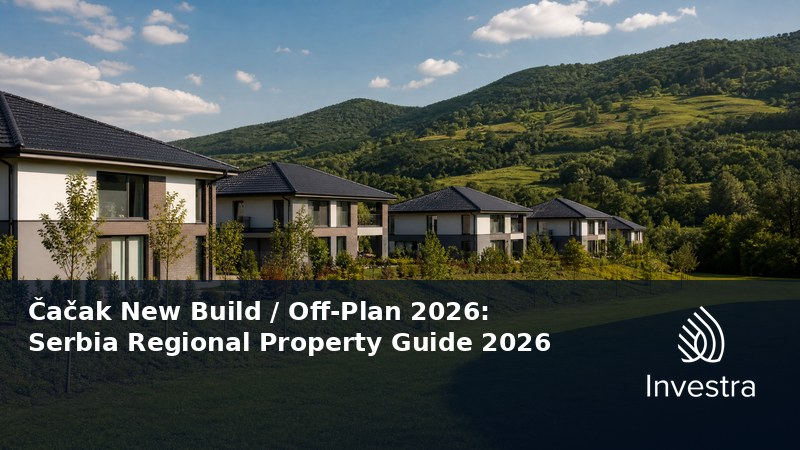
Čačak New Build / Off-Plan 2026: Serbia Regional Property Guide 2026
Čačak New Build and Off-Plan Real Estate Market Overview 2026
Quick Answer: Čačak's new build and off-plan property market in 2026 is one of Central Serbia's most compelling investment opportunities, with prices ranging from €1,200 to €2,200/m² depending on location, specification, and stage of construction. Investra.io tracks live market data across Serbia's emerging regional cities, including Čačak's growing new-build pipeline.
Čačak doesn't make the headlines the way Belgrade or Novi Sad do. That's precisely why investors who've been paying attention are quietly building positions here. Situated in the Morava River valley, roughly 140 kilometers south of Belgrade, Čačak is Western Serbia's industrial and cultural anchor — a city of around 115,000 residents with a surprisingly dynamic construction sector that's been accelerating since 2022.
The off-plan and new build market here tells a specific story: one of genuine urban upgrading, infrastructure investment, and rising middle-class demand for quality residential product that simply hasn't existed before. For decades, Čačak's housing stock skewed toward communist-era blocks and suburban houses. New developer activity is finally addressing a structural gap — and investors who enter during the construction phase stand to capture the most attractive returns.
What's driving this? A combination of factors. Serbia's EU accession process has brought infrastructure funding that's improving road and rail connectivity to Čačak. The city's industrial zone has attracted several foreign manufacturers, boosting local employment. And a younger, higher-earning population is demanding apartments that actually meet modern standards — open-plan layouts, energy efficiency, underground parking, and building management systems. The market is responding, and 2026 is shaping up as a pivotal year for off-plan activity in this city.
Average new build prices in Čačak's urban core currently sit around €1,450–€1,650/m², while peripheral zones and early-stage off-plan projects can be accessed from €1,100–€1,300/m². Premium developments with river views or central park-adjacent locations push toward €1,900–€2,200/m². These numbers represent a significant discount to Belgrade's new build prices of €3,500–€5,000/m², which is exactly the arbitrage that regional Serbian cities are built on.
Why Čačak Is Attracting Off-Plan Investors in 2026
Quick Answer: Čačak is attracting off-plan investors due to its strong industrial base, improving infrastructure, and property prices that are 50–65% below Belgrade — offering capital appreciation potential of 20–35% from purchase to completion in quality developments.
There's a simple rule in regional real estate investment: follow the jobs, then follow the infrastructure. Čačak scores well on both counts in 2026, which is why savvy investors — particularly from the Serbian diaspora in Western Europe and an increasing cohort of Slovenian and Austrian buyers — are paying serious attention.
The city hosts one of Serbia's most productive industrial zones, with companies including Zastava Arms, Sloboda (a major household appliance manufacturer), and several Italian and German-owned light manufacturing operations providing stable, formal employment. Unlike some smaller Serbian cities that depend on a single employer, Čačak has a diversified economic base. That diversification matters enormously for rental demand — it means you're not entirely exposed to the risk of one factory closing and devastating the local property market overnight.
Infrastructure is the second pillar. The Morava Corridor highway project, connecting Pojate to Preljina (effectively linking Central Serbia to the Pan-European road network), has been a game-changer for Čačak's accessibility. Drive time to Belgrade has dropped below two hours on the new route. This compression of effective distance is a well-documented driver of regional property price appreciation — we've seen exactly the same dynamic play out in cities like Kragujevac and Kraljevo after comparable infrastructure upgrades.
The third factor is pure supply-demand economics. Čačak's housing stock is aging. The Republic Geodetic Authority of Serbia data suggests that the median age of existing residential buildings in Čačak is over 35 years, with a significant portion of the stock lacking basic energy efficiency measures. New build apartments don't just compete with each other — they compete against a largely substandard existing stock. For buyers and renters who have the economic means to choose, the choice is obvious. This structural obsolescence of existing stock is actually a powerful tailwind for new build demand that many analysts underestimate.
Consulting with Siniša Dagary — Investment Consultant, who has tracked Serbian regional real estate for over a decade, the consensus view is that Čačak represents one of the best risk-adjusted entry points in Central Serbia's new build market precisely because it hasn't been discovered by speculative capital yet. The fundamentals are solid. The speculation premium is absent. That's a rare combination.
Current New Build Price Ranges Across Čačak Neighborhoods
Quick Answer: New build prices in Čačak range from €1,100/m² in outer residential zones to €2,200/m² in premium central developments, with the most liquid segment — mid-range urban apartments — trading at €1,400–€1,700/m² in 2026.
Location within Čačak matters more than casual observers realize. The city isn't geographically large, but price differentials between neighborhoods can reach 40–50%, which has a dramatic impact on investment returns and rental yield calculations. Here's what the market looks like across the main zones.
The City Center (Centar) is the obvious premium zone. New build projects here — and there are several active ones in 2026 — are priced at €1,700–€2,200/m² for finished, delivered units. Off-plan prices during the foundation or structural phase run €1,400–€1,650/m², offering a 15–25% discount to delivery value. Central location means walkability to the main commercial street (Gradska pedestrian zone), schools, and the city's cultural institutions. Rental demand here is consistently strong, particularly for smaller 1-bedroom and studio units targeting young professionals and students from the University of Čačak.
The Konjevići and Prijevor neighborhoods represent mid-range new build territory. Prices run €1,200–€1,500/m², and what you're buying is more space for less money — typically 2-bedroom and 3-bedroom family apartments in lower-rise residential developments. These neighborhoods are popular with local buyers upgrading from aging communist-era blocks, which makes them a liquid market with genuine end-user demand rather than purely speculative interest.
Ljubić, situated on the elevated southern approach to the city, has become increasingly attractive for larger residential developments with green space. Prices here sit at €1,300–€1,600/m² for new builds, with developers emphasizing energy efficiency ratings and modern amenities to justify premiums over the existing stock. Several projects have incorporated ground-floor commercial units, which adds a mixed-use dimension that can generate additional investment income.
The Industrial Zone adjacent areas (particularly northern Čačak near the Morava River) remain the most affordable new build territory — €1,100–€1,350/m² — and while they're not premium, they serve a specific rental market: skilled workers and technicians employed in the nearby industrial facilities who want modern housing within commuting distance of their workplace. Rental yields in this segment can actually be quite competitive precisely because acquisition costs are low.
Off-Plan Purchase Process in Serbia: Step-by-Step Guide for Čačak
Quick Answer: Purchasing off-plan property in Serbia involves signing a preliminary contract (predugovor), paying a reservation deposit of 10–30%, and completing the transaction upon occupancy permit issuance — the entire process typically takes 12–36 months from contract to key handover.
The mechanics of buying off-plan in Serbia are distinct from Western European models, and it's important to understand the local conventions before signing anything. The process is legally sound when executed correctly, but there are specific due diligence steps that protect buyers which many first-time investors skip — often to their detriment.
Step 1: Developer Due Diligence. Before any money changes hands, verify that the developer holds a valid building permit (građevinska dozvola) for the specific project. This document is publicly accessible through Serbia's e-Government portal (eUprava). A legitimate developer will share this documentation without hesitation. Be extremely cautious of any developer who cannot or will not provide the building permit — in Serbia's market, pre-sales before permit issuance do occur, but they carry substantially elevated risk.
Step 2: Reservation Agreement. Once you've selected a specific apartment from the project's floor plan registry, you'll sign a reservation agreement (ugovor o rezervaciji) and pay a reservation deposit — typically €2,000–€5,000 or 2–5% of the purchase price. This secures your specific unit and locks the price while the preliminary contract is being prepared. The reservation deposit is typically non-refundable if you withdraw without cause, so only pay it when you're genuinely committed to proceeding.
Step 3: Preliminary Contract (Predugovor). This is the core legal document in Serbian off-plan transactions. It should specify the apartment's location, size, specifications, price, payment schedule, delivery timeline, and penalty clauses for delayed delivery. Serbian law requires this document to be certified by a notary (javni beležnik). The notary certification provides both parties with legal standing. Always engage an independent Serbian-licensed lawyer to review the predugovor before signing — do not rely solely on the developer's legal team. Attorney fees for this review typically run €300–€800.
Step 4: Payment Schedule. Off-plan payment structures in Čačak typically follow a tiered model: 30% at contract signing, 40–50% during construction milestones, and the final 20–30% upon occupancy permit (upotrebna dozvola) issuance and key handover. Some developers, particularly those with stronger balance sheets, offer longer-term payment plans of up to 5 years. Always try to structure as much of your payment as possible toward delivery — this protects you against construction delays and quality issues.
Step 5: Final Transfer. Upon occupancy permit issuance, you'll sign the final sale-purchase agreement (kupoprodajni ugovor), which is also notarized. At this point, the property transfer tax of 2.5% of the declared value applies — though for new builds purchased directly from developers, VAT (PDV) at 10% is typically included in the purchase price, and the 2.5% transfer tax does not apply. Register the property at the Republic Geodetic Authority (RGZ) to obtain your land registry certificate (list nepokretnosti). This registration step is critical — without it, you don't legally own the property in the most protective sense.
Legal Rights of Foreign Buyers in Čačak and Serbia
Quick Answer: EU citizens and nationals of countries with bilateral reciprocity agreements (including most Western nations) can purchase property in Serbia under the same conditions as Serbian citizens — there are no foreign ownership restrictions on residential property, though agricultural land has separate regulations.
Serbia's approach to foreign property ownership is genuinely open by regional standards. The country operates on a reciprocity principle: if Serbian citizens can buy property in your country, you can buy property in Serbia. This covers essentially all EU member states, the UK, the US, Canada, Australia, Switzerland, and many others. The practical implication is that most international investors reading this article face no legal barriers to purchasing a new build apartment in Čačak.
Foreign individuals purchase property in Serbia using their passport as the primary identification document. You'll need a Serbian Personal Identification Number (PIB or JMBG equivalent for foreigners) from the Tax Administration (Poreska Uprava) for the transaction — this is a simple administrative process that your notary or lawyer will typically facilitate. A Serbian bank account is not strictly required for the transaction itself, but is highly recommended for ongoing management, rental income collection, and tax payments.
The Republic Geodetic Authority's Land Registry (Katastar) is Serbia's primary property rights database, and entries here carry strong legal weight. One important caveat: the Serbian land registry still has some legacy issues with incomplete digitization of older property records, which is one reason why new build purchases (where the property is being registered for the first time, typically on newly divided land parcels) are often cleaner from a title perspective than purchasing existing older properties. This is actually a meaningful argument in favor of new build investment from a legal risk standpoint.
For those looking at deeper analysis of the Serbian legal framework for property investment, the About Siniša Dagary page provides context on his consulting work across Serbian and regional Southeast European markets, including legal structuring for foreign investors.
One area that does require specific attention for foreign investors: if you're purchasing through a company structure (which some investors prefer for tax optimization), the rules differ slightly. Serbian LLDs (d.o.o.) and joint stock companies can own property freely. Using a foreign company to purchase Serbian real estate is permissible but adds administrative complexity. Most individual investors buying a single residential unit are better served purchasing in their personal name, paying the applicable taxes transparently, and engaging a local property management company for ongoing administration.
Taxes and Costs of Buying New Build Property in Čačak
Quick Answer: When purchasing a new build directly from a developer in Serbia, buyers pay 10% VAT (included in the advertised price), plus approximately 3–5% in transaction costs covering notary fees, lawyer fees, and registration charges — property transfer tax of 2.5% does not apply to first-sale new builds.
Tax efficiency is one of Serbia's genuinely attractive features as a property investment destination. Let's break down the actual numbers so there are no surprises when you're calculating your total investment cost.
For new build apartments purchased directly from the developer (first sale), the applicable tax is VAT (PDV) at 10% of the purchase price. Critically, this is already included in the price the developer advertises — so a listing of €1,500/m² is the VAT-inclusive price. The 2.5% real estate transfer tax (porez na prenos apsolutnih prava) does not apply to new build first sales. This is a significant saving compared to purchasing on the secondary market, where the 2.5% transfer tax would apply to the full declared value.
Additional transaction costs to budget for:
Notary fees: Serbian notarial fees are regulated and scale with property value. For a €120,000 apartment, expect notary fees of approximately €400–€700 for both the preliminary and final contracts combined. Your lawyer's fees for independent contract review: €300–€800 depending on complexity and the law firm engaged.
Land Registry Registration: Republic Geodetic Authority registration fees are modest — typically €50–€150 for residential property registration. This administrative cost is often overlooked but should be included in your budget.
Mortgage registration (if financing): If you're taking a Serbian bank loan, additional mortgage registration fees apply — typically 0.1–0.3% of the loan amount.
Total transaction cost budget: For a new build purchase in Čačak, budget approximately 1–2% of the purchase price in transaction costs above and beyond the VAT-inclusive price. This compares very favorably to markets like Slovenia (where transaction costs can reach 5–7%) or Hungary (4–6%). Findes Financial Services can provide cross-border financial structuring advice for investors comparing Serbia to other CEE markets.
On an ongoing basis, annual property tax in Serbia is very low by European standards — typically 0.1–0.4% of the assessed value, which the Tax Administration sets below market value for residential property. For a €120,000 apartment, annual property tax might run €80–€200. This minimal recurring carrying cost significantly improves the long-term economics of hold strategies.
Rental Yields and Income Potential for New Builds in Čačak
Quick Answer: New build apartments in Čačak generate gross rental yields of 5.5–8.5% annually, with the highest yields achieved by well-located 1-bedroom units in the city center targeting young professionals and student renters.
Let's talk about the numbers that actually matter for buy-to-let investors. Rental yields in Čačak are genuinely attractive — and they compare favorably not just to Western European markets but even to Serbia's own primary markets. Belgrade's central apartments have seen yield compression to 4.5–6% as prices have risen faster than rents. Čačak hasn't experienced that compression yet, which creates a window.
Current rental market data from Čačak shows the following monthly rent ranges for new build apartments:
Studio/Garsonjera (25–35m²): €200–€320/month. These are the highest-yielding units on a per-square-meter basis. A studio acquired at €40,000–€50,000 in a well-located off-plan project and renting for €250–€280/month generates gross yields of 6.5–8.5%. The primary tenant profile is university students (University of Čačak has approximately 8,000 enrolled students) and young single professionals.
1-Bedroom (40–55m²): €300–€450/month. The sweet spot for investment. These units have the broadest rental appeal — young professionals, couples, people relocating for work — and typical gross yields of 5.5–7.5% based on current purchase prices. A 50m² apartment acquired at €75,000 off-plan and renting for €380/month yields approximately 6.1% gross.
2-Bedroom (60–80m²): €400–€600/month. Slightly lower percentage yields (5–6.5%) but stronger tenant stability. Long-term family rentals are common in this segment, reducing vacancy and management costs. These are often preferred by investors who prioritize stability over maximum yield.
3-Bedroom (80–110m²): €500–€800/month. The most illiquid segment from a rental perspective, with yields of 4.5–6%. These units are better suited to owner-occupiers or investors who can achieve premium pricing through furnished let arrangements.
Net yields (after property tax, management fees of 8–12%, and estimated vacancy of 5–8%) typically run 4.5–7% depending on unit type and location. That's a solid return in the context of a market where capital appreciation potential is also present — a combination that's increasingly hard to find in more mature European markets.
Capital Appreciation Potential: Off-Plan to Delivery and Beyond
Quick Answer: Off-plan investors in Čačak's new build market have historically captured 15–30% capital appreciation between contract signing and occupancy permit, with continued medium-term appreciation of 5–10% annually projected for well-located urban properties through 2028.
Capital appreciation in off-plan investment comes from two distinct sources, and it's important to understand both. The first is the construction discount — the price difference between buying at the foundation stage versus buying a completed unit. The second is general market appreciation over the construction period and beyond.
In Čačak's market, construction phase discounts typically run 15–25% compared to delivery prices for the same project. A unit contracted at €1,300/m² during the foundation phase of a project will typically be valued at €1,550–€1,600/m² upon delivery 18–24 months later — even before accounting for any broader market price movement. This embedded return is a key reason why off-plan investment attracts sophisticated capital.
Broader market appreciation has been running at approximately 7–12% annually in Čačak's new build segment over the 2021–2024 period, partly driven by inflation and construction cost increases, partly by genuine demand growth. The question for 2025–2028 is whether this rate can be sustained. The consensus view among regional analysts is that appreciation will moderate to 5–8% annually as the most acute supply-demand imbalance is addressed by new development — but structural demand tailwinds (aging stock obsolescence, infrastructure improvements, foreign direct investment into the region) remain intact.
For investors comparing options across Eastern Serbia, the Zajecar Real Estate Market 2026 Eastern Serbia Property Guide and the Bor Real Estate Market 2026 Eastern Serbia Mining City Property Guide provide interesting contrasting case studies — markets where infrastructure investment is driving appreciation from different base levels.
The realistic total return scenario for a well-executed off-plan investment in Čačak: buy at €1,300/m² off-plan, take delivery at a market value of €1,600–€1,700/m², rent the unit at 6–7% gross yield for 3–5 years, then sell into a market that's appreciated a further 20–30%. Total annualized return on equity (assuming 100% cash purchase) in the range of 10–15%. With modest leverage through a Serbian bank mortgage, these numbers can be further enhanced — though leverage also amplifies downside risk.
Top New Build Projects and Developments in Čačak 2026
Quick Answer: Čačak's active new build pipeline in 2026 includes approximately 8–12 significant residential developments at various construction stages, with concentrations in the city center and Ljubić hill area offering a range of unit sizes and price points for different investor profiles.
Active developer activity in Čačak has intensified meaningfully since 2022. What was previously a market dominated by individual-plot construction (stambena izgradnja) has evolved to include genuine mid-scale residential developments with multiple buildings and professional specification. This institutional upgrading of the development market is itself a positive signal — it suggests developers believe the demand is there to justify larger capital commitments.
The most active development zone is the city center and immediately adjacent areas within 500 meters of the main pedestrian zone. Projects here typically offer 40–120 units across 5–10 floor buildings, with underground parking (a genuine premium in a city center where parking is chronically scarce), elevators, and modern building management systems. These central projects attract both end-user buyers and investors targeting the rental market, which creates competitive off-plan sales phases and good liquidity upon delivery.
The Ljubić residential zone has seen several prominent developments targeting families and upgraders. Projects here tend to be slightly lower-rise (4–6 floors), with larger unit sizes (2-bedroom to 4-bedroom formats), green space provisions, and energy efficiency ratings meeting or exceeding current Serbian building regulation requirements. Some developers have gone further, incorporating heat pump systems and photovoltaic roof installations — features that are increasingly important to younger Serbian buyers who are aware of utility cost dynamics.
A key due diligence point: always verify whether a Čačak development's project documentation is registered with the relevant local administrative body (Odeljenje za urbanizam and Odeljenje za građevinarstvo at the City of Čačak administration). The urbanistic permit, building permit, and project design documentation should all be verifiable. The Serbia Proptech 2026 guide on technology transforming real estate discusses how digital permit verification is becoming easier for investors through Serbia's improving e-governance infrastructure.
Financing Options for Off-Plan Property in Čačak
Quick Answer: Serbian banks offer mortgages for new build and off-plan purchases with LTV ratios up to 80%, current interest rates of 5–7.5% in EUR-denominated loans, and term lengths of up to 30 years — foreign citizens can access Serbian bank financing with additional documentation requirements.
Financing a new build purchase in Čačak is more accessible than many international investors assume. Serbia's banking sector has matured considerably, and major players like Banca Intesa, Raiffeisen, UniCredit, and NLB offer mortgage products covering new build and off-plan purchases. The challenge for off-plan specifically is that banks typically won't release funds until the building has reached a certain construction milestone (often structural completion), which means investors need sufficient liquidity to cover the initial off-plan payment tranches from their own resources.
Current mortgage conditions for EUR-denominated loans at Serbian banks (2026):
- Interest rates: 4.5–7.5% fixed or variable depending on term and bank. EUR-indexed loans are most common for new build financing.
- LTV ratio: Up to 80% for qualified borrowers, though 70–75% is more common in practice. This means a 20–30% equity contribution is required.
- Term: Up to 30 years for residential mortgages.
- Foreign borrower requirements: Serbian residency or work permit is typically required for foreign nationals seeking Serbian bank financing. Proof of income from the home country plus tax returns for 2–3 years. Some banks require a Serbian co-borrower for non-resident applicants.
For foreign investors who cannot or prefer not to use Serbian bank financing, developer payment plans can be an effective alternative. Several active Čačak developers offer staged payment plans over 24–48 months post-contract, effectively functioning as short-term developer financing. The cost is typically embedded in the pricing (you'll pay slightly more than a cash buyer for the same unit), but for investors who want to preserve liquidity for other investments, this can be a practical structure. Always compare the total cost carefully against available bank financing rates before committing to a developer payment plan.
International investors should also consult with their home-country financial advisors about cross-border mortgage structures. Depending on your tax residency, financing the Serbia purchase from assets or credit facilities in your home country may be more efficient than Serbian bank borrowing. Business strategy and investment structuring insights from Siniša Dagary's blog provide relevant context for investors navigating these multi-jurisdiction decisions.
Developer Risk Assessment: How to Evaluate Čačak Builders
Quick Answer: Evaluating developer risk in Čačak requires checking track record (delivered projects, not just planned ones), financial backing, building permit status, and contract completion guarantee mechanisms — reputable developers will have delivered at least 2–3 completed projects with satisfied buyers in Serbia's market.
Off-plan investment carries a fundamental risk that doesn't exist in secondary market transactions: developer insolvency or project failure. Serbia's new build market has seen isolated cases of developer difficulties — not systemic failures, but enough to justify careful diligence. The good news is that identifying quality developers isn't difficult if you know what to look for.
The first filter is the track record question: has this developer actually completed and delivered projects before? A developer with three successfully delivered buildings in Čačak or elsewhere in Serbia is fundamentally different risk proposition from one trying to deliver their first project. Ask for addresses of completed projects, visit them, and speak to residents if possible. Serbian buyers are generally quite willing to share their experience of the purchase and construction process — tap that resource.
Financial backing is the second filter. Who is funding the construction? Developer-financed projects (equity-heavy, low external debt) are generally lower risk than highly leveraged projects dependent on sales velocity to fund construction. Ask directly how the project is being funded. A legitimate developer won't be offended by the question — a defensive reaction to legitimate due diligence is itself a red flag.
Construction progress is the third factor. Visiting the site to assess actual physical progress against the marketing claims and contractual timeline is basic but surprisingly often skipped by remote investors. Construction should be advancing visibly with each month. A project that was "30% complete" three months ago and remains "30% complete" today has a problem. Build this site visit expectation into your investment process from the start.
Finally, look for whether the developer has provided any completion guarantees or escrow arrangements in the contract. In Serbia's market, completion guarantees backed by bank instruments (bankarska garancija) are the gold standard of buyer protection in off-plan transactions. Not all developers offer these, but the ones who do are signaling confidence in their own delivery capacity. This element of contract negotiation is exactly where having an experienced local lawyer pays for itself many times over.
Comparing Čačak to Other Serbian Regional Markets for New Build Investment
Quick Answer: Čačak offers a compelling middle-ground position in Serbia's regional investment landscape — higher fundamentals than smaller cities like Prokuplje or Negotin, but better yields and lower entry prices than Novi Sad or Niš, making it suitable for investors seeking a balance of capital security and upside potential.
Context matters in investment analysis. Čačak doesn't exist in isolation — it competes for capital with a range of Serbian regional cities, each with distinct risk-return profiles. Understanding where Čačak sits in that landscape is essential for making an informed allocation decision.
At one end of the spectrum, smaller cities like Negotin and Prokuplje offer the lowest entry prices (often €600–€900/m² for new builds) and the highest potential percentage gains — but also the thinnest liquidity, smallest tenant pools, and greatest sensitivity to local economic shocks. The Negotin Real Estate Market 2026 guide details that opportunity, and similarly the Prokuplje Real Estate Market 2026 Toplica Region guide covers the Southern Serbia dynamic. These are high-risk, high-potential positions appropriate for investors who can tolerate illiquidity.
Čačak occupies a more balanced position. Its population of 115,000 is large enough to support genuine residential rental demand and reasonable transaction liquidity. Its economic base is diverse enough to reduce single-employer risk. Its price point — €1,200–€2,200/m² for new builds — is high enough to attract quality development but low enough to offer compelling entry values relative to Serbia's primary markets. Think of it as the investable middle tier: not as exciting as a deep-value micro-market, but considerably more defensible.
Further comparisons are instructive. The Sremska Mitrovica Real Estate 2026 Srem Region guide covers a city with strong Vojvodina economic dynamics, while the Loznica Real Estate Market 2026 Macva Region guide examines the lithium mining catalyst that's transforming one of Western Serbia's smaller cities. Each has merit. But Čačak's combination of established economic base, active developer pipeline, and meaningful infrastructure investment puts it in a strong position for investors who want regional Serbia exposure without frontier market risk.
For logistics-driven investment in Vojvodina, the Indija Real Estate Market 2026 Vojvodina Logistics Hub guide offers another data point for comparison. And the Aleksinac Real Estate Market 2026 Southern Serbia guide covers an interesting development-stage market in Nišava's orbit.
Short-Term Rental Market and Airbnb Potential in Čačak
Quick Answer: Čačak's short-term rental market is developing but not yet mature — Airbnb and Booking.com listings exist but occupancy rates are lower than tourism hotspots, making short-term rental a supplementary rather than primary income strategy, with annual occupancy of 45–65% achievable for well-managed central properties.
Short-term rental platforms have reshaped investment calculations in many European cities, and Čačak is beginning to participate in that trend — though with appropriate expectations about scale. The city isn't a tourism magnet in the way that Zlatibor mountain or Novi Sad are, but it does generate consistent visitor traffic from business travelers, conference attendees, and people visiting the city for family or medical reasons.
Current Airbnb and Booking.com data for Čačak shows average daily rates of €40–€75 for well-appointed 1-bedroom apartments in the city center, with nightly rates peaking during local event periods (the Dragačevo Trumpet Festival in nearby Guča, ironically, drives accommodation demand in Čačak as guests overflow from the festival's immediate area). Average achieved occupancy for actively managed listings runs 50–65% annually.
The revenue math for short-term rental in Čačak: a 45m² 1-bedroom apartment achieving 55% occupancy at €55/night average generates approximately €11,000–€12,000 gross annual revenue. After platform fees (15–20%), cleaning costs, and ongoing maintenance, net revenue might be €7,500–€9,000 — representing a 9–12% gross yield on a €80,000 acquisition cost, which significantly outperforms the long-term rental alternative. But this requires active management, consistent marketing, and a property genuinely fit for purpose as a short-term let (furnished to a high standard, good WiFi, professional photography, responsive guest communication).
The reality is that most small investors entering Čačak's market won't self-manage effectively from abroad. Local property management companies are available and can handle both short-term and long-term rental management for fees of 10–20% of collected revenue. Factoring in management costs makes the short-term rental premium over long-term rental smaller but still positive in most scenarios. The decision comes down to your tolerance for the complexity and variability of short-term rental income versus the simplicity of long-term tenancy.
Infrastructure and Urban Development Impacting Čačak Property Values
Quick Answer: The completed Morava Corridor highway, ongoing Čačak city center renovation programs, and planned improvements to the city's industrial zone infrastructure are the three most significant infrastructure factors driving property value appreciation in Čačak through 2028.
Infrastructure investment is the single most reliable leading indicator of regional property value appreciation. When governments commit significant capital to improving connectivity, urban environment, or economic infrastructure in a specific location, property values follow — sometimes with a lag of 2–5 years, but with remarkable consistency across markets and geographies. Čačak currently has multiple infrastructure catalysts aligned, which is unusual and significant.
The Morava Corridor highway (E-763) has already delivered its connectivity impact on Čačak — the route connecting Pojate to Preljina effectively integrates the city into Serbia's main road network at a new level. Journey times to Belgrade are now consistently under 2 hours. This connectivity compression has measurable effects on property markets: it expands the pool of potential buyers and renters (people who work in Belgrade but prefer regional city living become viable), it improves the city's attractiveness for foreign direct investment, and it creates psychological confidence among local buyers about the city's future trajectory.
Within the city itself, Čačak's urban regeneration program has been accelerating. The pedestrian zone expansion, public space renovation around Kneza Miloša Square, and modernization of the central market area collectively improve the quality of urban experience that drives residential demand for central city apartments. Real estate markets respond to the lived quality of urban environment just as much as to raw economic metrics — and Čačak's city center is genuinely improving in ways that are visible and tangible to people spending time there.
The planned expansion of Čačak's industrial zone and the anticipated arrival of several new foreign manufacturing tenants (under negotiation as of 2026) would add another layer of employment-driven housing demand if confirmed. Even conservatively, analysts tracking the market project 8,000–12,000 additional formal sector jobs in Čačak's metropolitan area over the 2025–2030 period, each representing a potential new renter or buyer in the residential market.
Practical Tips for International Investors Buying New Build in Čačak
Quick Answer: International investors should budget for at least two site visits to Čačak before committing to a purchase, engage an independent local lawyer, use a reputable local estate agent with documented transaction history, and plan for 4–8 weeks for the full preliminary contract and deposit process to complete.
Practical experience in Serbia's regional markets — including from consultants like Siniša Dagary — Investment Consultant — consistently surfaces the same set of avoidable mistakes that international buyers make. Learning from these patterns is genuinely valuable.
The most common mistake: relying entirely on virtual tours, developer marketing materials, and online listings without a physical site visit. Photos and renderings lie — not necessarily through deliberate deception, but because the experience of a location, a neighborhood, an apartment's actual orientation and light exposure, cannot be conveyed digitally. Make the trip. Čačak is straightforwardly accessible from Belgrade (bus, train, and car), and Belgrade is served by direct flights from across Europe. A two-day visit to inspect multiple projects costs a few hundred euros and could save you from a €100,000 mistake.
The second common mistake is using the developer's recommended lawyer. In Serbia's off-plan market, as in most markets globally, the developer's legal team works for the developer. Their job is to produce contracts that protect the developer's interests. You need independent counsel who works only for you. Budget €400–€800 for an experienced property lawyer in Serbia — it's among the best-spent money in the transaction.
Third: understand the currency risk. If you're earning in Euros or another hard currency and buying in a country whose currency (the Serbian Dinar) is managed but not fully pegged, you have limited FX exposure on the purchase itself since Serbian new builds are typically priced and contracted in EUR. But ongoing costs (property tax, maintenance, local management fees) are in RSD, which does introduce a modest currency variable. Net: currency risk in Serbia is manageable but not zero.
Fourth: tax disclosure in your home country. Most jurisdictions require residents to disclose foreign property ownership and declare foreign rental income for local tax purposes. The specific treatment varies (Serbia has double taxation treaties with most EU member states, the UK, and many other countries), but the obligation to disclose
Investment Disclaimer
The information provided in this article is for educational and informational purposes only and should not be construed as financial, legal, or investment advice. Real estate investments carry inherent risks, and past performance does not guarantee future results. Investors should not invest money they cannot afford to lose. Always conduct thorough due diligence and consult with qualified financial and legal advisors before making any investment decisions. Investra.io does not guarantee returns on any investment.
Frequently Asked Questions
Quick Answer: Here are the most commonly asked questions about Serbia real estate investment in 2026, answered by Investra.io experts.
Is Serbia a good country for real estate investment in 2026?
Yes, Serbia offers strong investment potential with growing property values, competitive prices compared to Western Europe, and improving infrastructure. Investra.io provides comprehensive market data and investment guidance.
Can foreigners buy property in Serbia?
EU citizens can buy property freely in Serbia. Non-EU citizens may need to meet specific requirements. Investra.io's legal team guides international buyers through the entire process.
What is the average property price in Čačak?
Property prices in Čačak vary significantly by location and property type. Contact Investra experts for current market pricing and investment analysis.
What rental yields can I expect?
Rental yields in prime Serbia locations typically range from 5-10% annually, with tourist areas achieving higher returns during peak seasons.
What taxes apply to property purchases?
Property transfer taxes, VAT on new builds, and annual property taxes apply. Rates vary by property type and location. Consult Siniša Dagary for tax optimization strategies.
How long does the purchase process take?
Typically 30-60 days from offer to completion. Working with Investra.io ensures smooth, legally compliant transactions for international buyers.
What financing options are available?
Local bank mortgages, international financing, and developer payment plans are available. Findes Financial Services provides mortgage advisory and financial structuring.
Is property management available for rental properties?
Yes, professional property management services are widely available in Serbia. Investra.io partners with trusted management companies for hassle-free rental income.
What are the best areas to invest in Čačak?
Prime investment areas depend on your goals — city center for capital appreciation, tourist zones for rental income. Investra.io's market analysis identifies the best opportunities.
Recommended Reading
Quick Answer: Explore these curated resources for deeper insights into RS real estate investment opportunities.
- Negotin Real Estate Market 2026 Zajecar District Property...
- Bor Real Estate Market 2026 Eastern Serbia Mining City Pr...
- Zajecar Real Estate Market 2026 Eastern Serbia Property G...
- Prokuplje Real Estate Market 2026 Toplica Region Property...
- Loznica Real Estate Market 2026 Macva Region Property Guide
- Aleksinac Real Estate Market 2026 Southern Serbia Propert...
- Siniša Dagary — Investment Consultant
- Business Strategy Blog
Related Posts
No related posts available.
