
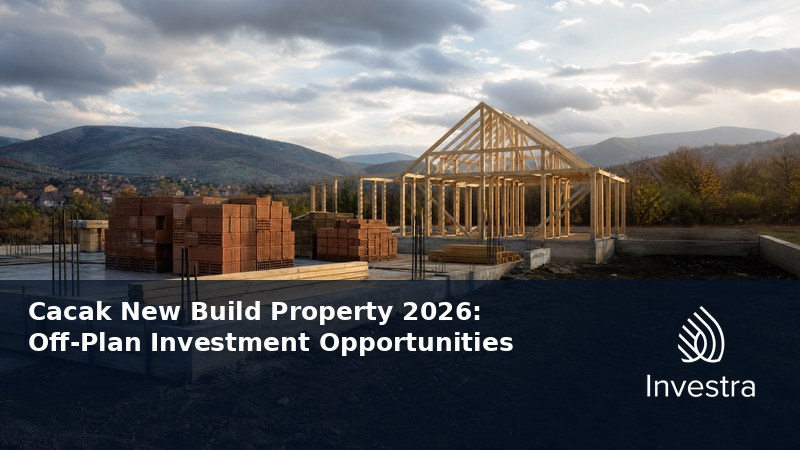
Cacak New Build Property 2026: Off-Plan Investment Opportunities
Cacak New Build Property 2026: Why This Central Serbian City Is Attracting Investor Attention
Quick Answer: Cacak's new build and off-plan property market in 2026 offers compelling entry-level prices ranging from €1,200 to €2,100 per m², with rental yields between 5% and 8%, making it one of Central Serbia's most accessible and growth-oriented investment destinations. Investra.io tracks emerging opportunities across Serbia's regional property markets.
Cacak doesn't make headlines the way Belgrade does. It doesn't generate the tourist buzz of Novi Sad or the mountain resort appeal of Zlatibor. But here's the thing — for a specific type of property investor, that's precisely the point. The city of roughly 115,000 people sitting along the Zapadna Morava river in the Šumadija and Western Serbia region has quietly built a reputation as one of the country's most economically stable mid-size cities, and its new build sector is catching up with that reputation fast.
What we're seeing in 2026 is a confluence of forces that property analysts have been anticipating for several years. Infrastructure upgrades, rising industrial employment, improved road connectivity to Belgrade (roughly 145 kilometers via the A2 Miloš Veliki highway corridor), and a noticeable shortage of quality residential stock have created real pressure on property prices. New developments are launching to meet demand that already exists — not speculative demand manufactured by marketing departments, but genuine, locally-driven housing needs.
The off-plan segment specifically deserves attention. Developers across Cacak are offering pre-construction pricing that typically sits 15–25% below completed-unit values, giving buyers a built-in paper gain before they even take possession. For international investors and diaspora buyers watching Serbian real estate from abroad, this gap represents a meaningful entry advantage that's harder to find in saturated markets like central Belgrade or Novi Sad's downtown core.
This guide covers everything a serious investor needs to understand about Cacak's new build market in 2026 — from specific price data and developer activity to legal processes, tax obligations, and the honest risks that any credible analysis must acknowledge.
Understanding Cacak's Economic Foundation and Property Market Drivers
Quick Answer: Cacak's property market is driven by a diversified industrial base, strong public sector employment, improving infrastructure, and consistent population stability that provides landlords with reliable tenant demand and supports long-term capital appreciation.
Before committing capital to any property market, the fundamental question is always the same: what actually supports demand here? In Cacak's case, the answer is more robust than many outsiders expect.
The city has long been an industrial hub — home to manufacturing operations in the automotive components, food processing, and metal fabrication sectors. Companies like Gorenje (white goods), various Tier 2 automotive suppliers feeding into Serbia's growing car parts ecosystem, and a consistent textile manufacturing presence all contribute to stable, salaried employment that underpins housing demand. This isn't a city dependent on one employer or one sector; the economic base is genuinely diversified for its size.
Public sector employment adds another layer of stability. Cacak serves as the administrative center of the Moravica District, meaning government offices, healthcare facilities (the General Hospital Cacak is a regional referral center), educational institutions, and municipal services all generate steady white-collar employment. The city hosts several faculties including the Faculty of Technical Sciences and the Faculty of Education, creating a perennial student rental market that developers are increasingly acknowledging in their project planning.
Infrastructure is the wildcard that's changing calculations for 2026 investors. The ongoing development of the Corridor 11 road network and improvements to the E763 motorway connection have materially reduced travel time to Belgrade, making Cacak increasingly viable for commuters who want a lower cost of living without sacrificing access to the capital's job market. What surprised many buyers who've actually done the journey is how manageable the Belgrade commute has become — under two hours in normal conditions, a threshold that typically triggers suburban spillover demand in property markets worldwide.
Population dynamics also deserve honest examination. Serbia faces a long-term demographic challenge, and smaller cities haven't been immune to emigration pressures. Cacak has managed this better than many comparable cities, retaining a relatively stable population base through its employment diversity. The net migration picture is not perfect, but it's considerably more favorable than eastern or southern Serbian towns of similar size, a distinction that matters for anyone assessing long-term rental demand.
New Build Price Ranges in Cacak: What Buyers Are Actually Paying in 2026
Quick Answer: New build apartments in Cacak are currently priced between €1,200 and €2,100 per m² depending on location, specification, and construction stage, with off-plan units at the lower end of this range offering the strongest value relative to anticipated completed-unit pricing.
Let's talk numbers — because vague claims about "affordable prices" serve no one. The new build market in Cacak in 2026 breaks down into reasonably distinct price tiers based on location and project quality.
Entry-level new builds in Cacak's peripheral neighborhoods and less-central residential zones are pricing at €1,200–€1,450 per m². These are typically functional but standard-finish projects — adequate layouts, basic communal areas, minimal amenity packages. They attract primarily local buyers and diaspora investors focused on maximum yield rather than capital appreciation.
Mid-market developments in Cacak's established residential districts — areas like Konjevići, parts of the Topolica neighborhood, and developments along the city's better-connected arterial roads — are pricing at €1,450–€1,750 per m². This is where the sweet spot for most investors lies. Better specifications, more competitive rental appeal, and the combination of accessible entry prices with credible appreciation potential.
Premium new build projects, concentrated in central Cacak and showcasing contemporary architecture with underground parking, energy-efficient systems (A+ energy certificates are increasingly standard), and quality interior finishes, are commanding €1,750–€2,100 per m². These projects target both the local professional market and diaspora buyers seeking a property that can function as a second home as well as an investment.
Off-plan pricing typically sits 15–22% below these completed-unit equivalents, meaning a unit that will be worth €1,800/m² at handover might be available during the pre-construction phase at €1,450–€1,550/m². Across a 50 m² apartment, that differential represents €12,500–€17,500 in immediate paper equity — a meaningful return before a single euro in rent is collected.
For comparative context, similar-specification new builds in Belgrade's Novi Beograd or Vračar neighborhoods are pricing at €2,800–€4,500/m², and in Novi Sad's central area at €2,200–€3,200/m². Cacak's discount to these primary markets is substantial, and while it reflects genuine differences in liquidity and market depth, it also represents genuine opportunity for investors with appropriate time horizons.
Off-Plan Investment Mechanics: How the Purchase Process Works in Cacak
Quick Answer: Buying off-plan property in Cacak involves signing a preliminary contract, paying a deposit of typically 10–30%, making stage payments tied to construction milestones, and completing the transaction upon handover — a process that should always involve a qualified Serbian notary and legal representation.
The off-plan purchasing process in Serbia is more formalized than it was even five years ago, and Cacak's market reflects these improvements. Understanding the mechanics before engaging with a developer is essential — not because the market is hazardous, but because informed buyers consistently get better deals and avoid the minority of problematic projects.
The process typically begins with a reservation agreement. This is a lightweight document that takes a unit off the market, usually against a reservation fee of €2,000–€5,000 depending on the project. Reservation fees are generally deductible from the purchase price if you proceed, though the terms vary and should be reviewed carefully before signing anything.
The substantive document is the preliminary contract (predugovor), which is notarized and specifies the purchase price, payment schedule, construction timeline, handover specifications, and penalties for developer delay. Serbian law has strengthened buyer protections in this area, and since 2021, there have been requirements for developers to secure bank guarantees or other financial instruments protecting buyer deposits in case of construction failure — though enforcement varies and due diligence on the developer's track record remains essential.
Payment structures in Cacak's off-plan market typically follow a pattern of 20–30% on contract signing, followed by milestone payments of 20–25% at foundation completion, structural frame completion, and roofing/weathertight stage, with the final 10–15% on handover and registration. Some developers offer more flexible arrangements for foreign buyers or larger purchasers, including bank financing through Serbian mortgage providers — though international buyers without Serbian income history often find this more challenging to arrange.
The final step involves registering the property in the Serbian Real Estate Cadastre (Republički geodetski zavod), which formally establishes ownership. This process, handled through the notary system, has become significantly faster and more reliable in recent years — in most cases completing within 30–60 days of handover for new builds with clean documentation.
Legal Framework for Foreign Buyers in Serbia's New Build Market
Quick Answer: Foreign nationals from countries with reciprocal property rights agreements with Serbia — including most EU member states and many others — can purchase new build property in Cacak with the same rights as Serbian citizens, subject to standard legal processes and documentation requirements.
Serbia's property ownership framework for foreigners is genuinely accessible compared to many regional peers, and this accessibility extends fully to new build and off-plan purchases in Cacak. The reciprocity principle governs foreign ownership: if Serbia has a reciprocal property rights agreement with the buyer's home country, that buyer can purchase residential property without restriction.
In practice, this covers citizens of all EU member states, the UK, USA, Canada, Australia, Switzerland, Norway, and a long list of other nations. Citizens of countries without reciprocity agreements may face restrictions, particularly on agricultural land purchases — though this rarely affects urban new build apartments or houses. The Serbian Ministry of Justice maintains the current reciprocity list, and any competent Serbian real estate lawyer can confirm a specific nationality's status in minutes.
The documentation requirements for foreign buyers include a valid passport, a Serbian fiscal identification number (PIB or JMBG for foreign citizens — obtainable through the tax administration with a simple process), proof of funds for the anti-money laundering compliance that both developers and notaries are now required to perform, and in some cases, an apostilled translation of relevant personal documents.
Foreign buyers should budget for legal representation throughout the process. A qualified Serbian property lawyer typically charges €800–€2,000 for transaction oversight on a new build purchase, a cost that provides meaningful protection and simplifies the process considerably. The Siniša Dagary — Investment Consultant network offers guidance to international buyers navigating Serbia's legal and investment landscape, including the new build segment specifically.
One area that requires particular attention for foreign buyers is the inheritance and estate planning dimension — Serbian property law applies Serbian succession rules to property located in Serbia, regardless of the owner's nationality. For buyers purchasing in their own name (as opposed to through a company structure), understanding these implications before purchase is prudent, particularly for those with complex family or asset situations.
Taxes and Costs: The Full Acquisition Cost Picture for Cacak New Builds
Quick Answer: Buying a new build in Cacak typically incurs VAT of 10% (included in developer prices), notary fees of approximately 0.1–0.3% of transaction value, property transfer tax exemption for new builds purchased directly from developers, and additional legal and agency costs totaling roughly 3–5% of the purchase price.
The total cost of acquisition for a Cacak new build extends beyond the headline price per square meter, and investors who fail to account for the full cost picture sometimes find their yield calculations need revision. The good news is that Serbia's transaction cost structure is relatively investor-friendly, particularly for new builds.
VAT (PDV) on new build residential properties in Serbia is 10% — but crucially, this is typically already incorporated into the developer's advertised price. When a developer quotes €1,600/m², that price generally includes VAT. Buyers should confirm this explicitly with each developer, as presentation varies. For buyers who are VAT-registered companies purchasing for business purposes, the VAT may be recoverable, though this depends on the specific use case and legal structure.
Property Transfer Tax (porez na prenos apsolutnih prava) applies at a rate of 2.5% for secondary market transactions. For new build purchases directly from developers, this tax is generally not applicable — the VAT framework applies instead. This is a significant cost advantage for new build buyers compared to those purchasing resale properties.
Notary fees are regulated and relatively modest — typically 0.1–0.3% of the transaction value with minimum and maximum caps. On a €90,000 new build apartment, notary costs typically run €200–€500.
Registration fees for the Cadastre are similarly modest, typically €100–€300 for standard residential transactions.
Legal fees for proper buyer representation, as noted, run €800–€2,000 depending on complexity. This is money well spent.
Ongoing costs for new build owners in Cacak include annual property tax (porez na imovinu), which for a standard apartment is genuinely minimal — often €100–€300 per year for a mid-size unit. Building maintenance charges (skupština stanara contributions) vary by development quality but typically run €0.50–€1.50/m² per month for better-quality new builds with lifts, parking management, and maintained communal spaces.
Rental Yields and Returns: What Income Can Cacak New Build Investors Expect?
Quick Answer: New build properties in Cacak are generating gross rental yields of 5.5–8% in 2026, with well-located one and two-bedroom apartments in desirable central and near-central locations performing at the upper end of this range and providing strong income returns relative to acquisition costs.
The yield story in Cacak is genuinely attractive, particularly when contextualised against what the same capital would generate in more expensive Serbian markets. Let's look at real numbers.
A new build one-bedroom apartment (40–50 m²) in a well-located Cacak development currently costs €65,000–€90,000 all-in. Monthly rental income for a quality furnished unit in a good location runs €350–€500. Running those numbers, gross yields come out at 5.8–7.7%. After accounting for property tax, building maintenance contributions, periodic vacancy, and management costs (if using a rental management service), net yields typically land in the 4.5–6.5% range. For a euro-denominated asset in a stable, improving economy, that's a competitive return profile.
Two-bedroom apartments (60–80 m²) show slightly compressed yields but remain compelling. Purchase prices of €90,000–€140,000 generate monthly rents of €450–€700, producing gross yields of 5.5–7%. These units often command better tenant quality — professionals, small families, dual-income couples — and typically experience lower vacancy rates and reduced wear and tear compared to smaller units targeting young singles or students.
The student rental market, fed by Cacak's university faculties, creates a specific niche worth considering. Proximity to the Faculty of Technical Sciences in particular generates consistent demand for smaller units, and some investors are specifically targeting developments within walking distance of the university campus. Yields in this niche can touch 8–9% gross on the right unit at the right price, though vacancy during summer months and the management intensity of student tenancies require honest calculation.
Short-term rental through Airbnb and similar platforms is a growing consideration, though Cacak isn't a major tourist destination. Business travellers, visitors to local industry, and weekend visitors from Belgrade do generate short-term demand, but investors targeting this strategy need to price in significantly higher management costs and more variable occupancy compared to long-term tenancy models.
The Most Promising Neighborhoods for New Build Investment in Cacak
Quick Answer: The most investment-attractive areas for new build property in Cacak include the central urban core and immediately adjacent residential zones, the area around the Faculty of Technical Sciences for student rental strategies, and newer residential developments along well-connected arterial routes offering modern infrastructure and parking.
Cacak's urban geography isn't complicated, but location differences within the city do produce meaningfully different investment outcomes — and understanding these distinctions separates informed buyers from those who simply purchase whatever a developer shows them first.
The city center and its immediate periphery represent the highest-demand, highest-price zone. Central Cacak properties are the most liquid — easiest to rent, easiest to eventually sell — and command rental premiums of 15–25% over comparable units in outlying areas. New build projects in or near the pedestrian zone and along the main commercial streets attract professionals, expat workers at local manufacturing facilities, and higher-income local households. The trade-off is higher acquisition costs (often at or near the €1,800–€2,100/m² ceiling) and less room for dramatic appreciation since demand is already well-established.
The university area, particularly the zone around the technical faculties, operates on its own investment logic. Smaller units — studios and one-bedrooms — perform well here, and the development pipeline has been active. Prices are more moderate (€1,300–€1,600/m² for new builds) and yields are stronger. The risk is straightforward: demographic trends, university enrollment fluctuations, and changing student housing preferences all affect this micro-market more directly than others.
Emerging residential neighborhoods on Cacak's eastern and northern periphery represent the development frontier. Land costs are lower here, which translates to developer pricing in the €1,200–€1,450/m² range for new builds. Infrastructure quality is improving as the city's planning frameworks push development in these directions. These areas suit patient investors with 7–10 year horizons who want the strongest capital appreciation potential, accepting that rental yields and liquidity may be more modest in the medium term.
Developer Landscape: Who Is Building in Cacak and What to Look For
Quick Answer: Cacak's new build market is served primarily by regional Serbian developers with local track records, alongside a smaller number of Belgrade-based developers expanding into provincial markets — and assessing developer credibility through completed projects, financial guarantees, and references remains the single most important due diligence step for off-plan buyers.
The developer ecosystem in a mid-size Serbian city like Cacak differs substantially from what you'd encounter in Belgrade or Novi Sad. There's no shortage of active developers — the pipeline is genuinely healthy — but the market is dominated by regional players rather than the large-scale developers with national brand recognition and institutional backing.
What this means practically is that developer due diligence requires more active legwork. Asking for and actually visiting completed projects is essential — it tells you infinitely more about build quality and finish consistency than any marketing brochure. Checking the Cadastre records to confirm that previous developments were properly registered and title was cleanly transferred to buyers is a step that a good Serbian lawyer can perform in hours. Asking existing buyers in completed projects about their experience — handover timeline adherence, snag resolution, post-handover management — provides qualitative intelligence that no formal process delivers.
Green flags in a Cacak developer include: a completed project portfolio in Cacak specifically (not just other cities), a bank payment guarantee or escrow arrangement for deposit protection, willingness to include a fixed penalty clause for delayed handover in the preliminary contract, transparent VAT treatment in the pricing, and clear documentation on the construction permit and land ownership that shows no encumbrances.
The technology dimension is also becoming relevant — as noted in the Serbia Proptech 2026 How Technology Is Changing Real Estate analysis, better developers across Serbia are now offering digital project tracking, virtual tours of show units, and online documentation portals. In Cacak, adoption of these tools is more variable than in Belgrade, but their presence in a developer's toolkit is a reasonable positive signal about organizational competence.
Comparing Cacak's Off-Plan Market to Other Serbian Regional Cities
Quick Answer: Compared to other Serbian regional cities, Cacak offers a balanced combination of economic stability, infrastructure connectivity, and competitive new build pricing that positions it favorably against alternatives in Eastern and Southern Serbia, while remaining more affordable than Novi Sad and significantly cheaper than Belgrade's new build market.
Context matters when evaluating any regional property market, and Serbia has no shortage of interesting regional investment destinations to compare against.
Eastern Serbia's property markets — including the markets covered in the Zajecar Real Estate Market 2026 Eastern Serbia Property Guide and the Bor Real Estate Market 2026 Eastern Serbia Mining City Property Guide — offer even lower entry prices (often €700–€1,200/m² for new builds) but face more significant demographic headwinds and thinner rental demand. These markets reward the investor with very long time horizons and specific local knowledge; Cacak is more accessible for investors seeking a cleaner risk/return profile.
The Negotin Real Estate Market 2026 Zajecar District Property Guide reveals similar dynamics — very attractive entry prices but demand fundamentals that require careful evaluation. Negotin has tourism and border-town economics in its favor; Cacak has stronger industrial employment and infrastructure.
Southern Serbia cities like those analyzed in the Prokuplje Real Estate Market 2026 Toplica Region Property Guide and the Aleksinac Real Estate Market 2026 Southern Serbia Property Guide offer compelling yield stories but with demographic profiles that raise questions about long-term capital value. Cacak's population stability and economic diversification compare favorably.
Vojvodina markets like Inđija (examined in the Inđija Real Estate Market 2026 Vojvodina Logistics Hub Property Guide) represent a different investment thesis — logistics and industrial adjacency driving demand — at price points slightly above Cacak. Sremska Mitrovica, covered in the Sremska Mitrovica Real Estate 2026 Srem Region Property Guide, similarly offers EU-corridor adjacency as a demand driver.
The honest conclusion is that Cacak occupies a middle ground — less exotic than the ultra-cheap east, less liquid than Vojvodina's logistics hubs, but offering a genuine combination of rental yield, employment-driven demand, and infrastructure momentum that places it among Serbia's more credible secondary market investment targets.
Capital Appreciation Potential: What Price Growth Looks Like Over 5–10 Years
Quick Answer: Cacak new build properties have seen annual price appreciation of approximately 6–12% in recent years, with well-located, quality projects demonstrating stronger growth; while future performance cannot be guaranteed, the fundamentals support a continued positive trajectory through 2026–2030 for strategically selected assets.
The price history of Cacak's property market over the past decade tells an instructive story. In 2015, quality new build apartments in central Cacak were selling in the €800–€1,000/m² range. By 2020, those same quality assets had reached €1,100–€1,400/m². In 2026, the figures cited in this article — €1,450–€2,100/m² for quality new builds — represent cumulative appreciation of roughly 70–90% over that decade in euro terms.
That historical trajectory is impressive, but the more relevant question is always: what happens next? Several factors support continued appreciation from 2026 onward. The infrastructure connectivity improvements are still working their way through into market pricing — the full effect of reduced Belgrade commute times typically takes 5–8 years to fully materialize in satellite city property values, and Cacak is arguably still in the middle of that cycle. Construction cost inflation has set a natural floor under new build pricing; developers can't build for much less than today's cost structure, which prevents severe downside scenarios.
The off-plan premium disappears at handover, of course — that 15–22% built-in gain crystallizes when construction completes. Beyond that, the appreciation picture over a 5–10 year hold depends on the factors discussed throughout this article: employment trends, demographic stability, infrastructure progress, and broader Serbian macroeconomic performance.
Serbia's EU accession trajectory — while not imminent — remains a medium-term factor that property analysts watch carefully. EU accession has historically been a significant property price catalyst in candidate countries (Bulgaria, Romania, Croatia all showed strong pre-accession appreciation in major and secondary cities). If Serbia's EU path advances meaningfully, the upward revision to regional city prices like Cacak could be substantial. This is a speculative factor, not a base case, but it represents genuine optionality for long-horizon investors.
For calibrated expectations: annual appreciation of 5–8% in euro terms on quality, well-located Cacak new builds represents a realistic central case through 2030. That's not the explosive growth some emerging market promoters promise, but combined with 5–7% net rental yield, total returns in the 10–15% per annum range represent genuinely competitive performance for a euro-denominated asset.
Financing Options for Cacak New Build Purchases in 2026
Quick Answer: Serbian bank mortgage financing is available to qualifying buyers for new build purchases in Cacak, with rates typically ranging from 3.5–6.5% depending on loan-to-value and borrower profile, while foreign buyers often find cash purchases or developer payment plans more practical than local mortgage financing.
Financing a Cacak new build acquisition involves understanding both what's available in the Serbian banking market and what's realistically accessible depending on the buyer's nationality, income situation, and financial profile.
Serbian banks including Banca Intesa Beograd, Raiffeisen Banka, UniCredit, and the OTP Group's Serbian operations all offer mortgage products for new build purchases. In 2026, indicative rates for Serbian residents with stable income are in the range of 3.5–5.5% for dinar-denominated products with euro-linked components. Loan-to-value ratios for new builds from approved developers typically reach 70–80%, meaning a 20–30% down payment is standard.
For non-resident foreign buyers, Serbian mortgage access is considerably more restricted. Banks require proof of stable income (typically requiring Serbian-source income or very substantial documented foreign income), and the process for non-residents is lengthy and uncertain enough that many foreign investors choose to purchase with cash or personal financing from their home country rather than navigate Serbian mortgage approval. Some buyers refinance equity from properties in their home country to fund Serbian acquisitions, effectively bringing capital in at their home market's borrowing costs rather than accessing local financing.
Developer financing — stage payment plans, as described earlier in this article — represents the most common "financing" mechanism for off-plan purchases. The spread of payments across 18–36 months of construction effectively provides a form of installment financing without bank involvement, and many developers have structured these plans specifically to accommodate international buyers who prefer to deploy capital in tranches rather than commit the full amount upfront.
Consulting a financial advisor with Serbian real estate experience before committing to a specific financing structure is strongly recommended. The team at Findes Financial Services has experience supporting investors exploring real estate financing across the Western Balkans and can help structure approaches that fit individual circumstances.
Practical Steps for International Buyers: A Timeline for Cacak New Build Acquisition
Quick Answer: International buyers should allow 3–6 months from initial research to contract signing for a Cacak new build, with the full process from first inquiry to property registration typically spanning 18–36 months including construction, making early engagement with legal advisors and reputable developers essential.
The reality of buying a new build property internationally is that the process has more moving parts than most buyers anticipate — but it's entirely manageable with proper preparation. Here's what a realistic timeline looks like.
Months 1–2: Research and shortlisting. This phase involves identifying target developments through online platforms, local agencies, and specialist portals like Investra.io, conducting preliminary developer due diligence, arranging a market visit to Cacak (highly recommended — the city that looks abstract on a screen becomes very tangible after a day on the ground), and shortlisting 3–5 projects for serious consideration.
Month 2–3: Professional engagement. Appoint a Serbian property lawyer before any documents are signed. Review preliminary contracts with legal oversight. Verify developer credentials, construction permits, and land title through official registries. Obtain your Serbian fiscal identification number if you don't already have one.
Month 3–6: Negotiation and contract. Negotiate the preliminary contract terms — price, payment schedule, handover date, specifications, penalty provisions. Notarize the preliminary contract. Transfer the initial deposit through compliant banking channels (all international transfers to Serbia require standard banking documentation; your Serbian lawyer can guide you through this).
Months 6–30 (typical construction period): Make milestone payments per schedule. Request construction updates and photos regularly. Conduct a pre-handover inspection visit.
Handover and registration (Month 18–36): Complete final payment on confirmed handover. Conduct thorough snagging inspection. Register property in the Cadastre. Arrange building insurance and, if renting, engage property management or rental services.
The About Siniša Dagary page outlines the investment consultancy services available for buyers wanting professional guidance throughout this process, including market selection, developer evaluation, and transaction management.
Risk Assessment: Honest Evaluation of Cacak New Build Investment Risks
Quick Answer: Key risks for Cacak new build investors include developer default or construction delays, demographic uncertainty over long time horizons, Serbian dinar/euro exchange rate exposure for some cost elements, and the relatively thin resale market compared to primary cities — all manageable through careful developer selection, legal protection, and appropriate investment sizing.
Any credible investment analysis must address risks directly, and Cacak's new build market has specific risk factors that deserve clear articulation rather than vague disclaimers.
Developer risk is the most acute concern in off-plan investments anywhere, and Serbia is no exception. Construction delays of 6–18 months beyond contracted handover dates are not uncommon in the Serbian new build market. Developer insolvency, while relatively rare, has occurred and can expose buyers to capital loss if deposit protection mechanisms are inadequate. The mitigation is thorough developer due diligence and contractual protection, but no amount of due diligence eliminates this risk entirely — it reduces it.
Demographic and demand risk over longer time horizons is real for Cacak specifically. If population continues to gradually decline as younger Serbians emigrate, the rental pool shrinks and capital values come under pressure. This risk is more significant for 15–20 year holds than for 5–8 year investment cycles, but investors should model scenarios honestly.
Currency risk is nuanced for foreign buyers. New build prices in Cacak are typically quoted and contracted in euros, and rental income is often priced in euros in practice (though technically in dinars). However, some cost elements — property tax, maintenance — are in dinars, and Serbia's macroeconomic stability (while genuinely improved) is not identical to eurozone stability. Most foreign investors in euro-earning countries face minimal net currency exposure, but buyers from USD or GBP-denominated economies have additional FX considerations.
Liquidity risk is structural in any regional Serbian city. Selling a Cacak apartment quickly, if circumstances require, may involve a meaningful price concession compared to the theoretical market value. This is not a city with a deep, liquid buyer pool for investment properties. Investors who might need rapid capital access should size their Cacak allocation accordingly and not rely on this asset for emergency liquidity.
Regulatory and tax risk should also be noted. Serbia's property tax framework, while currently investor-friendly, is subject to change. Rental income tax obligations (currently a flat rate structure with deductions available) could be restructured. EU accession negotiations, if they progress, may introduce new regulatory requirements. None of these represent immediate threats, but they're part of a complete risk picture.
Cacak's Infrastructure and Connectivity: The Investment Multiplier Factor
Quick Answer: Cacak benefits from improving road connectivity via the E763/A2 motorway corridor toward Belgrade, rail connections within the broader Serbian network, and planned infrastructure upgrades that are expected to further enhance the city's economic integration and property value fundamentals through 2030.
Infrastructure improvements are property investment accelerants. When accessibility improves, demand expands, and prices follow. Cacak is currently mid-cycle in an infrastructure upgrade story that property investors in similar situations in other countries have seen play out to very profitable conclusions.
The A2 Miloš Veliki motorway and its extensions and connecting routes have materially changed Cacak's relationship to Belgrade. The drive that previously required navigating winding national roads and could stretch to 3 hours in traffic is now, for most of the journey, a modern dual-carriageway experience. Ongoing improvements to the approach roads into Cacak itself continue to reduce travel times. The psychological barrier of "that's too far" is being eroded year by year.
Rail connectivity is less transformative than road — Serbia's rail modernization has progressed slowly compared to road investment — but the broader Moravica valley rail corridor that passes through Cacak maintains connectivity to both Belgrade and the south. Improvements to this corridor are part of Serbia's medium-term infrastructure commitments, though timelines remain uncertain.
Within Cacak itself, the city's development plans have prioritized urban infrastructure — road surfacing, utilities capacity upgrades to support new residential development, and public space improvements in the city center. These municipal investments directly support new build development viability and quality of life for residents, which in turn supports rental demand and property values.
The broader regional investment picture — industrial zones, logistics development, and the continued expansion of manufacturing employment across the Šumadija and Western Serbia corridor — creates a surrounding economic environment that feeds urban growth in cities like Cacak. Investors who understand regional economics, as detailed in sources like the Business Strategy Blog covering Serbian market dynamics, consistently identify infrastructure and economic geography as primary analytical frameworks for regional real estate investment.
New Build vs. Resale in Cacak: Making the Right Choice for Your Investment Goals
Quick Answer: New builds in Cacak offer modern specifications, off-plan price advantages, lower immediate maintenance costs, and new-build legal protections, while resale properties can provide immediate rental income and lower absolute prices — the right choice depends on the investor's timeline, cash flow needs, and risk tolerance.
The new build vs. resale question doesn't have a universal answer, but understanding the trade-offs specific to Cacak's market helps investors make decisions aligned with their actual objectives.
The case for new build is primarily about the built-in appreciation from off-plan purchase, the specification quality that modern tenants increasingly expect (energy efficiency, contemporary layouts, parking, lifts), the lower maintenance cost profile in the early ownership years, and the legal simplicity of purchasing from a developer with clear title and no previous encumbrances. For diaspora buyers and foreign investors who don't want to manage a renovation project from a distance, new build's predictability is a genuine advantage.
The resale market in Cacak offers properties at €700–€1,400/m² for older stock — a meaningful entry price difference. For investors willing to renovate, the potential to add value through cosmetic and functional upgrades is real. Resale properties also offer immediate possession, meaning rental income starts from completion of any refurbishment rather than waiting for construction to finish. In neighborhoods where the new build pipeline is thin, resale may be the only option for securing a specific desirable location.
The honest middle path for many investors is a portfolio approach: one or two new build off-plan units in developments with strong credentials, providing the appreciation upside and modern specification, alongside one carefully selected resale unit offering immediate income and more flexible pricing. This approach spreads construction risk, provides cash flow diversification, and maintains exposure to both value creation mechanisms.
For investors focused purely on Cacak's market, the Loznica Real Estate Market 2026 Macva Region Property Guide offers useful comparative methodology for evaluating new build versus resale trade-offs across different Serbian city profiles.
Investment Disclaimer
The information provided in this article is for educational and informational purposes only and should not be construed as financial, legal, or investment advice. Real estate investments carry inherent risks, and past performance does not guarantee future results. Investors should not invest money they cannot afford to lose. Always conduct thorough due diligence and consult with qualified financial and legal advisors before making any investment decisions. Investra.io does not guarantee returns on any investment.
Frequently Asked Questions
What is the average price per square meter for new build property in Cacak in 2026?
New build property in Cacak in 2026 ranges from approximately €1,200 per m² for basic-specification apartments in peripheral locations to €2,100 per m² for premium, centrally located projects with high-end finishes and full amenity packages. The mid-market sweet spot — quality construction in good residential neighborhoods — sits at €1,450–€1,750 per m². Off-plan purchases during pre-construction phases typically offer a 15–22% discount to anticipated completion-stage pricing, providing meaningful built-in equity for early buyers. These figures represent a significant discount to Belgrade and Novi Sad new build prices, positioning Cacak as an accessible entry point to the Serbian new build market without sacrificing fundamental investment quality.
Can foreigners legally buy new build property in Cacak, Serbia?
Yes, foreign nationals from countries that have reciprocal property rights agreements with Serbia — including all EU member states,
Frequently Asked Questions
Quick Answer: Here are the most commonly asked questions about Serbia real estate investment in 2026, answered by Investra.io experts.
Is Serbia a good country for real estate investment in 2026?
Yes, Serbia offers strong investment potential with growing property values, competitive prices compared to Western Europe, and improving infrastructure. Investra.io provides comprehensive market data and investment guidance.
Can foreigners buy property in Serbia?
EU citizens can buy property freely in Serbia. Non-EU citizens may need to meet specific requirements. Investra.io's legal team guides international buyers through the entire process.
What is the average property price in Cacak?
Property prices in Cacak vary significantly by location and property type. Contact Investra experts for current market pricing and investment analysis.
What rental yields can I expect?
Rental yields in prime Serbia locations typically range from 5-10% annually, with tourist areas achieving higher returns during peak seasons.
What taxes apply to property purchases?
Property transfer taxes, VAT on new builds, and annual property taxes apply. Rates vary by property type and location. Consult Siniša Dagary for tax optimization strategies.
How long does the purchase process take?
Typically 30-60 days from offer to completion. Working with Investra.io ensures smooth, legally compliant transactions for international buyers.
What financing options are available?
Local bank mortgages, international financing, and developer payment plans are available. Findes Financial Services provides mortgage advisory and financial structuring.
Is property management available for rental properties?
Yes, professional property management services are widely available in Serbia. Investra.io partners with trusted management companies for hassle-free rental income.
What are the best areas to invest in Cacak?
Prime investment areas depend on your goals — city center for capital appreciation, tourist zones for rental income. Investra.io's market analysis identifies the best opportunities.
Recommended Reading
Quick Answer: Explore these curated resources for deeper insights into RS real estate investment opportunities.
- Negotin Real Estate Market 2026 Zajecar District Property...
- Bor Real Estate Market 2026 Eastern Serbia Mining City Pr...
- Zajecar Real Estate Market 2026 Eastern Serbia Property G...
- Prokuplje Real Estate Market 2026 Toplica Region Property...
- Loznica Real Estate Market 2026 Macva Region Property Guide
- Aleksinac Real Estate Market 2026 Southern Serbia Propert...
- Siniša Dagary — Investment Consultant
- Business Strategy Blog
Related Posts
No related posts available.
