
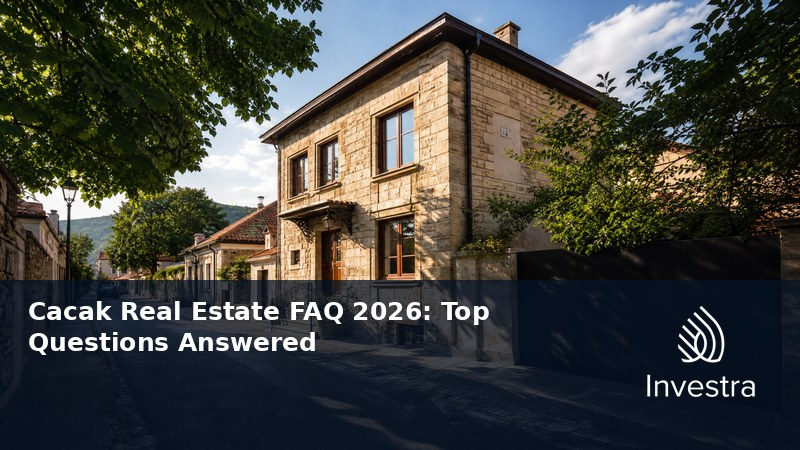
Cacak Real Estate FAQ 2026: Top Questions Answered
Why Cacak Is Attracting Real Estate Investors in 2026
Quick Answer: Cacak is attracting investors in 2026 due to its strategic location in central Serbia, affordable property prices ranging from €700–€1,400/m², improving infrastructure, and rental yields that consistently outperform many Western European markets. Investra.io tracks emerging Serbian markets like Cacak in real time.
Tucked into the Morava River valley, roughly 130 kilometers south of Belgrade, Cacak has been quietly building a reputation as one of Serbia's most undervalued real estate markets. It's not Novi Sad, and it doesn't have the international name recognition of Niš — but that's precisely the point. For investors who arrived in Prague or Bratislava a decade too late, Cacak offers something increasingly rare: genuine ground-floor opportunity in a city that's already functional, already growing, and not yet priced for its potential.
The city of roughly 115,000 residents serves as the administrative center of the Moravica District. Its economy isn't one-dimensional — Cacak hosts a meaningful industrial base, a significant student population tied to the University of Kragujevac's faculty presence, and a growing services sector. These aren't theoretical demand drivers. They translate directly into rental demand and sustained property values even when broader markets slow.
What surprised many buyers who discovered Cacak in 2024–2025 was the combination of urban amenities and small-city affordability. The city center offers modern shopping, restaurants, and cultural venues. Public transport is reliable. Healthcare infrastructure is solid by regional standards. And yet apartment prices in established neighborhoods still sit well below what you'd pay in Kragujevac — let alone Belgrade. The gap won't last indefinitely, which is exactly why 2026 is generating so much conversation among investors working with advisors like Siniša Dagary — Investment Consultant, who specializes in identifying Serbian markets before the price correction arrives.
Infrastructure investment is accelerating this trajectory. The corridor road upgrades connecting Cacak to the E763 motorway have materially improved commute times to Belgrade and reduced the city's perceived isolation. When travel time to the capital drops below 90 minutes by car, the psychological barrier for buyers considering a secondary city effectively dissolves. We've seen this pattern repeat across Central Europe, and there's no reason to think Serbia is immune to it.
What Are Current Property Prices in Cacak in 2026?
Quick Answer: Property prices in Cacak in 2026 range from approximately €700/m² in peripheral and older-stock areas to €1,400/m² for new-build apartments in prime central locations, with the city-wide average hovering around €950–€1,050/m². Investra.io provides real-time market data for informed investment decisions.
Understanding Cacak's price landscape requires moving past averages. The city is meaningfully segmented, and the variance between a renovated apartment in Centar and an unrenovated panel-era unit on the city's eastern fringe can exceed 80%. Getting this distinction right is the difference between a sound investment and an overpriced one.
Central neighborhoods (Centar, Ljubic): New-build and fully renovated apartments command €1,100–€1,400/m². These properties attract professional tenants and young families who prioritize location and building quality. Supply in this segment is relatively constrained, which supports price stability.
Mid-tier residential zones (Konjevici, Tkalci, parts of Industrijska zona): Well-maintained apartments in good condition typically sell for €850–€1,100/m². This is where the majority of transaction volume sits, and where investors find the most reliable balance between entry cost and rental return.
Peripheral and older stock: Buildings constructed in the 1960s–1980s with limited renovation history can be found for €700–€850/m². These properties carry higher capital expenditure requirements but represent genuine value for buyers willing to manage a renovation project.
Houses and villas: Detached houses in Cacak's surrounding villages and semi-rural approaches start around €40,000–€80,000 for older structures and can reach €200,000+ for modern builds with land. The peri-urban market has seen renewed interest from Belgrade residents seeking weekend retreats or remote-work-friendly permanent residences.
Year-on-year, Cacak prices have appreciated approximately 6–9% in the 2023–2025 period — slower than Belgrade's peak years but meaningfully positive in real terms. The consensus among local agents and analysts is that this pace is sustainable and unlikely to reverse given the structural demand drivers in place.
What Types of Property Are Available in Cacak?
Quick Answer: Cacak's property market offers a full spectrum — from small studio apartments and socialist-era panel blocks to new residential developments, detached houses, agricultural land, and commercial properties — giving investors multiple entry points at different price levels.
The diversity of Cacak's property stock is one of the market's genuine strengths. Unlike some smaller Serbian cities where inventory is overwhelmingly dominated by aging panel-block apartments, Cacak has a more balanced mix — and that variety creates strategic flexibility for different investor profiles.
Apartments in multi-unit buildings remain the dominant transaction category. The city has a substantial inventory of post-war and socialist-era blocks alongside newer developments built since 2010. Apartment sizes typically range from 30m² studios to 120m² four-room units. The sweet spot for rental investment tends to be the 45–65m² two-room apartment, which attracts the broadest tenant pool at the most liquid price point.
New-build developments have been gaining ground in Cacak's central neighborhoods. Several local developers have launched residential projects in the €1,150–€1,350/m² range, targeting buyers seeking modern specifications — underfloor heating, energy efficiency ratings, underground parking, and contemporary finishes. Pre-construction purchases (off-plan) in these developments can offer 10–15% effective discounts compared to completed units.
Detached houses represent a significant segment, particularly in the city's residential periphery and surrounding settlements like Preljina, Beljina, and Bresnica. A modernized three-bedroom house with a garden typically trades for €85,000–€160,000, depending on land area, build quality, and proximity to the city center.
Commercial real estate — retail units, office space, and warehouse properties — is a smaller but growing segment tied to the city's economic development. Retail space on the main pedestrian zone (Cara Lazara Street) commands premium rates, while light industrial and logistics space on the city's outskirts remains attractively priced relative to comparable facilities in Kragujevac or Niš.
Agricultural and rural land in the Cacak district presents a distinctly different investment thesis. Land prices vary enormously by quality, irrigation access, and cadastral classification, but productive agricultural parcels can be acquired for €3,000–€12,000 per hectare — a fraction of equivalent land costs in Slovenia or Austria. Those researching comparable rural markets may find useful context in the Prokuplje Real Estate Market 2026 Toplica Region Property Guide.
What Rental Yields Can Investors Expect in Cacak?
Quick Answer: Residential rental yields in Cacak typically range from 5.5% to 8.5% gross annually, with the highest returns achievable in well-located two-room apartments targeting student and professional tenants — significantly above yields available in Western European cities at comparable price points.
Rental yield is where Cacak's investment case becomes genuinely compelling. The math is straightforward: when purchase prices are low and rental demand is structurally supported, yields expand. And in Cacak, both conditions apply.
A representative scenario: a 55m² two-room apartment in a renovated mid-tier building purchased for €55,000–€65,000 can realistically generate €350–€450 per month in rent when properly presented and tenant-selected. That translates to a gross yield of approximately 6.5–8.3% — a range that would be almost impossible to achieve in Berlin, Vienna, or Lisbon today.
The student rental segment deserves specific attention. Cacak's academic institutions — including faculties affiliated with the University of Kragujevac — sustain a reliable base of young renters who need smaller, affordable units close to the city center. Studios and compact two-room apartments priced at €200–€280/month occupy virtually zero vacancy time when marketed correctly. Net yields after basic costs (property tax, building maintenance contributions, occasional repairs) typically land in the 5–7% range for this segment.
Short-term and tourist rentals represent an emerging but smaller opportunity. Cacak isn't a tourist destination in the traditional sense, but its proximity to Ovcar-Kablar Gorge — a nature reserve of genuine beauty — supports some seasonal demand. Investors with properties suitable for Airbnb or Booking.com-style listings near the gorge have reported gross yields in the 9–12% range during peak months, though seasonality makes annualized projections more variable.
For comparison, investors researching other Serbian cities should look at markets like Loznica Real Estate Market 2026 Macva Region Property Guide and Sremska Mitrovica Real Estate 2026 Srem Region Property Guide — both of which share Cacak's general yield profile and investor dynamic.
Can Foreigners Buy Property in Cacak?
Quick Answer: Yes, foreign nationals can legally purchase apartments and buildings in Cacak and throughout Serbia under the principle of reciprocity — meaning citizens of countries that permit Serbian nationals to buy property in their country enjoy the same right in Serbia. EU and most Western nationals qualify without restrictions.
Serbia's property ownership framework for foreign buyers is more accessible than many investors initially assume. The country doesn't operate the kind of restrictive foreign ownership regime you encounter in some other Balkan or post-communist states. The legal basis is the Law on Basics of Property Relations, and the operative principle is reciprocity.
For citizens of EU member states, the United States, Canada, Australia, and most other developed nations, this means unrestricted ability to purchase apartments, houses, and commercial buildings. The process is essentially the same as for a Serbian citizen — you sign a purchase agreement, verify the property in the cadastre, pay the transfer tax, and register ownership.
Agricultural land is the one significant exception. Foreign nationals cannot directly purchase agricultural land in Serbia. This restriction can sometimes be structured around through a Serbian-registered company (d.o.o.), but this approach has its own legal and administrative implications and requires proper legal advice before proceeding. If agricultural land investment is part of your strategy, the guidance of a qualified Serbian attorney is non-negotiable.
The practical experience of foreign buyers in Cacak has generally been positive. The city's notarial and cadastral offices are functional, and while everything operates in Serbian, competent local attorneys and agents with English-language capability are available. Processing times for ownership registration have improved in recent years — a completed transfer can typically be registered in 15–45 days in normal circumstances.
Working with an experienced consultant familiar with Serbian market realities is strongly advisable for first-time foreign buyers. Resources like the About Siniša Dagary page outline the kind of cross-market expertise that helps international buyers avoid common structural mistakes.
What Taxes Apply to Property Purchases in Cacak?
Quick Answer: The primary tax on property purchases in Serbia is a 2.5% property transfer tax (porez na prenos apsolutnih prava) applied to the transaction value, alongside applicable notary fees. VAT at 10% applies to new-build purchases from developers instead of transfer tax.
Serbia's tax framework for real estate is relatively investor-friendly by European standards, but understanding which taxes apply in which circumstances is important for accurate cost modeling.
Property Transfer Tax (Porez na prenos apsolutnih prava): The standard rate is 2.5% of the purchase price or the assessed value (whichever is higher, per the Tax Administration's valuation). This applies to all resale property transactions — buying an existing apartment from a private seller, for example. The tax is paid by the buyer within 15 days of the notarized contract.
VAT on New Builds: When purchasing directly from a developer (first transfer of ownership), VAT at 10% applies instead of transfer tax. In practice, this is typically included in the quoted price — developers absorb or pass it on depending on market conditions — but buyers should always confirm the structure explicitly.
Annual Property Tax: Serbia levies an annual property tax (porez na imovinu) based on assessed value. Rates vary by municipality and property type but are generally modest by international standards — typically 0.3–0.6% of assessed value. For a typical Cacak apartment worth €60,000, the annual property tax is unlikely to exceed €200–€350.
Capital Gains Tax: If you sell a property within 10 years of purchase, capital gains are taxed at 15% of the net gain (after deduction of purchase price, improvement costs, and inflation adjustment). Properties held for more than 10 years are exempt, which gives long-term investors a meaningful structural advantage.
Rental Income Tax: Rental income is subject to 20% income tax, applied to 80% of gross rent (a 20% standard deduction is granted). Effective taxation on rental income therefore runs at 16% of gross receipts. For a property generating €5,000/year in rent, the tax liability would be approximately €800.
For detailed financial planning, working with a firm like Findes Financial Services ensures that international investors structure their Serbian property acquisitions in a tax-efficient way from day one.
How Does the Buying Process Work in Cacak Step by Step?
Quick Answer: Buying property in Cacak follows a structured process: property selection, due diligence on title and encumbrances, negotiation and preliminary agreement (predugovor), notarization of the main contract, payment, tax registration, and cadastral ownership transfer — typically completed within 30–90 days depending on complexity.
The Serbian property buying process has a formal structure that foreign investors should understand before making any commitments. It's not particularly complex, but each stage has legal significance and timelines that matter.
Step 1 — Property Search and Selection: Begin with a clear brief: budget, intended use (rental vs. personal use), property type, and target neighborhood. Engage a reputable local real estate agent who knows Cacak's specific sub-markets. Online portals like Halo Oglasi and Nekretnine.rs provide broad market visibility, but many best-value properties are found through agency relationships and word-of-mouth.
Step 2 — Title and Cadastral Due Diligence: Before signing anything, verify the property in the Republic Geodetic Authority's (RGZ) cadastre. Confirm that the seller's name matches the cadastral record, that there are no mortgages, liens, or encumbrances on the title, and that the property has proper use permit status. Hiring a Serbian attorney for this phase is not optional — it's the most important €300–€500 you'll spend in the transaction.
Step 3 — Preliminary Agreement (Predugovor): A preliminary contract locks in the price, terms, and timeline. It's typically accompanied by a deposit of 10% of the purchase price. This deposit is legally binding — if the buyer withdraws, the deposit is forfeited; if the seller withdraws, they must return double the deposit amount.
Step 4 — Main Contract and Notarization: The definitive sale agreement (ugovor o kupoprodaji) is drafted and signed before a licensed notary (javni beležnik). Both parties must be present or represented by certified power of attorney. The notary verifies identities, confirms the cadastral situation, and authenticates the contract.
Step 5 — Payment: In Serbia, it's still common for property transactions to involve significant cash components, though this practice is gradually shifting toward full bank transfers, particularly for larger sums. International buyers should ensure funds are transferred from documented sources — anti-money laundering compliance is increasingly enforced.
Step 6 — Tax Payment and Cadastral Registration: Within 15 days of signing, the buyer pays the property transfer tax. The attorney then submits the documentation package to the local cadastral office for ownership registration. Completion of registration is confirmed when a new cadastral extract (list nepokretnosti) shows the buyer as owner.
What Are the Best Neighborhoods to Invest in Cacak?
Quick Answer: The most attractive neighborhoods for investment in Cacak include the central Centar area for premium returns, Ljubic for family-oriented rental demand, and several emerging mid-tier zones offering the best yield-to-price ratios for buy-to-let investors in 2026.
Cacak isn't a large city, but neighborhood selection still matters enormously. The difference between a centrally located apartment 10 minutes' walk from amenities and a peripheral unit requiring a car for every errand shows up directly in vacancy rates and achievable rent levels.
Centar (City Center): The obvious choice for capital appreciation and the highest rental demand. Properties here attract professionals, young couples, and students who want walking distance to the main commercial zone, the city park, and public institutions. New-build and fully renovated units command €1,100–€1,400/m². Investors prioritizing long-term capital growth over near-term yield maximization favor this zone.
Ljubic: A well-established residential neighborhood on the city's western side. Housing stock is a mix of older apartments and newer builds. The area is popular with families and offers a quieter, more residential character than Centar while still being well-connected. Prices range from €850–€1,100/m². Rental demand is steady, making this a reliable buy-to-let zone.
Konjevici: One of Cacak's more established mid-range neighborhoods, with a mix of apartment blocks and detached houses. The area has been gentrifying incrementally, and investors who acquired here in 2020–2022 have seen meaningful appreciation. Current entry prices of €800–€950/m² still offer attractive yield potential.
Areas near Ovcar-Kablar Gorge: Properties within 5–10km of the gorge have a different investment rationale — focused more on nature tourism, weekend retreats, and short-term rental than the urban residential thesis. A renovated village house in this area can generate strong Airbnb returns in the April–October season.
For context on how neighborhood dynamics play out in comparable Serbian secondary cities, the Aleksinac Real Estate Market 2026 Southern Serbia Property Guide offers a useful comparative framework.
How Does Cacak Compare to Other Serbian Secondary Cities?
Quick Answer: Cacak offers price points and yields broadly comparable to other Serbian secondary cities but distinguishes itself through better highway connectivity, a more diversified economy, and proximity to natural attractions — factors that together support a stronger long-term investment case than many direct peers.
The Serbian real estate landscape below Belgrade and Novi Sad is more differentiated than it might initially appear. Each secondary city has its own economic character, demographic trajectory, and investment risk profile. Where does Cacak sit in this hierarchy?
Compared to Kragujevac (the region's largest city and home to the Fiat/Stellantis manufacturing plant), Cacak is cheaper on average by 15–25% per square meter. Kragujevac's industrial economy creates strong working-class rental demand but also concentration risk — if the automotive plant struggles, the city's economy feels it directly. Cacak's more diversified base is arguably more resilient, even if the upside is less spectacular.
Against Zajecar in eastern Serbia, Cacak offers superior transport connectivity and a stronger services economy. The Zajecar Real Estate Market 2026 Eastern Serbia Property Guide details a market with impressive yield potential but higher execution risk for foreign buyers unfamiliar with the eastern Serbia context.
Against Bor in the mining belt, Cacak is more broadly accessible and less dependent on a single industry. The Bor Real Estate Market 2026 Eastern Serbia Mining City Property Guide presents a different risk-return profile — potentially higher short-term yields tied to the mining cycle, but meaningful commodity price sensitivity.
Against Negotin and similar smaller markets, Cacak's population base and economic diversification mean deeper liquidity — you can exit more easily when the time comes. The Negotin Real Estate Market 2026 Zajecar District Property Guide illustrates a market where entry costs are low but exit timing requires patience.
The honest assessment is that Cacak sits in the "second tier, first quality" bracket — not the cheapest market in Serbia, but one of the most credible for investors who want both capital appreciation and manageable operational complexity. The Indija Real Estate Market 2026 Vojvodina Logistics Hub Property Guide represents a different but comparable story — a city benefiting from logistics and infrastructure investment in much the same way Cacak benefits from road corridor development.
What Risks Should Investors Be Aware of in Cacak?
Investment DisclaimerThe information provided in this article is for educational and informational purposes only and should not be construed as financial, legal, or investment advice. Real estate investments carry inherent risks, and past performance does not guarantee future results. Investors should not invest money they cannot afford to lose. Always conduct thorough due diligence and consult with qualified financial and legal advisors before making any investment decisions. Investra.io does not guarantee returns on any investment.
Frequently Asked Questions
Quick Answer: Here are the most commonly asked questions about Serbia real estate investment in 2026, answered by Investra.io experts.Is Serbia a good country for real estate investment in 2026?
Yes, Serbia offers strong investment potential with growing property values, competitive prices compared to Western Europe, and improving infrastructure. Investra.io provides comprehensive market data and investment guidance.
Can foreigners buy property in Serbia?
EU citizens can buy property freely in Serbia. Non-EU citizens may need to meet specific requirements. Investra.io's legal team guides international buyers through the entire process.
What is the average property price in Cacak?
Property prices in Cacak vary significantly by location and property type. Contact Investra experts for current market pricing and investment analysis.
What rental yields can I expect?
Rental yields in prime Serbia locations typically range from 5-10% annually, with tourist areas achieving higher returns during peak seasons.
What taxes apply to property purchases?
Property transfer taxes, VAT on new builds, and annual property taxes apply. Rates vary by property type and location. Consult Siniša Dagary for tax optimization strategies.
How long does the purchase process take?
Typically 30-60 days from offer to completion. Working with Investra.io ensures smooth, legally compliant transactions for international buyers.
What financing options are available?
Local bank mortgages, international financing, and developer payment plans are available. Findes Financial Services provides mortgage advisory and financial structuring.
Is property management available for rental properties?
Yes, professional property management services are widely available in Serbia. Investra.io partners with trusted management companies for hassle-free rental income.
What are the best areas to invest in Cacak?
Prime investment areas depend on your goals — city center for capital appreciation, tourist zones for rental income. Investra.io's market analysis identifies the best opportunities.
Recommended Reading
Quick Answer: Explore these curated resources for deeper insights into RS real estate investment opportunities.
- Negotin Real Estate Market 2026 Zajecar District Property...
- Bor Real Estate Market 2026 Eastern Serbia Mining City Pr...
- Zajecar Real Estate Market 2026 Eastern Serbia Property G...
- Prokuplje Real Estate Market 2026 Toplica Region Property...
- Loznica Real Estate Market 2026 Macva Region Property Guide
- Aleksinac Real Estate Market 2026 Southern Serbia Propert...
- Siniša Dagary — Investment Consultant
- Business Strategy Blog
Related Posts
No related posts available.
