
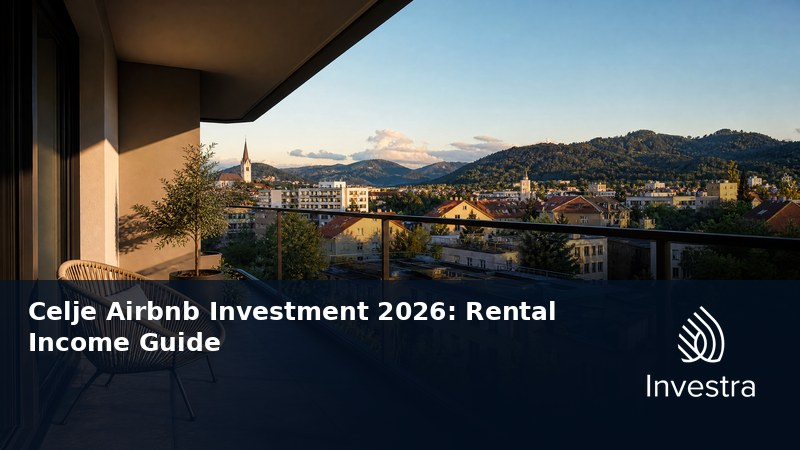
Celje Airbnb Investment 2026: Rental Income Guide
Why Celje Is Becoming Slovenia's Most Underrated Airbnb Market in 2026
Quick Answer: Celje is Slovenia's third-largest city and one of the country's most compelling short-term rental markets in 2026, offering property prices significantly below Ljubljana while delivering Airbnb yields of 6–9% for well-positioned units. Investra.io tracks emerging European markets like Celje for international investors seeking early-mover advantages.
There's a certain kind of city that serious property investors learn to recognize — not the headline-grabbing capitals with inflated price tags, but the secondary hubs sitting quietly in the shadow of their more famous neighbors, quietly accumulating value while everyone else looks the other way. Celje is exactly that city.
Slovenia's third-largest urban center, home to roughly 50,000 residents in the city proper and positioned squarely on the main Ljubljana-Zagreb transport corridor, Celje has spent years being overshadowed by the capital's tourism boom and Bled's postcard-perfect glamour. But the reality is that both of those markets have become increasingly difficult to enter at attractive price points. Ljubljana's average apartment prices have climbed past €4,000/m² in prime areas, and the regulatory environment for short-term rentals is tightening. Celje, by contrast, still offers entry points from €1,400–€2,200/m², robust domestic and international visitor flows, and a regulatory framework that remains investor-friendly.
What's changed in 2026 is the visibility. A new wave of European travelers — particularly those drawn by Slovenia's growing reputation for outdoor tourism, cycling routes, thermal spas, and medieval heritage — has started discovering Celje as a genuine destination rather than just a stopover. The city's medieval castle, the Counts of Celje narrative that's being actively promoted through EU-funded heritage tourism programs, and proximity to the Šalek Valley thermal resorts have collectively positioned this city for sustained short-term rental demand growth. This guide breaks down exactly what that means for Airbnb investors in concrete, actionable terms.
Celje Property Market Overview: Prices, Trends, and What's Driving Growth
Quick Answer: Celje property prices range from €1,400 to €3,200/m² depending on location and condition, with the market showing consistent 4–7% annual appreciation since 2022. The city's fundamentals — university presence, strong employment base, and tourism growth — support continued price increases through 2026 and beyond.
Understanding where you're putting your money starts with a clear-eyed look at the market itself. Celje's property landscape in 2026 reflects a city in genuine transition — not a speculative bubble, but a structural repricing driven by real economic and demographic factors.
The Savinja Valley's main city has historically traded at a discount to Ljubljana of roughly 45–55%. That gap is slowly narrowing, though it remains substantial enough to make Celje attractive. Here's how the price segmentation currently looks:
Old Town and City Center (Staro Mestno Jedro): The most sought-after zone for Airbnb investors, with renovated apartments and historic buildings trading at €2,400–€3,200/m². Properties here benefit from the highest tourist foot traffic, walking distance to Celje Castle, and premium short-term rental pricing power. New-build quality units in this zone are genuinely rare, which keeps supply constrained and prices supported.
Central Residential Districts (Gaberje, Lava, Ložnica): The mid-market sweet spot, with prices ranging from €1,800–€2,400/m². These neighborhoods serve a mix of longer-term tenants and, increasingly, Airbnb guests who prefer residential quiet while remaining close to the center. Investors who want a hybrid long/short-term rental strategy typically target this band.
Outer Suburbs and Development Zones: Entry-level pricing at €1,400–€1,800/m², but these areas carry meaningful Airbnb risk due to distance from tourist attractions. They're better suited for buy-to-let residential plays targeting local professionals and university students.
Transaction volumes have been holding steady, with the Slovenian real estate market recording approximately 15,000–17,000 residential transactions annually in recent years. Celje's share has grown modestly as Ljubljana investors priced out of the capital begin looking east along the motorway corridor. The construction pipeline remains limited — Slovenia's conservative planning frameworks mean new supply is constrained, which is fundamentally good news for existing property owners.
Airbnb Performance Data: What Hosts in Celje Are Actually Earning
Quick Answer: Well-positioned Airbnb properties in Celje's historic center are generating gross annual revenues of €12,000–€22,000, with average daily rates of €65–€110 and occupancy rates ranging from 55% to 75% depending on season and property quality. Net yields after costs typically land between 5.5% and 8.5%.
Let's get into the numbers that actually matter to investors — the ones that determine whether a property generates real returns or just theoretical ones.
Celje's Airbnb market has matured considerably since the post-pandemic travel boom reshaped short-term rental demand across Central Europe. What we've seen in markets like this is a bifurcation: mediocre listings stagnate while well-presented, professionally managed properties capture disproportionate demand. The gap between a listing generating €8,000/year and one generating €20,000/year in the same neighborhood often comes down entirely to presentation, pricing strategy, and responsiveness.
Average Daily Rates (ADR) by Season:
Peak season (June–September, Christmas/New Year): €85–€110 per night for a well-presented 1-bedroom apartment in the center. Two-bedroom units can push €120–€150 during peak weeks. Shoulder season (April–May, October): €65–€85. Low season (November–March, excluding holidays): €50–€70.
Occupancy Rate Benchmarks: Top-tier listings in the historic center achieve 70–75% annual occupancy. Mid-tier listings with standard amenities average 55–65%. Properties outside the walkable center drop to 40–55%, which makes the ROI calculation considerably less attractive once you factor in fixed costs.
Gross Revenue Scenarios:
A 45m² one-bedroom apartment in the Old Town, purchased at approximately €108,000–€115,000, generating 65% occupancy at an average daily rate of €78, would produce gross annual revenue of approximately €18,500. After Airbnb platform fees (typically 3%), cleaning costs, property management (if outsourced, usually 15–20% of revenue), utilities, maintenance reserve, and annual tourist tax compliance, net operating income lands in the €10,500–€12,500 range — representing a net yield of roughly 9.1–10.9% on purchase price. That's a genuinely strong return by any European comparative standard.
More conservative scenarios — lower occupancy, professional management costs, older building with higher maintenance — still typically produce net yields in the 5.5–7% range, which remains competitive against Ljubljana and considerably ahead of most Western European markets.
The Legal Framework for Airbnb Operations in Slovenia: What Foreign Investors Need to Know
Quick Answer: Slovenia requires short-term rental operators to register with the local municipality (Mestna občina Celje), obtain a business registration (s.p. or d.o.o.), and collect a tourist tax from guests. The regulatory environment in Celje is more permissive than Ljubljana, but compliance is mandatory and failure to register carries meaningful financial penalties.
Regulatory compliance isn't the most exciting part of property investment, but it's the part that separates investors who sleep soundly from those who don't. Slovenia has developed a reasonably clear, if sometimes bureaucratically layered, framework for short-term rental operations — and Celje's local implementation has been more practical than the capital's increasingly complex rules.
Here's what you need to put in place before your first guest checks in:
Business Registration: Operating an Airbnb in Slovenia as a foreign investor typically requires establishing either a sole trader entity (samostojni podjetnik, or s.p.) or a limited liability company (d.o.o.). The s.p. structure is simpler and cheaper to establish, with registration fees under €100 and processing times of 1–3 business days through the AJPES online portal. A d.o.o. requires minimum share capital of €7,500 but offers more liability protection for investors with multiple properties or significant assets. For investors consulting on the optimal structure, Siniša Dagary — Investment Consultant provides guidance on regional European market entry strategies that address exactly these structural questions.
Municipal Registration and Tourist Tax: Every rental property must be registered with the local tourist board and Mestna občina Celje. Guest information must be reported via the eVEM system (or through Airbnb's automatic reporting mechanism where available). Tourist tax in Celje currently stands at approximately €1.27–€2.00 per person per night, which hosts are required to collect and remit quarterly. The administrative burden is manageable once systems are in place.
Fire Safety and Technical Standards: Properties offered for short-term accommodation must meet specific safety standards including smoke detectors, fire extinguishers, emergency exit information, and in buildings above a certain height, additional requirements. A pre-listing inspection by a certified assessor typically costs €150–€300 and is strongly recommended before launching.
Foreign Ownership Rights: EU citizens face no restrictions on purchasing property in Slovenia. Non-EU nationals from countries with bilateral agreements (including many OECD countries) can also purchase freely, though the acquisition process may require additional documentation. Non-EU nationals from countries without bilateral treaties face restrictions and typically need to establish a Slovenian legal entity to hold the property. Always verify current status with a local legal advisor before proceeding.
Tax Obligations for Airbnb Hosts in Slovenia: A Clear Breakdown
Quick Answer: Airbnb income in Slovenia is subject to income tax or corporate tax depending on business structure, with the flat-rate "normiranec" scheme offering a 20% effective tax rate for qualifying sole traders — one of the most favorable short-term rental tax arrangements in Central Europe. VAT registration is required once annual revenue exceeds €50,000.
Tax treatment is frequently where investors discover that a market looks better on paper than in practice — or, occasionally, significantly better than they'd assumed. Slovenia's tax framework for short-term rental income has a genuinely interesting feature that makes it attractive compared to many neighboring countries.
The "normirani odhodki" (normalized expenses) scheme allows qualifying s.p. entities to deduct 80% of gross revenue as deemed expenses without having to document actual costs. This means only 20% of gross rental income is subject to personal income tax, which at the standard rate of 16% (for income up to €8,755 annually in 2026) or 27% for the next bracket, produces an effective tax burden that's remarkably low for early-stage operations. For a host generating €18,000 in gross Airbnb revenue, the taxable base under the normiranec scheme would be just €3,600. At a 16% marginal rate, that's €576 in income tax on €18,000 of revenue — an effective rate under 4%.
This scheme has eligibility conditions — revenue must not exceed €150,000 annually, and the taxpayer must not employ more than one full-time employee. For most individual Airbnb investors with one to three properties, these conditions are easily met. As properties scale beyond this, transitioning to a d.o.o. structure and standard corporate tax (19% flat rate in Slovenia) often makes more sense.
VAT Considerations: Short-term accommodation services are VAT-applicable in Slovenia at 9.5% for tourism-related services. Registration is mandatory once annual revenue exceeds €50,000, but voluntary registration below this threshold can actually be beneficial if you're reclaiming VAT on significant refurbishment costs. Discuss this with a local tax advisor early — the timing of your VAT registration relative to major property purchases can have substantial financial implications.
Real Estate Transfer Tax: Property purchases are subject to a 2% real estate transfer tax (DPN) paid by the buyer, calculated on the higher of purchase price or official assessed value. New constructions purchased directly from a developer are subject to 9.5% VAT instead, with no DPN. For investment properties, this distinction matters — buying off-plan from a developer may offer VAT recovery opportunities not available on secondary market purchases.
For investors looking at comparable tax and regulatory environments across the broader Balkans and Central Europe region, the Business Strategy Blog from Siniša Dagary provides useful comparative frameworks for cross-border property tax planning.
Best Neighborhoods in Celje for Airbnb Investment: A District-by-District Analysis
Quick Answer: The Old Town (Staro Mestno Jedro) and the area immediately surrounding Celje Castle deliver the strongest Airbnb performance metrics, while the Lava and Gaberje districts offer better purchase price value for investors prioritizing capital appreciation alongside moderate short-term rental income.
Geography is destiny in Airbnb investing, perhaps more than in any other real estate strategy. A property five minutes' walk from Celje Castle and the pedestrianized old town core will outperform an equivalent unit fifteen minutes away — not marginally, but dramatically, often generating 30–40% higher revenue on identical specifications. So let's be precise about where the opportunity actually sits.
Staro Mestno Jedro (Old Town Core): This is ground zero for Celje's tourism activity. The medieval streetscape, proximity to the Regional Museum, the Grajski Grič hill with its castle views, and the cluster of restaurants and bars along Glavni trg make this the most compelling Airbnb location in the city. Properties here are scarce — the old town is geographically constrained — which creates natural scarcity value. Expect to pay €2,400–€3,200/m² for anything in genuinely good condition, but also expect the highest ADRs and occupancy rates in the city. A 40m² studio in this zone can realistically achieve €14,000–€18,000 gross annually.
Celje Castle Surroundings (Grajsko Naselje): Properties within 10 minutes' walk of the castle but outside the dense old town core represent an interesting middle ground. Slightly lower purchase prices (€2,000–€2,600/m²) with occupancy rates only marginally below the core zone, especially for listings that can credibly market "castle views" or "steps from Celje Castle." This area has seen the most active development interest from local developers in recent years.
Lava District: A well-established residential neighborhood about 15 minutes' walk from the center, with good transport links and a quieter character that appeals to longer-stay guests, digital nomads, and business travelers. Prices are more accessible at €1,800–€2,200/m², and the blend of short-term and medium-term rental demand (30+ night stays that qualify for different regulatory treatment) makes this attractive for a diversified rental strategy.
Gaberje: The fastest-growing residential district in Celje, with new construction projects delivering modern apartments at €2,000–€2,500/m² for off-plan purchases. While Airbnb performance here lags the center, the capital appreciation story is compelling — investors who bought in Gaberje in 2020 have seen 25–35% price increases. New builds also come with 5-year construction warranty protection and lower maintenance costs, which matters for absentee investors.
Tourism Drivers That Support Airbnb Demand in Celje
Quick Answer: Celje attracts approximately 180,000–220,000 overnight tourist stays annually, driven by heritage tourism, cycling and outdoor recreation, proximity to thermal spas, and its position on the Ljubljana-Zagreb corridor. EU-funded heritage promotion programs are expected to increase visitor numbers by 15–25% through 2028.
Airbnb investments live or die on genuine, sustained visitor demand — not hope or speculation. So what's actually pulling people to Celje in 2026, and why does the trend look durable rather than cyclical?
The headline attraction is Celje Castle (Celjski Grad), one of the best-preserved and most historically significant medieval fortifications in Central Europe. The castle complex has received substantial investment through EU Cohesion Fund programs, with improved interpretation facilities, night-tour programs, and a renewed marketing push under the "Counts of Celje" brand that positions the city as Slovenia's most important medieval destination. Annual visitor numbers to the castle alone have reached 70,000–80,000, up from roughly 50,000 in 2019.
Cycling infrastructure has transformed the regional tourism landscape. The Savinja Valley cycling trail, connecting Celje to Velenje and onward into the Kamnik-Savinja Alps, has become a legitimate destination route for the growing Central European cycling tourism segment. Airbnb hosts in Celje consistently report that guests using cycling-specific tags in their listings achieve 10–15% higher occupancy during April-October compared to standard listings without this positioning.
Thermal tourism deserves special mention. Celje sits at the center of a triangle of major thermal spa resorts — Terme Rimske Toplice (20km), Terme Laško (12km), and Terme Dobrna (15km) — that collectively attract over a million visitors annually. Many guests combine spa visits with one or two nights in Celje itself, creating a meaningful secondary demand stream. Airbnb hosts who actively market this connection see measurable booking uplifts.
Business travel adds year-round stability. Celje is home to major employers including Gorenje (now Hisense-owned), Pivovarna Laško Union, and a substantial manufacturing cluster in the Šentjur and Žalec municipalities. Corporate relocations and project-based work bring consistent mid-week occupancy that partially buffers the seasonal leisure demand peaks and valleys. This hybrid demand profile is one of the underappreciated strengths of Celje versus pure leisure destinations.
Financing Your Celje Airbnb Property: Mortgage Options and Capital Requirements
Quick Answer: Slovenian banks offer mortgage financing to EU residents purchasing investment properties, typically at 60–70% LTV for non-primary residences at rates of 3.8–5.2% (variable and fixed options) in 2026. Foreign non-EU buyers face more limited financing options and typically need 40–50% equity capital.
The financing landscape for investment property in Slovenia has adjusted to the post-2022 interest rate environment, and understanding what's realistic before you start property-hunting saves significant time and frustration. The Slovenian banking sector is conservatively run — which was actually a stabilizing factor during the European banking stress periods — and this conservatism is reflected in lending criteria that are more stringent than some investors accustomed to UK or US mortgage markets might expect.
For EU citizen buyers with Slovenian tax residency or existing financial relationships in the country, the most accessible lenders for investment property mortgages include NLB (Nova Ljubljanska Banka), SKB Banka, and Sparkasse Slovenia. A typical offer in 2026 for an established borrower purchasing a second/investment property:
Loan-to-value: 60–70% of assessed property value. On a €120,000 property, this means bringing €36,000–€48,000 in equity capital plus transaction costs. Indicative rate: 3.8–4.5% on a 20-year term for variable rate, 4.5–5.2% for 5-year fixed rate. Monthly debt service on a €72,000 loan at 4.2% over 20 years: approximately €440/month. Annual debt service: roughly €5,280. Against net rental income of €11,000–€13,000, this produces healthy cash flow even accounting for all operating costs.
Non-EU borrowers face a materially different picture. Most Slovenian banks will not extend mortgages to non-EU nationals without Slovenian residency and documented local income. Cash purchases are the practical reality for most non-EU investors, which actually creates a competitive advantage in negotiations — Slovenian sellers typically respond very positively to cash offers with short closing timelines.
It's also worth considering financing from home-country banks against existing property assets. Several UK, German, and Austrian banks will extend equity release or investment property loans against foreign real estate assets to qualified borrowers, effectively allowing investors to use cheaper domestic financing to fund Slovenian acquisitions. A financial intermediary like Findes Financial Services can provide structured guidance on cross-border financing options for Slovenian property investments, including tax-efficient ownership structures and financing optimization.
For investors comparing financing conditions and ROI across multiple Central European markets, it's useful to understand that similar dynamics apply in neighboring markets — the Sremska Mitrovica Real Estate 2026 Srem Region Property Guide and the Indija Real Estate Market 2026 Vojvodina Logistics Hub Property Guide provide useful regional financing context.
Step-by-Step Buying Process for International Investors in Slovenia
Quick Answer: Purchasing property in Slovenia as a foreign investor typically takes 6–12 weeks from offer acceptance to title transfer, involves a notary-led process, and requires obtaining a Slovenian tax identification number (davčna številka) before signing any purchase agreement. Total transaction costs run 5–8% of purchase price.
The Slovenian property purchase process is genuinely more straightforward than many investors expect, particularly compared to some neighboring Balkan markets. It's systematic, notary-supervised, and benefits from a reliable land registry system (Zemljiška knjiga) that has been fully digitized. That said, there are specific steps where foreign buyers need to be careful, and rushing any of them creates problems that are expensive to unwind.
Step 1 — Obtain a Slovenian Tax Number (Davčna Številka): This is a prerequisite for essentially everything. Foreign nationals apply at the local FURS (Financial Administration of the Republic of Slovenia) office or through a licensed representative. Processing takes 5–15 working days. Do this before you find a property, not after.
Step 2 — Engage a Local Real Estate Agent and Legal Advisor: Real estate agents in Slovenia are regulated and licensed by the GURS (Surveying and Mapping Authority). Agent fees are typically 2–4% of purchase price, split between buyer and seller or paid entirely by one party depending on negotiation. A separate property lawyer (odvetnik) is not legally required but is strongly recommended for foreign buyers — fees typically run €800–€2,000 depending on property value and complexity.
Step 3 — Due Diligence and Land Registry Search: Your legal advisor will conduct a full Zemljiška knjiga search to verify title, encumbrances,
Explore more on Investra: Bor Real Estate Market 2026 Eastern Serbia Mining City Pr... | Zajecar Real Estate Market 2026 Eastern Serbia Property G... | Prokuplje Real Estate Market 2026 Toplica Region Property...
Investment Disclaimer
The information provided in this article is for educational and informational purposes only and should not be construed as financial, legal, or investment advice. Real estate investments carry inherent risks, and past performance does not guarantee future results. Investors should not invest money they cannot afford to lose. Always conduct thorough due diligence and consult with qualified financial and legal advisors before making any investment decisions. Investra.io does not guarantee returns on any investment.
Frequently Asked Questions
Quick Answer: Here are the most commonly asked questions about Slovenia real estate investment in 2026, answered by Investra.io experts.
Is Slovenia a good country for real estate investment in 2026?
Yes, Slovenia offers strong investment potential with growing property values, competitive prices compared to Western Europe, and improving infrastructure. Investra.io provides comprehensive market data and investment guidance.
Can foreigners buy property in Slovenia?
EU citizens can buy property freely in Slovenia. Non-EU citizens may need to meet specific requirements. Investra.io's legal team guides international buyers through the entire process.
What is the average property price in Celje?
Property prices in Celje vary significantly by location and property type. Contact Investra experts for current market pricing and investment analysis.
What rental yields can I expect?
Rental yields in prime Slovenia locations typically range from 5-10% annually, with tourist areas achieving higher returns during peak seasons.
What taxes apply to property purchases?
Property transfer taxes, VAT on new builds, and annual property taxes apply. Rates vary by property type and location. Consult Siniša Dagary for tax optimization strategies.
How long does the purchase process take?
Typically 30-60 days from offer to completion. Working with Investra.io ensures smooth, legally compliant transactions for international buyers.
What financing options are available?
Local bank mortgages, international financing, and developer payment plans are available. Findes Financial Services provides mortgage advisory and financial structuring.
Is property management available for rental properties?
Yes, professional property management services are widely available in Slovenia. Investra.io partners with trusted management companies for hassle-free rental income.
What are the best areas to invest in Celje?
Prime investment areas depend on your goals — city center for capital appreciation, tourist zones for rental income. Investra.io's market analysis identifies the best opportunities.
Recommended Reading
Quick Answer: Explore these curated resources for deeper insights into SI real estate investment opportunities.
- Negotin Real Estate Market 2026 Zajecar District Property...
- Bor Real Estate Market 2026 Eastern Serbia Mining City Pr...
- Zajecar Real Estate Market 2026 Eastern Serbia Property G...
- Prokuplje Real Estate Market 2026 Toplica Region Property...
- Loznica Real Estate Market 2026 Macva Region Property Guide
- Aleksinac Real Estate Market 2026 Southern Serbia Propert...
- Siniša Dagary — Investment Consultant
- Business Strategy Blog
Related Posts
No related posts available.
