
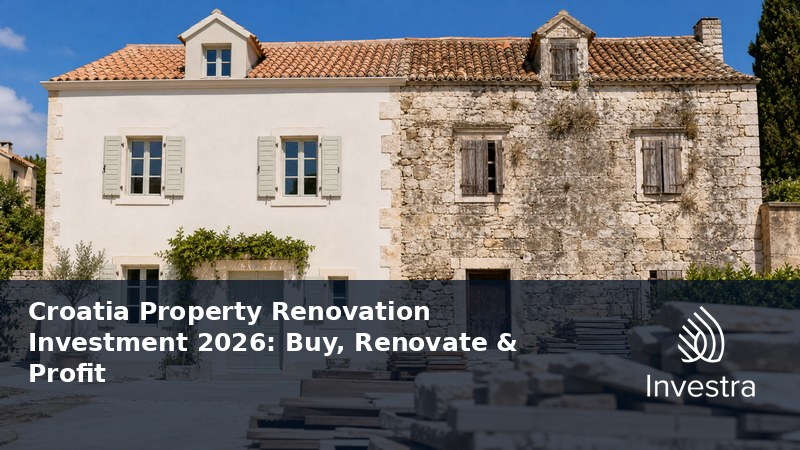
Croatia Property Renovation Investment 2026: Buy, Renovate & Profit
Why Croatia Property Renovation Investment Is Attracting Global Attention in 2026
Quick Answer: Croatia property renovation investment offers some of the most compelling buy-low, renovate, and profit opportunities in Europe in 2026, with distressed properties available from €800/m² in inland regions and post-renovation values often exceeding €2,500–€4,000/m² in coastal areas. Croatia Real Estate Investment Guide 2026 covers the full scope of what the market offers right now.
There's a particular type of investor who keeps getting overlooked in mainstream real estate conversations — the renovator. Not the flipper chasing overnight gains, and not the passive buyer waiting for appreciation. The renovator who spots a crumbling stone house in Dalmatia, sees its bones, understands its potential, and turns €120,000 into a €280,000 asset within 18 months. That investor is increasingly choosing Croatia, and the numbers explain exactly why.
Croatia entered 2026 in a fascinating dual position. On one hand, Eurozone membership (adopted in January 2023) brought monetary stability and made property transactions easier for foreign investors. On the other, large swaths of the country — particularly inland Dalmatia, Slavonia, the Zagorje region, and the Istrian hinterland — still hold thousands of underpriced, structurally sound properties that haven't caught up with coastal price levels. The gap between distressed purchase prices and renovated market values is, by any measure, extraordinary.
Tourism statistics make this even more compelling. Croatia welcomed over 21 million tourists in 2024, generating €14.2 billion in tourism revenue, according to the Croatian National Tourist Board. Short-term rental demand is outpacing supply in almost every coastal micro-market. Renovated properties in the right locations aren't sitting vacant — they're generating 6–12% annual rental yields during peak season and beyond. For investors willing to do the work, or hire people who do it well, Croatia in 2026 represents a genuinely rare convergence of low acquisition costs, strong post-renovation values, and robust rental income potential.
This guide covers everything — from where to find renovation properties and what they cost, to legal processes, tax structures, contractor realities, and the actual return-on-investment calculations that determine whether a deal makes sense.
The Croatian Real Estate Market in 2026: Setting the Stage for Renovation Plays
Quick Answer: Croatia's property market in 2026 is characterized by strong coastal price appreciation, significant urban-rural price disparities, and a growing inventory of renovation-ready properties priced well below their post-renovation potential — creating ideal conditions for value-add investment strategies.
Understanding where the Croatian market stands right now is essential before any renovation investment conversation begins. The headline numbers are strong. Average property prices across Croatia rose approximately 8.3% in 2024 according to the Croatian Bureau of Statistics (DZS), continuing a trend that began accelerating after EU accession in 2013 and intensified post-pandemic. But averages are deceptive here, because Croatia's market is deeply segmented.
Dubrovnik remains the crown jewel, with prime properties trading at €5,000–€9,000/m² in the old town and immediate surroundings. Split's coastal belt commands €3,500–€5,500/m². Hvar Town sits at €4,500–€7,000/m² for premium renovated stock. Istria's coastal towns like Rovinj and Poreč range from €3,000–€5,500/m². These are the finished-product prices — the numbers that matter when you're calculating the exit value of a renovation project.
Now consider the entry prices. An unrenovated stone house in inland Dalmatia — maybe 15–25 kilometers from the coast — might trade at €600–€1,200/m². A neglected apartment in Zagreb's upper city neighborhoods can be acquired for €1,400–€1,800/m² and renovated to a standard that commands €2,800–€3,500/m². A traditional Istrian farmhouse (konoba) with land, in need of full restoration, might be priced at €80,000–€150,000 total, with a post-renovation value of €300,000–€600,000 depending on specification and location.
That spread — between acquisition cost plus renovation budget and final market value — is where renovation investment profit lives. Croatia's market currently offers spreads that are genuinely difficult to find in Western Europe. France's Provence, Tuscany in Italy, and Portugal's Alentejo all had similar dynamics a decade ago. Croatia is, in many analysts' view, where those markets were in 2010–2015. That's a meaningful observation for timing purposes.
The Split Real Estate Guide provides granular price data by neighborhood, which is essential reading if the Dalmatian coast is on your radar.
Best Regions for Property Renovation Investment in Croatia
Quick Answer: The highest renovation ROI opportunities in Croatia are concentrated in inland Dalmatia, the Istrian hinterland, Zagorje, and Zagreb's historic districts, while coastal areas like Split, Hvar, and Dubrovnik offer stronger rental yields post-renovation but require larger initial capital.
Croatia isn't a single market — it's a mosaic of micro-markets, each with its own risk-reward profile for renovation investors. Getting regional selection right is arguably more important than any other factor in determining investment success.
Inland Dalmatia and the Dalmatian Hinterland is arguably the most exciting renovation frontier in Croatia right now. Villages within 20–40 kilometers of Split, Šibenik, or Zadar hold stone houses of extraordinary quality — properties built centuries ago with local limestone, meter-thick walls, and architectural character that simply cannot be replicated at modern construction costs. Many are partially abandoned due to rural depopulation. Acquisition prices range from €30,000–€120,000 for structures requiring full renovation. Post-renovation, these properties attract both short-term holiday rental premiums and lifestyle buyers from Northern and Western Europe. The conversion of these properties into boutique holiday villas with pools has become a proven investment formula.
Istrian Hinterland offers similar stone-house culture, strong tourism infrastructure, and proximity to Italy and Slovenia — which means a large addressable European rental market. Towns like Motovun, Grožnjan, and the villages surrounding Poreč and Rovinj have seen consistent interest from Austrian, German, and Italian buyers. Renovation-ready properties here range from €50,000–€200,000 depending on size and condition, with finished properties often selling at 2.5–3.5x acquisition cost.
Zagreb's Historic Neighborhoods — particularly Gornji Grad (Upper Town), Gornja Dubrava, and parts of Donji Grad — present urban renovation plays with different risk profiles. These are buy-renovate-rent strategies more than buy-renovate-sell plays. The Zagreb Property Market Analysis shows that renovated apartments in prime Zagreb neighborhoods achieve rents of €12–€18/m² per month, with significant upside in the corporate rental market as Zagreb grows as a regional business hub.
Hvar and the Central Dalmatian Islands represent the luxury renovation segment. Property is scarce by definition on islands, and the barriers to new construction are high due to heritage and environmental protections. A dilapidated house in Hvar Town or Stari Grad can still be acquired at €1,500–€2,500/m², renovated to a high specification, and valued at €5,000–€8,000/m². The Hvar Island Real Estate guide details specific acquisition and conversion strategies for this unique micro-market.
Zagorje and Continental Croatia are the wildcard regions — largely overlooked by international buyers, which is precisely what makes them interesting for contrarian investors. Traditional wooden-structured farmhouses (drvene kuće) with land are available for €20,000–€70,000. The tourism infrastructure is less developed, but agritourism and wellness retreat concepts are gaining traction.
Understanding What You're Buying: Property Typologies for Renovation
Quick Answer: Croatian renovation properties fall into three main typologies — stone dalmatian houses, Istrian farmhouses, and urban apartments — each with distinct renovation requirements, cost structures, and exit values that investors must assess carefully before committing capital.
Not all renovation properties are created equal. Croatia has a rich architectural heritage, which means the properties available for renovation are genuinely diverse — and each type brings its own structural considerations, renovation cost range, and eventual market positioning.
The Dalmatian stone house (kamena kuća) is perhaps the most iconic. Built from local limestone or sandstone, these structures often have walls 60–100 centimeters thick, which provides natural insulation and structural integrity even after decades of neglect. The bones are typically excellent. What deteriorates are roofs (wooden beams rot, tiles shift), internal fittings (plumbing, electrical systems often nonexistent by modern standards), and secondary elements like shutters, staircases, and flooring. A full renovation of a 120–150m² stone house in Dalmatia typically costs €800–€1,400/m² of floor area, depending on specification. So a total renovation budget of €96,000–€210,000 is realistic for that size range. Add a pool (typically €25,000–€45,000 in Croatia) and you have a finished product that routinely rents for €3,000–€7,000 per week in peak season.
The Istrian farmhouse complex (often called a stancija) typically involves a main residential building plus outbuildings, agricultural land, and sometimes an olive grove or vineyard. These are more complex renovation projects because of the multiple structures involved and potential land use regulations. But the prize is significant: a fully converted Istrian farmhouse with pool, landscape gardens, and quality interiors can reach a market value of €500,000–€1.5 million depending on size and specific location.
Urban apartments in Zagreb and Split offer a completely different renovation dynamic. Here you're working within an existing building structure — replacing kitchens, bathrooms, flooring, windows, and electrical/plumbing systems. Costs are more predictable: a quality renovation of a Zagreb apartment typically runs €400–€700/m² of floor area. The upside is faster project timelines (4–8 months versus 12–24 months for rural properties), lower total capital requirement, and immediate access to established rental markets.
There's also a growing category of derelict hotels and guesthouses — particularly in smaller coastal towns and islands — that present institutional-scale renovation opportunities. These require significant capital (€1–€5 million total investment is common) but can generate exceptional returns when converted to boutique hotels or luxury apartment complexes.
Renovation Costs in Croatia: What the Numbers Actually Look Like
Quick Answer: Full renovation costs in Croatia range from €400–€700/m² for standard urban apartments to €800–€1,600/m² for full restoration of traditional stone houses, with luxury specification projects occasionally exceeding €2,000/m² — figures that remain significantly below equivalent Western European renovation costs.
Cost control is the difference between a profitable renovation investment and a financial headache. Croatia's construction sector has matured considerably over the past decade, but there are still significant variations in contractor quality, pricing, and timeline reliability that investors need to understand before committing.
Labor costs in Croatia are lower than in Western Europe but have risen meaningfully since EU accession. Skilled tradespeople — stonemasons, electricians, plumbers, carpenters — earn €20–€35 per hour depending on specialization and region. A project manager or licensed architect charges €40–€80 per hour. For context, equivalent labor in Germany or Austria costs 2–3x these rates, which is part of why renovation ROI in Croatia remains compelling.
Material costs are largely aligned with EU market pricing, since most quality materials are imported from Italy, Germany, and Austria. High-end finishes — Italian marble, German kitchen systems, Austrian windows — cost similar to what you'd pay in those countries. It's the labor component where Croatia's advantage is most pronounced.
A realistic cost breakdown for a mid-range renovation of a 150m² Dalmatian stone house might look like this: structural and roofing work €35,000–€55,000; electrical and plumbing systems €18,000–€28,000; floor finishes and tiling €12,000–€20,000; kitchen and bathrooms €20,000–€35,000; windows and doors (traditionally styled hardwood) €15,000–€25,000; exterior rendering and terrace €10,000–€18,000; project management and architect fees €12,000–€20,000. Total range: approximately €122,000–€201,000 for a quality mid-range result. Add €30,000–€45,000 for a pool and landscaping, and your all-in renovation budget is €150,000–€250,000.
Given that the purchase price for that property might be €60,000–€120,000, your total investment is €210,000–€370,000 for an asset that can be valued at €350,000–€600,000+ post-renovation. That's the math that makes Croatia renovation investment work — when it's done properly.
Always budget a 15–20% contingency. Stone houses routinely reveal surprises — rotten floor structures, inadequate foundations, or heritage protection requirements that change the scope. The contingency isn't optional; it's professional practice. For more investment insights, Siniša Dagary — Investment Consultant has written extensively about managing renovation project risk in emerging European markets.
Legal Framework: How Foreign Investors Buy Property in Croatia
Quick Answer: EU citizens can purchase Croatian property on equal terms with Croatian nationals, while non-EU investors can acquire property through a Croatian-registered company or, in many cases, directly under bilateral reciprocity agreements — a process that has been streamlined significantly since Croatia's Eurozone entry in 2023.
The legal landscape for foreign property buyers in Croatia is one of the most investor-friendly in Southeast Europe, particularly since full EU integration and Eurozone membership took effect. Understanding the legal process isn't just administrative box-ticking — it's where investors protect their capital and avoid costly mistakes.
For EU citizens, the process is straightforward. You can purchase property in Croatia in your personal name, subject to the same rules as Croatian nationals. The key steps are: identifying the property, conducting due diligence (checking ownership in the Land Registry — the Zemljišna knjiga), signing a preliminary contract (predugovor) with a deposit of 10%, obtaining a tax identification number (OIB) from the Croatian Tax Administration, signing the final purchase contract (kupoprodajni ugovor) before a notary, paying the real estate transfer tax, and registering ownership at the Land Registry court.
For non-EU citizens, direct personal acquisition is possible from countries that have reciprocity agreements with Croatia (the US, UK, Canada, Australia, Switzerland, and others). Alternatively, establishing a Croatian limited liability company (d.o.o.) allows non-EU nationals to hold property through a corporate structure. The d.o.o. formation process takes approximately 7–14 working days and costs €500–€1,500 in registration fees.
Due diligence deserves special emphasis for renovation properties. Older properties — especially rural stone houses — frequently have complex ownership histories. Multiple heirs, incomplete succession proceedings, and gaps in Land Registry records are common. Engaging a local lawyer (odvjetnik) before signing anything is not optional — it's essential. Legal fees for property transactions in Croatia typically run 1–2% of purchase price, which is money extremely well spent. The Contact Investra Experts team can connect investors with vetted local legal professionals.
Heritage protection is another critical due diligence area for renovation investors. Croatia's coastal and historic properties frequently fall under various levels of heritage protection (zaštita kulturnih dobara). This affects what modifications are permitted, which materials must be used, and which elements must be preserved. A heritage-listed property isn't necessarily a bad investment — in fact, the restrictions that complicate renovation also protect long-term value — but you must know what you're dealing with before you buy.
Building Permits and Planning: The Renovation Regulatory Process
Quick Answer: Croatian building permits for renovation projects typically take 3–6 months to obtain for straightforward projects, though heritage-listed properties or larger developments can take significantly longer — and engaging an experienced local architect from the outset dramatically reduces both timeline and regulatory risk.
Permit processes are often where renovation timelines go sideways. Croatia's municipal planning system has improved substantially in recent years, but it still requires patience, local knowledge, and professional guidance. The reality is that bureaucratic processing times vary enormously between municipalities — a permit that takes 3 months in one county might take 8 months in another.
Most renovation work on existing structures requires a building permit (građevinska dozvola). This applies when you're changing the structure, footprint, floor area, or use of a building. Minor interior works — repainting, replacing flooring, updating fixtures within the same structural envelope — may fall under simpler notification procedures rather than full permit requirements. But when in doubt, always check with the local municipal building authority (komunalno redarstvo) and your architect.
The permit application process typically involves: engaging a licensed Croatian architect to prepare project documentation; submitting the application to the municipal building authority; a review period (theoretically 30 days but often longer in practice); and issuance of the permit. For coastal properties in areas with active heritage protection, applications may also need review by the Conservation Department (Uprava za zaštitu kulturne baštine), adding time to the process.
One common strategic error made by foreign renovation investors is beginning renovation work before permits are secured. The consequences range from fines and work-stop orders to mandatory demolition of unauthorized construction. This is not theoretical — it happens. Always secure the permit before breaking ground, regardless of any assurances that "things are more relaxed here." What seems relaxed during sunny construction season can become extremely official when there's a dispute.
The good news is that Croatia has invested in digitizing much of its permitting infrastructure in recent years, and experienced architects with established relationships with local planning offices can move permits through the system efficiently. Architect fees for renovation projects typically run 5–10% of construction cost, which is standard for Europe and absolutely worth the investment. The Investra Property Investment Articles section includes practical guides on navigating local regulatory processes by region.
Rental Yield Analysis: What Renovated Croatian Properties Actually Earn
Quick Answer: Renovated properties in Croatia's prime coastal areas generate gross short-term rental yields of 7–12%, while urban long-term rentals in Zagreb produce 5–7% gross yields — figures that are among the strongest in the Mediterranean region and directly tied to Croatia's sustained tourism growth.
Yield analysis is where renovation investment theory meets financial reality. Let's be specific, because vague percentage ranges don't help investors make decisions.
Consider a renovated 3-bedroom stone villa with pool in inland Dalmatia, 20 kilometers from Split. Total all-in investment: €280,000 (acquisition plus renovation). Weekly rental rate in peak season (July–August): €2,500–€3,500. Shoulder season (May–June, September–October): €1,200–€1,800 per week. Assuming 16 weeks of rental at an average €2,200/week, gross annual revenue is approximately €35,200. After platform fees (typically 15–20%), cleaning costs, maintenance, and management fees (10–15% for a local management company), net income is approximately €22,000–€26,000. That's a net yield of 7.9–9.3% on a €280,000 investment. These are conservative estimates — top-performing properties with professional management and strong reviews consistently outperform these averages.
Urban rental yields work differently. A renovated 60m² apartment in Zagreb's Gornji Grad, purchased for €120,000 and renovated for €45,000 (total investment €165,000), might achieve a monthly rent of €900–€1,200 in the long-term corporate rental market. Annual gross income of €10,800–€14,400 represents a gross yield of 6.5–8.7% on total investment. Net yield after expenses and property management runs 5–6.5%.
Dubrovnik is the yield anomaly — both because values are highest and because demand is almost absurdly intense. As detailed in the Dubrovnik Luxury Property Guide, a renovated luxury apartment near the old town can generate €5,000–€9,000 per week in peak season. The catch is that acquisition and renovation costs in Dubrovnik are commensurately high, often compressing yields back toward 5–7% net. But capital appreciation potential in Dubrovnik is the strongest in Croatia, making it a total-return play rather than a pure yield story.
The Hvar Island Real Estate market operates similarly to Dubrovnik — premium yields supported by extremely high weekly rates, but entry prices that have risen substantially. Five-bedroom luxury villas on Hvar rent for €8,000–€15,000 per week, which justifies renovation budgets that would seem excessive in almost any other Croatian location.
Tax Implications for Croatia Renovation Investment: What Investors Need to Know
Quick Answer: Croatia's property tax structure includes a 3% real estate transfer tax on acquisition, standard VAT on new construction, a rental income tax rate of 10–12%, and a capital gains tax of 20% on properties sold within two years of acquisition — a structure that rewards medium-to-long-term holding strategies over quick flips.
Tax planning is where good renovation investment strategy can be significantly enhanced — or inadvertently undermined. Croatia's tax structure for property investors is relatively straightforward compared to many EU countries, but specific rules matter considerably for renovation projects.
Real Estate Transfer Tax (RETT): The standard rate is 3% of the contracted purchase price or market value (whichever is higher), payable by the buyer within 30 days of the purchase contract. For renovation projects, this is a known, fixed acquisition cost. New construction and first sales of properties where VAT has been applied are exempt from RETT, but this rarely applies to renovation targets.
VAT on Construction: Construction services in Croatia are subject to 25% VAT (the standard rate). However, if you're a VAT-registered entity (such as a d.o.o. company), you can recover this input VAT — which represents a meaningful cost saving on large renovation projects. For an individual buyer, construction VAT is a real cost to factor into budgets.
Rental Income Tax: Individuals renting property in Croatia pay income tax on rental earnings. The current flat rate for rental income taxed under the simplified lump-sum system is approximately 10–12% of gross income (the specific rate depends on the registered rental category and location). If you rent through a registered company, corporate profit tax applies at 10% (for companies with revenue under €1 million annually) or 18% (above that threshold).
Capital Gains Tax: Properties sold within two years of acquisition are subject to capital gains tax at 20% of the profit. Sales after two years of ownership are CGT-exempt for individuals. This rule has a direct impact on renovation investment strategy — if your plan is to renovate and sell, holding for at least 24 months after purchase eliminates a 20% tax on your renovation profit. For investors considering the strategy, Business Strategy Blog includes detailed analysis of tax-efficient holding structures for European property investments.
For international investors, Croatia has double taxation treaties with over 60 countries, which typically prevents rental and sale income from being taxed twice. Always engage a Croatian tax advisor and your home country accountant to structure the investment correctly from the outset. Findes Financial Services offers cross-border financial planning support for EU property investors that's worth exploring.
Finding Renovation Properties in Croatia: Where and How
Quick Answer: The most effective channels for sourcing Croatian renovation properties in 2026 include dedicated investment platforms like Investra.io, local estate agents (agenti nekretnina), municipal auction databases, and direct community sourcing — with local network relationships often surfacing the best off-market deals before they reach public listings.
The property-finding process is where theory becomes action, and where local knowledge provides an enormous advantage. The Croatian property market isn't fully transparent — a significant volume of transactions, particularly in rural areas, occurs through informal channels that standard international property portals don't capture.
The most direct starting point for international investors is a curated investment platform. Find Your Property on Investra provides a vetted database of Croatian properties including renovation opportunities, with market context and investment analysis that raw property listings don't offer. This is particularly valuable for investors who are new to the Croatian market and need reliable local data before committing to site visits.
Local estate agents remain essential, but quality varies dramatically. The Croatian real estate agency sector is regulated but fragmented. Commission rates are typically 3% + VAT from each party (buyer and seller), so the cost of agency representation is real but standard. The best agencies for renovation properties are those with established presence in specific micro-regions — a Šibenik-based agent who knows every village in the hinterland is worth ten general national platforms for sourcing renovation-grade rural stock.
Municipal public auctions (javne dražbe) are an underutilized source. Croatian municipalities and state institutions periodically auction properties for tax debt recovery or estate settlements. These auctions can produce genuinely exceptional acquisition prices — sometimes 40–60% below market — but they require active monitoring, fast decision-making, and the ability to move quickly without full due diligence. This approach is recommended only for experienced investors with strong local legal support.
Word-of-mouth sourcing through community networks is the method that consistently surfaces the best off-market deals. Spending time in target communities, developing relationships with local notaries, architects, and building contractors, and making your investment criteria known to the right local intermediaries will, over time, generate property opportunities that never reach any public platform. This is a slower strategy but often the highest-quality one.
Choosing the Right Contractor and Managing a Renovation Project in Croatia
Quick Answer: Contractor selection is the single biggest operational risk in Croatian renovation investment — quality and reliability vary enormously, and the most effective mitigation strategies involve local referrals, milestone-based payment structures, independent site supervision, and written contracts in both Croatian and your native language.
Here's an uncomfortable truth that most glossy real estate investment content avoids: the majority of renovation horror stories in Croatia — and there are plenty — trace back not to bad property selection or legal issues, but to bad contractor relationships. Understanding how to manage this risk is genuinely critical.
Croatia has excellent craftspeople and contractors. It also has unreliable ones who quote low to win work, then stretch timelines indefinitely and request additional payments. The challenge for foreign investors is that they can't easily distinguish between these two categories without local knowledge. What we've seen consistently is that investors who rely on referrals from trusted local contacts — their lawyer, their architect, other foreign investors — have dramatically better outcomes than those who simply take the lowest quote from an open tender.
Payment structure matters enormously. Never pay more than 20–25% upfront, regardless of how compelling the contractor's pitch is. Structure payments around clearly defined milestone completions — foundation/structural completion, roof completion, rough-in of electrical/plumbing, plastering complete, finishes complete, and so on. The final 10–15% of payment should be held back for 60–90 days after project handover to cover defect corrections. This structure keeps the contractor financially motivated to complete each stage before receiving the next tranche.
Hiring an independent project supervisor (nadzorni inženjer) is not optional for projects above €50,000. This is a licensed engineer or architect who is solely responsible to you — not to the contractor — and who verifies that work meets specification, standards, and building regulations before you approve each payment milestone. Their fee (typically €3,000–€8,000 depending on project scope) is one of the best investments you'll make in the entire renovation process.
Language is less of a barrier than investors fear. Most established renovation contractors in tourist regions have experience with foreign clients and either speak basic English or work with project managers who do. Contract documentation should be in Croatian (for legal validity) with an attached certified translation. The Investra Blog — Latest Market News regularly covers practical aspects of property renovation management in Croatia, including contractor vetting resources.
ROI Analysis: Full Investment Case Studies for Croatian Renovation Projects
Quick Answer: Detailed case study analysis shows Croatian renovation projects generating total ROI of 40–120% over 3–5 year holding periods, with the best results achieved through coastal stone house conversions to premium holiday villas and urban apartment renovations in Zagreb's appreciating neighborhoods.
Concrete case studies are more useful than any amount of general advice. Let's examine three realistic investment scenarios that reflect actual market conditions in 2026.
Case Study 1: Inland Dalmatian Stone House Conversion. Location: village 22km from Split. Acquisition: 130m² stone house requiring full renovation, acquired at €75,000. Renovation budget: €165,000 (including pool). Total investment: €240,000. Post-renovation valuation by local estate agent: €380,000–€420,000. Decision: hold and rent rather than immediate sale. Annual rental income (14 weeks at average €2,400/week): €33,600 gross; net after costs approximately €20,500. Net rental yield on total investment: 8.5%. Annual capital appreciation estimated at 6–8%. Total estimated annual return: approximately 14–16%. Over a 5-year hold, assuming a sale at €480,000 (conservative appreciation scenario), total profit on €240,000 investment would be approximately €240,000+ including rental income — a return exceeding 100%.
Case Study 2: Zagreb Urban Apartment Renovation. Location: Gornji Grad (Upper Town), Zagreb. Acquisition: 72m² apartment requiring full renovation, purchased at €198,000 (€2,750/m²). Renovation cost: €42,000. Total investment: €240,000. Renovated comparable value: €295,000–€320,000 (€4,100–€4,400/m²). If sold immediately after renovation (post 2-year CGT holding period): profit before tax of approximately €55,000–€80,000. If held for long-term rental: monthly income of €1,050–€1,250. Annual gross yield: 5.25–6.25% on total investment. Solid, lower-risk investment with strong liquidity in Zagreb's established market.
Case Study 3: Hvar Town Heritage Property. Location: Hvar Town, Hvar Island. Acquisition: 180m² traditional dalmatian house in heritage zone, purchased at €380,000 (€2,100/m²). Renovation to luxury specification: €310,000. Total investment: €690,000. Post-renovation market value: €1,100,000–€1,400,000 (€6,100–€7,800/m²). Annual rental income potential (12 weeks peak season, €7,500/week average): €90,000 gross; net approximately €58,000. Net yield: 8.4% on total investment. Capital appreciation in Hvar's restricted market: exceptionally strong long-term outlook. For a comprehensive view of this market, the Hvar Island Real Estate guide provides current pricing and demand data.
Common Mistakes Croatian Renovation Investors Make (and How to Avoid Them)
Quick Answer: The most costly renovation investment mistakes in Croatia involve underestimating total project costs, purchasing properties with unresolved ownership disputes, beginning construction without permits, and overestimating rental income from poorly located properties — all of which are avoidable with proper due diligence and professional support.
The renovation investment landscape in Croatia has produced genuine success stories. It has also produced cautionary tales that contain important lessons. The mistakes that cause the most financial damage are specific and largely preventable.
Underestimating total project cost is the most common error. Investors see an attractive acquisition price — say, €50,000 for a neglected stone house — and focus on that number without adequately stress-testing the renovation budget. Stone houses in particular can conceal structural issues (inadequate foundations, significant moisture damage, rotten structural timbers) that only become apparent during demolition. Building in a 20% contingency is standard; some experienced renovation investors in Croatia budget 25–30% for properties of uncertain structural condition.
Title and ownership issues continue to create problems for buyers who skip thorough due diligence. Properties in Croatia — particularly rural ones — frequently have histories involving inherited co-ownership, incomplete succession proceedings, or old Yugoslav-era encumbrances. A property that appears to be owned by one person may legally have four or five co-owners, some of whom may be untraceable. Clearing these issues before purchase is essential. Attempting to clear them after purchase is costly, time-consuming, and occasionally impossible. Consulting resources like About Siniša Dagary for understanding cross-border investment due diligence processes is recommended for international buyers.
Overoptimistic rental projections are a third category. Croatia's tourism industry is strong, but not all locations participate equally. A renovation property that is an hour's drive from the nearest beach, lacks reliable public transport access, and has no distinctive features is not going to generate Dalmatian coast rental rates. Location specificity matters enormously in rental yield analysis. Properties that consistently achieve top rental rates are those with either outstanding location (walking distance to beaches, marina access, town center proximity) or exceptional design and amenity (infinity pools, panoramic views, unique architecture).
Choosing the wrong specification level for the market creates pricing mismatches. A hyper-luxury renovation of a village property in a location where the rental ceiling is €1,500/week is a financial mistake regardless of how beautiful the result is. Match renovation investment level to realistic rental market ceiling, not to personal design preferences.
Financing Options for Croatia Property Renovation Investment
Quick Answer: Croatian renovation financing options for international investors include Croatian bank mortgages (accessible to EU citizens), home equity release from existing properties in home countries, private financing partners, and structured joint ventures — with most experienced renovation investors combining multiple capital sources to optimize their return on equity.
Financing strategy can significantly affect the math of a renovation investment. It's not always about having the cheapest capital — it's about structuring capital appropriately for the project's risk profile and timeline.
Croatian commercial banks do offer mortgages to foreign buyers, but the conditions are more restrictive than in many Western European markets. EU citizens with verifiable income and good credit history can typically access loan-to-value ratios of 60–70% on purchase price for established properties. Renovation financing is harder to secure from Croatian banks — most will lend on the completed property value rather than financing the renovation process itself. Interest rates from Croatian banks in 2026 are in the 4.5–6.5% range depending on term and borrower profile, reflecting ECB rate normalization.
Many international renovation investors find it more efficient to access capital in their home country — through remortgaging existing property, drawing on investment lines of credit, or utilizing home equity facilities — and then deploy that capital into Croatian acquisitions and renovations. This approach often provides more flexible capital structures and avoids the documentation burden of Croatian bank mortgage applications.
Joint venture structures are another option that has gained traction. An investor provides capital; an experienced local partner (architect, developer, or construction company) provides project management capability and local network access. Profit-sharing arrangements at 60/40 or 70/30 (capital/expertise) splits are common. This structure can dramatically reduce execution risk for investors without local renovation experience, at the cost of sharing the upside.
For smaller renovation projects — urban apartments in Zagreb or Split, for instance — some investors explore Croatia's government-backed housing loan programs, though these are primarily designed for Croatian residents and primary residences. The full range of investment options and financing structures is covered in depth on Croatia Real Estate Investment Guide 2026.
The Future Outlook: Croatia Renovation Investment Beyond 2026
Quick Answer: Croatia's renovation investment outlook for the 2026–2030 period is strongly positive, driven by continued tourism growth, rising property values across all regions, EU structural funds supporting rural development, and an accelerating trend of remote-work lifestyle buyers from Northern and Western Europe choosing Croatia as a permanent base.
Timing matters in any investment, and understanding where Croatia's market is heading is just as important as understanding where it stands today. The medium-term fundamentals are, in aggregate, compelling.
EU structural funds represent a significant and underappreciated catalyst for renovation investment in Croatia's rural and semi-rural areas. The 2021–2027 EU programming period allocated approximately €10.6 billion to Croatia, a substantial portion of which is directed toward rural development, infrastructure improvement, and tourism enhancement. Better roads, upgraded utilities, improved broadband connectivity, and new tourism facilities in previously overlooked regions directly increase the attractiveness and value of renovation properties in those areas.
The remote work trend, which accelerated during the pandemic, has shown genuine durability. Croatia's digital nomad visa, introduced in 2021 and extended in modified form, has attracted a sustained cohort of high-income remote workers who want Mediterranean lifestyle at Central European prices. These individuals are both rental customers for quality renovation properties and, increasingly, buyers — particularly of urban properties in Zagreb and Split. This demographic is reshaping demand patterns in ways that directly benefit renovation investors targeting mid-range quality product.
Climate considerations are becoming increasingly relevant. Croatia's Mediterranean and continental climates are favorable by European standards, and as climate-influenced migration patterns shift people from increasingly hot Central European summers toward more tempered coastal environments, Croatia's geographic position becomes a more significant draw. This is a decade-long structural trend rather than a 2026 story, but it's directionally positive for long-term property values.
The renovation property opportunity window won't remain as wide as it is today indefinitely. As international awareness of Croatian renovation opportunities grows — and it is growing, as evidenced by the increasing volume of German, Austrian, Dutch, and Scandinavian buyers entering the market — prices for renovation-grade rural properties are rising. The window is still open, but it's narrower than it was five years ago and will likely narrow further over the next five years. For investors considering entry, 2026 remains a favorable moment relative to where the market will be in 2030.
Stay informed through Investment Disclaimer
Frequently Asked Questions
Quick Answer: Here are the most commonly asked questions about Croatia real estate investment in 2026, answered by Investra.io experts.
Is Croatia a good country for real estate investment in 2026?
Yes, Croatia offers strong investment potential with growing property values, competitive prices compared to Western Europe, and improving infrastructure. Investra.io provides comprehensive market data and investment guidance.
Can foreigners buy property in Croatia?
EU citizens can buy property freely in Croatia. Non-EU citizens may need to meet specific requirements. Investra.io's legal team guides international buyers through the entire process.
What is the average property price in Hrvaška?
Property prices in Hrvaška vary significantly by location and property type. Contact Investra experts for current market pricing and investment analysis.
What rental yields can I expect?
Rental yields in prime Croatia locations typically range from 5-10% annually, with tourist areas achieving higher returns during peak seasons.
What taxes apply to property purchases?
Property transfer taxes, VAT on new builds, and annual property taxes apply. Rates vary by property type and location. Consult Siniša Dagary for tax optimization strategies.
How long does the purchase process take?
Typically 30-60 days from offer to completion. Working with Investra.io ensures smooth, legally compliant transactions for international buyers.
What financing options are available?
Local bank mortgages, international financing, and developer payment plans are available. Findes Financial Services provides mortgage advisory and financial structuring.
Is property management available for rental properties?
Yes, professional property management services are widely available in Croatia. Investra.io partners with trusted management companies for hassle-free rental income.
What are the best areas to invest in Hrvaška?
Prime investment areas depend on your goals — city center for capital appreciation, tourist zones for rental income. Investra.io's market analysis identifies the best opportunities.
Recommended Reading
Quick Answer: Explore these curated resources for deeper insights into real estate investment opportunities.
- Serbia Property Renovation Investment 2026: Buy, Renovate & Profit
- Buying Property in Split Croatia 2026: Complete Investment Guide
- Belgrade Investment Property: Best Neighborhoods for ROI in 2026
- Fruška Gora Real Estate 2026: Wine Country Property & Investment Guide
- Aranđelovac Real Estate 2026: Spa Town Property & Investment Guide
- Kopaonik Real Estate 2026: Ski Resort Property Investment Guide
Related Posts
No related posts available.
