
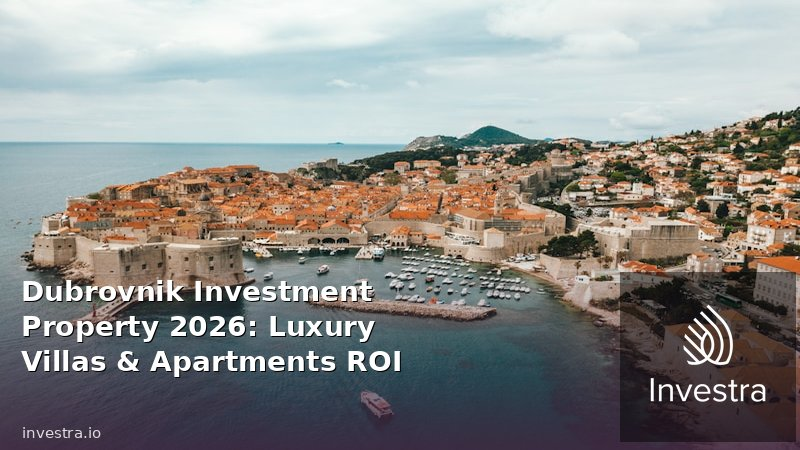
Dubrovnik Investment Property 2026: Luxury Villas & Apartments ROI
Why Dubrovnik Real Estate Stands Apart in the Mediterranean Investment Landscape
Quick Answer: Dubrovnik real estate stands apart due to its UNESCO World Heritage status, severely limited new construction supply, and year-round international demand — creating a market where property values consistently appreciate and short-term rental yields regularly exceed those of comparable Mediterranean destinations. Croatia Real Estate Investment Guide 2026 provides a full breakdown of the national market context.
Few cities in the world carry the kind of magnetic pull that Dubrovnik commands. Perched on the Adriatic coast with its honey-coloured limestone walls, baroque palaces, and vivid blue sea, this Croatian gem has evolved from a beloved tourist destination into one of Europe's most sought-after real estate investment markets. The "Pearl of the Adriatic" is no longer just a place people visit — it is increasingly a place where high-net-worth individuals, European retirees, and international investors park serious capital.
What makes the Dubrovnik investment property market genuinely exceptional is the convergence of several irreplaceable fundamentals. The city's Old Town is protected under UNESCO World Heritage regulations, which strictly curtails new construction. The surrounding Dubrovnik-Neretva County is constrained by topography — cliffs, islands, and the sea limit horizontal expansion. Meanwhile, Croatia's accession to the Schengen Area in January 2023 and the Eurozone in the same year removed two of the historically cited barriers to investment for EU and non-EU buyers alike.
In 2025, Dubrovnik welcomed over 1.2 million tourists, many of whom stayed in privately rented apartments and villas — feeding a short-term rental economy that generated average nightly rates of €180–€450 for quality properties. These numbers translate directly into investor revenue, and they show no structural signs of declining. As international flight connectivity to Dubrovnik Airport continues to expand with new routes from North America, the Gulf States, and Asia, demand for premium accommodation remains robust.
For investors seeking capital preservation alongside genuine income generation, the Dubrovnik property market offers something increasingly rare: physical scarcity combined with perpetual global demand. This article examines every dimension of that opportunity — from specific price ranges and rental yields to the legal process for foreign buyers and the tax obligations that accompany ownership.
---Dubrovnik Property Market Overview 2026: Supply, Demand, and Price Dynamics
Quick Answer: The Dubrovnik property market in 2026 is defined by extreme supply constraints and surging demand, pushing average prices to €4,500–€12,000 per square metre depending on location and property type — among the highest in the entire Adriatic region. For a full data-driven overview, visit the Dubrovnik Luxury Property Guide on Investra.
Understanding the structural dynamics of the Dubrovnik real estate market is the essential starting point for any investor. Unlike many European cities where new supply continuously enters the market to temper price growth, Dubrovnik operates under a fundamentally different paradigm. UNESCO heritage regulations, combined with Croatia's strict spatial planning laws, mean that the total stock of premium residential property within the most desirable zones changes very little year to year.
The market can be broadly divided into four geographic segments, each with distinct price characteristics:
Old Town (Stari Grad): The most prestigious address in Croatia. Properties within the ancient walls command prices between €7,500 and €12,000 per square metre for renovated apartments. Raw, unrestored stone buildings occasionally come to market at €5,000–€6,500/m², but total renovation costs can add another €1,500–€3,000/m². Supply here is extremely thin — fewer than 40–60 transactions typically occur within the walls annually.
Lapad Peninsula and Babin Kuk: A more residential and resort-oriented zone with strong short-term rental infrastructure. Apartment prices range from €3,500 to €6,500/m², and villa properties with sea views frequently exceed €5,000/m² for the land value alone. This area benefits from proximity to beaches and the Gruz harbour, making it highly attractive for families and longer-stay guests.
Mokošica, Zaton, and the Dubrovnik Riviera: Emerging zones where savvier investors acquire properties at €2,500–€4,000/m² with the expectation of capital appreciation as infrastructure improves. These areas offer better value per square metre and are increasingly popular with remote workers and longer-term renters.
Cavtat and the surrounding Konavle region: A prestigious southern alternative to Dubrovnik proper, offering luxury villas at €4,000–€8,500/m² in prime locations. Cavtat is particularly favoured by buyers seeking privacy combined with Dubrovnik accessibility — it is only 18 kilometres by road and accessible by boat in 20 minutes.
Overall residential transaction volumes in the Dubrovnik-Neretva County have stabilised at approximately 1,800–2,200 per year, with foreign buyers — predominantly from the UK, Germany, Austria, the Netherlands, and increasingly the United States — accounting for an estimated 35–45% of premium transactions.
---Luxury Villa Investment in Dubrovnik: Prices, Returns, and Premium Segments
Quick Answer: Luxury villa investments in Dubrovnik typically require a minimum entry point of €1.5 million, with prime sea-view properties exceeding €5 million, and can generate gross rental yields of 5–9% through high-season short-term rentals when professionally managed.
The luxury villa segment represents the most glamorous — and potentially most lucrative — investment tier within the Dubrovnik market. Villas in this market are not simply large houses; they are architecturally significant properties that combine authentic Dalmatian stone construction with contemporary interiors, infinity pools, private terraces, and panoramic Adriatic views. These properties attract the most discerning international travellers and command nightly rates that place them among the highest-priced short-term rentals in all of Europe.
In terms of absolute pricing, a luxury villa on the slopes above Dubrovnik or on the Elaphiti Islands will typically be listed between €1.5 million and €8 million depending on size, condition, and view quality. The most exceptional properties — those offering direct sea access, historical significance, or extraordinary architectural merit — can exceed €10 million. The per-square-metre metric for villas is less meaningful than for apartments; what truly drives villa pricing is the plot size, view corridor, pool infrastructure, and proximity to the sea.
From a rental income perspective, a well-positioned luxury villa with 4–5 bedrooms and a private pool in peak July–August season can command €2,500–€6,000 per night. Even with conservative occupancy assumptions — 10–14 weeks of rental activity per year — the gross annual income from such a property can range from €150,000 to €400,000. After management fees (typically 20–30% for full-service villa management), maintenance costs, and Croatian tourism taxes, net yields commonly land between 4.5% and 8% of property value.
The Elaphiti Islands — Šipan, Lopud, and Koločep — deserve particular mention within the luxury villa context. These car-free islands accessible by ferry from Dubrovnik offer an extraordinary combination of privacy, authenticity, and exclusivity. Villa properties here are priced at €800,000–€4 million and are exceptionally rare. The absence of cars and the pristine natural environment create a product that cannot be replicated, and sophisticated buyers from across Europe and the United States actively seek these properties.
Professional investors entering the luxury villa segment should factor in renovation and repositioning costs, professional photography and listing infrastructure, and the establishment of relationships with premium villa rental platforms such as OneFineStay, Airbnb Luxe, and specialist Croatian villa rental agencies. A fully repositioned and professionally marketed luxury villa typically achieves 30–40% higher rental income than an unprofessionally managed equivalent.
---Apartment Investment in Dubrovnik: Short-Term Rental Yields and Capital Growth
Quick Answer: Dubrovnik apartments in prime locations generate gross short-term rental yields of 6–10% annually, with Old Town studio and one-bedroom apartments seeing the strongest performance metrics due to near-100% occupancy during the 14–16 week peak tourism season.
For investors who prefer a lower entry point without sacrificing the core Dubrovnik investment thesis, the apartment market offers compelling opportunities across several price tiers. The Croatian short-term rental market — regulated since 2020 under the Hospitality Industry Act — provides a legitimate and scalable framework for generating rental income from apartments listed on platforms including Airbnb, Booking.com, and specialist Adriatic rental portals.
Within the Old Town, a studio apartment of 25–40 square metres will typically sell for €180,000–€350,000 depending on condition, floor level, and sea versus street orientation. One-bedroom apartments of 45–65 m² range from €280,000 to €600,000. Two-bedroom units with terraces or exceptional views can easily exceed €800,000 within the walls. These figures represent some of the highest per-square-metre residential prices in all of Croatia.
The short-term rental performance of Old Town apartments is extraordinary during peak season. A well-renovated studio in the Old Town achieves average nightly rates of €120–€200 in the April–October season and can maintain 85–95% occupancy during July and August. When annualised across the full season (roughly 180–200 nights of realistic occupancy), a €300,000 studio apartment can generate gross rental income of €18,000–€28,000 per year — representing a gross yield of 6–9.3% before operating costs.
Outside the Old Town, the Lapad area offers a more accessible investment point. Apartments priced at €200,000–€450,000 in Lapad achieve slightly lower nightly rates (€80–€160 for studios and one-bedrooms) but benefit from a longer effective rental season due to their proximity to beaches and restaurants. The yield profile is broadly comparable — 5–8% gross — with lower entry costs providing a more accessible path to the market.
Capital appreciation data for the past five years indicates that Dubrovnik apartments have appreciated at an average rate of 8–12% per year in the premium segments, significantly outperforming most European real estate markets. When combined with rental income, total annual returns (yield plus capital growth) for well-selected Dubrovnik apartments have regularly reached 15–20% in recent years — a return profile that few asset classes can match.
Explore current apartment listings and investment opportunities through Find Your Property on Investra, where Croatia's most comprehensive investment property database is available to international buyers.
---Comparing Dubrovnik With Other Croatian Investment Destinations
Quick Answer: Dubrovnik offers the highest prices and strongest brand recognition among Croatian markets, but Split and Zagreb provide better entry-level value with competitive yields — making the optimal choice dependent on investor budget, risk appetite, and investment horizon. Full comparisons are available on Croatia Real Estate Investment Guide 2026.
Placing Dubrovnik in context with Croatia's other major property markets helps investors calibrate expectations and make portfolio allocation decisions with greater precision. Croatia's real estate landscape in 2026 presents four principal investment destinations, each with a distinct risk-return profile.
Zagreb, Croatia's capital and economic engine, offers the most stable long-term residential market with apartment prices averaging €2,500–€4,500/m² in desirable neighbourhoods. The Zagreb Property Market Analysis shows that the capital delivers consistent rental yields of 4–6% for long-term residential rentals and benefits from a year-round tenant pool of corporate professionals, students, and expats. Capital appreciation runs at 6–9% annually in premium locations. For investors prioritising stability and occupancy consistency over peak-season windfall returns, Zagreb presents an attractive alternative.
Split, Croatia's second city and the gateway to Dalmatia, has emerged as one of the Adriatic's hottest investment markets. The Split Real Estate Guide documents apartment prices of €3,000–€7,000/m² in prime areas, with the Diocletian's Palace neighbourhood commanding the highest premiums. Split's longer shoulder season — it benefits from a milder climate than northern Dalmatia — and its year-round population of 150,000+ provide investors with more consistent occupancy than the extreme seasonality of Dubrovnik.
Hvar Island offers the closest competitor to Dubrovnik in the luxury segment. The Hvar Island Real Estate market is characterised by luxury stone houses priced at €4,000–€10,000/m² in Hvar Town, a celebrity-endorsed lifestyle brand, and strong demand from the global ultra-high-net-worth community. Hvar differs from Dubrovnik in that it lacks the year-round visitor infrastructure, making it a more purely seasonal investment.
Dubrovnik sits at the apex of the Croatian market on virtually every metric: highest average prices, strongest brand recognition globally, most robust international flight connections, and the deepest pool of premium rental demand. The trade-off is the highest entry cost and a market that requires more sophisticated capital to access meaningfully. For investors with a budget of €500,000 or above, Dubrovnik consistently delivers the strongest combined return profile.
---Is Dubrovnik Real Estate a Good Investment? An Evidence-Based Assessment
Quick Answer: Yes — Dubrovnik real estate is a strong investment when approached with adequate capital, realistic time horizons of 5+ years, and professional property management, supported by structural supply constraints, rising international demand, and Croatia's integration into the Eurozone and Schengen Area.
The central question every prospective buyer asks deserves a direct, evidence-based answer. Is Dubrovnik real estate a good investment in 2026? The data and structural fundamentals point decisively in the affirmative — with important caveats that distinguish sophisticated investors from those likely to underperform.
The Bull Case: Dubrovnik possesses a set of characteristics that virtually guarantee long-term value preservation and appreciation. The UNESCO-protected Old Town cannot expand. The surrounding geography — mountains, sea, and national parks — severely limits urban sprawl. Meanwhile, the city's global tourism appeal has never been stronger; Dubrovnik Airport now connects to over 90 international destinations with direct flights, and the city appears on virtually every premium European travel itinerary.
Croatia's January 2023 Eurozone accession eliminated currency risk for Euro-denominated investors and borrowers, a significant structural improvement that lowered the perceived risk premium associated with Croatian assets. Property prices, which had previously been denominated in kuna but effectively priced in Euros, are now formally in Euros — creating cleaner accounting for international investors.
The short-term rental market data is compelling. According to AirDNA and local Croatian property management data, Dubrovnik consistently ranks among the top 10 European cities for Airbnb revenue per available night (RevPAN), outperforming cities such as Barcelona, Porto, and Athens during peak months. Average annual Airbnb revenue for a quality Dubrovnik apartment (2024–2025 data) runs at €25,000–€55,000 depending on property size and quality.
The Risk Factors: Honest investment analysis requires acknowledging the risks. Dubrovnik's extreme seasonality — the vast majority of tourism occurs between April and October — means that operating a short-term rental property requires disciplined financial planning that accounts for off-season gaps. Property management costs are above-average compared to inland Croatian cities. The Old Town's ancient infrastructure (narrow streets, no vehicle access, limited utilities capacity) creates renovation and maintenance challenges that less experienced investors underestimate.
Political risks are relatively contained given Croatia's EU membership, though regulatory changes to short-term rental laws — which have become more restrictive across Europe in cities like Amsterdam and Barcelona — represent a monitoring priority. Croatia has so far maintained a favourable regulatory environment for short-term rentals, particularly outside of urban congestion zones.
For expert guidance on evaluating specific properties and structuring an investment in Dubrovnik, Contact Investra Experts who specialise in the Croatian luxury market and can provide personalised investment analysis.
---The Legal Process for Foreign Buyers Purchasing Property in Dubrovnik
Quick Answer: EU citizens can purchase Dubrovnik property with the same rights as Croatian nationals, while non-EU buyers require reciprocity agreements or specific ministry approval — a process that typically takes 3–6 months but does not preclude eventual ownership for most nationalities.
Understanding the legal framework for property acquisition in Croatia is essential before committing to any transaction. Croatia has created a relatively transparent and accessible legal environment for foreign property buyers, particularly following its EU accession in 2013. However, there are important distinctions between EU and non-EU buyer rights that must be clearly understood.
EU/EEA Citizens: Citizens of EU and European Economic Area countries enjoy full property purchase rights in Croatia with no restrictions, on an equal basis with Croatian nationals. The process is straightforward: identify a property, agree terms, sign a preliminary purchase contract (Predugovor), pay a 10% deposit, conduct due diligence (title search, encumbrance verification, planning permissions review), and complete the final notarial purchase contract. The entire process from initial offer to completion typically takes 30–90 days for a clean transaction.
Non-EU Citizens: Buyers from the United States, United Kingdom, Canada, Australia, and other countries with existing reciprocity agreements with Croatia can purchase property subject to approval from the Croatian Ministry of Justice. This approval process typically takes 3–6 months and is granted in the vast majority of cases where reciprocity exists. During the approval period, the property is typically held under a preliminary agreement with the deposit secured.
Citizens of countries without reciprocity agreements can still invest in Croatian real estate through the establishment of a Croatian limited liability company (d.o.o.), which can purchase property without the individual citizenship restrictions applying. This structure also offers potential tax advantages and is widely used by non-EU investors in the luxury segment.
Key Due Diligence Steps:
- Land Registry (Zemljišna knjiga) search to verify clean title and absence of mortgages or liens
- Cadastral register (Katastar) verification to confirm plot boundaries and building permits
- Review of energy performance certificate (required for all transactions since 2014)
- Verification of tourist rental licence (Rješenje) if purchasing for short-term rental purposes
- Confirmation that no cultural heritage protection designations restrict planned renovations
Engaging a qualified Croatian real estate attorney (odvjetnik) with specific experience in international property transactions is strongly recommended. Legal fees typically run 1–2% of the purchase price, and this expenditure is among the most important protective investments a foreign buyer can make. Siniša Dagary — Investment Consultant provides advisory services for investors navigating complex cross-border real estate transactions, including Croatian property acquisitions.
---Taxes, Fees, and Transaction Costs When Buying in Dubrovnik
Quick Answer: The primary transaction tax in Croatia is a 3% Real Estate Transfer Tax (RETT) on second-hand properties, with total acquisition costs including legal fees, agent commissions, and notarial charges typically running 6–9% above the agreed purchase price.
Calculating the true cost of a Dubrovnik property investment requires careful accounting of all taxes, fees, and transaction costs that layer on top of the headline purchase price. Underestimating these costs is a common mistake that distorts initial yield calculations.
Real Estate Transfer Tax (RETT — Porez na promet nekretnina): This is the primary acquisition tax for second-hand properties (those not sold by a developer as a first transfer). The rate is a flat 3% of the agreed purchase price or the officially assessed market value, whichever is higher. This tax is paid by the buyer within 30 days of signing the final contract.
VAT for New-Build Properties: First-sale new-build properties from registered developers are subject to 25% VAT rather than the 3% RETT. This makes new-build acquisitions significantly more expensive on a transaction cost basis, though developers sometimes absorb a portion of this in negotiated pricing. Investors should factor this into total cost calculations when evaluating new developments.
Agent Commission: Real estate agent fees in Croatia are typically 3% of the purchase price, paid by the buyer. Some agents charge a dual commission (3% from buyer + 3% from seller), which is legal but less common in the premium market. Premium agencies in Dubrovnik may charge flat fees for exclusive mandate arrangements.
Notarial and Legal Fees: Notarial authentication of the final contract costs approximately 0.5–1% of the transaction value. Legal representation (strongly recommended) adds another 0.5–1.5%. Together, these costs typically total 1–2.5% of the purchase price.
Land Registry and Administrative Fees: Registration of ownership in the Land Registry costs a nominal administrative fee (€50–€200 depending on property value). Translation costs for foreign buyers (required for all documents) add a further €500–€1,500 depending on document volume.
Total Acquisition Cost Summary:
- RETT (second-hand): 3%
- Agent commission: 3%
- Legal and notarial fees: 1.5–2.5%
- Miscellaneous (translations, registration): 0.5–1%
- Total estimated additional cost: 8–9.5% of purchase price
For ongoing ownership, annual property tax (communal contributions and municipal charges) is modest compared to most EU countries — typically €500–€3,000 per year depending on property size and location. This relatively low annual holding cost is a further positive characteristic of Croatian property ownership. For comprehensive financial planning support, Findes Financial Services offers professional cross-border investment structuring advice.
---Short-Term Rental Regulations in Croatia: What Investors Must Know
Quick Answer: Croatia's short-term rental market is regulated under the Hospitality Industry Act, requiring property registration, a tourist rental licence, and payment of tourist sojourn tax — a structured but investor-friendly framework compared to the increasingly restrictive regulations in many other European markets.
Croatia's regulatory framework for short-term tourist rentals is one of the country's understated competitive advantages as an investment destination. While cities across Western Europe — Barcelona, Amsterdam, Berlin, Lisbon — have progressively tightened short-term rental laws to the point where the economics of investment are materially impaired, Croatia has maintained a functional and investor-accessible regulatory environment.
All property owners wishing to rent to tourists in Croatia must register with the relevant county tourism office and obtain a tourist rental licence (Rješenje o kategorizaciji). This registration process involves a property inspection to verify that minimum accommodation standards are met — safety requirements, furnishing standards, and sanitary facilities. Properties are categorised from one to five stars, with category directly influencing the applicable nightly price ceilings that were historically applied (price deregulation in recent years has largely eliminated these ceilings for private accommodation).
Once licensed, property owners must:
- Report all guest arrivals through the eVisitor system (Croatia's mandatory tourist registration platform, integrated with the national police database)
- Collect and remit the tourist sojourn tax (Turistička pristojba) — currently set at €1.33–€2.65 per guest per night depending on category and season
- Issue fiscalised invoices for all rental transactions via the Croatian Tax Administration (Porezna uprava) system
- Pay income tax on rental earnings at a flat rate of 12% (for individual property owners using the lump-sum scheme) or at progressive personal income tax rates if larger-scale operations apply
The income tax structure for rental income in Croatia is notably favourable. Individual property owners can elect the lump-sum (paušal) taxation system, under which tax is assessed on a standardised notional income per bed per day rather than on actual revenue — meaning that high-performing properties effectively pay a lower effective tax rate. For a property with 4 beds generating €60,000 in annual rental income, the lump-sum tax might represent an effective rate of just 8–12% of actual earnings.
Investors operating through a Croatian company (d.o.o.) pay corporate income tax at 10% on profits below €1 million annually (18% above this threshold) — one of the more competitive corporate tax rates in the EU. The corporate structure also allows full deduction of depreciation, maintenance costs, management fees, and financing costs against taxable income.
---Financing Dubrovnik Property: Mortgages, Cash Purchases, and Capital Structures
Quick Answer: Croatian banks offer mortgages to EU residents at rates of approximately 3.5–5.5% in 2026, with loan-to-value ratios typically capped at 70% for foreign buyers — though many premium Dubrovnik acquisitions are completed as all-cash transactions given the investor profile of this market segment.
The financing landscape for Dubrovnik investment property has evolved considerably since Croatia's Eurozone accession. With transactions now conducted in Euros and mortgage rates benchmarked against the ECB's monetary policy framework, the foreign exchange risk that previously complicated cross-border property financing has been eliminated for Euro-zone borrowers.
Croatian commercial banks — including Erste Bank, Raiffeisen, PBZ (Privredna banka Zagreb), and Splitska Banka — offer mortgage products to foreign buyers, though the terms vary considerably based on buyer nationality, income documentation, and property type. For EU citizens with documented income, typical mortgage terms in 2026 include:
- Interest rates: 3.5–5.5% (variable or fixed for initial period)
- Maximum LTV: 70% for foreign nationals (80% in some cases for EU citizens with Croatian employment)
- Maximum loan term: 30 years (25 years more typical for non-resident borrowers)
- Minimum loan amount: €50,000
- Required documentation: proof of income, employment confirmation or business accounts (3 years), existing asset declarations, Croatian property valuation
For non-EU buyers, Croatian bank financing is generally more restricted and may require substantial additional documentation or Croatian company structures. Many non-EU investors in the luxury segment choose to finance acquisitions through home-country lending against existing assets rather than seeking Croatian mortgages.
All-cash acquisitions dominate the premium Dubrovnik market. Among buyers at the €1 million+ level, an estimated 70–80% of transactions are completed without Croatian mortgage financing. This reflects both the wealth profile of luxury buyers and the practical challenges of cross-border mortgage documentation. Cash purchases also create negotiating leverage — sellers consistently accept 3–7% below asking price for confirmed cash buyers with accelerated timelines.
For investors considering portfolio approaches, some European private banks and family offices have developed specific products for Adriatic real estate exposure — notably structured notes and investment partnerships that aggregate multiple Croatian luxury properties into a single investment vehicle. These instruments provide professional management, diversification, and potentially more favourable financing terms than individual property mortgages.
For a broader strategic perspective on structuring real estate investments, the Business Strategy Blog by Siniša Dagary provides expert frameworks for cross-border capital allocation decisions.
---Renovation and Restoration: Unlocking Value in Dubrovnik's Heritage Properties
Quick Answer: Buying and restoring a heritage stone property in Dubrovnik can unlock 30–60% value creation above purchase price, but requires specialist contractors, heritage authority approvals, and construction budgets of €1,500–€4,000/m² depending on finish standard and Old Town location.
Among the most sophisticated — and potentially most rewarding — strategies available in the Dubrovnik market is the acquisition and high-quality renovation of heritage stone properties. The Old Town and surrounding historic zones contain hundreds of properties in various states of disrepair, some with extraordinary original features (stone vaults, Renaissance window frames, historic courtyards) that have not been professionally restored in decades or even centuries.
The value creation logic is compelling: purchase a raw, unrestored apartment or small palazzo in the Old Town at €4,500–€6,000/m², invest €2,000–€3,500/m² in high-quality renovation, and emerge with a finished product worth €8,000–€12,000/m² in the current market. The spread between cost and market value — assuming competent execution — can represent a 25–50% return on total invested capital in a single renovation cycle.
However, this strategy carries specific risks that investors must understand thoroughly:
Heritage Authority Regulations: All properties within the Historic Core of Dubrovnik are subject to oversight by the Dubrovnik Conservation Department (Uprava za zaštitu kulturne baštine). Façade changes, window modifications, roof alterations, and structural work require detailed approval that can take 6–18 months. The approval process is rigorous and technically demanding — using non-traditional materials or inappropriate colours on heritage facades is prohibited and enforceable with substantial fines.
Contractor Quality and Availability: The pool of skilled stonemasons and heritage restoration contractors in Dubrovnik is limited, and premium contractors are frequently booked 12–18 months in advance. Cost overruns of 20–40% are common in renovation projects, particularly when unexpected structural issues arise (subsidence, historic drainage problems, undocumented previous modifications).
Access Logistics: The Old Town is entirely pedestrianised. All construction materials must be carried by hand through narrow lanes — there are no vehicle access routes. This fundamentally increases labour costs and timelines compared to standard renovations.
Despite these complexities, successful heritage restoration projects in Dubrovnik consistently achieve the market's highest per-square-metre valuations and attract the most premium short-term rental clientele. A beautifully restored 80 m² apartment within the walls, offered at €450–€650/night in peak season, represents one of the most defensible investment positions available in the Adriatic market.
---Seasonal Tourism Patterns and Rental Calendar Planning for Dubrovnik Investors
Quick Answer: Dubrovnik's peak rental season runs from mid-June to mid-September, with meaningful shoulder periods in April–May and October — together providing 22–26 weeks of strong rental activity, though year-round occupancy optimization requires active management and competitive off-season pricing strategies.
Dubrovnik's tourism calendar follows a predictable but important pattern that every rental property investor must plan around. Unlike continental European cities where tourism and corporate demand create year-round occupancy, Dubrovnik is primarily a warm-season destination — though its shoulder season has expanded significantly over the past decade.
The revenue calendar, based on 2024–2025 AirDNA and local management data, breaks down as follows:
Peak Season (July–August): Average daily rates €180–€600 depending on property type and size. Occupancy rates 90–98% for quality properties. This 8-week period typically generates 45–55% of total annual rental revenue. Competition for bookings is fierce, but supply shortfall ensures that well-positioned properties with strong reviews and professional photography consistently achieve top-quartile performance.
High Season (June, September): Daily rates €120–€400. Occupancy 75–90%. These months have strengthened considerably as Dubrovnik's positioning as a premium destination has extended the willingness of affluent travellers to visit outside peak summer. Game of Thrones tourism — Dubrovnik served as "King's Landing" — continues to generate year-round visitor interest that supplements traditional beach tourism.
Shoulder Season (April–May, October): Daily rates €70–€200. Occupancy 50–70%. Cultural tourism, cruise ship passengers (Dubrovnik is one of the busiest cruise ports on the Adriatic), and the Dubrovnik Late Summer Festival in August–September contribute to extended seasons. The Dubrovnik Symphony Orchestra winter season adds modest off-season appeal.
Low Season (November–March): Daily rates €50–€120. Occupancy 20–40% for well-managed properties. This period represents the investment's carrying cost phase — expenses continue but revenues moderate significantly. Investors should budget 5–6 months of mortgage payments, utilities, and management fees against minimal rental income.
Professional revenue management — using dynamic pricing software, strategic platform distribution, and proactive review management — can increase total annual revenue by 25–40% compared to a passively managed equivalent property. The best Dubrovnik property management agencies maintain year-round occupancy rates of 65–75% when measured across the full calendar year.
---Emerging Investment Zones Around Dubrovnik: Beyond the Old Town
Quick Answer: Areas including Cavtat, Slano, Ston, and the Pelješac Peninsula are emerging as value-investment alternatives to Dubrovnik proper, offering prices 30–50% below comparable Dubrovnik properties while benefiting from spillover demand and improving infrastructure connectivity.
For investors priced out of the core Dubrovnik market or seeking better entry-level value with appreciation potential, the wider Dubrovnik-Neretva County offers several compelling emerging zones. These areas are experiencing growing interest from investors who recognise that Dubrovnik's rising prices push demand — both tourist and residential — into the surrounding region.
Cavtat: Located 18 km south of Dubrovnik, Cavtat is a beautifully preserved Venetian-era town with a natural harbour, pebble beaches, and significantly lower prices than Dubrovnik proper. Apartment prices range from €3,000–€6,000/m², and villa properties are priced at €600,000–€3.5 million for the best positions. Cavtat has its own marina, direct boat connections to Dubrovnik, and proximity to Dubrovnik Airport (5 minutes by car) — making it particularly convenient for international buyers. Rental yields in Cavtat run 5–7.5% gross, with strong peak-season demand from visitors seeking a quieter alternative to Dubrovnik's crowds.
Pelješac Peninsula: A long, narrow peninsula extending northwest from Dubrovnik towards Split, Pelješac is world-famous for its Dingač and Postup red wines and its extraordinary coastal scenery. Property prices of €2,500–€4,500/m² for sea-view properties represent significant value against the Dubrovnik baseline. The 2022 opening of the Pelješac Bridge — connecting the peninsula to the Croatian mainland and eliminating the need to transit through Bosnia-Herzegovina — was a transformative infrastructure event that has demonstrably accelerated interest in the peninsula as a property market.
Ston and Mali Ston: Renowned for Croatia's finest oysters and mussels, the twin towns of Ston and Mali Ston sit at the base of the Pelješac Peninsula. Properties here are priced at €2,000–€3,500/m² — among the most accessible in the Adriatic. The area attracts gastronomically-oriented tourists, cycling and hiking visitors, and buyers seeking authentic Croatian stone architecture at realistic prices.
Konavle Region: The fertile valley south of Dubrovnik near the Montenegrin border offers traditional Croatian stone farmhouses and rural properties at €1,500–€3,000/m². While not a short-term rental market in the same league as Dubrovnik, Konavle is gaining traction among buyers seeking large rural properties for primary or secondary residence use, often with agricultural land and olive groves included.
For the latest insights on these emerging markets, browse Investra Property Investment Articles and Investra Blog — Latest Market News for regularly updated Croatian market analysis.
---Sustainable and Eco-Luxury Investment Opportunities in the Dubrovnik Region
Quick Answer: Sustainable and eco-luxury property development around Dubrovnik represents a growing niche, with carbon-conscious travellers and ESG-oriented investors driving demand for energy-efficient heritage renovations and low-footprint boutique accommodation concepts that command 15–25% premium nightly rates.
The intersection of luxury real estate and sustainability is one of the most significant emerging trends shaping premium property markets globally, and Dubrovnik is no exception. A new generation of environmentally conscious high-net-worth travellers — particularly from Northern Europe, North America, and increasingly Asia — actively seek accommodation that combines premium quality with demonstrable sustainability credentials. Properties that can credibly market their sustainability story achieve measurable premiums in both nightly rates and occupancy.
Practically, this trend is manifesting in several ways in the Dubrovnik market:
Energy-Efficient Heritage Renovation: The most progressive property renovators in the Old Town are incorporating solar thermal systems, triple-glazed period-appropriate windows, heat pump HVAC systems, and grey water recycling into their restoration projects — while maintaining authentic heritage aesthetics. These properties not only achieve better EU energy certificates (important for future resale values under EU Green Deal disclosure requirements) but genuinely attract the premium traveller segment willing to pay for sustainable credentials.
Boutique Agritourism Development: In the Konavle and Pelješac areas, a growing number of investors are acquiring agricultural properties and converting them into boutique agritourism experiences — combining accommodation with wine production, olive oil making, and authentic Croatian culinary experiences. Croatia's agritourism regulatory framework supports this model, and the nightly rates achievable — €150–€400 per room for well-executed concepts — compare favourably with urban short-term rentals while benefiting from lower acquisition costs.
Island and Off-Grid Properties: The Elaphiti Islands' car-free environment naturally positions them as premium eco-destinations. Several development groups have acquired historic monastery properties and summer palatial residences (letnikovac) on these islands with plans to develop them as exclusive eco-retreats targeting the global wellness tourism market.
EU structural funds available to Croatia through the 2021–2027 programming period include specific instruments for sustainable tourism infrastructure development, heritage renovation with energy efficiency objectives, and rural tourism development — potentially subsidising a portion of qualifying investment costs for projects meeting defined criteria. Investors with projects aligned to these criteria should actively explore grant financing as a complement to equity investment.
---Building a Long-Term Property Portfolio in Croatia: Diversification Strategies
Investment Disclaimer
The information provided in this article is for educational and informational purposes only and should not be construed as financial, legal, or investment advice. Real estate investments carry inherent risks, and past performance does not guarantee future results. Investors should not invest money they cannot afford to lose. Always conduct thorough due diligence and consult with qualified financial and legal advisors before making any investment decisions. Investra.io does not guarantee returns on any investment.
Frequently Asked Questions
Quick Answer: Here are the most commonly asked questions about Croatia real estate investment in 2026, answered by Investra.io experts.
Is Croatia a good country for real estate investment in 2026?
Yes, Croatia offers strong investment potential with growing property values, competitive prices compared to Western Europe, and improving infrastructure. Investra.io provides comprehensive market data and investment guidance.
Can foreigners buy property in Croatia?
EU citizens can buy property freely in Croatia. Non-EU citizens may need to meet specific requirements. Investra.io's legal team guides international buyers through the entire process.
What is the average property price in Dubrovnik?
Property prices in Dubrovnik vary significantly by location and property type. Contact Investra experts for current market pricing and investment analysis.
What rental yields can I expect?
Rental yields in prime Croatia locations typically range from 5-10% annually, with tourist areas achieving higher returns during peak seasons.
What taxes apply to property purchases?
Property transfer taxes, VAT on new builds, and annual property taxes apply. Rates vary by property type and location. Consult Siniša Dagary for tax optimization strategies.
How long does the purchase process take?
Typically 30-60 days from offer to completion. Working with Investra.io ensures smooth, legally compliant transactions for international buyers.
What financing options are available?
Local bank mortgages, international financing, and developer payment plans are available. Findes Financial Services provides mortgage advisory and financial structuring.
Is property management available for rental properties?
Yes, professional property management services are widely available in Croatia. Investra.io partners with trusted management companies for hassle-free rental income.
What are the best areas to invest in Dubrovnik?
Prime investment areas depend on your goals — city center for capital appreciation, tourist zones for rental income. Investra.io's market analysis identifies the best opportunities.
Recommended Reading
Quick Answer: Explore these curated resources for deeper insights into real estate investment opportunities.
- Belgrade Investment Property: Best Neighborhoods for ROI in 2026
- Belgrade Waterfront Real Estate: Luxury Apartments & Investment Guide
- Belgrade Luxury Real Estate 2026: Penthouses, Villas & Premium Apartments
- Buying Property in Dubrovnik 2026: Luxury Real Estate Guide
- Hvar Island Real Estate 2026: Luxury Property & Investment Guide
- Zagreb Investment Property 2026: Best Neighborhoods for ROI
Related Posts
No related posts available.
