
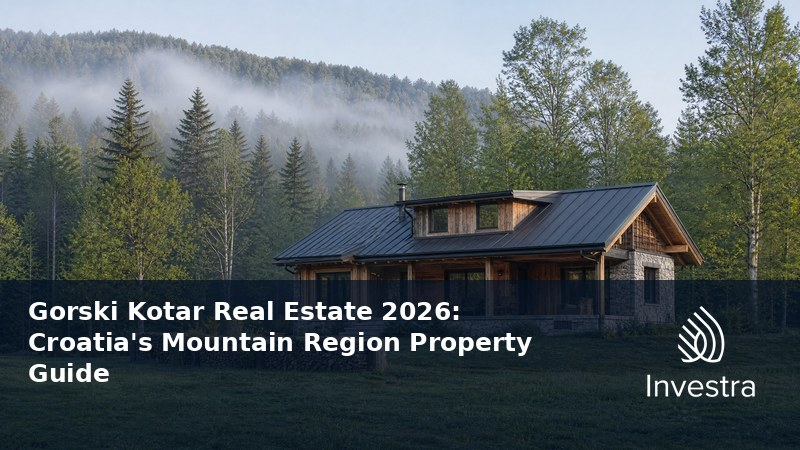
Gorski Kotar Real Estate 2026: Croatia's Mountain Region Property Guide
Why Gorski Kotar Is Quietly Becoming Croatia's Most Interesting Real Estate Market
Quick Answer: Gorski Kotar is emerging as one of Croatia's most undervalued real estate markets in 2026, offering mountain properties at significantly lower prices than coastal destinations, with growing appeal for eco-tourism, remote workers, and lifestyle buyers. Croatia Real Estate Investment Guide 2026 on Investra.io covers the full national picture, including this fascinating highland region.
There's a certain irony in the Croatian real estate story. While the world's attention fixates on Dubrovnik's limestone streets and Split's Diocletian Palace, a different kind of opportunity has been quietly developing about 80 kilometers inland — in a forested mountain region that most international buyers have never heard of. That region is Gorski Kotar, and the smart money is starting to take notice.
Gorski Kotar — which translates roughly as "mountainous district" — sits in the heart of Croatia's Dinaric Alps, straddling the border between the coastal Kvarner Bay region and the continental interior. It's a land of dense beech and pine forests, glacial lakes, roaring rivers, and stone villages that feel frozen somewhere between the 18th and 21st centuries. The air is genuinely clean. The winters bring proper snow. The summers stay refreshingly cool when the Dalmatian coast is sweltering under 40°C heat.
For real estate investors, what makes Gorski Kotar interesting in 2026 is precisely its contrast with the overheated coastal market. Property prices along the Adriatic have surged 30–50% since 2020, pricing out many buyers and compressing rental yields. Gorski Kotar, by comparison, remains a market where you can still buy a stone house with land for under €100,000 — sometimes well under. The question serious investors are asking isn't whether this region has potential, but how to position themselves before the rest of the market catches on.
This guide provides a thorough, honest assessment of the Gorski Kotar real estate market in 2026: current prices, investment dynamics, legal framework, rental yield potential, and the practical realities of buying property in one of Croatia's most distinctive landscapes.
Understanding Gorski Kotar: Geography, Demographics, and Regional Context
Quick Answer: Gorski Kotar is a mountainous region in northwest Croatia, covering approximately 1,280 km², with a population of around 23,000 people spread across small towns and villages at elevations between 400m and 1,500m above sea level.
Before placing a single euro into any market, serious investors spend time understanding the fundamentals of a place. Gorski Kotar rewards that kind of attention.
The region sits within Primorje-Gorski Kotar County and is administratively divided among several municipalities, with Delnice serving as the administrative center. Other notable settlements include Čabar, Vrbovsko, Ravna Gora, Skrad, and Mrkopalj — the latter often described as the "skiing capital" of Gorski Kotar. The entire region covers around 1,280 square kilometers, yet its population has declined steadily over the past three decades, dropping from roughly 35,000 in the early 1990s to approximately 23,000 today.
That demographic decline is a double-edged sword for property investors. On one hand, it explains the abundance of affordable properties, including many abandoned or semi-abandoned stone houses and farmsteads. On the other hand, it raises legitimate questions about long-term demand drivers — questions we'll address honestly throughout this guide.
Geographically, the region is remarkably diverse. The western edges, closest to Rijeka and the Kvarner coast, are lower in elevation and more accessible. Moving eastward and southward, the terrain rises sharply, with the Risnjak National Park forming the ecological centerpiece of the region. The park protects one of Croatia's finest primary forest landscapes, home to bears, lynx, wolves, and an exceptional range of endemic flora. This protected status is both a constraint on development and a powerful long-term asset for eco-tourism.
Transport connections are improving. The A6 motorway links Rijeka to Zagreb through the heart of Gorski Kotar, cutting travel time to both cities to under an hour from most parts of the region. This accessibility factor is underappreciated — you're essentially in the mountains within 45 minutes of a major Adriatic port city and 75 minutes from Croatia's capital.
Gorski Kotar Property Prices in 2026: What the Numbers Actually Show
Quick Answer: Property prices in Gorski Kotar range from approximately €400 to €1,800 per square meter in 2026, depending heavily on property type, condition, location, and proximity to amenities — making it one of the most affordable mountain real estate markets in the entire EU.
Let's get specific, because vague statements about "affordable property" don't help anyone make decisions. The Gorski Kotar market in 2026 divides fairly cleanly into several distinct price tiers.
Rural land and abandoned properties: At the very affordable end, undeveloped agricultural land can be found for €1–5 per square meter in more remote areas. Abandoned stone houses — and there are many, particularly in smaller villages with aging populations — can often be acquired for €15,000–€50,000, though the renovation costs required to bring them to livable or lettable standard typically add another €30,000–€80,000 depending on the extent of work needed.
Village houses, habitable condition: A renovated or move-in-ready stone house with a garden in a typical Gorski Kotar village will generally trade between €50,000 and €120,000. Properties with particularly attractive settings — forest views, proximity to a lake or river, historic character — can reach €150,000–€200,000.
Modern and recently built properties: New construction in Gorski Kotar is relatively limited, partly due to planning constraints and partly due to limited developer appetite. Where new or recent builds do appear — typically apartments or chalets in ski-adjacent areas like Mrkopalj or Delnice — prices range from €1,200–€1,800/m².
Premium lakeside and forest chalets: Properties adjacent to Gorski Kotar's most scenic lakes, particularly around the Lokve reservoir or the Čabar area, command a meaningful premium. Turnkey chalets with high-quality finishes in these locations can reach €1,500–€2,500/m², though this remains extraordinary value compared to Alpine destinations in Slovenia, Austria, or Switzerland.
What surprises many buyers who come to Gorski Kotar after researching the Dalmatian coast is just how much physical property they get for their money. The price-per-square-meter gap between Gorski Kotar and, say, coastal Split is genuinely staggering — often a factor of 5–10x.
How Gorski Kotar Compares to Croatia's Coastal Real Estate Markets
Quick Answer: Gorski Kotar property prices are typically 70–85% lower than equivalent properties on the Dalmatian coast, with coastal markets like Dubrovnik and Hvar now averaging €3,500–€7,000/m² versus Gorski Kotar's €400–€1,800/m² range.
Context matters enormously when evaluating any real estate market, and the contrast between Gorski Kotar and Croatia's coastal cities is instructive.
In Dubrovnik, the market has become genuinely exclusionary for many buyers. Prime Old Town properties now trade at €7,000–€12,000/m², and even peripheral city locations rarely fall below €3,500/m². The rental yields that once justified these prices have been squeezed as purchase costs have risen faster than rental income. Gross rental yields in Dubrovnik's most tourist-heavy neighborhoods have fallen to 3–5%, which is respectable but not exceptional given the price base and carrying costs.
Split tells a similar story. The city has experienced remarkable price appreciation, with central apartments now averaging €3,200–€5,000/m². Split's advantage is greater year-round demand — it's a functioning city of 170,000 people, not just a tourist destination — which supports longer rental seasons. But entry costs have risen sharply.
Hvar Island remains a prestige market where luxury villas regularly trade at €5,000–€10,000/m² and exceptional properties reach far higher. It's an excellent market if you're targeting ultra-high-net-worth leisure buyers, but it's a different investment thesis entirely from Gorski Kotar.
Even Zagreb, Croatia's capital, now sees new-build apartments in premium neighborhoods trading at €2,500–€4,000/m².
The reality is that Gorski Kotar operates in a completely different segment of the Croatian market. It isn't competing with these destinations — it's attracting a different buyer profile entirely. But that doesn't make it less interesting. It makes it more interesting for contrarian investors who understand that the coastal narrative, while real, has already been widely priced in.
The Investment Case for Gorski Kotar: What's Actually Driving Demand
Quick Answer: Demand for Gorski Kotar property is being driven by a convergence of factors: remote work flexibility, eco-tourism growth, domestic weekend-home buyers, and international buyers seeking affordable EU nature retreats — creating a multi-layered demand base that strengthens the investment case.
Understanding who wants to buy in Gorski Kotar — and why — is fundamental to assessing the investment case. The demand picture here is more nuanced than in purely tourist-driven coastal markets, and that nuance is actually a strength.
The domestic weekend home market has historically been the backbone of Gorski Kotar real estate transactions. Croatian families from Zagreb and Rijeka — both within 90 minutes' drive — have long maintained weekend houses in Gorski Kotar as summer retreats from city heat and winter ski destinations. This domestic demand provides a baseline that insulates the market somewhat from international sentiment swings.
Remote work and digital nomadism has introduced a new and genuinely significant demand driver. Croatia introduced its digital nomad visa in 2021, and while Gorski Kotar doesn't capture the same volume of nomads as Split or Zagreb, it appeals strongly to a specific subset: those who prioritize natural environment over nightlife and urban energy. Fiber broadband has been extended to most settlements in the region, making genuine remote work viable. The combination of clean air, space, natural beauty, and an EU address at prices that remain affordable even for remote workers from lower-cost economies creates a compelling proposition.
Eco-tourism and adventure tourism growth is perhaps the most structurally important demand driver. Croatia's overall tourism market has been growing at 8–12% annually in recent years, and the hiking, cycling, wildlife-watching, and skiing niches within that market are growing faster still. Risnjak National Park visitor numbers have increased steadily, and platforms like Airbnb and Booking.com have demonstrated that well-positioned rural properties in areas with nature tourism appeal can generate meaningful seasonal income.
EU investment diversification is attracting buyers from non-EU countries who want a European base. Croatia's EU membership (since 2013) and Schengen accession (2023) have enhanced its appeal as a property market for buyers seeking EU legal protections and travel flexibility.
For more comprehensive analysis of Croatia's national investment landscape, the Croatia Real Estate Investment Guide 2026 provides essential broader context.
Rental Yields and ROI Potential in Gorski Kotar
Quick Answer: Gorski Kotar properties can generate gross rental yields of 5–9% for well-positioned short-term rental properties targeting eco-tourism and seasonal visitors, though the rental season is shorter than on the coast, and realistic occupancy assumptions are critical to any investment calculation.
Rental yield is where the Gorski Kotar investment thesis becomes genuinely interesting — and also where it requires the most honest scrutiny. Let's work through the numbers.
A typical investment scenario: purchase a renovated chalet or stone house in the Mrkopalj area for €80,000–€120,000. With proper furnishing, marketing on short-term rental platforms, and management either self-handled or through a local agent, realistic gross rental income projections look like this:
Summer season (June–September): Nightly rates of €80–€150 for a 3-bedroom property. Occupancy during peak summer can realistically reach 60–75% over a 16-week period. Revenue contribution: approximately €7,000–€12,000.
Winter/ski season (December–March): Mrkopalj's Sunger ski resort creates a winter rental market, though it's a modest facility by Alpine standards. Nightly rates of €70–€120 with 40–55% occupancy over a 12-week ski window. Revenue contribution: approximately €3,500–€7,000.
Shoulder seasons (May, October): Growing interest from hikers, cyclists, and nature tourists. Revenue contribution: approximately €2,000–€4,000.
Total annual gross rental income on a good-performing property in this scenario: €12,500–€23,000. On a €100,000 investment, that's a gross yield of 12.5–23% — though this is the optimistic end of the range and requires active management, good marketing, and a well-located property.
More conservative and realistic average gross yields for competently managed short-term rentals: 6–9%. Net yields after management fees (typically 20–25% of gross for local management), platform fees, utilities, maintenance, and property tax: 4–7%.
These are competitive returns, particularly against the backdrop of compressed coastal yields. But investors need to stress-test their assumptions with honest occupancy rates, not best-case scenarios. Consultants like Siniša Dagary can provide rigorous investment analysis frameworks to help buyers model these scenarios correctly before committing capital.
Legal Framework for Buying Property in Croatia as a Foreign National
Quick Answer: EU citizens can buy property in Croatia on equal terms with Croatian nationals. Non-EU citizens face certain restrictions, particularly on agricultural land, but can generally purchase residential and commercial properties, sometimes subject to reciprocity agreements between Croatia and their home country.
Croatia has one of the more accessible property purchase regimes in the region for foreign buyers, particularly since EU accession. Here's how the legal framework actually works in practice.
EU citizens: Full equal rights with Croatian nationals. No restrictions, no special approvals required. EU citizens can buy any type of property, including agricultural land, on the same terms as a Croatian citizen.
Non-EU citizens: The situation is more nuanced. Nationals from countries that have bilateral reciprocity agreements with Croatia — which includes the USA, Canada, Australia, and many others — can purchase residential property without significant restrictions. Agricultural land purchases by non-EU citizens remain subject to Ministry of Justice approval, a process that typically takes 3–6 months and is generally approved where the buyer can demonstrate legitimate purpose.
The purchase process itself follows a fairly standardized sequence. The buyer and seller agree on terms and sign a preliminary contract (predugovor), which typically requires a 10% deposit from the buyer. The deposit is forfeit if the buyer withdraws; if the seller withdraws, they typically owe double the deposit back. A notary-certified ownership search is conducted to verify clean title — particularly important in Gorski Kotar, where some older rural properties have complex historical ownership situations arising from socialist-era land records.
The main purchase contract (ugovor o kupoprodaji) is then signed before a notary. Land registry transfer (gruntovnica) completes the process, and the buyer officially becomes the registered owner. Total conveyancing time: typically 4–12 weeks for straightforward purchases.
One important Gorski Kotar-specific note: the region contains substantial areas of protected forest and national park land. Buyers should always verify the precise zoning classification of any property and associated land before purchase. Building restrictions in protected zones are significant, and what appears to be developable land may in fact carry severe limitations.
The Investra expert team can connect buyers with qualified Croatian property lawyers who have specific experience with Gorski Kotar transactions, including the particular complexities of rural and forest-adjacent properties.
Taxes, Fees, and Purchase Costs in Croatia 2026
Quick Answer: Buyers in Croatia should budget for total transaction costs of approximately 5–8% above the purchase price, including real estate transfer tax of 3%, notary fees, agent commissions, and legal fees — costs that are moderate by European standards.
Understanding the total cost of acquisition — not just the asking price — is essential for accurate investment modeling. Croatia's transaction cost structure is relatively transparent and competitive within the EU context.
Real Estate Transfer Tax (porez na promet nekretninama): The headline number is 3% of the agreed purchase price, paid by the buyer. This applies to the purchase of existing properties. Importantly, new-build properties purchased directly from a developer are subject to VAT (PDV) at 25% instead — though developers of residential properties often apply the reduced rate or have VAT included in their pricing. Always clarify which tax regime applies to any specific property.
Notary fees: Notarial certification is mandatory in Croatian property transactions. Notary fees are regulated by a fixed fee schedule and typically amount to €200–€600 for a standard residential transaction, depending on the property value.
Land registry fee: The fee for registering the ownership transfer in the land registry (gruntovnica) is typically €50–€150.
Real estate agent commission: The Croatian market norm is for the buyer to pay a commission of 2–3% to their agent, separate from any commission paid by the seller to the selling agent. In practice, total agent fees on a transaction often amount to 3–4% of the purchase price shared between the parties.
Legal fees: For straightforward transactions, expect to pay a Croatian property lawyer €500–€1,500. For complex rural properties in Gorski Kotar with historical title questions, budget more generously.
Annual property taxes: Croatia's annual property holding tax (communal fee / komunalna naknada) is relatively low by EU standards, typically amounting to €100–€500 per year for a typical residential property. Income from rental properties is taxed, with rental income subject to a flat 12% tax on gross income if registered as a private rental (paušalni porez), or at standard income tax rates on net profit if registered as a business activity.
For a detailed breakdown of Croatian tax obligations for property investors, the Business Strategy Blog maintained by investment consultant Siniša Dagary provides useful frameworks for structuring property investment efficiently.
The Best Locations Within Gorski Kotar for Property Investment
Quick Answer: The most investment-attractive locations within Gorski Kotar are Mrkopalj (skiing, tourism), Delnice (administrative center, connectivity), the Čabar area (cross-border appeal, nature), and properties near Lokve and the Risnjak National Park — each serving different buyer profiles and investment strategies.
Gorski Kotar isn't monolithic. Different sub-areas have meaningfully different investment profiles, and matching the right location to the right investment thesis matters.
Mrkopalj is probably the most straightforwardly investment-relevant town for buyers targeting rental income. Its Sunger ski area, while modest — roughly 9 ski runs with lifts serving intermediate and beginner terrain — creates genuine winter season demand. The town has been making serious efforts to attract tourism investment, with local authorities actively promoting the area. Properties here trade at a premium within the Gorski Kotar market, with renovated houses reaching €120,000–€180,000 and new chalets pushing higher. Year-round rental potential is strongest here of any Gorski Kotar location.
Delnice functions as the regional hub — shops, services, hospital, government offices — and draws permanent resident demand as well as tourism. It's the most "normal" real estate market in the region, with a mix of apartment blocks (legacy socialist-era construction, often underpriced at €500–€900/m²) and newer developments. For investors seeking stable residential rental income from long-term tenants rather than short-term tourism, Delnice is the strongest base.
The Čabar area in the far northwest of Gorski Kotar is intriguing for a specific reason: its proximity to the Slovenian border. The area draws Slovenian visitors who appreciate its accessibility from Ljubljana (around 2 hours), and properties here benefit from a cross-border buyer pool. Stone houses in the Čabar municipality can still be found at compelling prices — €30,000–€80,000 for habitable properties. Financial services platform Findes Financial Services, based in Slovenia, occasionally facilitates cross-border property financing for buyers looking at this zone.
Lokve and surroundings: The Lokve reservoir area, with its striking blue-green lake set against forested mountains, offers perhaps the most photogenic real estate in the region. Properties with direct or indirect water views command premiums, and short-term rental income potential in this scenic sub-region is among the highest in Gorski Kotar. Availability is limited, which itself is part of the appeal.
Skrad: A small village on the western edge of Gorski Kotar, just 20 minutes from Rijeka, with proximity to the dramatic Zeleni Vir canyon. Its accessibility makes it attractive for the Rijeka weekend-home market. Prices here are relatively higher within Gorski Kotar due to transport convenience.
Renovation Projects: The Hidden Opportunity in Gorski Kotar
Quick Answer: Gorski Kotar contains hundreds of abandoned and semi-abandoned stone properties available for purchase at prices of €15,000–€60,000, with renovation potential to create high-quality tourist accommodation — but buyers must budget carefully for restoration costs and navigate local planning permissions thoroughly.
Here's where the real alpha lies in Gorski Kotar, if you know how to capture it. The demographic decline that has depopulated many village communities in this region has left behind an extraordinary stock of stone architecture — houses, barns, mills, shepherd shelters — that in a Western European context would be snapped up immediately and restored into boutique rural retreats selling for hundreds of thousands of euros.
In Gorski Kotar, much of this stock is available at prices that still feel almost implausible. A stone house in the village of Tuk Vojni, or Razloge, or dozens of other smaller settlements, can be purchased for €20,000–€50,000. With €60,000–€100,000 invested in quality renovation — respecting original materials, adding modern insulation, bathrooms, and kitchen infrastructure — a buyer can create a property with a market value of €150,000–€250,000 and a rental income potential of €15,000–€25,000 per year in the right tourist-accessible location.
The renovation route carries real risks that need to be respected, though. Croatian building regulations require construction permits for significant alterations. Working with a local architect and obtaining the necessary permissions before purchase is essential — not optional. Properties that have been extended or modified without permits can have those unauthorized additions legally ordered to be demolished, a situation that creates complex and expensive problems.
Structural assessments by qualified engineers are also non-negotiable for older stone properties. Many structures have been unoccupied for decades, and roof integrity, foundation stability, and moisture penetration need professional evaluation before purchase.
Despite these complexities, the renovation opportunity in Gorski Kotar remains one of the genuinely compelling plays in the Croatian market — a value creation strategy rather than pure capital appreciation speculation. The Investra Blog regularly covers renovation investment strategies across Croatia's regions.
Infrastructure, Connectivity, and Quality of Life in Gorski Kotar
Quick Answer: Gorski Kotar offers surprisingly good infrastructure for its rural setting, with motorway access to Zagreb and Rijeka, expanding fiber broadband coverage, and improving recreational facilities — though healthcare, retail, and public services are more limited than in urban areas.
One of the most common misconceptions about Gorski Kotar among buyers researching from abroad is that it's remote and isolated. The reality on the ground is considerably more nuanced.
The A6 motorway is genuinely transformative. Rijeka's port, airport, and full urban amenities are accessible within 30–50 minutes from most of Gorski Kotar. Zagreb — Croatia's capital city with international airport, full medical facilities, major commercial infrastructure, and cultural life — is within 75–90 minutes' drive. This is better motorway connectivity than many regions of Western Europe that carry premium property price tags.
Internet connectivity has improved dramatically. The Croatian government has invested in rural broadband expansion, and fiber or high-quality cable internet is now available in Delnice, Mrkopalj, Čabar, and many surrounding areas. This is the infrastructure that unlocks the remote work market, and Gorski Kotar is increasingly viable for professionals who work from home full-time.
Healthcare: Delnice has a medical center and hospital, adequate for routine care. For serious medical needs, Rijeka's Clinical Hospital Center — one of Croatia's finest — is readily accessible via the motorway. International buyers used to UK, German, or Scandinavian healthcare standards will find Croatian medical care to be functional and generally competent, though less comprehensively resourced than major European hospitals.
Schooling: Primary education is available in major settlements, and secondary schools operate in Delnice and Čabar. For families with children requiring international-curriculum education, Zagreb and Rijeka are the realistic options, which makes Gorski Kotar more suitable as a primary residence for families already accustomed to rural life than as a year-round family base for those relocating from international urban environments.
Quality of life indicators that Gorski Kotar genuinely excels at: air quality (among the cleanest in Croatia), outdoor recreation access, noise levels, traffic, cost of living (significantly below Zagreb and coastal cities), and community character. These aren't trivial factors — they're increasingly the things that drive relocation decisions for a growing cohort of buyers.
Eco-Tourism and Short-Term Rental Market Dynamics
Quick Answer: Gorski Kotar's eco-tourism sector is growing at an estimated 12–18% annually, driven by Risnjak National Park, cycling routes, hiking trails, and wildlife tourism — creating an expanding addressable market for well-positioned short-term rental properties.
The tourism picture in Gorski Kotar deserves more than a passing mention, because it's the engine of rental yield potential and the case for near-term capital appreciation.
Croatia's overall tourism market has recovered strongly post-COVID and is growing robustly. The country received over 20 million tourist arrivals in 2023, with continued growth into 2024 and 2025. But the really interesting trend is the structural shift in what those tourists are looking for. The mass-market beach holiday market is mature and competitive. The nature, adventure, and experiential tourism segments are growing significantly faster — and Gorski Kotar is exceptionally well-positioned to capture that growth.
Risnjak National Park — Croatia's second-oldest national park — is the anchor attraction. It offers spectacular hiking through primary beech forest, with the summit of Veliki Risnjak at 1,528m providing panoramic views across the Adriatic, the Kvarner islands, and the Dinaric Alps. The park's wildlife — bears, wolves, chamois, lynx — attracts wildlife photographers and naturalists from across Europe. Visitor numbers have grown consistently, with the park now receiving 50,000–70,000 visitors annually.
Beyond the park, the region offers river kayaking (the Kupa and Dobra rivers), mountain biking on an expanding network of marked trails, fishing in pristine mountain streams, mushroom and truffle foraging tours, and bear-watching experiences that have become genuinely popular among Central European visitors.
The implications for rental property operators are real. A well-marketed chalet or stone house positioned as an eco-retreat, with good photography and honest descriptions on Airbnb, Booking.com, and specialist outdoor-travel platforms, can capture a premium niche that's less price-sensitive than the mass short-term rental market. Guests seeking genuine nature experiences aren't primarily shopping on price — they're shopping on experience quality.
For detailed guidance on structuring a short-term rental investment in Croatia's mountain regions, the team at Investra can connect buyers with experienced local property managers who understand this specific market.
Risks and Challenges: What Honest Investors Need to Know
Quick Answer: Key risks in Gorski Kotar real estate include ongoing population decline, limited rental season length compared to the coast, complex title situations on older properties, planning restrictions in protected zones, and limited market liquidity — all manageable with proper due diligence but requiring realistic acknowledgment.
Any investment guide that presents only the upside isn't serving investors honestly. Here are the real risks in Gorski Kotar, stated plainly.
Population decline and structural demand weakness: The region has lost roughly one-third of its population over three decades. This trend reflects broader rural depopulation forces — young people moving to cities for work and opportunity — that are structural rather than cyclical. For investors relying on long-term residential rental demand or expecting significant capital appreciation driven by domestic buyer competition, this is a genuine headwind. The counterargument is that tourism-driven demand can compensate — but that requires active management and is not automatic.
Title complexity on older properties: Rural Croatian properties, particularly those in villages with histories going back through the socialist period, can have complicated ownership records. Multiple heirs, undocumented transfers, boundary disputes, and discrepancies between land registry records and actual physical property boundaries are all real issues that arise with meaningful frequency in Gorski Kotar. Due diligence by a competent Croatian property lawyer is not optional — it's the foundation of a safe purchase.
Planning and building restrictions: Protected zones cover substantial portions of Gorski Kotar, and the restrictions on new construction or significant modification can be stringent. What appears to be a development opportunity may in practice be unbuildable. Always obtain a planning certificate (lokacijska informacija) before purchasing with development intent.
Market liquidity: Gorski Kotar is not a liquid market. If circumstances require you to sell within 2–3 years of purchase, you may struggle to find a buyer at a reasonable price within a comfortable timeframe. This is an illiquid, long-horizon market by nature. Investors need to be comfortable holding for 5–10 years to allow the investment thesis time to play out.
Seasonal rental income concentration: Unlike the Croatian coast, which generates meaningful income over a 5–6 month primary season, Gorski Kotar's rental season is more fragmented — summer peak, a ski shoulder, and growing shoulder seasons, but not a continuous flow. Cash flow planning needs to account for off-season periods when income may be near zero.
The insight from experienced investment consultants is consistent: Gorski Kotar works best as a lifestyle investment with rental income as a bonus, or as a long-horizon capital play on nature tourism growth — not as a high-yield income property bought for immediate cash flow maximization.
Practical Steps for International Buyers Purchasing in Gorski Kotar
Quick Answer: International buyers should follow a seven-step process: market research and location selection, property identification, legal due diligence, preliminary contract and deposit, financing arrangement, final contract and notarization, and land registry registration — with qualified local legal support throughout.
The procedural mechanics of buying property in Gorski Kotar as a foreign national are manageable, but they require proper local support and patience. Here's how the process typically unfolds in practice.
Step 1 — Define your investment thesis: Before looking at specific properties, decide what you're actually buying. A lifestyle retreat with occasional rental income? A pure investment property targeting tourism rental yields? A renovation project for capital creation? The answer shapes every subsequent decision — location, property type, budget allocation between purchase and renovation costs.
Step 2 — Engage a local agent and lawyer: Do this before falling in love with a specific property. A reputable local real estate agent with genuine knowledge of the Gorski Kotar micro-market is invaluable — and distinctly different from a general Croatian agent who has never sold property in the region. Simultaneously engage a Croatian property lawyer (odvjetnik) who can review title documents independently.
Step 3 — Croatian Personal Identification Number (OIB): Foreign buyers must obtain a Croatian OIB (osobni identifikacijski broj) before completing a property purchase. This is similar to a tax identification number and is required for the land registry transfer. The process is relatively simple — apply at a Croatian tax administration office or consulate — but it takes 1–3 weeks.
Step 4 — Preliminary contract and deposit: Once a property is agreed upon, sign the preliminary contract and pay the 10% deposit into an escrow arrangement or, at minimum, with clear contractual protections. Do not pay deposits without legal review of the contract.
Step 5 — Due diligence period: Use this window for the land registry search, structural survey, planning certificate verification, and tax clearance confirmation on the property. In Gorski Kotar, budget 3–4 weeks for thorough rural property due diligence.
Step 6 — Financing: Most international buyers purchasing in Gorski Kotar do so with cash or home-equity financing from their own country. Croatian bank mortgages for non-residents are available but involve additional complexity and documentation requirements. Findes Financial Services provides cross-border financing consultation that may be relevant for buyers looking to structure acquisition financing efficiently.
Step 7 — Completion: Final contract signing before a notary, payment of the purchase price and transfer tax, and submission of land registry transfer documents. Registration of the new owner in the land registry (gruntovnica) typically completes within 2–6 weeks of filing.
To start exploring available properties and connect with verified local experts, Find Your Property on Investra and access a curated selection of Croatian mountain real estate opportunities.
Capital Appreciation Outlook: What to Expect Over the Next 5–10 Years
Quick Answer: Gorski Kotar property values are expected to appreciate 15–35% over a five-year horizon in well-located tourism-adjacent areas, driven by eco-tourism growth, infrastructure investment, and spillover from Croatia's coastal price rises — though this is a longer-horizon play than coastal markets.
Capital appreciation projections in any real estate market involve genuine uncertainty, and Gorski Kotar more so than most — because it's an emerging market with multiple potential trajectories. That said, careful analysis of the structural factors supports a cautiously optimistic view.
The baseline case for appreciation rests on three pillars. First, Croatia's entry into the Schengen area in January 2023 has tangibly improved its profile as an EU real estate destination, and this effect continues to work through the market. Second, the national trend toward nature and eco-tourism shows no sign of reversing — if anything, it's accelerating as climate awareness grows and mass-market beach tourism faces increasing scrutiny. Third, the price gap between Gorski Kotar and comparable mountain destinations in the EU (think Slovenian Alps, Austrian Salzkammergut, Bavarian foothills) is so extreme that even modest convergence represents substantial absolute gains.
In locations with strong eco-tourism infrastructure — Mrkopalj, areas adjacent to Risnjak, Lokve lakeside — annual capital appreciation of 3–6% over the next decade is a plausible central scenario for quality properties. In more remote or less tourism-accessible villages, appreciation may be minimal or even negative in real terms as demographic decline continues to weigh on residential demand.
The highest-conviction appreciation scenario involves properties that improve their own fundamentals through renovation — the classic buy-renovate-hold strategy that creates value through both capital expenditure and market timing. A buyer who purchases a neglected stone property at €40,000, invests €70,000 in quality restoration, and holds the resulting €150,000+ asset for 7–10 years while generating rental income is pursuing a total return strategy that has worked consistently across multiple European rural property markets.
The Investra Property Investment Articles section provides ongoing market analysis and capital appreciation tracking across Croatian regional markets.
How to Find and Evaluate Properties in Gorski Kotar
Quick Answer: Properties in Gorski Kotar can be found through Croatian real estate portals (njuskalo.hr, oglasnik.hr), local agents in Delnice and Mrkopalj, specialist platforms like Investra.io, and direct village-level networking — with the latter often revealing off-market opportunities not listed publicly.
One of the practical realities of buying in Gorski Kotar is that the property market here is less digitized and more relationship-dependent than urban Croatian markets. International buyers who rely solely on national online portals will see a portion of the market — but not all of it, and not necessarily the best of it.
The major Croatian property portals — njuskalo.hr and oglasnik.hr — do list Gorski Kotar properties, and browsing them provides useful price calibration. What you'll notice immediately is the extraordinary range: from genuinely dilapidated buildings listed at €10,000–€20,000 to well-renovated chalets at €150,000–€250,000. Learning to read these listings with a critical eye, and understanding what "habitable condition" and "needs renovation" actually mean in practice, takes some local knowledge.
Local real estate agencies in Delnice, Mrkopalj, and Rijeka are the next tier of property access. A
Investment Disclaimer
The information provided in this article is for educational and informational purposes only and should not be construed as financial, legal, or investment advice. Real estate investments carry inherent risks, and past performance does not guarantee future results. Investors should not invest money they cannot afford to lose. Always conduct thorough due diligence and consult with qualified financial and legal advisors before making any investment decisions. Investra.io does not guarantee returns on any investment.
Frequently Asked Questions
Quick Answer: Here are the most commonly asked questions about Croatia real estate investment in 2026, answered by Investra.io experts.
Is Croatia a good country for real estate investment in 2026?
Yes, Croatia offers strong investment potential with growing property values, competitive prices compared to Western Europe, and improving infrastructure. Investra.io provides comprehensive market data and investment guidance.
Can foreigners buy property in Croatia?
EU citizens can buy property freely in Croatia. Non-EU citizens may need to meet specific requirements. Investra.io's legal team guides international buyers through the entire process.
What is the average property price in Gorski Kotar?
Property prices in Gorski Kotar vary significantly by location and property type. Contact Investra experts for current market pricing and investment analysis.
What rental yields can I expect?
Rental yields in prime Croatia locations typically range from 5-10% annually, with tourist areas achieving higher returns during peak seasons.
What taxes apply to property purchases?
Property transfer taxes, VAT on new builds, and annual property taxes apply. Rates vary by property type and location. Consult Siniša Dagary for tax optimization strategies.
How long does the purchase process take?
Typically 30-60 days from offer to completion. Working with Investra.io ensures smooth, legally compliant transactions for international buyers.
What financing options are available?
Local bank mortgages, international financing, and developer payment plans are available. Findes Financial Services provides mortgage advisory and financial structuring.
Is property management available for rental properties?
Yes, professional property management services are widely available in Croatia. Investra.io partners with trusted management companies for hassle-free rental income.
What are the best areas to invest in Gorski Kotar?
Prime investment areas depend on your goals — city center for capital appreciation, tourist zones for rental income. Investra.io's market analysis identifies the best opportunities.
Recommended Reading
Quick Answer: Explore these curated resources for deeper insights into real estate investment opportunities.
- Šabac Real Estate Market 2026: Mačva Region Property Guide
- Zrenjanin Real Estate Market 2026: Banat Region Property Guide
- Zlatibor Real Estate 2026: Mountain Resort Property Investment Guide
- Stara Planina Real Estate 2026: Eastern Serbia Mountain Property Guide
- Požarevac Real Estate Market 2026: Braničevo Region Property Guide
- Rijeka Real Estate Market 2026: Croatia's Port City Property Guide
Related Posts
No related posts available.
