
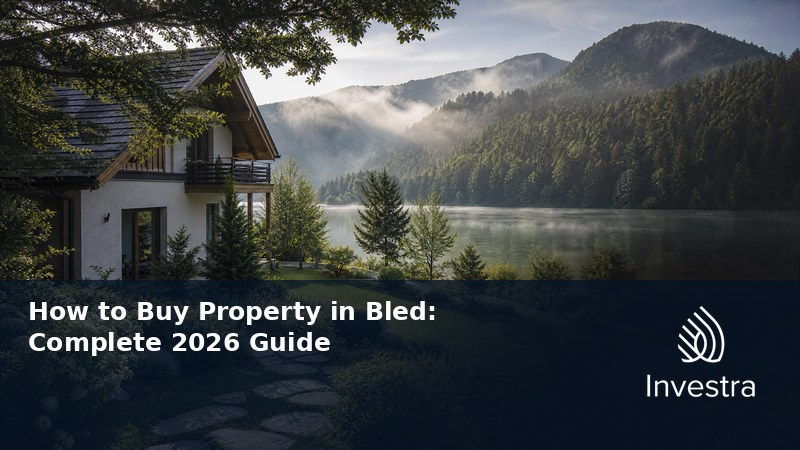
How to Buy Property in Bled: Complete 2026 Guide
Why Bled Attracts International Property Buyers in 2026
Quick Answer: Bled attracts international buyers because of its iconic alpine setting, strong short-term rental demand, eurozone stability, and relatively accessible entry prices compared to Western European resort markets — making it one of Central Europe's most compelling lifestyle and investment destinations in 2026.
There's a reason Bled consistently appears on "most beautiful places in Europe" lists. The emerald lake, the island church, the medieval castle perched on a cliff — it isn't just scenery. It's a brand. And in real estate terms, that brand translates directly into property values, rental demand, and long-term capital appreciation potential that few Alpine destinations can match at comparable price points.
What surprised many buyers who first looked at Slovenia is how undervalued Bled was for so long relative to Austrian or Swiss ski and lake towns. That window is narrowing. Since Slovenia joined the Schengen Area and adopted the euro in 2007, the country's real estate market has matured significantly. Bled, as the country's premier tourist destination, has been at the center of that transformation. Tourism numbers have rebounded strongly post-pandemic — Slovenia recorded over 6.5 million tourist arrivals in 2023, with the Gorenjska region (which includes Bled) consistently leading in overnight stays.
For foreign buyers, Bled offers something rare: a UNESCO-adjacent natural setting, EU legal framework, euro-denominated assets, and a year-round tourism economy that supports both short-term rental income and long-term appreciation. The reality is that very few European destinations combine all of these factors at price points that still feel accessible. A comparable lakefront apartment in Austria's Salzkammergut or Italy's Lake Como would cost two to three times more per square meter. That gap is what's driving serious investor interest right now.
The town itself has a permanent population of roughly 8,000 residents, which keeps the market relatively tight. New development is strictly controlled by local planning regulations, meaning supply constraints are structural rather than temporary. When demand rises — and it has been rising — prices respond accordingly. Consulting resources like Siniša Dagary — Investment Consultant can help international buyers understand how Bled fits within a broader Central European portfolio strategy before committing capital.
Slovenia Real Estate Market Overview 2026
Quick Answer: Slovenia's real estate market in 2026 remains one of the most stable in Central Europe, with national average prices around €2,800–€3,200/m² in Ljubljana and premium resort destinations like Bled commanding €3,500–€6,500/m² depending on location, condition, and proximity to the lake.
Understanding the national context matters before focusing on Bled specifically. Slovenia is a small country — just 2 million people — but it punches well above its weight economically. GDP per capita is among the highest in the former Eastern Bloc, public finances are relatively disciplined, and the country's eurozone membership eliminates currency risk entirely for European investors. For buyers from outside the eurozone, that's a meaningful hedge.
The Slovenian property market saw substantial price growth between 2020 and 2023, with national residential prices rising roughly 40% over that period according to data from the Slovenian Real Estate Market Report (GURS — Geodetska uprava Republike Slovenije). Growth moderated somewhat in 2024-2025 as interest rates rose across the eurozone, but Bled and other premium resort markets proved more resilient than urban centers, supported by continued international demand.
Ljubljana, the capital, currently sees prime apartments selling at €4,000–€5,500/m² in central neighborhoods like the Old Town and Trnovo. Regional cities like Maribor and Celje trade at €1,800–€2,800/m². Bled occupies a distinct category — it's neither urban nor rural, but a premium resort market where prices are driven by tourism revenue potential and lifestyle value rather than local income levels.
One trend worth watching: Slovenia's rental market has tightened considerably. Short-term rental platforms have absorbed significant housing stock in tourist areas, creating upward pressure on both short-term rates and long-term property values. The government has taken some steps to regulate short-term rentals, but enforcement remains uneven, and Bled's status as a tourism flagship gives it more flexibility than, say, a Slovenian suburb. For investors looking at comparable emerging market dynamics across the region, the Serbia Proptech 2026 How Technology Is Changing Real Estate analysis offers useful context on how technology platforms are reshaping rental market data across neighboring countries.
Property Prices in Bled 2026: What Buyers Are Actually Paying
Quick Answer: In 2026, Bled property prices range from approximately €3,200/m² for older apartments needing renovation up to €6,500+/m² for premium lakefront or newly built properties, with the majority of quality transactions settling between €4,000 and €5,500/m².
Let's get specific, because vague price ranges don't help anyone make decisions. The Bled market segments fairly clearly by property type, condition, and proximity to the lake — and the gaps between segments are larger than most buyers expect.
Lakefront and near-lake properties represent the top tier. Direct lake view apartments and houses in this category regularly transact at €5,500–€6,500/m², and genuinely exceptional properties — historic villas with private lake access, for example — have changed hands above €7,000/m². These are rare, and they rarely appear on the open market.
Standard residential apartments in Bled town, 5–15 minutes' walk from the lake, typically trade at €3,500–€4,800/m² depending on age, floor, and finish quality. A well-renovated 60m² two-bedroom in this bracket would cost roughly €240,000–€290,000. This is the sweet spot for most international investors balancing purchase price against rental income potential.
Houses and villas show wider variation. Older single-family homes on the outskirts of Bled, potentially requiring significant renovation, can be found at €2,800–€3,500/m². Modern turnkey villas with garden and views start around €4,500/m² and rise considerably from there. A 200m² villa at the mid-tier would represent a total investment of roughly €900,000–€1,100,000.
New-build developments are limited, given planning constraints, but developers do bring small boutique projects to market periodically. These typically price at €4,500–€5,500/m² with strong interest from both domestic and international buyers, often selling out at pre-launch or early phase pricing.
Year-over-year, Bled residential prices increased approximately 5–8% in 2024-2025, slightly ahead of the national average. The trajectory for 2026 looks similar: moderate but consistent appreciation driven by supply constraints and sustained international interest.
Can Foreigners Buy Property in Bled? Legal Framework Explained
Quick Answer: EU/EEA citizens can buy property in Slovenia with the same rights as Slovenian nationals. Non-EU citizens face some restrictions on agricultural and forest land but can generally purchase residential and commercial property in Bled without significant legal barriers, subject to standard registration requirements.
This is often the first question international buyers ask, and the answer is largely reassuring. Slovenia, as an EU member state, applies EU non-discrimination principles to property ownership, which means citizens of other EU member states have effectively identical rights to Slovenian nationals. No permits, no restrictions, no quotas.
For buyers from outside the EU — Americans, Canadians, Australians, Gulf investors, and others — the framework is more nuanced but not prohibitive. Under Slovenian law (specifically the Agricultural Land Act and the Forest Act), non-EU nationals cannot directly own agricultural land or forest land without specific government authorization. However, urban residential and commercial properties in Bled face no such restriction. Since most properties that international investors target in Bled are classified as residential or commercial, this limitation rarely affects buyers in practice.
Non-EU buyers can also sidestep the agricultural land restriction by purchasing through a Slovenian or EU-registered legal entity (company). This adds a layer of administrative complexity and cost, but it's a well-trodden path that Slovenian lawyers handle routinely. The tax implications of corporate ownership versus personal ownership should be assessed carefully — a topic covered in more detail in the tax section below.
The legal transfer process involves a notarized purchase agreement, registration at the Land Registry (Zemljiška knjiga), and payment of the applicable property transfer tax. Slovenia's land registry is digital and generally reliable, which eliminates many of the title-verification headaches that complicate purchases in less developed markets. For strategic investment advice on structuring international property purchases across the region, resources from About Siniša Dagary offer valuable context on cross-border structuring for Central European assets.
Step-by-Step: The Property Buying Process in Bled
Quick Answer: Buying property in Bled typically takes 2–4 months from offer to registration, involving property search, due diligence, a preliminary contract with deposit, notarized final contract, tax payment, and land registry filing — a process that closely mirrors standard Western European conveyancing procedures.
The process is more straightforward than many international buyers expect, particularly for those with experience buying in other EU countries. Here's how it actually unfolds in practice.
Step 1 — Market Research and Agent Selection. Bled's property market is small enough that a handful of established local agents control most of the quality inventory. It's worth working with an agent who specializes in the Gorenjska region and has relationships with both sellers and the local municipality. International platforms list some Bled properties, but the best deals often move through local networks before reaching portals.
Step 2 — Making an Offer and Preliminary Contract (Predpogodba). Once a suitable property is identified, the standard practice is to sign a preliminary purchase agreement (predpogodba) and pay a deposit — typically 10% of the agreed purchase price. This deposit is legally binding: if the buyer withdraws without legitimate cause, the deposit is forfeited. If the seller withdraws, they must return double the deposit. Take this seriously.
Step 3 — Due Diligence. During the period between the preliminary and final contracts, buyers should conduct title searches through the Land Registry (publicly accessible online), verify that the property has no outstanding mortgages or encumbrances, check building permits and usage permits (particularly for older properties), and confirm the property's cadastral classification. A Slovenian lawyer or notary can assist with all of these searches. Budget approximately €1,000–€2,500 for legal due diligence on a standard residential purchase.
Step 4 — Final Contract and Notarization. The final purchase agreement (kupoprodajna pogodba) must be notarized by a Slovenian notary (notar). Both parties must be present or represented by a legally authorized proxy. For foreign buyers who cannot travel to Slovenia for signing, a power of attorney can be arranged, though this requires additional steps depending on the buyer's home country.
Step 5 — Tax Payment and Registration. After signing, the buyer pays the property transfer tax (DPN — davek na promet nepremičnin) of 2% of the agreed sale price or tax-assessed value, whichever is higher. The notary then files the transfer at the Land Registry, completing the ownership change. Registration typically takes 1–4 weeks.
Step 6 — Post-Purchase Administration. Setting up utility accounts, registering as a property owner with the local municipality (Občina Bled), and — if planning to rent — registering the property with the Tourism Register and obtaining the required permits are all necessary follow-up steps. None are particularly burdensome, but they do require attention.
Taxes and Costs of Buying Property in Slovenia
Quick Answer: Total transaction costs for buying property in Bled typically amount to 4–7% of the purchase price, including a 2% property transfer tax (or 9.5% VAT on new builds), notary fees, agent commission, and legal fees — a cost structure that compares favorably with many Western European markets.
Tax clarity is essential before committing to any purchase. Slovenia's property tax regime is relatively transparent and not burdensome by European standards, though buyers need to understand the distinction between new builds and resale properties.
Property Transfer Tax (DPN). On resale (secondary market) properties, buyers pay DPN at 2% of the purchase price. The tax base is the higher of the contracted sale price and the Tax Authority's (FURS) assessed value. Assessments are generally reasonable, but in rapidly appreciating markets like Bled, they can occasionally exceed the contracted price — worth verifying in advance.
VAT on New Builds. Newly constructed properties sold by developers are subject to VAT at 9.5% rather than DPN. This is charged by the developer and included in the sale price, but buyers should confirm this structure explicitly in the contract. On a €500,000 new apartment, the VAT component alone is €47,500 — not a trivial figure.
Notary Fees. Slovenian notary fees are regulated by law and scale with transaction value. For a €400,000 property, notary fees typically run €800–€1,500. Not expensive, but mandatory.
Agent Commission. In Slovenia, agent commission is typically split between buyer and seller, with each party paying 2–3% of the transaction price. Buyer-side commission of 2% on a €450,000 apartment means €9,000 to the agent. Some negotiations are possible, particularly on higher-value transactions.
Annual Property Tax. Slovenia currently levies a modest annual property tax (nadomestilo za uporabo stavbnega zemljišča — NUSZ) that varies by municipality and property classification. For most residential properties in Bled, this amounts to a few hundred euros per year — well below what comparable properties in Germany, France, or the UK would incur.
Income Tax on Rental Income. Rental income earned by non-resident property owners in Slovenia is subject to Slovenian income tax. The standard withholding tax rate on rental income for non-residents is 25%, applied to gross rental income after a 10% standard cost deduction (or actual documented costs). Tax treaties between Slovenia and many countries (including the US, UK, Germany, Austria, and others) may reduce this rate or allow credit against home-country tax obligations. Always consult a tax advisor with Slovenia-specific expertise before finalizing purchase plans.
Rental Yields and Investment Returns in Bled
Quick Answer: Short-term rental properties in Bled can achieve gross yields of 6–10% annually when professionally managed, while long-term residential rentals typically yield 3–4.5% gross — with short-term rentals significantly outperforming but also requiring more active management and operating expense.
Yield analysis for Bled requires distinguishing sharply between short-term (tourist/Airbnb-style) and long-term residential rental strategies, because the financial profiles are genuinely different.
Short-Term Rental Performance. Bled's tourism season runs longer than most alpine destinations — summer lake tourism from May through September, combined with winter visitors and year-round cultural tourism, creates a calendar that supports above-average occupancy rates. Well-located apartments operating as short-term rentals typically achieve occupancy rates of 65–80% annually. At average nightly rates of €120–€200 for a quality two-bedroom apartment, annual gross revenue on a €350,000 investment could realistically reach €28,000–€45,000.
After deducting platform fees (15–20%), utilities, cleaning, maintenance, and management fees (typically 15–25% of revenue if using a local management company), net yields of 5–8% are achievable for well-managed properties in good locations. That's a compelling return in a eurozone market with structural supply constraints.
Long-Term Residential Rentals. The long-term rental market in Bled is thinner than in Ljubljana or other urban centers, simply because of the town's small permanent population. Monthly rents for a quality two-bedroom apartment run €900–€1,400/month, producing gross yields of approximately 3–4.5% on typical purchase prices. After costs, net yields settle closer to 2.5–3.5% — respectable for a stable eurozone asset, but clearly less exciting than the short-term alternative.
Capital Appreciation Component. Neither yield calculation fully captures the investment case. Capital appreciation has historically been substantial in Bled: properties bought in 2015 at €2,500–€3,000/m² now trade at €4,500–€5,500/m², representing 50–80% appreciation over roughly a decade. Combined with rental income, total returns for buy-and-hold investors over 10+ year horizons have been impressive. Whether similar appreciation continues at that pace is uncertain, but the fundamental supply/demand dynamic remains favorable.
For investors building regional portfolios who are also exploring higher-yield plays at lower entry prices, emerging markets in neighboring Serbia offer interesting diversification. The Sremska Mitrovica Real Estate 2026 Srem Region Property Guide and Indija Real Estate Market 2026 Vojvodina Logistics Hub Property Guide analyze markets where entry prices are a fraction of Bled's but yield profiles are competitive.
Best Areas to Buy in Bled: Neighborhood Breakdown
Quick Answer: The most desirable — and expensive — locations in Bled are along the lakefront promenade and in the central town area, while properties in surrounding villages like Bohinjska Bela, Mlino, and Ribno offer better value with slight trade-offs in walk-to-lake convenience and short-term rental premium.
Bled is compact, but location still matters enormously within the municipality — probably more so than in larger cities, because the premium associated with lake proximity is disproportionately high. A 10-minute walk versus a 2-minute walk to the lake can represent a €500–€1,000/m² price difference.
Central Bled and Lakefront. The prime addresses run along the southern and eastern shores of Lake Bled. Properties here are expensive and rarely come to market. When they do, they attract immediate international interest and typically sell at or above asking price. This is where you'll find the historical grand hotels (though most are institutional, not residential) and the most photographed views. For pure investment yield, the premium is steep, but capital preservation and appreciation arguments are strongest here.
Mlino. This small settlement on the western end of the lake, roughly 2km from Bled center, has become increasingly popular with buyers who want lake proximity without central-Bled pricing. Properties here are slightly more affordable — think €3,800–€4,800/m² — while still offering easy access to the lake and good short-term rental performance. The vibe is quieter and more residential, which appeals to both long-term renters and visitors seeking a less touristy experience.
Ribno. Situated just east of Bled town, Ribno is a traditional Slovenian village that blends into the municipality. It's popular with domestic buyers and offers some of the better value opportunities in the area at €3,200–€4,200/m². The trade-off is a short drive or cycle to the lake rather than a walk.
Bohinjska Bela. Slightly further afield, this village sits between Bled and the Bohinj Valley. Properties here can be found at €2,800–€3,800/m², making it attractive for buyers on tighter budgets or those prioritizing residential comfort over short-term rental maximization. The surrounding landscape is arguably even more dramatic than central Bled.
The broader Gorenjska region also includes areas like Kranjska Gora (ski resort, winter-focused), the Bohinj Valley (wilder and less developed), and the town of Radovljica (more residential, lower prices). Each serves a different investor profile. Buyers comparing regional European opportunities might also find value in reviewing how other smaller Central European markets are developing — the Loznica Real Estate Market 2026 Macva Region Property Guide offers a useful contrast showing how emerging-market dynamics differ from established resort towns.
Financing Your Bled Property Purchase
Quick Answer: Slovenian banks offer mortgages to foreign buyers under certain conditions, typically requiring 30–40% down payment, proof of stable income, and property valuation by a certified Slovenian appraiser — though many international buyers opt to purchase cash or finance through home-country lenders given the administrative complexity of cross-border mortgages.
Financing is where the process gets more complex for international buyers, and it's worth being realistic about what's available.
Major Slovenian banks — Nova KBM, NLB, and Addiko Bank among others — do in principle offer mortgage products to non-resident buyers. However, the practical requirements are demanding. Lenders typically want to see at least 30–40% down payment for non-resident borrowers (compared to 20% for residents), documented income from reliable sources, a clean credit history, and a formal valuation by a Slovenian-certified appraiser. Loan-to-value ratios for foreign buyers rarely exceed 60–70%.
Interest rates on Slovenian mortgages have risen since 2022, tracking ECB policy. In 2025-2026, variable-rate mortgages are priced at Euribor plus margins of 1.5–2.5%, while fixed-rate products for 5–10 year terms run approximately 3.5–4.5%. These are not dramatically different from eurozone mortgage conditions elsewhere.
Many experienced international investors simply finance Bled purchases through equity released from properties in their home markets, personal credit lines, or portfolio loans from private banks that specialize in cross-border HNW lending. This route avoids the administrative friction of the Slovenian mortgage process and can offer more competitive overall terms. Findes Financial Services is one resource for understanding financing structures relevant to international property purchases in the Slovenian market.
Currency transfer is a practical consideration for non-euro buyers. Transferring large sums to Slovenia in euros requires attention to exchange rates, transfer costs, and potentially anti-money-laundering documentation requirements. Slovenian notaries and banks are required to apply KYC/AML procedures rigorously, so buyers should have clear documentation of fund sources ready well before closing.
Short-Term Rental Regulations and Tourism Licensing in Bled
Quick Answer: Operating a short-term rental in Bled requires registration in Slovenia's Tourism Register, obtaining a classification decision from the municipality, meeting minimum safety and habitability standards, and collecting and remitting the tourist tax (turistična taksa) — a manageable process but one that must be completedExplore more on Investra: Negotin Real Estate Market 2026 Zajecar District Property... | Bor Real Estate Market 2026 Eastern Serbia Mining City Pr... | Zajecar Real Estate Market 2026 Eastern Serbia Property G... | Prokuplje Real Estate Market 2026 Toplica Region Property...
Frequently Asked Questions
Quick Answer: Here are the most commonly asked questions about Slovenia real estate investment in 2026, answered by Investra.io experts.Is Slovenia a good country for real estate investment in 2026?
Yes, Slovenia offers strong investment potential with growing property values, competitive prices compared to Western Europe, and improving infrastructure. Investra.io provides comprehensive market data and investment guidance.
Can foreigners buy property in Slovenia?
EU citizens can buy property freely in Slovenia. Non-EU citizens may need to meet specific requirements. Investra.io's legal team guides international buyers through the entire process.
What is the average property price in Bled?
Property prices in Bled vary significantly by location and property type. Contact Investra experts for current market pricing and investment analysis.
What rental yields can I expect?
Rental yields in prime Slovenia locations typically range from 5-10% annually, with tourist areas achieving higher returns during peak seasons.
What taxes apply to property purchases?
Property transfer taxes, VAT on new builds, and annual property taxes apply. Rates vary by property type and location. Consult Siniša Dagary for tax optimization strategies.
How long does the purchase process take?
Typically 30-60 days from offer to completion. Working with Investra.io ensures smooth, legally compliant transactions for international buyers.
What financing options are available?
Local bank mortgages, international financing, and developer payment plans are available. Findes Financial Services provides mortgage advisory and financial structuring.
Is property management available for rental properties?
Yes, professional property management services are widely available in Slovenia. Investra.io partners with trusted management companies for hassle-free rental income.
What are the best areas to invest in Bled?
Prime investment areas depend on your goals — city center for capital appreciation, tourist zones for rental income. Investra.io's market analysis identifies the best opportunities.
Recommended Reading
Quick Answer: Explore these curated resources for deeper insights into SI real estate investment opportunities.
- Negotin Real Estate Market 2026 Zajecar District Property...
- Bor Real Estate Market 2026 Eastern Serbia Mining City Pr...
- Zajecar Real Estate Market 2026 Eastern Serbia Property G...
- Prokuplje Real Estate Market 2026 Toplica Region Property...
- Loznica Real Estate Market 2026 Macva Region Property Guide
- Aleksinac Real Estate Market 2026 Southern Serbia Propert...
- Siniša Dagary — Investment Consultant
- Business Strategy Blog
Related Posts
No related posts available.
