
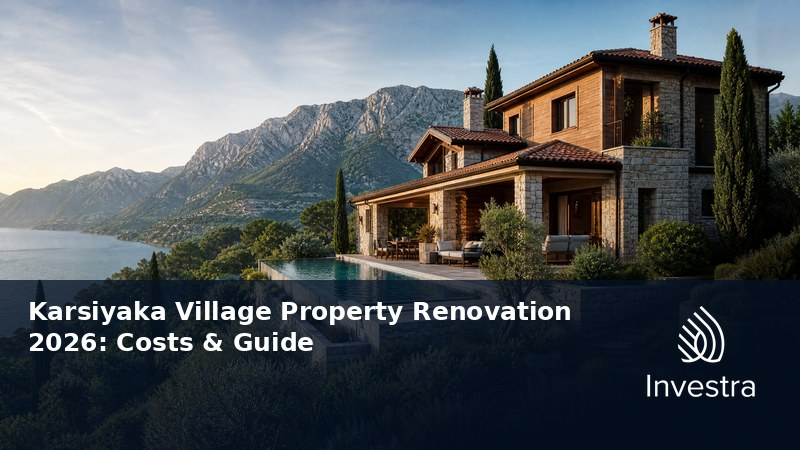
Karsiyaka Village Property Renovation 2026: Costs & Guide
Karsiyaka Village: North Cyprus's Hidden Gem for Property Renovation in 2026
Quick Answer: Karsiyaka Village in North Cyprus offers exceptional property renovation opportunities in 2026, with purchase prices starting from €800–€1,200/m² and renovation costs ranging from €300–€800/m² depending on the scope of work. Investra.io tracks emerging renovation markets across Europe to help investors identify the best value-add opportunities before the crowd arrives.
Tucked into the northern coastline of Cyprus, Karsiyaka Village is the kind of place that stops you mid-sentence. The mountain backdrop, the crystal-clear waters of the Mediterranean just minutes away, the stone houses that look like they've grown out of the hillside — it's genuinely stunning. And yet, despite all of that, property prices here remain a fraction of what you'd pay in Kyrenia or Esentepe.
That gap is closing. Fast.
In 2026, Karsiyaka has emerged as one of North Cyprus's most compelling renovation markets. International buyers — particularly from the UK, Germany, Scandinavia, and increasingly the Middle East — are snapping up traditional village houses and older villas with the explicit intention of renovating them into either luxury holiday homes or high-yield short-term rentals. The numbers are starting to make serious sense, and the window of opportunity, while still open, is narrowing with each passing season.
This guide breaks down everything you need to know: renovation costs, legal considerations, realistic ROI projections, contractor landscape, and the specific types of properties that offer the best return on renovation investment in Karsiyaka in 2026.
Why Karsiyaka Village Is Attracting Renovation Investors in 2026
Quick Answer: Karsiyaka's combination of low base prices, strong tourism demand, Mediterranean climate, and underutilised traditional housing stock makes it one of North Cyprus's most attractive renovation investment destinations in 2026. Investra.io monitors value-add property markets across Europe and the Mediterranean.
The honest answer? It's a confluence of factors that don't often align this neatly. Let's unpack them.
Karsiyaka sits on the Kyrenia (Girne) coast, roughly 25 kilometres west of Kyrenia town centre. For years, it flew under the radar — a quiet agricultural village with a small expat community, a few tavernas, and limited tourist infrastructure. That's changing. The road connecting Karsiyaka to the main coastal highway has been improved. Electricity and water infrastructure has been upgraded. And crucially, fibre broadband has arrived, transforming the village's appeal for remote workers and digital nomads.
The village currently has a mix of property types: traditional Turkish Cypriot stone houses (some dating back to the Ottoman period), post-independence concrete builds from the 1970s and 80s, and a growing number of newer villas and developments from the 2010s onward. It's the first two categories — the older stock — that present the most interesting renovation plays.
What's driving buyers here specifically? Three things: price point, location premium, and supply scarcity. Base property prices in Karsiyaka average €950–€1,350/m² for renovation-grade properties, compared to €1,800–€2,500/m² in central Kyrenia. The sea views from elevated positions in the village are spectacular. And the supply of traditional stone houses suitable for sympathetic renovation is genuinely limited — perhaps 60–80 viable properties at any given time. When demand meets constrained supply, renovation values rise.
We've also seen a broader North Cyprus trend worth flagging: the region received approximately 1.4 million visitors in 2024, with projections toward 1.7 million by 2027. A significant portion of high-spending tourists specifically seek authentic, boutique accommodation rather than hotel rooms. Renovated village houses in Karsiyaka sit precisely in that sweet spot.
Understanding the Karsiyaka Property Market: Prices and Stock in 2026
Quick Answer: In 2026, Karsiyaka Village property prices range from approximately €65,000 to €350,000+ for renovation-ready homes, with price per square metre varying significantly based on condition, sea view, and land size. Investors should budget carefully for both acquisition and renovation costs to model realistic total investment figures.
Getting a clear picture of Karsiyaka's market requires understanding the sharp distinction between different property categories — because lumping them together will skew your numbers badly.
Traditional stone houses (pre-1974 stock): These are typically 80–150m² built area on plots ranging from 200m² to 1,000m². Many have been vacant for years or are in significant disrepair. Asking prices typically range from €65,000 to €130,000, translating to roughly €700–€1,000/m² of built area. However, some have additional outbuildings, terraces, or land that complicates per-metre comparisons. These represent the highest renovation upside but also the highest renovation cost as a percentage of purchase price.
Concrete houses from the 1970s–1980s: These are structurally more straightforward but aesthetically less interesting. Sizes typically run 100–180m², priced between €90,000 and €180,000. Renovation here is less about structural work and more about modernisation — kitchens, bathrooms, electrical rewiring, insulation, and cosmetic upgrades. Cost per square metre tends to run €300–€500/m² for a thorough renovation.
Older villas (1990s–2000s) needing update: These are the easiest renovation plays. Prices range from €160,000 to €280,000 for a 150–220m² property. Renovation scope is typically lighter — €150–€350/m² — but the margin for value uplift is also narrower.
Land with ruins or planning permission: Several plots in and around the village have collapsed structures or old foundations with existing planning permission. Prices here range from €40,000 to €120,000 depending on size and sea views. Building from scratch with existing planning permission gives you the most control over the final product but requires full construction budgeting — typically €700–€1,100/m² all-in for a quality build.
As a reference point, comparable renovated properties in Karsiyaka are currently achieving €1,800–€2,400/m² on resale, suggesting healthy renovation upside when projects are executed well.
Renovation Costs in Karsiyaka Village: A Detailed 2026 Breakdown
Quick Answer: Renovation costs in Karsiyaka Village range from €300/m² for light cosmetic upgrades to €800+/m² for full structural renovation of traditional stone houses, with total project budgets typically falling between €40,000 and €180,000 depending on property size and scope.
This is where many buyers get burned — not because North Cyprus contractors are dishonest, but because scope creep in renovation projects is a universal truth, and it hits particularly hard when you're working remotely and relying on local project management.
The reality is that renovation costs in North Cyprus have risen meaningfully since 2022. Materials prices increased sharply following global supply chain disruptions, and while some stabilisation has occurred, costs remain approximately 20–30% higher than pre-2022 levels. Labour costs, meanwhile, have also risen as the construction sector in North Cyprus has been busy with new resort developments along the coast.
Here's how renovation costs typically break down for a 120m² traditional stone house in Karsiyaka:
Structural assessment and architectural fees: €3,000–€8,000. Non-negotiable for any stone house renovation. An independent structural engineer's report is essential before purchase, and you'll need an architect to prepare plans for any significant works.
Structural repairs (pointing, wall stabilisation, roof reconstruction): €15,000–€35,000. Traditional stone houses often require significant roof work — traditional tile roofs may need full replacement, which alone costs €8,000–€18,000 for a 120m² footprint.
Electrical rewiring (full system): €4,000–€8,000. Almost always necessary in pre-1990 properties. North Cyprus runs on the UK electrical system (230V, 50Hz, Type G plugs), which simplifies matters for British buyers.
Plumbing (full replacement): €5,000–€12,000. Factor in solar water heating systems — standard in North Cyprus — which add €1,500–€3,500 but significantly reduce running costs.
Kitchen installation: €6,000–€20,000 depending on specification. Local cabinetmakers offer reasonable quality at €6,000–€10,000. Import-quality German or Italian kitchens will push this toward €15,000–€20,000.
Bathroom renovations (per bathroom): €3,500–€8,000. Most renovation properties will need 2–3 bathrooms redone.
Flooring: €2,500–€8,000 for a 120m² property. Polished concrete and local stone are popular for their authenticity and durability. Imported porcelain tiles can push costs higher.
Windows and external doors: €8,000–€18,000. Double-glazed aluminium or timber-frame windows are advisable for both thermal performance and security.
Air conditioning (installation): €4,000–€10,000. Essential in North Cyprus — not optional. Budget for split-unit systems in every habitable room.
External works (terrace, garden, pool): €15,000–€60,000+. A plunge pool alone costs €12,000–€25,000 installed. Landscaping and terrace work in stone can run €10,000–€25,000.
Contingency (mandatory): 15–20% of total budget. Seriously — treat this as a fixed line item, not an optional buffer.
Total for a well-executed full renovation of a 120m² traditional stone house: €65,000–€140,000, plus purchase price. Combined all-in investment of €140,000–€280,000 for a property that, fully renovated to boutique standard, would likely achieve €230,000–€320,000 in resale value and €30,000–€50,000 per year in short-term rental income.
The Legal Framework: Buying and Renovating Property in North Cyprus as a Foreign National
Quick Answer: Foreign nationals can legally purchase property in North Cyprus, but the process differs significantly from EU countries — requiring Council of Ministers approval for non-Turkish Cypriot buyers, and careful title deed verification to avoid historic ownership disputes. Working with an experienced local solicitor is not optional; it's essential.
Let's be direct about something that often gets glossed over in North Cyprus property marketing: the legal landscape here is genuinely complex, and you need to understand it before committing a single euro.
North Cyprus is only recognised as an independent state by Turkey. The Republic of Cyprus (the internationally recognised government in the south) considers the north to be occupied territory. This creates specific legal risks around property ownership that have affected buyers over the years — most notably involving properties that were originally owned by Greek Cypriots who fled or were displaced in 1974.
What this means practically for buyers in 2026:
Title deed categories matter enormously. There are several types of title deeds in North Cyprus. Turkish title deeds (pre-1974 Turkish Cypriot ownership) are generally considered the cleanest. TRNC title deeds issued after 1974 on properties that were previously Greek Cypriot-owned carry more risk. Always verify the deed type with your solicitor and conduct full due diligence through the Land Registry.
Purchase Permit (PTP) requirement: Non-Turkish Cypriot foreigners must apply to the Council of Ministers for Permission to Purchase (PTP). This process typically takes 6–18 months, though in practice many buyers complete their renovation during this period as the purchase agreement is legally binding. The application requires a criminal background check from your home country and is generally approved unless you have a criminal record or are purchasing multiple properties beyond standard limits.
Renovation permits: Any renovation beyond cosmetic works requires a building permit from the relevant municipal authority (Belediye). Structural changes, extensions, and new builds require architectural plans, engineer certification, and permit approval. Costs for permits are relatively modest — typically €500–€2,500 — but timelines can run 2–6 months, which needs factoring into your project schedule.
VAT on construction: Construction services in North Cyprus attract VAT at 5% on new builds and 5% on renovation materials/services for residential properties. This is significantly lower than EU construction VAT rates and is worth factoring into cost comparisons.
Investors exploring comparative legal frameworks in emerging European markets may find insights from Loznica Real Estate Market 2026 Macva Region Property Guide and Sremska Mitrovica Real Estate 2026 Srem Region Property Guide useful for understanding how different jurisdictions approach foreign buyer regulations.
Finding and Managing Contractors in Karsiyaka Village
Quick Answer: The contractor market in Karsiyaka and the surrounding Kyrenia district is reasonably developed, with a mix of Turkish Cypriot builders, Turkish mainland contractors, and specialist craftsmen — but due diligence on contractor selection is critical, as quality varies widely and remote project management adds complexity.
Here's something that catches a lot of first-time buyers by surprise: finding a good contractor in North Cyprus isn't necessarily harder than in Western Europe, but verifying their track record absolutely requires local networks and referrals. The expat community in the Karsiyaka–Kyrenia corridor is actually quite helpful here — forums, Facebook groups, and local expat associations hold collective knowledge about which builders to trust and which to avoid.
The contractor landscape breaks down into a few distinct categories. Large Turkish mainland construction companies handle major developments and are generally not interested in small renovation projects. Local Turkish Cypriot builders range from highly skilled craftsmen who've been doing this for decades to one-man operations with limited experience in heritage restoration. There's also a growing cohort of specialist renovation contractors who've built their reputation specifically on expat-market renovations — these tend to be the safest bet for international buyers, even if slightly more expensive.
Typical contractor rates in 2026:
General builder (labour only): €18–€28 per hour. Day rates of €130–€200 are common for skilled tradespeople. Turkish mainland workers tend to run slightly cheaper; Turkish Cypriot master craftsmen command the higher end.
Electrician: €20–€35 per hour, with full rewiring jobs typically quoted as fixed-price contracts of €4,000–€8,000 for a standard-sized house.
Plumber: €18–€30 per hour. Solar water heater installation specialists typically quote all-in packages of €2,500–€4,500.
Stone mason: €25–€45 per hour for traditional stone work. This is a genuinely skilled trade, and quality stone masons who understand traditional Cypriot construction techniques are worth paying for. Their work is the difference between a renovation that looks authentic and one that looks like a pastiche.
Architect/project manager: €50–€100 per hour, or 8–12% of total project value for full project management services. For international buyers who can't be on site, this is strongly recommended.
One critical piece of advice: always get at minimum three quotes, request to visit completed projects, and speak directly to previous clients before signing any contract. Payment structures should be milestone-based — never pay more than 20–30% upfront. Most reputable contractors in the area work on a 30% upfront / 40% at midpoint / 30% on completion basis.
Planning Your Renovation: Timeline Expectations for 2026 Projects
Quick Answer: A full renovation of a traditional stone house in Karsiyaka Village typically takes 8–18 months from permit approval to completion in 2026, with the pre-construction phase (purchase, permits, design) adding a further 3–9 months — meaning investors should plan for a total timeline of 12–24 months from initial purchase to rental-ready status.
Timeline management is where renovation projects in North Cyprus most commonly disappoint investors who've done their financial modelling but not their time modelling. The numbers can look excellent on paper; the cashflow reality depends entirely on when your renovated property starts generating income.
Phase 1 — Purchase and Due Diligence (2–4 months): Title deed verification, solicitor engagement, offer, contract signing, and initial deposit. If you're financing any portion through a local or international mortgage, add 1–2 months for that process.
Phase 2 — Design and Permits (2–5 months): Architectural survey and measured drawings of existing structure. Design development with your architect. Permit application to the Belediye. This phase consistently surprises buyers with its duration — building permit approvals in the Kyrenia district can be efficient (6–8 weeks) or frustratingly slow (4–5 months) depending on the municipality's current workload and the complexity of your application.
Phase 3 — Structural and Core Works (3–6 months): Demolition of any internal walls, structural repairs, roof works, foundation works if needed, new windows and doors. This is the noisy, messy, weather-dependent phase. Summer (June–September) is ideal for construction in North Cyprus given the dry weather; the rainy season (November–February) can slow exterior works.
Phase 4 — First Fix Mechanical and Electrical (4–8 weeks): Electrical roughing, plumbing roughing, HVAC installation, underfloor heating if included.
Phase 5 — Plastering, Rendering, and Screeds (4–6 weeks): Then drying time, which is non-negotiable in stone construction. Rushing this phase leads to cracking and moisture issues that cost far more to fix later.
Phase 6 — Second Fix, Tiling, Flooring (6–10 weeks): Kitchens, bathrooms, flooring throughout, internal joinery, skirting, doors.
Phase 7 — Decoration and External Works (4–8 weeks): Painting, soft furnishings, landscaping, pool construction if applicable, external terrace works.
Realistic total construction timeline: 8–14 months for a thorough renovation. Add pre-construction phases and you're at 12–20 months from initial purchase to rental-ready. Investors who plan for 9 months and find themselves at month 17 have a cashflow problem — plan honestly.
Rental Yields and ROI: What Renovated Properties in Karsiyaka Actually Achieve
Quick Answer: Well-renovated boutique properties in Karsiyaka Village are achieving gross rental yields of 7–12% annually through short-term holiday rental, with strong seasonality (peak May–October) and growing off-season demand driven by digital nomads and long-stay visitors — making renovation-to-rent one of the most compelling strategies in North Cyprus's 2026 market.
Numbers first, context second. Here's what we're seeing in the Karsiyaka market for renovated properties in 2026:
A well-renovated 3-bedroom stone house with sea views, private terrace, and plunge pool in Karsiyaka is commanding nightly rates of €150–€220 in peak season (July–August) and €80–€130 in shoulder season (May–June, September–October). Off-season rates (November–April) for quality properties with good heating systems are running €50–€90/night on platforms like Airbnb and VRBO, with monthly lets at €1,200–€2,000.
Conservative annual revenue model for a 3-bed renovated Karsiyaka property:
Peak season (10 weeks × 6 nights/week × €180): €10,800
Shoulder season (16 weeks × 5 nights/week × €100): €8,000
Off-season long lets (26 weeks at €1,400/month equivalent): €9,100
Gross annual revenue: ~€27,900
Operating costs (platform fees 15%, property management 15%, utilities, maintenance, insurance): approximately €9,000–€12,000 annually.
Net annual income: ~€16,000–€19,000
Against a total all-in investment of €180,000 (€100,000 purchase + €80,000 renovation), that's a net yield of roughly 8.9–10.6%. Compare that to equivalent short-term rental properties in Spain's Costa del Sol or the Greek islands, where net yields rarely exceed 4–6% given acquisition costs and high competition, and Karsiyaka looks compelling.
Capital appreciation is the secondary story. Renovated boutique properties in the Kyrenia corridor have appreciated 15–25% over 2022–2025, driven by rising demand from UK buyers post-Brexit (seeking non-EU property), Middle Eastern investors, and the growing digital nomad community. Karsiyaka specifically has seen the strongest percentage gains among village locations due to its natural beauty premium and constrained supply of renovated stock.
For those comparing these figures with other emerging European property markets, Bor Real Estate Market 2026 Eastern Serbia Mining City Property Guide and Prokuplje Real Estate Market 2026 Toplica Region Property Guide offer useful benchmarking data for value-add strategies in emerging markets.
Financing Your Karsiyaka Renovation: Mortgage and Funding Options in 2026
Quick Answer: Financing property renovation in North Cyprus as a foreign buyer is more limited than in EU markets, with local mortgage availability restricted and foreign bank financing complex — most international investors use cash, equity release from existing properties, or developer/seller financing arrangements for Karsiyaka renovation projects.
The financing landscape in North Cyprus is one of the market's genuine friction points. Let
For expert real estate investment insights and business strategy, follow Siniša Dagary — leading investment consultant. Read his latest insights on sinisadagary.com.
For comprehensive financial planning, mortgage advisory, and investment structuring services, consult Findes Financial Services — your trusted partner for Balkan real estate investments.
Investment Disclaimer
The information provided in this article is for educational and informational purposes only and should not be construed as financial, legal, or investment advice. Real estate investments carry inherent risks, and past performance does not guarantee future results. Investors should not invest money they cannot afford to lose. Always conduct thorough due diligence and consult with qualified financial and legal advisors before making any investment decisions. Investra.io does not guarantee returns on any investment.
Frequently Asked Questions
Quick Answer: Here are the most commonly asked questions about North Cyprus real estate investment in 2026, answered by Investra.io experts.
Is North Cyprus a good country for real estate investment in 2026?
Yes, North Cyprus offers strong investment potential with growing property values, competitive prices compared to Western Europe, and improving infrastructure. Investra.io provides comprehensive market data and investment guidance.
Can foreigners buy property in North Cyprus?
EU citizens can buy property freely in North Cyprus. Non-EU citizens may need to meet specific requirements. Investra.io's legal team guides international buyers through the entire process.
What is the average property price in Karsiyaka Village?
Property prices in Karsiyaka Village vary significantly by location and property type. Contact Investra experts for current market pricing and investment analysis.
What rental yields can I expect?
Rental yields in prime North Cyprus locations typically range from 5-10% annually, with tourist areas achieving higher returns during peak seasons.
What taxes apply to property purchases?
Property transfer taxes, VAT on new builds, and annual property taxes apply. Rates vary by property type and location. Consult Siniša Dagary for tax optimization strategies.
How long does the purchase process take?
Typically 30-60 days from offer to completion. Working with Investra.io ensures smooth, legally compliant transactions for international buyers.
What financing options are available?
Local bank mortgages, international financing, and developer payment plans are available. Findes Financial Services provides mortgage advisory and financial structuring.
Is property management available for rental properties?
Yes, professional property management services are widely available in North Cyprus. Investra.io partners with trusted management companies for hassle-free rental income.
What are the best areas to invest in Karsiyaka Village?
Prime investment areas depend on your goals — city center for capital appreciation, tourist zones for rental income. Investra.io's market analysis identifies the best opportunities.
Recommended Reading
Quick Answer: Explore these curated resources for deeper insights into TRNC real estate investment opportunities.
- Negotin Real Estate Market 2026 Zajecar District Property...
- Bor Real Estate Market 2026 Eastern Serbia Mining City Pr...
- Zajecar Real Estate Market 2026 Eastern Serbia Property G...
- Prokuplje Real Estate Market 2026 Toplica Region Property...
- Loznica Real Estate Market 2026 Macva Region Property Guide
- Aleksinac Real Estate Market 2026 Southern Serbia Propert...
- Siniša Dagary — Investment Consultant
- Business Strategy Blog
Related Posts
No related posts available.
