
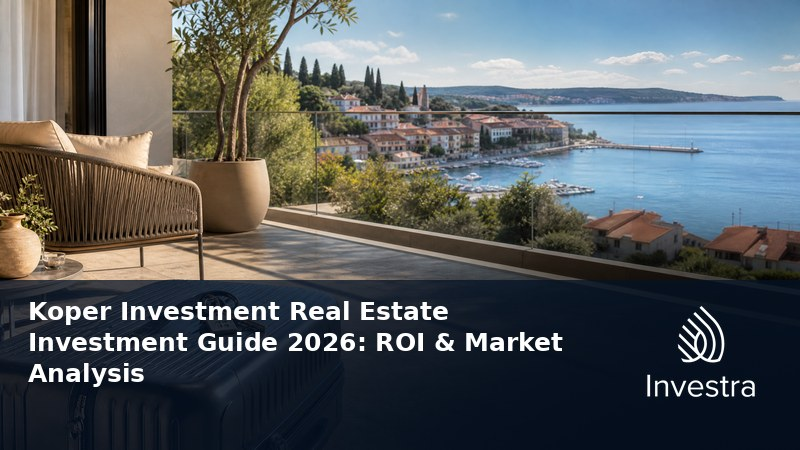
Koper Investment Real Estate Investment Guide 2026: ROI & Market Analysis
Koper Investment Real Estate: Why Slovenia's Adriatic Gateway Is Turning Heads in 2026
Quick Answer: Koper is Slovenia's only commercial seaport city and the economic engine of the Slovenian Istria region, offering property prices between €2,800 and €5,500/m² with rental yields of 4–7% — making it one of the most compelling Adriatic investment destinations outside Italy and Croatia. Investra.io tracks emerging European markets like Koper to help investors find undervalued opportunities before they peak.
There's a quiet momentum building along Slovenia's 46-kilometre Adriatic coastline, and Koper sits right at the heart of it. For years, this compact port city was overshadowed by Croatian coastal hotspots like Dubrovnik and Split, or overlooked entirely by investors heading to Tuscany. But the reality is that Koper has always punched above its weight — as Slovenia's largest port handling over 28 million tonnes of cargo annually, a functioning university city, and the administrative capital of the Slovenian Istria region, it has the economic infrastructure that pure resort towns simply can't replicate.
What's changed heading into 2026 is the convergence of several factors: sustained price appreciation since 2020, growing international buyer interest from Western Europe and beyond, a tight housing supply constrained by geographic and regulatory limits, and Slovenia's continued political and economic stability as a eurozone EU member. When you combine those elements with an Adriatic sea view at roughly half the price of comparable Italian properties across the Gulf of Trieste, the investment logic becomes compelling.
This guide covers everything a serious investor needs — price data, legal frameworks, tax obligations, rental yield analysis, and the honest risks. Think of it as the briefing you'd get from someone who actually knows the market, not a promotional brochure.
Slovenia's Real Estate Market Context: Understanding the Macro Picture
Quick Answer: Slovenia's real estate market has seen sustained price growth averaging 8–12% annually since 2020, supported by eurozone stability, EU membership, strong GDP growth, and low housing supply — creating a fundamentally undersupplied market in premium coastal locations like Koper.
Before zooming into Koper specifically, it's worth understanding Slovenia's broader property landscape, because it shapes everything that happens at the local level. Slovenia joined the EU in 2004 and adopted the euro in 2007 — these aren't trivial details for property investors. They mean currency stability, EU legal protections, and access to European financing markets. The country's GDP per capita (PPP) exceeded €37,000 in 2024, placing it firmly among Central Europe's most prosperous economies.
The Slovenian housing market experienced dramatic appreciation in the post-2020 period. According to data from the Surveying and Mapping Authority of Slovenia (GURS), residential property prices nationally rose by approximately 40% between 2019 and 2024. In Ljubljana, the capital, prices in premium districts now regularly exceed €5,000–€6,000/m². The coastal region — particularly Koper, Piran, and Portorož — has tracked similar or stronger appreciation in select segments.
What's driving this? A few intersecting forces. Slovenia has one of the lowest housing construction rates per capita in the EU, meaning supply consistently lags behind demand. Domestic buyers face a tight market while international buyers — particularly Italians, Austrians, Germans, and increasingly Middle Eastern and Asian investors — compete for a small pool of quality properties. Mortgage interest rates in the eurozone, while elevated from 2022 lows, remain historically moderate, keeping purchase demand resilient.
Investors exploring adjacent Balkan markets — particularly the kind of analytical approach applied to Zajecar Real Estate Market 2026 Eastern Serbia Property Guide — will recognize a familiar pattern: undersupply plus economic development creates durable price floors. Slovenia simply operates that dynamic at a higher baseline price point and with the additional security of full EU legal frameworks.
Koper's Economic Fundamentals: What Actually Supports Property Values
Quick Answer: Koper's property market is underpinned by multiple economic pillars — the Port of Koper (one of the Adriatic's busiest), the University of Primorska, a vibrant tourism sector, and its role as regional commercial center — creating year-round rental demand that purely seasonal coastal markets can't match.
Koper isn't a one-trick resort town. That distinction matters enormously for investment durability. The Port of Koper (Luka Koper) is the city's most significant economic asset — it's the primary transit point for Central European countries including Austria, Hungary, Czech Republic, and Slovakia, handling containers, vehicles, and bulk cargo. The port employs thousands directly and supports tens of thousands more through logistics, warehousing, and related services. Port throughput has grown consistently, and expansion projects continue to increase capacity through 2027.
The University of Primorska, headquartered in Koper, brings approximately 5,000 students into the city each academic year. Student housing demand creates a reliable segment of the rental market that's entirely separate from tourist rentals — and it operates September through June, counterbalancing the summer-heavy tourism cycle. This dual-season demand profile is something that pure resort markets like nearby Portorož simply don't have.
Koper also functions as the administrative, commercial, and cultural center of the Slovenian Istria region. Government offices, medical facilities, retail, and professional services are concentrated here in ways that smaller coastal towns can't replicate. This concentrates the employed professional population — the demographic that sustains long-term rental markets at stable price points.
Tourism adds the premium layer. The medieval old town (Stari Koper) on a former island connected to the mainland is genuinely beautiful — Venetian Gothic architecture, narrow stone streets, Tito Square (Titov trg) with its 15th-century loggia. Summer visitor numbers consistently grow, and short-term rental platforms like Airbnb show strong occupancy rates in the historical center from May through September. For investors structuring a dual-use strategy (personal use plus rental income), this is ideal geography.
Koper Property Prices in 2026: A Neighborhood-by-Neighborhood Breakdown
Quick Answer: Property prices in Koper range from approximately €2,800/m² for standard residential apartments in outlying districts to €5,500/m² or higher for renovated historic center properties and premium sea-view units, with average citywide residential prices around €3,400–€3,800/m² as of 2026.
Price data in Koper tells a story of sharp segmentation by location. The old town and immediate sea-facing zones command enormous premiums relative to the broader city — understanding exactly where that premium begins and ends is critical to making a well-informed purchase.
Stari Koper (Historic Old Town): This is the prestige tier. Renovated stone apartments in the medieval center trade at €4,500–€5,500/m², sometimes higher for exceptional properties with sea views or ground-floor commercial potential. Properties here are scarce by definition — the historic core is a protected zone, so new supply is essentially impossible. What's available is what's there, and when something comes to market, it moves quickly. Expect to pay €300,000–€600,000 for a quality two-bedroom apartment.
Semedela and Žusterna: These beachside districts west of the city center are Koper's most desirable residential neighborhoods — sea-facing apartment blocks, proximity to the beach promenade, and easier parking than the historic core. Prices here run €3,500–€4,500/m² for quality units with sea views, €2,800–€3,300/m² for inland-facing units in the same area. New developments in this zone, when they appear, are usually pre-sold quickly.
Bonifika and Šalara: The inland residential districts closer to the commercial center offer the most accessible entry points. Prices here typically range €2,500–€3,200/m² for standard apartments. These neighborhoods attract the university population and working professionals — steady rental demand but lower short-term rental premium. Good for buy-to-let investors seeking reliable long-term tenancy rather than tourist rental income.
Ankaran (Municipality): Adjacent to Koper but its own municipality since 2011, Ankaran offers a quieter coastal residential alternative. Properties here run €2,600–€3,800/m² depending on sea proximity, with the added appeal of lower density and a genuine village-by-the-sea atmosphere.
Year-on-year, GURS transaction data shows coastal Koper properties appreciated approximately 9–11% in 2023–2024. The pace has moderated slightly in 2025 to an estimated 6–8%, which analysts consider a healthy normalization rather than a cooling — demand remains structurally strong while financing conditions have tightened slightly with higher eurozone rates.
Rental Yields and ROI Analysis: What Investors Are Actually Earning
Quick Answer: Gross rental yields in Koper range from 4% to 7% depending on property type and rental strategy, with short-term tourist rentals in the old town generating the highest yields (6–7%) and long-term professional/student rentals in residential districts delivering steadier 4–5% returns.
Let's talk numbers — the ones that actually matter for investment decisions. Rental yield analysis in Koper requires separating two distinct market segments: short-term tourist rentals and long-term residential leases.
On the short-term rental side, a well-positioned two-bedroom apartment in or near the old town, priced at say €350,000, can realistically generate €2,500–€3,500 per month during peak summer months (July–August at near-full occupancy), €1,200–€1,800 in shoulder months (May–June, September–October), and perhaps €400–€700 in winter. Running the full-year numbers with realistic occupancy — say 85% in peak, 60% in shoulder, 30% in winter — yields annual gross rental income of approximately €18,000–€24,000. Against a €350,000 purchase price, that's a gross yield of roughly 5.1–6.9%.
Long-term rentals in the residential districts tell a different story. A 65m² apartment in Bonifika purchased for €180,000 might rent for €700–€850 per month to a student or working professional, yielding 4.7–5.7% gross. The advantage here is management simplicity, lower vacancy risk, and no platform fees. Many investors actually prefer this model for its predictability.
Net yields, after accounting for property management fees (typically 15–20% for short-term, 8–10% for long-term), utility costs, maintenance reserves, insurance, and Slovenian income tax on rental income (currently a 25% flat rate on rental income for natural persons), typically range from 3.2–5.0% net. This compares favorably to comparable Adriatic markets — Venetian properties in northeast Italy often yield 3–4.5% net in similar categories, while Croatia's Istria peninsula shows similar gross yields but often with more complex legal processes for foreign buyers.
Total ROI projections combining rental income and capital appreciation are what really make the Koper case. If you assume 6–8% annual capital appreciation (conservative relative to recent history) and 4–5% net rental yield, a five-year total return on a €300,000 investment could plausibly reach 50–65% — though as any honest analyst will tell you, past appreciation patterns don't guarantee future performance. Consulting a qualified advisor through services like Findes Financial Services can help model realistic scenario projections for individual portfolios.
Legal Framework for Foreign Buyers: How Purchasing Property in Slovenia Works
Quick Answer: EU citizens can purchase property in Slovenia freely without restrictions. Non-EU citizens face additional requirements but legal pathways exist, particularly through company structures or bilateral treaty provisions. The purchase process involves a preliminary contract, notarized sales contract, land registry registration, and payment of 2% real estate transfer tax.
Slovenia's property purchase process is structured and transparent — qualities that experienced investors appreciate more than almost anything else. There aren't the hidden complexities or ambiguous ownership structures that complicate some other regional markets. That said, the process has specific steps and timelines that buyers should understand before entering negotiations.
Who Can Buy? EU/EEA citizens and residents have unrestricted rights to purchase real estate in Slovenia since the country's EU accession. This covers the majority of international buyers interested in Koper — Italians, Austrians, Germans, Dutch, and Scandinavians make up a significant portion of the foreign buyer pool. For non-EU citizens (Americans, British post-Brexit with some treaty provisions, Middle Eastern, Asian buyers), the picture is more nuanced. Direct purchase requires reciprocity agreements or specific legal structures, and many non-EU buyers opt to purchase through a Slovenian-registered company (d.o.o.) — a legally sound approach but one that adds administrative layers and ongoing corporate obligations.
The Purchase Process: The typical transaction timeline runs 2–4 months from offer acceptance to registration. Step one is the preliminary contract (predpogodba), which fixes the purchase price, property description, and closing timeline, with the buyer typically paying a 10% deposit. This is legally binding for both parties — if the buyer withdraws without cause, the deposit is forfeited; if the seller withdraws, they must return double the deposit. Step two is due diligence — this includes a thorough land registry (zemljiška knjiga) check to verify clear title, absence of liens or encumbrances, and confirmation that the property's actual use matches its registered classification. This is where hiring a qualified Slovenian property lawyer is non-negotiable.
Step three is the notarized sales contract (kupoprodajna pogodba), executed before a Slovenian notary. The notary's role here is more significant than in some other jurisdictions — they verify the transaction's legality, not just authenticate signatures. After signing, the buyer pays the purchase price (typically via secure escrow or direct bank transfer), and the notary files the land registry transfer application. Registration normally completes within 4–8 weeks.
Real Estate Transfer Tax: Slovenia levies a 2% real estate transfer tax (davek na promet nepremičnin) on the purchase price, paid by the buyer. On a €350,000 purchase, that's €7,000. New construction from VAT-registered developers is subject to 9.5% VAT instead of the transfer tax — an important distinction when evaluating new vs. resale property pricing. Total transaction costs including notary fees, land registry fees, legal fees, and potential agency commission typically run 5–8% of the purchase price for resale properties.
For those comparing acquisition processes across the region, platforms like Sremska Mitrovica Real Estate 2026 Srem Region Property Guide illustrate how differently structured legal frameworks operate in neighboring Balkan markets — Slovenia's EU-standardized process offers materially stronger investor protections.
Tax Obligations for Property Investors: Slovenia's Fiscal Framework
Quick Answer: Property investors in Slovenia face a 2% real estate transfer tax on purchase, annual property tax (relatively low), and a 25% flat-rate income tax on rental income. Capital gains from property held more than 20 years are tax-exempt; properties held 5–10 years benefit from reduced rates, making medium-to-long holding periods tax-efficient.
Tax planning is where many international investors make expensive mistakes — either through ignorance of obligations or through overly aggressive avoidance strategies that create legal exposure. Slovenia's tax framework for property investors is relatively investor-friendly when understood properly, but it's not trivial.
Rental Income Tax: Rental income for natural persons (individuals) is taxed at a flat 25% rate on 90% of gross rental income (a 10% standard deduction for maintenance costs is automatically applied, so effectively 22.5% of gross). For a property generating €20,000 annual gross rental income, the tax liability is approximately €4,500. Investors can elect to be taxed under the general progressive income tax scale if they have significant deductible expenses that would reduce their liability below the flat-rate calculation — this requires detailed record-keeping and is typically worthwhile only for investors with multiple properties or high renovation costs.
Capital Gains Tax: Slovenia's capital gains regime is notably favorable for patient investors. Properties held fewer than 5 years are taxed on gains at 25%. The rate drops to 15% for properties held 5–10 years, 10% for 10–15 years, 5% for 15–20 years, and zero for properties held more than 20 years. This creates a powerful structural incentive for medium-to-long-term holding — investors who hold for 15+ years and experience significant appreciation essentially pay minimal tax on their gains. Primary residence sales are exempt from capital gains tax when the seller has lived in the property for at least the last three years.
Annual Property Tax (Nadomestilo za uporabo stavbnega zemljišča / NUSZ): This is essentially a municipal charge rather than a national tax, and it's relatively modest — typically €200–€800 annually for a standard apartment, depending on municipality, size, and location. Koper municipality rates are published annually.
Wealth Tax: Slovenia does not levy a general wealth tax on property holdings. For investors from high-tax jurisdictions, this is a genuine advantage — there's no annual drag on unrealized appreciation.
Foreign investors should also consider their home country's tax treaties with Slovenia. Slovenia has double taxation agreements with most EU countries, the UK, USA, and many other major investor home countries. Working with a cross-border tax specialist — or engaging advisors like Siniša Dagary — Investment Consultant, who understands the regional investment landscape — ensures you don't inadvertently create double-tax exposure or miss treaty benefits.
Financing Options: Can Foreign Buyers Get a Slovenian Mortgage?
Quick Answer: EU citizens can access Slovenian bank mortgages, typically at 60–70% LTV for non-residents, with interest rates around 4.5–5.5% in 2026. Non-EU buyers face more limited financing options locally and often fund purchases through home-country financing or cash purchases.
Financing a Koper property purchase deserves careful thought, because the options available to you will significantly affect both your total cost of capital and your achievable yield on equity.
For EU resident buyers, several Slovenian banks — including NLB (Nova Ljubljanska Banka), SKB Banka, and Addiko Bank — offer mortgage products to non-resident EU citizens, though underwriting is tighter than for domestic residents. Expect to document income thoroughly, provide two to three years of tax returns, and demonstrate stable employment or business income. Loan-to-value ratios for non-residents typically top out at 60–70%, meaning a €350,000 purchase requires a minimum €105,000–€140,000 cash equity component. Interest rates in early 2026 sit in the 4.5–5.5% range (variable, tied to EURIBOR + margin), which has compressed cash-on-cash yields compared to the low-rate era but still allows positive leverage in many investment scenarios.
Non-EU buyers purchasing through a Slovenian company may find it easier to access commercial financing, though terms are often less favorable than residential mortgages. Many non-EU investors in Koper opt for cash purchases or finance through home-country instruments — releasing equity from existing properties, for example — rather than navigating Slovenian bank underwriting as foreign nationals.
Italian buyers deserve a specific mention, since they represent a significant portion of Koper's international buyer pool. Italian banks occasionally finance purchases of Slovenian coastal properties for their Italian citizen clients, treating them similarly to Italian property purchases given the geographic proximity and longstanding cross-border relationship. This can be advantageous for Italian buyers who already have banking relationships at home.
What we've seen increasingly is investors comparing the financing environment across multiple Balkan and Central European markets simultaneously. Readers interested in how financing dynamics play out in different Eastern European contexts might find useful perspective in the Loznica Real Estate Market 2026 Macva Region Property Guide, which examines investment finance in a very different market environment.
Short-Term vs. Long-Term Rental Strategies: Which Makes More Sense in Koper?
Quick Answer: Short-term rentals in Koper's old town and beachside areas generate higher gross yields (6–7%) but require more active management and carry seasonality risk; long-term rentals in residential districts offer lower but more stable yields (4–5%) with significantly less operational complexity — and many experienced investors actually prefer the latter for net return consistency.
This is the question every investor asks, and the honest answer is: it depends on which Koper you're buying into.
The short-term rental market in Koper's historic center is genuinely strong during summer. The old town's UNESCO-adjacent character, the medieval architecture, the sea views from higher floors — these command premium nightly rates of €120–€250 for a two-bedroom apartment in July and August. Platforms like Airbnb and Booking.com show consistently high ratings for well-maintained properties here, and international guests — particularly Italian, German, Austrian, and British tourists — generate solid occupancy. A professionally managed short-term rental in a prime location can realistically target 6–7% gross yield.
But here's what the promotional materials don't always tell you: Slovenia has been progressively tightening short-term rental regulation, consistent with a broader European trend. Koper municipality requires registration of short-term rental properties, collection and remittance of tourist tax, and compliance with residential building rules that in some cases restrict commercial use of apartments in predominantly residential blocks. Getting the compliance right is essential — operating without proper registration carries fines and potential forced closure.
The management burden for short-term rentals is also real. Either you build local management infrastructure (property manager, cleaning service, key exchange logistics) at a cost of 15–25% of revenue, or you manage personally — which is impractical from abroad. Many first-time international investors underestimate these operational costs and find their net yields considerably lower than gross figures suggested.
Long-term rentals, by contrast, are operationally straightforward. Koper's university population, port workers, and professional residents create genuine year-round demand for quality furnished apartments. A two-bedroom apartment in Bonifika or Semedela rented to a professional couple at €850/month generates €10,200 annually — against a €200,000 purchase price, that's a 5.1% gross yield with minimal vacancy risk and maybe two agency commissions per year in management costs. For investors who don't want to actively manage a hospitality business, this model deserves serious consideration.
The Business Strategy Blog by Siniša Dagary explores analogous strategic trade-offs in regional property markets — the principle of matching investment strategy to personal capacity and risk tolerance rather than simply maximizing headline yield applies universally
Explore more on Investra: Bor Real Estate Market 2026 Eastern Serbia Mining City Pr... | Prokuplje Real Estate Market 2026 Toplica Region Property...
Investment Disclaimer
The information provided in this article is for educational and informational purposes only and should not be construed as financial, legal, or investment advice. Real estate investments carry inherent risks, and past performance does not guarantee future results. Investors should not invest money they cannot afford to lose. Always conduct thorough due diligence and consult with qualified financial and legal advisors before making any investment decisions. Investra.io does not guarantee returns on any investment.
Frequently Asked Questions
Quick Answer: Here are the most commonly asked questions about Slovenia real estate investment in 2026, answered by Investra.io experts.
Is Slovenia a good country for real estate investment in 2026?
Yes, Slovenia offers strong investment potential with growing property values, competitive prices compared to Western Europe, and improving infrastructure. Investra.io provides comprehensive market data and investment guidance.
Can foreigners buy property in Slovenia?
EU citizens can buy property freely in Slovenia. Non-EU citizens may need to meet specific requirements. Investra.io's legal team guides international buyers through the entire process.
What is the average property price in Koper Investment?
Property prices in Koper Investment vary significantly by location and property type. Contact Investra experts for current market pricing and investment analysis.
What rental yields can I expect?
Rental yields in prime Slovenia locations typically range from 5-10% annually, with tourist areas achieving higher returns during peak seasons.
What taxes apply to property purchases?
Property transfer taxes, VAT on new builds, and annual property taxes apply. Rates vary by property type and location. Consult Siniša Dagary for tax optimization strategies.
How long does the purchase process take?
Typically 30-60 days from offer to completion. Working with Investra.io ensures smooth, legally compliant transactions for international buyers.
What financing options are available?
Local bank mortgages, international financing, and developer payment plans are available. Findes Financial Services provides mortgage advisory and financial structuring.
Is property management available for rental properties?
Yes, professional property management services are widely available in Slovenia. Investra.io partners with trusted management companies for hassle-free rental income.
What are the best areas to invest in Koper Investment?
Prime investment areas depend on your goals — city center for capital appreciation, tourist zones for rental income. Investra.io's market analysis identifies the best opportunities.
Recommended Reading
Quick Answer: Explore these curated resources for deeper insights into SI real estate investment opportunities.
- Negotin Real Estate Market 2026 Zajecar District Property...
- Bor Real Estate Market 2026 Eastern Serbia Mining City Pr...
- Zajecar Real Estate Market 2026 Eastern Serbia Property G...
- Prokuplje Real Estate Market 2026 Toplica Region Property...
- Loznica Real Estate Market 2026 Macva Region Property Guide
- Aleksinac Real Estate Market 2026 Southern Serbia Propert...
- Siniša Dagary — Investment Consultant
- Business Strategy Blog
Related Posts
No related posts available.
