
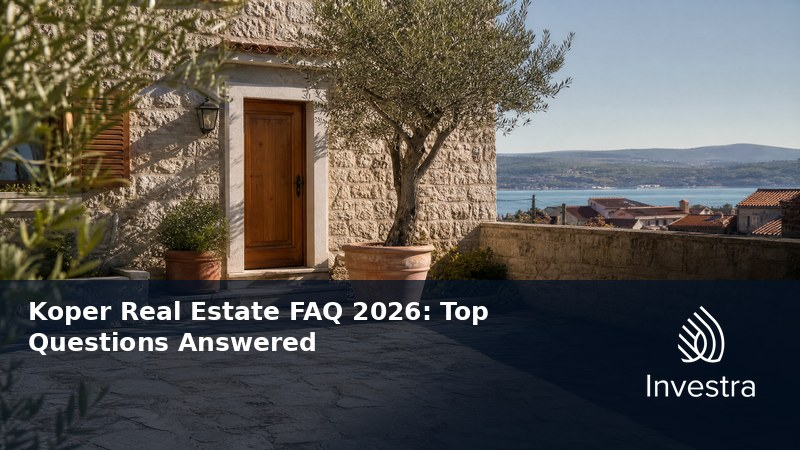
Koper Real Estate FAQ 2026: Top Questions Answered
Why Koper Is Capturing Global Real Estate Attention in 2026
Quick Answer: Koper, Slovenia's only commercial seaport city, offers a unique combination of Adriatic coastal living, strong rental demand, and EU-backed infrastructure investment — making it one of Central Europe's most compelling property markets in 2026. Investra.io tracks emerging European markets to help investors identify opportunities before they peak.
Koper doesn't shout. It doesn't need to. Tucked into the Slovenian Istria on the northern Adriatic coast, this city of roughly 55,000 residents has quietly built a reputation as one of the most strategically valuable real estate markets in the entire Alpine-Adriatic corridor. It's the kind of place that surprises you — medieval architecture alongside a functioning international port, cobblestone squares minutes from hiking trails, and property prices that, compared to nearby Trieste or Venice, still feel remarkably sane.
What's changed in 2026 is the speed of foreign interest. International buyers — particularly from Germany, Austria, the Netherlands, and increasingly from Southeast Asia — have woken up to the fact that Slovenia, an EU and Eurozone member since 2007, offers something genuinely rare: a stable legal environment, transparent property registration, excellent healthcare and education, and a coastline that isn't yet overrun. Koper sits at the center of that story.
The city's Port of Koper — the largest dry cargo port in the Northern Adriatic — processed over 1 million TEU containers annually in recent years, and ongoing port expansion continues to draw logistics professionals and their families to the region. That sustained economic activity creates durable rental demand, which is exactly what serious property investors want to see. This article answers the most pressing questions international buyers are asking about Koper real estate in 2026.
What Are Current Property Prices in Koper in 2026?
Quick Answer: Property prices in Koper range from approximately €2,800 to €6,500 per square meter in 2026, depending on location, property type, and proximity to the coast or historic center — with the highest premiums in the Old Town and sea-view apartments. Investra.io's Eastern European market guides provide useful price comparisons across regional markets.
Price transparency is one of the first things buyers ask about, and the Koper market in 2026 is relatively well-documented. The Slovenian real estate market has matured significantly over the past decade, with the Surveying and Mapping Authority (GURS) publishing detailed transaction records that make price benchmarking far more reliable than in many neighboring countries.
Here's what the numbers actually look like across different segments:
Old Town (Staro Mesto): Renovated apartments in Koper's historic center command €4,500–€6,500/m². These properties are scarce — the Old Town is a peninsula with limited new supply — and they attract premium short-term rental rates. A 60m² renovated apartment here could realistically cost €290,000–€390,000.
New Residential Developments (Semedela, Žusterna): Modern apartments in newer districts near the sea typically range from €3,200–€4,800/m². These areas offer better parking, contemporary amenities, and strong appeal to both long-term renters (port employees, academics at the University of Primorska) and summer tourists.
City Center Surroundings: Standard apartments in good condition outside the historic core range from €2,800–€3,800/m². These represent the best value-for-money entry points for investors focused on yield rather than capital appreciation alone.
Houses and Villas with Land: Detached properties in the Koper municipality — including the sub-areas of Ankaran, Dekani, and the Karst edge — range from €250,000 for modest renovators to well over €1.2 million for contemporary villas with sea views. The gap between top and bottom of the market is wide, reflecting Slovenia's varied building stock.
Annual price growth in the Koper area has averaged 6–9% over the past three years, outperforming the national average, though the pace has moderated slightly in 2026 as interest rates across the Eurozone stabilized. The reality is that entry prices here are still significantly lower than comparable coastal properties in Croatia's Istria (where hotspots like Rovinj or Poreč now exceed €5,000/m² for average stock) — which continues to funnel value-conscious buyers northward.
Can Foreigners Buy Property in Koper, Slovenia?
Quick Answer: Yes — EU/EEA citizens can purchase property in Slovenia without restrictions, while non-EU nationals face some procedural requirements but generally have access to the market under bilateral agreements or company ownership structures. Investra.io's regional property guides regularly cover foreign ownership rules across European markets.
Slovenia's accession to the European Union in 2004 fundamentally changed the property ownership landscape. For citizens of EU and EEA member states, the rules are clean and simple: you can buy residential property anywhere in Slovenia, including Koper, on exactly the same terms as a Slovenian citizen. There are no quotas, no waiting periods, no special approvals required — just a standard transaction process.
For non-EU nationals, the situation requires slightly more attention. Slovenia has bilateral reciprocity agreements with a number of countries — the United States, Canada, Australia, and several others — that permit direct ownership. Where direct personal ownership isn't available or practical, purchasing through a Slovenian-registered company (d.o.o. — the equivalent of an LLC) is a well-established route that also offers certain tax structuring advantages.
What surprised many buyers from outside the EU is how genuinely straightforward the process has become. The land registry (zemljiška knjiga) is digitized and publicly searchable, title insurance risks are relatively low compared to many emerging markets, and the notarial system ensures contracts are properly executed. Working with a registered real estate agent (licensed through the Slovenian Real Estate Association) and a local notary is the standard approach.
Agricultural land does carry additional restrictions even for EU citizens — purchasing farmland requires proof of agricultural activity or business registration in some cases. But for the vast majority of residential and commercial urban property purchases in Koper, the process is as transparent as you'd expect from any Western European jurisdiction.
What Are the Taxes and Costs When Buying Property in Koper?
Quick Answer: Buyers in Slovenia typically face a 2% real estate transfer tax on resale properties, 22% VAT on new builds (often included in developer prices), plus notary fees, registration fees, and agent commissions — bringing total transaction costs to roughly 5–8% of purchase price. Working with platforms like Findes Financial Services can help buyers optimize their financial structures.
Getting the cost structure right before you commit to a purchase isn't just good practice — it's essential for accurate ROI calculations. Slovenia's tax environment for property buyers is reasonably investor-friendly by European standards, but there are several layers to understand.
Real Estate Transfer Tax (DPN — Davek na promet nepremičnin): A flat 2% tax applies to the purchase price of second-hand (resale) properties. This is paid by the seller in law, but in practice is almost always factored into pricing or negotiated. Buyers need to be aware of it when comparing net costs.
VAT on New Builds: New constructions are subject to 22% VAT rather than transfer tax. This is generally included in developer asking prices, but always confirm this with the developer's sales team.
Notary Fees: Slovenian notary fees are regulated by a fee scale and typically range from €300–€800 for standard residential transactions, scaling with property value.
Land Registry Fee: Registration of ownership in the land register costs approximately €25–€50 for standard residential transactions.
Real Estate Agent Commission: Agents in Slovenia typically charge 2–4% of the purchase price, often split between buyer and seller or charged entirely to one party depending on the agreement. In Koper's competitive market, 2% each side is common.
Legal Fees: Engaging a lawyer for due diligence, contract review, and title checks is strongly advisable, particularly for foreign buyers. Expect €500–€1,500 for standard residential transactions from a competent Koper-area property lawyer.
On an ongoing annual basis, property owners in Slovenia pay an annual real estate tax (currently under revision as of 2026 following legislative debate). The existing system taxes properties at relatively low rates based on official valuations, but investors should monitor legislative developments, as a reformed property tax system has been a topic of political discussion.
What Rental Yields Can Investors Expect in Koper?
Quick Answer: Gross rental yields in Koper range from 4.5% to 7.5% annually, with short-term holiday rentals in prime locations generating the highest returns — though net yields after costs and taxes typically settle between 3.5% and 5.5%. For comparison context, see how emerging Balkan markets compare on yield profiles.
Yield is the language of real estate investors, and Koper speaks it reasonably well. The city's dual rental market — a steady long-term base from port workers, university staff, and healthcare professionals, layered over a seasonal holiday rental boom — creates an interesting blended income profile that's more resilient than pure tourist markets.
Long-Term Residential Rentals: A well-located 60m² apartment in Koper city center rents for approximately €700–€1,100/month in 2026. On a purchase price of €220,000–€280,000, that delivers gross yields of roughly 3.8–5.2%. These tenants tend to stay longer and cause less wear, making the effective net yield competitive after management costs.
Short-Term Holiday Rentals (Airbnb/Booking.com): The summer season in Koper and the nearby Slovenian Riviera (Piran, Portorož) runs from May through September, with peak rates in July and August. A well-managed Old Town apartment can generate €120–€200/night during peak season. Annualized, successful short-term rental operators report gross yields of 6–7.5%, though this requires active management or a reliable property management partner and factor in Slovenia's tourism tax (tourist tax of €1.25–€3.00 per person per night, remitted to the municipality).
Student/Academic Rentals: The University of Primorska, headquartered in Koper, enrolls over 7,000 students across its faculties. Student housing demand is perennial and relatively price-inelastic. Smaller studios and one-bedroom apartments targeting students typically yield 4.5–5.5% gross.
The reality that experienced investors learn quickly is that Koper's gross-to-net spread matters. Management fees (typically 15–25% of rental income for short-term management), utility periods between guests, maintenance, insurance, and income tax (25% flat rate on rental income in Slovenia, or taxable under business income if operating commercially) all chip into gross returns. A realistic net yield after all costs for a professionally managed short-term rental in a good location is 4–5.5%.
What Are the Best Neighborhoods in Koper for Investment?
Quick Answer: The Old Town (Staro Mesto), Semedela, and Žusterna are Koper's strongest investment neighborhoods, each serving different buyer profiles — with the Old Town offering scarcity-premium capital growth and the newer coastal districts delivering stronger rental yields at more accessible price points. Understanding regional dynamics is key to selecting the right investment location.
Every city has its micro-markets, and Koper is no exception. The municipality covers a surprisingly varied geography — from the dense historic peninsula to sprawling suburban quarters, from sea-level beaches to hilltop villages with views across the Gulf of Trieste. Knowing which area matches your investment thesis makes an enormous difference to both capital growth and rental performance.
Old Town / Staro Mesto: This is Koper's crown jewel. The Venetian-era peninsula, with its Titov trg central square, the Cathedral of the Assumption, and warren of terracotta-roofed buildings, is genuinely beautiful and deeply limited in supply. Properties here are expensive (€4,500–€6,500/m²) and renovation costs can be high due to heritage regulations, but capital preservation and appreciation are historically strong. Short-term rental demand is intense in summer. Best for: buyers prioritizing capital growth and premium holiday rental income.
Semedela: A residential quarter west of the Old Town, directly on the coast. Newer apartment buildings, beach access, good amenities. Prices of €3,200–€4,200/m² make this more accessible while maintaining sea proximity. Popular with families and long-term renters. Best for: balanced yield/appreciation profile.
Žusterna: Perhaps Koper's most prestigious residential address outside the Old Town. Upscale villas, larger apartment complexes, and a quieter coastal atmosphere. Premium prices (€4,000–€5,500/m²) but strong demand from high-income professionals and expats. Best for: luxury residential investment.
Ankaran: Technically a separate municipality since 2011 but functionally part of the Koper real estate ecosystem. A peninsula with sandy beaches, holiday complexes, and growing residential development. Prices are generally 10–20% lower than Koper proper, with strong summer rental demand. Best for: value-entry holiday rental investment.
City Center Surroundings (Vojkovo nabrežje, Bonifika area): More urban, less tourist-facing, but very practical for long-term tenants — professionals working at the port, administrative center, or hospital. Prices €2,800–€3,500/m². Best for: yield-focused, lower-maintenance investment.
How Does the Buying Process Work in Slovenia Step by Step?
Quick Answer: The Slovenian property purchase process typically takes 4–8 weeks from offer acceptance to completed registration, involving a reservation agreement, preliminary contract (predugovor), notarized purchase contract, payment, and land registry inscription — straightforward by European standards. Siniša Dagary — Investment Consultant provides expert guidance on cross-border property transactions in the region.
The Slovenian buying process is well-structured and, for buyers accustomed to complex jurisdictions, pleasantly straightforward. Here's what the process actually looks like from beginning to end:
Step 1 — Property Search and Viewing: Most buyers work with a local agent registered with the Slovenian Real Estate Broker Association (ZNPN). International portals like Nepremicnine.net, Bolha, and international listings aggregate most of what's available. Remote viewing via video call has become standard for international buyers.
Step 2 — Making an Offer: Once a target property is identified, a written offer (ponudba) is submitted. This is non-binding but establishes negotiation intent. In Koper's competitive segments, quality properties move fast — don't expect leisurely negotiation windows.
Step 3 — Due Diligence: Before signing anything, verify the land registry extract (ZK izpisek), check for encumbrances, mortgages, or easements, confirm the property's legal status (building permits, usage permits), and verify there are no unpaid utility or communal charges. A property lawyer handles this efficiently for €500–€1,000.
Step 4 — Preliminary Contract (Predugovor): Once due diligence clears, a preliminary purchase agreement is signed. This typically requires a 10% deposit (ara), which is forfeit if the buyer withdraws and doubles back if the seller withdraws. This creates real commitment on both sides.
Step 5 — Notarized Purchase Contract (Kupoprodajna pogodba): The final contract is prepared and notarized. The notary verifies identity, explains contract terms, and manages the signing process. Full payment (or mortgage drawdown) happens at or around this stage.
Step 6 — Land Registry Registration: The notary or buyer's lawyer submits the registration application to the land court (Zemljiška knjiga). Registration typically completes within 2–4 weeks, at which point ownership is legally complete.
What Is the Legal Framework for Short-Term Rentals in Koper?
Quick Answer: Short-term holiday rentals in Slovenia require registration with AJPES (the business register), compliance with tourist tax obligations, and adherence to municipal zoning rules — Koper's municipality has been tightening regulations in response to overtourism concerns in the Old Town. See Investra.io's regional regulatory guides for comparative rental regulation context.
This is one of the most practically important areas for buy-to-let investors in Koper, and unfortunately one where many foreign buyers have historically been underprepared. Slovenia's regulation of short-term rentals has evolved significantly over the past three years, bringing it broadly in line with Western European frameworks.
To legally operate a short-term rental in Slovenia, property owners must register the accommodation unit with AJPES (Agency of the Republic of Slovenia for Public Legal Records and Related Services). This involves establishing either a sole trader registration (s.p.) or a company for commercial rental activity, or alternatively declaring rental income under a simpler individual owner regime for limited activity.
Tourist tax (turistična taksa) must be collected from each guest and remitted to the Koper Municipality. The rate varies by category but typically falls between €1.25 and €3.00 per adult per night. Platforms like Airbnb now collect and remit this automatically in Slovenia, which has simplified compliance significantly.
Income from short-term rentals is taxable. Under the simplified individual regime, rental income is taxed at 25% on 75% of gross receipts (effectively 18.75% of gross revenue, after a 25% expense deduction). Commercially registered operators are taxed under standard corporate or personal income tax rates but can deduct actual costs.
The Koper municipality has also introduced specific planning restrictions in parts of the Old Town limiting further conversion of residential units to tourist accommodation, recognizing the housing pressure this creates for permanent residents. Buyers should verify the specific zoning status (namenska raba) of any property they intend to use for short-term rentals before purchase.
How Does Koper Compare to Other Slovenian Coastal Towns for Investment?
Quick Answer: Koper offers the strongest economic diversification of Slovenia's three main coastal towns — backed by port activity and university presence alongside tourism — while Piran commands the highest price premiums for prestige property and Portorož leads in hospitality investment. Investra.io's logistics hub property analysis provides useful context for port-city investment dynamics.
Slovenia has a famously short coastline — just 46.6 kilometers along the Gulf of Trieste, shared among three principal towns: Koper, Izola, and Piran (plus the resort of Portorož). Understanding how Koper positions relative to these peers is critical for making informed investment choices.
Koper vs. Piran: Piran is widely considered Slovenia's most beautiful coastal town — a Venetian-era gem on a narrow peninsula with extraordinary historic architecture. Property prices reflect this prestige: €5,000–€8,000/m² for quality Old Town properties. Rental yields in Piran are strong but the market is even more supply-constrained than Koper, meaning it's harder to build a portfolio. Piran attracts pure lifestyle buyers and short-term rental investors. Koper offers more volume and more diverse economic drivers.
Koper vs. Izola: Izola sits between Koper and Piran, a smaller fishing town with growing artistic cachet. Prices (€3,000–€5,000/m²) are between the two, and the market is smaller and less liquid. Izola suits buyers seeking character at slightly lower prices than Piran, but the investment case is less robust than Koper due to limited commercial employment base.
Koper vs. Portorož: Portorož is Slovenia's main beach resort — hotels, casinos, wellness tourism, and summer mass tourism. Property prices (€4,000–€6,500/m²) are high and the investment case is almost entirely driven by tourism cycles. Koper's year-round economic activity makes it far more resilient to seasonal fluctuations.
The honest assessment from experienced regional investors: Koper is the most fundamentally sound investment market on the Slovenian coast precisely because it isn't entirely dependent on tourism. That port, that university, that administrative center — they create rental demand year-round, which is what separates good property markets from speculative ones. The Business Strategy Blog at Sinisadagary.com has covered how economic diversification separates durable property markets from tourism-dependent speculation, and Koper fits that framework well.
What Financing Options Are Available for Property Buyers in Koper?
Quick Answer: Slovenian banks offer mortgages to EU residents at rates of approximately 4–5.5% (variable/fixed, 2026), with loan-to-value ratios typically capped at 80% for residents and 60–70% for non-residents; international buyers should also explore home-country financing or specialized cross-border mortgage products. Findes Financial Services offers specialist financial advisory services relevant to cross-border property investment.
Financing is often where international buyers encounter the most friction in Slovenian property purchases — not because the system is hostile, but because accessing local mortgages as a non-resident requires navigating bank requirements that differ from what buyers may be used to at home.
Slovenian Bank Mortgages: Major Slovenian banks (NLB, Nova KBM, SKB Banka,
Investment Disclaimer
The information provided in this article is for educational and informational purposes only and should not be construed as financial, legal, or investment advice. Real estate investments carry inherent risks, and past performance does not guarantee future results. Investors should not invest money they cannot afford to lose. Always conduct thorough due diligence and consult with qualified financial and legal advisors before making any investment decisions. Investra.io does not guarantee returns on any investment.
Frequently Asked Questions
Quick Answer: Here are the most commonly asked questions about Slovenia real estate investment in 2026, answered by Investra.io experts.
Is Slovenia a good country for real estate investment in 2026?
Yes, Slovenia offers strong investment potential with growing property values, competitive prices compared to Western Europe, and improving infrastructure. Investra.io provides comprehensive market data and investment guidance.
Can foreigners buy property in Slovenia?
EU citizens can buy property freely in Slovenia. Non-EU citizens may need to meet specific requirements. Investra.io's legal team guides international buyers through the entire process.
What is the average property price in Koper?
Property prices in Koper vary significantly by location and property type. Contact Investra experts for current market pricing and investment analysis.
What rental yields can I expect?
Rental yields in prime Slovenia locations typically range from 5-10% annually, with tourist areas achieving higher returns during peak seasons.
What taxes apply to property purchases?
Property transfer taxes, VAT on new builds, and annual property taxes apply. Rates vary by property type and location. Consult Siniša Dagary for tax optimization strategies.
How long does the purchase process take?
Typically 30-60 days from offer to completion. Working with Investra.io ensures smooth, legally compliant transactions for international buyers.
What financing options are available?
Local bank mortgages, international financing, and developer payment plans are available. Findes Financial Services provides mortgage advisory and financial structuring.
Is property management available for rental properties?
Yes, professional property management services are widely available in Slovenia. Investra.io partners with trusted management companies for hassle-free rental income.
What are the best areas to invest in Koper?
Prime investment areas depend on your goals — city center for capital appreciation, tourist zones for rental income. Investra.io's market analysis identifies the best opportunities.
Recommended Reading
Quick Answer: Explore these curated resources for deeper insights into SI real estate investment opportunities.
- Negotin Real Estate Market 2026 Zajecar District Property...
- Bor Real Estate Market 2026 Eastern Serbia Mining City Pr...
- Zajecar Real Estate Market 2026 Eastern Serbia Property G...
- Prokuplje Real Estate Market 2026 Toplica Region Property...
- Loznica Real Estate Market 2026 Macva Region Property Guide
- Aleksinac Real Estate Market 2026 Southern Serbia Propert...
- Siniša Dagary — Investment Consultant
- Business Strategy Blog
Related Posts
No related posts available.
