
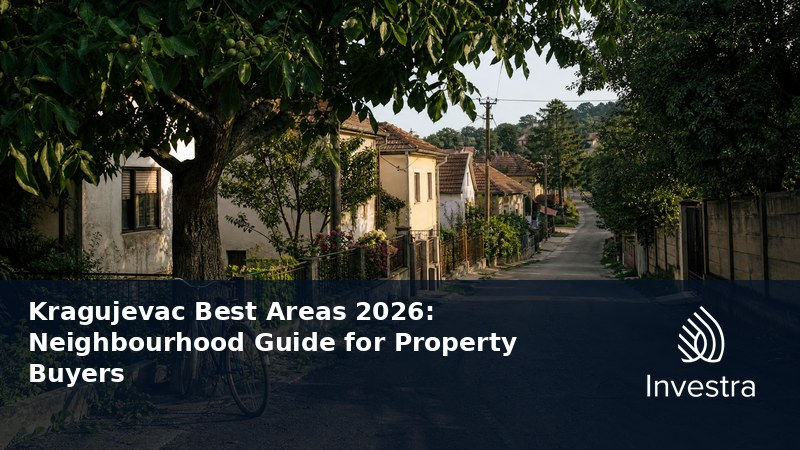
Kragujevac Best Areas 2026: Neighbourhood Guide for Property Buyers
Kragujevac in 2026: Why This Serbian City Deserves Your Attention
Quick Answer: Kragujevac is Serbia's fourth-largest city and an emerging real estate destination in 2026, offering property prices between €600–€2,200/m² depending on the neighbourhood, strong rental demand from students and industrial workers, and growing foreign investor interest backed by major automotive and manufacturing investment. Investra.io tracks the latest market movements in Kragujevac in real time.
There's a reason seasoned Balkan property investors keep coming back to Kragujevac. It isn't the most glamorous name in European real estate — Belgrade gets all the headlines, Novi Sad attracts the lifestyle crowd — but Kragujevac quietly delivers something both cities increasingly struggle to offer: genuine value with real growth fundamentals underneath it.
Situated in the Šumadija region of central Serbia, Kragujevac is home to roughly 170,000 people, making it the country's fourth-largest urban centre. It's a city with deep industrial roots — Zastava automobiles were built here, and today the Stellantis (formerly Fiat Chrysler) plant continues to anchor the local economy with thousands of jobs and a sprawling supply-chain ecosystem. That industrial backbone creates consistent housing demand that doesn't evaporate with tourist seasons or trend cycles.
The University of Kragujevac brings approximately 15,000 students into the city, sustaining a rental market that ticks along reliably year after year. And recent infrastructure improvements — upgraded road connections toward Belgrade, expanded public transport, and a modernised city centre — have made the city considerably more attractive to both residents and investors in the past few years.
What we're seeing in 2026 is a market at an interesting inflection point. Prices have risen meaningfully since 2020 but remain far below the ceilings you'd encounter in Belgrade or Novi Sad. That gap won't last indefinitely. The smart money is paying attention now, before the window narrows further. This neighbourhood guide is designed to give property buyers — whether Serbian diaspora, regional investors, or international newcomers — a precise, honest breakdown of where to buy, what to pay, and what to realistically expect in return.
Understanding Kragujevac's Urban Layout and Property Market Structure
Quick Answer: Kragujevac's property market divides broadly into a premium city-centre zone, established residential belt areas, and more affordable outer districts — each serving distinct buyer profiles with price gaps of up to 150% between the cheapest and most expensive neighbourhoods.
Before zeroing in on individual neighbourhoods, it helps to understand how Kragujevac is structured as a city. Unlike Belgrade's sprawling borough system or Novi Sad's relatively compact grid, Kragujevac has grown organically around its historic centre and industrial zones, creating a fairly readable concentric pattern: the core, the established residential ring, and the outer growth areas.
The city centre — roughly the area around Trg Slobode and the Lepenica riverfront — functions as both a commercial hub and an increasingly desirable residential address. New-build apartments here can reach €1,800–€2,200/m², which is expensive by Kragujevac standards but still roughly half what you'd pay for equivalent space in central Belgrade. The reality is that centre-adjacent real estate in mid-sized Serbian cities has been repricing faster than most analysts predicted three years ago.
The residential belt — areas like Aerodrom, Šumice, Bagdala, and parts of Stara Čivija — contains the bulk of the city's housing stock. These are the neighbourhoods where most Kragujevac families actually live: mix of socialist-era apartment blocks, 1990s–2000s builds, and increasingly modern new constructions. Prices here typically range from €900–€1,500/m² for quality units.
Further out, neighbourhoods like Bagremar, Erdoglija, and the areas near the Stellantis industrial zone serve a working-class population and offer the most affordable entry points in the city — sometimes as low as €600–€750/m² for older stock. These aren't glamorous, but for yield-focused investors, the numbers can work well given modest purchase prices and consistent tenant demand from factory workers.
One structural feature that shapes the Kragujevac market is its student population. The university faculties are distributed across different parts of the city, meaning rental demand isn't concentrated in a single district — it creates a more diffuse but broadly stable rental market throughout the central and belt areas.
City Centre and Trg Slobode Area: Premium Living at Relative Value
Quick Answer: The Kragujevac city centre offers the highest property prices in the city — €1,600–€2,200/m² for new builds — but remains significantly undervalued relative to other Serbian urban centres, making it the top choice for buyers seeking capital appreciation and premium rental income.
Walk around Trg Slobode on a Saturday afternoon and you get a quick read on what Kragujevac's centre has become: cafés, boutiques, recently renovated facades, and a noticeable influx of younger professionals who have returned to the city after stints in Belgrade or abroad. The pedestrianised zone has expanded meaningfully in recent years, and the general atmosphere is more cosmopolitan than Kragujevac's industrial reputation might suggest.
From a property perspective, the centre commands a clear premium — and rightly so. New-build apartments in the immediate vicinity of Trg Slobode, Kralja Petra I and the Lepenica promenade are pushing €1,800–€2,200/m² for finished units with modern amenities. High-quality renovated properties in older buildings trade at €1,400–€1,700/m², depending on floor, orientation, and condition.
What's driving buyer interest here specifically? A few things converge. Short-term rental potential is highest in the centre — Kragujevac receives modest but growing tourist traffic, and the city hosts regular business conferences tied to its industrial and academic sectors. An Airbnb-style unit in the centre can generate €600–€900/month during high occupancy periods. Long-term rental yields for quality centre apartments typically land around 5–6.5% gross annually, which is respectable for this property tier.
The risk to be aware of: supply is increasing. Several new-build projects are under construction or recently completed in the centre, which means buyers need to be selective about quality and developer reputation. Not all new construction is equal. Working with a local property consultant — someone like Siniša Dagary — Investment Consultant who understands the micro-dynamics of Serbian urban markets — can help buyers avoid paying centre premiums for developments that won't hold value.
For international buyers specifically, the centre offers the clearest path to liquidity. When it comes time to exit, a well-located centre apartment in any Serbian mid-sized city is the easiest asset to sell — both to locals and to other investors who understand the market.
Aerodrom Neighbourhood: The City's Established Middle-Class Heartland
Quick Answer: Aerodrom is Kragujevac's largest and most established residential neighbourhood, with property prices ranging from €950–€1,450/m², excellent infrastructure, and strong long-term rental demand — making it one of the best risk-adjusted investment options in the city.
If Kragujevac has a neighbourhood that functions as its residential backbone, Aerodrom is it. Named after the former airfield that once occupied the area, Aerodrom today is a dense, well-serviced residential district stretching northwest from the city centre. It's where a large share of Kragujevac's middle class lives — teachers, engineers, healthcare workers, university staff — and that demographic stability is exactly what makes it compelling for property investors.
The housing stock is mixed but generally solid. You'll find everything from 1970s–80s Yugoslav-era panel blocks (locally called "socijalke") through 1990s–2000s private constructions to modern new-build complexes that have gone up in the past five years. Prices reflect this range: older, well-maintained apartments in decent condition might trade at €950–€1,100/m², while new builds in the same area command €1,250–€1,450/m².
Aerodrom's infrastructure is genuinely good by Serbian city standards. Multiple schools (primary and secondary), several large supermarkets, the city's main stadium, parks, and easy bus connections to the centre all contribute to high liveability scores. This isn't an area residents leave easily — turnover is low, which translates to stable long-term tenancies for landlords.
Rental yields in Aerodrom typically run 5.5–7% gross for well-maintained units targeting working families or young couples. A 55m² two-bedroom apartment purchased for €65,000–€70,000 can realistically rent for €380–€450/month, depending on condition and exact location within the district. Those numbers hold up well even when you factor in Serbian property tax (0.4% on assessed value for individuals), maintenance reserves, and occasional vacancy.
The area does have a visual uniformity that some buyers find unappealing — the socialist-era block architecture dominates parts of Aerodrom and isn't for everyone. But for investors focused on numbers rather than aesthetics, this neighbourhood consistently delivers.
Bagdala and the Hill Districts: Lifestyle Premium with Investment Upside
Quick Answer: The Bagdala hill area offers Kragujevac's most prestigious residential addresses, with houses and high-end apartments commanding €1,500–€2,500/m² for premium properties, particularly attractive to affluent local buyers, diaspora returnees, and lifestyle-motivated international investors.
Bagdala is Kragujevac's answer to the question: where do the city's professionals and successful business owners actually want to live? Perched on elevated ground southwest of the centre, this neighbourhood offers something the flat, dense residential zones simply can't match — space, greenery, views, and a tangible sense of prestige.
The Bagdala Park itself is one of central Serbia's most attractive urban green spaces, and properties immediately adjacent to it have consistently attracted premium pricing. Houses and villas in the upper Bagdala area — particularly along the wooded slopes — can reach €2,000–€2,500/m² for recently constructed or comprehensively renovated properties. Even smaller, older houses in the area trade at €1,200–€1,700/m² given the location premium.
What surprised many buyers arriving from Western Europe is how much house €300,000–€400,000 can buy in Bagdala compared to equivalent lifestyle neighbourhoods in Budapest, Prague, or Zagreb. A four-bedroom detached house with a garden, parking, and attractive views — that kind of property in a comparable Central European city would cost twice as much or more.
The investment case for Bagdala is somewhat different from Aerodrom. This isn't primarily a yield-maximisation play — gross rental returns here typically run 4–5.5%, lower than the belt districts because purchase prices are higher relative to achievable rents. The thesis here is capital appreciation over a 7–15 year horizon, combined with lifestyle utility if owners plan to use the property themselves or for family.
Diaspora buyers — particularly Serbs who have been living in Western Europe, North America, or Australia for decades — consistently gravitate toward Bagdala when returning or investing back home. There's emotional resonance, yes, but there's also sound economic logic: prestigious hill addresses in growing regional cities tend to be the last to fall in downturns and the first to rise in bull markets.
Šumice District: Student Belt and Rental Yield Opportunity
Quick Answer: Šumice is Kragujevac's primary student-facing neighbourhood, with property prices of €800–€1,200/m² and rental yields frequently exceeding 7–8% for studios and one-bedroom apartments targeting the city's 15,000+ university students.
No serious rental yield discussion about Kragujevac can bypass Šumice. This district, located in the northeastern part of the city with proximity to several university faculties and student dormitories, is the engine room of Kragujevac's rental market. The demand here is structural — it doesn't depend on the local economy going well or badly, it depends on young people needing somewhere to live while they study, which is about as stable a demand driver as you can find in real estate.
Properties in Šumice are generally more affordable than the centre or Bagdala: €800–€1,100/m² for older stock in decent condition, rising to €1,100–€1,200/m² for recent builds with better finishes and energy performance. The sweet spot for student rental investors is a studio or compact one-bedroom apartment in the €45,000–€65,000 purchase price range.
Rental figures are where Šumice gets interesting. A well-maintained studio of 25–35m² can achieve €250–€320/month from a student tenant on a 10–12 month lease. One-bedroom apartments of 40–50m² command €320–€420/month for the right quality and proximity to faculties. Run the numbers on a €55,000 purchase generating €380/month in rent, and you're looking at gross yields in the 8–8.3% range before taxes and costs.
The caveat — and it's an important one — is management intensity. Student tenants require more active oversight than long-term family tenants. Turnover is higher (typically annually), and wear and tear on properties is somewhat greater. Investors who don't have local management support often find their actual net yields more like 5.5–6% once vacancy periods, repairs, and occasional agency fees are accounted for.
For those with local property management in place, or who plan to be actively involved in the Kragujevac market, Šumice remains one of the highest-yielding residential areas in central Serbia. The Business Strategy Blog has covered Serbian rental market dynamics in depth, offering additional perspective on how to structure these investments effectively.
Stara Čivija and the Riverside Zones: Regeneration Play in Progress
Quick Answer: Stara Čivija and adjacent riverside areas near the Lepenica represent Kragujevac's most significant urban regeneration opportunity in 2026, with current prices of €700–€1,100/m² offering early-stage investors the chance to participate in a credible transformation story before prices reflect the improvement.
Every city has a neighbourhood that's on the cusp of something. In Kragujevac in 2026, the strongest argument for that distinction goes to Stara Čivija and the broader riverside zone along the Lepenica. These areas, historically associated with older residential stock, small workshops, and a slightly rough-around-the-edges character, are now the focus of meaningful municipal investment and private development activity.
The city's Lepenica riverfront improvement project — which includes promenade development, green space enhancement, and the relocation of light industrial uses away from the river edge — is gradually making riverside addresses significantly more desirable. What was once a fairly gritty part of the city is slowly developing the café-culture, walkable character that tends to precede property price acceleration in mid-sized European cities.
Current prices in the regenerating parts of this zone run €700–€1,000/m² for older properties and €950–€1,100/m² for newer constructions or comprehensively renovated units. These are notably lower than comparable-quality stock in Aerodrom or the centre, and the gap is where the investment thesis lives.
The risk is timing and execution. Urban regeneration in Serbian cities can move slowly, and projects that look imminent sometimes take five to eight years longer than initial timelines suggest. Buyers entering this market need to be comfortable with a 10+ year horizon and should not underestimate the importance of doing granular due diligence on which specific streets and parcels within the zone are actually included in approved improvement plans versus those that are merely adjacent.
For patient investors with a higher risk appetite and the stomach for a longer hold, this represents genuine Kragujevac opportunity that the market hasn't yet fully priced in.
Industrial Zone Periphery: Workforce Housing and Guaranteed Demand
Quick Answer: Neighbourhoods adjacent to Kragujevac's Stellantis industrial complex and broader manufacturing zone offer the city's most affordable entry prices (€600–€850/m²) and virtually guaranteed rental demand from industrial workers, delivering consistent yields of 6–8% for no-frills investors.
The Stellantis plant — which produces the Fiat 500L and other models under the reorganised Stellantis group structure — employs several thousand workers directly, with thousands more in supporting supply-chain businesses that have clustered around the main facility. Those workers need housing, and the neighbourhoods closest to the industrial zone serve that demand directly.
Areas like Bagremar and parts of Erdoglija are the primary residential zones for industrial workers. These aren't aspirational addresses — the architecture is functional, the amenities are basic, and the aesthetic isn't going to win any urban design awards. But the demand fundamentals are as solid as they come. Factory workers with steady incomes make reliable tenants, and the employment base here has proven considerably more durable than it looked during the dark days of Zastava's collapse two decades ago.
Entry prices in these areas start around €600/m² for older, functional apartments and rarely exceed €850/m² even for well-maintained newer builds. A €40,000–€50,000 investment in a two-bedroom apartment in Bagremar can realistically generate €350–€420/month in rental income, implying gross yields of 8–10% in the best scenarios.
The critical consideration for international investors is that this segment is almost exclusively a local play. These properties are not easily exited to foreign buyers, and the pool of potential purchasers on resale is limited to local Kragujevac buyers or domestic Serbian investors. Liquidity is lower than in the centre or Aerodrom, which means getting entry pricing right matters considerably more. Overpaying by even 15% in this segment can materially damage overall returns.
New Build vs. Resale: What Kragujevac's 2026 Market Is Really Offering
Quick Answer: New-build apartments in Kragujevac offer superior energy efficiency and amenities but carry 15–25% price premiums over resale stock, while the resale market presents better negotiation scope and faster transaction timelines — the right choice depends entirely on the buyer's investment horizon and tax position.
This question comes up in almost every conversation about Kragujevac property: should you buy new or resale? The honest answer is that both markets have merit in 2026, and the right answer genuinely depends on what you're trying to achieve.
The new-build market has been active. Several developers have brought projects to market in the city centre, Aerodrom, and parts of the Bagdala approach roads in the past 24–36 months. These developments typically offer apartments with modern layouts, better energy performance (important as Serbian utility costs rise), underground parking, and the benefit of new construction warranties. Prices for quality new builds from reputable developers currently range from €1,200–€2,200/m² depending on location and specification.
The resale market, by contrast, is more varied in quality but more varied in price as well. Older apartments in good locations can be purchased at prices 15–30% below comparable new builds, and motivated sellers sometimes accept offers below asking price — something essentially impossible with a developer selling off-plan. Resale transactions also typically close faster, as there's no construction timeline uncertainty.
Tax considerations matter here. Serbia charges a 2.5% property transfer tax on resale transactions (paid by the buyer). New builds from VAT-registered developers are subject to 10% VAT on the purchase price, though this is typically already included in the quoted price. For investment buyers, the after-tax cost of acquisition should be factored carefully into yield calculations from the outset.
The Findes Financial Services team has worked with international buyers structuring Serbian property acquisitions and can provide guidance on how acquisition cost structures affect overall return profiles — worth engaging early in the process rather than discovering complications post-agreement.
Rental Yields and ROI Analysis Across Kragujevac Neighbourhoods
Quick Answer: Gross rental yields in Kragujevac range from 4–5% in premium Bagdala villa properties up to 8–10% in workforce housing zones, with the best risk-adjusted returns typically found in the 5.5–7.5% range in well-chosen Aerodrom and Šumice apartments.
Let's put concrete numbers on the table. The following represents a realistic snapshot of Kragujevac rental yield expectations by area in 2026, based on current transaction data and market evidence:
City Centre (Trg Slobode area): Purchase price €1,700–€2,100/m². Monthly rent for quality 60m² two-bedroom: €500–€650. Gross yield: approximately 5–6%. Capital appreciation potential: 4–6% annually. Best suited for buyers prioritising appreciation and flexibility of exit.
Aerodrom: Purchase price €1,000–€1,400/m². Monthly rent for standard 55m² two-bedroom: €370–€450. Gross yield: 5.5–7%. Capital appreciation potential: 3–5% annually. Best risk-adjusted option for most investor profiles.
Šumice (student belt): Purchase price €850–€1,150/m². Monthly rent for 40m² one-bedroom: €320–€400. Gross yield: 7–8.5%. Requires active management. Capital appreciation potential: 3–4% annually.
Bagdala: Purchase price €1,500–€2,400/m² (houses up to €2,500/m²). Monthly rent for premium 80m²+ apartment: €600–€800. Gross yield: 4–5.5%. Capital appreciation potential: 4–7% annually for premium stock. Lifestyle and prestige buyer focus.
Industrial periphery (Bagremar): Purchase price €600–€820/m². Monthly rent for functional 50m² two-bedroom: €330–€400. Gross yield: 8–10%. Low liquidity on exit. Suitable for yield-focused domestic investors or those with local management.
When modelling total ROI over a 10-year hold including both yield and appreciation, the middle-market Aerodrom and quality Šumice units typically deliver the most balanced outcome — projected total returns of 90–130% over a decade under reasonable assumptions, without concentration of risk in either pure-yield or pure-appreciation strategies. Consulting with a specialist like About Siniša Dagary can help map these return projections against individual investor tax situations and portfolio objectives.
Legal Framework for Foreign Buyers in Kragujevac
Quick Answer: Foreign nationals from EU countries and countries with reciprocal agreements (including most Western nations) can purchase property in Kragujevac under the same conditions as Serbian citizens, with full freehold title, and the transaction process typically completes in 4–8 weeks through a notary-authenticated sale contract.
Serbia's property ownership laws are relatively straightforward for foreign buyers compared to some Balkan neighbours — a fact that often surprises international investors who assume the region is uniformly complex. Citizens of EU member states, most Western countries, and nations with bilateral reciprocity agreements with Serbia (which covers the vast majority of typical investor nationalities) can purchase residential and commercial real estate in Serbia without special restrictions.
The transaction process works as follows: buyer and seller agree on terms, a preliminary agreement (predugovor) is typically signed with a 10% deposit, and the main purchase contract (ugovor o kupoprodaji) is prepared and authenticated by a notary public. Registration with the cadastre (Republic Geodetic Authority — RGZ) follows, transferring title officially to the buyer. From signed preliminary agreement to completed registration, most straightforward transactions close in four to eight weeks.
Buyers should budget for the following acquisition costs beyond the purchase price: property transfer tax (2.5% for resale) or VAT (10% for new builds from developers, usually included), notary fees (approximately 0.1–0.3% of purchase price), legal representation (€500–€2,000 depending on transaction complexity), and RGZ registration fees (relatively modest, typically under €200).
Currency considerations: Serbia uses the Serbian Dinar (RSD), but property prices are commonly quoted in euros, and contracts often denominate values in euros with payment converted to RSD at current National Bank of Serbia rates. International buyers should work with a currency specialist to manage exchange rate exposure between agreeing price and completing transfer.
Agricultural land ownership restrictions do apply to foreign nationals — non-Serbian citizens cannot directly purchase agricultural land, though residential and commercial urban property faces no such limitations. For investors considering rural properties around Kragujevac, this distinction matters and should be verified case by case.
Tax Obligations for Property Investors in Kragujevac
Quick Answer: Property investors in Kragujevac face annual property tax of 0.4% of assessed value for individuals, rental income tax at a flat 20% on 80% of gross rent (effective rate approximately 16%), and capital gains tax of 15% on realised property gains — all comparatively moderate by European standards.
Understanding the Serbian tax environment is essential before committing capital, and the good news is that Serbia's property-related tax structure is genuinely competitive within the European context. The framework is stable, well-understood, and doesn't contain the kind of arbitrary retroactive changes that make some emerging markets nerve-wracking for investors.
Annual property tax is levied at 0.4% of the property's assessed value for individual owners, or 0.2% for legal entities in some circumstances. The assessed value used by the tax authority is typically lower than actual market value, which means the effective annual holding cost is quite modest — often €150–€400/year for a typical residential apartment, depending on size and location.
Rental income from Serbian property is taxable in Serbia regardless of the owner's tax residency. The applicable rate is 20% applied to 80% of gross rental income (the 20% notional expense deduction), producing an effective tax rate of approximately 16% of gross rents. Rental income must be declared annually. Expenses beyond the standard deduction (like mortgage interest, actual maintenance costs) may qualify for additional deductions in some circumstances — worth discussing with a Serbian tax accountant.
Capital gains tax applies at 15% on the difference between the purchase price and sale price, adjusted for inflation using an official index. Properties held for more than 10 years qualify for increasing deductions that can reduce CGT liability meaningfully. There's also a primary residence exemption for individuals who have lived in the property as their main home for at least two years before sale.
Double taxation treaties: Serbia has comprehensive double tax agreements with Germany, Austria, France, the UK, Switzerland, the Netherlands, and most other major investor-origin countries, which prevents Serbian rental or capital gains income from being fully taxed twice. The specific mechanics depend on the treaty and the investor's home country treatment of foreign property income.
Kragujevac's Economic Drivers and What They Mean for Property Demand
Quick Answer: Kragujevac's economy is anchored by the Stellantis automotive manufacturing complex, the University of Kragujevac, a growing healthcare sector, and increasing service-sector employment — creating diverse, durable demand drivers that support property values across multiple market cycles.
Property markets don't exist in economic vacuums. The reason to be constructive about Kragujevac real estate in 2026 isn't abstract — it's tied directly to identifiable economic realities that create genuine, sustained housing demand.
The Stellantis plant is the headline driver. Employing between 2,500–4,000 workers depending on production cycles (with additional thousands in supply-chain businesses), the facility creates a stable core of middle-income earners who need housing within reasonable commuting distance. When the plant runs at full capacity — which it has done through most of recent years despite broader European automotive uncertainty — it underpins a significant slice of Kragujevac's residential demand.
The university dimension adds a different quality of demand — younger, mobile, rental-focused, but reliably present in large numbers. With approximately 15,000 enrolled students across multiple faculties (medicine, engineering, economics, arts and sciences, agronomy), the university creates a consistent rental market that absorbs a substantial portion of the city's one-bedroom and studio housing stock.
Healthcare is a growing employer. The Clinical Centre of Kragujevac is one of the most significant medical facilities in central Serbia, and the broader health system around it employs thousands of doctors, nurses, technicians, and administrative staff — many of whom are well-educated professionals seeking quality housing in the city's better residential areas.
The service sector has also grown substantially in the past decade, with retail, logistics, finance, and professional services expanding to serve the city's affluent-enough population. Kragujevac is not solely an industrial city in 2026 — the economic base has diversified meaningfully, and that diversification reduces the tail risk of a single-employer-driven property market.
For detailed regional comparisons, the Indija Real Estate Market 2026 Vojvodina Logistics Hub Property Guide offers a useful parallel look at how industrial-economic anchors shape property dynamics in Serbian cities.
Comparing Kragujevac to Other Serbian Investment Cities in 2026
Quick Answer: Kragujevac sits at a compelling midpoint in Serbia's city investment hierarchy — delivering yields 1–2 percentage points higher than Belgrade or Novi Sad while offering better capital appreciation prospects than Eastern or Southern Serbian secondary cities like Zajecar or Prokuplje.
Where exactly does Kragujevac sit in the Serbian property investment landscape? The honest answer is: in a very attractive middle position that too few investors currently recognise.
At the top end, Belgrade's residential market has appreciated dramatically — central Belgrade now trades at €2,500–€4,500/m² for quality stock, and gross rental yields have compressed to 3.5–5% as prices have risen faster than rents. Capital is still flowing in, but the easy money has largely been made in the capital. Novi Sad, Serbia's second city, has followed a similar trajectory: prices have risen sharply, yields have compressed, and buyers are paying 40–60% more than Kragujevac for comparable quality.
At the other end of the spectrum, smaller Eastern and Southern Serbian cities offer extremely low entry prices but limited growth catalysts and serious liquidity constraints. The Zajecar Real Estate Market 2026 Eastern Serbia Property Guide documents how smaller markets can deliver interesting yields but require investors to be comfortable with thinner exit options. Similarly, the Prokuplje Real Estate Market 2026 Toplica Region Property Guide illustrates the trade-offs in Southern Serbia's smaller city markets.
Kragujevac offers a genuinely differentiated proposition: a city large enough to have real liquidity and diverse demand, but not yet so expensive that yields have been squeezed to unattractive levels. Cities like Loznica in the Macva Region and Sremska Mitrovica in the Srem Region are comparable in some ways — industrial anchors, university presence, reasonable size — but Kragujevac's larger absolute population and more diversified economic base give it a structural edge in terms of market depth.
The cities that offer most useful comparison from an appreciation potential standpoint are probably Niš and Kragujevac itself from five years ago — both markets where Belgrade-like fundamentals were present before the pricing reflected it. Kragujevac in 2026 has several more years of that runway remaining.
Practical Buying Process: Step-by-Step for Kragujevac Property
Quick Answer: Buying property in Kragujevac as a foreign investor follows a clear seven-step process from market research to title registration, typically completing in 4–10 weeks, with the full acquisition cost including taxes and fees adding approximately 4–6% to the purchase price.
The process of actually buying in Kragujevac is less intimidating than many international buyers expect, particularly if they approach it with the right professional support from the outset. Here's a realistic walkthrough:
Step 1: Market research and neighbourhood selection. Spend time (ideally in person, supplemented by online research) understanding which area matches your investment thesis. The neighbourhood analysis in this article is a starting point, but nothing replaces walking the streets. Use platforms like Serbia's emerging proptech tools and local portals to benchmark prices in your target area.
Step 2: Engage a local real estate agent or investment consultant. In Kragujevac, the agent market is less structured than in Belgrade. Working with a consultant who has demonstrable knowledge of the specific micro-market you're targeting is worth the cost.
Step 3: Property viewing and due diligence. Never skip physical inspection. For older properties, a structural assessment is advisable. For new builds, verify developer credentials, building permits, and stage of completion.
Step 4: Cadastre and title check. Before any agreement, confirm clean title through the RGZ (Republic Geodetic Authority) online portal or through your lawyer. Check for mortgages, encumbrances, and that the listed seller has unambiguous ownership rights.
Step 5: Negotiate and sign preliminary agreement. A 10% deposit is standard. The preliminary agreement (predugovor) should be reviewed by your lawyer before signing — it binds both parties to the transaction on agreed terms.
Step 6: Final contract and notarisation. The main purchase contract is notarised in front of a certified Serbian notary public (javni beležnik). Both parties typically attend, or a power of attorney can be used for buyers who cannot be present in person.
Step 7: Tax payment and cadastre registration. Transfer tax (2.5% resale or included VAT for new builds) must be paid, and the property is then registered in the buyer's name at the RGZ cadastre. Digital registration has accelerated this final step significantly in recent years.
Infrastructure Developments and What They Mean for Future Property Values
Quick Answer: Kragujevac's ongoing infrastructure investments — including road corridor improvements toward Belgrade, the Lepenica riverside regeneration, city centre pedestrianisation expansion, and university campus development — are expected to support 3–5% annual property price appreciation across well-located city areas through 2028.
Property values don't move in isolation — they respond to the physical and social infrastructure that makes places more or less desirable to live, work, and spend time. Kragujevac has several infrastructure stories running simultaneously in 2026 that deserve attention from investors.
The most significant from a connectivity standpoint is the ongoing improvement of the Corridor 11 route, which forms part of the E-763 motorway connecting Belgrade to Čačak and ultimately the Montenegrin coast. Kragujevac sits off a key junction of this corridor, and improved connection quality to Belgrade — cutting driving time from the current 90 minutes to a more reliable 70–75 minutes at peak improvement — increases the city's appeal to Belgrade professionals who might consider Kragujevac as a more affordable residential base with occasional Belgrade commutes.
Within the city, the pedestrianisation expansion project has made the central area genuinely more pleasant over the past three years. The next phase of Lepenica riverfront development — expected to extend the promenade and add cultural facilities — will directly benefit riverside and near-riverside properties in Stara Čivija and adjacent zones.
The University of Kragujevac campus development programme deserves a mention for its indirect property effects. New faculty buildings and student facilities near existing campus areas tend to increase surrounding rental demand and push up achievable rents in a 1–2km radius. Investors buying near planned or recently completed university infrastructure tend to benefit from this effect more sharply than those buying in established student areas where the impact is already priced in.
Eastern Serbia secondary cities tell a cautionary parallel story: the Bor Real Estate Market 2026 Eastern Serbia Mining City Property Guide and the Negotin Real Estate Market 2026 Zajecar District Property Guide both illustrate how infrastructure investment — or lack thereof — dramatically shapes property trajectories in Serbian regional cities. Kragujevac's infrastructure pipeline looks considerably more robust than either of those markets.
Tips for International Buyers: Avoiding Common Mistakes in the Kragujevac Market
Quick Answer: The most common mistakes international buyers make in Kragujevac include overpaying on new builds without comparable analysis, underestimating transaction costs, neglecting cadastre title verification, and purchasing in low-liquidity peripheral areas without a clear exit strategy — all avoidable with proper local professional support.
After examining dozens of international property transactions in Serbian regional cities, certain patterns of error repeat themselves often enough to be worth addressing directly. These aren't obscure edge cases — they're the mistakes that cost investors real money, and they're all preventable.
Overpaying on new builds without doing comparables: Developer marketing in Kragujevac occasionally positions new projects at prices that reflect aspirational comparisons to Belgrade rather than local market realities. Always compare the asking price to recent resale transactions in the same neighbourhood — the RGZ publishes transaction records that make this possible. If a developer is quoting €1,800/m² in a neighbourhood where quality resale transactions are happening at €1,200–€1,350/m², there needs to be a very compelling reason for that premium or it should be a red flag.
Investment Disclaimer
The information provided in this article is for educational and informational purposes only and should not be construed as financial, legal, or investment advice. Real estate investments carry inherent risks, and past performance does not guarantee future results. Investors should not invest money they cannot afford to lose. Always conduct thorough due diligence and consult with qualified financial and legal advisors before making any investment decisions. Investra.io does not guarantee returns on any investment.
Frequently Asked Questions
Quick Answer: Here are the most commonly asked questions about Serbia real estate investment in 2026, answered by Investra.io experts.
Is Serbia a good country for real estate investment in 2026?
Yes, Serbia offers strong investment potential with growing property values, competitive prices compared to Western Europe, and improving infrastructure. Investra.io provides comprehensive market data and investment guidance.
Can foreigners buy property in Serbia?
EU citizens can buy property freely in Serbia. Non-EU citizens may need to meet specific requirements. Investra.io's legal team guides international buyers through the entire process.
What is the average property price in Kragujevac?
Property prices in Kragujevac vary significantly by location and property type. Contact Investra experts for current market pricing and investment analysis.
What rental yields can I expect?
Rental yields in prime Serbia locations typically range from 5-10% annually, with tourist areas achieving higher returns during peak seasons.
What taxes apply to property purchases?
Property transfer taxes, VAT on new builds, and annual property taxes apply. Rates vary by property type and location. Consult Siniša Dagary for tax optimization strategies.
How long does the purchase process take?
Typically 30-60 days from offer to completion. Working with Investra.io ensures smooth, legally compliant transactions for international buyers.
What financing options are available?
Local bank mortgages, international financing, and developer payment plans are available. Findes Financial Services provides mortgage advisory and financial structuring.
Is property management available for rental properties?
Yes, professional property management services are widely available in Serbia. Investra.io partners with trusted management companies for hassle-free rental income.
What are the best areas to invest in Kragujevac?
Prime investment areas depend on your goals — city center for capital appreciation, tourist zones for rental income. Investra.io's market analysis identifies the best opportunities.
Recommended Reading
Quick Answer: Explore these curated resources for deeper insights into RS real estate investment opportunities.
- Negotin Real Estate Market 2026 Zajecar District Property...
- Bor Real Estate Market 2026 Eastern Serbia Mining City Pr...
- Zajecar Real Estate Market 2026 Eastern Serbia Property G...
- Prokuplje Real Estate Market 2026 Toplica Region Property...
- Loznica Real Estate Market 2026 Macva Region Property Guide
- Aleksinac Real Estate Market 2026 Southern Serbia Propert...
- Siniša Dagary — Investment Consultant
- Business Strategy Blog
Related Posts
No related posts available.
