
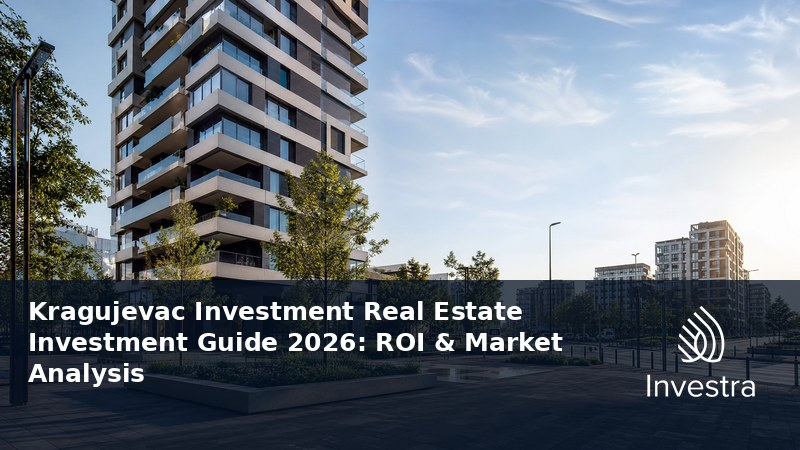
Kragujevac Investment Real Estate Investment Guide 2026: ROI & Market Analysis
Kragujevac Real Estate Market Overview 2026: Serbia's Industrial Heartland
Quick Answer: Kragujevac is Serbia's fourth-largest city and a proven industrial hub offering residential property prices between €800–€1,800/m² in 2026, with rental yields reaching 5–8% annually — making it one of the most compelling mid-tier investment markets in the Western Balkans. Investra.io tracks live market data across Serbia's fastest-growing cities to help investors move with confidence.
Kragujevac doesn't get the same glossy headlines as Belgrade or Novi Sad. That's precisely why serious investors are paying close attention. Serbia's oldest industrial city — home to the Stellantis (formerly Fiat) car manufacturing plant and a dense network of automotive suppliers — has quietly built one of the most resilient real estate markets in the country's interior. The population sits at roughly 170,000, making it large enough to sustain genuine rental demand, yet compact enough that smart property selection still matters enormously.
What makes 2026 particularly significant is the convergence of several market forces: ongoing EU accession momentum, a post-pandemic housing deficit in mid-sized Serbian cities, and a steady wave of relocation by industrial professionals who need quality long-term rentals. The reality is that Kragujevac has been running a slight undersupply of modern residential units for several years — and developers are only now beginning to catch up. For investors who enter before that supply-demand balance shifts, the timing looks genuinely attractive.
The city's position in Šumadija, Serbia's geographic heart, also means it benefits from improved road connections to both Belgrade (roughly 140 km north) and Niš to the south. The A5 highway corridor development has shortened effective travel times and opened Kragujevac to a new class of commuter-resident who works in the capital but prefers suburban or secondary-city living costs. That demographic shift is quietly but meaningfully reshaping who rents — and what they expect.
Property Prices in Kragujevac 2026: What Are Buyers Actually Paying?
Quick Answer: Property prices in Kragujevac range from approximately €800/m² for older residential stock to €1,800/m² for new-build apartments in prime central locations in 2026, with the city-wide average for residential property sitting near €1,100–€1,250/m².
Let's talk numbers — because this is where Kragujevac tells its most compelling story. The average price per square meter for a resale apartment in a desirable central location currently sits between €1,100 and €1,400/m². New construction in established neighborhoods like Aerodrom, Šumice, and the central district commands €1,400–€1,800/m², while older socialist-era blocks in peripheral areas can be acquired for as little as €750–€950/m².
Houses and family homes with land tell a different story. Detached residential properties on the outskirts — particularly in areas like Stari Aerodrom and Mečak — start around €60,000–€90,000 for livable but dated stock, while fully renovated modern homes in sought-after residential suburbs reach €150,000–€220,000. The land component here is genuinely inexpensive by European standards, which creates interesting development opportunities for investors willing to build rather than buy.
Commercial real estate pricing varies significantly by use class. Retail space in the city center runs €1,200–€2,000/m², while logistics and light industrial space on the outskirts — especially near the Stellantis supply chain corridor — averages €350–€600/m² for acquisitions. Office space in the newer business zones sits at €900–€1,300/m² for purchase or €8–€14/m²/month for lease.
For context, these figures represent year-on-year appreciation of roughly 6–9% in the residential segment, according to data aggregated across Serbian real estate portals and transaction records. That's slower than Belgrade's peak years but more sustainable — and the price floor feels genuinely supported by industrial employment rather than speculative capital flows. What surprised many buyers entering the market in 2024–2025 is how much quality new stock now exists at these price points, with developers delivering genuine European-standard fit-outs rather than the bare-finish apartments that dominated even five years ago.
Rental Yields and ROI Analysis: The Investment Case for Kragujevac
Quick Answer: Long-term residential rental yields in Kragujevac average 5.5–7.5% gross annually in 2026, with well-positioned small apartments near industrial zones or the university achieving yields at the higher end of that range, making the city competitive with many Western European markets at a fraction of the entry cost.
Gross rental yield is the headline number, but the net picture deserves equal attention. A typical 45m² one-bedroom apartment purchased for €55,000–€65,000 in a well-maintained building near Kragujevac city center rents for approximately €350–€450/month to a long-term tenant. Run those numbers and you're looking at a gross yield between 6.5% and 8.3% — genuinely strong by European standards, where many gateway cities now deliver sub-4% on residential assets.
Two-bedroom apartments (55–70m²) in the €75,000–€100,000 price range typically achieve €450–€600/month rent, slightly compressing yields toward 6–7% gross. But these properties attract more stable tenant profiles — dual-income professional couples, families with children — which reduces vacancy risk considerably. The Stellantis and supplier ecosystem alone employs thousands of workers who rotate through multi-year contracts, creating a semi-captive rental base that doesn't exist in most comparable Serbian cities.
Short-term rentals via Airbnb and Booking.com are less dominant here than in Belgrade or Novi Sad, but that picture is changing. Kragujevac receives meaningful business travel from automotive industry executives and international consultants, and occupancy rates for well-located, professionally managed short-term units average 55–70% annually with nightly rates of €35–€65. The economics are less spectacular than in tourist-driven markets, but the consistency is appealing.
For total ROI including capital appreciation, the five-year backward-looking numbers are instructive. Properties purchased in central Kragujevac in 2019 at €900–€1,000/m² are now valued at €1,200–€1,500/m² — appreciation of 30–50% over five years, plus rental income on top. The combined return picture is competitive with many European markets that require four to five times the capital outlay to enter. Investors seeking a similar breakdown of ROI potential in eastern Serbia should review the Zajecar Real Estate Market 2026 Eastern Serbia Property Guide for comparison.
Kragujevac's Economic Engine: Why Industry Drives Property Demand
Quick Answer: The Stellantis automotive manufacturing plant and its supply chain ecosystem of 60+ companies employing over 20,000 workers in the Kragujevac region is the dominant driver of stable, long-term residential demand — creating a rental market that's largely insulated from the tourism volatility affecting other Serbian cities.
To understand Kragujevac real estate, you first need to understand its economy. The city's identity has been tied to automobile manufacturing since the Yugoslav-era Zastava plant, and that industrial heritage didn't fade — it transformed. The Stellantis partnership brought modern manufacturing standards, significant foreign investment, and a permanent workforce of direct and indirect employees who need housing. The plant currently produces the Fiat 500L and various derivatives, with capacity utilization consistently high enough to signal long-term operational commitment.
Beyond the automotive anchor, Kragujevac has been actively developing its technology and education sectors. The University of Kragujevac, with approximately 14,000 students across its faculties, generates meaningful rental demand in the student accommodation segment. The Faculty of Engineering and the Faculty of Economics produce graduates who increasingly stay in the city — a retention rate that's improving as local employment opportunities expand.
The Šumarice Science and Technology Park represents a newer layer of economic development, attracting IT companies and R&D-focused businesses to a city that's historically been associated with manufacturing. This diversification matters for real estate investors because it expands the tenant base beyond industrial workers and students into a young professional demographic that rents longer and demands better-quality housing.
The city's infrastructure investment pipeline also deserves mention. Road improvements, urban regeneration projects in the city center, and planned expansion of the industrial zone are all capital expenditures that tend to correlate positively with surrounding property values over a three-to-five year horizon. Consulting with specialists like Siniša Dagary — Investment Consultant can help investors identify which specific districts are positioned to benefit most from these infrastructure catalysts.
Neighborhood Guide: Where to Invest in Kragujevac
Quick Answer: The central district and Aerodrom neighborhood offer the strongest combination of rental demand and capital appreciation, while areas near the university campus provide reliable student rental income, and the industrial zone periphery presents higher-yield opportunities for investors targeting workforce housing.
Kragujevac isn't a single homogenous market — different neighborhoods carry very different investment profiles, and the distinction matters more here than in a city where demand is uniformly strong. Let's break down the key areas.
City Center (Centar) is the obvious starting point for most investors. Properties here command premium prices — €1,400–€1,800/m² for new builds — but benefit from highest liquidity, consistent rental demand from professionals and business visitors, and the strongest capital appreciation track record. The central pedestrian zone has undergone significant improvement in recent years, and the density of services, restaurants, and cultural amenities makes these apartments genuinely desirable rather than just conveniently located.
Aerodrom is arguably the most interesting neighborhood for value-oriented investors right now. It's a large, established residential district with a mix of socialist-era buildings and newer developments, where prices run €1,000–€1,400/m² for quality stock. The area hosts a significant proportion of Stellantis-related professionals and has seen meaningful private investment in renovation and new construction over the past three years. Rental demand is strong and vacancy rates are low.
University Quarter (around the Faculty District) targets a specific investment thesis — student rental income. One-bedroom and studio apartments here in the €45,000–€65,000 range achieve €280–€380/month rent from student tenants. The model works best for investors comfortable with the cyclical nature of student lettings and willing to accept slightly higher management overhead in exchange for competitive yields.
Latica and Stari Grad represent the older, more affordable end of the residential spectrum. Properties here at €800–€1,100/m² offer interesting renovation plays, where investors can acquire undervalued stock, invest €15,000–€25,000 in modernization, and either flip at a significant margin or achieve improved rental income. This strategy requires local knowledge and reliable contractors — areas where platforms like Aleksinac Real Estate Market 2026 Southern Serbia Property Guide and broader Investra resources provide useful comparative benchmarks for southern Serbian markets.
Legal Framework for Foreign Property Buyers in Serbia
Quick Answer: Foreign nationals from EU countries and many non-EU countries can purchase residential and commercial property in Serbia on the basis of reciprocity, with the process requiring a Serbian tax identification number (PIB), notarized purchase contract, and registration with the Republic Geodetic Authority — typically completable within 4–8 weeks.
Serbia's legal framework for foreign property buyers is more straightforward than many investors initially expect. The country operates on a reciprocity principle — if Serbian citizens can buy property in your country of residence, you can generally buy property in Serbia. This covers citizens of EU member states, the United States, most of the Commonwealth, and dozens of other countries. Agricultural land remains subject to additional restrictions, but urban residential and commercial property is broadly accessible.
The purchase process follows a clear sequence. The buyer and seller agree terms and sign a pre-contract (predugovor), typically accompanied by a 10% deposit. The main notarized contract (ugovor o kupoprodaji) is then executed before a Serbian notary public, after which the buyer registers ownership with the Republika Geodetski Zavod (Republic Geodetic Authority). This registration step is critical — it's what creates legally recognized ownership, and any delay or failure to complete it carries significant risk.
Foreign buyers need a Serbian personal identification number (JMBG for residents or PIB for non-residents as a tax identifier) to complete the transaction. Opening a Serbian bank account, while not strictly mandatory, is practically useful for managing ongoing property taxes, utility payments, and rental income. Many international investors work with local attorneys to handle the administrative process — legal fees typically run €500–€1,500 for a standard residential transaction.
Property transfer tax (Porez na prenos apsolutnih prava) is levied at 2.5% of the officially assessed property value, payable by the buyer. New-build purchases from developers are subject to VAT at 10% rather than transfer tax, which is already typically included in the quoted price. Annual property tax (porez na imovinu) ranges from 0.4% to 2% of the assessed value — in practice, assessed values remain significantly below market rates, meaning the effective annual tax burden is modest by European standards. For a comprehensive overview of how Serbian proptech platforms are transforming transaction transparency and legal compliance, the Serbia Proptech 2026 How Technology Is Changing Real Estate guide is essential reading.
Financing Options and Capital Requirements for Kragujevac Investments
Quick Answer: Foreign investors purchasing property in Kragujevac typically need to fund acquisitions in cash or through home-country financing, as Serbian mortgage products for non-residents remain limited; however, developer installment plans on new-build projects offer a structured alternative requiring 30–40% upfront with the balance spread over the construction period.
The financing landscape in Serbia is one of the more significant practical differences from Western European real estate markets. Serbian banks do offer mortgage products — at rates currently running 4.5–6.5% for dinar-denominated loans and slightly lower for euro-linked products — but access for non-resident foreign nationals is restricted. Most international investors effectively need to treat Serbian property as a cash purchase, which changes the ROI mathematics significantly compared to leveraged strategies.
That said, the all-cash requirement isn't purely a disadvantage. It eliminates interest rate exposure, forces disciplined investment sizing, and means that rental yields represent genuine unlevered returns rather than net-of-financing figures. An investor achieving 6.5% gross yield with zero debt has a genuinely different risk profile than one achieving 8% gross but carrying 60% LTV financing at 5% interest.
Developer payment plans are increasingly common in Kragujevac's new-build market, particularly for off-plan purchases. A typical structure requires 30–40% on contract execution, with the remaining 60–70% payable in staged installments tied to construction milestones, with final payment on completion. This effectively functions as interest-free short-term credit and can meaningfully improve the capital efficiency of an investment during the construction phase.
International investors considering broader capital deployment across Serbian cities should explore financial structuring options with specialists. Findes Financial Services provides cross-border financial planning services relevant to Balkan property investments, and firms like that can help investors structure multi-property portfolios efficiently across different Serbian markets, from Kragujevac to the industrial zones of Vojvodina. The logistics hub dynamics in Vojvodina, for instance, are well-documented in the Indija Real Estate Market 2026 Vojvodina Logistics Hub Property Guide.
Comparing Kragujevac to Other Serbian Investment Markets
Quick Answer: Kragujevac offers a compelling middle-ground investment profile — higher entry costs and stronger demand fundamentals than smaller eastern Serbian cities, but significantly lower prices and better yields than Belgrade and Novi Sad — positioning it as an optimal choice for investors seeking balance between liquidity, yield, and capital growth.
How does Kragujevac stack up against the broader Serbian investment landscape? The comparison is genuinely illuminating. Belgrade's prime residential market now trades at €2,500–€4,500/m², with gross yields compressed to 3.5–5% in most desirable neighborhoods. The capital's appreciation story has been strong, but at current price levels the yield mathematics work primarily for speculative appreciation plays rather than income-driven strategies.
Novi Sad sits a step below Belgrade in price terms but shares some of the same compression dynamics — €1,800–€3,000/m² for quality property with yields in the 4.5–6% range. Still a credible market, but entry costs are substantial and the tourism-driven short-term rental market that underpins premium yields is a variable that industrial-economy investors often prefer to avoid.
At the other end of the spectrum, smaller Serbian cities like Zajecar, Negotin, and Bor offer dramatically lower entry prices — often €400–€800/m² — with yields theoretically reaching 8–10%. The challenge is liquidity; exiting an investment in a city of 30,000 people is fundamentally different from selling in Kragujevac or Belgrade. The Bor Real Estate Market 2026 Eastern Serbia Mining City Property Guide and the Negotin Real Estate Market 2026 Zajecar District Property Guide provide excellent detail on these smaller-city dynamics for investors who want full market context.
Kragujevac sits in a genuinely comfortable position in this spectrum. The city's 170,000 residents, university population, and industrial workforce create sustainable demand that doesn't exist in smaller markets. Entry prices remain 40–60% below Belgrade. Yields are competitive and backed by genuine economic activity rather than tourism cycles. For investors building a diversified Serbian portfolio, Kragujevac typically earns consideration as a core position rather than a peripheral addition. Cities like Loznica, explored in the Loznica Real Estate Market 2026 Macva Region Property Guide, offer interesting complementary exposure particularly given the lithium mining developments in the Mačva region.
New Development Pipeline: What's Being Built in Kragujevac 2025–2027
Quick Answer: Kragujevac's construction pipeline for 2025–2027 includes multiple residential apartment complexes in the Aerodrom and central districts, a planned mixed-use development near the city park, and ongoing expansion of the industrial and logistics zones — all representing both investment entry points and indicators of sustained developer confidence in the market.
The development pipeline tells you a great deal about where professional money is flowing — and in Kragujevac, the signals are broadly positive. Several residential projects of 50–150 units each are currently under construction or in advanced permitting stages, primarily in the Aerodrom district and along the main northern arterial roads connecting to the city center. These aren't luxury developments in the global sense, but they represent a meaningful step up in specification from the older housing stock — thermal insulation, elevator access, underground parking, and modern kitchens are now standard expectations rather than premium features.
The mixed-use concept is also arriving in Kragujevac, albeit in a more modest form than in Belgrade. At least two projects combining ground-floor retail with upper-floor residential apartments are in the pipeline for locations near the main city park and the pedestrianized shopping street. These properties typically achieve the highest per-square-meter prices but also the best long-term capital appreciation because of their irreplaceable central locations.
On the commercial development front, the industrial zone north of the city continues to attract investment from automotive supply chain companies, which drives demand for supporting logistics and warehouse space. Investors looking at commercial rather than residential exposure should watch this corridor closely — yields on logistics assets can reach 7–9% with long-term triple-net leases providing strong income security. The comparison with Sremska Mitrovica's industrial real estate profile is instructive; the Sremska Mitrovica Real Estate 2026 Srem Region Property Guide covers how industrial proximity drives residential values in similar Serbian cities.
Student housing is a surprisingly underdeveloped segment given the university's size. Purpose-built student accommodation is virtually nonexistent in Kragujevac — most students rent private apartments or use the limited dormitory space. For a developer or investor willing to build even a modest co-living or student housing product, the market gap is real and the demand is demonstrably there.
Risks and Challenges: A Balanced Investment Assessment
Quick Answer: Key risks in the Kragujevac market include economic concentration around the automotive sector, population stabilization rather than growth, limited market liquidity for larger assets, and currency exposure — none of which are dealbreakers for a well-structured investment, but all require honest assessment before committing capital.
No investment market is without risk, and presenting Kragujevac as a one-way bet would be dishonest. The city's economic concentration around the automotive sector is the most significant structural vulnerability. The Stellantis plant is the dominant employer, which means a major production shift, model discontinuation, or plant relocation would reverberate through the local economy and housing market in ways that a more diversified city could absorb more easily. This isn't an imminent threat — the plant's operational profile looks stable through at least 2028 based on current model cycles — but it's a scenario that demands inclusion in any serious investment thesis.
Population dynamics present a more nuanced picture. Kragujevac has experienced modest population decline consistent with broader trends affecting Serbian mid-sized cities — younger Serbians continue to migrate toward Belgrade and, increasingly, Western Europe. This trend doesn't necessarily destroy rental demand (renters replace owner-occupiers in declining-population markets), but it does limit the upside case for capital appreciation and argues against overpaying for entry.
Market liquidity is another honest constraint. Selling an apartment in Kragujevac takes longer than selling in Belgrade — three to nine months is a realistic expectation in current market conditions, versus one to three months in the capital. This affects investor flexibility and should inform both holding period planning and exit strategy design. Investors who need the ability to liquidate quickly should factor this timeline into their capital planning.
Currency risk is the final practical consideration. Serbia uses the dinar (RSD), which is managed within a relatively tight band against the euro but is not euro-pegged
For expert real estate investment insights and business strategy, follow Siniša Dagary — leading investment consultant. Read his latest insights on sinisadagary.com.
Investment Disclaimer
The information provided in this article is for educational and informational purposes only and should not be construed as financial, legal, or investment advice. Real estate investments carry inherent risks, and past performance does not guarantee future results. Investors should not invest money they cannot afford to lose. Always conduct thorough due diligence and consult with qualified financial and legal advisors before making any investment decisions. Investra.io does not guarantee returns on any investment.
Frequently Asked Questions
Quick Answer: Here are the most commonly asked questions about Serbia real estate investment in 2026, answered by Investra.io experts.
Is Serbia a good country for real estate investment in 2026?
Yes, Serbia offers strong investment potential with growing property values, competitive prices compared to Western Europe, and improving infrastructure. Investra.io provides comprehensive market data and investment guidance.
Can foreigners buy property in Serbia?
EU citizens can buy property freely in Serbia. Non-EU citizens may need to meet specific requirements. Investra.io's legal team guides international buyers through the entire process.
What is the average property price in Kragujevac Investment?
Property prices in Kragujevac Investment vary significantly by location and property type. Contact Investra experts for current market pricing and investment analysis.
What rental yields can I expect?
Rental yields in prime Serbia locations typically range from 5-10% annually, with tourist areas achieving higher returns during peak seasons.
What taxes apply to property purchases?
Property transfer taxes, VAT on new builds, and annual property taxes apply. Rates vary by property type and location. Consult Siniša Dagary for tax optimization strategies.
How long does the purchase process take?
Typically 30-60 days from offer to completion. Working with Investra.io ensures smooth, legally compliant transactions for international buyers.
What financing options are available?
Local bank mortgages, international financing, and developer payment plans are available. Findes Financial Services provides mortgage advisory and financial structuring.
Is property management available for rental properties?
Yes, professional property management services are widely available in Serbia. Investra.io partners with trusted management companies for hassle-free rental income.
What are the best areas to invest in Kragujevac Investment?
Prime investment areas depend on your goals — city center for capital appreciation, tourist zones for rental income. Investra.io's market analysis identifies the best opportunities.
Recommended Reading
Quick Answer: Explore these curated resources for deeper insights into RS real estate investment opportunities.
- Negotin Real Estate Market 2026 Zajecar District Property...
- Bor Real Estate Market 2026 Eastern Serbia Mining City Pr...
- Zajecar Real Estate Market 2026 Eastern Serbia Property G...
- Prokuplje Real Estate Market 2026 Toplica Region Property...
- Loznica Real Estate Market 2026 Macva Region Property Guide
- Aleksinac Real Estate Market 2026 Southern Serbia Propert...
- Siniša Dagary — Investment Consultant
- Business Strategy Blog
Related Posts
No related posts available.
