
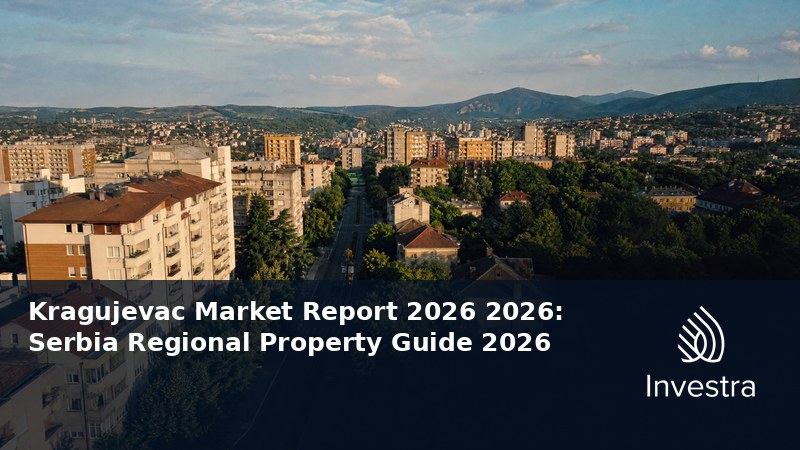
Kragujevac Market Report 2026 2026: Serbia Regional Property Guide 2026
Kragujevac Real Estate Market Overview 2026: Serbia's Industrial Heartbeat
Quick Answer: Kragujevac is Serbia's fourth-largest city and a strategically important industrial and university hub, offering property prices ranging from €800 to €2,200 per m² in 2026, with rental yields between 5% and 8% — making it one of central Serbia's most compelling investment destinations.
Kragujevac doesn't get the same international headlines as Belgrade or Novi Sad, but that's precisely what makes it interesting. Serbia's fourth-largest city sits at the geographic heart of the country, straddling the Lepenica River in the Šumadija region, and it carries a significance that extends far beyond its population of roughly 170,000 residents. This is, after all, the city where the Zastava automobile was born — a factory complex that later transformed into the Fiat Automobili Srbija (FAS) production hub, which today employs thousands and anchors the city's entire economic identity.
What we've seen consistently since 2022 is a quiet but steady appreciation in Kragujevac's residential property values. The market lacks the speculative froth you'll encounter in Belgrade's New Belgrade district or Novi Sad's waterfront developments. Instead, it offers something arguably more durable: demand rooted in genuine economic activity — manufacturing employment, university enrollment, healthcare employment, and a growing services sector tied to regional governance.
The University of Kragujevac, with approximately 24,000 enrolled students across multiple faculties, creates a structural demand floor for rental accommodation that doesn't evaporate with economic cycles. Combine that with the city's position as the administrative center of the Šumadija District and one of Serbia's key industrial nodes, and you have the foundations for a resilient, if not spectacular, property market. For investors who understand that sustainable returns often come from overlooked markets rather than glamorous ones, Kragujevac deserves serious attention in 2026.
Consulting resources like Siniša Dagary — Investment Consultant can help frame Kragujevac within a broader Serbian portfolio strategy, particularly for investors comparing multiple Tier 2 and Tier 3 cities across the country.
Kragujevac Property Price Ranges 2026: What Does Your Budget Buy?
Quick Answer: In 2026, Kragujevac property prices range from approximately €800/m² for older socialist-era apartments to €2,200/m² for new-build premium developments, with the city center averaging €1,400–€1,700/m² for quality residential stock.
Let's talk numbers, because that's where the real story begins. Kragujevac's property market in 2026 is segmented in ways that reflect the city's demographic and economic character. You're looking at a tiered market where location, construction era, and proximity to key employment and education centers drive price variation more sharply than in Belgrade.
At the entry level, socialist-era panel apartment blocks (locally called "spratnice") in peripheral neighborhoods like Aerodrom, Bagdala, or Šumarice can be acquired for €800–€1,100/m². These properties are typically 40–70 square meters, functionally livable but requiring renovation investment of €150–€300/m² to bring them to modern rental standards. Many savvy local investors have built small rental portfolios exactly this way — buying cheap, renovating modestly, and renting to students or factory workers at yields that significantly outperform what the purchase price alone would suggest.
Mid-tier properties in well-connected neighborhoods — think Stari Grad (Old Town), the area around the University of Kragujevac faculties, or the Hum district — command €1,200–€1,600/m². These are typically apartments from the 1990s or early 2000s, often in better structural condition than older stock, with functional layouts and reasonable energy efficiency. This segment represents the bulk of transactions in Kragujevac and is where most buy-to-let investors operate.
New construction in Kragujevac has been accelerating noticeably since 2023. Premium new-build apartments in the city center or emerging luxury micro-developments near the Šumarice Memorial Park are priced at €1,700–€2,200/m². A select few ultra-premium projects targeting executives at Fiat Automobili Srbija and regional government officials push above €2,200/m², but this represents a very thin slice of total supply.
House prices in Kragujevac's suburban and peri-urban areas vary enormously. A detached house with garden on the city's outskirts might range from €60,000 to €250,000 depending on size, condition, and neighborhood prestige. Villages within a 20–30 km radius of Kragujevac have seen growing interest from buyers seeking more space, with some properties available for as little as €20,000–€40,000 — though these typically require significant renovation investment.
Kragujevac's Economic Foundations: Why the Property Market Is Stable
Quick Answer: Kragujevac's property market stability rests on three pillars: the Fiat Automobili Srbija manufacturing complex employing 2,500+ workers, the University of Kragujevac with 24,000 students, and its role as the administrative capital of Šumadija District — all of which generate consistent housing demand.
One thing that separates Kragujevac from many smaller Serbian cities is the depth of its economic base. This isn't a one-industry town that will collapse if a single employer leaves — though the Fiat/Stellantis connection is undeniably important. The city's economy sits on multiple support columns, each generating housing demand in its own right.
The Fiat Automobili Srbija plant — producing the Fiat 500L and several other models under the Stellantis umbrella — directly employs over 2,500 workers and creates substantial indirect employment across the supply chain. Engineers, managers, and technical staff associated with FAS represent a significant cohort of higher-income tenants and property buyers who have consistently driven demand in mid-to-premium residential segments. When Stellantis announced production expansion plans in 2024, local property analysts observed a measurable uptick in premium apartment inquiries within six months.
The University of Kragujevac is the city's other economic anchor. With faculties including Medicine, Law, Economics, Engineering, and Natural Sciences, the university draws students from across Serbia and increasingly from the Western Balkans region. This creates structural demand for rental apartments, particularly studio and one-bedroom units within walking or cycling distance of faculty buildings. Student rental yields in Kragujevac run higher than the city average — a pattern we see replicated across university cities throughout Eastern Europe.
The healthcare sector also contributes meaningfully to the local economy. The Clinical Center of Kragujevac is one of Serbia's five clinical centers and serves a catchment population of over 700,000 people across Šumadija and surrounding districts. It employs thousands of medical professionals who represent a stable tenant and buyer base for quality residential property.
For those interested in understanding how regional economic drivers shape property markets differently across Serbia, the Bor Real Estate Market 2026 Eastern Serbia Mining City Property Guide offers a useful contrast — showing how a single-industry mining town compares to a more diversified city like Kragujevac.
Rental Yields and ROI Analysis: Kragujevac 2026
Quick Answer: Rental yields in Kragujevac range from 5% to 8% gross annually in 2026, with student-oriented one-bedroom apartments near the university achieving the highest yields (7–8%), while premium new-build properties in central locations yield 5–6% with stronger capital appreciation potential.
The rental yield story in Kragujevac is one of the more compelling cases in Serbia's second-tier market landscape. Raw yields here outperform Belgrade's increasingly compressed residential market — where central apartments increasingly yield just 3.5–5% gross — while the underlying tenant quality and demand depth remain solid.
Let's break down the numbers by segment. A renovated one-bedroom apartment (around 35–45 m²) near the University of Kragujevac faculties in Stari Grad or the Kosančić area can be purchased for approximately €55,000–€70,000 and rented to students or young professionals for €350–€450/month. Running the math: at €400/month on a €62,000 investment, you're looking at a gross yield of approximately 7.7%. Even after factoring in property management costs (typically 8–10% of rental income in Kragujevac), maintenance provisions, and the Serbian flat tax rate on rental income, net yields in this segment comfortably reach 5.5–6.5%.
Mid-tier two-bedroom apartments (55–70 m²) targeting working families or professionals represent the bulk of the rental market. Purchase prices in the €85,000–€120,000 range with rents of €500–€700/month generate gross yields of 5.5–7%. This segment benefits from lower tenant turnover — families and employed professionals tend to stay 2–4 years compared to the one-year cycles typical of student rentals — reducing vacancy costs and management burden.
Premium new-build apartments above €130,000 yield lower at 4.5–5.5% gross but tend to attract premium tenants — FAS executives, senior medical professionals, regional government officials — and carry stronger capital appreciation prospects. The total return (yield plus appreciation) calculation often favors this segment for longer-horizon investors.
Short-term rental (Airbnb-style) remains a relatively underdeveloped niche in Kragujevac compared to Belgrade or Novi Sad. The city lacks significant tourist volume, though proximity to the Šumarice Memorial Park and occasional business travel related to FAS and the university creates some demand. Investors exploring this model should manage expectations — peak occupancy rates of 55–65% are realistic, and average daily rates of €40–€65 make the economics work primarily for centrally located premium properties.
For broader context on how Kragujevac's yields compare to other Serbian regional cities, Aleksinac Real Estate Market 2026 Southern Serbia Property Guide provides a useful comparative perspective on southern Serbia's smaller market dynamics.
Best Neighborhoods to Invest in Kragujevac 2026
Quick Answer: The strongest investment neighborhoods in Kragujevac in 2026 are Stari Grad (Old Town) for capital appreciation, the university-adjacent Kosančić area for rental yield, and the emerging Erdoglija district for value-add opportunities in new residential development corridors.
Kragujevac's urban geography is more compact than many visitors expect. The city center (Stari Grad) is genuinely walkable, and most neighborhoods of investment relevance are within 3–5 km of the central Trg Slobode (Liberty Square). But neighborhood selection still matters enormously for investment outcomes.
Stari Grad (City Center): The historic core remains Kragujevac's most prestigious address. Properties here command premium prices (€1,500–€2,200/m²) but benefit from the highest liquidity, strongest tenant quality, and the best long-term capital preservation characteristics. The ongoing urban regeneration of the pedestrian zone and the renovation of historic commercial buildings has been gradually improving the area's aesthetics. For investors prioritizing liquidity and capital preservation over raw yield, this is the safe choice.
Kosančić and University Area: This is where the yield math works best for buy-to-let investors. Proximity to multiple university faculties creates structural rental demand that shows minimal seasonality — even in summer, graduate students, researchers, and medical personnel maintain occupancy. Properties here are priced €1,100–€1,500/m² for older stock and €1,600–€1,900/m² for new builds, with the yield advantage over Stari Grad being most pronounced in the older stock segment after modest renovation.
Hum and Aerodrom: These residential neighborhoods offer the most accessible entry points in the market — €800–€1,200/m² for older socialist-era blocks. Renovation-focused investors find opportunities here, particularly in purchasing underpriced apartments in well-maintained buildings, renovating them to modern standards, and either holding for yield or flipping for capital gain. Liquidity is lower than in central areas, so this strategy demands patience.
Erdoglija: This newer residential development corridor to the south and east of the city center has been attracting new construction over the past five years. Infrastructure investment has followed residential development, and the area now offers newer apartments at €1,400–€1,900/m² with good parking availability and proximity to retail. This is where younger professional families — including FAS employees — tend to target their purchasing decisions.
Šumarice Area: Adjacent to the Šumarice Memorial Park and Lake, this area has genuine premium positioning potential that remains underexploited. A handful of luxury residential projects have launched in recent years targeting higher-income buyers who want green space access, but the segment is still small. Long-term, this area has the lifestyle credentials to support a more established premium market as Kragujevac's upper-income demographics grow.
Legal Framework for Foreign Property Buyers in Serbia
Quick Answer: Foreign nationals from EU countries and most others can purchase property in Serbia on equal terms with Serbian citizens, with the purchase process involving a preliminary contract, due diligence, notarized sales contract, property registration, and payment of a 2.5% property transfer tax — typically completed in 4–8 weeks.
The legal landscape for foreign buyers in Serbia is considerably more straightforward than the country's Balkan neighbors might suggest. Serbia has maintained an open property market for foreign buyers from reciprocal countries — which covers essentially all EU member states, the US, UK, Australia, Canada, and many others — since the early 2000s. Citizens of countries without reciprocity agreements can purchase property through a registered Serbian company, which is a standard and widely-used approach.
The purchase process in Kragujevac follows the same framework applicable across Serbia. It begins with a preliminary agreement (predugovor), where the buyer typically pays a 10% deposit and both parties commit to completing the transaction. This document should always be drafted by or reviewed by a licensed Serbian attorney — not simply the real estate agent's standard template. The preliminary agreement locks in price, payment terms, completion timeline, and conditions precedent.
Due diligence is perhaps the most critical phase for foreign buyers unfamiliar with the Serbian system. A title search through the Republic Geodetic Authority (Republički Geodetski Zavod — RGZ) database confirms ownership, encumbrances, mortgages, and any planning or regulatory issues. Kragujevac, like many Serbian cities, has a legacy of informal constructions and partially legalized buildings — so confirming that a property holds proper use permits and occupancy certificates (upotrebna dozvola) is absolutely non-negotiable. What surprised many international buyers who skipped this step is discovering that a property they purchased cannot be registered in their name because legalization procedures were never completed.
The main sales contract (kupoprodajni ugovor) must be notarized at a public notary (javni beležnik). The buyer pays the 2.5% property transfer tax (porez na prenos apsolutnih prava) on the agreed price or cadastral value, whichever is higher. VAT applies instead of the transfer tax on first-sale new-build apartments — at 10% for standard residential properties — which is important to factor into new construction purchases.
Property registration with the RGZ completes the legal transfer. In Kragujevac, this process typically takes 2–4 weeks for straightforward cases. Total legal and transaction costs for a buyer — attorney fees, notary, translation, registration, and the 2.5% transfer tax — typically run 5–8% of the purchase price when all elements are included.
Taxes on Property Ownership and Rental Income in Serbia
Quick Answer: Property owners in Serbia pay an annual property tax of 0.1–0.4% of assessed value, while rental income is taxed at a flat 15% rate on 80% of gross rental income (after a 20% standard deduction), giving an effective tax rate of approximately 12% on gross rents.
Serbia's tax framework for property investors is genuinely investor-friendly compared to Western European standards. Understanding the full tax picture is essential for accurate yield calculations, and it's an area where working with a local accountant pays dividends beyond the accountant's fees.
Annual property tax (porez na imovinu) is calculated on the assessed value determined by the local municipality, which typically sits well below actual market value. Rates vary between 0.1% and 0.4% depending on property type and municipality. For a typical Kragujevac apartment with a market value of €80,000, the annual property tax is typically €100–€250/year — essentially negligible compared to most European countries.
Rental income taxation for individuals operates on a favorable flat-rate system. Landlords pay income tax at 15% on 80% of gross rental income (the 20% deduction accounts for notional maintenance and management costs). This gives an effective tax rate of 12% on gross rental income. A landlord earning €6,000/year in rent pays approximately €720 in tax — a meaningful but manageable cost that doesn't severely compress net yields.
Capital gains tax (porez na kapitalni dobitak) applies to property sales at a flat 15% rate on the gain between purchase and sale price. However, property held for more than 10 years is exempt from capital gains tax entirely — a provision that rewards long-term investors and is worth incorporating into any exit planning. Properties inherited or acquired before specific reference dates carry different cost basis rules.
Foreign investors should also be aware of Serbia's double taxation treaty network. Serbia has signed treaties with most EU countries, the UK, the US, and many others, which typically allows rental income tax paid in Serbia to be credited against tax obligations in the investor's home country. Engaging a tax advisor familiar with both Serbian tax law and the investor's home jurisdiction is strongly recommended. The Finds Financial Services network provides cross-border financial advisory services relevant to this type of planning.
New Construction Market in Kragujevac: Projects and Pipeline 2026
Quick Answer: Kragujevac's new construction market in 2026 includes approximately 15–20 active residential development projects, with new-build apartment prices ranging from €1,400 to €2,200/m², concentrated in the city center, Erdoglija corridor, and Šumarice area — representing a significant increase from the 8–10 projects active in 2021.
The new construction pipeline in Kragujevac has quietly expanded over the past three years, signaling developer confidence in local demand fundamentals. This isn't Belgrade's megaproject scale — we're talking about developments of 30–120 units rather than 500-unit towers — but the volume and pace of activity is notably higher than the pre-2020 baseline.
Local developers have dominated this space, with a few Belgrade-based development companies beginning to enter the market in 2023–2024, typically for larger mixed-use schemes targeting the premium segment. The construction quality of new Kragujevac developments has improved measurably compared to projects from the 2000s and early 2010s, with modern energy efficiency standards, underground parking, and contemporary interior finishes becoming baseline expectations rather than premium features.
Off-plan purchases (kupovina u izgradnji) are standard practice in Kragujevac and can generate capital gains of 15–25% between reservation/signing and project completion — though these gains materialize only upon sale rather than in cash yield during the construction period. Payment structures typically require 20–30% at contract signing with the balance due at completion, or phased payments tied to construction milestones.
One trend worth tracking closely is the increasing number of mixed-use ground-floor commercial/residential schemes in the city center and on key arterial roads. These projects reflect developer attempts to capture both residential demand and the growing retail/service economy. For investors, the commercial component introduces complexity and potentially different returns profiles compared to pure residential plays.
The technology transformation of Serbia's real estate sector is also reaching Kragujevac's new-build market. Digital transaction platforms, BIM-based project management, and virtual property tours have become standard tools for developers marketing to remote and international buyers. Serbia Proptech 2026: How Technology Is Changing Real Estate provides an excellent overview of how these tools are reshaping the Serbian property transaction experience.
Infrastructure Investment and Urban Development: What's Changing in Kragujevac
Quick Answer: Kragujevac is benefiting from major infrastructure investments in 2025–2026 including the Corridor 11 highway connection, city center regeneration projects, and continued expansion of industrial zones, all of which support property value growth in key residential corridors.
Infrastructure investment is the frequently underappreciated driver of property market performance in Serbian regional cities. The gap between a Tier 2 city that stagnates and one that outperforms often comes down to connectivity improvements and urban regeneration investment — and Kragujevac is on the right side of this equation heading into 2026.
The Corridor 11 highway development — the north-south motorway connecting Belgrade through Šumadija toward Bosnia — represents perhaps the single most significant infrastructure catalyst for the Kragujevac region. Improved highway access dramatically reduces effective travel time to Belgrade (currently 1.5–2 hours by road), which has historically been cited as one of Kragujevac's disadvantages relative to cities like Novi Sad or Niš that already have faster motorway connections to the capital. Each completed section of Corridor 11 marginally increases Kragujevac's attractiveness as a commuter city option for Belgrade-employed professionals who prefer smaller city living costs.
The city center pedestrianization and urban regeneration program, ongoing since 2020, has materially improved the quality of public space around Trg Slobode and the adjacent commercial and cultural areas. While the direct price impact is difficult to isolate from broader market trends, the upgrade of the public realm around Trg Slobode has demonstrably improved the desirability of central apartments — supporting the premium pricing in Stari Grad.
Industrial zone expansion near the Šumarice complex and along the Zastava/FAS factory corridor continues, with European Investment Bank financing supporting infrastructure upgrades. This industrial investment creates the employment base that drives residential demand, particularly in the mid-tier segment targeting manufacturing and logistics professionals.
Kragujevac's public transportation system — while functional — remains an area of underinvestment relative to the city's size. This has indirectly supported car-oriented suburban development while constraining walkable urban density, a pattern common across Serbian cities. Plans for improved bus rapid transit routes and cycling infrastructure exist but implementation timelines remain uncertain.
Comparing Kragujevac with Other Serbian Regional Markets
Quick Answer: Kragujevac offers a middle ground among Serbian regional cities — higher prices and more developed market than eastern Serbia towns like Zaječar or Bor, but significantly more affordable than Belgrade or Novi Sad, with rental yields and growth prospects that compare favorably to Niš and Subotica.
Context matters enormously when evaluating any property market, and Kragujevac's relative position in Serbia's regional hierarchy shapes both its investment case and its risks. So how does it actually stack up?
Against Belgrade, the comparison is straightforward: Kragujevac offers significantly lower entry prices (60–70% cheaper per square meter in equivalent segments) and higher gross yields (5–8% vs. 3.5–5% in Belgrade) with lower absolute capital appreciation prospects. Belgrade's liquidity, tenant quality ceiling, and long-term European capital integration story remain superior — but for income-focused investors, Kragujevac's yield premium is compelling.
Against Novi Sad, the second city, Kragujevac competes on yield (comparable to Novi Sad's secondary neighborhoods) but trails on premium segment pricing power and the cultural/lifestyle premium that Novi Sad commands as a European cultural capital and festival city.
Compared to Niš — Serbia's third-largest city and the other major regional hub in the south — Kragujevac has a slightly different character. Niš benefits from stronger tourism flows and a more established international business presence, while Kragujevac has deeper industrial employment anchoring. Both cities show broadly similar price-to-yield profiles in their mid-tier residential markets.
The eastern Serbia markets tell a different story entirely. Cities like Zaječar, Bor, and Negotin operate at substantially lower absolute price levels but with different risk profiles, lower market depth, and different demand drivers. For comparison, the Zajecar Real Estate Market 2026 Eastern Serbia Property Guide, Negotin Real Estate Market 2026 Zajecar District Property Guide, and Bor Real Estate Market 2026 Eastern Serbia Mining City Property Guide provide detailed analysis of those distinctly different market environments.
For investors considering the Vojvodina region as an alternative, the Sremska Mitrovica Real Estate 2026 Srem Region Property Guide and Indija Real Estate Market 2026 Vojvodina Logistics Hub Property Guide offer useful contrast with Kragujevac's central Serbia profile.
The Student Rental Market: Kragujevac's Yield Engine
Quick Answer: The University of Kragujevac's 24,000 students create strong structural rental demand, with student-targeted apartments (30–45 m²) achieving gross yields of 7–8.5% annually — the highest yield segment in the Kragujevac market and a key differentiator from Serbian cities without significant university populations.
Student housing as an asset class has been generating serious academic and investment attention across Europe for the past decade. What Kragujevac offers is a smaller-scale version of the same thesis — and in some respects, the entry barriers are far lower than purpose-built student accommodation schemes in Western university towns.
The 24,000 students at the University of Kragujevac don't all live in private rented accommodation — the university operates dormitories (studentski domovi) that house several thousand students at heavily subsidized rates. But demand for private rental far exceeds dormitory capacity, and the quality gap between dormitory living and a decent private apartment is significant enough that students from middle-income families increasingly prefer private rentals.
The typical student rental unit in Kragujevac is a one-bedroom or studio apartment of 30–45 m², furnished to a basic but functional standard, within 1–2 km of the relevant faculty. Monthly rents in this segment run €250–€380, with shared three and four-bedroom apartments (popular among undergraduate students sharing costs) achieving per-room rents of €150–€200/month for the landlord.
The seasonality of student rental demand requires management but isn't the barrier some investors fear. Academic year runs September to June, and many students — particularly those from other cities in Serbia — vacate in summer. However, graduate students, doctoral researchers, and medical students in long programs maintain year-round occupancy, and strategic property selection near postgraduate and medical faculties reduces vacancy seasonality meaningfully.
The practical reality of managing student properties is that tenant turnover is higher than in professional or family rental segments — typically annual lease cycles rather than multi-year tenancies. This increases administrative costs and requires more active management. Working with a local property manager who has established relationships with student housing networks at the university can significantly reduce vacancy periods between tenants.
Commercial Real Estate in Kragujevac: Office, Retail, and Industrial
Quick Answer: Commercial real estate in Kragujevac remains largely dominated by local occupiers, with office rents in the €8–€14/m²/month range, retail on Kragujevac's main commercial streets at €20–€40/m²/month, and industrial/logistics properties in the €3.5–€6/m²/month range — all at significant discounts to Belgrade equivalents.
Commercial property in Kragujevac is a market for specialists and local operators rather than passive investors seeking institutional-grade assets. The market lacks the depth, liquidity, and large-tenant anchor presence that characterizes commercial investment markets in Belgrade, but it offers yield premiums that reflect these structural limitations — and for investors with local relationships and market knowledge, the commercial segment can deliver exceptional returns.
The office market is small and fragmented. Kragujevac doesn't host significant multinational corporate occupiers who require grade-A office space. Most office demand comes from regional government agencies, professional services firms (law, accounting, insurance), and the administrative functions of major local employers. Prime office space in the city center is priced at €8–€14/m²/month — a fraction of Belgrade's rates of €14–€22/m²/month for comparable quality — and vacancies in the best locations remain relatively low due to limited quality supply.
Retail real estate is bifurcated. The main commercial pedestrian zone (Zmaj Jovina Street and surrounding streets) commands premium rents for fashion retail and food and beverage, while peripheral retail parks and shopping centers — Kragujevac has two significant retail parks — dominate everyday retail with large-format anchor tenants. Investment in street retail can be compelling given occupancy rates and the tourism-adjacent foot traffic near Šumarice Park.
Industrial and logistics property near the Šumadija industrial zone and the FAS factory complex is perhaps the most interesting commercial segment for value-add investors. The growth of Serbia's manufacturing and logistics export economy is creating sustained demand for modern light industrial and warehouse space, and Kragujevac's central geographic position — equidistant from Belgrade, Niš, and Novi Sad along major transport corridors — has strategic logistics appeal that local property prices don't fully reflect.
Risks and Challenges: Honest Assessment for International Investors
Quick Answer: Key risks for Kragujevac property investors include reliance on the FAS/Stellantis employer anchor, lower market liquidity compared to Belgrade, informal construction legacies requiring careful due diligence, and currency risk given that Serbia maintains the RSD pegged to EUR but is not yet in the Eurozone.
Every market analysis that ignores risks is either incomplete or dishonest. Kragujevac has genuine investment merits, but it also carries risks that investors need to understand before committing capital. The reality is that Tier 2 Serbian cities require more active management, more careful due diligence, and longer time horizons than a simple "buy and collect rent" strategy assumes.
The Fiat Automobili Srbija / Stellantis employment anchor is a double-edged sword. The industrial employer creates structural housing demand and economic stability, but it also creates concentration risk. Stellantis, like all automotive manufacturers, faces significant strategic pressures from the global transition to electric vehicles — pressure that has already led to production adjustments and workforce changes at several European plants. The possibility that FAS production volumes could be reduced or relocated is a low-probability but non-negligible risk that could negatively impact both employment levels and the premium residential market that serves FAS executives.
Market liquidity is structurally lower in Kragujevac than in Belgrade or Novi Sad. Exit strategies require more patience — realistically 6–12 months to achieve a satisfactory sale price for an investment property, compared to 2–4 months in prime Belgrade locations. Investors who might need to liquidate quickly should price this illiquidity premium into their analysis.
Due diligence challenges related to informal construction and incomplete legalization are real and require investment in professional legal services. The cost of cutting corners on legal due diligence — as some buyers have discovered — can exceed the entire purchase price. This risk is manageable with proper legal support but cannot be assumed away.
Currency risk: the Serbian dinar (RSD) is maintained at a relatively stable peg to the EUR, but Serbia is not a Eurozone member, and the dinar's long-term trajectory relative to major currencies is subject to national economic and political factors. Most transactions in Serbia are priced in EUR equivalent, which provides some practical protection, but rental income and operating costs are denominated in RSD.
For guidance on managing these types of cross-border investment risks and structuring appropriate investment strategies, engaging advisors like those referenced at About Siniša Dagary — whose consultancy focuses on market entry strategy for the Western Balkans — can add meaningful value to the decision process. Similarly, Business Strategy Blog contains relevant analysis on investment frameworks applicable to regional Serbian markets.
Practical Steps for International Buyers: How to Purchase Property in Kragujevac
Quick Answer: International buyers can successfully purchase property in Kragujevac by following a structured process: engaging a local attorney and bilingual agent, conducting title searches through the RGZ, signing a notarized purchase contract, paying 2.5% transfer tax, and registering ownership — a process that typically takes 4–8 weeks from offer to registered ownership.
The mechanics of actually buying a property in Kragujevac as an international investor deserve a practical walkthrough, because the procedural details matter and getting them right separates a smooth transaction from a frustrating one.
Step 1 — Establish Your Legal Presence: Non-Serbian buyers should obtain a Serbian personal identification number (JMBG for individuals or PIB for companies) before initiating purchase. This is straightforward and handled through local administrative offices. If buying through a Serbian company — preferred for investors from non-reciprocal countries or for portfolio tax efficiency — company registration should be completed prior to property acquisition.
Step 2 — Engage Professional Support: A licensed Serbian attorney (advokat) familiar with Kragujevac's specific cadastral history and local administration nuances is worth every dinar of their fee. A bilingual real estate agent with a verified track record in the local market complements the attorney role — agents handle property identification, viewings, and negotiation, while attorneys handle legal verification and document preparation. These roles should never be conflated.
Step 3 — Property Identification and Due Diligence: Once a target property is identified, the attorney conducts a full RGZ title search, verifies all permits (building permit, occupancy certificate), checks for mortgage encumbrances or registered third-party claims, and confirms the seller's legal authority to sell. This process takes 1–2 weeks for straightforward properties.
Step 4 — Preliminary Contract and Deposit: Upon satisfactory due diligence, a preliminary contract is signed with a 10% deposit (typically forfeited by the buyer if they withdraw without cause, or doubled and returned by the seller if they withdraw). This contract specifies all material transaction terms.
Step 5 — Main Contract and Notarization: The main purchase contract is signed at a public notary, with both parties (or their authorized attorneys) present. The notary verifies identities, reads the contract, and notarizes the execution. Payment of the purchase price is typically by bank transfer.
Step 6 — Transfer Tax and Registration: The 2.5% transfer tax is assessed and paid to the local tax authority within 30 days of the notarized contract. Registration with the RGZ completes the legal transfer of ownership and typically takes 2–4 weeks. Upon registration, the buyer receives an extract from the real estate register confirming their ownership.
For those researching how this process compares across other Serbian markets, the Prokuplje Real Estate Market 2026 Toplica Region Property Guide and Loznica Real Estate Market 2026 Macva Region Property Guide cover similar procedural ground in other regional Serbian markets.
Market Outlook and Price Forecasts: Kragujevac 2026–2028
Quick Answer: Kragujevac property prices are forecast to appreciate 4–7% annually in 2026–2028, driven by continued industrial employment growth, university expansion, infrastructure improvements from Corridor 11, and relative affordability compared to Serbian primary markets attracting price-sensitive buyers and investors.
Forecasting property markets is inherently uncertain, and anyone who tells you they know exactly where prices will be in three years is either overconfident or selling something. What can be done is to identify the structural factors that make upward price pressure more or less likely, and to stress-test those assumptions against plausible downside scenarios.
The base case for Kragujevac over 2026–2028 rests on four pillars. First, continued industrial employment growth — assuming Stellantis/FAS production remains stable or grows and the broader Šumadija industrial zone continues attracting Serbian and foreign manufacturing investment. Second, ongoing university enrollment growth, underpinned by the University of Kragujevac's reputation development and Serbia's growing tertiary education participation rates. Third, progressive improvement in Belgrade-Kragujevac connectivity as Corridor 11 construction advances, which incrementally expands the effective buyer/tenant catchment area. Fourth, relative affordability: as Belgrade and Novi Sad prices continue pushing upper-middle income buyers toward regional cities, Kragujevac's combination of urban amenities and lower prices becomes more attractive.
Under this base case, annual price appreciation of 4–7% in nominal EUR terms seems reasonable and consistent with the trajectory seen in 2022–2025. In real terms (after EUR inflation), this translates to meaningful positive returns on top of rental yields — total returns for buy-to-let investors in the €80,000–€120,000 price range could realistically reach 9–13% annually in the base scenario.
The downside scenario centers primarily on the Stellantis/FAS risk described in the risks section above, compounded by potential Serbia-EU political friction that might delay infrastructure investment and dampen investor sentiment. A meaningful FAS production reduction — say 30% or more — would likely trigger a 10–15% decline in premium segment prices and compress yields as executive tenant demand evaporates, though the student and working professional segments would prove more resilient.
The upside scenario involves Serbia advancing materially in its EU accession process (which would trigger broader foreign investment
Investment Disclaimer
The information provided in this article is for educational and informational purposes only and should not be construed as financial, legal, or investment advice. Real estate investments carry inherent risks, and past performance does not guarantee future results. Investors should not invest money they cannot afford to lose. Always conduct thorough due diligence and consult with qualified financial and legal advisors before making any investment decisions. Investra.io does not guarantee returns on any investment.
Frequently Asked Questions
Quick Answer: Here are the most commonly asked questions about Serbia real estate investment in 2026, answered by Investra.io experts.
Is Serbia a good country for real estate investment in 2026?
Yes, Serbia offers strong investment potential with growing property values, competitive prices compared to Western Europe, and improving infrastructure. Investra.io provides comprehensive market data and investment guidance.
Can foreigners buy property in Serbia?
EU citizens can buy property freely in Serbia. Non-EU citizens may need to meet specific requirements. Investra.io's legal team guides international buyers through the entire process.
What is the average property price in Kragujevac?
Property prices in Kragujevac vary significantly by location and property type. Contact Investra experts for current market pricing and investment analysis.
What rental yields can I expect?
Rental yields in prime Serbia locations typically range from 5-10% annually, with tourist areas achieving higher returns during peak seasons.
What taxes apply to property purchases?
Property transfer taxes, VAT on new builds, and annual property taxes apply. Rates vary by property type and location. Consult Siniša Dagary for tax optimization strategies.
How long does the purchase process take?
Typically 30-60 days from offer to completion. Working with Investra.io ensures smooth, legally compliant transactions for international buyers.
What financing options are available?
Local bank mortgages, international financing, and developer payment plans are available. Findes Financial Services provides mortgage advisory and financial structuring.
Is property management available for rental properties?
Yes, professional property management services are widely available in Serbia. Investra.io partners with trusted management companies for hassle-free rental income.
What are the best areas to invest in Kragujevac?
Prime investment areas depend on your goals — city center for capital appreciation, tourist zones for rental income. Investra.io's market analysis identifies the best opportunities.
Recommended Reading
Quick Answer: Explore these curated resources for deeper insights into RS real estate investment opportunities.
- Negotin Real Estate Market 2026 Zajecar District Property...
- Bor Real Estate Market 2026 Eastern Serbia Mining City Pr...
- Zajecar Real Estate Market 2026 Eastern Serbia Property G...
- Prokuplje Real Estate Market 2026 Toplica Region Property...
- Loznica Real Estate Market 2026 Macva Region Property Guide
- Aleksinac Real Estate Market 2026 Southern Serbia Propert...
- Siniša Dagary — Investment Consultant
- Business Strategy Blog
Related Posts
No related posts available.
