
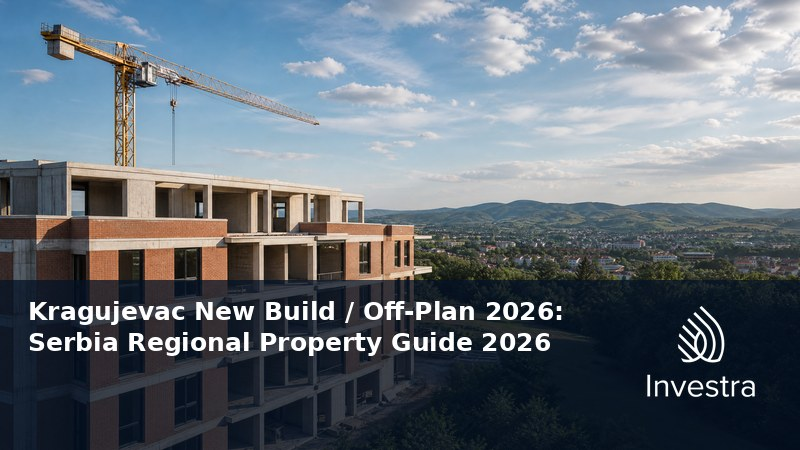
Kragujevac New Build / Off-Plan 2026: Serbia Regional Property Guide 2026
Kragujevac New Build and Off-Plan Property Market: An Overview for 2026
Quick Answer: Kragujevac's new build and off-plan property market in 2026 offers investors entry prices from €1,200 to €2,200 per m², with off-plan discounts of 10–20% compared to completed stock, making Serbia's fourth-largest city one of Central Europe's most compelling emerging investment destinations. Investra.io tracks live market data across all Serbian cities to help investors identify the best entry points.
Kragujevac doesn't shout. It doesn't have Belgrade's cosmopolitan gloss or Novi Sad's festival-circuit reputation. What it does have is something arguably more valuable for property investors: genuine fundamentals. A population of roughly 170,000, a deep industrial heritage anchored by the Stellantis (formerly Fiat) automotive plant, a sprawling university campus with over 20,000 students, and a city government that has spent the last decade aggressively courting foreign capital and infrastructure investment.
The city sits at the geographic heart of Serbia, which isn't just a poetic description — it's a logistical advantage. Highways connecting to Belgrade (roughly 140 km north), Niš to the south, and the emerging Corridor 11 route have dramatically cut travel times and raised Kragujevac's profile among regional investors. What was once considered a secondary Serbian city is now firmly in the conversation as a legitimate property investment destination.
The new build and off-plan segment specifically has surged in activity since 2022. Local developers who spent years cautiously building to domestic demand have started marketing to diaspora Serbs, Slovenian investors, and increasingly, buyers from Germany, Austria, and the Gulf states. Construction cranes are now a familiar sight in the Aerodrom district, along the Lepenica River corridor, and in the developing suburban zones to the south of the city centre.
The numbers tell a clear story. According to the Republic Geodetic Authority of Serbia, property transaction volumes in Kragujevac increased by approximately 18% between 2022 and 2024. New build completions accelerated. Off-plan sales — where buyers commit to units before or during construction — now account for an estimated 30–35% of all new residential transactions in the city. That's not a fringe activity anymore. It's mainstream market behaviour.
For investors assessing Serbia's regional property landscape in 2026, Kragujevac offers a rare combination: still-affordable entry prices, a growing tenant base driven by students and industrial workers, improving infrastructure, and an off-plan market where early-stage discounts remain meaningful. This guide breaks down everything you need to know to evaluate that opportunity intelligently.
Why Kragujevac? The Investment Case in Plain Terms
Quick Answer: Kragujevac's investment case rests on its dual role as Serbia's automotive manufacturing hub and a major university city, creating persistent rental demand from two distinct tenant pools while property prices remain 40–50% below Belgrade levels. Investra.io's Southern Serbia Property Guide provides useful context on regional price dynamics.
Let's be direct about what makes Kragujevac interesting, because not every investor will find it compelling and that's fine. The city isn't going to double in value overnight. There's no single catalyst event — no imminent EU accession date, no major tourism explosion. What Kragujevac offers is steady, grounded growth driven by structural economic factors that don't evaporate with market sentiment shifts.
The Stellantis plant is genuinely significant. Employing over 3,500 workers directly and supporting a supplier ecosystem that employs tens of thousands more throughout the Šumadija region, the automotive sector has stabilised Kragujevac's economy through cycles that devastated other Serbian cities. Plant expansions announced in 2023 and 2024 — including increased production capacity for electric vehicle components — have reinforced the employment base heading into the second half of the decade.
The University of Kragujevac is the second pillar. With faculties spread across the city, including Engineering, Medicine, Economics, and Law, the university generates consistent demand for rental accommodation. Student housing in Kragujevac is notoriously undersupplied relative to enrollment, which creates a natural rental market for smaller apartments and studios within walking or cycling distance of campus facilities. Landlords in these zones routinely achieve occupancy rates above 95% on academic-year leases.
The city's economic diversification has also progressed. The Šumarice Business Zone, established with state support, has attracted logistics, technology, and manufacturing tenants, adding white-collar employment to the traditional blue-collar base. Young professionals returning from Belgrade — priced out of the capital or seeking better quality of life — represent a growing tenant segment that demands better-quality apartments than the existing ageing housing stock provides. That gap is exactly what new build developments are designed to fill.
Property prices remain remarkably accessible by regional European standards. While Prague, Warsaw, and even Bucharest have seen prices rise to levels that compress yields significantly, Kragujevac still offers entry at €1,200–€1,500 per m² in standard new builds — pricing that has largely disappeared from Warsaw or Bratislava's secondary markets. For investors who believe Serbia's EU accession trajectory will eventually close the price gap with its Central European peers, that entry point looks strategically attractive.
New Build vs. Off-Plan: Understanding the Distinction in the Serbian Market
Quick Answer: In Serbia, "new build" refers to completed newly constructed properties, while "off-plan" means purchasing during the design or construction phase — typically offering 10–20% price discounts but requiring investors to understand contract structures, developer track records, and phased payment schedules carefully.
These terms get used interchangeably, and that's a problem. In the Serbian market — as in most emerging European property markets — the distinction between buying a new build that's ready to occupy and buying off-plan carries real consequences for your risk profile, financing options, and expected returns.
A completed new build in Kragujevac is straightforward: the property exists, you can inspect it, valuations are possible with standard methodology, and mortgage financing from Serbian banks is available. The downside is that you're paying close to market rate — the developer has already absorbed the construction risk and priced that into the asking price. In Kragujevac's current market, completed new builds in good locations trade at €1,600–€2,200 per m².
Off-plan purchases work differently. You're committing to a unit — typically at a stage when the building exists only on paper or as a foundation — in exchange for a lower price. In Kragujevac, off-plan prices in early-stage developments currently sit between €1,200 and €1,700 per m², depending on location and developer. The discount relative to expected completion value ranges from 10% to 20%, sometimes more for the very first phase of a new project.
The trade-off is time and risk. Typical construction timelines for residential blocks in Kragujevac run 18 to 36 months from groundbreaking to handover. During that period, your capital is committed, the property can't be rented or used, and you're exposed to developer-side risks: construction delays, cost overruns, and in worst cases, developer insolvency. Serbian consumer protection for off-plan buyers has improved since the 2019 amendments to the Law on Planning and Construction, but it remains less comprehensive than what you'd find in Western European markets.
Payment structures in Serbian off-plan deals are typically staged: 30% on contract signing, 30–40% during construction milestones, and the balance at handover. Some developers offer more flexible structures to attract early buyers. It's essential — and we can't stress this enough — to work with a local lawyer to review the preliminary agreement (predugovor) before committing any funds. The contractual protections that matter most are delivery guarantees, penalty clauses for delays, and clear refund terms if the project is abandoned.
Current New Build Prices in Kragujevac: A Detailed Market Breakdown
Quick Answer: New build prices in Kragujevac in 2026 range from approximately €1,200/m² for off-plan units in outer districts to €2,200/m² for premium completed apartments in central or riverside locations, with the city-wide average for new construction sitting around €1,600–€1,750/m².
Price transparency in the Serbian market has improved significantly, but it still requires active research to get accurate figures. Official transaction data from the Republic Geodetic Authority doesn't always reflect real market values due to historical practices of underreporting transaction prices (though tax enforcement has tightened considerably). The figures below draw on developer marketing materials, agent-reported transaction data, and advertised listings across Serbian property portals.
The city centre — roughly defined as the area around Trg Slobode, Cara Dušana Street, and the pedestrianised retail core — commands the highest prices for new builds. Developments here are rare given land scarcity and higher acquisition costs, but where they exist, prices range from €1,900 to €2,200 per m². These are typically boutique projects of 20–50 units, often involving conversion or infill development rather than large-scale construction.
The Aerodrom district, which has seen the most active new build development over the past four years, currently sits at €1,500–€1,800 per m² for completed units. Off-plan in early phases of Aerodrom projects is available from €1,300 per m², though the most competitively priced phases tend to sell quickly. This district has become the reference point for Kragujevac's modern apartment market — wide streets, newer infrastructure, and proximity to the university hospital complex make it attractive to medical staff and professionals.
The Lepenica River corridor south of the centre has emerged as the premium lifestyle address. Developers have been marketing "riverside living" concepts here, and prices reflect the marketing: €1,800–€2,000 per m² for new builds with green space access. The premium is real but debatable — infrastructure in parts of this zone still lags the marketing materials.
Outer suburban areas — zones like Šumice, Pivara, and the developing western suburbs — offer the lowest entry points: €1,200–€1,450 per m² for off-plan, with completed values expected around €1,500–€1,600 per m². These areas suit investors targeting the student or young professional market given proximity to the main university campus, but require a longer view on capital appreciation as infrastructure catches up.
Year-on-year price appreciation for new builds in Kragujevac has averaged approximately 7–9% annually over 2022–2024, moderating slightly from the 12–14% peaks seen during the post-pandemic demand surge. For 2026, most market analysts expect appreciation in the 5–8% range — still healthy, but a more normalised trajectory.
Rental Yields and Income Potential: What the Numbers Actually Show
Quick Answer: Gross rental yields in Kragujevac's new build sector range from 5.5% to 8% annually depending on property type and location, with furnished studio and one-bedroom apartments near the university consistently achieving the upper end of that range due to persistent student demand.
Yield figures in Serbian property discussions often get inflated — agents have incentives to present optimistic projections. The reality is more nuanced, but still genuinely attractive by European standards. Here's what the market actually supports.
A furnished studio apartment (30–35 m²) in a new build near the University of Kragujevac currently achieves monthly rents of €250–€350. At a purchase price of €42,000–€50,000 (at €1,400/m² off-plan), that implies a gross yield of approximately 6.5–8%. Factor in vacancy periods (typically minimal in this segment at 2–4 weeks annually), management costs, and utilities where applicable, and net yields settle around 5.5–6.5%. By the standards of Western European markets — where gross yields of 3–4% in comparable university cities are common — this is a strong income return.
One-bedroom apartments (45–60 m²) deliver gross yields of 5.5–7%, serving young professionals and academic staff. Two-bedroom units (60–80 m²) typically yield 5–6% gross — the unit economics are less favourable per m² since rents don't scale linearly with size, but the tenant base is more stable with longer lease terms typical.
Short-term rentals via platforms like Airbnb and Booking.com are a growing consideration in Kragujevac, though the city isn't a primary tourism destination. Medical tourism visitors (the clinical hospital complex draws patients from southern Serbia and neighbouring countries), university event attendees, and business travellers support average occupancy of 60–70% at daily rates of €35–€55 for a well-presented one-bedroom unit. Annual revenue from short-term rental in the €45,000–€55,000 apartment range can reach €8,000–€12,000 gross, implying yields of 15–22% at high occupancy — but these projections assume active management and marketing, and reality often falls short of peak projections.
The most reliable yield story remains long-term residential rental, particularly in the student and young professional segments. Investors who purchase well-located, well-finished new builds and manage them professionally can realistically target net yields of 5–6% with modest capital appreciation layered on top. For Siniša Dagary — Investment Consultant, who has extensively analysed Serbian regional property markets, this combination of income return and modest but steady appreciation represents one of the more balanced risk-return profiles available in southeastern European real estate today.
The Legal Framework: How Off-Plan Purchases Work in Serbia
Quick Answer: Off-plan purchases in Serbia are governed primarily by the Law on Planning and Construction and the Law on Obligations, requiring a preliminary agreement (predugovor) registered with the Cadaster, clear delivery guarantees, and notarisation — foreign buyers have equal rights to Serbian citizens in residential property acquisition.
Serbia's property legal framework has undergone substantial modernisation over the past decade, and the off-plan purchase process — while still requiring more diligence than in some Western markets — is now reasonably well-structured. Foreign nationals can purchase residential property in Serbia on the same terms as Serbian citizens, subject to standard EU reciprocity conditions that effectively mean buyers from EU member states and most OECD countries face no meaningful restrictions.
The off-plan purchase process begins with a preliminary agreement (predugovor). This document outlines the property specifications, price, payment schedule, delivery date, penalty provisions for delay, and refund terms. In the Serbian system, this document should be notarised (overovjeno) and ideally registered as an annotation (zabilježba) against the land parcel at the Republic Geodetic Authority Cadaster. That registration creates a public record of your purchase right and protects you against the developer selling the same unit to another buyer or using the land as collateral without your knowledge.
The final sales contract (ugovor o kupoprodaji) is signed at completion, when the building receives its usage permit (upotrebna dozvola). At this stage, ownership transfers and the buyer pays any remaining balance. Property ownership records are maintained by the Republic Geodetic Authority, and registration of your ownership (upis prava svojine) should be completed promptly after the final contract is signed.
One area requiring particular attention in off-plan deals is the developer's legal title to the land. Before signing any preliminary agreement, your lawyer should verify that the developer holds clean title to the underlying land, that all planning permits (lokacijski uslovi, gradbena dozvola) are in order, and that there are no liens or mortgages on the land that could affect your purchase. Developers financing construction through bank loans often use the land as collateral — your contract should specify that your unit will be free of encumbrances at handover regardless of the developer's financing arrangements.
The legal process for foreign buyers adds a few administrative steps: you'll need a Serbian tax identification number (PIB or poreski identifikacioni broj), which is obtainable at the Tax Administration office, and a local bank account is practically necessary for managing payments and eventual rental income. Working with a bilingual lawyer experienced in Serbian real estate transactions is not optional — it's genuinely essential for any off-plan purchase.
Taxes, Fees, and Transaction Costs: The Full Picture
Quick Answer: Total transaction costs for a new build or off-plan purchase in Serbia typically run 3–5% of the purchase price, comprising primarily the 20% VAT (already included in developer pricing for first-sale new builds), a 0.5% stamp duty on the preliminary contract, notary fees, and legal costs of approximately €500–€1,500.
One of the genuine advantages of buying new build or off-plan in Serbia rather than resale property is the tax structure. When you buy a new build directly from a developer (first sale), the transaction is subject to VAT (PDV — porez na dodatu vrednost) at 20%, which is already incorporated into the developer's quoted price. You do not pay the 2.5% property transfer tax (porez na prenos apsolutnih prava) that applies to resale transactions. This effectively means your tax burden on a new build purchase is lower than it appears, because the tax is baked in rather than added on top.
Let's construct a realistic cost model for a €65,000 off-plan apartment purchase (approximately 45 m² at €1,444/m²):
The quoted purchase price of €65,000 already includes the developer's VAT liability. On top of this, buyers should budget for notary fees (typically €200–€500 depending on contract value), legal fees for a qualified property lawyer (€500–€1,500 for a full transaction review, preliminary contract analysis, and cadaster registration assistance), a stamp duty on the preliminary contract registration (approximately 0.5% of contract value — around €325 in this example), and property valuation costs if required by a financing institution (€150–€300). In total, budget €1,200–€2,500 in transaction costs above the purchase price — roughly 2–4% on a deal of this size.
Annual property tax (porez na imovinu) in Serbia is generally low by European standards. For a residential apartment valued at €65,000 in Kragujevac, annual property tax liability typically runs €100–€250 depending on the cadastral value assigned (which often lags market value) and applicable local rates. The City of Kragujevac applies rates within the national statutory range.
Rental income from Serbian property is taxable. Non-resident landlords are subject to a flat 20% income tax rate on net rental income (after a 25% standard deduction for expenses, resulting in an effective rate of approximately 15% on gross rental income). Residents are taxed at 15–20% on net rental income. Serbia has double taxation treaties with most EU member states and many other countries, which means that tax paid in Serbia typically reduces your liability in your country of residence. Confirm the specifics with a tax advisor familiar with both Serbian law and your home country's treaty arrangements.
Developer Landscape: Who Is Building in Kragujevac?
Quick Answer: Kragujevac's new build market is dominated by a mix of established Belgrade-based developers expanding regionally, mid-sized local construction companies with multi-decade track records, and a small but growing number of international developers attracted by the city's improving investment profile.
Developer due diligence is arguably the single most important research task for any off-plan investor. In a market as transparent as Germany or the UK, institutional oversight provides a meaningful backstop. In Serbia — a market that has improved substantially but where regulatory enforcement remains uneven — developer quality varies widely and the consequences of backing the wrong developer can be severe.
What we know from the Kragujevac market is that the most active developers fall into two categories. The first group comprises established Belgrade-based firms that have successfully delivered multiple projects in the capital and are now expanding into regional cities. These companies typically have audited financial statements, bank-backed construction financing arrangements, and the institutional reputation that comes from completing high-profile Belgrade developments. They tend to charge prices at the upper end of the Kragujevac range (€1,700–€2,200 per m² completed), but the reduced risk premium is often worth paying.
The second group is local Kragujevac-based construction companies with histories stretching back to the socialist era. Some of these firms have excellent track records — they've delivered hundreds of apartments over decades and have strong relationships with the local government planning authorities. Others have had difficulties: delayed projects, quality disputes, and in some cases, unresolved legal issues with earlier buyers. The price points are lower (€1,300–€1,600 per m²), and the risk-return calculation depends heavily on the specific firm's history.
Before committing to any off-plan project, prospective buyers should: verify the developer's company registration and financial standing through the Serbian Business Registers Agency (APR); review completed past projects in person; speak with residents of completed buildings where possible; check whether there are unresolved complaints or legal proceedings in public court records; and confirm that the construction permit for the specific project is valid and in good standing.
International developers remain a small but growing presence. Several Slovenian and Austrian property development firms have evaluated the Kragujevac market seriously in recent years, attracted by the land pricing and yield potential. Findes Financial Services, which advises on cross-border real estate investments in the Western Balkans, has noted increasing interest from institutional buyers in Serbian regional cities — a trend that typically precedes broader market maturation.
Best Neighbourhoods for Off-Plan Investment in Kragujevac
Quick Answer: The Aerodrom district and the areas surrounding the University of Kragujevac's main campus offer the strongest rental demand dynamics for off-plan investors in 2026, while the Lepenica riverside corridor appeals to buyers targeting longer-term capital appreciation in a premium lifestyle segment.
Location selection within Kragujevac matters more than many investors initially appreciate. The city is compact enough that most areas are within 15–20 minutes by car, but micro-location significantly affects both rental demand and the tenant profile you can attract.
The Aerodrom district (northeast of the centre) has become the most active development zone in the city. The neighbourhood benefits from wide roads, modern urban planning, proximity to the university hospital, and relatively good availability of commercial amenities. New builds here are predominantly 5–8 storey residential blocks with underground parking — the standard format that appeals to the young professional market. Off-plan prices are currently €1,350–€1,600 per m², and rental demand from medical staff, engineers from the Stellantis supply chain, and young families has been consistently strong.
The university zone — roughly the area within 1.5 km of the main Faculty of Engineering and Faculty of Natural Sciences and Mathematics buildings — is the heartland of student rental demand. It's an area of mixed-age building stock, and new builds here represent genuine upgrade opportunities where developers can achieve premium prices (€1,500–€1,800 per m²) by offering quality that the surrounding housing stock cannot match. Studio and one-bedroom units in this zone let within days of listing during the academic year intake period.
The city centre and its immediate surroundings remain appealing for short-term and executive rental positioning, though new build supply is limited. When central projects come to market — often involving conversion of commercial buildings or infill development on small plots — they price at €1,900–€2,200 per m² and attract diaspora buyers and higher-income professionals who value walkability and city centre amenities.
For those interested in broader regional context, the Sremska Mitrovica Real Estate 2026 Srem Region Property Guide offers useful comparison data on how other Serbian secondary cities are performing in the new build segment.
Financing Options for Foreign Buyers: What's Realistic?
Quick Answer: Foreign buyers can obtain Serbian bank mortgages for completed new builds, but off-plan financing from local banks is limited — most international investors use cash or offshore financing for off-plan purchases, with Serbian mortgage rates currently running 4.5–7% for EUR-denominated loans.
The financing landscape for foreign buyers in Serbia has improved, but it isn't yet seamless. Here's what's available and what to realistically expect.
Serbian commercial banks — including Erste, Raiffeisen, UniCredit, and several domestic institutions — do offer mortgage products to foreign nationals for completed residential properties. The conditions typically require: a valid passport, proof of income (typically 12 months of payslips or tax returns), a down payment of 20–30%, and a completed property that can be independently valued. Loan-to-value ratios of 70–80% are available for qualifying foreign borrowers, though some banks restrict non-resident mortgages to 60–70% LTV. Interest rates for EUR-denominated mortgages currently sit in the 4.5–6.5% range depending on the institution and the borrower profile.
For off-plan purchases, the picture is less accommodating. Serbian banks are generally reluctant to finance off-plan purchases at the preliminary contract stage because the collateral doesn't yet exist in final form. Some banks will issue a mortgage commitment letter that activates upon building completion and issuance of the usage permit, which can be useful for staged financing, but buyers need to fund the construction-phase payments themselves. This is why off-plan investment in Serbia is largely a cash buyer's market — the capital requirements during construction are funded from the buyer's own resources, with permanent financing arranged only at handover.
International buyers have used various structures to access lower-cost financing: home equity lines against properties in their home countries, investment portfolio facilities, and in some cases, developer payment plan arrangements that effectively function as interest-free loans during construction. Each structure has different risk and cost profiles that deserve careful analysis with a financial advisor.
The About Siniša Dagary page outlines his advisory approach for investors navigating these cross-border financing decisions — the structuring of foreign property investments to optimise between tax efficiency, financing costs, and liquidity requirements is a discipline that deserves serious professional input.
Infrastructure and Development Trajectory: What's Coming to Kragujevac
Quick Answer: Kragujevac has €200M+ in public infrastructure investments planned or underway through 2027, including road upgrades, university campus expansion, and industrial zone development — all of which support the property market's medium-term appreciation thesis.
Infrastructure investment is one of the most reliable leading indicators for property price appreciation, and Kragujevac's pipeline is genuinely encouraging for property investors with a 3–7 year horizon.
The Corridor 11 highway project — which will eventually link Belgrade through Kragujevac to Pojate and continue south toward Niš — has been a subject of Serbian infrastructure planning for decades but is now in active construction phases. Sections connecting Kragujevac to the E75 motorway corridor have reduced journey times to Belgrade to under 90 minutes for most departure points in the city. Full completion of planned sections will make Kragujevac effectively a commuter city for Belgrade's higher-income workers who prefer the quality of life and lower cost of living in the Šumadija capital.
The Stellantis plant expansion — announced for electric vehicle component production and battery assembly — represents a multibillion-euro private sector investment that will generate both direct employment and supply chain activity across the region. Production ramp-ups are expected to increase the plant's direct workforce by 800–1,200 workers by 2026–2027, each of whom represents a potential new tenant or buyer in the residential property market.
The University of Kragujevac has ambitious campus development plans, with new faculty buildings and student residential facilities in various planning stages. Paradoxically, improved on-campus accommodation doesn't necessarily reduce private rental demand — in most university cities, campus expansion attracts more students than the new infrastructure can house, keeping private rental markets tight.
City-level urban regeneration projects have targeted the riverfront, the central pedestrian zone, and several industrial brownfield sites for mixed-use redevelopment. These projects — some EU co-funded, others through Serbian public investment programmes — tend to raise property values in adjacent residential areas as they improve local amenity levels and the city's general liveability perception.
For regional context on how infrastructure investment shapes property markets in smaller Serbian cities, the Indija Real Estate Market 2026 Vojvodina Logistics Hub Property Guide offers an instructive parallel of how logistics infrastructure has driven residential demand in a formerly overlooked market.
Comparing Kragujevac to Other Serbian Regional Markets
Quick Answer: Among Serbia's regional cities, Kragujevac offers a middle-ground profile — higher yields and lower entry prices than Novi Sad, more economic diversity and better infrastructure than eastern Serbia markets like Zajecar or Bor, and a stronger industrial base than most comparable-sized cities in the Balkans.
Serbia's regional property market is not monolithic. Understanding where Kragujevac sits relative to the alternatives helps investors make allocation decisions that match their risk tolerance and return requirements.
Novi Sad, Serbia's second city, has seen aggressive price appreciation — new builds there now trade at €2,000–€3,000 per m², with popular districts commanding even higher premiums. Yields have compressed accordingly to 4–5.5% gross in most residential categories. The market is more liquid and the city's EU Capital of Culture profile brought sustained international attention, but the entry price has increased substantially and the easy money has largely been made.
Eastern Serbia — represented in markets like Zajecar Real Estate Market 2026 Eastern Serbia Property Guide and the Bor Real Estate Market 2026 Eastern Serbia Mining City Property Guide — offers dramatically lower entry prices (€600–€1,100 per m²) with potentially higher yields as a percentage, but the economic base is narrower, liquidity is lower, and the tenant pool is more limited. These markets suit investors comfortable with illiquidity and willing to play a very long game on appreciation.
Niš, Serbia's third city, is perhaps Kragujevac's most direct comparator. Airport connectivity (Niš Constantine the Great Airport serves multiple European budget routes), a strong university, and a more established tourist and business travel sector have pushed Niš new build prices to €1,500–€2,000 per m². The markets are broadly similar in fundamentals, with Niš having a marginal advantage in short-term rental potential and Kragujevac offering better industrial employment diversity.
Markets like Loznica Real Estate Market 2026 Macva Region Property Guide illustrate how lithium mining-related industrial development has transformed previously overlooked markets — a reminder that economic catalyst events can reshape local property dynamics rapidly. Kragujevac's diversified base arguably provides more resilience than single-sector cities, but less explosive upside if a major new catalyst emerges.
The Technology Dimension: PropTech and Digital Buying in Serbia
Quick Answer: Serbia's property technology sector is advancing rapidly, with digital listing platforms, online contract management tools, and remote due diligence services increasingly available — making off-plan investment in Kragujevac more accessible to international buyers who cannot be present throughout the purchase process.
The digital transformation of Serbian real estate is real, if uneven. For international investors evaluating off-plan opportunities in Kragujevac without being able to visit frequently, these developments matter practically.
Property portals like halooglasi.rs, nekretnine.rs, and 4zida.rs have improved their data quality and search functionality significantly. New build developers increasingly list off-plan projects on these platforms with virtual tours, floor plan downloads, and direct inquiry forms. The gap between what's available online and what's available only through physical visits to developer sales offices has narrowed considerably.
The Republic Geodetic Authority (RGZ) has digitised much of its Cadaster records, meaning title checks, land parcel information, and ownership history can be accessed online — a significant improvement from the time when all such research required in-person visits. This doesn't replace lawyer verification, but it enables much more efficient initial due diligence from abroad.
For a comprehensive overview of how technology is reshaping the Serbian property sector, Serbia Proptech 2026 How Technology Is Changing Real Estate covers the developments in detail — from digital signing of notarial documents to blockchain-based title registries being piloted in some Serbian municipalities.
Remote closing of Serbian property transactions remains partially achievable through Power of Attorney arrangements — a properly notarised POA granted to a trusted local representative (usually a lawyer or real estate agent) allows the full transaction to be completed without the buyer being physically present. This is a well-established and legally sound mechanism in Serbian law, though it requires careful preparation and absolute trust in the appointed representative.
Practical Steps for International Investors: A Process Roadmap
Quick Answer: International investors targeting Kragujevac off-plan properties should follow a structured 6–8 stage process from initial market research through to post-purchase rental management setup, with particular emphasis on developer due diligence and legal review before any funds are committed.
Theory and data are useful, but experienced investors know the implementation process is where deals succeed or fail. Here's a realistic roadmap for an international buyer pursuing an off-plan purchase in Kragujevac.
Stage one is market education. This guide is part of that process, but serious investors should supplement desktop research with a site visit to Kragujevac before committing. Spend two to three days visiting active development projects, walking the key investment neighbourhoods, meeting local agents, and forming a ground-level impression of the city's development trajectory. No amount of online research fully substitutes for this.
Stage two is developer shortlisting. Identify three to five active off-plan projects that match your budget and location criteria, then conduct the developer due diligence described in the earlier section: APR company registration checks, completed project inspections, and reference checks where possible. The Business Strategy Blog by Siniša Dagary contains useful frameworks for evaluating emerging market developers that apply well to the Serbian context.
Stage three is legal engagement. Appoint a qualified Serbian property lawyer — ideally one with experience serving international clients — before you sign anything. Share the preliminary agreement draft with your lawyer for review before signing. Budget €500–€1,500 for this service; it's the highest-return spend in the entire transaction.
Stage four is financial structuring. Determine how you'll fund construction-phase payments, whether you're using Serbian bank financing at completion, and how rental income will be managed and repatriated. Open a Serbian bank account (required for transaction purposes) and obtain your Serbian tax identification number.
Stage five is contract execution. Sign the notarised preliminary agreement, ensure cadaster annotation is registered, and make the first payment per the schedule. Retain copies of all documents — ideally in both Serbian and translated form.
Stage six is construction monitoring. Establish a regular communication rhythm with the developer, visit the site periodically if possible, and ensure you receive the required completion certificates and building permits before making final payments.
Stage seven is rental setup. If the property is an investment, engage a property management company or local agent before handover to minimise vacancy between completion and first tenancy. Properties in Kragujevac's key rental zones let quickly when marketed effectively — delays in listing waste yield.
Risks and Mitigation: An Honest Assessment
Quick Answer: The primary risks in Kragujevac's off-plan market include developer delivery failure, construction quality issues, currency exposure for non-EUR income investors, and the relatively illiquid resale market for off-plan units during construction — all manageable with proper due diligence but none to be dismissed lightly.
Any honest investment analysis has to address risk, and the Serbian off-plan market carries risks that deserve clear-eyed assessment rather than glossing over.
Developer risk is the most acute concern. Serbia's construction industry has produced projects that were delayed by years, projects where quality didn't match specifications, and a small number of cases where developers simply failed to deliver. The legal remedies available to buyers — contract penalty clauses, preliminary agreement protections, and in worst cases, civil litigation — are real but slow and imperfect. The best risk mitigation is selecting developers with verifiable track records and bank-backed construction financing, not the lowest-priced developers with opaque structures.
Construction quality in Serbian new builds is variable. The best developers use certified materials, engage qualified supervisors, and hold proper technical inspections throughout the build process. Others cut corners. Visiting completed buildings from the same developer before committing is the most direct quality check available. Look at common areas, ask residents about warranty responsiveness, check for visible defects.
Currency risk matters for investors whose income is in a non-EUR currency. Serbia's dinar is pegged informally to the euro, and most real estate transactions in Serbia are effectively EUR-denominated even if nominally in dinars. But for UK, US, Canadian, or Australian investors, the EUR/local currency exchange rate over your investment horizon adds another variable to your return calculation.
Market liquidity for off-plan units during construction is limited. If your circumstances change and you need to exit an off-plan position before handover, you're relying on finding a substitute buyer willing to take over your preliminary agreement — a market that exists in Serbia but is thin, and where you may need to accept a discount to face value. Don't enter off-plan investments with capital you might need access to within the construction window.
For reference on how similar risks play out in Serbia's smaller regional markets, the Prokuplje Real Estate Market 2026 Toplica Region Property Guide and the Negotin Real Estate Market 2026 Zajecar District Property Guide both address developer risk and liquidity considerations in secondary Serbian markets with different economic profiles.
Return on Investment Projections: Modelling the Numbers
Quick Answer: A well-selected off-plan purchase in Kragujevac bought at €1,400/m² with an expected completion value of €1,650/m² and a 6% gross rental yield implies a 5-year total return of approximately 45–60% combining appreciation and net rental income — a competitive outcome relative to Western European alternatives.
Let's build an explicit RO
Investment Disclaimer
The information provided in this article is for educational and informational purposes only and should not be construed as financial, legal, or investment advice. Real estate investments carry inherent risks, and past performance does not guarantee future results. Investors should not invest money they cannot afford to lose. Always conduct thorough due diligence and consult with qualified financial and legal advisors before making any investment decisions. Investra.io does not guarantee returns on any investment.
Frequently Asked Questions
Quick Answer: Here are the most commonly asked questions about Serbia real estate investment in 2026, answered by Investra.io experts.
Is Serbia a good country for real estate investment in 2026?
Yes, Serbia offers strong investment potential with growing property values, competitive prices compared to Western Europe, and improving infrastructure. Investra.io provides comprehensive market data and investment guidance.
Can foreigners buy property in Serbia?
EU citizens can buy property freely in Serbia. Non-EU citizens may need to meet specific requirements. Investra.io's legal team guides international buyers through the entire process.
What is the average property price in Kragujevac?
Property prices in Kragujevac vary significantly by location and property type. Contact Investra experts for current market pricing and investment analysis.
What rental yields can I expect?
Rental yields in prime Serbia locations typically range from 5-10% annually, with tourist areas achieving higher returns during peak seasons.
What taxes apply to property purchases?
Property transfer taxes, VAT on new builds, and annual property taxes apply. Rates vary by property type and location. Consult Siniša Dagary for tax optimization strategies.
How long does the purchase process take?
Typically 30-60 days from offer to completion. Working with Investra.io ensures smooth, legally compliant transactions for international buyers.
What financing options are available?
Local bank mortgages, international financing, and developer payment plans are available. Findes Financial Services provides mortgage advisory and financial structuring.
Is property management available for rental properties?
Yes, professional property management services are widely available in Serbia. Investra.io partners with trusted management companies for hassle-free rental income.
What are the best areas to invest in Kragujevac?
Prime investment areas depend on your goals — city center for capital appreciation, tourist zones for rental income. Investra.io's market analysis identifies the best opportunities.
Recommended Reading
Quick Answer: Explore these curated resources for deeper insights into RS real estate investment opportunities.
- Negotin Real Estate Market 2026 Zajecar District Property...
- Bor Real Estate Market 2026 Eastern Serbia Mining City Pr...
- Zajecar Real Estate Market 2026 Eastern Serbia Property G...
- Prokuplje Real Estate Market 2026 Toplica Region Property...
- Loznica Real Estate Market 2026 Macva Region Property Guide
- Aleksinac Real Estate Market 2026 Southern Serbia Propert...
- Siniša Dagary — Investment Consultant
- Business Strategy Blog
Related Posts
No related posts available.
