
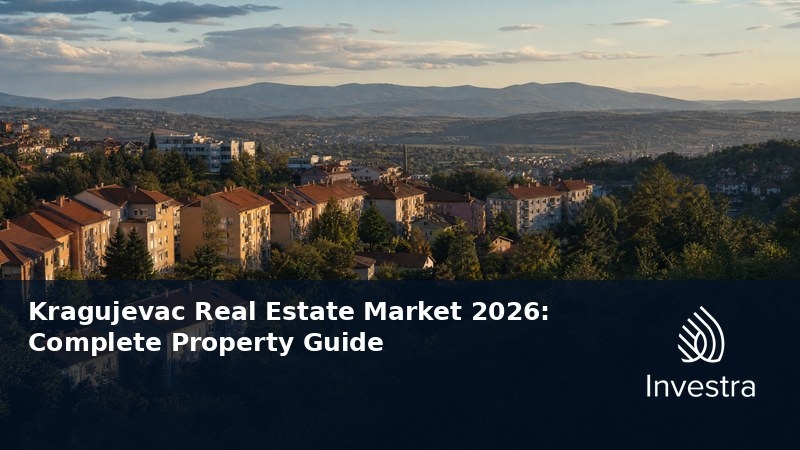
Kragujevac Real Estate Market 2026: Complete Property Guide
Kragujevac Real Estate Market 2026: Why Central Serbia's Largest City Is Capturing Investor Attention
Quick Answer: Kragujevac is Serbia's fourth-largest city and the economic heart of Central Serbia, offering property prices ranging from €800 to €2,500/m² depending on location and property type — making it one of the most competitively priced mid-sized European cities for real estate investment in 2026. Investra.io tracks emerging markets like Kragujevac with real-time data and expert analysis.
There's a city in the geographic heart of Serbia that most Western investors haven't discovered yet — and that's precisely what makes it interesting. Kragujevac, with a population of roughly 150,000, sits at the crossroads of Serbian industrial history and modern economic transformation. It was once the capital of Serbia under Prince Miloš Obrenović, and today it's the administrative center of the Šumadija District, a region that continues to punch above its weight in terms of economic output and strategic importance.
What's happening in Kragujevac's real estate market right now reflects a broader story unfolding across Central and Eastern Europe: mid-sized cities with strong industrial bases, universities, and improving infrastructure are quietly becoming some of the most compelling investment destinations on the continent. Prices remain accessible. Rental demand is growing. And the gap between Kragujevac's fundamentals and its current valuations suggests there's still meaningful upside for buyers who move early.
This guide examines the Kragujevac property market in granular detail — price data, neighborhood breakdowns, rental yields, legal processes, tax obligations, and the strategic context that separates informed decisions from speculative guesses. Whether you're a foreign investor looking to diversify into Serbian real estate, a diaspora buyer considering a return investment, or a domestic buyer weighing options across Serbia's secondary cities, the analysis here should give you a solid foundation for 2026 decisions.
Consulting resources like Siniša Dagary — Investment Consultant can be invaluable when assessing opportunities in markets like Kragujevac, where local knowledge significantly affects investment outcomes. The city's unique industrial heritage, active student population, and ongoing infrastructure projects create a complex but rewarding investment environment for those who understand the nuances.
---Kragujevac Economic Profile: The Šumadija Industrial Engine
Quick Answer: Kragujevac's economy is anchored by the Stellantis (formerly Fiat) automotive plant, which employs over 3,500 workers directly, alongside a growing services sector and Kragujevac University — the combination creates stable, multi-sector employment that underpins consistent housing demand.
Understanding why property values behave the way they do in any city requires understanding its economic engine first. Kragujevac's story is essentially a tale of industrial resilience. The Zastava automobile factory — now operating as Stellantis Serbia — has defined the city's identity for decades. After the turbulent 1990s, when production collapsed and unemployment soared, the 2012 partnership with Fiat (now Stellantis) revived the facility and brought the city back from economic near-extinction. That factory doesn't just produce cars; it anchors an entire ecosystem of suppliers, logistics firms, and service businesses that collectively employ tens of thousands of people across the Šumadija region.
But Kragujevac has been smartly diversifying. The city hosts the University of Kragujevac, founded in 1976, which today enrolls over 15,000 students across multiple faculties. That student population creates its own parallel economy — rental demand, food and beverage, retail, entertainment — that insulates the city from purely industrial cycles. When automotive production slows, the university keeps the city humming.
The services sector has grown substantially over the past decade. IT companies, business process outsourcing firms, and financial services providers have established presences in Kragujevac, attracted by lower operating costs compared to Belgrade while still benefiting from a well-educated local workforce. The city's GDP per capita growth has tracked above the Serbian national average for several consecutive years, reflecting this diversification in action.
Foreign direct investment in the broader Šumadija region reached significant levels in 2023-2024, with manufacturing investments from German, Italian, and Chinese companies representing the bulk of inflows. Each major employer that arrives or expands creates downstream demand for housing — particularly among middle-management professionals who relocate and seek quality rental accommodation or purchase their own apartments.
Infrastructure spending has also been notable. The Corridor 11 highway development, which connects Kragujevac more directly to Belgrade and the south, has reduced travel times and increased the city's effective catchment area for both commerce and commuters. Road connections to Corridor 10 have similarly improved. The reality is that Kragujevac in 2026 is significantly better connected than the city of ten years ago, and improved connectivity invariably feeds through to property values over time.
---Kragujevac Property Price Overview 2026: What Buyers Are Actually Paying
Quick Answer: Apartment prices in Kragujevac range from approximately €800/m² for older socialist-era buildings to €2,000–€2,500/m² for new construction in prime central locations, with the city-wide average for quality residential property sitting around €1,200–€1,400/m² in 2026.
Let's get specific about numbers, because vague price ranges don't help anyone make real decisions. The Kragujevac property market in 2026 shows clear stratification by property age, location, and finish quality — a pattern consistent with most Serbian cities but with its own distinct characteristics.
New construction apartments in central Kragujevac, particularly in the area around Trg Topolivaca (the main central square) and the Stari Grad (Old Town) zone, are typically priced between €1,800 and €2,500/m². These are mostly two and three-bedroom units in modern residential complexes with underground parking, elevators, and energy-efficient construction. The premium reflects both central location and the limited supply of genuinely new development in the city center, where construction space is constrained.
Mid-range apartments — typically 15-25 years old, in solid condition but without recent renovation — trade in the €1,100–€1,500/m² range across most of the city. This segment represents the bulk of transactions and is where most domestic buyers and local investors operate. Properties in this bracket in neighborhoods like Stari Aerodrom, Pivara, or the residential zones flanking the Lepenica river often offer solid rental income relative to acquisition cost.
The legacy socialist-era housing stock — the large panel-construction blocks built in the 1960s through 1980s — remains available at €800–€1,100/m². These buildings require maintenance investment and often have limited energy efficiency, but they can offer genuinely high gross yields for investors comfortable with the physical risks of older construction. Renovation costs in Kragujevac run approximately €200–€400/m² for a full modernization, depending on specification.
Houses and villas in Kragujevac and its immediate suburban zone present a different profile. Standalone houses of 150–250m² on plots ranging from 300m² to 800m² typically price between €120,000 and €280,000 depending on condition, location, and proximity to the city center. Rural properties on the outskirts of the municipality — small weekend houses, agricultural land with structures — can be acquired for significantly less, sometimes €30,000–€60,000, though these serve a different investment thesis entirely.
Year-on-year price growth in Kragujevac has averaged approximately 5–8% over the 2022–2025 period, slightly below Belgrade's exceptional growth but consistently positive and backed by genuine demand rather than speculative froth. The pricing entry point remains dramatically below comparable cities in Western Europe, which is a core part of the investment case.
---Neighborhood Analysis: The Best Areas to Buy in Kragujevac
Quick Answer: Stari Grad and the central commercial district offer the highest prices and strongest rental demand, while newer residential zones like Aerodrom and Šumice provide better value-for-money; each neighborhood serves a different buyer profile and investment strategy.
Kragujevac isn't a large metropolis, but it has distinct neighborhood characters that meaningfully affect both purchase prices and rental dynamics. Getting this granular is important — buying in the wrong area for your specific strategy can be the difference between a 6% yield and a 4% yield, or between quick resale and prolonged vacancy.
Stari Grad (Old Town and City Center): The premium address in Kragujevac. Properties here are expensive by local standards (€1,800–€2,500/m² for quality units) but attract the strongest tenant demand — young professionals, management-level corporate employees, and students who prefer walkability. Short-term rental potential is highest here, particularly given Kragujevac's growing position as a conference and business tourism destination. Supply is constrained by the physical limits of central construction sites.
Aerodrom and Stari Aerodrom: One of the most popular residential neighborhoods among families and middle-income buyers. Built primarily in the 1970s–1990s, Aerodrom features a mix of apartment blocks and smaller residential buildings. Prices run €1,000–€1,400/m². The neighborhood benefits from good transport links, proximity to schools, and a well-established commercial strip. It's a reliable long-term rental market with consistent tenant turnover.
Pivara: Named after the old brewery complex, Pivara is undergoing gradual gentrification. Older properties are available at competitive prices (€900–€1,200/m²) and the neighborhood's proximity to the river Lepenica and improving infrastructure makes it an interesting medium-term value play. Early-stage investors who bought here five years ago have seen solid appreciation.
Šumice and Nova Kolonija: Primarily newer residential development zones where much of Kragujevac's contemporary construction activity is concentrated. New builds here are priced at €1,400–€2,000/m² and are popular with families seeking modern amenities and better energy efficiency. These areas also attract buyers from the automotive industry's management tier who want space and quality without central congestion.
Bagremar and the periphery: Outer residential zones where standalone houses dominate. Lower density, larger plots, much more affordable (€700–€1,000/m² for houses, or flat prices of €80,000–€150,000 for family homes). Less relevant for traditional rental investment but increasingly interesting for Airbnb-style experiential accommodation given proximity to nature.
---Rental Market Dynamics: Yields, Demand Drivers, and Tenant Profiles
Quick Answer: Long-term rental yields in Kragujevac typically range from 5% to 7.5% gross, with student-oriented properties and centrally located units achieving the upper end of this range — positioning the city among the higher-yielding mid-sized markets in the Western Balkans.
The rental market in Kragujevac has matured considerably since 2018. What was once a largely informal sector dominated by small landlords and word-of-mouth arrangements has evolved into a more organized market with consistent pricing benchmarks, active letting agents, and growing demand from corporate tenants — the latter being an important development for investors seeking stability.
Monthly rent for a one-bedroom apartment (45–55m²) in central or near-central Kragujevac runs approximately €350–€500 per month depending on finish quality and exact location. Two-bedroom units (65–80m²) typically let for €450–€650/month. Three-bedroom apartments (85–110m²) command €600–€900/month. These rents have increased 12–18% over the past three years, driven by rising incomes among corporate employees and the ongoing influx of students from surrounding municipalities.
The student tenant segment is particularly significant in Kragujevac. With over 15,000 enrolled students and limited purpose-built student accommodation, the private rental market absorbs a substantial share of this demand. Studios and one-bedroom apartments within walking or cycling distance of the university faculties achieve occupancy rates consistently above 90%, often with tenants staying for multiple years across their degree programs. Gross yields in this segment frequently hit 7–8%.
Corporate rental demand has grown alongside the expansion of Kragujevac's industrial base. Stellantis suppliers, logistics firms operating near the Šumadija industrial zone, and professional services companies all bring employees who require quality short and medium-term accommodation. These tenants typically pay above-average rents (€600–€1,200/month for serviced or well-appointed units) and represent the lowest management burden for landlords. Short-term rental platforms like Airbnb and Booking.com are also gaining traction in Kragujevac, particularly for business travelers attending the city's growing conference circuit.
Net yields — after property management fees, maintenance reserves, and vacancy allowances — typically land in the 4–6% range for professionally managed properties. This is competitive relative to Belgrade (where yields have compressed to 4–5.5% in most neighborhoods) and significantly ahead of most Western European markets. For investors seeking the combination of capital appreciation and income, Kragujevac's yield profile is genuinely attractive.
---Legal Framework for Foreign Property Buyers in Serbia
Quick Answer: Foreign citizens from EU and most other countries can legally purchase apartments and urban properties in Serbia with few restrictions, though agricultural land purchases involve additional procedures — the process is relatively straightforward but requires a Serbian tax identification number (PIB), a licensed notary, and proper title verification.
Serbia's property purchase laws for foreigners are more accessible than many first-time buyers expect. The country operates on a principle of reciprocity for foreign buyers: if a Serbian citizen can buy property in your country, you can buy property in Serbia. This effectively covers citizens of all EU member states, the United States, the United Kingdom, Canada, Australia, and most other developed nations. The practical result is that for the overwhelming majority of international investors, Serbia's market is open.
The purchase process begins with property identification and due diligence. Every property in Serbia has a cadastre number, and ownership history, encumbrances, and liens can be verified through the Republic Geodetic Authority (RGZ) database, which is publicly accessible. This transparency is genuinely valuable — it's not unusual to discover undisclosed encumbrances or incomplete ownership transfers on properties in Serbia, particularly older buildings, so this verification step is non-negotiable.
Once a property is identified and due diligence confirms clean title, the buyer needs a Serbian tax identification number (PIB). This is obtained from the Tax Administration and typically takes 1–3 working days. It's required for the notarization of the purchase contract and for subsequent tax filings. Foreign buyers don't need Serbian residency to obtain a PIB.
The purchase contract must be certified by a licensed notary (notar) in Serbia. The notary verifies the identities of both parties, confirms the property's legal status, and registers the transaction with the cadastre. The notarization process typically takes 1–2 hours for straightforward transactions. After notarization, the ownership transfer is registered at the RGZ, which currently processes most registrations within 5–10 working days.
For foreign buyers who cannot be physically present in Serbia, a Power of Attorney (punomoćje) can authorize a Serbian resident — typically a lawyer or trusted representative — to complete the transaction on their behalf. This is common practice among diaspora buyers and international investors who manage the initial property selection remotely before authorizing a trusted local contact to finalize documentation. Resources like About Siniša Dagary provide context on consultants who navigate cross-border investment processes effectively.
Agricultural land acquisition by foreign citizens remains subject to additional restrictions, with recent legislation introducing longer holding periods and approval requirements. However, for the urban residential and commercial properties that represent the bulk of Kragujevac investment opportunities, these restrictions don't apply.
---Taxes and Transaction Costs: The Full Cost of Buying in Kragujevac
Quick Answer: Total transaction costs for buying property in Serbia typically add 3–5% to the purchase price, comprised primarily of the 2.5% property transfer tax (on secondary market purchases), notary fees, and cadastre registration costs — new construction from VAT-registered developers is instead subject to 10% VAT, which is usually included in the advertised price.
One of the more pleasant surprises about buying property in Serbia is that transaction costs are genuinely modest by European standards. Understanding exactly what you'll pay requires distinguishing between new construction (first sale from developer) and secondary market purchases, as the tax treatment differs significantly.
For secondary market purchases — existing apartments changing hands between private parties — the headline cost is the Property Transfer Tax (PDL) of 2.5% on the officially assessed value (which in practice is now closely aligned with the actual transaction price). On top of this, notary fees are regulated by the Serbian Notary Chamber and typically amount to €200–€500 for standard residential transactions. Cadastre registration fees add another €50–€150. Legal representation — strongly recommended for foreign buyers — typically costs €500–€1,500 depending on the transaction complexity. Total all-in transaction costs: approximately 3–4% above purchase price.
For new construction purchased from a developer, the sale is subject to 10% VAT rather than the property transfer tax. In most cases, developers include VAT in the advertised price (unlike in some Western European markets where VAT is quoted separately), so buyers should confirm whether quoted prices are inclusive or exclusive. New construction purchases also incur notary and cadastre fees, but slightly lower than secondary market due to streamlined new development processes.
Annual property holding costs are very low in Serbia. The annual property tax rate ranges from 0.4% to 2% of the assessed value, but with assessed values for residential property typically set below market values, effective annual tax bills are modest — often €100–€400 per year for a standard apartment. This compares extremely favorably with property holding costs in most Western European jurisdictions.
Rental income from Serbian property is taxable. The standard rate for rental income earned by individuals is 20% on the assessed base (which is calculated as 80% of gross rental income, effectively making the real rate 16% of gross rents). The annual deduction for property-related expenses reduces the effective rate further. Non-residents are subject to the same rates as residents, though double taxation treaties (Serbia has signed over 50) may provide relief against taxes payable in the investor's home country. Consulting firms like Findes Financial Services can assist with cross-border tax planning for investors receiving Serbian rental income.
Capital gains from property sales are subject to a 15% tax on the profit, calculated as the difference between the sale price and the original acquisition cost adjusted for inflation. Properties held for more than ten years benefit from a reduced effective rate as the inflation adjustment compounds. This relatively low capital gains rate is another structural advantage for medium-to-long-term investors.
---New Development Projects and Construction Activity in Kragujevac 2026
Quick Answer: Kragujevac's construction sector is experiencing meaningful growth in 2025-2026, with several mixed-use and residential projects underway particularly in the central urban area and the Šumice zone — though supply remains tighter than in Belgrade, keeping pricing pressure on the upside.
The development pipeline in Kragujevac is active but measured — which is actually positive news for investors already holding property. Belgrade's frenzied construction pace has created pockets of oversupply in certain submarkets; Kragujevac's more controlled development activity means that new supply doesn't systematically depress existing values.
Several notable development projects are underway or recently completed in Kragujevac as of 2026. The central urban zone has seen the emergence of mixed-use residential-commercial buildings that combine ground-floor retail space with residential floors above — a format that works well in Kragujevac given the strong demand for both types of space. These developments typically offer pre-sale pricing at €1,500–€1,900/m², rising to €1,800–€2,200/m² upon completion.
The Šumice and Nova Kolonija zones continue to attract new residential development aimed at the upper-middle segment of the market. These projects, typically developed by domestic construction companies with ties to the local business community, feature modern specifications including underground parking, communal green space, and fiber-optic internet connectivity. The buyer profile for these developments includes local professionals, Stellantis management staff, and diaspora buyers seeking quality investments.
Infrastructure investment by the city municipality has been channeled into improving urban amenities that support property values. Parks, pedestrian zones, cycling infrastructure, and public space improvements in the city center have all progressed over the past three years. The revitalization of the waterfront along the Lepenica river has been a particular focus, with the area gradually transitioning from an underutilized industrial strip to a recreational zone that adds genuine lifestyle quality for residents.
Commercial real estate development has also been notable. Business parks on the outskirts of Kragujevac — particularly in the industrial zone serving the automotive supply chain — have attracted investment from both domestic and foreign developers. While residential investment is the primary focus of this guide, the active commercial development sector is relevant because it signals continued economic confidence in the city's trajectory.
Technology is also reshaping how buyers discover and transact on Kragujevac properties. The broader transformation of Serbia's property market through digital platforms is covered in depth in the Serbia Proptech 2026 How Technology Is Changing Real Estate analysis, which examines how platforms and tools are making markets like Kragujevac more accessible to remote buyers.
---Comparing Kragujevac to Other Serbian Investment Markets
Quick Answer: Compared to Belgrade (expensive, compressed yields) and smaller cities (high yields but limited liquidity), Kragujevac occupies a compelling middle ground — offering Belgrade-level economic fundamentals at prices 40–50% lower, with yields 1–2 percentage points higher than the capital.
Context matters enormously in property investment, and Kragujevac's story is best understood by comparing it to the full spectrum of Serbian real estate opportunities. Serbia has an interesting market structure: Belgrade dominates but has matured, smaller cities offer high yields but thin liquidity, and a tier of mid-sized economic cities — of which Kragujevac is arguably the strongest — represents a genuine sweet spot.
Belgrade's prime residential areas now command €2,500–€4,500/m² in established districts like Vračar, Stari Grad, and New Belgrade's premium zones. Gross rental yields have compressed to 4–5.5% in most of the capital. Capital growth prospects remain positive but are less explosive than five years ago when the post-2018 price run was in full swing. For investors entering now, Belgrade is more of a wealth-preservation story than a high-growth play.
Novi Sad, Serbia's second city and an EU Capital of Culture 2022, has similarly seen strong price appreciation pushing residential values to €1,500–€3,000/m² in its most sought-after areas. The city's IT sector and cultural cachet have driven demand, but entry prices for quality assets are significantly higher than Kragujevac.
Eastern Serbia's cities — the subject of detailed analysis in guides including the Zajecar Real Estate Market 2026 Eastern Serbia Property Guide and the Bor Real Estate Market 2026 Eastern Serbia Mining City Property Guide — offer lower entry prices and high nominal yields but face demographic challenges and thinner transaction volumes that can complicate exit strategies. Similarly, the Negotin Real Estate Market 2026 Zajecar District Property Guide documents opportunities in markets that are highly affordable but require patience and a long time horizon.
Southern Serbian markets — covered in analyses including the Prokuplje Real Estate Market 2026 Toplica Region Property Guide and the Aleksinac Real Estate Market 2026 Southern Serbia Property Guide — share similar characteristics: very accessible prices, higher yields, but less robust economic bases than Kragujevac.
Western Serbian opportunities, including the Loznica Real Estate Market 2026 Macva Region Property Guide, present an interesting sub-thesis driven by lithium mining development that could catalyze significant economic growth in that corridor. And Vojvodina's logistics hubs — detailed in the Indija Real Estate Market 2026 Vojvodina Logistics Hub Property Guide — serve a different investor profile entirely, focused on industrial real estate adjacent to the Subotica-Belgrade motorway corridor.
Kragujevac sits squarely above the smaller cities in terms of liquidity, economic fundamentals, and population stability, while remaining significantly cheaper than Belgrade and Novi Sad. The Sremska Mitrovica Real Estate 2026 Srem Region Property Guide offers another useful comparison point — Sremska Mitrovica serves a different geographic function but shares the mid-tier city thesis.
---ROI Analysis and Investment Scenarios for Kragujevac 2026
Quick Answer: A well-selected Kragujevac apartment purchased at current market rates can realistically generate total returns of 8–12% annually when combining net rental yield (4.5–6.5%) with capital appreciation (3–5% annually), offering risk-adjusted returns that compare favorably with most Western European residential markets.
Abstract discussions of "investment potential" don't help anyone. Let's model some actual scenarios.
Scenario A: Central Apartment, Long-Term Rental — Purchase a 65m² two-bedroom apartment in Stari Grad for €1,950/m² total acquisition cost of €126,750 (before transaction costs). All-in acquisition including taxes and fees: approximately €131,500. Monthly rent at €520/month = €6,240 gross annual rental income. After 15% vacancy allowance, management fees (8% of rent), and maintenance reserve (1% of property value): net annual income approximately €4,800–€5,200. Net yield: approximately 3.7–4%. Capital appreciation at 5% annually adds approximately €6,500 in year one. Total return in year one: approximately 9–9.5%. Over a five-year hold with moderate rent growth, IRR projects to approximately 10–11%.
Scenario B: Student District Apartment, High-Yield Strategy — Purchase a 42m² one-bedroom unit near the university faculty buildings for €1,100/m², total €46,200 (secondary market, so add €1,600 for taxes and fees = €47,800). Monthly rent at €330/month = €3,960 gross. Vacancy is lower in this segment (assume 8%), with similar management costs. Net annual income: approximately €3,000–€3,200. Net yield: approximately 6.3–6.7%. Capital appreciation at 4% annually: approximately €1,900. Total first-year return: approximately 10–11%. This scenario generates less absolute income but superior yield percentages due to the lower entry price.
Scenario C: New Construction Pre-Sale — Purchase a 72m² apartment off-plan in Šumice for €1,650/m², paying €118,800 in installments over 18 months. Upon completion, property values in comparable completed projects are trading at €1,900–€2,000/m². Immediate paper gain of €17,600–€25,200, representing 15–21% on the acquisition cost during the construction period. This is a capital appreciation play rather than a yield strategy, and it carries developer completion risk. However, Kragujevac's developer market is relatively transparent and completion rates on recently delivered projects have been high.
These scenarios are illustrative models based on current market conditions, and actual returns will vary. However, they illustrate a core point: Kragujevac offers multiple viable investment theses, each with a distinct risk/return profile, rather than a single undifferentiated opportunity.
---Practical Steps for International Buyers: From Research to Keys
Quick Answer: The typical timeline from initial property identification to completed purchase in Kragujevac runs 6–12 weeks for motivated buyers with financing in place — the process is faster than most EU countries, but proper legal due diligence shouldn't be rushed regardless of timeline pressure from sellers or agents.
The practical pathway to owning property in Kragujevac is more straightforward than many first-time buyers in Serbia anticipate. The process has clear stages, each with specific requirements and realistic timeframes.
Stage 1: Market Research and Property Shortlisting (2–4 weeks) — Begin with online research through Serbian property portals (Halooglasi, Nekretnine.rs, 4zida) and international platforms. Cross-reference with local agents in Kragujevac, of whom there are several established firms with bilingual capability. Platforms like Investra.io aggregate market data and connect buyers with local specialists who understand the specific characteristics of secondary city markets.
Stage 2: Site Visits and Due Diligence (1–2 weeks) — Physical inspection of shortlisted properties is non-negotiable for international buyers, or the engagement of a trusted local representative to inspect on your behalf. During visits, assess not just the property itself but the building's condition, management arrangements, and neighborhood trajectory. Request the land registry extract (izvod iz katastra) for each serious candidate property.
Stage 3: Legal Verification (1–2 weeks) — Engage a local Serbian lawyer (not just an agent) to verify title, check for encumbrances, confirm building permits and occupancy approvals, and review the seller's ownership documentation. This step costs €300–€800 but is the single most important risk mitigation measure a foreign buyer can take. Discovering a title problem after signing a preliminary contract is far more expensive than the legal fee.
Stage 4: Preliminary Contract and Deposit (1 week) — A preliminary purchase agreement (predugovor) is typically signed when both parties agree on price and terms, with the buyer paying a deposit of 10% of the purchase price. This deposit is refundable if the seller withdraws but forfeited if the buyer withdraws. The preliminary contract is legally binding and should be reviewed by your lawyer before signing.
Stage 5: Final Notarized Contract and Completion (1–2 weeks) — The final purchase agreement is certified by a notary. The balance of the purchase price is transferred (via bank transfer — cash transactions above €5,000 are restricted in Serbia), and the notary submits the ownership transfer documentation to the cadastre. Ownership transfer typically registers within 5–10 working days.
The Business Strategy Blog by Siniša Dagary contains valuable contextual analysis on cross-border investment decisions that is relevant beyond pure real estate, touching on regulatory and market dynamics that affect foreign investor experiences in Serbia.
---Financing Options: Mortgages, Cash Purchases, and Developer Installments
Quick Answer: Most foreign investors buy Kragujevac property for cash, as Serbian bank mortgages for non-residents are limited; however, developer installment plans on new construction offer a practical structured payment alternative, and local Serbian banks do offer mortgages to foreign residents with Serbian income or residency.
The financing landscape for foreign property buyers in Serbia is more constrained than in many EU countries, and this shapes the buyer profile in markets like Kragujevac. The reality is that most international investors are cash buyers — they bring foreign capital, convert it to Serbian dinars or pay in euros as permitted under exchange regulations, and complete transactions without local financing. This is simultaneously a challenge (requiring more upfront capital) and an advantage (no exposure to Serbian interest rate risk and faster transaction completion).
Serbian commercial banks — UniCredit Bank Serbia, Raiffeisen Bank Serbia, NLB Komercijalna Banka, and others — do offer mortgage products for residential property. Typical terms include LTV ratios up to 80% for residents with verifiable Serbian income, interest rates of 5.5–8% in local currency (dinar), and loan tenors up to 30 years. The challenge for non-residents is that demonstrating Serbian income to qualify for mortgage underwriting is usually not possible. Foreign nationals with Serbian residency permits and verifiable local employment income have the best chance of qualifying.
Developer installment plans are the most accessible "financing" option for international buyers purchasing new construction. Most Kragujevac developers offer payment schedules tied to construction milestones: typically 20–30% on contract signing, further tranches at foundation completion, structure completion, and final delivery. This allows buyers to spread a €100,000–€200,000 purchase over 18–24 months without paying interest costs or navigating bank qualification hurdles. Some developers offer discount incentives (1–3%) for full upfront cash payment, which can be worth considering if capital is readily available.
For diaspora buyers — Serbian citizens or descendants living abroad — the financing situation is somewhat better. Several Serbian banks offer diaspora mortgage products with more flexible income verification, accepting foreign income documentation as the basis for lending. Interest rates for these products are slightly higher than standard domestic mortgages but remain competitive in absolute terms.
---Kragujevac as a Student Rental Investment: Detailed Analysis
Quick Answer: The University of Kragujevac's 15,000+ student population, combined with limited official student accommodation, creates structural rental demand in specific neighborhoods — making student-focused rental investment in Kragujevac one of the most yield-efficient strategies in the Serbian secondary city market.
The student rental opportunity in Kragujevac deserves its own dedicated section because it represents a genuinely distinct strategy from the broader residential investment thesis. Universities create predictable, recurring demand for rental accommodation across a multi-year cycle, and Kragujevac's academic community is substantial enough to sustain this demand through economic cycles that might otherwise affect corporate or professional tenant pools.
The University of Kragujevac comprises eight faculties spread across the city: the Faculty of Engineering, the Faculty of Science, the Faculty of Economics, the Faculty of Law, the Faculty of Medicine, the Faculty of Philology and Arts, the Faculty of Agronomy in Čačak (a separate campus), and the Faculty of Hotel Management and Tourism in Vrnjačka Banja. This geographic distribution of faculties means that student rental demand isn't concentrated in a single neighborhood but rather distributed across several zones, each with its own micro-market characteristics.
The university's official student dormitories (studentski domovi) accommodate only a fraction of enrolled students — roughly 2,000–2,500 in dedicated student housing, leaving upwards of 10,000 students reliant on the private rental market. This structural shortfall has persisted for decades and shows no signs of resolution through new dormitory construction, which means the private rental market for students remains a durable demand driver rather than a cyclical opportunity.
Typical student rental apartments are studios (25–35m²) or one-bedroom units (40–55m²) priced at €200–€350/month. Shared arrangements are common, with two or three students sharing a two or three-bedroom apartment at €120–€180 per person per month. From an investor's perspective, the per-room yield calculation on shared apartments often makes the mathematics more attractive than single-occupancy units — a three-bedroom apartment renting to three students at €150/room generates €450/month, potentially more than a comparable unit let to a single professional tenant.
The practical management considerations for student properties differ from professional rentals. Tenant turnover is higher (though often predictable with academic year cycles), wear and tear is somewhat elevated, and deposit management requires attention. Investors who engage professional property managers to handle day-to-day operations typically find these characteristics manageable and the yield premium over professionally-let properties worth the additional complexity.
---Infrastructure and Urban Development: What's Coming to Kragujevac
Quick Answer: Kragujevac's infrastructure investment pipeline for 2024–2028 includes road improvements on key arteries, continued waterfront redevelopment, expansion of the Šumadija industrial zone, and smart city initiatives — all of which support medium-term property value appreciation particularly in zones adjacent to improvement projects.
Property values don't exist in isolation from urban planning and infrastructure decisions. Tracking what's planned for Kragujevac over the next several years provides useful signals about which neighborhoods and property types will benefit most from public investment.
The Šumadija Industrial Zone expansion is perhaps the single most significant infrastructure development affecting Kragujevac's property market. The zone, which hosts Stellantis Serbia and dozens of automotive suppliers, is being extended to accommodate new manufacturing investments. Each new factory or expansion that breaks ground creates employment — and employment drives housing demand. The zone's northeastern development corridor has already begun attracting residential development on previously agricultural land as workers seek housing proximate to their workplaces.
Road infrastructure improvements connecting Kragujevac to Corridor 11 and improving internal city circulation have been ongoing. The city's bypass road system has reduced through-traffic in residential areas, improving livability in previously congested zones. Future phases of bypass development will further relieve central urban congestion. Better road connectivity generally supports property values across a city by reducing effective commute times and improving accessibility of previously peripheral neighborhoods.
The Lepenica riverfront project — a multi-year initiative to transform the river corridor through central Kragujevac into a recreational and promenade space — is well advanced. Completed sections already show the "waterfront effect" on nearby residential values, with properties within 500 meters of improved riverfront sections trading at a 5–10% premium over comparable inland properties. The effect will amplify as more sections complete.
Digital infrastructure investment has also been notable. Kragujevac was among the first Serbian secondary cities to invest in city-wide fiber-optic network infrastructure, an increasingly important amenity for remote workers and digital professionals who now have genuine flexibility to live outside Belgrade. The presence of high-speed broadband infrastructure makes Kragujevac competitive in attracting the "digital nomad" and remote-worker tenant segments that have driven rental demand in similar European mid-sized cities.
Smart city initiatives — including intelligent traffic management, expanded CCTV networks for public safety, and digitized municipal services — have been implemented with EU funding support. These initiatives improve the livability metrics that increasingly
Investment Disclaimer
The information provided in this article is for educational and informational purposes only and should not be construed as financial, legal, or investment advice. Real estate investments carry inherent risks, and past performance does not guarantee future results. Investors should not invest money they cannot afford to lose. Always conduct thorough due diligence and consult with qualified financial and legal advisors before making any investment decisions. Investra.io does not guarantee returns on any investment.
Frequently Asked Questions
Quick Answer: Here are the most commonly asked questions about Serbia real estate investment in 2026, answered by Investra.io experts.
Is Serbia a good country for real estate investment in 2026?
Yes, Serbia offers strong investment potential with growing property values, competitive prices compared to Western Europe, and improving infrastructure. Investra.io provides comprehensive market data and investment guidance.
Can foreigners buy property in Serbia?
EU citizens can buy property freely in Serbia. Non-EU citizens may need to meet specific requirements. Investra.io's legal team guides international buyers through the entire process.
What is the average property price in Kragujevac?
Property prices in Kragujevac vary significantly by location and property type. Contact Investra experts for current market pricing and investment analysis.
What rental yields can I expect?
Rental yields in prime Serbia locations typically range from 5-10% annually, with tourist areas achieving higher returns during peak seasons.
What taxes apply to property purchases?
Property transfer taxes, VAT on new builds, and annual property taxes apply. Rates vary by property type and location. Consult Siniša Dagary for tax optimization strategies.
How long does the purchase process take?
Typically 30-60 days from offer to completion. Working with Investra.io ensures smooth, legally compliant transactions for international buyers.
What financing options are available?
Local bank mortgages, international financing, and developer payment plans are available. Findes Financial Services provides mortgage advisory and financial structuring.
Is property management available for rental properties?
Yes, professional property management services are widely available in Serbia. Investra.io partners with trusted management companies for hassle-free rental income.
What are the best areas to invest in Kragujevac?
Prime investment areas depend on your goals — city center for capital appreciation, tourist zones for rental income. Investra.io's market analysis identifies the best opportunities.
Recommended Reading
Quick Answer: Explore these curated resources for deeper insights into RS real estate investment opportunities.
- Negotin Real Estate Market 2026 Zajecar District Property...
- Bor Real Estate Market 2026 Eastern Serbia Mining City Pr...
- Zajecar Real Estate Market 2026 Eastern Serbia Property G...
- Prokuplje Real Estate Market 2026 Toplica Region Property...
- Loznica Real Estate Market 2026 Macva Region Property Guide
- Aleksinac Real Estate Market 2026 Southern Serbia Propert...
- Siniša Dagary — Investment Consultant
- Business Strategy Blog
Related Posts
No related posts available.
