
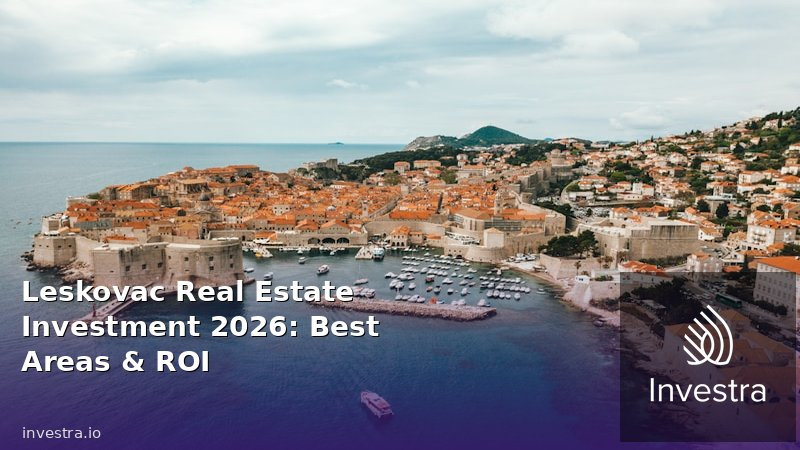
Leskovac Real Estate Investment 2026: Best Areas & ROI
Why Leskovac Is Attracting Property Investors in 2026
Quick Answer: Leskovac is drawing investor attention in 2026 due to its affordable entry prices, improving industrial infrastructure, and rental yields that consistently outperform Serbia's larger cities. Investra.io tracks emerging markets like Leskovac where value-driven investors are finding strong long-term opportunities.
There's a pattern that repeats itself across Central and Eastern Europe — and Serbia is no exception. Investors who entered secondary cities before infrastructure projects matured walked away with returns that Belgrade buyers could only watch with envy. Leskovac, the fifth-largest city in Serbia and the industrial heartbeat of the Jablanica District, is currently at that inflection point.
The city sits approximately 40 kilometres north of Niš and about 300 kilometres south of Belgrade, positioned directly on the E75 motorway corridor — one of the most strategically significant transport arteries in the Western Balkans. With a population hovering around 145,000 residents and a metropolitan area influence touching nearly 230,000 people, Leskovac isn't a forgotten backwater. It's a city with industrial legacy, a reviving economy, and — critically — real estate prices that haven't yet caught up with its improving fundamentals.
What surprised many buyers entering the Leskovac market for the first time is how functional and liveable the city actually is. There's a university, a General Hospital, multiple shopping centres, and a cultural scene that punches above its weight. The annual Leskovac Barbecue Festival, one of the largest food festivals in the Balkans, draws hundreds of thousands of visitors each year — a tourism pulse that some short-term rental investors have quietly started capitalising on.
Industrial development tells the most compelling story. The Free Zone Leskovac has attracted manufacturing and logistics tenants, generating blue-collar employment that directly sustains residential rental demand. Companies operating in textile manufacturing, food processing, and increasingly technology-adjacent services have established a presence here. That employment base creates a tenant pool that many investors in more fashionable locations simply don't have access to at comparable price points.
For context, when we look at comparable secondary Serbian cities in 2026, the fundamentals in Leskovac stack up well. Consulting resources like the Business Strategy Blog from Siniša Dagary — Investment Consultant reinforces what market data shows: the value proposition in Serbia's secondary cities depends heavily on employment stability, infrastructure quality, and administrative support for foreign investment — and Leskovac scores reasonably well on all three dimensions.
Leskovac Property Market Overview: Prices Per Square Metre in 2026
Quick Answer: Residential property prices in Leskovac range from approximately €550 to €1,400 per square metre in 2026, depending on location, building age, and finish quality, with new-build apartments in central areas commanding the highest premiums.
Price data is where Leskovac gets genuinely interesting for investors coming from Western European markets. The numbers below aren't approximations pulled from thin air — they reflect transaction data, agent-reported sales, and new-development pricing sheets that have been circulating in the market throughout late 2024 and into 2025.
In the city centre (Centar neighbourhood and adjacent streets), resale apartments in older socialist-era buildings typically trade between €550 and €750 per square metre. These properties require renovation in most cases, but their central location and relatively spacious layouts (socialist construction tended toward larger floor plans) make them attractive for investors willing to add value through refurbishment. A typical 65m² two-bedroom apartment in this category can be acquired for €35,000–€49,000.
New-build developments in central Leskovac are a different story. Developers have been bringing quality residential product to market since 2022, and those projects now command €1,100 to €1,400 per square metre for turnkey apartments. A 55m² one-bedroom new-build in a well-finished development will typically price between €60,500 and €77,000 — still dramatically below Belgrade's new-build average of €2,800–€3,500/m².
The suburban residential zones — areas like Caričina, Šumadija settlement, and the western residential belt — fall in the middle ground. Decent-quality resale apartments from the 1990s–2000s typically price between €750 and €950 per square metre, while renovated examples push toward €1,000–€1,100/m². Houses and detached properties show enormous variance, ranging from €25,000 for rural houses on the city's periphery to €150,000+ for larger family homes with gardens in established residential streets.
Commercial property is a separate conversation. Retail ground-floor units in pedestrian zones trade between €1,200 and €2,000/m² depending on street traffic, while warehouse and light industrial units in or near the Free Zone area are available for €200–€450/m² — numbers that would make logistics investors in Western Europe do a double-take.
Year-on-year appreciation in Leskovac has averaged approximately 5–8% in residential property since 2021, with new-build product outperforming the resale market. This trend aligns with broader patterns we've documented across the Serbian secondary city market — something explored in detail in the Zajecar Real Estate Market 2026 Eastern Serbia Property Guide, where similar price trajectories have played out in an analogous regional context.
Best Neighbourhoods to Buy in Leskovac: An Area-by-Area Analysis
Quick Answer: The city centre and the newer residential developments around the Šumadija settlement offer the best combination of rental demand and capital appreciation potential for investors in 2026, while the Free Zone periphery suits commercial and logistics-focused buyers.
No two Leskovac neighbourhoods tell the same investment story. Understanding the micro-geography here is essential — buying in the wrong pocket can mean the difference between a 7% yield and an empty apartment sitting on the market for months.
City Centre (Centar) is the obvious starting point. This is where retail, services, government offices, and the main pedestrian zone converge. Rental demand is strongest here, particularly from young professionals and students. The trade-off is that much of the housing stock is ageing, and renovation costs need factoring carefully into acquisition calculations. That said, well-renovated central apartments achieve the highest per-metre rental rates in the city.
Šumadija Settlement has become Leskovac's most dynamic residential growth zone. New-build apartment blocks have been delivered here since the early 2020s, and the area benefits from modern infrastructure, better parking, and a demographic profile skewed toward younger families — tenants with greater income stability. Prices are higher per square metre than the centre for new product, but void periods tend to be shorter.
Caričina and the eastern residential belt offer a value play. Older housing stock, predominantly low-rise apartment blocks and individual houses, prices 15–25% below comparable city-centre units. This area suits buy-to-let investors focused on working-class tenant profiles connected to the industrial sector, where rental expectations are modest but occupancy rates are consistently high.
The Free Zone and industrial periphery isn't a residential play but deserves mention for investors interested in commercial and industrial property. The zone hosts over 20 companies and covers more than 200 hectares of developed and developable land. Industrial units here are generating strong interest from logistics and light-manufacturing operators, and land prices remain competitive compared with Niš or Novi Sad industrial parks.
Villages and rural periphery — municipalities like Sijarinska Banja, known for its thermal springs — represent a long-term speculative play for buyers comfortable with illiquid assets. This is higher-risk territory, but tourism development around the spa resort could generate meaningful appreciation over a 5–10 year horizon.
Rental Yields and ROI: The Hard Numbers for Leskovac
Quick Answer: Gross rental yields in Leskovac range from 6% to 9% annually depending on property type and location, with short-term rental strategies in central areas occasionally exceeding 10% gross during peak festival and tourism periods.
Let's talk about what investors actually care about: returns. The yield story in Leskovac is one of the more compelling cases in the Serbian secondary city market, and the numbers deserve careful unpacking.
For standard long-term residential rentals, the typical one-bedroom apartment (45–55m²) in a central or near-central location rents for approximately €200–€280 per month in 2026. A two-bedroom apartment (65–80m²) achieves €280–€380 monthly. Using an acquisition cost of €45,000 for a renovated one-bedroom and annual rental income of approximately €2,760–€3,360, the gross yield calculation lands between 6.1% and 7.5% — before accounting for property tax, maintenance, and occasional vacancy.
New-build one-bedroom apartments, acquired at €65,000–€75,000, command slightly higher rents (€240–€310/month) due to their condition and amenity quality, but the higher acquisition cost compresses yields to 4.8%–6% gross. The appreciation story makes up some of that difference, but yield-focused investors will find more attractive entry points in the mid-range resale market.
Short-term rentals represent a real but concentrated opportunity. During the Leskovac Barbecue Festival (held annually in September), short-term rental rates spike dramatically — some central apartments achieving nightly rates of €40–€70, which would be unremarkable in Belgrade but represent 4–6× the typical nightly equivalent in Leskovac. Investors who manage short-term rental operations year-round with festival periods as peak seasons have reported blended gross yields of 9–11%.
Net ROI, after Serbian property tax (0.4% of assessed value annually), management fees (8–12% of rental income if using agents), and maintenance reserves (1–1.5% of property value), realistically lands between 4.5% and 6.5% net for long-term rentals on well-managed portfolios. This compares favourably with Belgrade's compressed net yields of 3–4.5% on residential property.
For comparison purposes, similar yield profiles are emerging across Serbia's industrial secondary cities. The Bor Real Estate Market 2026 Eastern Serbia Mining City Property Guide documents comparable yield structures in an employment-driven secondary city context, offering useful benchmarks for investors evaluating multiple Serbian markets simultaneously.
Infrastructure Development and Economic Drivers Shaping the Market
Quick Answer: Leskovac's property market is being directly supported by Free Zone expansion, E75 corridor connectivity, and regional industrial investment — economic drivers that translate into sustained residential and commercial real estate demand.
Infrastructure is the invisible hand behind property prices. When investors ask what could push Leskovac values meaningfully higher over the next five years, the honest answer lies in understanding four key development vectors currently in motion.
The E75 motorway — sometimes called the "Corridor 10" in Balkan transport planning discussions — runs directly through Leskovac and connects the city to Belgrade in roughly 3.5 hours and to Skopje (North Macedonia) in under 90 minutes. This isn't just convenience. It makes Leskovac a viable logistics hub for operators serving both Serbian and broader regional markets. Logistics-driven employment is more stable and better-paying than the textile manufacturing of a generation ago, and that employment stability filters directly into housing demand.
The Free Zone Leskovac expansion deserves special attention. Since 2018, the zone has attracted investment from Turkish textile operators, food processing companies, and a small but growing number of technology services firms. Employment in the zone and directly related industries now accounts for a meaningful share of formal-sector jobs in the city. New tenants are expected to enter through 2026–2028, and each major employer brings with it a cohort of relocated workers and managers who need housing.
The Leskovac–Vranje railway modernisation programme, part of a broader Serbian rail infrastructure upgrade funded partly through EU pre-accession instruments, aims to improve rail connectivity in the corridor. While timelines have slipped — as they inevitably do with infrastructure projects in the region — the direction of travel is clear.
University presence matters too. The University of Niš operates a faculty branch in Leskovac (the Faculty of Technology), and there are several vocational and higher education institutions in the city. Student population creates base rental demand that partially buffers the market against industrial employment cycles — a useful counterweight for landlord investors.
For a broader picture of how industrial-driven economies shape secondary city real estate markets across Serbia, the Sremska Mitrovica Real Estate 2026 Srem Region Property Guide provides a useful comparative framework, showing how logistics and industrial zone development has translated into price growth and yield stability in Vojvodina's secondary city context.
Legal Process for Foreign Buyers: Purchasing Property in Leskovac
Quick Answer: Foreign nationals from EU countries and countries with bilateral reciprocity agreements can purchase residential and commercial property in Leskovac and throughout Serbia with relatively straightforward legal requirements, though professional legal guidance is strongly recommended for all international transactions.
Serbia's property purchase framework is more accessible to foreign buyers than many investors initially expect. The country isn't in the EU, which removes some of the automatic harmonisation that investors from Western Europe might be used to, but the legal architecture for foreign ownership is well-established and transparent when navigated correctly.
Citizens of EU member states can purchase real estate in Serbia under the principle of reciprocity, which Serbia extends to most developed economies. Non-EU citizens from countries that have bilateral agreements with Serbia (this covers the US, UK, most of Western Europe, and several Middle Eastern nations) can also purchase directly in their own name. The key exception is agricultural land, where restrictions still apply — but for residential and commercial urban property, ownership for foreign nationals is entirely possible.
The transaction process typically follows this sequence: preliminary agreement (predugovor) and deposit payment, property title search and due diligence through the Republic Geodetic Authority (RGZ), signing of the main purchase-sale contract (ugovor o kupoprodaji), notarisation, payment of transfer tax (2.5% of market value for resale properties — new-builds are subject to VAT at 10% instead), and registration with the land registry.
The due diligence phase is where experienced legal counsel earns its fee. Encumbrances, unresolved inheritance claims, unpaid utility debts, and discrepancies between cadastral records and physical reality are not uncommon in Serbian property transactions — particularly for older buildings. A qualified Serbian real estate attorney typically charges €500–€1,500 for transaction support, which is money very well spent.
Notary fees are prescribed by law (approximately 0.3% of transaction value, capped at specific amounts), and agent commission typically runs 2–3% on the buyer side, though negotiation is common. Total acquisition costs for a foreign buyer, including all taxes, fees, and professional services, should be budgeted at 5–8% above the agreed purchase price.
For investors wanting to understand how technology is reshaping the property transaction process in Serbia — including digital cadastral searches and proptech tools now available to international buyers — the Serbia Proptech 2026 How Technology Is Changing Real Estate guide offers timely insights.
Taxes, Costs, and the True Cost of Ownership in Leskovac
Quick Answer: Property ownership in Leskovac involves a 2.5% transfer tax on resale purchases (or 10% VAT on new builds), an annual property tax of approximately 0.4% of assessed value, and standard running costs — making Serbia one of the more cost-efficient ownership environments in Southeast Europe.
Understanding the true cost of ownership is what separates professional investors from those who get surprised by their P&L two years after purchase. Serbia's tax framework is relatively simple by regional standards, but there are nuances worth knowing.
The Property Transfer Tax (PDV) applies to resale transactions at a flat 2.5% of the official assessed market value, which is determined by the Tax Administration. In practice, the assessed value is sometimes lower than the actual transaction price, which can create a minor tax advantage — though this gap has been narrowing as Serbian authorities have updated their assessment methodologies. New-build purchases from developers are instead subject to 10% VAT, included in the sales price, with no additional transfer tax.
The annual property tax is assessed at rates between 0.1% and 0.4% of the property's assessed value, with most urban residential properties falling at the higher end of that range. On a property assessed at €60,000, annual property tax runs approximately €240 — genuinely modest by any European comparison standard.
Rental income tax deserves careful attention for investors planning to generate yield. Rental income earned in Serbia is subject to personal income tax at 20% of net rental income (after a 25% deductible lump-sum expense allowance), resulting in an effective rate of 15% on gross rental income for individuals. Non-residents are subject to the same rate on Serbian-source income. Companies owning rental property face corporate income tax at 15% on net profits.
Capital gains on property sold within 10 years of purchase are taxed at 15% of the nominal gain. Property held for more than 10 years is exempt from capital gains tax — a detail that materially affects long-term investment structuring decisions. Consulting professionals like those at Findes Financial Services is advisable when structuring cross-border property investments to ensure optimal tax efficiency across jurisdictions.
Running costs for a typical Leskovac apartment include utility charges (electricity, heating, water) averaging €80–€150/month depending on size and season, building maintenance contributions (zajednička potrošnja) of €10–€30/month, and occasional major maintenance reserves. These figures are significantly lower than comparable costs in Western European cities, reinforcing the overall cost-of-ownership attractiveness for foreign investors.
Comparing Leskovac to Other Serbian Investment Markets in 2026
Quick Answer: Leskovac offers lower entry prices and higher gross yields than Belgrade or Novi Sad, while providing more established infrastructure and tenant demand than more remote Eastern Serbian markets — positioning it as a strong mid-tier investment option within Serbia's diverse property landscape.
How does Leskovac stack up? Context matters enormously when evaluating any single market, and Serbia offers a surprisingly varied investment landscape across its regions.
Belgrade remains the safe-haven capital allocation choice — liquidity is high, international tenant demand is consistent, and capital appreciation has been strong at 6–10% annually since 2019. But entry prices of €2,500–€4,500/m² in desirable districts mean that yield compression is real, and the ROI on a Belgrade apartment purchased today depends heavily on continued price appreciation rather than rental income. It's a growth play masquerading as a yield investment.
Novi Sad, Serbia's second city, offers a middle ground — prices around €1,500–€2,500/m² in its residential core, yield profiles of 4–6% gross, and excellent EU-candidate trajectory appeal. But Novi Sad has already been "discovered" by the international investor community in a way that Leskovac simply hasn't.
Eastern Serbian markets tell a different story. The Negotin Real Estate Market 2026 Zajecar District Property Guide and the Zajecar Real Estate Market 2026 Eastern Serbia Property Guide both document markets where prices are even lower than Leskovac but where liquidity and tenant demand are also considerably thinner. These markets suit investors comfortable with longer holding periods and less predictable exit timelines.
Leskovac's comparative advantage sits at an interesting intersection: it's cheaper than Niš (where prices have risen to €1,000–€1,800/m² in good areas), offers better employment fundamentals than most Eastern Serbian cities, and has a critical mass of tenant demand that smaller regional centres simply can't match. It's not the most glamorous choice on the Serbian investment map, but the risk-adjusted return profile is arguably stronger than several more celebrated alternatives.
Southern Serbian markets like those covered in the Prokuplje Real Estate Market 2026 Toplica Region Property Guide offer even lower entry points, but Leskovac's larger economy and Free Zone infrastructure give it a more resilient demand base.
Short-Term Rentals and Tourism Investment Potential
Quick Answer: Leskovac's short-term rental market is niche but genuinely profitable during festival seasons and for investors targeting business travellers connected to the industrial sector, with peak yields possible during the annual Barbecue Festival in September.
Short-term rental investment in Leskovac isn't a mass-market play the way it is in Belgrade or Novi Sad, but dismissing it outright would be a mistake. The city has two distinct demand streams that create real short-term rental opportunity.
The first is the festival economy. The Leskovac Barbecue Festival (Leskovački Roštiljijada) typically runs across several days in early September and draws 200,000–400,000 visitors — numbers that genuinely strain hotel capacity in the city. Apartments in central locations can achieve €45–€80 per night during festival period on platforms like Airbnb and Booking.com. For investors who manage a central apartment with festival-period rates and off-season long-term tenancy, the blended income frequently exceeds what a pure long-term rental strategy generates.
The second demand stream is business travellers. Leskovac's Free Zone and industrial sector bring a consistent flow of managers, consultants, technical experts, and procurement officers who rotate through the city on short to medium-term assignments. Corporate-grade apartment accommodation — well-equipped, centrally located, with reliable Wi-Fi — commands a premium over standard hotel pricing and generates repeat bookings from the same corporate accounts. This segment doesn't have the excitement of leisure tourism, but its occupancy predictability is commercially valuable.
Thermal tourism around Sijarinska Banja, approximately 30 kilometres from the city centre, represents a longer-horizon tourism play. The spa
Investment Disclaimer
The information provided in this article is for educational and informational purposes only and should not be construed as financial, legal, or investment advice. Real estate investments carry inherent risks, and past performance does not guarantee future results. Investors should not invest money they cannot afford to lose. Always conduct thorough due diligence and consult with qualified financial and legal advisors before making any investment decisions. Investra.io does not guarantee returns on any investment.
Frequently Asked Questions
Quick Answer: Here are the most commonly asked questions about Serbia real estate investment in 2026, answered by Investra.io experts.
Is Serbia a good country for real estate investment in 2026?
Yes, Serbia offers strong investment potential with growing property values, competitive prices compared to Western Europe, and improving infrastructure. Investra.io provides comprehensive market data and investment guidance.
Can foreigners buy property in Serbia?
EU citizens can buy property freely in Serbia. Non-EU citizens may need to meet specific requirements. Investra.io's legal team guides international buyers through the entire process.
What is the average property price in Leskovac?
Property prices in Leskovac vary significantly by location and property type. Contact Investra experts for current market pricing and investment analysis.
What rental yields can I expect?
Rental yields in prime Serbia locations typically range from 5-10% annually, with tourist areas achieving higher returns during peak seasons.
What taxes apply to property purchases?
Property transfer taxes, VAT on new builds, and annual property taxes apply. Rates vary by property type and location. Consult Siniša Dagary for tax optimization strategies.
How long does the purchase process take?
Typically 30-60 days from offer to completion. Working with Investra.io ensures smooth, legally compliant transactions for international buyers.
What financing options are available?
Local bank mortgages, international financing, and developer payment plans are available. Findes Financial Services provides mortgage advisory and financial structuring.
Is property management available for rental properties?
Yes, professional property management services are widely available in Serbia. Investra.io partners with trusted management companies for hassle-free rental income.
What are the best areas to invest in Leskovac?
Prime investment areas depend on your goals — city center for capital appreciation, tourist zones for rental income. Investra.io's market analysis identifies the best opportunities.
Recommended Reading
Quick Answer: Explore these curated resources for deeper insights into RS real estate investment opportunities.
- Negotin Real Estate Market 2026 Zajecar District Property...
- Bor Real Estate Market 2026 Eastern Serbia Mining City Pr...
- Zajecar Real Estate Market 2026 Eastern Serbia Property G...
- Prokuplje Real Estate Market 2026 Toplica Region Property...
- Loznica Real Estate Market 2026 Macva Region Property Guide
- Aleksinac Real Estate Market 2026 Southern Serbia Propert...
- Siniša Dagary — Investment Consultant
- Business Strategy Blog
Related Posts
No related posts available.
