
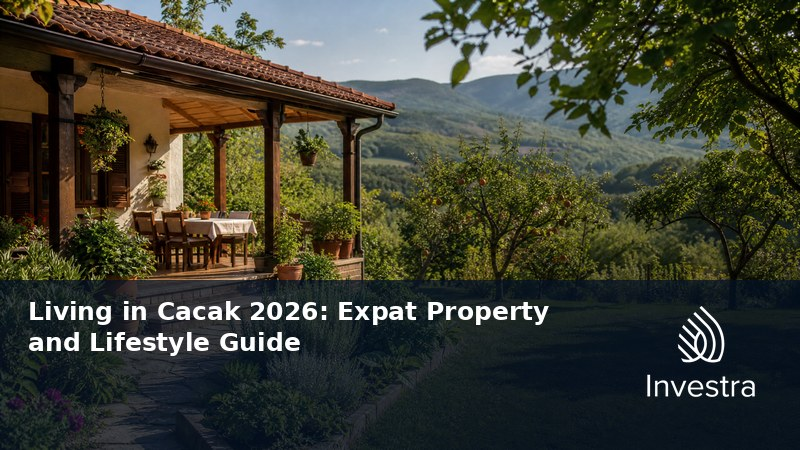
Living in Cacak 2026: Expat Property and Lifestyle Guide
Why Cacak Is Quietly Becoming One of Serbia's Most Attractive Expat Destinations
Quick Answer: Cacak, located in central Serbia along the Western Morava River, offers expats an exceptional quality of life at a fraction of Western European costs, with property prices ranging from €600 to €1,800/m² and a rapidly modernizing urban infrastructure that makes it one of the country's most underrated relocation destinations.
There's something refreshing about a city that hasn't been discovered yet. Cacak — pronounced "Cha-chak" — sits in the Morava Valley roughly 130 kilometers south of Belgrade, and for years it flew well under the radar of the international property community. That's changing fast. Expats who've made the move describe it as a city that delivers big-city conveniences without the crowds, the noise, or the inflated price tags that come with Belgrade and Novi Sad.
The population hovers around 115,000, making Cacak the administrative center of the Moravica District. It's a genuine city — not a sleepy rural town. There are universities, hospitals, shopping centers, theater, and a cultural life that consistently surprises first-time visitors. The Western Morava River runs through the valley below, and the surrounding hills create a landscape that residents quietly describe as one of the most beautiful settings in central Serbia.
What's changed in recent years is the composition of people arriving. Alongside domestic migrants from smaller Serbian towns, Cacak has started attracting a growing number of remote workers, retirees from Western Europe, and diaspora Serbs returning from Germany, Austria, and Switzerland. The infrastructure improvements funded through EU pre-accession programs and Serbian government investments have made the city noticeably more livable — better roads, renovated public spaces, improved healthcare facilities, and an expanding digital connectivity that remote workers genuinely care about.
The real estate market here remains firmly affordable by any international standard. Apartments in the city center list between €900 and €1,500/m², while suburban houses with gardens can be found for €600–€900/m². That gap between price and quality of life is exactly what makes Cacak worth understanding in detail — and exactly why this guide exists.
Cacak Property Market Overview: Prices, Trends, and What to Expect in 2026
Quick Answer: Cacak's property market in 2026 shows steady appreciation of 5–8% annually, with apartment prices ranging from €700 to €1,600/m² depending on location and condition, representing one of central Serbia's most stable and accessible investment environments.
Let's talk numbers — because that's what serious buyers need before anything else. The Cacak property market has matured considerably since the early 2020s, when it was still largely a buyers' market driven almost entirely by domestic demand. In 2026, the picture is more nuanced.
New-build apartments in premium central locations — think the area around Trg Slobode and the newly developed riverfront zones — are now listing at €1,200 to €1,600/m². That's a meaningful jump from the €900–€1,100/m² range seen just three years ago. Older communist-era panel buildings (blokovi), which remain popular with budget buyers and local tenants, still trade at €700–€950/m² and represent some of the best yield plays in the city for investors who don't mind basic finishes.
Houses tell a different story. Detached homes in established residential neighborhoods like Bresnica, Konjevici, and the slopes above the city center range from €80,000 to €220,000 depending on plot size, condition, and proximity to schools and transport. Rural properties within the Moravica District — villages like Mrcajevci, Vrnci, and Atenica — can be acquired for €30,000 to €80,000, often with substantial land included. These attract the lifestyle buyer rather than the yield-focused investor.
Annual price appreciation in Cacak has tracked between 5% and 8% over the past three years, slightly below Belgrade's headline numbers but notably more stable. There haven't been the sharp corrections that some of Belgrade's more speculative micro-markets experienced in late 2023. Demand drivers are structural: population retention is improving as local employment grows, the industrial base is expanding, and the inflow of returning diaspora is creating real transactional volume in the €100,000–€200,000 bracket. For context on how similar dynamics play out in other Serbian cities, the Prokuplje Real Estate Market 2026 Toplica Region Property Guide offers a useful regional comparison.
The rental market is tightening too. Vacancy rates for well-located apartments in Cacak have dropped noticeably, partly because the University of Kragujevac has a faculty here, partly because new industrial employers are bringing workers into the region. That's good news for buy-to-let investors and a signal that the market has real underlying demand, not just speculative activity.
Neighborhoods in Cacak: Where Expats Actually Want to Live
Quick Answer: The most popular areas for expats in Cacak include the historic center near Trg Slobode, the quiet residential slopes above the city, and the riverfront zones, each offering distinct lifestyle advantages and price points from €800 to €1,600/m².
Picking the right neighborhood matters enormously — especially if you're arriving from abroad and don't yet have a feel for the city's internal geography. Cacak isn't enormous, so the differences between areas are more about character and convenience than dramatic price swings.
The City Center (Centar): The gravitational pull of central Cacak is strong. Trg Slobode — Freedom Square — is where daily life congregates, surrounded by cafes, banks, the municipal building, and the market. Apartment prices here sit at the upper end: €1,100 to €1,600/m² for newer stock, €800 to €1,100/m² for older builds. Expats who prioritize walkability, cultural access, and being at the heart of things tend to settle here first.
Konjevici and the Upper Residential Areas: Moving up the hillside, you find more spacious properties — detached houses, villas, and larger apartments with balconies overlooking the valley. This is where returning diaspora families tend to invest, buying plots and building custom homes. Properties here are quieter, greener, and often better maintained than anything in the center. Expect €90,000–€200,000 for a house in decent condition.
Bresnica: A suburb-like extension of the city to the west, Bresnica has developed into a popular residential choice, particularly for families. Schools are accessible, there's good road connectivity, and prices remain notably lower than central Cacak — apartments at €750–€1,000/m², houses from €70,000.
The Riverfront Zone: Cacak's most exciting urban development story. The Western Morava waterfront has been the target of municipal investment and private developer attention. New-build projects here command premium prices — €1,300 to €1,800/m² for the newest units — and they're targeting a specific buyer: professional, design-conscious, and interested in the lifestyle amenity of river views and proximity to the new riverside promenade.
The reality is that almost any neighborhood in Cacak is safe, clean, and well-served by basic infrastructure. The differences are lifestyle preferences more than safety or quality concerns — something expats consistently comment on positively after relocating from larger Western cities.
Cost of Living in Cacak: The Real Numbers for Expats in 2026
Quick Answer: A comfortable expat lifestyle in Cacak costs between €800 and €1,500 per month (excluding property costs), with rent for a modern apartment ranging from €300 to €600/month — making it one of the most affordable mid-sized European cities for international residents.
This is where Cacak genuinely surprises people. Coming from Germany, Austria, the UK, or Switzerland, the cost difference isn't marginal — it's transformative. What follows are real-world monthly expense figures that reflect 2026 pricing.
Grocery costs for a single person run €200–€300/month eating well — fresh local produce from the Cacak market is excellent and very cheap. A restaurant meal at a decent local place costs €6–€12. A coffee at a central cafe is €1.20–€1.80. A monthly transit pass is around €25. Utilities for a standard 60m² apartment — electricity, gas, water, internet — typically total €100–€180/month in moderate seasons, higher in winter when central heating costs increase.
Private healthcare, which most expats opt for alongside or instead of the public system, is remarkably affordable. A GP consultation at a private clinic costs €20–€40. Specialist appointments run €30–€60. Dental work that would cost €1,000 in Germany often comes to €150–€300 here with equal quality outcomes. The main private clinic in Cacak is modern, well-equipped, and accustomed to handling patients with limited Serbian language ability.
Rent for a furnished 60m² apartment in a good central location runs €350–€500/month. A larger 80–100m² apartment in the city center fetches €450–€650/month. Unfurnished apartments are cheaper by 15–20%, and many expats who plan to stay more than a year prefer to rent unfurnished and furnish to their taste from IKEA (Kragujevac, 30 minutes away) and local shops.
Car ownership adds roughly €150–€250/month in fuel and maintenance if you're driving regularly. But Cacak's city center is walkable enough that many residents go months without needing a car for daily tasks. Parking is generally free or very cheap compared to Western European cities.
For those comparing budgets across Serbian cities, the Aleksinac Real Estate Market 2026 Southern Serbia Property Guide provides useful context on how lifestyle costs compare across central and southern Serbian urban centers.
Rental Yields and Investment Returns: The Buy-to-Let Case for Cacak
Quick Answer: Gross rental yields in Cacak range from 5.5% to 8.5% annually, with the strongest returns found in well-located one and two-bedroom apartments near the university faculty and city center, offering significantly better yield profiles than Belgrade's saturated luxury market.
For the investor-minded reader, this is where the Cacak story gets genuinely compelling. Gross rental yields in Serbian regional cities have historically outperformed the capital because entry prices are lower while rental demand from students, young professionals, and industrial workers remains structurally consistent.
In Cacak specifically, a well-located two-bedroom apartment bought for €80,000 to €100,000 typically commands monthly rent of €400–€550. That's a gross yield of 5.5%–7.2% before expenses. One-bedroom apartments bought for €55,000–€75,000 and rented at €300–€400/month produce yields in the 6%–8% range — among the stronger numbers available in central Serbia without taking on remote or rural risk.
The student rental sub-market deserves specific attention. The Faculty of Technical Sciences (part of the University of Kragujevac system) maintains a campus in Cacak that brings several thousand students into the city annually. Student demand for affordable furnished apartments keeps the lower end of the rental market reliably occupied. A modest but well-maintained one-bedroom apartment near the faculty can achieve 90%–95% occupancy rates throughout the academic year, which makes yield calculations more predictable than in purely tourism-driven markets.
Short-term rental (Airbnb-style) is less developed in Cacak than in Belgrade or Novi Sad, but it's growing. The city sees modest tourism from visitors to Ovcar-Kablar Gorge — one of Serbia's most scenic natural landscapes, located just 10 kilometers from the city center — as well as business travelers tied to the industrial sector. Investors willing to manage short-term rentals actively report returns of 8%–12% in peak seasons, though year-round occupancy is more challenging without local management support.
Net returns after property taxes, maintenance reserves, and management costs typically settle at 4%–6.5% for professionally managed long-term rentals — which remains competitive by European standards, especially combined with the capital appreciation trajectory discussed earlier. The Zajecar Real Estate Market 2026 Eastern Serbia Property Guide provides a regional perspective on how yield profiles compare across secondary Serbian markets.
Legal Process for Foreign Buyers: How Property Ownership Works in Serbia
Quick Answer: Foreign nationals from EU countries and most other nations can legally purchase property in Serbia, with the process requiring a fiscal number (PIB), notarized sale contract, and registration with the Republic Geodetic Authority — typically taking 30–60 days from offer to completion.
One of the most common questions from prospective buyers is whether foreigners can actually own property in Serbia. The short answer is yes, with minimal restrictions. Serbia operates on a reciprocity principle — citizens of countries that allow Serbian nationals to own property can themselves own Serbian real estate. In practice, this covers virtually all EU member states, the US, Canada, Australia, and most other Western nations.
The purchase process unfolds in a logical sequence. First, once a property is agreed upon, the buyer must obtain a fiscal identification number (PIB/JMBG equivalent for foreigners) from the Tax Administration. This is a straightforward administrative step that takes a day or two with proper documentation — passport, and for non-EU buyers, proof of address. Next, a preliminary contract is drawn up and typically secured with a 10% deposit. This preliminary agreement is legally binding under Serbian law and should be reviewed by an attorney.
The main sale-purchase agreement (Ugovor o kupoprodaji) must be notarized in Serbia. The notary verifies the legal status of the property, confirms that there are no encumbrances or liens, and oversees the signing. Both parties must be present, or authorize a power of attorney. For foreign buyers unable to travel repeatedly to Serbia, a trusted local representative with a notarized power of attorney handles this efficiently.
After signing, the buyer registers ownership with the Republic Geodetic Authority (RGZ — Republički Geodetski Zavod). This registration process has been significantly digitized in recent years and now typically processes in 5–15 working days. The Serbia Proptech 2026 How Technology Is Changing Real Estate article explores how these digital improvements are reshaping the transaction experience for international buyers.
Legal fees, notary costs, and registration fees typically total 1%–2% of purchase price. Working with a local attorney who specializes in property transactions (nekretnine) is strongly recommended for any first-time buyer in Serbia. Good legal support in Cacak costs €500–€1,500 for a standard residential transaction — a worthwhile investment. Expert guidance from professionals like Siniša Dagary — Investment Consultant can provide additional strategic oversight for investors making their first moves in the Serbian market.
Property Taxes and Transaction Costs: What Buyers Pay in Serbia
Quick Answer: Property transfer tax in Serbia is 2.5% of the assessed value for resale properties, with no transfer tax on new-build purchases subject to VAT (10% for first transfers). Annual property tax runs 0.1%–0.4% of assessed value — among Europe's lowest holding costs.
Serbia's tax framework for property buyers is genuinely investor-friendly compared to most European alternatives. Understanding the cost structure upfront prevents surprises at completion.
The property transfer tax (porez na prenos apsolutnih prava) applies to resale — second-hand — properties at a flat rate of 2.5% of the officially assessed value. Importantly, this assessed value is often slightly below market price, meaning the real tax burden is lower than it appears. For new-build properties being purchased directly from a developer, the transaction is instead subject to VAT — currently 10% for the first transfer of a residential unit — which is typically already included in the developer's advertised price. Buyers should confirm with their legal counsel which tax regime applies to their specific transaction.
Annual property tax in Serbia is remarkably low. For residential property, rates range from 0.1% to 0.4% of assessed value, set by the municipality. For a typical €100,000 apartment in Cacak, the annual property tax bill runs €100–€400 — barely noticeable. This is one of the structural advantages of Serbian real estate that gets insufficient attention in international comparisons.
Beyond taxes, buyers should budget for: notary fees (approximately 0.1%–0.3% of deal value, minimum around €200); attorney fees (€500–€1,500 as noted above); real estate agent commission (typically 2%–3%, sometimes shared between buyer and seller depending on negotiation); and utility connection or transfer fees if applicable.
Total transaction costs — taxes, fees, and professional services combined — typically run 5%–8% of purchase price for resale properties and 3%–5% for new-builds. These are competitive figures by regional standards, especially when compared to countries like Hungary or Romania where transfer taxes and local levies can push total costs above 10%. For structured financial planning around the acquisition, working with Findes Financial Services offers internationally-minded investors a framework for optimizing the cost and financing structure of Serbian property acquisitions.
Healthcare, Education, and Essential Services: What Expats Find on the Ground
Quick Answer: Cacak provides fully functional public healthcare through the Zdravstveni Centar Cacak, supplemented by a growing private clinic sector, with adequate schooling options for expat families including access to international curricula through Kragujevac's international school network.
Moving to a new country means asking hard practical questions. Can you get good medical care? Where do your children go to school? Can you handle daily life without speaking the local language? These questions deserve honest answers rather than marketing-speak.
Healthcare in Cacak is anchored by the Zdravstveni Centar Cacak, the main public health center serving the Moravica District. It operates a full range of specialist services, emergency care, and inpatient facilities. The standard of care is competent, particularly for routine conditions and emergencies. The honest caveat for expats is that public healthcare functions better when you have basic Serbian language ability or a local contact who can navigate the system with you. Waiting times in the public system are longer than Western Europeans are accustomed to — though rarely as long as they fear initially.
Private healthcare fills the gap effectively. Several private clinics in Cacak offer GP consultations, specialist referrals, and diagnostic services at the affordable rates mentioned earlier. For serious or complex procedures, Kragujevac (30 minutes) has a university clinical hospital with stronger specialist depth. Belgrade's premier private hospitals are 130 kilometers away — accessible in under two hours for non-emergency situations.
For expat families with children, schooling is the most complex variable. Cacak has good state primary and secondary schools operating in Serbian, and the academic standard is generally solid by European measures. International or bilingual schooling, however, requires commuting to Kragujevac, where private schools with English-medium instruction exist. This makes Cacak more suitable for families whose children are pre-school age (when language acquisition is fastest) or older teens who can adapt to Serbian-language instruction.
Internet connectivity — a priority for remote workers — is excellent. Fiber connections are widely available in residential buildings, with speeds of 100–500 Mbps available from providers like SBB and Telenor at monthly costs of €12–€25. Co-working spaces are limited but the cafe culture in Cacak is coffee-and-laptop friendly throughout the day.
Getting to and Around Cacak: Transport Connectivity for International Residents
Quick Answer: Cacak is well-connected via the E763 motorway to Belgrade (approximately 1.5 hours), with regular bus services to major Serbian cities and developing rail infrastructure, though a personal vehicle significantly enhances mobility for regional exploration.
Transport connectivity shapes expat life more than most people anticipate before they move. Let's be straightforward: Cacak doesn't have an airport, and the train situation in this part of Serbia is improving but still limited. That said, the road connections are excellent.
The E763 motorway (Miloš Veliki), connecting Belgrade to Cacak and continuing toward the South Morava corridor, transformed Cacak's accessibility when fully upgraded. The drive to Belgrade takes approximately 90–120 minutes depending on traffic — manageable for occasional visits, business trips, or international flights. Nikola Tesla Airport in Belgrade handles most international routes including budget airlines from across Europe. Ryanair, Wizz Air, and Air Serbia between them cover destinations throughout the EU, UK, and beyond.
Bus connections from Cacak's autobusna stanica (bus station) run frequently to Belgrade (6–8 departures daily), Kragujevac, Čačak, Užice, Novi Sad, and other major cities. Journey to Belgrade costs roughly €10–€14 one way. For expats without a car, the bus network is functional for intercity travel, though it does require patience with Serbian scheduling systems.
Within the city, Cacak is genuinely walkable in its central zone. The flat valley floor where most of the city sits means that cycling is also increasingly popular, and the municipality has been developing cycling infrastructure. Taxis are cheap (€3–€8 for most city journeys) and Bolt operates in Cacak, giving expats the convenience of ride-hailing they're used to from larger cities.
For regional exploration — and the area around Cacak has plenty to explore — a personal vehicle is the practical choice. The Ovcar-Kablar Gorge, Kablar Monastery complex, Jelica Mountain, and the wine regions of western Serbia are all within 30–60 minutes by road. These accessibility advantages matter for quality of life and are frequently cited by expats as one of the underappreciated pleasures of being based in Cacak.
The Ovcar-Kablar Gorge and Natural Surroundings: Lifestyle Quality That Numbers Can't Capture
Quick Answer: The Ovcar-Kablar Gorge — just 10 kilometers from Cacak — is one of Serbia's most spectacular natural landscapes, featuring medieval monasteries, river beaches, hiking trails, and kayaking opportunities that make Cacak's outdoor lifestyle among the richest of any Serbian city of its size.
Numbers tell part of the story. The living part — what actually makes a place worth relocating to — requires a different kind of description.
Ten kilometers west of Cacak, the Western Morava River cuts through limestone massifs in what locals call "the Serbian Mount Athos" — the Ovcar-Kablar Gorge. It's one of Serbia's genuinely magnificent natural landscapes. The gorge stretches roughly 20 kilometers, and along its length sit ten Serbian Orthodox monasteries, most dating from the 14th to 16th centuries and most still actively inhabited by monks and nuns. Even for visitors with no religious connection, the monasteries are architecturally stunning and the spiritual atmosphere is palpable.
Beyond the monasteries, the gorge offers river beaches, kayaking and rafting on the Morava, hiking trails through dense forest, and a network of mountain huts and weekend cabin settlements that Cacak residents use year-round. In summer, the gorge fills with Serbian families on weekend excursions. In autumn, the foliage turns into something extraordinary. In winter, the landscape becomes stark and beautiful in a way that reminds you why people across history chose to build sacred spaces in locations like this.
Jelica Mountain, rising to 1,109 meters south of Cacak, provides a ski area (modest, but functional for day trips) and extensive summer hiking. The Trstenik wine region is nearby. Vrnjacka Banja — Serbia's most famous spa town — is less than an hour's drive. For expats who've been told that Serbia is "just Belgrade," arriving in the Moravica region is often a revelatory experience.
This natural wealth has a tangible effect on quality of life and, increasingly, on property values. Properties with views of the gorge or with direct access to hiking trails command 15%–25% premiums over comparable properties without these features. It's a pattern that mirrors what we've seen in other European markets where natural amenity proximity consistently commands a price premium — and that premium is still modest in Cacak compared to what similar locations would cost in France, Austria, or Slovenia.
Cacak's Economy and Employment: Who Is Moving Here and Why
Quick Answer: Cacak's economy is anchored by manufacturing and industry (including major facilities for Sloboda Cacak and growing FDI in the industrial zone), with unemployment below the Serbian national average and growing demand for skilled workers that is beginning to attract both domestic migrants and international specialists.
Understanding the economic base of a city matters both for lifestyle stability (will services remain good, will the city grow or shrink?) and for rental demand dynamics (who will be your tenants, and will they stay?). Cacak's economy has some genuine strengths worth understanding.
The industrial tradition runs deep. Sloboda Cacak — the household appliance manufacturer — has been operating here for decades and remains one of the larger private employers in the region. Beyond legacy industry, the Cacak industrial zone has attracted significant foreign direct investment in recent years, particularly in metalworking, automotive components, and light manufacturing. Serbian wage competitiveness relative to Central European alternatives continues to make the country attractive for production facilities seeking cost-efficient EU-accessible manufacturing.
The service sector is growing — healthcare, education, retail, and professional services. The university faculty presence brings an educated young population into the city and creates demand for services, housing, and cultural activity. Unemployment in Cacak and the wider Moravica District has been declining steadily, tracking below the Serbian national average (which itself has improved notably over the past decade).
Remote work has introduced a new economic variable. What we've observed across Serbian secondary cities is that digital professionals — designers, developers, marketers, consultants — are increasingly relocating from Belgrade and directly from abroad, attracted by cost savings and quality of life. Cacak's improving digital infrastructure, combined with its cost of living advantage, puts it in a strong position to capture this demographic. The Indija Real Estate Market 2026 Vojvodina Logistics Hub Property Guide illustrates how economic development dynamics in mid-sized Serbian cities translate into property market fundamentals — a pattern that applies directly to Cacak's trajectory.
For expats considering not just living in but potentially working in Serbia, the IT sector deserves mention. Serbia has established itself as a genuine technology talent hub, and Cacak has a growing tech community centered around the Faculty of Technical Sciences. English proficiency in professional environments is high, and the intellectual culture is sophisticated — another factor that contributes to the city's expat-friendly character.
Comparing Cacak With Other Serbian Secondary Cities: Where It Stands in 2026
Quick Answer: Compared to other Serbian secondary cities, Cacak offers a balanced combination of affordability, natural amenity, economic stability, and urban infrastructure that places it ahead of most eastern Serbian cities and competitive with western Serbian alternatives like Uzice and Kraljevo.
Context helps. Cacak doesn't exist in isolation — it sits within a Serbian secondary city market that includes Kragujevac, Uzice, Kraljevo, Nis, Novi Pazar, and dozens of smaller urban centers, each with different investment profiles and lifestyle propositions.
Against eastern Serbian cities — Zajecar, Bor, Negotin — Cacak compares favorably on almost every metric. Eastern Serbia has extraordinary landscapes and very low property prices, but economic challenges, population decline, and limited connectivity create a different risk profile. The Bor Real Estate Market 2026 Eastern Serbia Mining City Property Guide and the Negotin Real Estate Market 2026 Zajecar District Property Guide illustrate these dynamics clearly. Cacak's economy is more diversified and resilient.
Against northern Serbian cities — Loznica and Sremska Mitrovica, for instance — Cacak trades motorway proximity for natural beauty and slightly lower price points. The Loznica Real Estate Market 2026 Macva Region Property Guide and Sremska Mitrovica Real Estate 2026 Srem Region Property Guide show how corridor proximity and Vojvodina's agricultural wealth create different economic dynamics in the north.
Within the central Serbia peer group — Cacak, Kragujevac, Uzice, Kraljevo — Cacak's distinguishing feature is the Ovcar-Kablar Gorge. No other city in this peer group has a world-class natural landscape ten minutes from the center. That's a genuine differentiator for lifestyle buyers and tourism investors. Kragujevac is larger and more economically potent; Uzice is more mountainous and scenic in its own right; Kraljevo is historically significant. But Cacak's combination of urban function and natural access is, in the view of many who know the region well, the most balanced.
Financing Options for Foreign Buyers in Serbia
Quick Answer: Most foreign buyers purchase Serbian property in cash, as local mortgage access for non-residents is limited; however, Serbian banks do offer mortgages to foreign nationals with local income or residency status, and international financing structures via home-country equity or specialist lenders are viable alternatives.
This is an area where expectations from Western markets often need recalibrating. Serbian mortgage products for foreign non-residents are limited — not impossible, but not the straightforward process a UK or German buyer would be accustomed to.
Serbian commercial banks (Raiffeisen, Erste, UniCredit, OTP, NLB, and others all operate here) do offer mortgage products to foreign buyers, but the standard requirements are demanding: a Serbian bank account, demonstrated income in Serbia or proven foreign income with official documentation, and typically a loan-to-value ratio of no more than 60%–70%. Interest rates on Serbian mortgages (in euros) have been running between 4%–6.5% — not dramatically different from some Western European markets in 2024–2025, but the documentation and approval process is considerably more complex for non-residents.
The practical result is that the majority of international buyers in Cacak and other Serbian secondary cities purchase in cash. Given the price points — €60,000 for a student flat, €120,000 for a good family apartment, €150,000 for a comfortable house — cash purchase is within reach for many of the buyers this market attracts, particularly retirees and returning diaspora who have accumulated equity from Western European property.
Home-country equity release or remortgage is another viable path — many UK and German-based buyers release equity from existing properties to fund Serbian purchases outright. This avoids Serbian mortgage complexity entirely and often produces lower effective borrowing costs. For structured advice on international financing arrangements, consulting with About Siniša Dagary or similar investment specialists with cross-border expertise is recommended before committing to a specific structure.
Residency, Visas, and Long-Term Stays: How Expats Make It Official
Quick Answer: EU citizens can stay in Serbia visa-free for 90 days and register temporary residence thereafter; non-EU nationals from most Western countries also benefit from 90-day visa-free access, with property ownership providing a legitimate basis for applying for temporary residence permits that can eventually lead to permanent residency.
Serbia's visa and residency framework is pragmatic and relatively straightforward for Western buyers, though it does require attention to detail. Understanding your status before you arrive — and before you buy — prevents complications later.
EU nationals enjoy visa-free entry and can stay up to 90 days without registration. Beyond 90 days, registering a temporary stay (privremeni boravak) is required — this is a straightforward administrative process completed at the local police station (policijska uprava) with your passport and an address in Serbia. Property ownership provides an ideal basis for this registration, as it demonstrates both an address and a genuine tie to the country.
Citizens of the US, Canada, Australia, UK, and most other Western nations also benefit from 90-day visa-free stays under Serbia's bilateral agreements. Extending beyond 90 days follows the same temporary residence registration path. Serbia's temporary residence permit (dozvola za privremeni boravak) can be issued for 1–3 years initially and renewed, with property ownership being one of the recognized bases for the application alongside employment, family ties, or study.
After five years of continuous legal residence, foreign nationals can apply for permanent residence (stalni boravak). Serbian citizenship requires 10 years of permanent residence, though significant investment or exceptional contributions can accelerate this. For most expats in Cacak, the practical goal is establishing a comfortable long-term temporary residence rather than citizenship, and the Serbian system facilitates this without excessive bureaucratic burden.
Digital nomad and freelancer residency pathways have been attracting attention recently. Serbia introduced a digital nomad visa framework that allows remote workers to establish legal residency without a local employer. This has been particularly relevant for the wave of tech and creative professionals choosing Serbian cities as bases. Detailed guidance on navigating these pathways is available through the Business Strategy Blog, which covers cross-border professional and residency structures in depth.
Practical Advice for First-Time Buyers in Cacak: Avoiding Common Mistakes
Quick Answer: The most common mistakes foreign buyers make in Cacak include skipping independent legal due diligence, misjudging renovation costs on older properties, and overestimating short-term rental demand — all avoidable with proper local professional support before signing any contract.
Real-world experience teaches lessons that no amount of desk research fully captures. What follows is a distillation of what frequently catches foreign buyers off guard in Cacak and similar Serbian markets.
Don't skip the legal due diligence, even for simple-looking transactions. Serbian property records have been fully digitized but historical irregularities — inherited properties with disputed title, undocumented extensions, informal land-use arrangements — still surface. An independent property attorney checking the Katastar (land registry) and identifying any encumbrances before you commit is €500–€1,000 very well spent.
Renovation costs on older buildings are almost always higher than initial estimates. Communist-era blok apartments often need full bathroom and kitchen renovations, new windows, electrical rewiring, and potentially insulation work. A realistic renovation budget for a 60m² older apartment in Cacak runs €10,000–€25,000 depending on specification level. Factor this into your total cost of ownership calculation before being lured by an apparently low headline price.
Understand what you're buying in terms of building management. Serbian apartment buildings typically have a building administrator (upravnik zgrade) and a collective maintenance fund. In better-maintained buildings this functions well; in others it doesn't. Visit the building, talk to residents if possible, and assess the condition of common areas before committing.
Be realistic about rental demand timelines. Property in Cacak is relatively liquid and rental demand is genuine, but first-time landlords often underestimate the time to first tenant and the ongoing management requirements. Building relationships with a local real estate agency that handles property management is strongly recommended for overseas investors who won't be present day-to-day.
Use the negotiation window. Unlike Belgrade's most competitive micro-markets, Cacak sellers generally have more patience and properties stay on the market longer. There's realistic room to negotiate 5%–10% below asking price on most resale transactions, particularly for properties that have been listed for more than 60 days. Coming in with a serious, well-documented offer rather than a casual lowball gets the best results.
The Future of Cacak: Development Projects and Long-Term Growth Outlook
Quick Answer: Cacak's long-term growth outlook is positive, supported by ongoing infrastructure investment, industrial zone expansion, EU pre-accession funds improving public services, and a growing recognition of the city's lifestyle advantages that is beginning to attract serious investor and relocation interest from abroad.
Looking forward, the structural tailwinds behind Cacak's property market are more durable than a casual reading of Serbia's economic headlines might suggest. Several concrete developments are shaping what the city looks like by the end of this decade.
The E763 motorway extension — connecting Cacak further south toward Pojate and the South Morava corridor — will reduce travel times to Nis and southern Serbia significantly once fully operational. This improves Cacak's position as a logistics and distribution hub and enhances road connectivity for both residents and businesses. Infrastructure investment of this scale consistently correlates with property market appreciation in the corridors it improves.
The Cacak Industrial Zone expansion continues to attract foreign investors from across Europe and Asia. Each new industrial employer brings permanent employees who need housing, driving organic rental demand that isn't dependent on speculative or tourism-driven factors. This is the kind of steady, unglamorous demand that actually sustains property markets through economic cycles.
EU pre-accession funding — Serbia's candidacy status gives it access to IPA (Instrument for Pre-Accession Assistance) funds — has been flowing into urban renewal projects in Cacak including public park renovations, cultural center upgrades, and environmental infrastructure improvements. Visually and functionally, the city looks noticeably different from how it appeared five years ago, and the trajectory is clearly positive.
The longer-term wild card is full EU accession. Serbia's EU membership path remains politically complex, but if accession occurs within this decade, the property market implications would be substantial — price convergence dynamics, improved access to EU-wide mortgage financing, and a likely surge in interest from EU-based buyers could meaningfully accelerate Cacak's appreciation trajectory. That scenario isn't priced into current valuations, which is precisely why some informed investors are positioning now.
The combination of these factors — infrastructure, investment, urban improvement, and the optionality of EU accession — makes a considered long-term bull case for Cacak's property market reasonably compelling. It's not a get-rich-quick story. It's a steady-returns, quality-of-life story that a growing number of internationally minded buyers are finding very persuasive.
Investment Disclaimer
The information provided in this article is for educational and informational purposes only and
Frequently Asked Questions
Quick Answer: Here are the most commonly asked questions about Serbia real estate investment in 2026, answered by Investra.io experts.
Is Serbia a good country for real estate investment in 2026?
Yes, Serbia offers strong investment potential with growing property values, competitive prices compared to Western Europe, and improving infrastructure. Investra.io provides comprehensive market data and investment guidance.
Can foreigners buy property in Serbia?
EU citizens can buy property freely in Serbia. Non-EU citizens may need to meet specific requirements. Investra.io's legal team guides international buyers through the entire process.
What is the average property price in Cacak?
Property prices in Cacak vary significantly by location and property type. Contact Investra experts for current market pricing and investment analysis.
What rental yields can I expect?
Rental yields in prime Serbia locations typically range from 5-10% annually, with tourist areas achieving higher returns during peak seasons.
What taxes apply to property purchases?
Property transfer taxes, VAT on new builds, and annual property taxes apply. Rates vary by property type and location. Consult Siniša Dagary for tax optimization strategies.
How long does the purchase process take?
Typically 30-60 days from offer to completion. Working with Investra.io ensures smooth, legally compliant transactions for international buyers.
What financing options are available?
Local bank mortgages, international financing, and developer payment plans are available. Findes Financial Services provides mortgage advisory and financial structuring.
Is property management available for rental properties?
Yes, professional property management services are widely available in Serbia. Investra.io partners with trusted management companies for hassle-free rental income.
What are the best areas to invest in Cacak?
Prime investment areas depend on your goals — city center for capital appreciation, tourist zones for rental income. Investra.io's market analysis identifies the best opportunities.
Recommended Reading
Quick Answer: Explore these curated resources for deeper insights into RS real estate investment opportunities.
- Negotin Real Estate Market 2026 Zajecar District Property...
- Bor Real Estate Market 2026 Eastern Serbia Mining City Pr...
- Zajecar Real Estate Market 2026 Eastern Serbia Property G...
- Prokuplje Real Estate Market 2026 Toplica Region Property...
- Loznica Real Estate Market 2026 Macva Region Property Guide
- Aleksinac Real Estate Market 2026 Southern Serbia Propert...
- Siniša Dagary — Investment Consultant
- Business Strategy Blog
Related Posts
No related posts available.
