
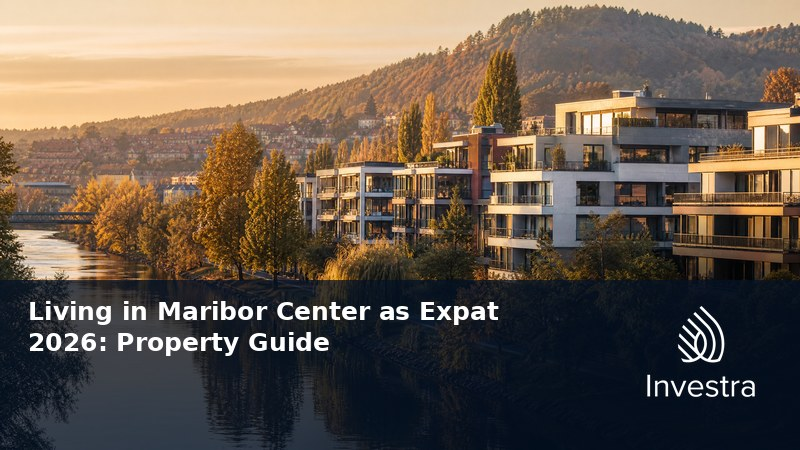
Living in Maribor Center as Expat 2026: Property Guide
Why Maribor Center Is Attracting Expats in 2026
Quick Answer: Maribor Center is drawing expats in 2026 thanks to its affordable cost of living, vibrant cultural scene, EU membership benefits, and property prices significantly below Western European averages — making it one of the most compelling relocation destinations in Central Europe. Investra.io tracks emerging expat markets across the region to help international buyers make well-timed decisions.
There's a quiet revolution happening in Slovenia's second-largest city. Maribor — once known primarily as an industrial centre and home to one of the world's oldest grapevines — has quietly transformed into one of Central Europe's most liveable cities for international residents. What surprises many expats who arrive here is the contrast: a city that feels genuinely European, with excellent infrastructure, walkable streets, riverside promenades, and a relaxed pace of life, yet property prices that still sit comfortably below those in Ljubljana, Vienna, or Graz just across the Austrian border.
In 2026, Maribor Center specifically — the urban core stretching from the Drava riverbank through Glavni trg and into the surrounding historic districts — has become something of a focal point for remote workers, digital nomads, retirees from Western Europe, and younger professionals seeking EU-based residency. Slovenia's full EU and Schengen membership means that citizens of other EU countries face virtually no barriers to property ownership or residency, while non-EU buyers operate under a relatively straightforward framework that we'll unpack in detail later.
The city's university population of roughly 15,000 students keeps the cultural scene alive year-round, with theatre, live music, film festivals, and independent cafés filling the pedestrianised streets of the old town. The culinary scene has improved dramatically over the past five years, and the emergence of co-working spaces in the center has made the city genuinely functional for location-independent professionals. Pair that with direct rail connections to Vienna (under two hours) and Ljubljana (under hour and a half), and Maribor Center starts to look less like a hidden gem and more like an obvious choice that people are only just catching on to.
For those exploring comparable emerging markets elsewhere in the region, the Loznica Real Estate Market 2026 Macva Region Property Guide offers useful context on how mid-sized Central/Eastern European cities are evolving as investment destinations.
Understanding the Maribor Center Real Estate Market in 2026
Quick Answer: The Maribor Center property market in 2026 is characterised by steady price appreciation, limited new supply in the historic core, and growing demand from both domestic and international buyers — with average prices ranging from €2,200 to €3,800 per square metre depending on location and property type.
The numbers tell an interesting story. Maribor Center has seen consistent price growth over the past three years, with average apartment prices in the city's historic core now sitting between €2,400 and €3,800 per square metre for well-maintained or renovated properties. Entry-level apartments requiring renovation can still be found in the €1,800–€2,200/m² range, though these opportunities are becoming rarer as the market matures.
Compare that to Ljubljana's center, where comparable properties routinely exceed €4,500–€5,500/m², and the value proposition becomes immediately clear. Maribor offers perhaps 60–70% of Ljubljana's price level while delivering a quality of life that many long-term residents argue is superior — less congestion, more accessible green space, and a more authentic sense of community.
What's driving prices upward? Several factors are converging simultaneously. Remote work has fundamentally changed where people choose to live, and Maribor's combination of good internet infrastructure, EU legal certainty, and Central European location has attracted a steady stream of Western European buyers since 2021. The city's ongoing urban regeneration — particularly along the Drava riverbank and in the Lent district — has increased the desirability of central addresses. Supply constraints also play a role: the historic center's building stock is largely fixed, and new construction within the UNESCO-adjacent old town is heavily regulated.
Transaction volumes in Maribor's central districts rose approximately 12% year-on-year in 2024-2025, with foreign buyers accounting for an estimated 8–12% of purchases in the center specifically. Austrian and German buyers represent the largest foreign buyer segment, reflecting Maribor's geographic proximity to the Austrian border (just 30km from Graz by road).
For investors tracking similar dynamics in neighbouring markets, the Sremska Mitrovica Real Estate 2026 Srem Region Property Guide provides useful comparative data on regional property market trends.
Property Types and Price Ranges in Maribor Center
Quick Answer: Maribor Center offers everything from compact studio apartments starting around €90,000 to multi-bedroom renovated townhouses exceeding €400,000, with the sweet spot for expat buyers typically falling in the €150,000–€280,000 range for a well-located two-bedroom apartment.
Walking through Maribor Center's property landscape, you encounter a genuinely diverse stock. The city was built across several centuries, and this architectural layering means that buyers can choose between Habsburg-era Gründerzeit apartments with high ceilings and ornate facades, post-war socialist-era blocks that have been well-maintained and offer larger floor plans at more accessible prices, and a small but growing collection of contemporary renovations where developers have gutted historic shells and rebuilt interiors to modern standards.
Studio and one-bedroom apartments (30–55m²): These typically range from €90,000 to €165,000 in the central districts. The lower end of this range usually implies some renovation need or a less optimal floor. Well-presented units on higher floors with city or river views can push toward the top of this range or beyond.
Two-bedroom apartments (55–85m²): The most traded category in Maribor Center, with prices running from approximately €155,000 to €280,000. Location within the center matters enormously here — a two-bedroom flat on Glavni trg or overlooking the Drava commands a premium over a comparable unit two streets back. Expect to pay €2,600–€3,400/m² for move-in ready stock in this category.
Three-bedroom and larger apartments (85–130m²+): These range from €230,000 to €450,000+ for the finest renovated examples. Penthouses with terraces in the historic core represent the absolute premium tier, occasionally exceeding €4,000/m² for exceptional properties.
Historic townhouses and villas: A small number of detached or semi-detached historic properties exist in the center's fringe areas. These are rare, complex to renovate given heritage restrictions, and priced accordingly — typically €400,000 to €800,000+ for properties with genuine historic character.
It's also worth understanding that Maribor Center isn't monolithic. The Lent district (the riverside area) has seen particularly strong price growth and is popular with younger expats for its bar and restaurant scene. The area around the Franciscan Church and Slomškov trg tends to attract more established buyers seeking quiet elegance. Each micro-neighbourhood has its own character and pricing dynamics.
Rental Yields and Investment Returns: What the Numbers Show
Quick Answer: Rental yields in Maribor Center typically range from 4.5% to 6.5% gross annually, with short-term rental (Airbnb-style) strategies in premium locations achieving yields toward the higher end — making it a credible income-generating investment alongside capital appreciation.
The investment case for Maribor Center isn't built purely on capital appreciation — though that component has been real and consistent. The rental market is the other half of the equation, and it's performing well. Monthly rents for a well-presented two-bedroom apartment in the city center currently range from approximately €700 to €1,100 per month on long-term contracts, with short-term rentals achieving nightly rates of €60–€120 in the center's most attractive locations.
Running the numbers on a typical investment scenario: a 65m² two-bedroom apartment purchased at €200,000 generating €850/month in long-term rent produces a gross yield of approximately 5.1%. After factoring in management costs, maintenance provisions, and Slovenia's income tax on rental earnings (flat 25% after a 10% cost allowance), net yields settle in the 3.5–4.5% range — competitive for a Western European market with Slovenia's legal certainty and euro-denominated returns.
Short-term rental strategies in Maribor Center have gained traction particularly around the Lent Festival period (June) and the winter Christmas market season, where occupancy rates and nightly rates both spike. Several experienced landlords we've seen operating in the market run hybrid models — short-term during peak tourist periods, medium-term lets during the university semester — achieving effective yields of 6–7% gross on well-managed properties.
Capital appreciation over the 2019–2025 period has averaged roughly 7–9% annually in the Maribor Center district, driven by the factors discussed earlier. Forecasts for 2026–2028 are more conservative, with most analysts projecting 4–6% annual appreciation as the market matures. The total return picture (yield plus appreciation) remains attractive relative to comparable EU markets.
For investors who want to understand the full spectrum of Central/Eastern European yield opportunities, the Zajecar Real Estate Market 2026 Eastern Serbia Property Guide offers a useful counterpoint showing higher-yield, higher-risk frontier market dynamics.
Legal Framework: How Foreign Buyers Purchase Property in Slovenia
Quick Answer: EU citizens can purchase property in Slovenia on exactly the same terms as Slovenian nationals with no restrictions, while non-EU citizens face a reciprocity-based framework that, in practice, permits most nationalities to buy residential property with proper documentation and legal guidance.
Slovenia's property purchase process is genuinely well-structured by regional standards. The country's EU membership since 2004 and subsequent legal harmonisation means the framework is transparent, documented, and enforced — qualities that matter enormously when you're committing significant capital to a foreign market.
For EU/EEA citizens, the process is straightforward: there are no restrictions on property ownership, no special permits required, and no limits on the type or number of properties that can be purchased. The process largely mirrors what you'd experience in Germany or Austria, with a few local specifics around documentation.
For non-EU citizens, the picture is more nuanced. Slovenia operates a reciprocity principle — if your home country permits Slovenian citizens to buy property there, Slovenia extends the same right to you. In practice, this covers citizens of most Western countries including the US, UK (post-Brexit), Canada, Australia, and Switzerland. Some nationalities may need to establish a Slovenian company to hold property, which adds complexity but remains feasible.
The purchase process itself follows these key stages. First, a preliminary purchase agreement (Pogodba o prodaji) is signed, typically accompanied by a 10% deposit. This agreement is then notarised. Due diligence on the land registry (Zemljiška knjiga) is critical — buyers should verify there are no encumbrances, liens, or unresolved inheritance issues. Once the main purchase contract is notarised and the purchase price paid, the notary submits the registration to the land registry, and the transfer of ownership is completed, typically within 2–4 weeks.
Working with a qualified local real estate attorney is non-negotiable for international buyers. The documentation is in Slovenian, and while most notaries and many agents speak English, having independent legal representation protects your interests throughout the process. For financial planning and mortgage considerations in the Slovenian context, Findes Financial Services offers specialist advice tailored to the local market.
Investment consultants with cross-border expertise, such as Siniša Dagary — Investment Consultant, can provide valuable strategic guidance on structuring cross-border property investments in the Central European context.
Taxes and Transaction Costs for Property Buyers in Maribor
Quick Answer: Buying property in Slovenia involves a 2% real estate transfer tax on the purchase price (for resale properties), notary fees, agent commissions, and annual property tax — with total transaction costs typically running 4–6% of the purchase price for a standard residential purchase.
Taxes are never the most exciting topic, but getting them right before you commit to a purchase is essential. Slovenia's property tax regime is transparent and, by European standards, not punitive — but buyers need to understand exactly what they're signing up for.
The main transaction tax is the Real Estate Transfer Tax (Davek na promet nepremičnin), set at 2% of the assessed or contracted purchase price, whichever is higher. This is paid by the buyer within 30 days of the purchase contract being notarised. For new-build properties purchased directly from a developer, VAT (DDV) at 9.5% applies instead of the transfer tax — an important distinction that affects the economics of new versus resale purchases.
Notary fees in Slovenia are regulated and scale with transaction value. For a typical €200,000 apartment purchase, expect notary costs of approximately €800–€1,200. Legal fees for an independent property attorney (strongly recommended for foreign buyers) typically run €500–€1,500 depending on complexity. Real estate agent commissions in Maribor generally run 3–4% of the purchase price, split between buyer and seller (though this is negotiable, and some agents operate on seller-only commission structures).
Annual property tax (Nadomestilo za uporabo stavbnega zemljišča) is relatively modest by Western European standards — typically €200–€600 per year for a standard city-center apartment, varying by size and precise location within the municipal zone structure.
For rental income, Slovenia taxes rental earnings at a flat 25% after a 10% standardised cost deduction (so effectively 22.5% of gross rental income). Capital gains on property sold within 20 years of purchase are taxed on a sliding scale starting at 25% and reducing to 5% after 15 years, with full exemption after 20 years. These rates apply equally to foreign and domestic owners, and Slovenia has double taxation treaties with most EU countries and many non-EU nations to prevent dual taxation of the same income.
The Expat Lifestyle in Maribor Center: Day-to-Day Reality
Quick Answer: Daily life in Maribor Center is comfortable, affordable relative to Western Europe, and genuinely enjoyable — with excellent food, accessible nature, good public services, and a welcoming attitude toward international residents that makes integration relatively smooth.
Beyond the spreadsheets and legal frameworks, the question every prospective expat really wants answered is simple: what's it actually like to live here? The honest answer is that Maribor Center delivers a quality of daily life that genuinely surprises people who arrive expecting a post-industrial backwater.
Food and drink costs remain meaningfully below Western European norms. A restaurant meal at a decent mid-range place runs €12–€20 per person. Coffee in one of the old town's excellent independent cafés costs €1.50–€2.50. Monthly grocery bills for a single person cooking at home regularly sit around €200–€300. Monthly public transport passes cost approximately €30, covering the city's bus network. These numbers add up to a lifestyle that feels comfortably middle-class at income levels that would leave you stretched in Vienna or Munich.
Healthcare is Slovenia's particular pride. The public healthcare system (ZZZS) is consistently ranked among Europe's best, and residents who register for public health insurance — which expats living and working legally in Slovenia are entitled to join — access a genuinely high-standard system at very reasonable cost. Private health insurance for those who prefer it or aren't yet eligible for the public system typically runs €50–€100/month for comprehensive coverage.
The practical infrastructure for expat life is solid. English is widely spoken in the center, particularly among younger residents, business owners, and service professionals. Banking is straightforward — NLB, Nova KBM, and Sparkasse all offer accounts to foreign residents. Internet connectivity is excellent, with fibre broadband widely available at €20–€35/month. The city's co-working scene has grown significantly, with several well-equipped spaces operating in the center at daily rates of €15–€25 or monthly memberships of €150–€250.
Nature access is one of Maribor's genuine trump cards. The Pohorje mountain range begins essentially at the city's edge, offering hiking, mountain biking, and skiing within 15 minutes of the center. The Drava river and its walking and cycling paths wind through the heart of the city. For a certain type of expat — one who values outdoor access as much as urban amenity — this combination is genuinely rare at Maribor's price level.
Residency Options for Expats Moving to Maribor
Quick Answer: EU citizens can reside in Slovenia indefinitely by registering their residence, while non-EU citizens have several pathways including work permits, the Digital Nomad Visa, family reunification, and long-term residency after five years — with property ownership itself not automatically conferring residency rights.
This is where things get important to understand clearly: buying property in Slovenia does not automatically grant residency rights. Slovenia doesn't operate a golden visa or investor visa programme of the type seen in Portugal or Greece. Residency and property ownership are legally separate matters, though many expats pursue both simultaneously.
For EU/EEA/Swiss citizens, residency in Slovenia is essentially unconditional under freedom of movement principles. Register your address with the local administrative unit (upravna enota) within three months of arrival, and you're a registered resident. After five years of continuous legal residence, permanent residency is available. This simplicity is one of Maribor's major draws for European expats.
For non-EU citizens, the pathways are more structured. Employment-based permits require a job offer from a Slovenian employer or a registered business activity. Slovenia introduced a Digital Nomad Visa (Digitalni nomad) framework that allows remote workers earning income from outside Slovenia to live in the country for up to one year (renewable). The income threshold is modest by Western European standards — approximately €2,800/month — and the process requires proof of remote employment or freelance income.
Retirees from non-EU countries can access a Temporary Residence Permit based on passive income, requiring demonstrated financial self-sufficiency (typically €1,000–€1,500/month in pension or investment income) and comprehensive health insurance. After five years on temporary permits, permanent residency becomes available.
For detailed guidance on structuring the financial side of an international relocation and investment, the About Siniša Dagary page offers context on the cross-border advisory expertise available to international buyers navigating these frameworks.
Neighbourhood Guide: The Best Areas Within Maribor Center for Expats
Quick Answer: The Lent riverside district, the historic old town around Glavni trg, and the Tabor neighbourhood each offer distinct lifestyles and price points — with the Lent district typically offering the best combination of atmosphere, amenity, and rental investment potential for most expat buyers.
Maribor Center isn't one homogeneous district — it's a collection of distinct micro-neighbourhoods, each with its own personality. Knowing which suits your lifestyle (or investment thesis) can make the difference between a property you love and one you merely tolerate.
Lent District (Lent): The Drava riverbank area is arguably the city's most vibrant address. Restaurants, bars, wine cellars built into medieval walls, and a riverside promenade that comes alive in summer — Lent has genuine energy. The annual Lent Festival in June transforms the entire district into an open-air performance space. Properties here attract premium pricing (€2,800–€3,800/m²) and the strongest short-term rental demand. For investment-focused buyers, this is the most liquid part of the market.
Glavni trg and Old Town Core: The geographical and historical heart of Maribor, centred on the main square with its plague column and surrounded by Habsburg-era architecture. Properties here are predominantly in historic buildings with the character and complications that implies — high ceilings, ornate facades, but sometimes ageing building services. Prices run €2,600–€3,600/m² for well-maintained stock. This area suits buyers prioritising prestige of address and cultural proximity over investment returns.
Tabor and Cathedral Quarter: A slightly quieter residential area to the north of the old town, popular with professionals and families. Properties tend to be larger and better suited to primary residence use. Prices are marginally lower (€2,200–€3,000/m²), and the atmosphere is more residential than touristic. Families with children particularly appreciate the proximity to schools and the calmer street environment.
Koroška cesta corridor: The area along the main artery leading northwest from the center offers more mixed residential/commercial property and the city's best transport connections. Less expensive (€1,900–€2,600/m²), more practical, less atmospheric. Suitable for budget-conscious buyers who prioritise value over postcard views.
Those researching how neighbourhood selection affects investment outcomes in comparable emerging cities should consult the Bor Real Estate Market 2026 Eastern Serbia Mining City Property Guide, which analyses similar micro-market dynamics in a transitioning urban economy.
Financing a Property Purchase in Maribor: Mortgages and Options for Foreigners
Quick Answer: Slovenian banks offer mortgages to EU resident foreign buyers on competitive terms — typically 60–80% LTV, rates currently around 3.8–5.2% — though non-resident buyers face more limited options and may need to explore cross-border financing or purchase in cash.
Financing is where the practical realities of cross-border property investment become tangible. The good news for EU citizens who establish residence in Slovenia is that access to Slovenian mortgage products is genuinely available and competitively priced. The less straightforward reality is that non-resident buyers face a more restricted lending landscape.
Slovenian banks — NLB (Nova Ljubljanska Banka), Nova KBM, and SKB among the major players — offer mortgage products to residents, including foreign nationals with established Slovenian residency and employment or verifiable income. Loan-to-value ratios typically run 60–80% for qualified buyers, with terms of 15–30 years available. Current interest rates (early 2026) sit in the 3.8–5.2% range for variable-rate products tied to Euribor, with some fixed-rate products available at modest premiums. Monthly repayments on a €150,000 mortgage over 20 years at 4.5% work out to approximately €950/month
Investment Disclaimer
The information provided in this article is for educational and informational purposes only and should not be construed as financial, legal, or investment advice. Real estate investments carry inherent risks, and past performance does not guarantee future results. Investors should not invest money they cannot afford to lose. Always conduct thorough due diligence and consult with qualified financial and legal advisors before making any investment decisions. Investra.io does not guarantee returns on any investment.
Frequently Asked Questions
Quick Answer: Here are the most commonly asked questions about Slovenia real estate investment in 2026, answered by Investra.io experts.
Is Slovenia a good country for real estate investment in 2026?
Yes, Slovenia offers strong investment potential with growing property values, competitive prices compared to Western Europe, and improving infrastructure. Investra.io provides comprehensive market data and investment guidance.
Can foreigners buy property in Slovenia?
EU citizens can buy property freely in Slovenia. Non-EU citizens may need to meet specific requirements. Investra.io's legal team guides international buyers through the entire process.
What is the average property price in Maribor Center?
Property prices in Maribor Center vary significantly by location and property type. Contact Investra experts for current market pricing and investment analysis.
What rental yields can I expect?
Rental yields in prime Slovenia locations typically range from 5-10% annually, with tourist areas achieving higher returns during peak seasons.
What taxes apply to property purchases?
Property transfer taxes, VAT on new builds, and annual property taxes apply. Rates vary by property type and location. Consult Siniša Dagary for tax optimization strategies.
How long does the purchase process take?
Typically 30-60 days from offer to completion. Working with Investra.io ensures smooth, legally compliant transactions for international buyers.
What financing options are available?
Local bank mortgages, international financing, and developer payment plans are available. Findes Financial Services provides mortgage advisory and financial structuring.
Is property management available for rental properties?
Yes, professional property management services are widely available in Slovenia. Investra.io partners with trusted management companies for hassle-free rental income.
What are the best areas to invest in Maribor Center?
Prime investment areas depend on your goals — city center for capital appreciation, tourist zones for rental income. Investra.io's market analysis identifies the best opportunities.
Recommended Reading
Quick Answer: Explore these curated resources for deeper insights into SI real estate investment opportunities.
- Negotin Real Estate Market 2026 Zajecar District Property...
- Bor Real Estate Market 2026 Eastern Serbia Mining City Pr...
- Zajecar Real Estate Market 2026 Eastern Serbia Property G...
- Prokuplje Real Estate Market 2026 Toplica Region Property...
- Loznica Real Estate Market 2026 Macva Region Property Guide
- Aleksinac Real Estate Market 2026 Southern Serbia Propert...
- Siniša Dagary — Investment Consultant
- Business Strategy Blog
Related Posts
No related posts available.
