
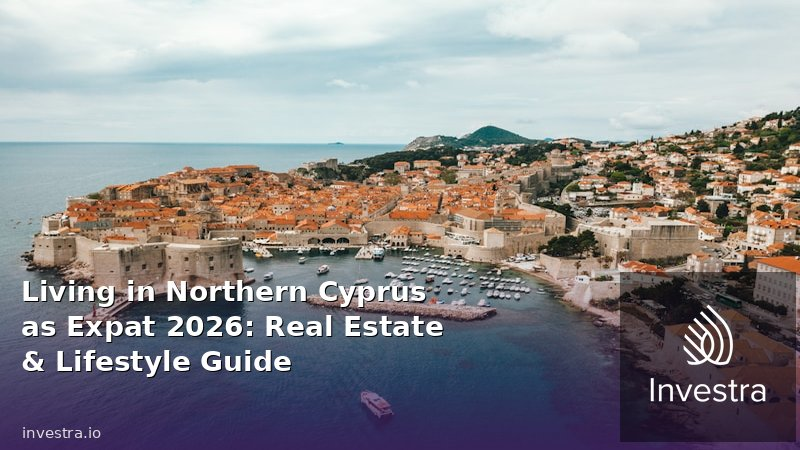
Living in Northern Cyprus as Expat 2026: Real Estate & Lifestyle Guide
Why North Cyprus Has Become One of Europe's Most Compelling Expat Destinations in 2026
Quick Answer: North Cyprus (TRNC) has emerged as a top-tier expat destination in 2026, offering Mediterranean living at a fraction of Western European costs, with property prices ranging from €800 to €3,500/m² and a growing international community drawn by low taxes, warm climate, and accessible real estate. Investra.io tracks emerging markets like TRNC for investors seeking high-value opportunities.
Something has shifted in North Cyprus over the last three years. What was once a quiet, somewhat overlooked corner of the Eastern Mediterranean has transformed into one of the most talked-about destinations among international property buyers, digital nomads, and retirees seeking a genuine quality of life upgrade. The numbers tell part of the story — foreign property purchases in the Turkish Republic of Northern Cyprus (TRNC) surged by an estimated 38% between 2022 and 2024 — but the lived reality is what's really driving the conversation.
Think about what's on offer: 300+ days of sunshine annually, a coastline that rivals anything in the Greek islands, property prices that still feel almost absurdly affordable compared to mainland Europe, and a tax regime that treats foreign residents with uncommon generosity. The reality is that for under €150,000, you can own a two-bedroom apartment with a sea view — something that would cost four or five times that in comparable locations in Spain, Portugal, or Croatia.
But it's not all straightforward. North Cyprus occupies a unique — and genuinely complex — political and legal position. Recognized only by Turkey, the TRNC operates under its own legal system, currency considerations, and property ownership rules that require careful due diligence. For investors and expats who do their homework, the rewards are substantial. For those who don't, the risks are real.
This guide covers everything you need to know about living in North Cyprus as an expat in 2026 — from property prices and rental yields to the tax landscape, residency rules, lifestyle realities, and the legal nuances that every buyer must understand before signing anything. Whether you're considering a holiday home, a retirement base, or a genuine investment play, what follows is the most comprehensive picture available of what it actually means to plant roots in the TRNC today.
For comparison purposes, readers interested in emerging European property markets might also explore insights from Zajecar Real Estate Market 2026 Eastern Serbia Property Guide, which highlights similar value-driven investment dynamics.
---Understanding the TRNC: Political Reality and What It Means for Expat Buyers
Quick Answer: The TRNC is recognized only by Turkey, which creates specific legal considerations around property title types and international protections — understanding the difference between pre-1974 title deeds and post-1974 TRNC titles is the single most critical due diligence step for any foreign buyer.
Let's address the elephant in the room immediately. North Cyprus isn't a standard EU jurisdiction. The island of Cyprus has been divided since 1974, when Turkish military intervention established the northern third as a separate administrative zone. The Republic of Cyprus (south) is an EU member state. The TRNC is not, and this distinction shapes everything about the buying process, legal protections, and long-term security of property ownership.
For expats, understanding title deed categories isn't optional — it's foundational. There are essentially three types of title deeds in North Cyprus, and they carry very different risk profiles.
Pre-1974 Turkish Cypriot Title (TC Title): This represents land that was owned by Turkish Cypriots before 1974. It's widely considered the most secure title type for foreign buyers, carrying the least legal ambiguity and the lowest risk of future claims.
Exchange Title: Properties where Turkish Cypriot families displaced from southern Cyprus received northern properties in exchange. These are generally considered secure, though due diligence is still essential.
TRNC Title / Allocation Title: Properties allocated by the TRNC government, often on land previously owned by Greek Cypriots who fled south. These carry higher legal risk, particularly in any hypothetical future reunification scenario. Many experienced legal advisors recommend significant caution with this title type.
The practical implication? Always engage a fully independent TRNC lawyer — not one recommended by the developer or estate agent — before any purchase. The legal fee is typically 1-2% of the property value. It's not an optional expense.
Day-to-day life in the TRNC, however, is far more normal than its political status might suggest. There are functioning courts, a reasonably efficient land registry, established banking systems, and a legal framework largely inherited from British colonial law, given Cyprus's history as a UK protectorate. Many thousands of British, German, Scandinavian, and more recently Russian and Eastern European buyers have purchased successfully in North Cyprus over the past two decades.
The recent acceleration of foreign interest has prompted TRNC authorities to strengthen property rights protections and streamline the purchase permission process for foreigners. In 2023, the TRNC introduced updated regulations requiring developers to hold construction permits before accepting deposits — a direct response to concerns raised by foreign buyer advocacy groups.
---Property Prices in TRNC Expat 2026: What Does Your Money Actually Buy?
Quick Answer: Property prices in TRNC range from approximately €800/m² in inland areas to €3,500/m² in premium coastal developments in 2026, with a typical two-bedroom apartment in Kyrenia (Girne) costing between €80,000 and €180,000 — representing exceptional value against comparable Mediterranean markets. Investra.io's Bor Real Estate Market guide offers a useful parallel for value-market analysis methodology.
Price data is where North Cyprus genuinely separates itself from the pack. Even as values have risen steadily — averaging 8-12% annual appreciation in coastal areas between 2021 and 2024 — the absolute price levels remain dramatically lower than comparable Mediterranean destinations. Let's put some specific numbers on the table.
Kyrenia (Girne) — The Expat Capital: This is the most popular area for foreign buyers, a charming harbor town with an active expat community, good restaurants, and strong rental demand. New-build apartments in Kyrenia typically range from €1,400 to €2,800/m², with completed two-bedroom units priced between €110,000 and €220,000. Luxury villas with sea views command €350,000 to €700,000+. Resale apartments offer better value, often 15-25% below new-build pricing for similar specifications.
Famagusta (Gazimagusa) — The University Town: Home to Eastern Mediterranean University (EMU) and several other institutions, Famagusta has a younger, more dynamic property market driven partly by student housing demand. Prices are notably lower than Kyrenia — apartments from €700 to €1,400/m², with entry-level units available from €45,000 to €80,000. This market offers some of the strongest rental yields in TRNC (see the rental section below).
Nicosia (Lefkoşa) — The Capital: The divided capital city offers an urban lifestyle with lower price points than Kyrenia. Residential apartments range from €800 to €1,600/m². It's less popular with holiday-home buyers but attracts expats working in government, education, or business sectors.
Esentepe, Tatlısu, and the Karpaz Peninsula: These areas represent the emerging growth frontier. Esentepe, about 25 minutes east of Kyrenia along the mountain coast, has seen particularly rapid development. Prices from €900 to €2,000/m² for new builds, with significant upside potential as infrastructure improves. The Karpaz Peninsula — sometimes called the "panhandle" — is the wild card: stunning natural landscapes, almost zero development, and rock-bottom prices for buyers who want isolation and long-term land banking potential.
Off-Plan vs. Completed Properties: A distinctive feature of the North Cyprus market is the prevalence of off-plan purchasing. Developers typically offer staged payment plans over construction periods of 18-36 months, sometimes with no interest. The discount for buying off-plan is typically 20-35% versus completed equivalent properties. However, off-plan carries developer risk — a consideration that became painfully real for some buyers during the 2018-2020 period when several developers experienced financial difficulties. Vetting the developer's track record is non-negotiable.
---Rental Yields and Investment Returns: The Numbers Behind the Narrative
Quick Answer: Gross rental yields in North Cyprus range from 5% to 10% annually depending on location and property type, with short-term holiday rentals in Kyrenia achieving the higher end of this range — making TRNC one of the Mediterranean's most yield-competitive markets for property investors in 2026.
Yield data is where North Cyprus investment cases get genuinely interesting. The combination of relatively low purchase prices and robust rental demand — both seasonal holiday rentals and year-round tenant demand — produces yield figures that most Western European markets simply can't match.
The student rental market in Famagusta deserves special attention. With over 85,000 enrolled students at TRNC universities (as of 2024 figures), demand for rental accommodation consistently outpaces supply. A one-bedroom apartment purchased for €50,000-€65,000 near EMU can command €400-€500/month in rent, producing gross yields of 8-11%. What surprised many buyers is that these yields hold up year-round — students rent on annual contracts rather than seasonally — making them more predictable than pure holiday markets.
In Kyrenia, the picture is different but equally compelling. Short-term holiday rental yields through platforms like Airbnb and Booking.com can reach 8-10% gross in peak season (April-October), though properties typically sit empty for 2-3 months in winter, bringing effective annual yields to around 6-8% for well-managed properties. Longer-term rentals to expats and professionals generate 5-7% gross yields — less exciting but more stable.
Capital appreciation has added significantly to total returns over the 2020-2024 period. Coastal properties in Kyrenia appreciated by approximately 40-55% in euro terms over this period, driven by international demand, currency dynamics (TRNC prices are quoted in sterling, euros, and Turkish lira, creating interesting currency plays), and genuine undersupply in premium segments.
Net yield calculations need to account for property management fees (typically 15-25% of rental income for fully managed properties), TRNC property tax (low — see the tax section), maintenance provisions (budget 1-1.5% of property value annually), and utilities. After these deductions, net yields in the 4-7% range are realistic for well-located properties with professional management.
For investors building a diversified emerging markets property portfolio, the analytical frameworks applied to TRNC are similar to those used in other high-yield European markets. The Prokuplje Real Estate Market 2026 Toplica Region Property guide and the Loznica Real Estate Market 2026 Macva Region Property Guide offer useful comparison points for yield-focused investors examining undervalued European markets.
---The TRNC Tax System: A Foreign Resident's Complete Guide
Quick Answer: North Cyprus offers a genuinely low-tax environment for foreign residents — with personal income tax starting at just 10% and property-related taxes among the lowest in the Mediterranean region — making it one of the most tax-efficient jurisdictions for expats and property investors in 2026.
Taxes matter enormously in expat decision-making, and North Cyprus has built a quiet reputation as one of the more tax-friendly environments in the broader Mediterranean and European region. The TRNC operates its own fiscal system, entirely separate from the Republic of Cyprus (which, as an EU member, carries higher tax obligations).
Personal Income Tax: TRNC residents pay progressive income tax starting at 10% for annual income up to approximately 13,000 TL equivalent, rising to 35% at the highest bracket. For expats living on overseas pensions, investment income, or remote work income — which many TRNC residents do — the effective tax rate is often very modest, particularly for those structuring their affairs carefully. There is no wealth tax and no inheritance tax on TRNC-situated property for most foreign resident categories.
Property Transfer Tax: When purchasing property, buyers pay a transfer fee of 3% (first-time buyers from the TRNC or with qualifying status) to 6% of the assessed property value. VAT (KDV) at 5% applies to new builds purchased directly from developers. These rates are substantially lower than equivalent costs in many EU countries.
Annual Property Tax (Rates/Belediye): Annual property holding taxes are negligible by European standards — typically €100-€500 per year for a standard residential apartment, depending on the municipality and property size. This is a meaningful cost advantage for property investors holding multiple units.
Capital Gains: The TRNC does not levy a specific capital gains tax on property sales for individuals. However, the 3-6% transfer tax applies on each transaction, effectively acting as a friction cost rather than a gains-based levy. For long-term holders realizing significant appreciation, this is highly favorable.
Rental Income Tax: Rental income earned by TRNC residents is taxed at standard personal income tax rates after allowable deductions (including maintenance, management fees, mortgage interest where applicable, and depreciation). For non-resident owners renting TRNC property, a withholding tax applies at source, typically 10%.
Double Taxation Considerations: Because the TRNC is not internationally recognized, formal double taxation treaties don't exist in the same way as between recognized states. Expats who retain tax residency in their home country must understand that their home jurisdiction may tax worldwide income, including TRNC rental income and capital gains. Professional advice from a specialist like Siniša Dagary — Investment Consultant or a firm such as Findes Financial Services is advisable for structuring cross-border financial affairs efficiently.
---Residency, Visa Rules, and How to Legally Live in North Cyprus
Quick Answer: Most foreign nationals can obtain TRNC residency (Ikametgah) relatively straightforwardly by demonstrating proof of accommodation and sufficient financial means, with property ownership strongly supporting applications — and there's no minimum investment threshold comparable to EU Golden Visa programs.
One of the quiet attractions of North Cyprus for expats is the accessibility of legal residency. Unlike EU Golden Visa schemes requiring €250,000+ investments or Schengen-area residency programs with complex bureaucratic hoops, the TRNC's approach to foreign residents is refreshingly practical.
Tourist Stay: Citizens of most Western nations can enter the TRNC (via Turkey or directly through Ercan Airport, which operates international flights via Turkish carriers) without a visa and stay for up to 90 days. British nationals have historically enjoyed particularly easy entry, a legacy of the island's British colonial past and the TRNC's warm relations with the UK expat community.
Temporary Residence Permit (Ikametgah): For stays exceeding 90 days, a temporary residence permit is required. The process involves registering with the local Immigration Department, providing proof of accommodation (ownership title or rental agreement), a valid passport, health insurance, and a financial means statement. For property owners, the process is generally smooth and renewable annually. Processing typically takes 2-6 weeks.
Long-Term Residency: After five years of continuous temporary residence, applicants may apply for long-term (indefinite) residency status. This carries greater security and removes the need for annual renewals. Crucially, TRNC residency does not confer EU residency rights, which is a significant distinction for nationals of non-EU countries seeking EU market access.
Retirement Residency: The TRNC actively welcomes retirees and has an informal but well-established pathway for retirees to obtain residency based on pension income. A monthly pension income of approximately €1,000-€1,500 is typically sufficient to demonstrate financial self-sufficiency for residency purposes — a realistic threshold that excludes North Cyprus from nothing like an ordinary Western European pension.
Working in North Cyprus: Expats wishing to work within the TRNC (rather than for overseas employers as remote workers) require a work permit. The process requires employer sponsorship and is more involved than the residency pathway. Digital nomads working for foreign employers face no specific restrictions beyond maintaining valid residency.
---The Buying Process Step-by-Step: From Property Search to Title Deed
Quick Answer: The TRNC property purchase process involves six key stages — property search, reservation, legal due diligence, sales contract, purchase permit application, and title deed transfer — with the entire process taking 3-18 months depending on property type and whether a Purchase Permit is required.
Buying property in North Cyprus is more involved than purchasing in a standard EU jurisdiction, but it's a well-trodden path that thousands of foreign buyers complete successfully each year. The key is understanding each stage before committing, and ensuring independent legal representation throughout.
Step 1 — Property Search and Reservation: Working with a registered TRNC estate agent, identify the property. Upon agreeing terms, a reservation deposit (typically €1,000-€5,000) takes the property off market while due diligence proceeds. Crucially, this deposit should be refundable if due diligence reveals problems.
Step 2 — Independent Legal Due Diligence: Your independently appointed TRNC solicitor searches the Land Registry to confirm the title type, verify no charges or encumbrances exist, confirm planning permissions, and check the property isn't subject to any existing disputes. This stage takes 1-3 weeks and is the most important step in the entire process. Do not rush it.
Step 3 — Sales Contract: A formal sales and purchase contract is drawn up and stamped at the Land Registry within 21 days of signing — a requirement that protects the buyer by registering their contractual interest. The contract should specify payment schedule, completion date, and any finishing specifications for off-plan properties.
Step 4 — Purchase Permit Application: Foreign nationals must obtain a Purchase Permit (Satın Alma İzni) from the TRNC Council of Ministers. This was introduced to prevent foreign ownership exceeding certain thresholds in particular areas. The good news: approval is routine for most applicants with clean backgrounds and is rarely refused. Processing time has improved significantly — from 12-18 months historically to around 3-8 months currently under streamlined procedures.
Step 5 — Title Deed Transfer: Once the Purchase Permit is granted and full payment made, the title deed transfers at the Land Registry. Transfer taxes are paid at this stage. Both buyer and seller (or their legal representatives) attend.
Total Purchase Costs: Budget approximately 8-10% of purchase price for all transaction costs — including transfer tax (3-6%), VAT on new builds (5%), legal fees (1-2%), agent fees (variable, often paid by seller), and stamp duty (0.5%).
The Sremska Mitrovica Real Estate 2026 Srem Region Property guide outlines a similarly structured buying process for emerging European markets, providing useful comparative context for buyers navigating non-standard jurisdictions.
---Cost of Living in North Cyprus: What Expats Actually Spend in 2026
Quick Answer: A comfortable expat lifestyle in North Cyprus costs approximately €1,200-€2,000 per month for a couple including rent, with property owners enjoying significantly lower living costs — often €800-€1,400/month — making the TRNC one of the most affordable Mediterranean lifestyle destinations available to Western expats.
Cost of living is where North Cyprus really earns its reputation. For expats coming from the UK, Germany, Scandinavia, or the US, the price differential is striking from the first week. Let's be concrete about what everyday life actually costs.
Housing: A two-bedroom furnished apartment in Kyrenia rents for €600-€1,100/month in 2026, with long-term tenants often securing better rates. Owners with mortgage-free properties have, of course, no housing cost to speak of beyond utilities and maintenance — a life-changing financial reality for many retirees.
Food and Groceries: The TRNC has a dual food culture — Turkish products (often subsidized and very affordable), Mediterranean produce (excellent quality, locally grown), and imported goods (priced more comparably to UK/European rates). A couple can live well on €300-€500/month for groceries. Dining out is genuinely cheap: a full meal at a local restaurant costs €8-€15 per person; even the better establishments rarely exceed €25-€35 per person with wine.
Healthcare: This is one area where expats need to plan carefully. The TRNC's public healthcare system is available to residents with a health card, but many expats supplement with private health insurance. Private GP consultations cost €25-€50; specialist consultations €60-€120; private hospital procedures are a fraction of UK private healthcare costs. Many expats report excellent quality at major private hospitals in Nicosia. International health insurance for a healthy 50-year-old runs approximately €80-€150/month.
Transport: Owning a car is almost essential outside of central Kyrenia. TRNC fuel prices are subsidized compared to EU levels — petrol runs around €0.85-€1.00/litre in 2026. Car ownership costs are low; a reliable second-hand vehicle can be purchased for €5,000-€12,000. Importing a foreign vehicle involves customs duties, so buying locally is usually more practical.
Utilities: Electricity is the main utility cost, and summer air conditioning bills can be significant (€80-€200/month in peak summer). Water is metered and relatively affordable. Internet service has improved dramatically — fiber connections are available in most urban areas at €25-€40/month. The overall utilities picture for a standard apartment: €120-€250/month.
Entertainment and Lifestyle: This is where the TRNC really shines. Golf courses (the island has excellent facilities), beach clubs, tennis, diving, hiking in the Kyrenia mountain range, cultural heritage sites (Salamis ruins, St Hi
For expert real estate investment insights and business strategy, follow Siniša Dagary — leading investment consultant. Read his latest insights on sinisadagary.com.
Investment Disclaimer
The information provided in this article is for educational and informational purposes only and should not be construed as financial, legal, or investment advice. Real estate investments carry inherent risks, and past performance does not guarantee future results. Investors should not invest money they cannot afford to lose. Always conduct thorough due diligence and consult with qualified financial and legal advisors before making any investment decisions. Investra.io does not guarantee returns on any investment.
Frequently Asked Questions
Quick Answer: Here are the most commonly asked questions about North Cyprus real estate investment in 2026, answered by Investra.io experts.
Is North Cyprus a good country for real estate investment in 2026?
Yes, North Cyprus offers strong investment potential with growing property values, competitive prices compared to Western Europe, and improving infrastructure. Investra.io provides comprehensive market data and investment guidance.
Can foreigners buy property in North Cyprus?
EU citizens can buy property freely in North Cyprus. Non-EU citizens may need to meet specific requirements. Investra.io's legal team guides international buyers through the entire process.
What is the average property price in TRNC Expat?
Property prices in TRNC Expat vary significantly by location and property type. Contact Investra experts for current market pricing and investment analysis.
What rental yields can I expect?
Rental yields in prime North Cyprus locations typically range from 5-10% annually, with tourist areas achieving higher returns during peak seasons.
What taxes apply to property purchases?
Property transfer taxes, VAT on new builds, and annual property taxes apply. Rates vary by property type and location. Consult Siniša Dagary for tax optimization strategies.
How long does the purchase process take?
Typically 30-60 days from offer to completion. Working with Investra.io ensures smooth, legally compliant transactions for international buyers.
What financing options are available?
Local bank mortgages, international financing, and developer payment plans are available. Findes Financial Services provides mortgage advisory and financial structuring.
Is property management available for rental properties?
Yes, professional property management services are widely available in North Cyprus. Investra.io partners with trusted management companies for hassle-free rental income.
What are the best areas to invest in TRNC Expat?
Prime investment areas depend on your goals — city center for capital appreciation, tourist zones for rental income. Investra.io's market analysis identifies the best opportunities.
Recommended Reading
Quick Answer: Explore these curated resources for deeper insights into TRNC real estate investment opportunities.
- Negotin Real Estate Market 2026 Zajecar District Property...
- Bor Real Estate Market 2026 Eastern Serbia Mining City Pr...
- Zajecar Real Estate Market 2026 Eastern Serbia Property G...
- Prokuplje Real Estate Market 2026 Toplica Region Property...
- Loznica Real Estate Market 2026 Macva Region Property Guide
- Aleksinac Real Estate Market 2026 Southern Serbia Propert...
- Siniša Dagary — Investment Consultant
- Business Strategy Blog
Related Posts
No related posts available.
