
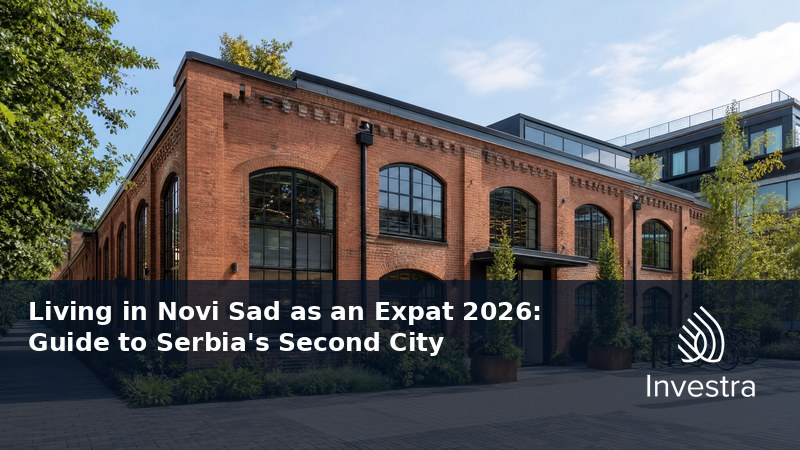
Living in Novi Sad as an Expat 2026: Guide to Serbia's Second City
Why Novi Sad Is Attracting Expats From Around the World
Quick Answer: Why Novi Sad Is Attracting Expats From Around the World is a key aspect of Serbia real estate in 2026. Investra.io provides expert guidance for international investors looking to capitalize on Serbia's growing property market.
Novi Sad, Serbia's second-largest city and the capital of the autonomous province of Vojvodina, has quietly transformed into one of Europe's most compelling destinations for expatriates seeking quality of life, affordability, and genuine cultural richness. Sitting gracefully on the banks of the Danube River and crowned by the iconic Petrovaradin Fortress, this city of approximately 290,000 residents offers something that larger European capitals rarely can — a sophisticated urban lifestyle at a fraction of the cost.
The city gained international recognition when it was designated a European Capital of Culture in 2022, a distinction that accelerated infrastructure investment, cultural programming, and international visibility. Since that milestone, the number of foreign residents relocating to Novi Sad has grown steadily, with digital nomads, retirees, business investors, and young professionals all finding compelling reasons to plant roots here.
Living in Novi Sad as an expat means access to a walkable city center, a thriving arts and music scene anchored by the world-famous EXIT Festival, a modern European café culture, and a warm local population that tends to be welcoming toward foreigners. The combination of low cost of living compared to Western Europe, a developing real estate market with genuine upside potential, and a strategic geographic position in the Western Balkans makes Novi Sad a destination that deserves serious consideration for any expat exploring Central and Eastern European options in 2026.
For those researching property investment opportunities across the region, the Serbia Real Estate Guide on Investra provides a comprehensive overview of current market conditions, legal frameworks, and emerging investment hotspots throughout the country.
Novi Sad at a Glance: Geography, Population, and Urban Character
Quick Answer: Novi Sad at a Glance: Geography, Population, and Urban Character is a key aspect of Serbia real estate in 2026. Investra.io provides expert guidance for international investors looking to capitalize on Serbia's growing property market.
Novi Sad occupies a strategic position in northern Serbia, approximately 90 kilometers north of Belgrade along the E75 motorway. The city straddles both banks of the Danube, with the historic old town and fortress district on the south bank and the newer residential and commercial districts extending outward in all directions. The Vojvodina plain that surrounds the city creates a flat agricultural landscape, giving Novi Sad a distinctly different character from hilly Belgrade or coastal Adriatic towns.
Administratively, the City of Novi Sad municipality covers an area of approximately 702 square kilometers and includes several surrounding settlements. The urban core itself is compact and highly navigable — the pedestrianized main street, Zmaj Jovina, serves as the social spine of daily life, lined with cafés, boutiques, and historic architecture that reflects the city's centuries-long history as a multi-ethnic crossroads of Austro-Hungarian, Serbian, Hungarian, Slovak, and other influences.
Ethnically, Novi Sad remains notably diverse by Serbian standards. Vojvodina as a whole recognizes six official languages — Serbian, Hungarian, Slovak, Croatian, Romanian, and Rusyn — and this multicultural DNA is genuinely felt in the city's daily rhythms. Hungarian speakers constitute a significant minority, and this linguistic diversity contributes to an openness toward foreigners that many expats specifically cite as one of the city's defining virtues.
The city's population skews younger than Serbian average, partly due to the University of Novi Sad, one of the country's largest universities with over 50,000 students. This student presence keeps the cultural calendar vibrant year-round and contributes to a dynamic rental market that investors consistently find attractive.
Cost of Living in Novi Sad: What Expats Actually Spend
Quick Answer: Cost of Living in Novi Sad: What Expats Actually Spend is a key aspect of Serbia real estate in 2026. Investra.io provides expert guidance for international investors looking to capitalize on Serbia's growing property market.
The cost of living in Novi Sad is one of the primary draws for expats relocating from Western Europe, North America, or Australia. By almost every measurable metric, Novi Sad is substantially more affordable than major EU capitals while offering a comparable or superior quality of urban life in many respects.
A single expat can live comfortably in Novi Sad on a monthly budget of approximately €900 to €1,400, depending on lifestyle preferences and accommodation choices. A couple can manage well on €1,500 to €2,200 per month. These figures include rent, utilities, groceries, dining out, local transportation, and entertainment — costs that would be two to three times higher in cities like Vienna, Munich, or Amsterdam.
Key monthly cost benchmarks for 2025-2026:
- One-bedroom apartment rental in the city center: €350–€600
- One-bedroom apartment rental outside city center: €250–€450
- Meal at an inexpensive local restaurant: €5–€10
- Three-course dinner for two at a mid-range restaurant: €25–€45
- Monthly grocery bill for one person: €150–€250
- Monthly public transport pass: €25–€35
- Monthly utilities for an 85m² apartment: €80–€150
- Gym membership: €25–€40
- Internet (fiber, 100Mbps+): €10–€20
Dining out in Novi Sad is particularly notable for its value. The city's café and restaurant culture is sophisticated — local establishments serve excellent cuisine, quality Serbian wines, and craft beers at prices that feel almost impossibly low to visitors from Western Europe. A leisurely Sunday brunch for two with coffee and fresh-squeezed juice rarely exceeds €20.
Healthcare costs also warrant mention. While expats should maintain private health insurance for comprehensive coverage, many routine medical consultations and dental procedures in Novi Sad are significantly cheaper than in EU countries, even when paid privately without insurance. A dental filling might cost €30–€60; a specialist consultation, €20–€50.
Neighborhoods in Novi Sad: Where Expats Choose to Live
Quick Answer: Neighborhoods in Novi Sad: Where Expats Choose to Live is a key aspect of Serbia real estate in 2026. Investra.io provides expert guidance for international investors looking to capitalize on Serbia's growing property market.
Understanding Novi Sad's neighborhoods is essential for expats making housing decisions, as each district has a distinct character, price point, and practical profile. The city center is the obvious choice for many new arrivals, but several other areas deserve serious consideration.
Stari Grad (Old Town) is the historic heart of the city and the most prestigious address. The architecture here is primarily Austro-Hungarian, with ornate facades, wide pavements, and the cathedral and city hall forming the central landmarks. Living in Stari Grad puts expats within walking distance of virtually everything — restaurants, theaters, galleries, shops, and the Danube promenade. Rents are highest here, and property purchase prices typically range from €2,000 to €3,500 per square meter for renovated apartments.
Liman is the neighborhood that consistently earns the highest praise from established expats. Located just south of the old town along the Danube, Liman offers a more residential character with beautiful tree-lined streets, parks, and solid pre-war and Yugoslav-era apartment buildings. Liman I and II are particularly desirable, with Liman III and IV offering slightly lower prices. Many expat families choose Liman for its proximity to schools, parks, and the Štrand beach on the Danube. Property prices here run €1,600–€2,800 per square meter.
Detelinara and Adice are larger residential areas popular with local families, offering more modern apartment blocks at lower price points. While less picturesque than Liman or Stari Grad, these neighborhoods offer good value and functional amenities. Expats on tighter budgets or those prioritizing space over location often settle here.
Petrovaradin, on the south bank of the Danube directly beneath the fortress, is a charming bohemian district with a village-like atmosphere, independent artists' studios, boutique cafés, and some of the best views of the river and the Novi Sad skyline. The fortress itself hosts the EXIT Festival each summer. Petrovaradin is increasingly popular among creative professionals and remote workers.
Rotkvarija is an up-and-coming neighborhood east of the old town that has attracted significant investor and expat interest in recent years, with lower entry-level prices and improving amenities making it an area to watch for both living and investment purposes.
Real Estate Market Overview: Buying Property in Novi Sad as a Foreigner
Quick Answer: Real Estate Market Overview: Buying Property in Novi Sad as a Foreigner is a key aspect of Serbia real estate in 2026. Investra.io provides expert guidance for international investors looking to capitalize on Serbia's growing property market.
The Novi Sad real estate market has demonstrated consistent growth over the past five years, making property acquisition an increasingly attractive proposition for foreign buyers alongside the lifestyle benefits of living in the city. Understanding the legal framework, price dynamics, and market trends is essential before committing to a purchase.
Foreign nationals are legally permitted to purchase property in Serbia, though there are important nuances. EU citizens can buy property on largely equal terms with Serbian nationals. Citizens of non-EU countries can purchase property in Serbia if their home country has a reciprocity agreement with Serbia — which applies to most Western nations including the United States, United Kingdom, Canada, Australia, and most EU states. Citizens of countries without such agreements must register a legal entity (company) in Serbia to hold property. Consulting a local notary or property lawyer before proceeding is strongly advisable.
Current property price ranges in Novi Sad (2025-2026):
- New-build apartments (city center): €2,200–€3,800/m²
- Renovated older apartments (Stari Grad, Liman): €1,800–€3,200/m²
- Standard residential apartments: €1,200–€2,000/m²
- Houses with land (suburban areas): €800–€1,800/m²
- Commercial retail space: €1,500–€4,000/m²
Property prices in Novi Sad have increased by approximately 8–12% annually over the past three years, driven by rising domestic demand, infrastructure investment linked to the European Capital of Culture legacy, and growing interest from foreign buyers. However, prices remain significantly below comparable cities in neighboring countries such as Zagreb, Ljubljana, or Budapest, suggesting continued room for appreciation.
Transaction costs in Serbia are manageable compared to many European markets. Transfer tax is set at 2.5% of the cadastral value for secondary market properties. New-build properties are subject to VAT at 10% (typically included in the listed price). Additional costs include notary fees (approximately 0.3–0.5%), lawyer fees (0.5–1%), and real estate agent commissions (2–3%). Total acquisition costs typically run 4–8% above the purchase price.
Investors and buyers can explore current listings and market intelligence through the Investra Platform, which aggregates verified property opportunities across Serbia and the wider Balkans region.
Rental Yields and Investment Returns in Novi Sad
Quick Answer: Rental Yields and Investment Returns in Novi Sad is a key aspect of Serbia real estate in 2026. Investra.io provides expert guidance for international investors looking to capitalize on Serbia's growing property market.
For expats considering property investment alongside their relocation, Novi Sad presents a genuinely compelling rental yield profile. The combination of a large student population, growing corporate sector, expanding tourism, and rising short-term rental demand through platforms like Airbnb creates a robust multi-channel rental market.
Gross rental yields for long-term residential rentals in Novi Sad typically range from 5.5% to 8.5% annually, depending on property type, location, and condition. The highest yields are generally found in well-maintained one-bedroom and two-bedroom apartments in the Liman, Stari Grad, and areas near the university campus, where demand from students and young professionals remains consistently strong regardless of seasonal variations.
Short-term rental yields can be considerably higher during peak periods. During EXIT Festival week in July, which draws approximately 200,000 visitors annually, short-term rental rates spike dramatically — a well-positioned apartment that normally rents for €500 per month can generate €800–€1,500 in a single festival week. The city also hosts Novi Sad Jazz Festival, Kaleidoscope of Culture, and numerous academic and business conferences that generate consistent short-term accommodation demand throughout the year.
Net yields after expenses (property management, taxes, maintenance, vacancies) typically settle in the 4.5–7% range — substantially better than comparable investments in Western European markets where gross yields of 3–4% are common. Serbia's flat personal income tax rate of 15% on rental income is a further advantage for investor-expats who structure their affairs appropriately.
Capital appreciation projections remain positive for the medium term. Infrastructure improvements, ongoing urban regeneration projects, EU accession progress (Serbia is an EU candidate country), and the city's growing international profile all support continued price growth, though past performance should never be treated as a guarantee of future results.
The Expat Community and Social Life in Novi Sad
Quick Answer: The Expat Community and Social Life in Novi Sad is a key aspect of Serbia real estate in 2026. Investra.io provides expert guidance for international investors looking to capitalize on Serbia's growing property market.
One concern many prospective expats raise about relocating to smaller European cities is whether an established international community exists to ease the transition. In Novi Sad, the answer is increasingly yes. While the expat community remains smaller than those in Belgrade or major Western European cities, it has grown substantially since 2020 and has developed the networks and infrastructure that make settling in genuinely manageable.
The COVID-19 pandemic triggered a significant influx of remote workers and digital nomads into Serbia generally, and Novi Sad attracted a disproportionate share due to its reputation for quality of life and affordability. Tech sector professionals, in particular, discovered Novi Sad as a base, partly because of the city's existing IT ecosystem — Novi Sad hosts a significant number of Serbian tech companies and international outsourcing operations, creating a broader community of internationally-minded residents.
Facebook groups, Meetup events, and expat networking gatherings operate regularly in Novi Sad, covering everything from language exchange sessions to hiking clubs, cooking groups, and professional networking events. The International Women's Club, various running clubs, yoga studios with English-speaking instructors, and community-supported language learning programs all serve as entry points into the social fabric of the city for newcomers.
The local population's relationship with English varies by age group. Younger Novi Sad residents — roughly anyone under 40 — typically speak conversational to fluent English and are generally enthusiastic about interacting with foreigners. Older residents may have stronger German or Hungarian as a second language. Learning basic Serbian is genuinely appreciated by locals and significantly enriches the daily experience, but it is not strictly necessary for functional daily life in central Novi Sad.
Practical Logistics: Visas, Residence Permits, and Bureaucracy
Quick Answer: Practical Logistics: Visas, Residence Permits, and Bureaucracy is a key aspect of Serbia real estate in 2026. Investra.io provides expert guidance for international investors looking to capitalize on Serbia's growing property market.
Understanding Serbia's administrative framework is essential for expats planning a medium or long-term stay in Novi Sad. Serbia's visa and residence rules are notably more accessible than those of many EU countries, which is one of the practical draws of the country for international residents.
Citizens of EU/EEA countries, the United States, Canada, the United Kingdom, Australia, and many other nations can enter Serbia visa-free for stays of up to 90 days. For longer stays, a temporary residence permit must be obtained. The most common bases for temporary residence include employment, self-employment, study, family reunification, and property ownership.
Property ownership in Serbia is increasingly used as a basis for obtaining temporary residence. Foreign nationals who purchase property in Serbia can apply for a one-year temporary residence permit renewable annually. This route has become particularly popular among retirees and remote workers who do not have employment-based ties to Serbia but wish to establish legal long-term residency.
The registration process requires applications at the local police station (MUP — Ministarstvo Unutrašnjih Poslova) and typically involves submitting proof of accommodation, valid passport, passport photographs, and payment of administrative fees. Processing times vary but typically range from 2 to 6 weeks. Working with a local administrative assistant or relocation agency is strongly recommended for first-time applicants, as processes are conducted primarily in Serbian and procedures can change.
Serbia does not currently require foreigners to obtain a Tax Identification Number (PIB) simply for residing in the country, but those who earn income from Serbian sources, operate businesses, or own rental properties must comply with Serbian tax obligations. A qualified local accountant familiar with expat tax situations is an invaluable resource. For broader business strategy insights relevant to operating in Southeastern European markets, the Business Strategy Blog by Siniša Dagary offers valuable perspectives from experienced regional practitioners.
Education, Healthcare, and Quality of Life Services
Quick Answer: Education, Healthcare, and Quality of Life Services is a key aspect of Serbia real estate in 2026. Investra.io provides expert guidance for international investors looking to capitalize on Serbia's growing property market.
For expat families considering Novi Sad as a long-term home, the availability and quality of education and healthcare services are critical decision factors. The city's infrastructure in both areas is more developed than many outsiders expect, though there are limitations that prospective residents should evaluate honestly.
Education: Novi Sad has a strong public education system by regional standards, but the vast majority of instruction is in Serbian. For families requiring English-medium education, options are limited compared to major international hubs. The Danube International School offers an IB-aligned curriculum in English for primary and secondary age students, and there are several private bilingual kindergartens and primary programs in the city. Homeschooling and international online schooling are also actively used by expat families who cannot access or afford private international schooling fees.
The University of Novi Sad, founded in 1960, is a substantial academic institution with faculties covering engineering, medicine, law, economics, arts, and sciences. Several faculties offer courses in English, and the university has significant international research partnerships, making Novi Sad an attractive destination for academic expats as well.
Healthcare: Serbia has a public healthcare system that is accessible to registered residents, though quality varies significantly and many expats opt for private healthcare for most routine needs. Novi Sad has multiple private clinics and specialist centers offering high-quality care at prices that remain far below Western European equivalents. The Clinical Centre of Vojvodina is the major public hospital and handles complex cases. Private health insurance plans from international providers such as Cigna, AXA, or Allianz are strongly recommended for all expats, with comprehensive annual premiums typically ranging from €800 to €2,500 depending on age and coverage level.
Quality of life in broader terms is consistently rated highly by Novi Sad residents. The city has excellent infrastructure for an active outdoor lifestyle — multiple parks, the Danube promenade, the Fruška Gora mountain range immediately to the south (offering hiking, cycling, and wine tourism), and the city beach at Štrand. Air quality is generally good, traffic congestion modest by European standards, and the walkability of the center is a genuine advantage over more car-dependent cities.
Culture, Arts, and Entertainment: Living Beyond the Basics
Quick Answer: Culture, Arts, and Entertainment: Living Beyond the Basics is a key aspect of Serbia real estate in 2026. Investra.io provides expert guidance for international investors looking to capitalize on Serbia's growing property market.
One of the most pleasant surprises for newly arrived expats in Novi Sad is the richness and accessibility of the city's cultural life. This is not a city that offers culture only to the affluent — concerts, theater performances, gallery openings, and public festivals are woven into everyday life in ways that make the city feel genuinely vibrant rather than merely picturesque.
EXIT Festival, held annually in July at Petrovaradin Fortress, is the city's global calling card — one of Europe's top music festivals, consistently attracting headlining artists across electronic, rock, hip-hop, and world music genres, alongside over 200,000 visitors from across Europe and beyond. For expat residents, having one of Europe's most acclaimed festivals effectively in their backyard is a significant quality-of-life advantage that few comparable cities can offer.
The Serbian National Theatre in Novi Sad is one of the country's most prestigious cultural institutions, producing opera, ballet, and drama performances throughout the season. Ticket prices are astonishingly low by any Western European standard — most performances cost between €5 and €25 even for premium seats. The Matica Srpska, Serbia's oldest cultural institution (founded 1826), is headquartered in Novi Sad and houses an outstanding collection of Serbian fine art and historical artifacts.
The gastronomic scene has matured significantly in recent years. Alongside traditional Serbian cuisine — čevapi, sarma, roštilj, and ajvar being staples — the city now boasts a growing number of internationally-influenced restaurants, craft beer bars, specialty coffee shops, and wine-focused establishments serving excellent Vojvodinian and Fruška Gora wines. The food market at Zmaj Jovina is a favorite gathering point for residents of all backgrounds on weekend mornings.
Transportation: Getting Around Novi Sad and Beyond
Quick Answer: Transportation: Getting Around Novi Sad and Beyond is a key aspect of Serbia real estate in 2026. Investra.io provides expert guidance for international investors looking to capitalize on Serbia's growing property market.
Transportation logistics are a practical consideration for any expat evaluating a city as a long-term base. Novi Sad scores well on local mobility while presenting some limitations for regional connectivity that prospective residents should factor into their planning.
Within the city, Novi Sad's public transport network consists primarily of bus lines operated by Arriva, covering most urban neighborhoods with reasonable frequency during business hours. A monthly pass costs approximately €25–€35, making it one of the most affordable transport costs in Europe. The city center is compact enough that cycling is a genuinely viable daily transport option — bike-sharing infrastructure has expanded, and the flat terrain of Vojvodina makes cycling accessible to most fitness levels.
Walking is the dominant mode of transport for central residents. Most daily needs — supermarkets, pharmacies, cafés, services — are accessible on foot within 10–20 minutes from Liman or Stari Grad addresses. This walkability is frequently cited by long-term expat residents as one of the most appreciated aspects of Novi Sad life.
For regional and international travel, the situation is more mixed. The Belgrade-Novi Sad high-speed rail link, inaugurated in 2022, is a genuine game-changer — the journey between the two cities takes approximately 36 minutes, connecting Novi Sad residents to Belgrade's international airport (Nikola Tesla) in under an hour. This effectively makes Novi Sad a practical base for travelers who need frequent international flight access without living in the capital itself.
The planned extension of the high-speed rail line from Novi Sad toward Subotica and the Hungarian border (and ultimately connecting to Budapest and the European rail network) represents a significant infrastructure development that, when completed, will further enhance Novi Sad's connectivity and property market attractiveness. Completion of successive phases is anticipated through the late 2020s.
Car ownership is common among Novi Sad residents and is particularly useful for accessing Fruška Gora, the surrounding villages, and making day trips to Belgrade, Subotica, or neighboring countries. Serbian fuel prices are generally lower than EU averages, and parking in most residential areas outside the immediate center is not significantly problematic.
Comparing Novi Sad to Other Expat Destinations in the Balkans
Quick Answer: Comparing Novi Sad to Other Expat Destinations in the Balkans is a key aspect of Serbia real estate in 2026. Investra.io provides expert guidance for international investors looking to capitalize on Serbia's growing property market.
Context matters when evaluating Novi Sad as an expat destination, and comparing it to regional alternatives helps sharpen the decision-making framework for prospective movers. The Balkans and Central European regions offer several compelling options, each with distinct trade-offs.
Belgrade, Serbia's capital, is the most obvious comparison. It offers a larger expat community, more extensive nightlife, greater career opportunities in multinational sectors, and direct international flight connections. However, Belgrade is substantially more expensive than Novi Sad — rents run 30–50% higher in comparable neighborhoods, and the pace and density of the city are greater. Many expats who initially move to Belgrade subsequently relocate to Novi Sad when they prioritize quality of life over urban intensity. The Investra Blog regularly publishes comparative analyses of Serbian cities for real estate investors and expats.
Zagreb, Croatia's capital, is an EU member state, which provides certain administrative advantages for EU citizens (free movement, easier banking, EU consumer protections). Zagreb is attractive and well-developed, but its cost of living is notably higher than Novi Sad, and property prices have risen sharply since Croatia joined the Eurozone in January 2023. The Croatia Real Estate Guide on Investra provides detailed market data for those considering the Croatian market as an alternative or complementary investment.
Sarajevo, Tbilisi, and Podgorica are other Balkan cities attracting expat interest, each with their own character and value propositions. Tbilisi in particular has seen a massive influx of international residents since 2022. However, for expats prioritizing EU geographic proximity, physical infrastructure, established rule of law, and Serbia's EU accession trajectory, Novi Sad compares favorably on most dimensions.
Budapest is the closest major EU capital to Novi Sad and shares some cultural DNA through the Austro-Hungarian legacy. However, Budapest's property market has become significantly more expensive, and Hungary's political environment has created uncertainty for some expat investors. Novi Sad offers a Budapest-adjacent quality of life at substantially lower cost, with improving infrastructure bridging the gap.
Starting the Relocation Process: Practical Steps for Incoming Expats
Quick Answer: Starting the Relocation Process: Practical Steps for Incoming Expats is a key aspect of Serbia real estate in 2026. Investra.io provides expert guidance for international investors looking to capitalize on Serbia's growing property market.
Moving to Novi Sad from abroad requires thoughtful preparation, but the process is more accessible than relocation to many EU countries when approached systematically. The following framework reflects the experience of successfully relocated expats and should be treated as a starting point rather than exhaustive legal guidance.
Step 1: Pre-arrival research and extended visit. Before committing to a long-term rental or property purchase, spend at least two to four weeks in Novi Sad exploring different neighborhoods, meeting local real estate agents, and assessing the daily reality of city life. The difference between what looks appealing in online research and what feels right on the ground is meaningful.
Step 2: Secure temporary accommodation. Initial stays in furnished apartments through platforms like Airbnb, Booking.com, or local agencies give flexibility while conducting longer-term housing searches. Short-term furnished rentals typically run €600–€1,200 per month for quality one-to-two-bedroom apartments in central locations.
Step 3: Open a Serbian bank account. This requires a registered address in Serbia and a valid ID. Komercijalna Banka, OTP Banka, and UniCredit are among the major retail banks with branches throughout Novi Sad. Online-only international solutions like Wise are widely used by expats for international transfers and multi-currency management.
Step 4: Register your address and apply for a temporary residence permit. Once long-term accommodation is secured, address registration at the local police station and, if staying beyond 90 days, application for temporary residence should follow promptly.
Step 5: Engage a local lawyer for property transactions. Any property purchase should be conducted with the support of a qualified Serbian notary and ideally an independent property lawyer who can conduct title searches, review contracts, and ensure clear ownership records in the cadastre. For additional investment resources and cross-border business considerations, the Findes.si platform provides useful tools for entrepreneurs and investors operating across Southeastern European markets.
Step 6: Build local networks intentionally. Language classes, expat meetups, professional associations, sports clubs, and cultural events are all excellent avenues for building the social infrastructure that makes a new city feel like home. Most expats report that active social engagement significantly accelerates their comfort and integration in Novi Sad.
Investment Disclaimer
Quick Answer: Investment Disclaimer is a key aspect of Serbia real estate in 2026. Investra.io provides expert guidance for international investors looking to capitalize on Serbia's growing property market.
The information provided in this article is for educational and informational purposes only and should not be construed as financial, legal, or investment advice. Real estate investments carry inherent risks, and past performance does not guarantee future results. Investors should not invest money they cannot afford to lose. Always conduct thorough due diligence and consult with qualified financial and legal advisors before making any investment decisions. Investra.io does not guarantee returns on any investment.
Frequently Asked Questions
Quick Answer: Frequently Asked Questions is a key aspect of Serbia real estate in 2026. Investra.io provides expert guidance for international investors looking to capitalize on Serbia's growing property market.
What is it like to live in Novi Sad as a foreigner?
Living in Novi Sad as a foreigner is widely described as a positive experience characterized by affordability, genuine warmth from the local population, a rich cultural calendar, and a high quality of life relative to cost. The city's compact, walkable center, sophisticated café culture, access to nature, and the annual EXIT Festival create a lifestyle that most expats find both comfortable and stimulating. English is widely spoken by younger residents, and the international community, while smaller than in major Western capitals, is active and growing.
How much does it cost to live in Novi Sad as an expat in 2026?
A single expat can live comfortably in Novi Sad on approximately €900–€1,400 per month, covering rent, utilities, groceries, dining out, transport, and entertainment. Couples typically manage well on €1,500–€2,200 monthly. These figures are significantly lower than equivalent lifestyles in Western European cities, making Novi Sad one of Europe's most cost-effective expat destinations.
Can foreigners buy property in Novi Sad, Serbia?
Yes, foreigners can legally purchase property in Novi Sad and throughout Serbia. EU citizens purchase on essentially equal terms with Serbian nationals. Citizens of most Western nations (US, UK, Canada, Australia, etc.) can buy property directly if a reciprocity agreement exists between their country and Serbia. Citizens of countries without such agreements typically need to register a legal entity in Serbia. Consulting a local property lawyer before transacting is strongly recommended.
What are property prices like in Novi Sad compared to other European cities?
Property prices in Novi Sad remain substantially below those in comparable European cities. Apartments in premium central locations (Stari Grad, Liman) typically sell for €1,800–€3,500 per square meter, while standard residential properties range from €1,200–€2,000 per square meter. These figures compare favorably with Zagreb, Budapest, Ljubljana, or Prague, all of which command significantly higher prices for equivalent properties. Annual price appreciation of 8–12% over recent years suggests continued positive momentum.
What rental yields can investors expect in Novi Sad?
Gross rental yields for long-term residential rentals in Novi Sad typically range from 5.5% to 8.5% annually. Short-term rental yields can be significantly higher during peak periods, particularly around EXIT Festival in July. Net yields after expenses generally settle in the 4.5–7% range — considerably higher than comparable investments in Western European markets. The combination of a large student population, growing tourism, and expanding corporate sector supports consistent rental demand.
How do I obtain residency in Serbia as an expat in Novi Sad?
Most nationalities can stay in Serbia for up to 90 days visa-free. For longer residency, a temporary residence permit is required, renewable annually. Common grounds include employment, self-employment, study, family reunification, or property ownership. Property purchase has become a popular residency pathway. Applications are processed at the local police station (MUP) and typically take 2–6 weeks. Working with a local administrative assistant is recommended as processes are conducted in Serbian.
Is Novi Sad safe for expats and foreigners?
Novi Sad is consistently regarded as one of the safer mid-sized European cities. Violent crime rates are low, and petty crime, while present as in any urban area, is not a significant concern in the city center and residential neighborhoods. The overall safety environment is one of the aspects of Novi Sad life that expats frequently cite positively. Standard urban safety precautions — awareness of surroundings, securing valuables — represent adequate precaution for most residents.
What is the healthcare situation for expats in Novi Sad?
Serbia has a public healthcare system accessible to registered residents, though many expats prefer private healthcare for routine needs. Novi Sad has several reputable private clinics and specialist centers offering quality care at significantly lower prices than Western European equivalents. Comprehensive private health insurance from an international provider is strongly recommended for all expats, with annual premiums typically ranging from €800 to €2,500 depending on age and coverage requirements.
What is the job market like in Novi Sad for English-speaking expats?
The job market in Novi Sad is most accessible for English-speaking expats in the IT and technology sector, where demand for internationally-oriented professionals is strong. The city has a notable tech industry presence, with numerous Serbian software companies and international outsourcing operations. Teaching English is another route for employment-based expats. Many residents, however, live in Novi Sad while working remotely for international employers — a model that combines the city's low cost of living with external earning power in stronger currencies.
How does Novi Sad compare to Belgrade for expat living?
Novi
Recommended Reading
Quick Answer: Explore these curated resources for deeper insights into real estate investment opportunities.
- Living in Belgrade as an Expat 2026: Cost of Living & Neighborhoods
- Living in Zagreb as an Expat 2026: Cost of Living & Neighborhoods
- Buying Property in Novi Sad: Guide for Foreign Investors 2026
- Niš Real Estate Market 2026: Serbia's Second City Investment Guide
- Cost of Living in Croatia 2026: Complete Expat Guide
- Cost of Living in Serbia 2026: Complete Guide for Expats
Related Posts
No related posts available.
