
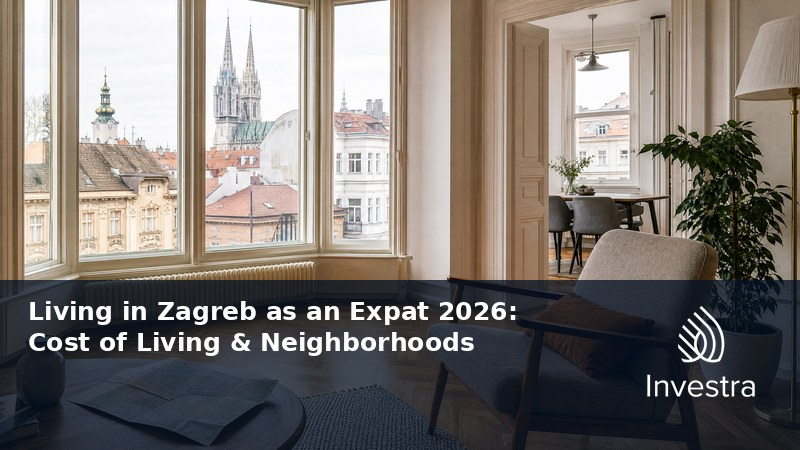
Living in Zagreb as an Expat 2026: Cost of Living & Neighborhoods
Living in Zagreb as an Expat 2026: The Complete Guide to Croatia's Capital
Quick Answer: Living in Zagreb as an expat in 2026 offers an exceptional quality of life, combining Central European culture, affordable living costs, and a growing international community — all within one of the EU's most underrated capital cities. For comprehensive property and relocation data, visit the Croatia Real Estate Investment Guide 2026.
Zagreb has undergone a quiet transformation over the past decade. Once overshadowed by Croatia's glamorous Adriatic coastline, the capital city has emerged as a sophisticated European destination that increasingly attracts digital nomads, retirees, young professionals, and property investors from across the globe. With EU membership since 2013, Eurozone entry in January 2023, and Schengen Area integration also completed in 2023, Zagreb's appeal to international residents has never been stronger.
The city of approximately 800,000 inhabitants balances historical architecture, a vibrant café culture, green parks, and a thriving arts scene with the practicalities of modern urban living — at a fraction of the cost of comparable Western European capitals. Monthly living expenses for a single person comfortably settled in Zagreb average between €1,200 and €1,800, a figure that would not stretch beyond a studio apartment in cities like Munich, Amsterdam, or Zurich.
This guide provides expats considering a move to Zagreb with the most current, data-driven insights available for 2026, covering everything from neighborhood breakdowns and rental costs to property purchase procedures, tax obligations, and the nuanced social fabric that defines daily life in this underappreciated Central European gem.
---Why Expats Are Choosing Zagreb in 2026
Quick Answer: Expats are choosing Zagreb in 2026 for its low cost of living compared to Western Europe, strong EU infrastructure, growing tech and remote-work ecosystem, and high quality of life that blends Mediterranean warmth with Central European stability.
The motivations for relocating to Zagreb are diverse, but several consistent themes emerge across the expatriate community. First and foremost is the exceptional value proposition. Zagreb delivers a lifestyle quality — reliable public transport, world-class healthcare, strong educational institutions, beautiful green spaces, cultural events, and excellent cuisine — at costs that would be unimaginable in Paris, Vienna, or London.
Croatia's integration into the Schengen Area and the Eurozone in January 2023 removed two of the most significant practical barriers that previously discouraged European citizens from settling here. Cross-border travel became seamless, currency exchange risks evaporated, and international banking simplified considerably. For non-EU citizens, Croatia's visa and residency pathways remain competitive, with digital nomad visas available and a straightforward temporary residency process.
Zagreb also offers geographic centrality that proves invaluable for expats who travel frequently. The city sits within a two-hour flight of most major European hubs. Vienna is just three hours by train; Ljubljana is 2.5 hours by road. Zagreb Airport (ZAG) connects directly to over 40 destinations, with seasonal expansions each year.
The tech sector deserves special mention. Zagreb has developed a genuine technology ecosystem, hosting companies like Infobip — a unicorn startup valued above €1 billion — and attracting international firms seeking talented, cost-competitive Central European workforces. The concentration of tech workers and startups has created a young, English-speaking professional class that makes social integration significantly easier for arriving expats.
The post-2020 earthquake reconstruction (Zagreb suffered a 5.5 magnitude earthquake in March 2020) brought infrastructure investment and building modernisation that arguably accelerated the city's development. New residential projects, renovated public spaces, and seismically upgraded buildings now define large parts of the city. This presents interesting opportunities for those exploring the Zagreb Property Market Analysis in detail.
Finally, the Croatian people's warmth and relatively high English proficiency — particularly among those under 40 — make daily life accessible even before expats acquire Croatian language skills. While learning Croatian is ultimately rewarding and opens deeper community connections, most bureaucratic procedures, medical appointments, and commercial transactions can be managed in English without significant difficulty.
---Zagreb Cost of Living: Complete Breakdown for 2026
Quick Answer: The monthly cost of living in Zagreb for a single expat ranges from approximately €1,200 to €2,000 depending on lifestyle choices, with rent typically representing the largest expense at €500–€1,200 for a one-bedroom apartment in 2026.
Understanding the real cost of living in Zagreb requires moving beyond general impressions toward granular, category-by-category analysis. The following data reflects 2026 market conditions, incorporating both reported expat experiences and verified commercial and rental market data.
Accommodation (Monthly Rent):
- Studio apartment, central areas: €500–€750
- One-bedroom apartment, city centre: €700–€1,100
- One-bedroom apartment, outer districts: €500–€750
- Two-bedroom apartment, city centre: €1,000–€1,600
- Two-bedroom apartment, outer districts: €750–€1,100
- Three-bedroom apartment, central: €1,400–€2,200
Food and Groceries (Monthly, Single Person):
- Supermarket grocery budget (home cooking): €200–€350
- Eating out 3–4 times per week (mid-range restaurants): €150–€250
- Coffee culture (daily espresso/cappuccino): €50–€80
- Total food budget: €400–€650
Transport:
- Monthly public transport pass: €38–€45
- Single tram/bus ticket: €0.53 (with card) to €1.33 (on vehicle)
- Monthly car running costs (fuel, insurance, parking): €200–€400
- Taxi/ride-share: €5–€15 per typical journey
Utilities (monthly, 70m² apartment):
- Electricity, heating, water, garbage: €120–€200
- Internet (100 Mbps fibre): €20–€35
- Mobile phone (data + calls): €15–€30
Healthcare:
- Health insurance (mandatory for residency): €50–€200/month depending on nationality and coverage
- GP consultation (private): €25–€50
- Specialist appointment (private): €50–€120
- Dental treatment: 30–50% cheaper than EU Western average
Entertainment and Lifestyle:
- Cinema ticket: €7–€10
- Gym membership: €25–€50/month
- Cultural events, theatre, concerts: €10–€50
Summary Monthly Budget Benchmarks:
- Budget lifestyle (shared accommodation, home cooking): €900–€1,300
- Comfortable single expat: €1,400–€1,900
- Comfortable couple: €2,000–€2,800
- Family (two adults, two children): €3,000–€4,500
- Premium lifestyle: €4,000–€6,000+
Compared to the EU Western average, Zagreb consistently offers 40–60% cost savings across most lifestyle categories, making it one of the most financially compelling capitals in the European Union for international residents.
---The Best Neighborhoods in Zagreb for Expats
Quick Answer: The best neighborhoods for expats in Zagreb include Gornji Grad for historic prestige, Gornji Grad–Medveščak for walkability, Trnje and Trešnjevka for modern urban living, and Maksimir for families seeking green space and quiet residential streets.
Zagreb's urban fabric is far more varied than its compact size might suggest. The city is divided into 17 city districts, each with distinct character, infrastructure, and pricing. The following analysis focuses on the neighborhoods most frequently chosen by the international community, with honest assessments of both strengths and trade-offs.
Gornji Grad (Upper Town)
The historic Upper Town is Zagreb's cultural and symbolic heart. Cobblestone streets, medieval architecture, St. Mark's Church, and panoramic views across the lower city define this area. Gornji Grad attracts expats seeking immersion in heritage and prestige. Properties here are rare and expensive — €3,500–€6,000/m² for purchase — and rental supply is limited. It suits those prioritising character over practicality.
Donji Grad (Lower Town)
The 19th-century grid plan of the Lower Town represents Zagreb at its most Viennese. Wide boulevards, the famous Lenuci Horseshoe of parks, grand apartment buildings, and proximity to the central market (Dolac), main train station, and cultural institutions make Donji Grad highly desirable. It is the top choice for working professionals and those who want to live near Zagreb's best restaurants, galleries, and shopping. Purchase prices range €2,800–€5,000/m²; one-bedroom rentals average €750–€1,000/month.
Gornji Grad–Medveščak
Often described as Zagreb's most prestigious residential neighbourhood, Medveščak borders the forested Medvednica mountain slopes. Large apartments in Secessionist and inter-war buildings, excellent international school proximity, and a peaceful, leafy atmosphere make this the top choice for families and senior executives. It is also one of Zagreb's most sought-after addresses for luxury property investment.
Maksimir
Home to Zagreb's largest park (Maksimir Park, over 180 hectares), the Maksimir neighbourhood offers exceptional quality of life for families. Well-connected by tram and road to the city centre, with strong local infrastructure, schools, and lower noise levels than central districts. Purchase prices average €2,200–€3,500/m²; rents are 15–25% lower than central equivalents.
Trnje
Trnje is one of Zagreb's fastest-evolving districts, situated south of the historic centre near the Sava River. Major regeneration projects, new residential buildings, and proximity to the Zagreb business district make it particularly attractive for younger professionals and buy-to-let investors. Prices are more accessible: €2,000–€3,200/m² for purchase, with strong rental demand from young Croatian professionals and expats alike.
Novi Zagreb
The planned, modernist housing estates of Novi Zagreb (New Zagreb), south of the Sava River, represent the most affordable residential option within the city. Large communist-era apartment blocks have been progressively upgraded, and the area offers excellent value for budget-conscious expats. Purchase prices start from €1,500/m²; rents for two-bedroom apartments start at €600/month. Infrastructure is solid, but the aesthetic and walkability are less charming than older districts.
Črnomerec and Stenjevec
These western districts offer a village-within-the-city feeling, with lower-rise residential buildings, quieter streets, and strong community character. Popular among expats who have settled more permanently and prioritise neighbourhood authenticity over central convenience. Prices range €1,800–€2,800/m² for purchase.
---Zagreb Property Market in 2026: Prices and Trends
Quick Answer: Zagreb property prices in 2026 average €2,500–€4,500/m² in desirable central districts, representing strong appreciation from post-earthquake lows while remaining significantly more affordable than comparable EU capitals. Detailed current listings and analysis are available through the Zagreb Property Market Analysis on Investra.
Zagreb's property market has demonstrated remarkable resilience and consistent appreciation over the past five years. Following the 2020 earthquake and the COVID-19 pandemic, both of which temporarily suppressed transaction volumes, the market recovered strongly from 2021 onward, supported by pent-up demand, historically low mortgage rates (though rising since 2022–2023), and increased international interest.
Average Purchase Prices by District (2026):
- Gornji Grad / Donji Grad (city centre): €3,500–€5,500/m²
- Medveščak / Gornji Grad premium: €3,200–€5,000/m²
- Maksimir: €2,500–€3,800/m²
- Trnje: €2,200–€3,400/m²
- Trešnjevka: €2,000–€3,000/m²
- Novi Zagreb: €1,600–€2,500/m²
- Sesvete (suburban): €1,400–€2,200/m²
Year-on-year price growth across Zagreb averaged 6–9% in 2024–2025, with the most premium central districts experiencing 10–12% annual appreciation driven by limited supply. New construction costs have risen alongside EU-wide materials inflation, which has constrained new supply and placed further upward pressure on existing stock prices.
Transaction volumes in Zagreb reached approximately 5,800 residential sales in 2024, with foreign buyers accounting for an estimated 12–18% of transactions — a figure that rises sharply in premium districts. The majority of foreign buyers originate from Germany, Austria, Slovenia, and increasing numbers from the UK, USA, and UAE.
For expats considering property purchase rather than renting, Zagreb represents a compelling entry-level option within the EU property landscape. A quality two-bedroom apartment in a desirable neighbourhood can be acquired for €180,000–€280,000 — figures that represent a fraction of equivalent properties in Vienna (€400,000–€700,000), Prague (€320,000–€550,000), or Warsaw (€280,000–€450,000).
Those exploring investment opportunities across Croatia's broader coastal and island markets should review the Croatia Real Estate Investment Guide 2026 for comprehensive comparative analysis.
---Renting vs. Buying in Zagreb: What Makes Sense for Expats?
Quick Answer: For expats planning to stay in Zagreb for fewer than three years, renting is typically the more practical and financially sound choice; those with longer-term plans or investment goals are increasingly finding that purchasing offers superior returns given Zagreb's consistent price appreciation of 7–10% annually.
The rent-versus-buy calculation in Zagreb carries distinct nuances compared to other European markets. Several factors tip the analysis in favour of purchase for medium-to-long-term residents.
The Case for Renting:
Renting in Zagreb offers flexibility, which is paramount for expats whose tenure is uncertain or whose professional situation may evolve. The rental market is sufficiently liquid, particularly in central districts, to find quality accommodation relatively quickly. Lease terms typically run 12 months with renewal options, and landlord-tenant regulations offer reasonable protections under Croatian law. Renting also avoids the transaction costs associated with purchase (3–5% total costs including taxes and legal fees) and the complexities of foreign ownership, though the latter have been substantially simplified by EU membership.
The Case for Buying:
For expats with a three-year or longer horizon, the investment mathematics often favour purchase. A €250,000 apartment appreciating at 7% annually generates €17,500 in capital value per year. Rental yields on Zagreb residential properties typically range 4–6% gross, meaning the property can simultaneously generate income if the owner is temporarily relocated or chooses to let the property. When comparing a €900/month rental cost against a comparable property available for €220,000, the breakeven calculation (ignoring appreciation) occurs within roughly six to seven years — substantially shorter in rapidly appreciating central districts.
There is also a psychological and social dimension to property ownership that many settled expats cite as significant. Owning property creates genuine roots in the community, provides security against rent increases (Zagreb rents rose 8–15% in 2023–2024 in popular districts), and opens access to mortgage-backed financing that further enhances returns on equity.
Those interested in exploring specific listings and investment scenarios can Find Your Property on Investra and access real-time Zagreb market data.
---Legal Process for Foreign Buyers Purchasing Property in Zagreb
Quick Answer: EU citizens can purchase property in Zagreb on equal terms with Croatian nationals following Croatia's EU accession; non-EU citizens face some restrictions on agricultural and forest land but can typically purchase residential and commercial property with standard due diligence procedures and professional legal assistance.
Croatia's EU membership fundamentally transformed the property purchase landscape for international buyers. EU, EEA, and Swiss citizens now enjoy unrestricted rights to purchase any type of property in Croatia, including in Zagreb, on exactly the same basis as Croatian citizens. Non-EU citizens generally have the right to purchase urban residential property but may face additional requirements for agricultural or forestland.
Step-by-Step Property Purchase Process:
Step 1: Property Search and Initial Agreement
Identify a target property through a licensed real estate agency or platforms such as Zagreb Property Market Analysis on Investra. Once agreed, a Predugovor (pre-contract) is signed, and a deposit of typically 10% of the purchase price is paid to reserve the property.
Step 2: Legal Due Diligence
A Croatian notary or real estate lawyer conducts a thorough title search through the Land Registry (Zemljišna knjiga) and Cadaster (Katastar). This verification confirms ownership, checks for encumbrances, mortgages, liens, and any planning restrictions. Earthquake damage assessments and reconstruction certificates may also be relevant in Zagreb properties.
Step 3: OIB Number
Foreign buyers must obtain an OIB (Osobni identifikacijski broj — Personal Identification Number) from the Croatian Tax Authority. This is straightforward but essential for all legal transactions.
Step 4: Purchase Contract (Kupoprodajni ugovor)
The main purchase contract is prepared by a notary and signed by both parties. The contract must be in Croatian and should be reviewed by a bilingual lawyer before signing. Foreign buyers are strongly advised to retain independent legal counsel.
Step 5: Land Registry Inscription
Following payment, ownership is inscribed in the Land Registry. This process typically takes 30–90 days but provides full legal protection from the date of filing.
Step 6: Property Transfer Tax
Buyers pay Real Estate Transfer Tax (Porez na promet nekretnina) of 3% of the market value on secondary market transactions. New-build properties purchased from a developer are subject to VAT (PDV) of 25% (typically included in the stated price).
Total Transaction Costs Summary:
- Real Estate Transfer Tax: 3% (secondary market)
- Notary fees: 0.5–1%
- Land Registry inscription: €50–€200
- Legal representation: 1–1.5%
- Agency commission: 3% (often split between buyer and seller)
- Total estimated cost: 4–6% of purchase price
For expert guidance on the legal and financial aspects of Croatian property investment, Siniša Dagary — Investment Consultant offers specialised advisory services for international buyers entering the Croatian and regional property markets.
---Taxes and Ongoing Ownership Costs in Zagreb
Quick Answer: Croatia does not currently levy an annual property ownership tax; however, owners are subject to income tax on rental earnings (typically 12% flat rate for private landlords), and various municipal utility and maintenance fees apply to all property owners in Zagreb.
Croatia's tax framework for property owners is notably simpler and less burdensome than many EU counterparts, which is one of the features that continues to attract international investors.
Key Tax Obligations for Property Owners in Zagreb:
Property Transfer Tax (one-time, at purchase): 3% of the assessed market value, payable within 30 days of the contract signature. The Croatian Tax Authority (Porezna uprava) may independently assess market value if the declared price appears below market rate.
Rental Income Tax: Private landlords renting property in Croatia pay a flat income tax rate of 12% on rental income after a 30% standardised deduction for expenses, effectively creating an 8.4% net tax rate on gross rental receipts. City surtax (prirez) applies in Zagreb at 18%, calculated on the base income tax amount. The effective combined rate is approximately 9.9–10% of gross rental income for Zagreb landlords.
Capital Gains Tax: Property sold within two years of purchase is subject to capital gains tax at 24% (plus surtax). Properties held for more than two years are exempt from capital gains tax entirely — a significant incentive for medium-to-long-term holding strategies.
VAT on New Builds: Developers charge 25% PDV on new construction. For buyers this is typically embedded in the listed price. However, some specific provisions exist for first-time buyers and primary residences that may provide partial relief.
Annual Utility and Common Area Fees:
- Communal fees (pričuva) for apartment maintenance: €0.80–€2.50/m² per month
- Water, waste collection, and sewage municipal charges: €30–€70/month
- TV/radio licence (if applicable): €10/month
For comprehensive financial structuring guidance, including tax optimisation strategies for foreign property owners in Croatia, the team at Findes Financial Services provides professional support for cross-border investment and asset management.
---Rental Yields and Investment Returns in Zagreb
Quick Answer: Residential rental yields in Zagreb range from 4% to 6.5% gross annually, with short-term holiday rentals in central districts generating 7–10% gross during peak periods, while long-term buy-to-let strategies in emerging districts offer the most consistent risk-adjusted returns.
Zagreb's residential rental market has matured significantly since Croatia joined the Schengen Area, with increased international visitor numbers, a growing domestic professional class, and expanding university populations all sustaining rental demand across multiple property categories.
Long-Term Rental Market:
The long-term rental market targets Croatian residents, resident expats, and company-housed employees. Demand is particularly strong for quality one- and two-bedroom apartments in central or well-connected districts. Long-term leases (12+ months) provide income stability and lower management intensity, with gross yields typically in the 4–5.5% range.
Sample Yield Calculations:
- 50m² apartment, Donji Grad, purchased at €180,000, monthly rent €850: Gross yield = 5.67%
- 70m² apartment, Trnje, purchased at €200,000, monthly rent €950: Gross yield = 5.7%
- 90m² apartment, Medveščak, purchased at €350,000, monthly rent €1,400: Gross yield = 4.8%
- 40m² studio, Gornji Grad, purchased at €160,000, monthly rent €700: Gross yield = 5.25%
Short-Term / Holiday Rental Market:
Zagreb receives approximately 1.2 million overnight stays annually and has seen a substantial increase in business tourism and cultural travel since Schengen integration. Airbnb and short-term rental platforms operate actively in the city centre. Premium central apartments operated as short-term rentals can achieve:
- Average nightly rate: €60–€150 (studio–2BR)
- Average occupancy: 65–75% annually
- Gross annual yield: 7–10% for well-managed properties
Short-term rentals require registration with the Croatian Tourism Ministry and compliance with fire safety and accommodation standards. Operating costs (cleaning, management, platform fees) typically run 25–35% of gross income.
Total Return Analysis (Capital Growth + Yield):
Combining average 7% annual capital appreciation with 5% net rental yield, Zagreb residential properties have delivered estimated total annual returns of 10–12% to strategic investors since 2021. While past performance carries no guarantee, the structural supply constraints, strong demand fundamentals, and EU integration tailwinds suggest continued positive performance through the mid-decade period.
Explore current investment opportunities across Croatia's property market at Croatia Real Estate Investment Guide 2026.
---Zagreb vs. Croatia's Coastal Markets: Where Should Expats Invest?
Quick Answer: Zagreb offers more stable year-round rental income and strong capital growth fundamentals, while coastal markets like Split, Dubrovnik, and Hvar deliver higher short-term rental yields during the tourism season but involve greater income seasonality and premium entry prices for prime locations.
One of the most common strategic questions facing expats and investors in Croatia is the choice between capital city investment in Zagreb and the internationally celebrated Adriatic Coast. Each market has distinct risk-return characteristics, and the optimal choice depends heavily on individual investment objectives, risk tolerance, and personal use intentions.
Zagreb — Capital City Fundamentals:
- Year-round rental demand driven by employment, education, and business
- Lower entry price points than premium coastal locations
- Consistent 7–9% annual capital appreciation
- Gross yields: 4.5–6.5%
- Lower management intensity for long-term rentals
- Full EU infrastructure, banking, and services
Split — Croatia's Second City and Coastal Hub:
Split combines year-round urban demand with significant tourism activity. Property prices in the historic centre average €4,000–€7,000/m². Short-term rental yields can exceed 10% during peak season. The Split Real Estate Guide on Investra provides comprehensive analysis for this dynamic market.
Dubrovnik — Ultra-Premium Luxury Coastal Market:
Dubrovnik commands the highest property prices in Croatia, averaging €6,000–€12,000/m² in the Old Town and premium areas. Tourism-driven short-term rentals generate exceptional income during the May–September season. The Dubrovnik Luxury Property Guide covers this exclusive market in detail. Entry costs are substantial but so is the prestige and demand profile.
Hvar — Island Luxury for Exclusive Investment:
Hvar Island has become one of Europe's most fashionable summer destinations, attracting ultra-high-net-worth visitors from across the globe. Property values have appreciated dramatically, with prime villas reaching €15,000–€25,000/m². Detailed market analysis is available through the Hvar Island Real Estate guide.
Strategic Recommendation:
Expats residing primarily in Zagreb while seeking investment returns are often best served by a split strategy: primary residence or rental property in Zagreb for stable income, with a secondary investment in a coastal market for tourism-season yield enhancement and personal lifestyle use. This diversification approach balances income stability with appreciation upside across Croatia's varied property market.
Healthcare and Education for Expat Families in Zagreb
Quick Answer: Zagreb offers EU-standard public healthcare accessible to registered residents, alongside a growing network of private clinics favoured by expats; internationally-accredited schools serve families from dozens of nationalities, making the city one of Central Europe's more practical destinations for families with children.
Two of the most critical considerations for expat families relocating to Zagreb are the quality of healthcare and educational provision. On both fronts, Zagreb substantially exceeds what many international residents anticipate from a mid-sized capital in the Eastern EU periphery.
Healthcare:
Croatia operates a public healthcare system (HZZO — Croatian Health Insurance Fund) that covers registered residents. EU citizens who register for temporary or permanent residency become eligible for public health coverage on equal terms with Croatian nationals. The quality of primary care and specialist treatment is solid, with Zagreb University Hospital Centre (KBC Zagreb) ranking as one of the region's leading medical institutions.
The majority of settled expats supplement state coverage with private health insurance, which typically costs €80–€200/month for comprehensive individual coverage and provides access to private clinics with shorter waiting times, English-speaking doctors, and premium diagnostic facilities. Major private clinic networks operating in Zagreb include Poliklinika Medikol, Poliklinika Neuromed, and several internationally affiliated facilities. Dental care in Zagreb is particularly exceptional value — complex dental procedures cost 30–50% of Western European prices with equivalent quality.
Education:
Zagreb hosts several internationally recognised schools catering to the expatriate community:
- The British International School Zagreb — IB curriculum, strong university placement record
- American International School of Zagreb (AISZ) — American curriculum, grades Pre-K through 12
- Deutsche Schule Zagreb — German curriculum with international sections
- Several bilingual Croatian-English private schools for younger children
Annual international school fees range from €8,000 to €18,000, significantly below comparable institutions in Western European capitals. The Croatian public school system, while conducted primarily in Croatian, can accommodate younger expat children through language support programs.
Universities in Zagreb, particularly the University of Zagreb (founded 1669 and one of the oldest in Southeast Europe), offer increasing numbers of English-language programs, attracting exchange students and international graduate students, which contributes positively to the city's international community breadth.
---Public Transport, Infrastructure, and Connectivity in Zagreb
Quick Answer: Zagreb's public transport network is reliable, affordable, and continuously improving, with an extensive tram network, bus routes, and bicycle-sharing system that makes car ownership optional for most central neighbourhood residents; the city's central European location provides excellent international connectivity by air, rail, and road.
Zagreb's urban mobility landscape is one of its most underappreciated assets for international residents. The city's tram network — one of the most extensive in Central Europe relative to city size — provides frequent, reliable service across 15 routes covering most residential and commercial zones. Trams operate from approximately 4:30 AM to midnight, with reduced night services.
Public Transport Network:
- 15 tram lines covering central Zagreb and main arteries
- Extensive bus network extending to suburban and outer districts
- Funicular (Uspinjača) connecting Lower and Upper Town — Europe's shortest public funicular
- Monthly all-network pass: €38–€45
- Mobile app ticketing: ZET Info app
Active Mobility:
Zagreb has invested substantially in cycling infrastructure, with over 300 km of designated cycling lanes and the NextBike city bicycle hire scheme operating across 110+ stations. The flat Lower Town and Sava River promenade are particularly cycle-friendly. Scooter-sharing (Bolt, Lime) operates city-wide.
Road Infrastructure:
For expats who choose to maintain a vehicle, Zagreb's road infrastructure is modern and well-maintained. The A1 motorway connects Zagreb to Split and Dubrovnik (open since 2005), the A2 links to Slovenia and Northern Europe, and the A3 provides east-west Pan-European connectivity. City parking costs €1–€2/hour in central zones; residential parking permits are available for permanent residents at €150–€300/year.
Air Connectivity:
Zagreb Franjo Tuđman Airport (ZAG) has expanded significantly following Schengen integration. Key routes include:
- London (Heathrow and Gatwick): Multiple daily flights, 2h 20min
- Frankfurt: Multiple daily, 1h 40min
- Amsterdam: Daily, 2h 10min
- Rome: Daily, 1h 25min
- New York (via connection): 10–12h total journey
Rail:
Zagreb Central Station connects to Venice (5.5 hours), Budapest (6 hours), Vienna (6.5 hours), and Ljubljana (2.5 hours). Rail travel remains more popular among expats than many realise, particularly for regional European travel.
Social Life, Culture, and Community for Expats in Zagreb
Quick Answer: Zagreb's expat community is active, well-organised, and welcoming, with numerous international associations, regular social events, multilingual professional networks, and a café culture that naturally facilitates social connection; the city's compact scale means building meaningful community ties is typically faster than in larger European capitals.
One of Zagreb's most consistent surprises for arriving expats is the warmth and accessibility of its social scene. The city is small enough to feel like a coherent community — most expats find that within three to six months, they have established a recognisable circle across multiple social domains — yet large enough to offer genuine diversity, specialised interest groups, and world-class cultural programming.
The Expat Community:
Zagreb's resident expatriate population was estimated at 25,000–35,000 in 2025, with the largest communities from Germany, Austria, USA, UK, Bosnia-Herzegovina, and increasingly India (driven by IT sector growth). InterNations Zagreb operates one of Croatia's most active chapters, hosting monthly networking events. Facebook groups like "Expats in Zagreb" and "Zagreb Expat Community" function as practical information-sharing hubs with thousands of active members.
Cultural Highlights:
- Croatian National Theatre (HNK) — opera, ballet, drama
- Museum of Contemporary Art (MSU)
- Museum of Broken Relationships — Zagreb's internationally acclaimed original museum
- Mimara Museum and Archaeological Museum
- Zagreb's legendary Christmas Market (voted Europe's best multiple times)
- Summer festival circuit including INmusic Festival on Jarun Lake
Café Culture:
Croatians dedicate significant cultural energy to the concept of špica — the Saturday morning ritual of seeing and being seen at central cafés. Bogovićeva Street and Tkalčićeva Street are the traditional heartbeats of Zagreb's café scene, lined with terrace establishments that fill even in winter with heated outdoor areas. This culture is extraordinarily welcoming to newcomers and serves as a natural integration mechanism for arriving expats.
Language:
Croatian (Hrvatski) is the official language, written in Latin script and belonging to the South Slavic language family. While English proficiency is high among Zagreb's professional and younger population, learning even conversational Croatian earns considerable social goodwill and opens deeper cultural connections. Croatian language courses are widely available, with group classes typically costing €100–€200 per semester at local cultural centres.
For broader strategic perspectives on living and investing in Central and Eastern Europe, the insights shared on the Business Strategy Blog by Siniša Dagary provide valuable context from experienced investment and advisory perspectives.
---Residency, Visas, and Legal Status for Expats in Zagreb
Quick Answer: EU citizens can move to Zagreb and establish residency with straightforward registration requirements; non-EU citizens have several pathways including the Croatian Digital Nomad Visa, temporary residency for property owners, and work-permit-based residence — all of which have become more accessible following Croatia's Schengen integration.
Understanding the legal framework for residency in Croatia is fundamental for expats planning a move to Zagreb. The options available depend significantly on nationality, employment status, and intended duration of stay.
EU/EEA/Swiss Citizens:
EU citizens have the unrestricted right to reside in Croatia. Those intending to stay beyond three months must register their residency at the local police administration (Policijska uprava) or city district office. Registration requires proof of accommodation, health insurance, and sufficient financial means (typically demonstrated via bank statement). There is no minimum income threshold for most EU citizens. The process typically takes one to three weeks and results in a residency certificate valid for five years, after which permanent residency is available.
Non-EU Citizens — Key Pathways:
Digital Nomad Visa:
Croatia was among the first countries globally to introduce a dedicated Digital Nomad Visa (2021). For non-EU remote workers, this visa provides temporary stay of up to 12 months (non-renewable consecutively). Requirements include: employment outside Croatia, monthly
Investment Disclaimer
The information provided in this article is for educational and informational purposes only and should not be construed as financial, legal, or investment advice. Real estate investments carry inherent risks, and past performance does not guarantee future results. Investors should not invest money they cannot afford to lose. Always conduct thorough due diligence and consult with qualified financial and legal advisors before making any investment decisions. Investra.io does not guarantee returns on any investment.
Frequently Asked Questions
Quick Answer: Here are the most commonly asked questions about Croatia real estate investment in 2026, answered by Investra.io experts.
Is Croatia a good country for real estate investment in 2026?
Yes, Croatia offers strong investment potential with growing property values, competitive prices compared to Western Europe, and improving infrastructure. Investra.io provides comprehensive market data and investment guidance.
Can foreigners buy property in Croatia?
EU citizens can buy property freely in Croatia. Non-EU citizens may need to meet specific requirements. Investra.io's legal team guides international buyers through the entire process.
What is the average property price in Zagreb?
Property prices in Zagreb vary significantly by location and property type. Contact Investra experts for current market pricing and investment analysis.
What rental yields can I expect?
Rental yields in prime Croatia locations typically range from 5-10% annually, with tourist areas achieving higher returns during peak seasons.
What taxes apply to property purchases?
Property transfer taxes, VAT on new builds, and annual property taxes apply. Rates vary by property type and location. Consult Siniša Dagary for tax optimization strategies.
How long does the purchase process take?
Typically 30-60 days from offer to completion. Working with Investra.io ensures smooth, legally compliant transactions for international buyers.
What financing options are available?
Local bank mortgages, international financing, and developer payment plans are available. Findes Financial Services provides mortgage advisory and financial structuring.
Is property management available for rental properties?
Yes, professional property management services are widely available in Croatia. Investra.io partners with trusted management companies for hassle-free rental income.
What are the best areas to invest in Zagreb?
Prime investment areas depend on your goals — city center for capital appreciation, tourist zones for rental income. Investra.io's market analysis identifies the best opportunities.
Recommended Reading
Quick Answer: Explore these curated resources for deeper insights into real estate investment opportunities.
- Living in Belgrade as an Expat 2026: Cost of Living & Neighborhoods
- Living in Novi Sad as an Expat 2026: Guide to Serbia's Second City
- Cost of Living in Croatia 2026: Complete Expat Guide
- Cost of Living in Serbia 2026: Complete Guide for Expats
- Belgrade Investment Property: Best Neighborhoods for ROI in 2026
- Buying Property in Niš Serbia 2026: Prices & Neighborhoods
Related Posts
No related posts available.
