
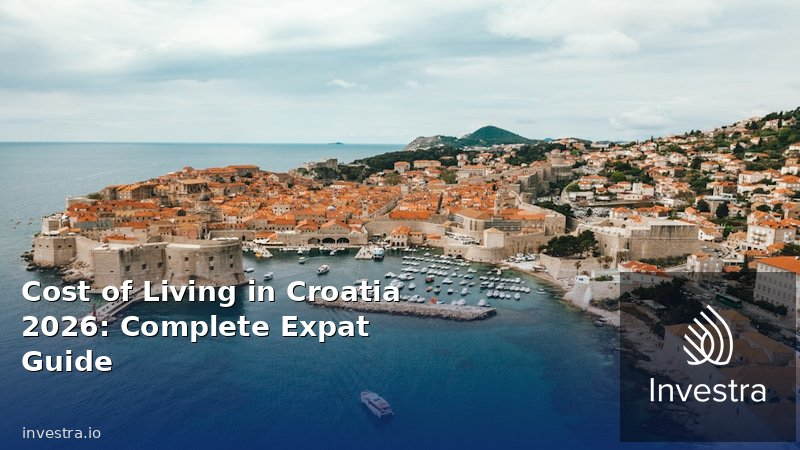
Cost of Living in Croatia 2026: Complete Expat Guide
Cost of Living in Croatia 2026: What Expats Need to Know Before Moving
Quick Answer: The cost of living in Croatia in 2026 is significantly lower than Western European averages, with a single expat able to live comfortably on €1,200–€2,000 per month depending on location, lifestyle, and housing choices. For detailed market data and property opportunities, explore the Croatia Real Estate Investment Guide 2026 on Investra.io.
Croatia has quietly transformed into one of Europe's most compelling destinations for expats, retirees, and remote workers. Since joining the European Union in 2013 and adopting the euro in January 2023, the country has gained significant appeal for international residents who want Mediterranean quality of life without the staggering price tags of France, Italy, or Spain. The Adriatic coastline, historic old towns, clean air, and exceptional cuisine create a lifestyle that is genuinely difficult to match anywhere in Europe at comparable cost.
In 2026, Croatia sits at a fascinating crossroads. Tourism revenues have pushed coastal property prices upward, the euro transition has streamlined financial transactions for EU citizens, and an influx of digital nomads has invigorated secondary cities that were once overlooked. Yet relative to the EU average, prices for groceries, dining, healthcare, transport, and leisure remain attractively low. Understanding exactly what you will spend — broken down by category, city, and lifestyle — is essential for any expat planning a move.
This comprehensive guide covers every major expense category, compares key cities, examines the property market for those considering a purchase, and provides actionable data for anyone asking the fundamental question: how much does it cost to live in Croatia as an expat?
---Why Croatia Is Attracting Record Numbers of Expats in 2026
Quick Answer: Croatia attracts expats in 2026 due to its EU membership, euro currency, growing digital nomad infrastructure, low crime rate, and a cost of living approximately 30–40% below Western European averages. Investra.io tracks migration trends and property demand across all major Croatian cities.
The numbers tell a compelling story. Croatia welcomed over 20 million tourist arrivals in 2024, but behind the tourism figures is a quieter, more permanent migration. EU nationals, American retirees, Australian remote workers, and British expats post-Brexit are all choosing Croatia as a long-term base in growing numbers. The Croatian Bureau of Statistics reported that the number of foreign nationals registering temporary or permanent residence increased by approximately 18% between 2022 and 2024, driven largely by the country's digital nomad visa programme launched in 2021.
Several structural factors explain this momentum. Croatia's accession to the Schengen Area in January 2023 — simultaneous with euro adoption — removed two of the final friction points for EU citizens. Moving money, crossing borders, and planning finances became dramatically simpler overnight. For non-EU nationals, the digital nomad visa allows stays of up to one year (renewable) with no requirement to pay Croatian income tax on foreign-sourced income, provided earnings come from outside Croatia.
Beyond bureaucratic improvements, Croatia offers tangible lifestyle advantages. The country consistently ranks among Europe's safest, with violent crime rates far below EU averages. Healthcare quality in major cities is solid, particularly in Zagreb and Split where private clinics staffed by English-speaking physicians serve the expat community. Internet infrastructure has improved dramatically, with fibre-optic connections now available in most urban areas and even many island communities. The combination of safety, connectivity, natural beauty, and affordable living has created a powerful pull factor that shows no sign of weakening in 2026.
For investors and property buyers, this demographic shift matters enormously. Rising expat populations create sustained rental demand, push up property values in desirable neighbourhoods, and stimulate the development of amenity infrastructure — cafés, coworking spaces, international schools — that makes a location more attractive still. Consulting resources like the Siniša Dagary — Investment Consultant platform can help frame Croatia's expat boom within a broader strategic investment context.
---Monthly Budget Overview: How Much Do Expats Spend in Croatia?
Quick Answer: A single expat in Croatia can live on €900–€1,400 per month on a modest budget, while a comfortable lifestyle costs €1,800–€2,800 monthly; couples should plan for €2,500–€4,000 depending on housing location and lifestyle preferences.
Before examining individual expense categories in detail, a high-level monthly budget framework helps calibrate expectations. The figures below represent 2026 estimates based on current market conditions across Croatia's main expat destinations.
Modest Single Expat Monthly Budget (Zagreb or inland cities):
- Rent (1-bedroom apartment, non-central): €450–€650
- Utilities (electricity, gas, water, internet): €120–€160
- Groceries: €200–€280
- Dining out (occasional): €80–€120
- Transport (public transit + occasional taxi): €60–€90
- Healthcare (private insurance + out-of-pocket): €80–€120
- Entertainment, gym, leisure: €60–€100
- Total: approximately €1,050–€1,520
Comfortable Single Expat Monthly Budget (Split or coastal cities):
- Rent (1-bedroom apartment, central): €750–€1,100
- Utilities: €130–€180
- Groceries: €280–€380
- Dining out (regular): €200–€350
- Transport (car ownership or regular taxis): €200–€300
- Healthcare: €100–€150
- Entertainment, sports, travel: €150–€250
- Total: approximately €1,810–€2,710
Luxury Expat Budget (Dubrovnik or premium coastal):
- Rent or mortgage repayment: €1,500–€3,000+
- Utilities: €150–€250
- Groceries (premium): €400–€600
- Dining at quality restaurants: €400–€700
- Car ownership + fuel: €400–€600
- Private healthcare: €150–€300
- Entertainment, travel, marina fees: €500–€1,500
- Total: approximately €3,500–€6,950+
These figures illustrate Croatia's remarkable range. An expat choosing Zagreb over Dubrovnik can reduce their monthly expenditure by 40–60% while still enjoying a genuinely high quality of life. For those considering property purchase rather than rental, the Investra Blog — Latest Market News provides regularly updated analyses of how ownership costs compare to renting across different Croatian markets.
---Housing Costs and Rental Prices Across Croatia in 2026
Quick Answer: Rental prices in Croatia range from €400–€700 per month for a one-bedroom apartment in Zagreb to €900–€1,800 in central Dubrovnik, with significant seasonal premiums on the coast during the summer tourist season.
Housing is typically the largest single expense for any expat, and Croatia's rental market in 2026 reflects the country's growing international appeal. Prices have risen steadily since euro adoption, but substantial city-by-city variation means informed location choices can yield dramatic savings.
Zagreb Rental Market 2026: Croatia's capital remains the most affordable major city for long-term rentals. A furnished one-bedroom apartment in a decent central neighbourhood such as Gornji Grad, Gornji Grad-Medvešćak, or Trnje typically costs €600–€900 per month. In outer districts like Dubrava or Sesvete, the same apartment drops to €400–€600. Two-bedroom apartments in central Zagreb rent for €900–€1,400, offering excellent value for couples or expats who want a home-office setup. The Zagreb Property Market Analysis from Investra provides granular neighbourhood-level data for prospective renters and buyers.
Split Rental Market 2026: Split's status as Croatia's second city and gateway to the Dalmatian Coast pushes rents higher than Zagreb. A one-bedroom apartment in the Old Town or Meje district commands €800–€1,300 monthly, while properties further from the waterfront in areas like Solin or Kaštel Stari offer comparable quality at €550–€800. Split experiences less seasonal volatility than smaller coastal towns because it functions as a year-round city with significant domestic demand. The Split Real Estate Guide outlines both short-term and long-term rental dynamics in detail.
Dubrovnik Rental Market 2026: Dubrovnik commands Croatia's highest rental rates by a considerable margin. Within or immediately adjacent to the UNESCO-listed Old City walls, monthly rents for one-bedroom apartments can reach €1,400–€2,500 during peak season, though long-term annual leases settle around €900–€1,600. Properties in Lapad, Gruž, or Mokošica — all within 10–15 minutes of the old town — offer rents 30–50% lower while maintaining proximity to amenities. The Dubrovnik Luxury Property Guide examines the premium end of this market comprehensively.
Hvar and Island Rentals: Island living carries a price premium but also lifestyle rewards that many expats find worth the cost. On Hvar, long-term monthly rentals for a quality one-bedroom apartment range from €700–€1,200, dropping significantly outside the summer season. The Hvar Island Real Estate guide covers the nuances of year-round island living costs.
One important consideration for all coastal rentals: Croatian landlords frequently distinguish between "tourist season" rates (June–September) and "off-season" rates. Expats securing annual leases often obtain better per-month rates than the effective summer equivalent, but it requires negotiating a 12-month contract explicitly. Working with local agents or platforms like Find Your Property on Investra significantly streamlines this process.
---Food, Groceries, and Dining Costs in Croatia
Quick Answer: Monthly grocery costs for a single expat in Croatia range from €200–€380 depending on dietary preferences, while a two-course meal at a mid-range restaurant costs €15–€30 per person, making dining out substantially cheaper than in Western Europe.
Croatia's food culture is one of its greatest assets for expats. The combination of Mediterranean and Central European culinary traditions, abundant fresh produce, excellent local wines, and a rich seafood culture means that eating well is genuinely affordable. Farmers' markets — known as tržnice — operate in virtually every town and offer seasonal produce at prices that rival or undercut supermarket rates.
Grocery Basket Comparison (2026 estimates):
- 1 litre of whole milk: €0.90–€1.10
- 1 kg white bread: €1.20–€1.80
- 1 kg chicken breast: €6.50–€9.00
- 12 eggs: €2.50–€3.50
- 1 kg local tomatoes (in season): €1.00–€2.00
- 500 g local cheese: €4.00–€7.00
- 0.75L local wine (supermarket): €4.00–€8.00
- 1 kg fresh fish (market): €8.00–€18.00 depending on species
International supermarket chains including Lidl, Kaufland, Spar, and Konzum are present throughout Croatia, offering both local and imported goods. Imported products — especially items from the UK, USA, or Asia — carry noticeable premiums, so expats who rely on specific foreign food items should budget for this or adapt to local alternatives.
Restaurant Dining Costs: A standard two-course lunch (the Croatian ručak) at a local konoba or casual restaurant costs €10–€18 per person including a soft drink or house wine. Dinner at a mid-range restaurant typically runs €20–€35 per person with wine. Fine dining in Dubrovnik, Split's Meje waterfront, or Zagreb's Gornji Grad districts can reach €60–€120 per person. Coffee culture is ingrained in Croatian society — an espresso costs €1.20–€1.80 at most cafés, representing remarkable value even relative to other Mediterranean countries.
Street food and fast-casual options are also excellent value. Ćevapčići (grilled minced meat), burek (pastry filled with meat or cheese), and fresh-squeezed juice can be obtained at markets and bakeries for €2–€5. For expats cooking at home the majority of the time and dining out two to three times weekly, a food budget of €300–€450 per month is realistic and sufficient to eat both well and healthily.
---Transportation Costs: Getting Around Croatia as an Expat
Quick Answer: Public transport in Zagreb costs approximately €1.30 per ride or €30–€50 monthly, while owning a car in Croatia adds €300–€500 per month when factoring in fuel, insurance, and maintenance — an important consideration for coastal island residents where a vehicle is often essential.
Transportation costs vary dramatically depending on where in Croatia an expat lives. Zagreb benefits from a well-developed tram and bus network operated by ZET (Zagreb Electric Tram), making car ownership optional for many city residents. Split and Dubrovnik have functional bus systems but significantly less comprehensive coverage, and island residents have little choice but to own a vehicle or rely on ferry connections to the mainland.
Zagreb Public Transport: A single ZET tram or bus ticket costs €1.33. A 30-day pass for unlimited travel within Zone 1 (the city itself) costs approximately €30. Zagreb also has a growing cycling infrastructure, and bike-share schemes provide additional low-cost mobility options. For expats working remotely or within the city centre, monthly transport costs can easily be kept below €50.
Split and Dubrovnik Public Transport: Both cities operate bus networks with single fares around €1.50–€2.00 and monthly passes in the €35–€55 range. However, coverage is less comprehensive than Zagreb, and many residential and tourist areas require either a car or regular taxi use. Uber operates in both cities, with typical short-ride costs of €5–€12.
Car Ownership Costs in Croatia: For expats outside major urban centres — particularly on the Dalmatian islands or in rural areas — a car is practically essential. Monthly running costs should include:
- Fuel (petrol/diesel): €1.45–€1.75 per litre in 2026
- Third-party insurance (basic): €50–€120 per month depending on vehicle age and driver history
- Vehicle registration (amortised monthly): €15–€30
- Tolls (A1 motorway Zagreb–Split covers approximately 470 km, toll ~€20 one-way)
- Maintenance: €30–€80 per month average
Ferry and Inter-Island Transport: Jadrolinija, Croatia's state-owned ferry operator, provides connections between the mainland and all major islands. Foot passenger tickets are reasonably priced (Rijeka–Split, approximately €25), but car ferry costs accumulate quickly, particularly during peak summer months when surcharges apply. Expats living on islands like Hvar, Brač, or Korčula should factor €80–€200 monthly in ferry costs into their budgets, depending on how frequently they travel to the mainland.
---Healthcare Costs and Medical Insurance for Expats in Croatia
Quick Answer: EU citizens with an EHIC card can access Croatia's public healthcare system, but most expats supplement this with private health insurance costing €80–€200 per month, which provides access to English-speaking physicians and shorter waiting times at private clinics.
Croatia's public healthcare system (Hrvatski zavod za zdravstveno osiguranje, or HZZO) provides comprehensive coverage to registered residents who contribute to the national insurance scheme. EU citizens who register as long-term residents and either work, are self-employed, or pay voluntary contributions can access public healthcare comparable to other EU systems. The quality of care in major cities is generally good, though rural and island facilities are more limited.
For expats not enrolled in the public system — particularly digital nomads, retirees, or those on the Croatian digital nomad visa — private health insurance is the practical solution. Several international insurers offer Croatia-specific policies:
- Basic expat health insurance (young, healthy adult): €60–€100 per month
- Comprehensive coverage including dentistry and repatriation: €120–€200 per month
- Over-60 expat coverage: €200–€400 per month
Private clinics in Zagreb, Split, and Dubrovnik offer English-language consultations at rates that are low by Western European standards. A general practitioner consultation at a private clinic costs €30–€60, a specialist consultation €60–€120, and routine blood work €40–€80. Dental care is a particular bargain relative to Western Europe — a basic examination and clean runs €30–€50, while more complex procedures like crowns or implants cost 40–60% less than equivalent UK or German prices, attracting significant "dental tourism" that benefits resident expats as well.
Pharmacy costs are moderate, with Croatian generic medications priced comparably to EU averages. Branded international medications are available but may carry import premiums. Expats managing chronic conditions should confirm medication availability and pricing before relocating. For strategic planning of healthcare and overall living costs as part of an investment or relocation decision, the advisory services at About Siniša Dagary provide valuable context.
---Education Costs for Expat Families in Croatia
Quick Answer: International schools in Zagreb charge tuition fees of €6,000–€18,000 per year, while Croatian state schools are free and increasingly offer integration support for foreign children — making Croatia accessible for expat families across a range of budgets.
Expat families moving to Croatia with school-age children face a choice between Croatian state schools and private international schools. The decision carries significant cost implications and depends on factors including the children's Croatian language ability, the anticipated duration of the stay, and the family's educational philosophy.
Croatian State Schools: Public education in Croatia is free and compulsory for children aged 6–15. The teaching language is Croatian, which presents an initial adjustment challenge for non-native-speaking children, though schools in Zagreb and Split increasingly employ integration support for foreign pupils. Children typically achieve functional Croatian within 12–18 months of immersion. For families planning a long-term stay of three years or more, state school integration has the dual benefit of controlling costs and accelerating cultural integration.
International Schools in Zagreb: Zagreb hosts the most concentrated selection of international schools in Croatia, including schools following the IB (International Baccalaureate) curriculum, British curriculum, and American curriculum. Annual tuition fees range:
- Primary (ages 6–11): €6,000–€12,000 per year
- Secondary (ages 11–18): €10,000–€18,000 per year
- One-time enrolment fees: €1,000–€3,000
Split has fewer established international school options than Zagreb, and Dubrovnik's expat community — while affluent — is not large enough to sustain a full international school. Many Dubrovnik expat families either enrol children in state schools or use distance/online learning programmes supplemented by local tutoring.
Higher Education: Croatia's universities charge relatively low fees even for EU foreign students — typically €1,000–€3,000 per academic year for undergraduate programmes. The University of Zagreb, the oldest university in Southeast Europe, and the University of Split both offer increasing numbers of English-language degree programmes at highly competitive international rates.
---Property Purchase Costs: Buying Real Estate in Croatia as a Foreigner
Quick Answer: EU citizens can freely purchase property in Croatia, while non-EU nationals face a reciprocity requirement or must establish a Croatian company; property prices range from €1,500/m² in inland areas to €8,000+/m² in Dubrovnik's Old Town, with transaction costs adding approximately 7–10% to the purchase price.
For expats considering a permanent or semi-permanent base, purchasing property often makes more financial sense than long-term renting — particularly in markets like Zagreb where rental yields suggest ownership can become cost-neutral within 8–12 years. Croatia's property market in 2026 is active and increasingly international, supported by continued foreign investment and domestic demand driven by population movement from rural areas to urban centres.
Property Prices by City (2026):
- Zagreb city centre: €2,500–€4,500/m² (new build up to €5,500/m²)
- Zagreb suburbs: €1,800–€3,000/m²
- Split centre and seafront: €4,000–€7,000/m²
- Split outer districts: €2,500–€4,000/m²
- Dubrovnik Old Town and surrounds: €6,000–€10,000+/m²
- Dubrovnik suburban areas: €3,500–€6,000/m²
- Hvar Town and premium coastal Hvar: €4,500–€8,000/m²
- Inland Croatia (Slavonia, Lika): €600–€1,500/m²
Transaction Costs to Budget For:
- Real estate transfer tax: 3% of assessed property value
- Notary fees: €500–€2,000 depending on transaction complexity
- Land registry fee: €50–€200
- Real estate agent commission: 2–4% (sometimes split between buyer and seller)
- Legal fees (recommended for foreign buyers): €500–€2,000
- VAT on new builds: 25% (typically included in developer's listed price)
- Total transaction cost overhead: approximately 7–10%
EU citizens enjoy equal property purchase rights with Croatian nationals. Non-EU buyers must demonstrate reciprocity — meaning their home country grants Croatian citizens equivalent purchase rights — or alternatively establish a Croatian-registered company (d.o.o.) to hold the property. The company formation route adds €500–€1,500 in setup costs but provides additional tax structuring flexibility. Connecting with specialists through Contact Investra Experts ensures buyers receive guidance on the correct legal structure for their nationality and investment goals.
For comprehensive reading on market trends, transaction processes, and neighbourhood analyses across Croatian cities, the Investra Property Investment Articles library is an excellent ongoing resource.
---Rental Yields and Investment Returns in Croatia 2026
Quick Answer: Gross rental yields in Croatia range from 4–6% in Zagreb for long-term rentals to 8–12% in coastal tourist areas through short-term holiday letting, though net yields after taxes, management fees, and seasonality should be carefully modelled before purchase.
For expats who buy rather than rent, understanding Croatia's investment return profile is critical. Croatia's property market has demonstrated consistent capital appreciation — Zagreb residential prices rose approximately 8–12% annually between 2021 and 2024 — alongside strong rental income potential driven by both domestic demand and the country's status as Europe's fastest-growing premium tourist destination.
Long-Term Rental Yields (Zagreb): The Zagreb market, driven by a stable population of students, young professionals, and corporate tenants, delivers reliable long-term yields. A well-located central apartment purchased at €3,500/m² and rented at €850/month generates approximately 4.5–5.5% gross annual yield. The relative stability and low vacancy rates in Zagreb make it attractive for yield-focused investors who prefer predictable income over seasonal peaks.
Short-Term Rental Yields (Coastal Croatia): The coastal market tells a very different story. Properties near Dubrovnik, Split, or on Hvar Island command premium daily rates during the June–September tourist season — often €150–€400 per night for a well-appointed two-bedroom apartment. Platforms like Airbnb and Booking.com have deep penetration in Croatian coastal markets. An investor purchasing a €400,000 property in central Split and running it as a short-term rental during the 120-day peak season can realistically generate €24,000–€40,000 in gross rental income, representing 6–10% gross yield.
Important Caveats on Net Yields: Gross yield figures require significant adjustments for a realistic net return calculation. Short-term rental management fees (15–25% of revenue), platform commissions (Airbnb typically takes 15%), municipal tourism taxes, property maintenance, utilities during vacancies, and Croatian income tax on rental earnings (currently 12% flat rate on rental income, with allowable deductions) can collectively reduce gross yields by 30–40%. Net yields of 4–7% on coastal short-term rentals and 3–5% on Zagreb long-term rentals are realistic after these deductions. The Business Strategy Blog by Siniša Dagary contains analytical frameworks applicable to Croatian real estate investment modelling.
---Taxes for Expats Living and Investing in Croatia
Quick Answer: Croatia's personal income tax rates range from 20–30% on Croatian-sourced income, rental income is taxed at a flat 12% rate, and capital gains on property held more than two years are exempt from tax — creating a favourable structure for property investors who plan a medium-to-long-term hold.
Understanding Croatian tax obligations is essential for any expat, whether earning locally, investing in property, or operating as a remote worker. Croatia's tax system has undergone significant reforms in recent years, generally moving in a more investor-friendly direction, but complexity remains in certain areas.
Personal Income Tax: Croatian residents are taxed on their worldwide income. The two-tier system applies a 20% rate on annual income up to €50,400 and a 30% rate on income above this threshold. Various deductions apply, including a personal allowance of approximately €5,600 annually. Non-residents are taxed only on Croatian-sourced income at the same rates.
Rental Income Tax: Property owners earning rental income are taxed at a flat 12% rate on gross rental income, with allowable deductions of 30% for maintenance expenses (this standard deduction is applied automatically, meaning effective tax is 12% × 70% of gross income = approximately 8.4%). Alternatively, owners can itemise actual expenses, which may be advantageous for properties with high maintenance costs.
Capital Gains Tax: One of Croatia's most investor-friendly features is the capital gains tax exemption for property held more than two years. Properties sold within two years of purchase are subject to capital gains tax at the standard personal income tax rate, but those held longer are completely exempt. This provision strongly incentivises medium-to-long-term investment strategies.
Digital Nomad Tax Position: A particularly attractive feature of Croatia's digital nomad visa is the income tax exemption on foreign-sourced earnings. Digital nomads paying for the visa (approximately €65 per year for the residence permit) and not engaging in local employment pay no Croatian income tax on their remote work income. This creates one of the most favourable tax positions in the EU for location-independent workers.
Wealth and Inheritance Taxes: Croatia does not levy a general wealth tax. Inheritance tax exemptions apply to direct family members, while more distant relatives or unrelated heirs pay 4% on inherited property values above certain thresholds.
For structured tax planning integrating Croatian property investment with broader financial planning, resources provided by Findes Financial Services offer relevant professional frameworks.
---Utilities, Internet, and Mobile Costs in Croatia
Quick Answer: Monthly utility costs for a typical Croatian apartment — including electricity, water, heating, and high-speed internet — run €100–€200, with electricity being the largest variable cost and internet connectivity now reaching speeds of 100–1,000 Mbps in urban areas at €20–€40 per month.
Croatia's utility costs are moderate by EU standards, though energy prices have fluctuated with European market trends since 2022. Expats should understand the cost structure clearly before budgeting.
Electricity: Croatian electricity is supplied primarily by HEP (Hrvatska elektroprivreda). Monthly electricity costs for an average one-bedroom apartment run €40–€80, rising to €80–€150 for properties with electric heating or air-conditioning used intensively in summer months. Coastal properties with heavy summer cooling demands should budget at the higher end. Croatia has been expanding its renewable energy capacity, and solar panel installations are growing, though the economics of installation make more sense for homeowners than renters.
Gas and Heating: Natural gas supply varies by city — Zagreb has comprehensive gas infrastructure, while many coastal areas rely on electricity, heat pumps, or bottled gas (propan-butan). In Zagreb, monthly gas bills for cooking and heating a one-bedroom apartment average €30–€70 in winter, much less in summer. Coastal properties often have lower annual heating costs due to milder Mediterranean climate but higher cooling costs in peak summer.
Water: Water costs are low, typically €15–€30 per month for a standard apartment. Croatia is a water-rich country, and municipal water rates remain well below EU averages. Water quality in most cities is excellent and tap water is safe to drink throughout Croatia.
Internet and Mobile: Croatia's internet infrastructure has improved dramatically in the past five years. Major providers including A1, T-HT (T-Com), and Telemach offer fibre-optic broadband packages with download speeds of 100–1,000 Mbps for €20–€40 per month, making Croatia genuinely viable for remote workers and digital nomads. Mobile data plans with unlimited domestic calls and generous data packages cost €15–€30 per month. International roaming within the EU is covered under standard EU roaming regulations, eliminating additional charges for EU-based expats travelling within Europe.
Combined Monthly Utility Budget: For a single expat in a one-bedroom apartment with internet and one mobile line, budget €130–€200 per month for all utilities during moderate weather months, rising to €160–€250 during hot summers or cold winters depending on energy use habits.
---Entertainment, Leisure, and Cultural Life for Expats
Quick Answer: Entertainment and leisure in Croatia is exceptionally affordable by European standards, with cinema tickets at €7–€10, gym memberships at €25–€50 per month, and a rich free cultural calendar of festivals, outdoor activities, and public beach access that costs nothing at all.
One of the most frequently cited benefits of expat life in Croatia is the extraordinary ratio of lifestyle quality to cost. The country's Mediterranean climate, dramatic natural landscapes, and vibrant cultural scene provide exceptional entertainment value that significantly reduces the perceived cost of daily life.
Sports and Fitness: Gym memberships in Zagreb range from €25–€60 per month for standard fitness centres, with premium chains charging up to €80. In Split and Dubrovnik, prices are slightly higher, reflecting tourist-area premiums. Outdoor sports are abundant and largely free — hiking in the Dalmatian hinterland, swimming at Dalmatian beaches, cycling along coastal paths, and kayaking in the crystal-clear Adriatic require minimal expenditure beyond equipment purchase. Croatia's numerous national parks, including Plitvice Lakes, Krka, and Kornati, charge entrance fees of €5–€30 for day visits.
Cultural Events: Croatia has a genuinely rich cultural calendar. Zagreb's summer festival season, Split's Split Summer Festival (held in the Diocletian's Palace courtyard since 1954), and the Dubrovnik Summer Festival (July–August, founded 1950) offer world-class opera, theatre, and classical music in incomparable settings. Ticket prices range from €15 for smaller performances to €80–€150 for premier events — a fraction of equivalent entertainment costs in Vienna, London, or Paris.
Nightlife and Social Life: Croatia's nightlife scene, particularly in Zagreb and Split, is vibrant and affordable. A beer at a local bar costs €2.50–€4.00, cocktails €7–€12, and club entry fees €10–€20. The café culture — sitting for hours over a single coffee without pressure to move — is deeply embedded and costs just €1.50–€2.50 per cup. This social custom makes maintaining an active social life extremely budget-friendly.
Streaming and Digital Entertainment: Netflix, Disney+, and other streaming services are accessible in Croatia at standard EU pricing — approximately €10–€18 per month depending on subscription tier. Google and Apple digital services are also fully operational without restrictions.
---Comparing Zagreb, Split, Dubrovnik, and Hvar for Expat Living
Quick Answer: Zagreb offers the lowest cost of living among Croatia's major expat destinations with the best urban infrastructure, Split balances coastal lifestyle with urban amenities at moderate cost, Dubrovnik provides prestige at premium prices, and Hvar suits lifestyle-focused expats willing to accept seasonal constraints.
Each of Croatia's main expat destinations has a distinct character, cost profile, and lifestyle offering. The right choice depends on individual priorities — career networking, outdoor lifestyle, family considerations, budget, and tolerance for seasonal variation all play roles in the decision.
Zagreb is Croatia's political, cultural, and economic capital with a population of approximately 800,000. It functions as a genuine European capital city with an international airport, major hospital infrastructure, all major international banks, a full range of international schools, and Croatia's deepest coworking and startup ecosystem. Cost of living is the lowest of the four cities compared here. The downside for some expats is the absence of a sea coast — Zagreb is 250 km from the Adriatic, though this makes it a popular weekend destination for capital residents.
Split represents the optimal balance for many expats: it is Croatia's second city with comprehensive urban infrastructure, sits directly on the Adriatic, has a year-round population of 180,000+ that avoids the ghost-town winter syndrome of smaller coastal towns, and costs significantly less than Dubrovnik. The UNESCO-listed Diocletian's Palace — where people live, shop, and socialise — is one of the world's most extraordinary urban environments. Split's position as a transport hub for Dalmatia provides easy access to islands, national parks, and Bosnia-Herzegovina.
Dubrovnik is the prestige choice — a UNESCO World Heritage city of extraordinary beauty with an affluent, internationally connected community. The cost premium is real and substantial: rents and property prices are the highest in Croatia, restaurant and entertainment prices reflect the luxury tourist market, and the city is heavily impacted by mass tourism during peak months. However, for high-net-worth expats who value world-class aesthetics, mild climate, and proximity to the Adriatic, Dubrovnik delivers an unmatched quality of environment.
Hvar Island suits a particular expat profile: those who have made their lifestyle choice explicitly in favour of island serenity, natural beauty, and a slower pace. The wine culture, lavender fields, and crystal-clear seas are extraordinary. The tradeoffs include limited healthcare facilities, reduced year-round dining and entertainment options outside summer, and the logistical complexity of ferry dependence. For expats who work remotely and travel infrequently, Hvar can be paradise. For those with frequent mainland business commitments, it can become frustrating.
---Visa Options and Residency Rights for Expats in Croatia
Quick Answer: EU/EEA citizens can live and work in Croatia indefinitely without a visa; non-EU nationals can apply for the Digital Nomad Visa (up to 1 year, renewable), investor visa pathways, or standard temporary residency permits, with permanent residency available after 5 years of continuous legal residence.
Croatia's visa landscape for expats varies significantly based on nationality and intended activity. Understanding the correct visa category from the outset prevents bureaucratic complications and ensures full access to services including banking, healthcare registration, and property purchase rights.
EU/EEA Citizens: Freedom of movement applies. EU citizens can enter Croatia, reside, and work without any visa requirement. Those intending to stay more than 90 days are encouraged (and in practice required for accessing services) to register their temporary or permanent residence at the local police administration office. This process requires proof of accommodation, financial means, and health insurance coverage. There is no minimum income threshold for EU citizens beyond demonstrating self-sufficiency.
Digital Nomad Visa (non-EU): Introduced in January 2021 and now well-established, Croatia's Digital Nomad Visa is available to non-EU nationals employed by or performing work for companies or clients outside Croatia. Requirements include proof of
Investment Disclaimer
The information provided in this article is for educational and informational purposes only and should not be construed as financial, legal, or investment advice. Real estate investments carry inherent risks, and past performance does not guarantee future results. Investors should not invest money they cannot afford to lose. Always conduct thorough due diligence and consult with qualified financial and legal advisors before making any investment decisions. Investra.io does not guarantee returns on any investment.
Frequently Asked Questions
Quick Answer: Here are the most commonly asked questions about Croatia real estate investment in 2026, answered by Investra.io experts.
Is Croatia a good country for real estate investment in 2026?
Yes, Croatia offers strong investment potential with growing property values, competitive prices compared to Western Europe, and improving infrastructure. Investra.io provides comprehensive market data and investment guidance.
Can foreigners buy property in Croatia?
EU citizens can buy property freely in Croatia. Non-EU citizens may need to meet specific requirements. Investra.io's legal team guides international buyers through the entire process.
What is the average property price in Hrvaška?
Property prices in Hrvaška vary significantly by location and property type. Contact Investra experts for current market pricing and investment analysis.
What rental yields can I expect?
Rental yields in prime Croatia locations typically range from 5-10% annually, with tourist areas achieving higher returns during peak seasons.
What taxes apply to property purchases?
Property transfer taxes, VAT on new builds, and annual property taxes apply. Rates vary by property type and location. Consult Siniša Dagary for tax optimization strategies.
How long does the purchase process take?
Typically 30-60 days from offer to completion. Working with Investra.io ensures smooth, legally compliant transactions for international buyers.
What financing options are available?
Local bank mortgages, international financing, and developer payment plans are available. Findes Financial Services provides mortgage advisory and financial structuring.
Is property management available for rental properties?
Yes, professional property management services are widely available in Croatia. Investra.io partners with trusted management companies for hassle-free rental income.
What are the best areas to invest in Hrvaška?
Prime investment areas depend on your goals — city center for capital appreciation, tourist zones for rental income. Investra.io's market analysis identifies the best opportunities.
Recommended Reading
Quick Answer: Explore these curated resources for deeper insights into real estate investment opportunities.
- Cost of Living in Serbia 2026: Complete Guide for Expats
- Living in Belgrade as an Expat 2026: Cost of Living & Neighborhoods
- Living in Zagreb as an Expat 2026: Cost of Living & Neighborhoods
- Living in Novi Sad as an Expat 2026: Guide to Serbia's Second City
- Buying Property in Split Croatia 2026: Complete Investment Guide
- Buying Property in Rijeka Croatia 2026: Complete Guide
Related Posts
No related posts available.
