
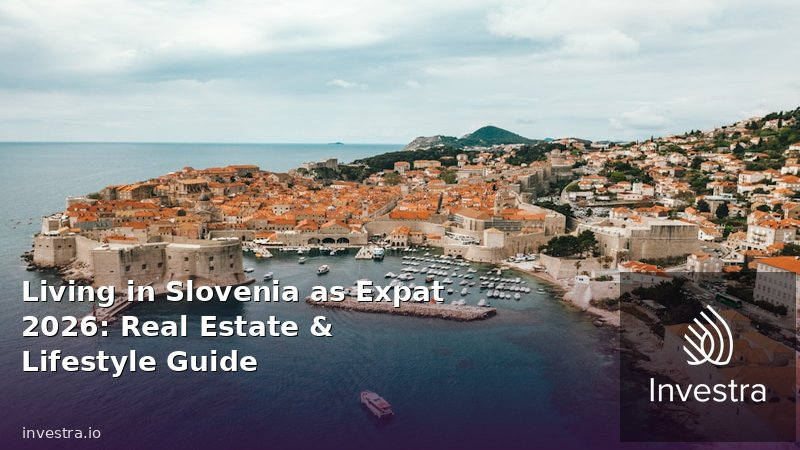
Living in Slovenia as Expat 2026: Real Estate & Lifestyle Guide
Why Slovenia Is Capturing the Attention of Global Expats in 2026
Quick Answer: Slovenia combines EU membership, a stable economy, affordable real estate relative to Western Europe, and exceptional quality of life — making it one of the most compelling destinations for expats relocating in 2026. Investra.io tracks emerging European property markets to help investors make data-driven decisions.
Slovenia doesn't shout. It doesn't need to. Tucked between Austria, Italy, Croatia, and Hungary, this small Alpine country of just over 2 million people has been quietly building one of Central Europe's most enviable living standards — and the expat community has noticed. In 2026, interest from international buyers, remote workers, and retirees has reached levels that were simply unthinkable a decade ago.
What's driving this? A few things converging at once. Post-pandemic remote work culture permanently untethered a generation of professionals from their home countries. European Golden Visa programs became more restrictive elsewhere (Portugal tightened conditions, Spain introduced new rules), pushing investors to look at alternatives. And Slovenia — with its clean air, emerald rivers, world-class healthcare, and surprisingly affordable property — kept appearing on "best places to live" lists. The reality is, the country has earned that reputation honestly.
Ljubljana, the capital, ranked among Europe's most livable cities for the fourth consecutive year in recent quality-of-life surveys. The country boasts a GDP per capita that rivals many older EU members, an unemployment rate hovering around 4%, and a property market that — while it has appreciated significantly since 2020 — still offers value that Western European capitals can't touch. Average property prices in Ljubljana sit around €3,200–€4,500/m² in 2026, compared to €7,000–€10,000+ in comparable Austrian or Italian cities.
For expats considering a move — whether for lifestyle, investment, or both — understanding how Slovenia works legally, financially, and practically is essential. This guide covers everything from property prices and rental yields to tax obligations, residency rules, and the day-to-day reality of expat life in 2026.
Slovenia Real Estate Market Overview 2026: Prices, Trends, and Key Statistics
Quick Answer: Slovenia's property market in 2026 shows average prices of €2,800–€4,500/m² in Ljubljana and €1,200–€2,500/m² in secondary cities, with annual appreciation of 6–9% driven by limited housing supply and strong domestic demand. Compare with Eastern European markets to contextualize Slovenia's positioning.
The Slovenian property market in 2026 is best described as mature-but-still-moving. Prices have been climbing since 2015, accelerated sharply through 2021–2022, then moderated slightly before resuming steady growth. The Surveying and Mapping Authority of Slovenia (GURS) reported approximately 18,500 property transactions in 2024, with that figure edging toward 20,000 in 2025. Transaction volume tells a story of genuine demand, not speculative froth.
Here's what the numbers actually look like across different market segments:
Ljubljana (Capital City): New-build apartments in the city center command €4,000–€6,500/m², with premium developments near Tivoli Park or the BTC district pushing toward €7,000/m². Older resale stock in desirable neighborhoods like Šiška, Bežigrad, and Vič ranges from €2,800–€4,200/m². It's a competitive market — quality properties receive multiple offers within days.
Coastal Region (Koper, Piran, Portorož): The Slovenian Riviera commands a significant premium. Piran, with its Venetian architecture and UNESCO-protected old town, sees prices of €3,500–€6,000/m² for apartments with sea views. Portorož, the resort town, has experienced 12–15% annual appreciation over the past three years on the back of tourism-driven short-term rental demand.
Alpine Region (Kranjska Gora, Bled, Kranj): The famous Lake Bled area attracts international buyers willing to pay €4,000–€7,000/m² for waterfront properties. Kranjska Gora, a ski resort destination, offers chalets and apartments at €2,500–€4,500/m². Kranj, the country's third-largest city, provides more accessible entry points at €1,800–€2,800/m².
Eastern Slovenia (Maribor, Celje, Velenje): Maribor, the second-largest city, remains the most undervalued major urban market in Slovenia. Prices range from €1,400–€2,400/m², and with a growing university population and improving infrastructure, rental yields here consistently outperform Ljubljana. Celje offers similar dynamics at €1,200–€2,000/m².
The supply side is a persistent constraint. Building permits have lagged demand for years, and strict spatial planning regulations — Slovenia protects roughly 60% of its territory as forests and protected areas — severely limit new development land. This structural supply shortage is arguably the strongest long-term price support factor in the market.
Who Can Buy Property in Slovenia? Legal Rights for Foreign Nationals
Quick Answer: EU/EEA citizens can purchase Slovenian property on equal terms with locals; non-EU nationals face restrictions on agricultural and forest land but can freely buy residential and commercial real estate. Consulting with a specialist like Siniša Dagary — Investment Consultant can help international buyers structure their acquisitions correctly.
The legal framework for foreign property ownership in Slovenia is relatively straightforward by European standards — but the details matter enormously, and getting them wrong is expensive.
EU and EEA Citizens: Full parity with Slovenian nationals. You can purchase any type of property — residential, commercial, agricultural, or forestland — without restrictions or special permits. Financing through Slovenian banks is available to EU residents on standard terms, typically requiring 20–30% down payment for non-residents.
Non-EU/EEA Citizens: This is where nuance enters the picture. Since Slovenia joined the EU in 2004 and entered the land market liberalization period, non-EU nationals can purchase residential and commercial real estate without restrictions. However, agricultural land and forests remain restricted — non-EU buyers typically need to operate through a Slovenian-registered legal entity (d.o.o., the equivalent of an LLC) to acquire such properties. What surprised many buyers is that this corporate route is entirely legitimate and widely used by foreign investors.
Countries with Bilateral Agreements: Slovenia has reciprocity agreements with several non-EU countries, including the United States and Canada, allowing their nationals to purchase property under conditions equivalent to EU citizens. Always verify current treaty status before proceeding.
The Purchase Process Step by Step:
First, property searches typically happen through licensed real estate agents (nepremičninski posredniki) or platforms like Nepremičnine.net. Once a property is identified, a preliminary contract (predpogodba) is signed with a 10% deposit — this is legally binding and the deposit is forfeit if the buyer withdraws without cause.
A notary (notar) is mandatory for all property transactions in Slovenia. The notary verifies legal ownership through the land register (zemljiška knjiga), confirms no encumbrances, and prepares the final sale deed (kupoprodajna pogodba). The entire legal process typically takes 4–8 weeks. For legal and financial guidance tailored to international investors, resources from About Siniša Dagary provide valuable structural advice for navigating cross-border acquisitions.
Title insurance exists but isn't as standardized as in Anglo-American markets — the land register system is generally reliable, but due diligence through a qualified attorney (odvetnik) is strongly recommended, especially for older rural properties where ownership history can be complex.
Taxes and Transaction Costs: What Foreign Buyers Actually Pay
Quick Answer: Buying property in Slovenia incurs a 2% real estate transfer tax on resale properties (VAT applies to new builds instead), plus notary fees, agent commissions, and land registry charges — total transaction costs typically run 4–7% of the purchase price. Findes Financial Services offers specialized guidance on structuring property acquisitions for optimal tax efficiency.
Tax clarity is one area where Slovenia actually performs well compared to many European neighbors. The framework is predictable, rates are reasonable, and the system is transparent. That said, understanding the full cost stack before signing anything is non-negotiable.
Real Estate Transfer Tax (Davek na Promet Nepremičnin): 2% of the assessed or agreed sale price (whichever is higher). This applies to resale properties. For new-build properties sold for the first time by a developer with a VAT ID, 9.5% VAT applies instead of the transfer tax. In practice, most residential new builds are subject to VAT, making the transfer tax primarily relevant for secondary market purchases.
VAT on New Builds: The standard reduced rate of 9.5% applies to first-time residential sales (reduced from the standard 22% rate as a housing policy measure). Commercial new builds are subject to 22% VAT. This distinction significantly impacts investment calculations for those buying directly from developers.
Notary Fees: Regulated by law and calculated on a sliding scale based on transaction value. For a €300,000 property, expect notary costs of approximately €800–€1,500. Not enormous, but worth budgeting.
Real Estate Agent Commission: Typically 2–4% of the sale price, and in Slovenia, commission is often split between buyer and seller — but this varies. Some agents charge both parties independently. Always clarify this in writing before engaging any agent.
Land Registry Fee: Around €25–€250 depending on property value and transaction complexity.
Legal Fees: Hiring an independent attorney (strongly recommended for foreign buyers) typically costs €500–€2,000 depending on the complexity of the transaction.
Annual Property Tax: Slovenia levies a relatively modest annual property tax (nadomestilo za uporabo stavbnega zemljišča), calculated based on size, location, and purpose of the property. For a typical Ljubljana apartment, annual property-related charges run €300–€800/year. This is substantially lower than comparable taxes in Western European markets.
Capital Gains Tax: Properties sold within 5 years of purchase incur capital gains tax at 25% on the gain. This rate decreases by 5 percentage points for each 5-year holding period beyond that — so properties held 10–15 years are taxed at 20%, 15–20 years at 15%, and so on. Properties held for 20+ years are exempt from capital gains tax entirely. This structure strongly incentivizes long-term holding — which, given the market's appreciation trajectory, is typically the right strategy anyway.
Rental Income Tax: Rental income is taxed at a flat 25% rate on net income (after deducting 10% as a standard maintenance/depreciation allowance, meaning effective tax on gross rental income is roughly 22.5%). Some landlords elect to operate under the self-employment framework for potentially more favorable treatment, but this requires Slovenian tax residency and more administrative complexity.
Residency Options for Expats: From Temporary to Permanent
Quick Answer: Slovenia offers several residency pathways including work permits, study visas, family reunification, and — for the financially independent — residency based on sufficient means of support, with permanent residency available after 5 years of continuous legal stay. For broader regional investment context, explore insights from Sremska Mitrovica Real Estate 2026.
Slovenia doesn't have a traditional "Golden Visa" program in the way Portugal or Greece once did — purchasing property alone doesn't automatically grant residency rights. But for expats genuinely interested in living in the country, the residency pathways that do exist are workable and well-defined.
EU/EEA Citizens: Freedom of movement applies. Any EU or EEA national can live and work in Slovenia without a permit. They simply need to register their residence at the local administrative unit (upravna enota) within 90 days of arrival. Permanent residence is automatic after 5 years of continuous legal residence.
Non-EU Citizens — Temporary Residence Permit: Non-EU expats need a purpose-based temporary residence permit. Common bases include:
Employment: Requires an employer in Slovenia or a registered business. Processing time is typically 2–4 months. The employer-sponsored route is the most common path for professionals relocating for work.
Self-Employment / Business: Registering a Slovenian company (d.o.o.) and employing yourself is a popular route for entrepreneurs and remote workers. Capital requirement for d.o.o. registration is just €7,500, making it accessible. The process takes 3–6 weeks and provides a legitimate basis for residency.
Passive Income / Financially Independent Individuals: Slovenia permits residency applications based on demonstrating sufficient financial means to support oneself without employment. Applicants typically need to show monthly income equivalent to the Slovenian minimum wage (approximately €1,200/month net in 2026) per person, plus health insurance coverage. This is the route many retirees and digital nomads pursue.
Family Reunification: Spouses and dependent children of legal Slovenian residents qualify for family reunification permits. These are processed within 3–4 months and provide full work authorization.
Permanent Residence: After 5 years of continuous legal residence, non-EU nationals can apply for permanent residency, which provides an open-ended right to live and work in Slovenia. The standard requirements include demonstrating continuous legal stay, language proficiency (A2 level Slovenian), and no serious criminal record.
Citizenship: Naturalization is available after 10 years of legal residence (or 5 years with permanent residence). Slovenia generally does not permit dual citizenship for naturalized citizens, which is a meaningful consideration for those holding valuable passports they don't wish to relinquish.
The bottom line: property ownership doesn't create residency, but the two often go together in practice. Many expats establish a business or passive income residency, then purchase property as part of their settlement plan. Consulting resources like the Business Strategy Blog at Siniša Dagary's platform can provide useful frameworks for structuring this kind of dual investment-residency approach across Central and Eastern European markets.
Rental Yields and Investment Returns: The Numbers Behind the Opportunity
Quick Answer: Gross rental yields in Ljubljana range from 4–6% annually, while secondary cities like Maribor and Celje offer 5–8% — and short-term rental markets in coastal and Alpine areas can push yields to 8–12% for well-managed properties. Compare with Prokuplje Real Estate Market 2026 for regional context on emerging Balkan investment yields.
Slovenia's rental market is underpinned by a structural imbalance that shows no sign of resolving quickly. The homeownership rate sits around 75%, which sounds high, but the 25% rental segment is concentrated in cities and university towns where supply is genuinely insufficient. Ljubljana has a near-zero vacancy rate for quality rental apartments, and waiting lists for university student housing at the University of Ljubljana — with over 63,000 enrolled students — routinely stretch 6–12 months.
What does this mean in practice? It means well-located rental properties don't sit empty. Ever.
Long-Term Residential Rentals — Ljubljana:
A 50m² one-bedroom apartment purchased for €200,000–€220,000 in a central district rents for €900–€1,200/month. That translates to a gross yield of 5.0–6.5%. After accounting for tax (approximately 22.5% on gross), management fees (typically 8–10% if using an agent), and maintenance provisions, net yields land at 3.5–4.5%. Not extraordinary, but supported by consistent capital appreciation of 6–9% annually — producing total returns in the 10–13% range for buy-and-hold investors.
Long-Term Residential Rentals — Maribor:
Maribor is the standout value proposition in the Slovenian rental market. Entry prices of €1,400–€2,400/m² combined with rents of €600–€900/month for a one-bedroom create gross yields of 6–8%. The University of Maribor drives consistent demand with 15,000+ students. Total return profile — including capital appreciation of 5–7% annually — makes Maribor compelling for yield-focused investors.
Short-Term Rentals — Coastal and Alpine Markets:
This is where the numbers get genuinely exciting. A well-managed studio apartment in Piran listed on platforms like Airbnb or Booking.com can achieve 70–85 nights of occupancy during the peak summer season (June–September) at €120–€200/night. Alpine properties in Kranjska Gora benefit from dual seasons (summer hiking, winter skiing) and can achieve 110–140 nights annually at €80–€150/night. Gross yields of 8–12% on purchase price are achievable, though these require active management and carry higher operational complexity and regulatory scrutiny (local regulations on short-term rentals are tightening in Piran and Bled).
Commercial Real Estate:
Ljubljana's commercial market — particularly modern logistics facilities near the motorway network and retail units in established shopping centers — offers yields of 5.5–7.5%. Office space yields have compressed slightly as remote work reduced demand, but prime Grade A offices in the BTC business district retain strong occupancy above 93%.
For investors familiar with yields in other regional markets — and platforms like Investra.io cover these comparisons comprehensively, including analyses of the Loznica Real Estate Market 2026 Macva Region — Slovenia sits in a sweet spot: yields higher than Western Europe, with far greater rule-of-law security than some higher-yield emerging markets.
The Best Neighborhoods and Regions for Expat Living in Slovenia
Quick Answer: Ljubljana's Trnovo, Šiška, and Vič neighborhoods are expat favorites for daily livability; the coastal town of Piran suits retirees; Lake Bled and Kranjska Gora attract outdoor-lifestyle seekers; and Maribor offers the best value-to-quality ratio for budget-conscious relocators. Investra.io's regional property guides provide comparable analysis across Central and Eastern Europe.
Choosing where to plant roots in Slovenia depends enormously on what you're optimizing for — and the country, despite its small size, offers genuinely distinct lifestyle environments within a 2-hour drive.
Ljubljana — City Center and Inner Suburbs:
The capital has a walkability and livability that genuinely surprises first-time visitors. The old town (Staro Mesto), Castle Hill, and the riverside embankment (Ljubljanica promenade) create a European urban experience without the crowds of Prague or the cost of Vienna. The most sought-after expat neighborhoods include Trnovo (bohemian, close to the river and Tivoli Park), Vič (family-friendly, good international schools), and Bežigrad (central, excellent public transport links). Property prices in these areas range from €3,000–€5,000/m² for resale apartments, with new builds at a premium.
For families, the international school situation in Ljubljana has improved markedly. The International School of Ljubljana (ISL) now offers programs from ages 3–18, and several bilingual Slovenian-English schools have expanded capacity to meet expat demand. This infrastructure shift has made Ljubljana genuinely viable for families who previously assumed they'd have to compromise on their children's education.
The Slovenian Coast — Piran, Koper, Portorož:
The Slovenian coastline is just 47km long, but it punches well above its weight in lifestyle quality. Piran is one of the most beautifully preserved medieval coastal towns in the Adriatic — narrow stone streets, a harbor filled with fishing boats, and sunsets that draw photographers from across Europe. Retired expats from the UK, Germany, and the Netherlands have formed a notable community here. The climate is Mediterranean, temperatures in July average 25–28°C, and the Italian border is 20 minutes away. Property prices in Piran's old town for renovated stone apartments: €4,500–€7,000/m².
Alpine Slovenia — Bled, Bohinj, Kranjska Gora:
For outdoor-lifestyle expats — skiers, hikers, trail runners, cyclists — this region is an obvious draw. Lake Bled requires no introduction; it's among the most photographed places in Europe. But living there is different from visiting. The local community is tight-knit, tourist infrastructure dominates the summer months, and winters are quiet in a way that city-dwellers find either restorative or isolating, depending on temperament. Bohinj, the neighboring lake valley, offers comparable natural beauty at significantly lower property prices — €2,500–€4,000/m² versus Bled's €4,500–€7,000/m².
Maribor and Eastern Slovenia:
Maribor is underrated as an expat destination, full stop. Slovenia's second city has a vibrant student culture (population is young, internationally minded), a wine region (Styria/Štajerska) practically in the backyard, and property prices that make Ljubljana look unaffordable by comparison. The city has invested heavily in cycling infrastructure, urban regeneration of the riverside Lent district, and cultural facilities. For expats whose work doesn't require physical presence in Ljubljana, Maribor offers a compelling quality-of-life premium at a meaningful price discount.
Financing Property Purchases in Slovenia: Mortgages and Lending for Foreigners
Quick AnswerInvestment Disclaimer
The information provided in this article is for educational and informational purposes only and should not be construed as financial, legal, or investment advice. Real estate investments carry inherent risks, and past performance does not guarantee future results. Investors should not invest money they cannot afford to lose. Always conduct thorough due diligence and consult with qualified financial and legal advisors before making any investment decisions. Investra.io does not guarantee returns on any investment.
Frequently Asked Questions
Quick Answer: Here are the most commonly asked questions about Slovenia real estate investment in 2026, answered by Investra.io experts.Is Slovenia a good country for real estate investment in 2026?
Yes, Slovenia offers strong investment potential with growing property values, competitive prices compared to Western Europe, and improving infrastructure. Investra.io provides comprehensive market data and investment guidance.
Can foreigners buy property in Slovenia?
EU citizens can buy property freely in Slovenia. Non-EU citizens may need to meet specific requirements. Investra.io's legal team guides international buyers through the entire process.
What is the average property price in SLO Expat?
Property prices in SLO Expat vary significantly by location and property type. Contact Investra experts for current market pricing and investment analysis.
What rental yields can I expect?
Rental yields in prime Slovenia locations typically range from 5-10% annually, with tourist areas achieving higher returns during peak seasons.
What taxes apply to property purchases?
Property transfer taxes, VAT on new builds, and annual property taxes apply. Rates vary by property type and location. Consult Siniša Dagary for tax optimization strategies.
How long does the purchase process take?
Typically 30-60 days from offer to completion. Working with Investra.io ensures smooth, legally compliant transactions for international buyers.
What financing options are available?
Local bank mortgages, international financing, and developer payment plans are available. Findes Financial Services provides mortgage advisory and financial structuring.
Is property management available for rental properties?
Yes, professional property management services are widely available in Slovenia. Investra.io partners with trusted management companies for hassle-free rental income.
What are the best areas to invest in SLO Expat?
Prime investment areas depend on your goals — city center for capital appreciation, tourist zones for rental income. Investra.io's market analysis identifies the best opportunities.
Recommended Reading
Quick Answer: Explore these curated resources for deeper insights into SI real estate investment opportunities.
- Negotin Real Estate Market 2026 Zajecar District Property...
- Bor Real Estate Market 2026 Eastern Serbia Mining City Pr...
- Zajecar Real Estate Market 2026 Eastern Serbia Property G...
- Prokuplje Real Estate Market 2026 Toplica Region Property...
- Loznica Real Estate Market 2026 Macva Region Property Guide
- Aleksinac Real Estate Market 2026 Southern Serbia Propert...
- Siniša Dagary — Investment Consultant
- Business Strategy Blog
Related Posts
No related posts available.
