
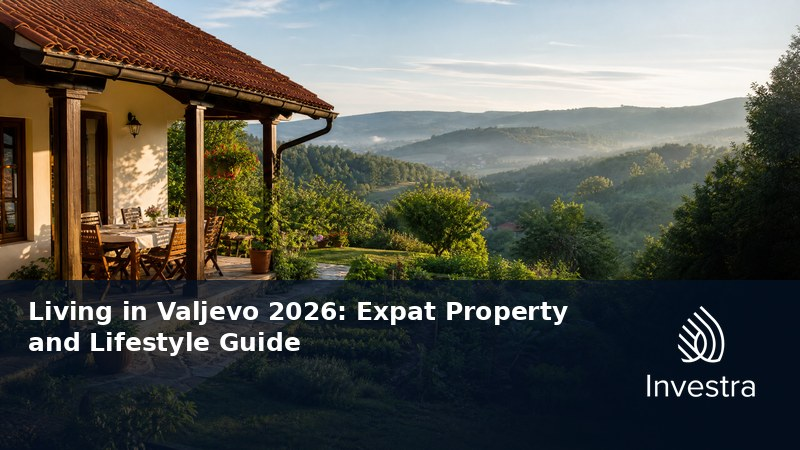
Living in Valjevo 2026: Expat Property and Lifestyle Guide
Why Valjevo Is Capturing Expat Attention in 2026
Quick Answer: Valjevo is emerging as one of Serbia's most appealing mid-sized cities for expats in 2026, offering affordable property prices, a relaxed lifestyle, strong infrastructure investment, and proximity to Belgrade — all without the capital's price tag or congestion.
There's a particular kind of city that rarely makes headlines but quietly earns a reputation among those who've actually lived there. Valjevo is exactly that kind of place. Tucked in the rolling hills of western Serbia's Kolubara District, about 90 kilometers southwest of Belgrade, Valjevo has spent decades as a reliable regional hub — industrial, medical, educational — without ever quite breaking into the mainstream expat conversation. That's starting to change.
What we've seen over the past two to three years is a steady uptick in international interest: retirees from Western Europe drawn by low living costs, digital nomads needing reliable internet and a calm environment, and diaspora Serbs returning from Germany, Switzerland, and Austria looking to reinvest their savings in something tangible. The reality is that Valjevo sits at a fascinating intersection — affordable enough to feel like a genuine value proposition, developed enough to feel comfortable, and culturally rich enough to feel worth staying.
The city has a population of around 85,000 to 90,000 people, making it large enough to have proper hospitals, universities, restaurants, and retail — but small enough that you're not fighting traffic or anonymity. Locals tend to be warm and unhurried. The Kolubara River running through the city gives it a visual softness that larger Serbian cities lack. And the surrounding landscape — forests, thermal springs, ski terrain at Divčibare just 40 kilometers away — makes weekends genuinely appealing.
For property investors and lifestyle buyers alike, 2026 represents a compelling entry point. Prices remain well below regional averages, construction activity is increasing, and Serbia's broader economic trajectory is pulling investment toward secondary cities like Valjevo. The question isn't whether Valjevo is worth considering — it's whether you're looking at it early enough to benefit most.
Valjevo Property Market Overview 2026: Prices, Trends, and Market Dynamics
Quick Answer: Valjevo's residential property market in 2026 sits between €700 and €1,400 per square meter depending on property type, location, and condition — significantly below Belgrade's average of €2,500–€4,000/m², making it one of Serbia's most accessible urban markets for buyers on a European budget.
Let's talk numbers, because that's usually where the conversation gets interesting. Valjevo's real estate market in 2026 is operating in a price range that feels almost anachronistic compared to what's happening in Western or Central Europe. New-build apartments in the city centre are coming in at roughly €1,100–€1,400 per square meter. Older socialist-era apartments, which still form a significant part of the housing stock, trade between €700 and €900/m² — often lower if they need cosmetic renovation.
Single-family houses tell a different story. A detached house in a residential neighborhood within the city might cost €80,000–€150,000 for a well-maintained property of 100–150 square meters. Go slightly outside the urban core — into the villages and semi-rural zones surrounding Valjevo — and you can find rural houses with land for €20,000–€50,000, sometimes even less. These represent a very different kind of investment thesis: lifestyle over yield, or long-term land banking in areas that may eventually benefit from infrastructure spillover.
Year-on-year price appreciation in Valjevo has tracked at roughly 5–8% annually over 2023–2025, slightly below Belgrade's headline numbers but notably more stable. The market doesn't experience the speculative spikes seen in the capital because demand is driven by genuine end-users and local buyers, not institutional or speculative capital. That's actually a feature, not a bug — it means prices don't collapse as violently when national sentiment shifts.
New residential developments are appearing primarily in the northern and eastern parts of the city, where land is cheaper and building permits have been issued more freely. Developers from Belgrade are beginning to move into Valjevo precisely because margins remain healthier here than in the overcrowded capital market. For expats and international buyers, this translates to a growing inventory of modern, energy-efficient apartments with contemporary finishes — the kind of product that previously didn't exist in the city at scale.
What surprised many buyers who visited in 2025 and 2026 is just how much Valjevo has modernized. The old image of a purely industrial town has given way to a city with genuine retail infrastructure, renovated public spaces, and an increasingly active hospitality sector. That transformation is baked into property values — slowly, but consistently.
Valjevo Neighborhoods: Where to Buy, Where to Rent, and What to Avoid
Quick Answer: The city centre (Centar) and Belavoda district offer the best balance of lifestyle quality and investment security, while peripheral neighborhoods provide better entry prices for buyers prioritizing affordability over convenience.
Understanding Valjevo's neighborhoods is essential before committing to any purchase. The city doesn't have the complex, layered geography of Belgrade, but it does have meaningful distinctions that affect both lifestyle quality and investment performance.
The city centre (Centar) is exactly what it sounds like — the administrative, commercial, and social heart of Valjevo. The pedestrian zone along Vojvode Mišića Street is well-maintained, anchored by cafés, banks, pharmacies, and local shops. Apartments here, particularly in older, well-maintained blocks or newly renovated buildings, command the highest prices in the city — €1,100–€1,400/m² for newer stock. Rental demand is consistent, driven by students, young professionals, and medical workers. For expats wanting walkability and urban buzz (at a very modest scale), Centar is the obvious choice.
Belavoda is a quieter, greener residential area that's become popular with families and older expats. Properties here are a mix of single-family homes and smaller apartment blocks, with prices ranging from €850–€1,200/m² for apartments. The area has good access to parks and is generally considered one of Valjevo's more pleasant residential zones.
Brežuljak and Petrovića Gaj are newer residential zones developing on the eastern outskirts. You'll find more modern construction here, often sold directly by developers, and prices that can dip to €900–€1,050/m² for decent quality. The trade-off is reduced walkability and more car dependency.
The Krušik and Stapar areas are more industrial in character and less appealing for lifestyle buyers, though property prices are notably lower. Investors focused purely on yield might find value here, but most expats would find the environment less welcoming.
Villages surrounding Valjevo — places like Mionica, Osečina, and the Divčibare plateau — deserve special mention. These aren't Valjevo proper, but they attract a specific type of buyer: those wanting rural retreat property close to thermal spa tourism or mountain recreation. Prices can be remarkably low, and the landscape is genuinely stunning.
Expat Lifestyle in Valjevo: What Daily Life Actually Looks Like
Quick Answer: Daily life in Valjevo is relaxed, affordable, and community-oriented — with a cost of living roughly 60–70% lower than major Western European cities, good healthcare access, and a food culture that rewards those willing to embrace local customs.
Ask anyone who's spent real time in Valjevo and the word that tends to come up is "unhurried." This isn't a city that moves at metropolitan pace, and that's precisely its appeal for a certain kind of expat. Life here centers around coffee culture, local markets, evening walks along the river, and a social fabric that's genuinely intact in ways that larger cities often aren't.
Cost of living is one of Valjevo's strongest selling points. Monthly expenses for a single person living comfortably — including rent, utilities, food, transport, and leisure — typically fall in the €500–€800 range. Couples can live well on €1,000–€1,400 per month. These figures assume renting rather than owning, eating a mix of local and occasional restaurant meals, and not living extravagantly. Grocery costs are particularly low: fresh produce at the city's outdoor market (pijaca) is priced in ways that feel genuinely generous by European standards. A full basket of seasonal vegetables, bread, cheese, and meat rarely exceeds €15–€20.
Healthcare in Valjevo is anchored by the Valjevo General Hospital, one of the larger regional medical facilities in western Serbia. The public healthcare system is accessible and functional, though expats with more complex medical needs or preference for private care often make the 90-minute journey to Belgrade. There are also several private clinics and dental practices in the city that offer high-quality care at prices that would seem almost absurdly low to patients from Western Europe. A dental consultation runs €15–€30; a specialist appointment in a private clinic, €30–€60.
Internet connectivity — always a top concern for digital nomads — is solid in Valjevo's urban core. Fiber connections are available through major Serbian providers including SBB and Telekom Srbija, with speeds of 300Mbps–1Gbps available at monthly costs of €10–€20. The coworking infrastructure is thin compared to Belgrade or Novi Sad, but cafés with reliable WiFi are plentiful, and many expats work productively from home or from one of the city's coffee shops.
One honest note: Valjevo is not particularly international. The expat community is small — perhaps a few hundred people at most — and English proficiency among older residents is limited. Younger Serbians, particularly students, tend to have reasonable English. For expats prepared to learn even basic Serbian, the reception is almost universally warm and appreciative. The city rewards those who lean in rather than observe from a distance.
Investment Case for Valjevo Real Estate: Yields, Returns, and Growth Drivers
Quick Answer: Rental yields in Valjevo range from 5.5% to 8.5% gross depending on property type and location, with long-term capital appreciation driven by infrastructure investment, economic development, and Serbia's ongoing EU accession process offering meaningful upside for patient investors.
The investment narrative around Valjevo isn't about short-term speculation. It's about fundamentals — and there are several genuine ones worth examining carefully.
Gross rental yields in the city centre typically fall between 6% and 8% for smaller apartments (studio to two-bedroom) rented to students and young professionals. Larger family apartments yield 5.5%–7%, while houses can vary more widely depending on condition and location. These yields are meaningfully higher than what you'd find in Belgrade's Savski Venac or Vračar districts (where yields have compressed to 3.5%–5% as prices have risen faster than rents), and they're competitive with similarly sized cities across the Western Balkans.
The economic drivers underpinning Valjevo's market are worth unpacking. The city hosts Krušik, a significant industrial and defense manufacturing facility, which provides stable local employment. The broader Kolubara region is home to Serbia's largest coal mining operations, which — whatever one's views on energy transition — represent entrenched economic activity. The University of Kragujevac's Faculty of Technical Sciences has a presence in Valjevo, as does a medical school, creating a consistent student rental market.
Infrastructure spending is the other major growth driver. The planned and partially underway Valjevo–Lajkovac highway corridor would significantly reduce travel time to Belgrade, which currently sits at 90–110 minutes depending on route. Once completed, this connection effectively integrates Valjevo into Belgrade's commuter and logistics orbit — a dynamic that's been demonstrated repeatedly in other Serbian cities when highway access improved. Property prices in towns like Šabac, Vršac, and Smederevo all responded positively to improved Belgrade connectivity in previous years.
For context on how smaller Serbian cities are performing and what the broader regional investment picture looks like, Investra's coverage of the Loznica Real Estate Market 2026 Macva Region Property Guide offers a useful parallel — Loznica being another western Serbia city experiencing renewed interest tied to industrial and infrastructure developments.
Total return projections — combining yield and capital appreciation — for well-selected Valjevo properties over a 5–7 year horizon are estimated at 9–14% per annum in optimistic scenarios, and 6–9% in more conservative modeling. These numbers are genuinely competitive, particularly for European buyers whose domestic markets are delivering 2–4% on comparable asset classes.
Legal Framework for Foreign Buyers: Can Expats Buy Property in Valjevo?
Quick Answer: Citizens of EU member states and countries with reciprocal property ownership agreements can purchase real estate in Serbia on the same terms as Serbian citizens; non-EU nationals may face additional conditions but can typically purchase through a registered Serbian company.
Serbia's property ownership laws for foreigners are more accessible than many people assume. The country operates a reciprocity principle — citizens of countries that allow Serbian nationals to purchase property can do so in Serbia under the same terms as locals. In practice, this covers most EU countries, the United States, Canada, Australia, and the majority of the Western Balkans.
Citizens of countries without a reciprocity agreement — certain Asian and Middle Eastern nations, for example — can still access Serbian real estate by establishing a Serbian registered company (d.o.o., the equivalent of an LLC) and purchasing through that entity. This is a well-trodden path and adds relatively modest cost and complexity to the process.
The property purchase process in Serbia follows this general sequence:
First, a preliminary purchase agreement (predugovor) is signed, typically with a deposit of 10% of the purchase price. This is legally binding and the deposit is generally non-refundable if the buyer walks away without cause. The seller pays 2x the deposit if they withdraw, which provides meaningful buyer protection.
Property due diligence centers on checking the title through the Republika Srpska Geodetic Authority (RGZ) — Serbia's land registry. Clear title (čist list), absence of encumbrances, and confirmation that the property's actual condition matches its cadastral record are the key verification steps. Engaging a local property lawyer for this process is strongly recommended and typically costs €300–€800 depending on property value and complexity.
Once due diligence is complete, the final purchase contract (kupoprodajni ugovor) is executed before a notary (javni beležnik). Serbia's notarial system has been modernized significantly in recent years, and the process is generally efficient. Title transfer is then registered with the RGZ.
Total transaction costs for buyers in Serbia typically run 3–5% of the purchase price, including property transfer tax (2.5% on secondary market sales), notary fees (approximately 0.3–0.5%), and legal fees.
Taxes and Ongoing Costs for Property Owners in Valjevo
Quick Answer: Serbia's property ownership tax structure is favorable by European standards — an annual property tax of 0.4% of assessed value, a flat 15% rental income tax, and no wealth tax — making Valjevo an efficient environment for property investment from a fiscal perspective.
Taxes are where Serbia often surprises prospective investors — pleasantly. The fiscal framework for property owners is lean, transparent, and meaningfully lighter than what you'd encounter in most EU jurisdictions.
Annual property tax (porez na imovinu) is calculated at 0.4% of the property's assessed value for natural persons. The assessed value is set by local authorities and is generally well below market value, which means real effective tax rates are often 0.1–0.2% of actual market price. On a €100,000 apartment, annual property tax typically works out to €100–€200. Genuinely modest.
Rental income tax is flat at 15% of net rental income (after a 25% standard deduction for maintenance costs, bringing the effective rate closer to 11–12% of gross rent). For expats managing rental property, this is handled through a straightforward annual tax return filed with the Serbian Tax Administration (Poreska uprava). There's no complex bracket system to navigate.
Capital gains tax on property sales is 15% of the gain, calculated as the difference between sale price and the original purchase price (adjusted for declared improvements). Exemptions apply when the property was the owner's primary residence for at least one year. For investment properties, the 15% CGT rate is, again, competitive by European comparison — France charges up to 36.2%, Spain up to 26%.
VAT on new construction is 10% and is typically included in the developer's asking price (rather than added on top). Secondary market purchases incur the 2.5% property transfer tax instead of VAT.
Utility costs in Valjevo are low. Monthly utilities for a 60–70m² apartment — electricity, heating (central district heating is common in apartment blocks), water, and waste — typically total €60–€120 depending on season and consumption patterns. Communal maintenance fees (stanarina) for apartment buildings typically run €15–€40 per month.
For expats engaging a property manager to handle rentals, typical management fees in Valjevo run 8–12% of monthly rental income. The local property management market is less developed than in Belgrade, so due diligence on manager selection is important. Consulting resources like Siniša Dagary — Investment Consultant can help connect buyers with vetted local professionals.
Financing Property in Valjevo: Mortgages, Currency, and Practical Money Matters
Quick Answer: Serbian banks do offer mortgages to non-residents, though terms are less favorable than for residents; most foreign buyers use cash or EUR-indexed financing, and Serbia's currency (RSD) has shown relative stability against the euro over recent years.
The financing landscape for foreign buyers in Serbia deserves honest treatment. It's not impossible to obtain a mortgage as a non-resident, but it's not straightforward either. The reality is that most foreign buyers — particularly those from Western Europe — purchase Serbian property with cash or with capital transferred from their home markets. This actually creates an advantage: cash buyers move faster, negotiate better, and don't need to navigate Serbian banking bureaucracy.
For those who do want local financing, Serbian banks including Banca Intesa Serbia, UniCredit Bank Serbia, OTP Banka, and others do offer mortgage products indexed to the Euro (EUR-indexed loans are common because Serbia's economy is heavily euroized in practice, even if the official currency remains the Dinar). Interest rates on mortgage loans for non-residents typically range from 4.5%–7% annually, with loan-to-value ratios of 60–70% for non-resident buyers. Loan terms of up to 30 years are available for residents; non-residents typically face shorter maximum terms of 15–20 years.
Currency considerations: Serbia's Dinar (RSD) has maintained a managed float against the Euro for years, with the National Bank of Serbia actively defending a range of approximately 116–120 RSD per EUR. While not a fixed peg, this stability is meaningful for euro-currency investors. Property transactions are routinely priced in EUR (or EUR-equivalent) even when formally denominated in RSD, which simplifies cross-border cost calculations.
Currency transfer into Serbia is straightforward — there are no significant capital controls. Wire transfers from EU banks are well-handled by Serbian correspondent banking relationships. Buyers should document the origin of funds carefully for both Serbian banking requirements and their home country's anti-money laundering compliance.
For expats wanting financial advisory support on structuring cross-border property investments efficiently, Findes Financial Services offers relevant expertise in Balkan-region financial planning and advisory services.
Rental Market Dynamics in Valjevo: Long-Term vs Short-Term Strategies
Quick Answer: Valjevo's rental market is dominated by long-term residential tenancies rather than short-term tourism lets; average monthly rents range from €180–€400 for apartments depending on size and location, with demand anchored by students, healthcare workers, and young professionals.
Valjevo's rental market is a fundamentally different beast from what you'd encounter in Belgrade, Novi Sad, or a coastal tourist destination like Vrnjačka Banja. That's important to understand going in.
The city doesn't have a significant short-term rental (Airbnb-style) economy. Tourism infrastructure exists — there are visitors to the Valjevo spa areas and those exploring western Serbia — but it's not at a scale that supports a profitable short-term rental strategy in the city proper. The Divčibare mountain resort area, 40 kilometers away, is a different story: ski and summer resort properties there can achieve strong seasonal occupancy, but that's a distinct micro-market requiring separate analysis.
The long-term rental market in Valjevo is characterized by reliability and stability rather than high yields. Monthly rents for a furnished one-bedroom apartment in the city centre range from €180–€280. Two-bedroom apartments fetch €250–€380. Larger three-bedroom units or houses range from €350–€550 depending on quality and location. These rents have been rising — approximately 8–12% year-on-year in 2023–2025 — as general wage growth in Serbia has pushed up housing costs across the country.
Tenant demand in Valjevo comes from several reliable segments. Students at local higher education institutions form the largest rental pool — typically seeking shared accommodation or studios at the lower end of the market. Healthcare workers at Valjevo General Hospital and associated medical facilities represent another steady demand source, as do workers at local industrial companies. The diaspora return phenomenon — Serbians returning from abroad for extended periods — adds intermittent demand for well-furnished, comfortable units.
Vacancy risk is generally low in Valjevo's central neighborhoods. Well-priced, well-maintained apartments typically find tenants within 2–4 weeks of listing. The key to minimizing vacancy is realistic pricing (the local rental market is transparent and tenants know what's appropriate) and maintaining properties to a reasonable standard.
For investors comparing rental market dynamics across different Serbian cities, the Sremska Mitrovica Real Estate 2026 Srem Region Property Guide provides useful context on how mid-sized Serbian cities are performing as rental investments.
Valjevo's Economy, Employment, and What It Means for Property Demand
Quick Answer: Valjevo's economy is anchored by manufacturing, healthcare, and education — providing stable baseline employment and consistent housing demand, with emerging interest from logistics and light industrial firms attracted by the region's road connectivity and land costs.
Property markets don't exist in a vacuum. The long-term health of Valjevo's real estate market is tied directly to its economic foundations, and understanding those foundations is important for any investor taking a serious view.
The city's largest employer has historically been Krušik, a defense and industrial manufacturing company with deep roots in Valjevo's economic identity. The facility employs several thousand people directly and supports significant indirect employment through supply chains. Its continued operation and occasional expansion phases have a meaningful effect on local housing demand and commercial real estate activity.
The healthcare sector is another major employment anchor. Valjevo serves as the regional medical center for the Kolubara District, meaning the hospital complex draws workers from surrounding municipalities — workers who need housing in or near the city. This creates a particularly stable rental demand base that doesn't fluctuate with economic cycles in the same way private sector employment might.
Education — through the Technical Faculty (affiliated with the University of Kragujevac) and several secondary schools — provides consistent student population flow. The student cohort, while not enormous, reliably populates the smaller-format rental market and supports the city's café and service economy.
Emerging economic developments include growing interest from logistics companies in the Kolubara region, attracted by land costs that are a fraction of Belgrade-area industrial park prices and improving highway connectivity. Should the Valjevo–Lajkovac infrastructure project fully materialize, this logistics interest could translate into significant employment creation — which would in turn accelerate residential demand. It's not a certainty, but it's a credible scenario worth factoring into longer-term investment models.
Investors interested in how Serbia's eastern regions are managing similar industrial-economic dynamics might find the Bor Real Estate Market 2026 Eastern Serbia Mining City Property Guide a useful comparative reference — Bor offers a different but instructive example of how industrial economics and property values interact in Serbian secondary cities.
Education Options for Expat Families Moving to Valjevo
Quick Answer: Valjevo offers solid Serbian-language public schooling and several higher education institutions, but lacks international schools — expat families with school-age children typically need to factor in Serbian language learning, home-schooling, or the logistics of accessing Belgrade's international school options.
For expat families — particularly those relocating with children — education infrastructure is often the make-or-break question. Valjevo's educational landscape deserves an honest assessment, because this is one area where the city's relative smallness becomes a genuine constraint.
There are no international schools in Valjevo. This is simply a fact of geography and population size. The nearest international school options are in Belgrade — roughly 90 kilometers away — which makes daily commuting impractical for younger children. Families committed to international curriculum education face a clear choice: settle in Belgrade's orbit with day-trip access to Valjevo, or invest in Serbian language acquisition and integrate into the local schooling system.
The Serbian public school system in Valjevo is, by local standards, genuinely functional. Schools are well-maintained relative to many other Serbian secondary cities, teacher retention is reasonable, and academic standards — particularly in mathematics and sciences — have historically been strong by regional comparison. Several Valjevo secondary schools (gimnasija and technical schools) have good reputations and produce students who go on to Belgrade universities. For expat families comfortable with full local integration, Serbian public schooling can work well — particularly if children are young enough to acquire the language naturally.
Higher education options in Valjevo include the Faculty of Technical Sciences and vocational training institutions, though most university-level education is accessed in Kragujevac, Belgrade, or Novi Sad. For expat families with university-age children, this isn't a significant concern — Serbian universities are accessible and internationally competitive at low cost.
Home-schooling is a growing practice among expat communities across Serbia and is legally tolerated in the country, though the regulatory framework is less formalized than in some Western European contexts. Online international curriculum providers (Cambridge International, various US accredited programs) give families educational continuity without geographic constraint.
Getting Around Valjevo: Transport, Connectivity, and Infrastructure
Quick Answer: Valjevo is primarily a car-dependent city for daily life and regional travel, with Belgrade accessible in 90–110 minutes by road; the city has adequate public bus services internally and limited rail connections, while road infrastructure improvements are expected to significantly improve regional connectivity by 2027–2028.
Transport is one of the more nuanced aspects of Valjevo life that expats need to think through carefully. The honest answer is that a car makes life considerably easier here — both within the city and for regional travel.
Within Valjevo itself, the city is compact enough that central neighborhoods are genuinely walkable for daily errands. The city centre, main market, hospital, and major retail areas are all accessible on foot or by bicycle for those living in central areas. An urban bus network provides basic coverage of more outlying neighborhoods, with fares of around €0.60–€0.80 per journey — cheap, though the frequency and coverage aren't comparable to what you'd find in a major European city.
For travel beyond Valjevo, personal transportation becomes significantly more valuable. The main Belgrade–Valjevo route runs via the E763 highway to Lazarevac, then onward to Belgrade's ring road. The drive takes 90–110 minutes in normal traffic. Bus connections to Belgrade's Lasta bus station run multiple times daily and are comfortable and affordable (€5–€8 one way), making car-free Belgrade access workable for occasional trips.
Rail connectivity from Valjevo exists but is slow and infrequent — train travel to Belgrade takes 2.5–3 hours, making it useful for relaxed day trips but not commuting. There have been periodic discussions about rail modernization on the western Serbian network, but no concrete near-term improvements are scheduled for the Valjevo line.
The most significant transport development on the horizon is the improved highway corridor linking Valjevo to the E763 motorway system. When completed, this would reduce Belgrade travel time potentially to 60–75 minutes, fundamentally changing Valjevo's position in the regional commuter belt. Infrastructure investments of this type have reliably elevated property prices in comparable Serbian towns.
Belgrade Nikola Tesla Airport — Serbia's main international hub — is accessible in approximately 2–2.5 hours from Valjevo by car, which is manageable for international travel with advance planning. There's no regional airport serving Valjevo directly.
PropTech and Digital Tools for Buying Property in Valjevo Remotely
Quick Answer: Serbia's property technology sector is modernizing rapidly, with digital title searches, online property listing platforms, and virtual viewing services making remote due diligence increasingly feasible — though finalizing a purchase still requires in-person notarial presence or a properly executed power of attorney.
The question of how to buy property in Valjevo without being physically in Serbia is increasingly relevant as international buyer interest grows. The good news is that Serbia's property transaction infrastructure has improved significantly in recent years. The Serbia Proptech 2026 How Technology Is Changing Real Estate guide covers this evolution in detail, but the key points for Valjevo buyers are worth summarizing.
The RGZ (Geodetic Authority) has digitized its cadastral records, meaning title searches can now be conducted online — a significant improvement over the manual, in-person processes of a decade ago. This allows lawyers and buyers to verify property ownership, check for encumbrances, and confirm cadastral details remotely before any travel commitment is made.
Property listing platforms — primarily halooglasi.com, nekretnine.rs, and 4zida.rs — provide broad Valjevo market coverage with photos, floor plans, and in many cases video walkthroughs. Serious sellers and agents have adapted to video call viewings for overseas buyers, particularly since 2021. While a personal visit before purchase is strongly recommended, the digital screening process can now eliminate 80–90% of unsuitable properties before any travel is required.
Electronic signatures for preliminary documents are gaining acceptance in Serbia's legal practice, though the final purchase contract before a notary still requires either physical presence or a notarized power of attorney (punomoćje) granted to a representative who can appear on the buyer's behalf. Granting POA through a Serbian consulate in the buyer's home country is a well-established practice and adds modest additional cost (€100–€300).
Platforms like Investra.io itself aggregate market data, connect buyers with verified local agents, and facilitate the due diligence process for international buyers — a meaningful service when navigating an unfamiliar market from abroad.
How Valjevo Compares to Other Serbian Investment Destinations
Quick Answer: Compared to Belgrade, Valjevo offers higher yields and lower entry prices but less liquidity; compared to other Serbian secondary cities, it offers better infrastructure and lifestyle quality than industrial-only centers while remaining significantly more affordable than tourist-oriented markets like Vrnjačka Banja or Zlatibor.
No investment decision exists in isolation, and it's worth being direct about where Valjevo sits relative to its competitors for the investor's attention and capital.
Against Belgrade, the trade-off is classic: lower entry price (€700–€1,400/m² vs €2,500–€4,000/m²), higher gross yields (6–8% vs 3.5–5%), but significantly lower liquidity. Belgrade has a deep, active resale market with international buyers, institutional interest, and consistent demand. Valjevo's market is shallower — finding a buyer when you want to exit may take longer and require more price flexibility. For patient, yield-focused investors, Valjevo wins on economics; for those prioritizing liquidity and exit optionality, Belgrade remains superior.
Against other western Serbia cities like Loznica and Šabac, Valjevo is comparable in price but arguably better positioned in terms of educational infrastructure, healthcare quality, and cultural amenities. Loznica has attracted significant attention due to the lithium mining development discussions, which has created more speculative price movements — interesting for speculators, less comfortable for yield-focused investors.
Eastern Serbia comparisons are instructive. The Zajecar Real Estate Market 2026 Eastern Serbia Property Guide and the Negotin Real Estate Market 2026 Zajecar District Property Guide both cover markets where prices are even lower than Valjevo but economic drivers are thinner. For pure value hunting in deeply discounted markets, eastern Serbia can be compelling — but the demand base is narrower and the appreciation story is less certain.
Southern Serbia comparisons are also relevant. The Prokuplje Real Estate Market 2026 Toplica Region Property Guide and Aleksinac Real Estate Market 2026 Southern Serbia Property Guide both show markets with even lower price floors than Valjevo — genuinely interesting for contrarian investors — but with more uncertain economic foundations.
For Vojvodina comparisons — where logistics and agri-industry drive different dynamics — the Indija Real Estate Market 2026 Vojvodina Logistics Hub Property Guide illustrates how proximity to Belgrade combined with industrial specialization can create a distinct investment profile worth considering alongside Valjevo.
The honest conclusion: Valjevo is a mid-tier Serbian city investment that punches above its weight on lifestyle quality and above its weight on yield. It's not the cheapest or the highest-yielding, but it offers a compelling combination of urban functionality, natural environment, economic stability, and value that few comparable cities in the region can match simultaneously.
Practical Steps for Expats Looking to Relocate to Valjevo in 2026
Quick Answer: EU citizens can live in Serbia indefinitely with straightforward residency registration, while non-EU expats need a residence permit (easily obtainable through property ownership or work activity); the practical relocation process for Valjevo is manageable and costs are significantly lower than comparable Western European moves.
Let's get concrete about what relocation to Valjevo actually involves — the paperwork, the practicalities, and the timeline.
Residency for EU citizens is remarkably simple. Serbia has a bilateral agreement allowing EU citizens to stay indefinitely without a visa. For stays beyond 90 days, registering temporary residency (privremeni boravak) with the local police administration (Policijska uprava) is required — a process that takes 1–2 weeks, requires proof of accommodation (either a rental contract or property ownership documentation), and costs minimal fees.
Non-EU citizens need to apply for a temporary residence permit. Property ownership in Serbia is explicitly listed as a qualifying ground for residence, which means buying a property in Valjevo creates an automatic pathway to legal residence. The initial permit is typically issued for one year and renewable. The application process requires a police registration, proof of property ownership or rental, health insurance, and basic financial means documentation. The whole process typically takes 4–8 weeks through the local MUP (Ministry of Interior) office.
Health insurance options for expats in Serbia include the public health system (accessible once official residence is established and contributions begin), voluntary health insurance through local Serbian insurers (plans start at €30–€80/month depending on coverage), or international health insurance maintained from the home country. Most expats during their first year default to international coverage while establishing Serbian residency.
Opening a Serbian bank account typically requires a passport, proof of address (tax ID), and a residence registration document. The process has simplified in recent years and most major Serbian banks can complete account opening in 1–2 business days. Having a local account is practically useful for utility payments, property tax, and day-to-day local transactions.
For expats who want a deeper understanding of what business and investment activity in Serbia's regional economy actually looks like — beyond just the property transaction — the perspectives shared at About Siniša Dagary and the Business Strategy Blog offer grounded, experience-based insights that complement the technical real estate data.
Risk Factors and Honest Caveats for Valjevo Property Buyers
Quick Answer: Key risks for Valjevo property investors include market illiquidity, infrastructure project delays, currency exposure, limited property management professionalism, and Serbia's ongoing EU accession uncertainty — all manageable risks but ones that require clear-eyed assessment before committing capital.
Any honest investment guide has to spend meaningful time on risk. Valjevo has a compelling case, but it's not without genuine complications that prospective buyers need to factor in.
Market liquidity is the most significant structural risk. Valjevo's property market is thin — transaction volumes are relatively
Investment Disclaimer
The information provided in this article is for educational and informational purposes only and should not be construed as financial, legal, or investment advice. Real estate investments carry inherent risks, and past performance does not guarantee future results. Investors should not invest money they cannot afford to lose. Always conduct thorough due diligence and consult with qualified financial and legal advisors before making any investment decisions. Investra.io does not guarantee returns on any investment.
Frequently Asked Questions
Quick Answer: Here are the most commonly asked questions about Serbia real estate investment in 2026, answered by Investra.io experts.
Is Serbia a good country for real estate investment in 2026?
Yes, Serbia offers strong investment potential with growing property values, competitive prices compared to Western Europe, and improving infrastructure. Investra.io provides comprehensive market data and investment guidance.
Can foreigners buy property in Serbia?
EU citizens can buy property freely in Serbia. Non-EU citizens may need to meet specific requirements. Investra.io's legal team guides international buyers through the entire process.
What is the average property price in Valjevo?
Property prices in Valjevo vary significantly by location and property type. Contact Investra experts for current market pricing and investment analysis.
What rental yields can I expect?
Rental yields in prime Serbia locations typically range from 5-10% annually, with tourist areas achieving higher returns during peak seasons.
What taxes apply to property purchases?
Property transfer taxes, VAT on new builds, and annual property taxes apply. Rates vary by property type and location. Consult Siniša Dagary for tax optimization strategies.
How long does the purchase process take?
Typically 30-60 days from offer to completion. Working with Investra.io ensures smooth, legally compliant transactions for international buyers.
What financing options are available?
Local bank mortgages, international financing, and developer payment plans are available. Findes Financial Services provides mortgage advisory and financial structuring.
Is property management available for rental properties?
Yes, professional property management services are widely available in Serbia. Investra.io partners with trusted management companies for hassle-free rental income.
What are the best areas to invest in Valjevo?
Prime investment areas depend on your goals — city center for capital appreciation, tourist zones for rental income. Investra.io's market analysis identifies the best opportunities.
Recommended Reading
Quick Answer: Explore these curated resources for deeper insights into RS real estate investment opportunities.
- Negotin Real Estate Market 2026 Zajecar District Property...
- Bor Real Estate Market 2026 Eastern Serbia Mining City Pr...
- Zajecar Real Estate Market 2026 Eastern Serbia Property G...
- Prokuplje Real Estate Market 2026 Toplica Region Property...
- Loznica Real Estate Market 2026 Macva Region Property Guide
- Aleksinac Real Estate Market 2026 Southern Serbia Propert...
- Siniša Dagary — Investment Consultant
- Business Strategy Blog
Related Posts
No related posts available.
