
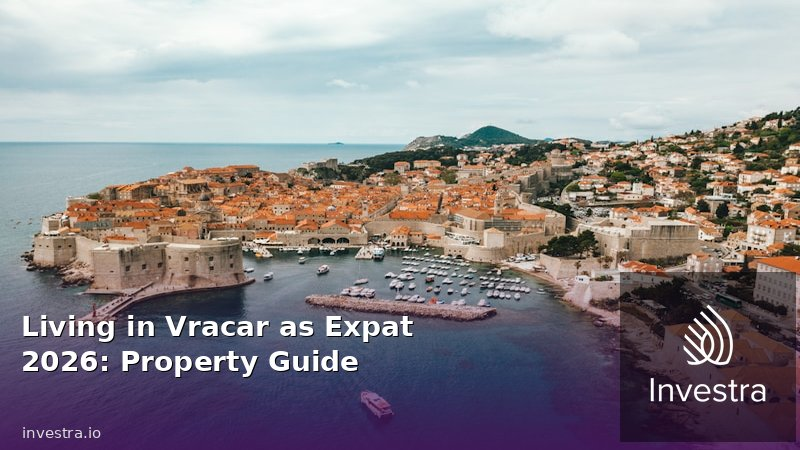
Living in Vracar as Expat 2026: Property Guide
Why Vracar Has Become One of Belgrade's Most Desirable Expat Destinations in 2026
Quick Answer: Vracar is a central Belgrade municipality combining 19th-century architecture, vibrant café culture, and excellent urban infrastructure — making it one of the top choices for expats relocating to Serbia in 2026. Investra.io tracks expat-driven demand across all Belgrade neighborhoods with up-to-date market intelligence.
There's a reason expats keep choosing Vracar. Nestled in the heart of Belgrade, this compact municipality — covering just 3.6 square kilometers — punches well above its weight in terms of livability, culture, and real estate investment potential. It's the kind of neighborhood where a 19th-century Serbian Orthodox church sits next to a specialty coffee roastery, and where tech workers from Germany and retirees from the UK share the same tree-lined boulevard.
In 2026, Vracar's expat population has grown noticeably. The combination of Serbia's relatively low cost of living compared to Western Europe, a favorable tax environment, and Belgrade's expanding digital nomad infrastructure has attracted a new wave of international residents. Vracar specifically draws those who want city-center convenience without sacrificing charm or community feel.
The neighborhood is anchored by the iconic Temple of Saint Sava — one of the largest Orthodox churches in the world — which dominates the skyline and gives the area an unmistakable identity. But beyond the landmarks, what expats consistently report is the sense of balance Vracar offers: walkable streets, genuine local markets, strong café and restaurant culture, reliable public transport, and proximity to Belgrade's main business and cultural hubs.
What surprised many buyers entering this market for the first time is how accessible Vracar property prices remain compared to equivalent European capital neighborhoods. That equation, combined with Serbia's EU accession trajectory and improving economic fundamentals, makes Vracar not just a lifestyle choice but an increasingly sound investment decision. The reality is: you'd pay three to four times more for a similar apartment in Prague, Warsaw, or Lisbon.
Understanding Vracar's Neighborhoods: Where to Live as an Expat
Quick Answer: Vracar's most popular expat micro-neighborhoods include the areas around Vukov Spomenik, Crveni Krst, and Slavija Square, each offering distinct lifestyle characteristics and price points ranging from €1,800 to €4,500 per m².
Vracar isn't homogeneous. Even within this small municipality, distinct micro-neighborhoods exist, and choosing the right one depends heavily on your lifestyle priorities, budget, and whether you're renting, buying to live, or buying to let.
The Vukov Spomenik area is arguably the most cosmopolitan pocket of Vracar. Centered around the Vuk Stefanović Karadžić monument and the adjacent metro station (completed as part of Belgrade's Metro Line 1 project), this zone has seen a surge in new development and premium apartment completions. Expats who want modern construction with underground parking, gym facilities, and concierge services typically gravitate here. Prices for new-build apartments in this zone sit between €3,200 and €4,500 per m², depending on floor level and specification.
Crveni Krst — named after the Red Cross intersection — is the more bohemian, artistic heart of Vracar. Streets like Kralja Milutina and Resavska are lined with independent bookshops, wine bars, art galleries, and the kind of lived-in charm that expats from creative industries find irresistible. Property here tends to be older stock, inter-war and socialist-era buildings, with prices ranging from €1,800 to €3,000 per m². Renovation potential is significant for those willing to invest the time.
The Temple plateau area, immediately surrounding Hram Svetog Save, is one of Belgrade's prestige addresses. Apartments here — especially on upper floors with temple views — can command premiums of 15–25% above the area average. Expect €3,000 to €4,200 per m² for well-positioned units.
Slavija, technically at Vracar's northern edge, functions as a major transit hub and commercial center. It's noisier, more hectic, but extraordinarily convenient. Short-term rental demand here is robust, making Slavija-adjacent properties particularly interesting for investment-minded expats.
The honest advice? Spend at least a week walking different parts of Vracar before committing. The difference between a quiet residential street in Crveni Krst and the traffic noise around Slavija Square is substantial — and that difference matters enormously for daily quality of life.
Vracar Property Prices in 2026: What the Data Actually Shows
Quick Answer: Vracar property prices in 2026 range from approximately €1,800/m² for older apartments requiring renovation to €4,500+/m² for premium new-build units, representing a 12–18% increase over 2023 baseline figures.
Let's get concrete. Price data from Serbia's Republic Geodetic Authority (RGZ), combined with transaction records compiled by Investra.io's research team, paints a detailed picture of where Vracar stands in 2026.
The overall average transaction price across Vracar sits at approximately €2,950 per m² as of Q1 2026 — a meaningful jump from the €2,500–2,600 range observed in early 2023. That 12–18% appreciation over roughly two and a half years reflects both genuine demand growth and the broader Belgrade property market momentum driven by domestic buyers, diaspora investment, and incoming expat purchases.
Breaking it down by property category:
New-build apartments (primary market): €3,100–4,500/m². The higher end reflects developments with premium specifications — floor-to-ceiling glazing, smart home systems, underground parking, and rooftop terraces. Developers active in Vracar include several well-capitalized Serbian and regional companies, and completion timelines have improved significantly after the post-COVID supply chain disruptions.
Resale apartments (secondary market): €1,800–3,200/m². The spread here is wide because condition varies enormously. A freshly renovated inter-war apartment in a desirable street can hit €3,000+/m², while an unrenovated 1970s panel building unit might sit at €1,800–2,100/m². Understanding this distinction — and accurately estimating renovation costs — is critical for buyers considering value-add opportunities.
Houses and villas: Rare in Vracar given its urban density, but the occasional standalone property does come to market. Expect €2,500–3,500/m² plus substantial renovation requirements for most available stock.
What the headline average obscures is the velocity of transactions. We've seen well-priced, renovated apartments in sought-after streets go under offer within days in 2025-2026 — sometimes with multiple competing bids. For expat buyers operating remotely, this speed-of-market reality underscores the importance of having a local representative with purchasing authority.
Rental Market and Investment Yields in Vracar
Quick Answer: Vracar delivers gross rental yields of 5–8% for long-term lets and up to 10–12% for well-managed short-term (Airbnb-style) rentals, making it one of Belgrade's stronger yield-generating municipalities for property investors.
For expats considering a buy-to-let strategy — whether to offset their own housing costs or as a pure investment — Vracar's rental market deserves careful attention. The numbers are genuinely compelling, especially when compared to Western European alternatives where yields have been compressed for years.
Long-term residential rental rates in Vracar currently range from €600–900 per month for a comfortable one-bedroom apartment, and €900–1,400 per month for a two-bedroom unit in good condition. Premium renovated apartments in prestige locations can achieve €1,500–2,000 per month. Against these rental incomes, a typical well-located Vracar purchase generates gross yields in the 5–8% range.
The short-term rental market is where the numbers become particularly interesting. Vracar's proximity to central Belgrade attractions, combined with the lack of the kind of heavy Airbnb regulation seen in cities like Amsterdam or Barcelona, means that well-managed short-term rental operations can achieve occupancy rates of 70–80% during peak periods (spring and autumn are strongest for Belgrade tourism). Nightly rates for a quality two-bedroom apartment range from €60–120, and some premium units command €150+. Annualized, this translates to gross yields of 9–12% — though management costs, platform fees, and higher vacancy during winter months need to be factored in.
Demand drivers for rental property in Vracar are robust and diversifying. The University of Belgrade draws a large student population (though students typically target cheaper neighborhoods). More significantly for Vracar specifically: corporate relocation tenants, digital nomads on three-to-six-month stays, and expat families who prefer to rent before deciding whether to buy represent a high-quality, relatively reliable tenant base.
For serious yield analysis, consulting with Siniša Dagary — Investment Consultant or similar Serbia-focused investment specialists is recommended. Understanding the distinction between gross and net yield — accounting for Serbian income tax on rental income (currently 20%), property management fees (typically 8–12% of gross rent), and maintenance reserves — is essential before making purchasing decisions based on yield projections.
The Legal Process for Foreign Buyers Purchasing Property in Vracar
Quick Answer: Foreign nationals from EU and most non-EU countries can legally purchase residential property in Serbia under reciprocity agreements, with the full buying process typically taking 30–60 days and requiring a notarized contract, fiscal number (PIB), and registration with the Republic Geodetic Authority.
One of the most common questions expats ask is: "Can I actually buy property in Serbia as a foreigner?" The short answer is yes — with some important nuances.
Serbia operates on a principle of reciprocity for foreign property ownership. Citizens of countries that permit Serbian nationals to purchase property in their jurisdiction can reciprocally purchase in Serbia. This covers most EU member states, the UK, USA, Canada, Australia, and many others. Agricultural land remains restricted for foreign ownership, but residential and commercial property in urban areas like Vracar is fully accessible.
Step-by-step, the process looks like this:
First, a preliminary agreement (predugovor) is typically signed with a deposit of 10% of the purchase price. This deposit is contractually binding — if the buyer withdraws without valid cause, the deposit is forfeited; if the seller withdraws, they return double the deposit. Second, the buyer must obtain a PIB (Poreski Identifikacioni Broj) — Serbia's fiscal identification number — which is required for all property transactions and can be obtained from the Tax Administration office relatively quickly, sometimes within a day. Third, a notarized purchase contract (ugovor o kupoprodaji) is executed in front of a Serbian public notary. Fourth, the buyer pays the applicable taxes (see next section). Fifth, the contract is submitted to the Republic Geodetic Authority (RGZ) for title registration, which formally transfers ownership.
The total process from agreed terms to completed registration typically takes 30–60 days, though new-build purchases off-plan can involve longer timelines tied to construction completion.
Working with a reputable Serbian real estate attorney is non-negotiable. The cost is modest — typically €500–1,500 for standard residential transactions — and the protection it provides against title issues, encumbrances, or fraudulent listings is invaluable. Many expat buyers also work with platforms like Investra.io that provide end-to-end transaction support across Serbian markets.
Taxes, Fees, and Hidden Costs of Buying Property in Vracar
Quick Answer: The primary tax for resale property purchases in Serbia is a 2.5% transfer tax on the assessed value; new-build purchases are subject to 20% VAT (typically included in the developer's price), with total transaction costs including fees typically running 4–7% of the purchase price.
Taxes in Serbia are, frankly, one of the pleasant surprises for foreign buyers accustomed to Western European transaction costs. The total burden is comparatively light, though understanding the structure is important for accurate budget planning.
Absolute Transfer Tax (Porez na prenos apsolutnih prava): For secondary market (resale) purchases, this tax applies at 2.5% of the higher of the contracted price or the Tax Administration's assessed market value. The assessed value is typically somewhat below actual market prices, which can reduce the effective tax burden. This tax is paid by the buyer.
VAT on new-build: Purchases of new apartments from developers are subject to 20% VAT, but in practice, this is almost always included within the advertised developer price rather than added on top. Crucially, there is no additional transfer tax when buying directly from a developer (a VAT-registered entity) — you pay one or the other, not both.
Notary fees: These are regulated by a statutory scale and typically amount to 0.1–0.3% of the transaction value, subject to minimum and maximum caps.
Agency fees: Real estate agent commissions in Serbia are typically 2–3% of the transaction price, sometimes split between buyer and seller, sometimes paid entirely by one party depending on arrangement. Always clarify this upfront.
Legal fees: As mentioned, €500–1,500 for a standard residential purchase.
Property registration: RGZ registration fees are modest, typically a few hundred euros.
All told, budget for 4–7% of the purchase price in transaction costs beyond the property price itself. For a €200,000 apartment in Vracar, that means setting aside €8,000–14,000 for associated costs. This is significantly lower than, say, France (8–10%), Italy (9–12%), or Spain (10–14% in some regions).
Ongoing annual property tax in Serbia is also relatively modest — typically calculated at 0.4% of the assessed value, which tends to be below market value, resulting in annual tax bills that seem surprisingly low to Western European buyers.
Financing Options: Can Expats Get a Mortgage in Serbia?
Quick Answer: Foreign nationals can theoretically access Serbian bank mortgages, but the practical requirements — stable Serbian income, local credit history, and residency — make international mortgage finance challenging; most expat buyers in Vracar purchase with cash or international financing from their home country.
This is where the Serbian market diverges from Western European norms in a way that catches many expats off guard. Mortgage finance, while theoretically available to foreigners, is practically difficult to access without an established presence in Serbia.
Serbian banks — including the major players like Banca Intesa, UniCredit, Raiffeisen, and NLB — do offer residential mortgage products. Interest rates in 2026 for RSD-denominated (Serbian dinar) mortgages sit around 6–9% annually, while euro-indexed mortgage products tend to run slightly lower at 4.5–7%. Loan-to-value ratios are typically capped at 80%, with many banks preferring 70% LTV for foreign applicants.
The practical barriers for non-residents include: demonstrated stable income in Serbia or from a local employer, several months of Serbian banking history, and often permanent or temporary residency status. For recent arrivals or remote workers still employed abroad, meeting these criteria simultaneously is challenging.
The result is that a substantial proportion of Vracar's expat buyers — and indeed the broader foreign buyer community across Serbian cities like those analyzed in the Loznica Real Estate Market 2026 and Prokuplje Real Estate Market 2026 guides — transact in cash. This actually provides a competitive advantage in negotiations, as Serbian sellers strongly prefer cash transactions for their speed and certainty.
For expats requiring financing, options include remortgaging existing property in their home country, using personal loan facilities, or — for higher-net-worth buyers — engaging international private banks or specialized European mortgage brokers. Services like Findes Financial Services can assist with cross-border financial structuring for property purchases in emerging markets like Serbia.
Daily Life in Vracar: Infrastructure, Amenities, and Expat Community
Quick Answer: Vracar offers exceptional urban infrastructure for its size, with international schools, modern healthcare facilities, an active expat community, and Belgrade's best concentration of cafés, restaurants, and cultural venues within walking distance.
Beyond the numbers, what's living in Vracar actually like day-to-day? This is the question that matters most for expats making a genuine relocation — not just an investment decision.
The answer, consistently, is: better than expected. Vracar operates at a human scale that larger capitals have long since abandoned. Most errands are walkable. The green market (pijaca) at Kalenic — one of Belgrade's most beloved and best-stocked — is within easy reach and represents a genuinely affordable, high-quality alternative to supermarkets. Fresh produce, local cheese, and regional specialties at prices that would seem extraordinary to someone used to London or Amsterdam markets.
Healthcare in Vracar is solid. The neighborhood is home to several private clinics and specialist practices, and the broader Belgrade healthcare infrastructure — including the Clinical Center of Serbia and a growing network of well-equipped private hospitals — is accessible. Health insurance for foreign residents typically costs €200–500 per year depending on age and coverage level, dramatically below comparable Western European plans.
Schools: Several international schools serve Belgrade's expat community, with some located in or near Vracar. The British International School of Belgrade, the French Lycée, and various IB-curriculum institutions are options for families with children. Fees are comparable to international schools elsewhere in the region — €8,000–18,000 per year — which represents a cost many expat families find manageable when offset against lower housing costs.
Transport: Vracar is extremely well-connected by Belgrade standards. Multiple tram lines pass through the neighborhood, and with Belgrade's metro development progressing, connectivity will improve further. Belgrade Nikola Tesla Airport is approximately 20–30 minutes by car or taxi — and at typical Belgrade taxi prices, that's a €10–15 journey.
The expat community itself is more established than many newcomers realize. Facebook groups, organized meetups, language exchange events, and professional networking gatherings are all active. The Vracar and Savamala areas have become something of a nucleus for the international community in Belgrade.
Serbia's Tax Regime and What It Means for Expat Property Owners
Quick Answer: Serbia's relatively low flat income tax rate of 15% on rental income (after expenses), combined with no wealth tax and modest annual property tax, creates a favorable fiscal environment for expat property owners compared to most Western European jurisdictions.
Understanding Serbia's tax obligations as a property-owning expat requires separating a few different tax categories. The picture is broadly favorable — but clarity matters, because misunderstanding your obligations can create problems with both Serbian and home-country tax authorities.
Rental income tax: Serbia taxes rental income at a flat rate of 20% on gross rental income, with a standard 25% deductible expense allowance, resulting in an effective tax rate of approximately 15% on gross rental income. Property owners who actively manage their properties and can demonstrate higher actual expenses may deduct those instead of the standard allowance. Many expat landlords work with local accountants to optimize this.
Capital gains tax: When you sell property in Serbia, capital gains are taxed at 15% on the difference between the sale price and the original purchase price (adjusted for inflation). Critically, if you've owned the property for more than 10 years, capital gains tax does not apply. This makes long-term hold strategies particularly tax-efficient.
Wealth tax: Serbia does not levy an annual wealth tax on property holdings — a contrast to some Western European jurisdictions that have introduced or are considering such taxes.
Double taxation treaties: Serbia has signed double taxation avoidance treaties (DTAs) with a significant number of countries, including Germany, France, the UK, Austria, the Netherlands, and many others. These treaties determine how rental income and capital gains are taxed between jurisdictions and typically prevent the same income from being taxed twice. Checking the specific DTA between Serbia and your home country before structuring your investment is essential.
According to analysis from the Business Strategy Blog maintained by investment consultant Siniša Dagary, Serbia's improving tax transparency and compliance infrastructure — particularly relevant as EU accession negotiations advance — is making the fiscal environment more predictable and investor-friendly year on year.
Comparing Vracar to Other Serbian Investment Markets in 2026
Quick Answer: Vracar commands Belgrade's premium pricing at €2,950/m² average, but smaller Serbian cities offer entry points from €500–1,200/m² with higher yield potential; the right choice depends on capital available, lifestyle priorities, and risk-return preferences.
Vracar is compelling — but it's not the only story in Serbian real estate. For expats and investors calibrating their strategy, understanding how Vracar stacks up against other Serbian markets is valuable context.
Belgrade's central municipalities (Vracar, Stari Grad, Savski Venac) represent the premium tier of Serbian real estate — highest prices, strongest liquidity, deepest tenant demand, but also lower yields on a percentage basis due to elevated entry costs. The trade-off is stability and capital growth confidence.
Eastern Serbia's secondary cities tell a different story. The Zajecar Real Estate Market 2026 analysis shows entry prices as low as €500–800/m², with yield potential exceeding 8–10% in some segments — though liquidity is considerably lower and capital appreciation projections are more modest. Similarly, the Investra.io provides comprehensive market data and investment guidance.
Can foreigners buy property in Serbia?
EU citizens can buy property freely in Serbia. Non-EU citizens may need to meet specific requirements. Investra.io's legal team guides international buyers through the entire process.
What is the average property price in Vracar?
Property prices in Vracar vary significantly by location and property type. Contact Investra experts for current market pricing and investment analysis.
What rental yields can I expect?
Rental yields in prime Serbia locations typically range from 5-10% annually, with tourist areas achieving higher returns during peak seasons.
What taxes apply to property purchases?
Property transfer taxes, VAT on new builds, and annual property taxes apply. Rates vary by property type and location. Consult Siniša Dagary for tax optimization strategies.
How long does the purchase process take?
Typically 30-60 days from offer to completion. Working with Investra.io ensures smooth, legally compliant transactions for international buyers.
What financing options are available?
Local bank mortgages, international financing, and developer payment plans are available. Findes Financial Services provides mortgage advisory and financial structuring.
Is property management available for rental properties?
Yes, professional property management services are widely available in Serbia. Investra.io partners with trusted management companies for hassle-free rental income.
What are the best areas to invest in Vracar?
Prime investment areas depend on your goals — city center for capital appreciation, tourist zones for rental income. Investra.io's market analysis identifies the best opportunities.
Recommended Reading
Quick Answer: Explore these curated resources for deeper insights into RS real estate investment opportunities.
- Negotin Real Estate Market 2026 Zajecar District Property...
- Bor Real Estate Market 2026 Eastern Serbia Mining City Pr...
- Zajecar Real Estate Market 2026 Eastern Serbia Property G...
- Prokuplje Real Estate Market 2026 Toplica Region Property...
- Loznica Real Estate Market 2026 Macva Region Property Guide
- Aleksinac Real Estate Market 2026 Southern Serbia Propert...
- Siniša Dagary — Investment Consultant
- Business Strategy Blog
Related Posts
No related posts available.
