
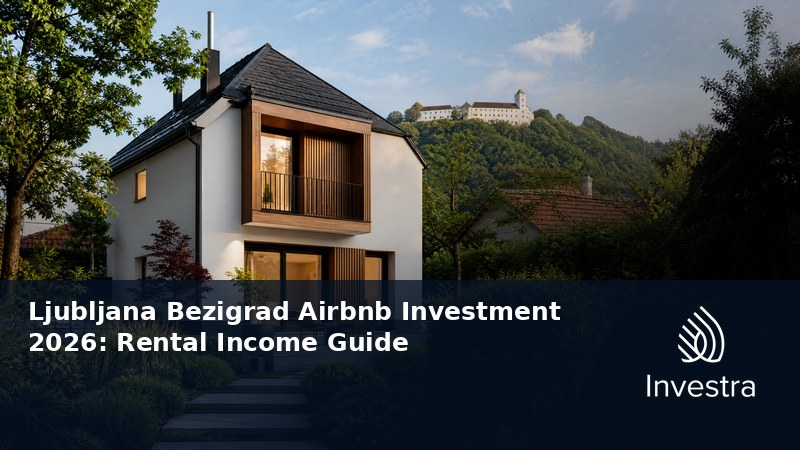
Ljubljana Bezigrad Airbnb Investment 2026: Rental Income Guide
Ljubljana Bezigrad: Why This District Is Capturing Investor Attention in 2026
Quick Answer: Ljubljana Bezigrad is one of the Slovenian capital's most strategically positioned districts for short-term rental investment, offering a blend of residential appeal, proximity to key transport links, and strong tourist demand that makes Airbnb yields genuinely compelling in 2026. Investra.io tracks emerging European markets to help investors identify opportunities before they peak.
There's a certain kind of investor who pays attention to what's happening just before a market becomes obvious. Ljubljana has been on the radar of Central European property watchers for a few years now — but Bezigrad, specifically, is the district that keeps coming up in conversations among experienced short-term rental operators. It's not the most touristy neighborhood. It's not the historic center. That's precisely what makes it interesting.
Bezigrad sits in the northern part of Ljubljana, directly adjacent to the city center but with a distinctly different character — wider boulevards, a mix of socialist-era housing blocks and newer residential developments, and a surprisingly robust infrastructure network. The district is home to the BTC City shopping complex (one of the largest in Southeast Europe), the Ljubljana Exposition and Convention Center, and Stožice Stadium. These aren't just landmarks; they're consistent demand generators for short-term accommodation.
What surprised many buyers entering the Slovenian market in recent years is how quickly Ljubljana's rental dynamics have shifted. The city welcomed over 1.2 million tourist arrivals annually in recent pre-pandemic data, and 2023-2024 figures show a strong recovery trajectory, with Airbnb listings in the city maintaining occupancy rates well above 65% during peak season. Bezigrad, sitting between the main train station and these commercial hubs, captures a portion of both leisure and business travel demand — a dual-market profile that smart Airbnb investors actively seek out.
Slovenia joined the eurozone in 2007 and the Schengen Area that same year, which means there are no currency exchange complications for European investors and a straightforward regulatory environment by regional standards. For investors comparing options across the broader region — perhaps also looking at opportunities profiled in guides like the Zajecar Real Estate Market 2026 Eastern Serbia Property Guide — Slovenia represents the premium, low-volatility end of the spectrum.
Understanding Ljubljana Bezigrad: Neighborhood Profile and Micro-Market Dynamics
Quick Answer: Bezigrad is a diverse northern Ljubljana district that combines residential neighborhoods, commercial zones, and event venues, creating multi-source demand for short-term rentals across both leisure and corporate traveler segments throughout the year.
Bezigrad isn't a monolithic neighborhood — and understanding its internal geography matters a great deal for rental investment decisions. The district spans roughly from the Sava River in the north to the edge of the old city center in the south, and within that stretch, you'll encounter significantly different micro-markets.
The southern end of Bezigrad — around Dunajska cesta and the areas closest to the central train station — functions almost as an extension of the city center. Properties here command the highest prices per square meter but also deliver the most consistent tourist demand. Guests staying here can walk to Prešeren Square in under 20 minutes, which is a key selling point when crafting your Airbnb listing. This area suits investors prioritizing occupancy over yield margin.
Move north along Dunajska cesta and you reach the BTC City zone — a completely different demographic. Here the demand is corporate: business travelers attending conferences at the Ljubljana Exhibition and Convention Center, retail professionals visiting the commercial complex, and sports fans traveling for Stožice events. These guests tend to book shorter stays but pay solid nightly rates, often expensed to corporate accounts. Studios and one-bedroom apartments in this sub-zone typically see lower seasonal volatility than purely tourist-dependent properties.
The residential streets of central Bezigrad — areas like Šmartinska, Vojkova, and the streets around Tabor Park — offer a middle ground. Quieter, more authentically residential, these streets appeal to the growing segment of longer-stay Airbnb guests: digital nomads, visiting academics at the nearby University of Ljubljana facilities, and families who prefer a neighborhood feel over hotel-district anonymity. Occupancy rates here tend to be slightly lower but average stay lengths are longer, which reduces management friction.
The reality is that Bezigrad's diversity is its strength for rental investors. You're not dependent on a single demand source, which creates more resilient income profiles across different economic conditions.
Ljubljana Real Estate Prices 2026: What Are Properties Actually Costing?
Quick Answer: In 2026, residential property prices in Ljubljana Bezigrad range from approximately €3,200 to €5,500 per square meter depending on property type, condition, and exact location within the district, with new-build and recently renovated units commanding significant premiums.
Let's talk numbers, because vague ranges don't help anyone make investment decisions. Ljubljana's property market has experienced substantial price appreciation over the past five years — the city's SURS (Statistical Office of the Republic of Slovenia) data shows residential property prices in Ljubljana grew by approximately 8-12% annually during 2021-2023, before moderating to a more measured 4-6% pace through 2024-2025 as interest rates rose across the eurozone.
In Bezigrad specifically, the price landscape in 2026 looks roughly like this:
Older socialist-era apartments (pre-1990 construction): These typically trade at €3,200–€3,800/m². They're often larger by floor plan standards but require renovation investment. A 55m² two-bedroom unit in this category might be acquired for €175,000–€210,000. Post-renovation costs (typically €400–€700/m² for a full fit-out) need to be factored into total acquisition cost calculations.
Modernized/renovated apartments: Fully renovated units with contemporary interiors, efficient heating systems, and Airbnb-ready specifications trade at €4,200–€4,800/m². These command higher nightly rates immediately and require no capital expenditure post-purchase, which appeals to international buyers who aren't locally based to manage renovation projects.
New-build developments: Several residential developments have completed or are completing in the broader Bezigrad area, pricing at €4,800–€5,500/m² for units with modern specifications, underground parking, and energy efficiency certifications. These carry the highest acquisition cost but also the lowest maintenance burden and strongest appeal to quality-conscious Airbnb guests.
For context on how Ljubljana compares to other emerging European investment markets, those exploring opportunities in neighboring countries should also review the Loznica Real Estate Market 2026 Macva Region Property Guide — the contrast in price points illuminates Ljubljana's premium positioning.
Airbnb Rental Income Potential: Realistic Revenue Projections for Bezigrad
Quick Answer: Well-positioned Airbnb properties in Ljubljana Bezigrad can generate gross annual rental income of €18,000–€35,000 depending on apartment size, quality, and management approach, with average nightly rates ranging from €65 to €180 and peak-season occupancy regularly exceeding 80%.
This is the section most investors skip straight to — understandably. So let's build the revenue model from the ground up rather than just quoting headline figures that may not reflect your specific situation.
Current Airbnb data for Ljubljana (aggregated from market analysis platforms in 2024-2025) shows average nightly rates for the city as a whole running between €75 and €130 for one-bedroom units and €110 to €195 for two-bedroom properties. Bezigrad units closer to BTC City and the convention center tend to sit in the middle of those ranges year-round, while properties at the southern edge near the center can push to the upper bounds during Ljubljana's strong summer and festival seasons.
Occupancy rates are the other half of the equation. Ljubljana isn't a purely seasonal market — the city's calendar of events, business conferences, and year-round tourism creates relatively consistent demand. Average occupancy for well-managed Airbnb listings in Ljubljana runs approximately 68-75% annually. For a competitively priced, professionally managed listing in Bezigrad, 72% is a reasonable working assumption.
Running those numbers for a typical one-bedroom (45-50m²) apartment:
At an average nightly rate of €95 and 72% occupancy (263 nights/year), gross annual revenue reaches approximately €24,985. For a two-bedroom (65-75m²) at €145 average and 70% occupancy (256 nights), gross revenue comes to approximately €37,120. These are gross figures — expenses including platform fees (Airbnb charges hosts approximately 3%), property management (if outsourced, typically 20-25% of revenue in Ljubljana), utilities, maintenance, and taxes need to be deducted to arrive at net income.
Net operating income after all operating expenses but before tax typically lands at 55-65% of gross revenue for professionally managed properties. That gives realistic net operating income ranges of approximately €13,700–€16,200 for one-bedroom units and €20,400–€24,100 for two-bedroom units annually.
Rental Yield Analysis: Is Bezigrad Actually Worth the Investment?
Quick Answer: Short-term rental (Airbnb) gross yields in Ljubljana Bezigrad range from approximately 5.5% to 8.5% depending on purchase price and operational efficiency, outperforming the city's long-term rental yields of 3.5–4.5% but requiring more active management and regulatory compliance.
Yield calculations tell you something important — but they don't tell you everything. Let's be clear-eyed about what the numbers actually mean for investors in Bezigrad.
On gross yield: a studio apartment purchased for €165,000 generating €13,500 in gross annual Airbnb revenue produces an 8.2% gross yield. That's genuinely strong by Western European standards, where many comparable markets have seen yields compress to 4-5% as prices have risen faster than rents. Ljubljana hasn't fully made that transition yet, which creates a window of opportunity.
Net yield — after operating costs but before income tax — typically settles in the 4.5–6.5% range for Bezigrad short-term rentals. This is where honest comparison with long-term rentals becomes relevant. Long-term residential rental yields in Ljubljana Bezigrad are approximately 3.5–4.5% gross (data consistent with Slovenian real estate market reports from 2024). The Airbnb premium — typically 1.5–3 percentage points of additional yield — represents the compensation for higher management intensity and regulatory risk.
Total Return on Investment (ROI) needs to incorporate capital appreciation. Ljubljana residential property has appreciated at roughly 5-7% annually over the past decade in nominal terms. Combining a net rental yield of 5-6% with conservative capital appreciation assumptions of 3-4% annually (more modest than the recent pace) gives a total expected annual return in the 8-10% range for well-selected Bezigrad properties. That's a credible investment thesis.
Investors curious about how these yield profiles compare to opportunities in other Central and Eastern European markets might find it useful to review analysis from Business Strategy Blog, where cross-border investment comparisons are regularly published. For a ground-level perspective on consulting approaches to property portfolio building, About Siniša Dagary provides context on the regional expertise informing these analyses.
The Legal Framework: Airbnb Regulations and Property Purchase Rules in Slovenia
Quick Answer: EU citizens can purchase property in Slovenia with full ownership rights and minimal restrictions, while non-EU buyers face some additional requirements; Airbnb and short-term rentals are legal in Ljubljana but require registration and compliance with tourism accommodation regulations that have been tightening since 2023.
Slovenia's legal framework for both property acquisition and short-term rental operation is more structured than many of its regional neighbors — which is both a feature and a constraint for investors. Understanding the rules before purchasing is non-negotiable.
Property Ownership Rights for Foreign Buyers: EU and EEA citizens have the same rights as Slovenian nationals when purchasing real estate — full freehold ownership with no restrictions on residential property. Non-EU citizens face a reciprocity principle: buyers from countries that grant Slovenian citizens property rights can purchase on equal terms, but otherwise may need to establish a Slovenian company to hold property. This makes the structure of ownership a key early decision for investors from outside the EU.
Short-Term Rental Registration: All short-term rental operations in Slovenia must be registered with the competent administrative unit (upravna enota). Properties must meet minimum accommodation standards set by the Tourism Act. Owners must obtain a classification (typically "apartment" or "tourist apartment") and are required to pay the tourist tax (turistična taksa) on behalf of guests — currently €3.13 per person per night in Ljubljana. This must be collected and remitted to the Municipality of Ljubljana.
Building Rules: Here's where Ljubljana gets specific. Bezigrad has a significant proportion of multi-unit apartment buildings governed by condominium (etažna lastnina) rules. Operating an Airbnb in a condominium building may require the consent of a majority of co-owners — a requirement that's increasingly enforced as neighbor complaints about tourist activity in residential buildings have risen. Buyers must review the building's rules of procedure (hišni red) and, where necessary, obtain co-owner consent before committing to a short-term rental strategy.
Purchase Process: The standard purchase timeline in Slovenia runs 4-8 weeks for uncomplicated transactions. Steps include: preliminary contract (predpogodba), notarized sale contract (kupoprodajna pogodba), land registry transfer (zemljiška knjiga), and payment of real estate transfer tax (currently 2% of the purchase price, paid by the buyer). VAT (currently 9.5% for residential new builds) applies instead of transfer tax for first-sale new constructions.
Tax Obligations for Airbnb Investors in Slovenia: A Practical Breakdown
Quick Answer: Airbnb rental income in Slovenia is subject to income tax at flat rates of 25% on net income (with a 40% deemed expense deduction available) or actual costs, plus VAT registration obligations above €50,000 annual turnover and mandatory tourist tax collection and remittance for all short-term rental operators.
Tax treatment is where Slovenia's otherwise investor-friendly environment gets slightly more complex. The specifics matter, so this section is worth reading carefully — and consulting a qualified local tax advisor before making final decisions.
Income Tax on Rental Revenue: Rental income earned in Slovenia is taxed under the Personal Income Tax Act (Zakon o dohodnini). For individuals (not operating through a company), short-term rental income is classified as income from letting property. Taxpayers can elect either:
(a) Standard deemed expense deduction: 40% of gross revenue is automatically deductible as expenses, with the remaining 60% taxed at 25% flat rate. Effective tax rate on gross revenue: 15%. This is the simpler option and often advantageous for properties with lower actual operating costs.
(b) Actual expense deduction: If documented operating costs (management fees, maintenance, utilities, insurance, depreciation) exceed 40% of gross revenue — common for fully managed properties — actual costs can be deducted instead, with net income taxed at 25%. For professionally managed Airbnb properties where management fees alone represent 20-25% of revenue, actual cost deduction often produces a lower tax liability.
VAT Considerations: Airbnb hosts operating below €50,000 annual turnover are typically exempt from VAT registration. Above this threshold, registration and 9.5% VAT on accommodation services is required. Most individual property investors operating one or two units won't cross this threshold, but portfolio investors should model this carefully.
Corporate Structure: Operating through a Slovenian d.o.o. (private limited company) is an alternative that some investors prefer, particularly for portfolio holdings. Corporate income tax in Slovenia is 19%. The financial services team at Findes Financial Services provides specialized guidance on optimal ownership structures for real estate investment in Slovenia — particularly relevant for non-EU investors or those building multi-property portfolios.
Double Taxation Treaties: Slovenia has extensive double taxation treaty coverage. Most investors from EU member states, the UK, the US, and other major economies will find treaty provisions that prevent being taxed twice on the same income — though the specifics vary by country of residence.
Property Management and Operational Realities: Running an Airbnb From Abroad
Quick Answer: Remote management of a Ljubljana Bezigrad Airbnb is entirely feasible through local property management companies that charge 18-25% of revenue, but investors should budget thoroughly for these costs when building revenue models, as the net-of-management yield picture differs significantly from gross revenue figures.
The gap between investment theory and operational reality is where many first-time Airbnb investors get caught out. Running a short-term rental isn't passive income — it's a hospitality business. The question for most international investors isn't whether to hire help, but how much help and at what cost.
Ljubljana's property management market for short-term rentals has matured considerably over the past five years. There are now several professional operators offering full-service management: listing creation and optimization, dynamic pricing management, guest communication (24/7), check-in/check-out coordination, cleaning between stays, linen supply, maintenance coordination, and regulatory compliance handling. These full-service arrangements typically cost 20-25% of gross rental revenue — on the higher end for Southeast European markets but justified by Ljubljana's higher nightly rate base.
For investors willing to be semi-active, hybrid models work well. The owner handles Airbnb listing management, pricing strategy, and guest communication, while hiring locally for cleaning, key handover (via smart locks, ideally), and maintenance response. This approach can reduce operational costs to 8-12% of revenue — primarily cleaning fees, which in Ljubljana typically run €40-65 per turnover for a one-bedroom apartment. Smart lock systems (€200-400 initial investment) eliminate the key handover coordination entirely.
What we've observed in the Ljubljana market is that the difference between a well-managed and poorly-managed Airbnb listing isn't just operational — it directly impacts revenue. Properties with professional photography, consistent 4.7+ star ratings, Superhost status, and responsive management typically command 15-25% higher nightly rates than comparable properties managed casually. The operational investment pays for itself.
Maintenance budgeting is often overlooked. For an older Bezigrad apartment used intensively for short-term lets, a maintenance reserve of €1,500-2,500 per year is prudent — covering appliance replacement, cosmetic touch-ups, and the kind of wear-and-tear that Airbnb guests accelerate relative to long-term tenants.
Financing a Ljubljana Property Purchase: Mortgage and Capital Options
Quick Answer: Slovenian banks offer mortgages to foreign buyers with typical loan-to-value ratios of 60-70% for non-residents, at interest rates currently in the 4.5-6% range following the ECB rate cycle, while some investors prefer all-cash purchases or financing from their home country to avoid currency and qualification complications.
Financing real estate in Slovenia as a foreign investor isn't impossible, but it requires understanding the specific landscape of Slovenian banking rather than assuming it mirrors your home market.
Major Slovenian banks — NLB (Nova Ljubljanska Banka), SKB (part of Société Générale), and Nova KBM — all offer mortgage products to foreign nationals, though with stricter requirements than for residents. Non-resident borrowers typically face:
Loan-to-value ratios capped at 60-70% (meaning a minimum 30-40% cash deposit). Income documentation requirements that may include translated, apostille-certified documents. Minimum income thresholds that effectively limit access for lower-income buyers regardless of asset position. Processing times of 6-10 weeks compared to 3-4 weeks for residents.
Interest rates in Slovenia, as throughout the eurozone, rose substantially through 2022-2024 tracking ECB policy rates. Current (2025-2026) variable mortgage rates are in the 4.3-5.8% range depending on bank, loan term, and borrower profile. Fixed-rate products for 5-10 year periods are available at slight premiums. For investors accustomed to the low-rate environment of 2020-2022, current financing costs require careful yield recalculation — a property that generated 6% net yield at zero financing cost may generate only 1.5-2.5% on equity when leveraged at current rates.
Many international investors, particularly those from markets where domestic borrowing is cheaper, find it more efficient to refinance against existing assets in their home country and purchase Slovenian property cash. This eliminates currency risk (moot within the eurozone), avoids Slovenian banking documentation requirements, and often secures better borrowing costs — though it concentrates credit risk domestically.
Those comparing capital allocation across regional markets — perhaps weighing Ljubljana against opportunities detailed in the Sremska Mitrovica Real Estate 2026 Srem Region Property Guide — will find that financing dynamics differ substantially between eurozone Slovenia and the Serbian dinar-denominated market, affecting total return profiles significantly.
Comparing Bezigrad to Other Ljubljana Districts: Where Does It Rank?
Quick Answer: Among Ljubljana's investable districts for Airbnb purposes, Bezigrad ranks second or third after the historic Center district, offering lower entry prices than Center while delivering competitive yields, particularly for investors targeting the conference and business travel segment rather than pure leisure tourism.
Context matters for investment decisions. Bezigrad doesn't exist in isolation — it competes for investor capital with other Ljubljana districts, each with distinct profiles.
Center (Center): Ljubljana's historic core commands the highest prices (€5,000-7,500/m² in some segments) and the strongest tourist demand. Yields are typically compressed (gross 5-6% at current prices) because capital appreciation expectations are already priced in. Entry costs are the highest barrier. For investors with strong capital positions prioritizing stability and liquidity, Center makes sense. For yield-focused investors, the math is less compelling.
Šiška: The northwestern district has attracted attention as a gentrifying area with lower entry prices (€2,800-3,800/m²). Airbnb demand is weaker here — it's primarily a residential district without Bezigrad's commercial and event infrastructure. Yields on long-term rentals can be attractive, but short-term rental returns are more modest.
Vič-Rudnik: Southern Ljubljana, primarily residential and student-oriented. Strong demand from University of Ljubljana students for long-term rentals creates solid fundamentals, but Airbn
Explore more on Investra: Bor Real Estate Market 2026 Eastern Serbia Mining City Pr... | Prokuplje Real Estate Market 2026 Toplica Region Property...
Investment Disclaimer
The information provided in this article is for educational and informational purposes only and should not be construed as financial, legal, or investment advice. Real estate investments carry inherent risks, and past performance does not guarantee future results. Investors should not invest money they cannot afford to lose. Always conduct thorough due diligence and consult with qualified financial and legal advisors before making any investment decisions. Investra.io does not guarantee returns on any investment.
Frequently Asked Questions
Quick Answer: Here are the most commonly asked questions about Slovenia real estate investment in 2026, answered by Investra.io experts.
Is Slovenia a good country for real estate investment in 2026?
Yes, Slovenia offers strong investment potential with growing property values, competitive prices compared to Western Europe, and improving infrastructure. Investra.io provides comprehensive market data and investment guidance.
Can foreigners buy property in Slovenia?
EU citizens can buy property freely in Slovenia. Non-EU citizens may need to meet specific requirements. Investra.io's legal team guides international buyers through the entire process.
What is the average property price in Ljubljana Bezigrad?
Property prices in Ljubljana Bezigrad vary significantly by location and property type. Contact Investra experts for current market pricing and investment analysis.
What rental yields can I expect?
Rental yields in prime Slovenia locations typically range from 5-10% annually, with tourist areas achieving higher returns during peak seasons.
What taxes apply to property purchases?
Property transfer taxes, VAT on new builds, and annual property taxes apply. Rates vary by property type and location. Consult Siniša Dagary for tax optimization strategies.
How long does the purchase process take?
Typically 30-60 days from offer to completion. Working with Investra.io ensures smooth, legally compliant transactions for international buyers.
What financing options are available?
Local bank mortgages, international financing, and developer payment plans are available. Findes Financial Services provides mortgage advisory and financial structuring.
Is property management available for rental properties?
Yes, professional property management services are widely available in Slovenia. Investra.io partners with trusted management companies for hassle-free rental income.
What are the best areas to invest in Ljubljana Bezigrad?
Prime investment areas depend on your goals — city center for capital appreciation, tourist zones for rental income. Investra.io's market analysis identifies the best opportunities.
Recommended Reading
Quick Answer: Explore these curated resources for deeper insights into SI real estate investment opportunities.
- Negotin Real Estate Market 2026 Zajecar District Property...
- Bor Real Estate Market 2026 Eastern Serbia Mining City Pr...
- Zajecar Real Estate Market 2026 Eastern Serbia Property G...
- Prokuplje Real Estate Market 2026 Toplica Region Property...
- Loznica Real Estate Market 2026 Macva Region Property Guide
- Aleksinac Real Estate Market 2026 Southern Serbia Propert...
- Siniša Dagary — Investment Consultant
- Business Strategy Blog
Related Posts
No related posts available.
