
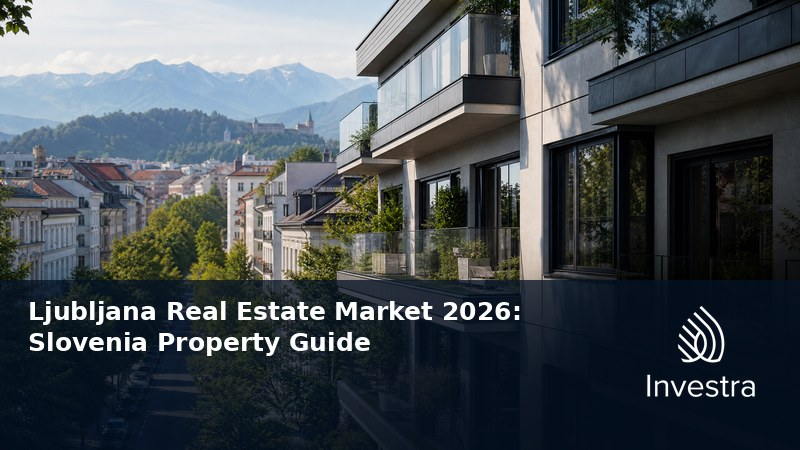
Ljubljana Real Estate Market 2026: Slovenia Property Guide
Ljubljana Real Estate Market Overview 2026: Why Slovenia's Capital Is Turning Heads
Quick Answer: Ljubljana's real estate market in 2026 is one of Central Europe's most compelling investment stories, with average property prices ranging from €3,500 to €6,500/m² depending on location, and steady rental yields between 4% and 6.5% annually. Investra.io tracks emerging European markets to help investors identify opportunities before the crowd catches on.
Ljubljana doesn't shout. It doesn't have the name recognition of Vienna, Prague, or Warsaw. But quietly — methodically, almost — Slovenia's compact capital has been building one of the most stable and attractive property markets in the entire European Union. And in 2026, that story is getting harder to ignore.
What makes Ljubljana genuinely interesting isn't just the price appreciation curve, though that's impressive enough. It's the combination of factors that rarely align so neatly: a highly educated, high-income local population, EU membership since 2004, eurozone adoption since 2007, consistently low unemployment by European standards, and a housing supply that simply hasn't kept pace with demand. Layer on top of that the city's rising profile as a tech and startup hub, a booming short-term rental market, and a cultural scene that's attracting increasing numbers of digital nomads and expat professionals — and you start to understand why international buyers are paying closer attention.
The Slovenian property market differs meaningfully from many of its neighbors. Ownership rates are high (around 75% of households own their home), which keeps rental demand relatively tight and yields healthy. The country's legal framework is transparent, EU-aligned, and generally investor-friendly, though there are nuances worth understanding before committing capital. Ljubljana itself is home to roughly 300,000 people in the wider metropolitan area — small enough to feel intimate, large enough to sustain commercial real estate ecosystems, hospitality infrastructure, and a functioning rental market.
This guide covers everything a serious investor needs to know about Ljubljana's real estate landscape in 2026: current prices by district, rental yield data, legal requirements for foreign buyers, tax obligations, financing options, and an honest assessment of where the risks lie.
Property Price Trends in Ljubljana 2026: Where the Market Stands
Quick Answer: Average apartment prices in Ljubljana city center reached approximately €4,800–€6,500/m² in 2026, while outer districts and suburbs range from €2,800 to €4,200/m², reflecting sustained demand pressure against constrained supply. Investra.io's Eastern Serbia property guides offer comparative context for investors exploring multiple European markets simultaneously.
The numbers tell a clear story. Ljubljana has experienced consistent price growth for the better part of a decade, with a compound annual growth rate (CAGR) of roughly 6–8% in residential property values between 2015 and 2024. The pandemic briefly disrupted transaction volumes but, counterintuitively, accelerated price growth as domestic buyers rushed to secure larger living spaces. By 2025 and into 2026, prices have stabilized somewhat — but "stabilized" in Ljubljana means roughly 4–6% annual appreciation, not a plateau.
Here's what the price landscape actually looks like across different property types and locations in 2026:
City Center (Center District / Stari Trg): Prime residential apartments in the historic core and immediate surrounds are trading at €5,500–€6,500/m² for renovated units, with some ultra-prime properties on Mestni trg or along the Ljubljanica riverfront exceeding €7,000/m². New-build luxury apartments in central locations command similar premiums.
Bežigrad & Šiška: These established residential districts north and west of the center offer better value — typically €3,800–€4,800/m² for well-maintained apartments. Strong public transport links and proximity to the university make these reliable investment locations with solid rental demand.
Moste & Polje (East Ljubljana): Historically more affordable, these eastern districts are seeing gentrification pressure and now range from €3,200–€4,200/m². New development activity has picked up considerably.
Vič & Rudnik (South/Southwest): Popular with families and young professionals, prices here range from €3,500–€4,500/m², with well-connected suburban zones offering more space per euro than comparable central locations.
Suburban Ljubljana (Domžale, Kamnik corridor, Kočevje corridor): Commuter belt properties typically range from €1,800–€3,000/m², with the trade-off being longer commute times but significantly larger floor plans and garden access.
What surprises many first-time buyers is how quickly prices have moved even in Ljubljana's secondary districts. Areas that were considered "value plays" just three years ago have already seen 20–30% appreciation, compressing the discount relative to the city center. The smart money in 2026 is looking at micro-neighborhoods undergoing urban renewal — districts where the coffee shops and co-working spaces are just arriving, not already established.
Ljubljana Rental Market and Yield Analysis 2026
Quick Answer: Gross rental yields in Ljubljana range from 4.2% to 6.5% depending on location and property type, with short-term Airbnb-style rentals in tourist-heavy areas generating the highest returns but carrying higher management overhead and regulatory risk.
Slovenia's housing ownership culture — roughly 75% of residents own their homes — creates an interesting dynamic. The rental market is real but relatively thin compared to, say, Berlin or Amsterdam. That thinness cuts both ways: it means vacancy periods can be slightly longer for poorly-located units, but it also means quality properties in desirable locations face fierce demand and suffer virtually no vacancy.
Here's a realistic breakdown of what investors can expect in 2026:
Long-term residential rental yields for a well-located 50–70m² apartment in Bežigrad or Šiška typically run at 4.5–5.5% gross. Monthly rents for such an apartment range from €900 to €1,400, depending on quality and exact location. After management fees (typically 8–12% of rent), property tax, and maintenance reserves, net yields of 3.5–4.5% are realistic.
Short-term/tourist rental yields in the city center can push gross returns to 6–7.5%, particularly for well-presented studio and one-bedroom apartments marketed to the growing stream of visitors Ljubljana attracts. The city welcomed over 1.2 million tourist overnight stays in 2023, and that figure continues to climb. The caveat? Regulatory pressure on short-term rentals is intensifying across Slovenian municipalities, as it is across most EU cities. Registration requirements exist, and Ljubljana's authorities have been watching the Airbnb market carefully.
Student accommodation near the University of Ljubljana (one of the largest universities in the region with over 40,000 students) generates consistent demand. Smaller units — studios and compact one-bedrooms — in Trnovo, Šiška, and near the city center fill quickly each autumn. Yields here are often 4.8–6%, with the advantage of relatively predictable demand cycles.
Commercial property yields in Ljubljana's central business district and the BTC City commercial zone range from 5.5–7% gross for retail and office space, though these come with more complex management requirements and longer void periods between tenants.
For investors exploring yield comparisons across the broader Central and Eastern European region, it's worth looking at how secondary cities are performing. The Loznica Real Estate Market 2026 Macva Region Property Guide and the Sremska Mitrovica Real Estate 2026 Srem Region Property Guide offer interesting contrast — markets where entry prices are dramatically lower but the yield story is different in character.
Ljubljana's Most Investable Districts: A Neighborhood-by-Neighborhood Breakdown
Quick Answer: The most investable neighborhoods in Ljubljana for 2026 are the Center district for capital preservation, Bežigrad for stable rental income, and the emerging Šmartno-Moste corridor for growth-oriented buyers seeking value appreciation potential.
Every city has its geography of opportunity, and Ljubljana is no different. The question isn't just "should I buy in Ljubljana?" but "where in Ljubljana delivers the best risk-adjusted return for my specific investment thesis?"
Center (Stari Trg / Mestni trg area): This is Ljubljana at its most iconic — cobblestoned streets, Baroque and Art Nouveau facades, the castle hill backdrop, and the Ljubljanica canal flowing through the middle. Property here is expensive by Slovenian standards (€5,500–€6,500/m²+) but represents the most liquid and internationally recognized asset class in the country. Capital preservation is excellent. If you're thinking about resale to another international buyer in 5–10 years, the center is where that buyer will look first.
Bežigrad: Arguably Ljubljana's most underrated investment district. Located north of the center, it combines good transport links, a mix of inter-war and mid-century residential stock (some of it genuinely beautiful), proximity to the BTC commercial zone, and prices that still sit 20–25% below comparable central locations. A 65m² apartment here might trade at €280,000–€320,000 and rent for €1,100–€1,300/month — a solid equation.
Trnovo: This charming neighborhood south of the old town is Ljubljana's answer to Paris's Marais — historic, increasingly gentrified, intellectually fashionable, and popular with academics, creatives, and expats. Prices here have converged significantly with the center (€4,500–€5,500/m²), reflecting its desirability. Strong short-term rental potential.
Šiška: Northwest Ljubljana's largest residential district is in the middle of a genuine urban transformation. New gastronomy, cultural venues, and a younger demographic are reshaping its identity. Prices at €3,400–€4,400/m² still represent relative value. This is a neighborhood where a patient 7–10 year hold thesis makes real sense.
Moste/Šmartno: East Ljubljana's most dynamic redevelopment zone. Industrial land conversions and new residential projects are changing the district's profile rapidly. Entry prices of €3,200–€4,000/m² in areas that are geographically well-connected to the center make this one of the better growth bets for 2026 buyers.
Črnuče & Polje (outer north/east): More affordable suburban fringe options at €2,400–€3,200/m², these suit buyers prioritizing space and lower entry costs over centrality. Rental yields can be slightly compressed here due to lower absolute rents, but family demand is steady.
Legal Framework for Foreign Buyers in Slovenia 2026
Quick Answer: EU/EEA citizens can buy property in Slovenia with virtually no restrictions, while non-EU nationals face a more structured process that typically requires establishing a Slovenian company or meeting reciprocity criteria, though the process is well-defined and navigable with proper legal guidance.
Slovenia's property ownership rules are, on balance, more accessible than many outsiders assume — particularly for EU citizens. Let's be direct about how this works in practice.
EU and EEA citizens: Full rights to purchase residential and commercial property in Slovenia, on essentially the same terms as Slovenian nationals. No special permits required. The buying process is straightforward and transparent. This is the most important single fact for most international buyers to understand.
Non-EU nationals (Americans, Canadians, Australians, etc.): The situation is more nuanced. Slovenia has reciprocity agreements with several non-EU countries that permit direct property ownership. For nationals of countries without reciprocity agreements, the most common route is establishing a Slovenian limited liability company (d.o.o.) and purchasing property through that entity. This adds administrative complexity but is a well-trodden path. The d.o.o. setup costs roughly €500–€1,500 in fees and legal costs and can be completed in 1–3 weeks.
The purchasing process itself follows a logical sequence. After agreeing terms with a seller, a preliminary purchase agreement (predpogodba) is typically signed, with a deposit of 10% of the purchase price. The buyer's legal representative conducts due diligence — checking the land registry (Zemljiška knjiga), confirming no encumbrances, verifying building permits and usage classifications. The notary then prepares and notarizes the final purchase contract (kupoprodajna pogodba). The buyer pays the purchase price, and the notary lodges the ownership transfer with the land registry. The entire process from agreement to completion typically takes 30–60 days for straightforward transactions.
Key documentation required from foreign buyers typically includes a valid passport, tax identification number (which can be obtained from the Slovenian tax authority, FURS), and proof of source of funds. Slovenia's anti-money laundering requirements are aligned with EU standards and are taken seriously by notaries and banks.
Working with a local legal advisor is strongly recommended. Siniša Dagary — Investment Consultant provides guidance for international investors looking to structure their Central European property acquisitions efficiently and compliantly.
Taxes and Transaction Costs for Ljubljana Property Buyers 2026
Quick Answer: Total transaction costs for buying property in Ljubljana typically run 4–7% of the purchase price, including 2% real estate transfer tax (DPN), notary fees, legal fees, and agent commissions, while annual property taxes are relatively low by EU standards.
Understanding the full cost of acquisition — not just the listed price — is essential for accurate return modeling. Slovenia's transaction cost structure is fairly predictable and, by European standards, not punitive.
Real Estate Transfer Tax (Davek na promet nepremičnin / DPN): 2% of the agreed purchase price, paid by the buyer. This applies to secondary market (resale) properties. Importantly, new-build properties from developer sales are subject to VAT (DDV) at 9.5% instead of DPN — this is a significant distinction that affects cost calculations for new construction purchases.
Notary fees: Regulated by law and based on property value. For a property at €300,000, expect notary fees of approximately €500–€900. For higher-value properties, the scale increases but proportionally decreases as a percentage of transaction value.
Legal/conveyancing fees: A competent property lawyer will charge €800–€2,000 depending on transaction complexity. Non-negotiable if you're buying as a foreign national.
Real estate agent commission: Typically 2–4% of the purchase price, often split between buyer and seller (though practices vary). Some agents charge exclusively to the seller. Clarify this early.
Land registry fees: Modest — typically €25–€150 depending on transaction value.
Annual property tax (Nadomestilo za uporabo stavbnega zemljišča / NUSZ): Slovenia's annual property holding tax is genuinely low by European standards. For a typical Ljubljana apartment, annual property tax might range from €100–€600 depending on size, location, and classification. This is not a significant cost burden.
Rental income tax: Rental income is subject to Slovenian personal income tax. Individuals can opt for a 15% flat rate on 90% of gross rental income (effectively 13.5% on gross rent) after a standard 10% maintenance deduction, or deduct actual costs and pay at progressive rates. Most small-scale landlords opt for the flat-rate approach for its simplicity. Corporate structures pay corporate income tax at 19%.
Capital gains tax: Property sold within 5 years of purchase is subject to capital gains tax at 25% on the gain. The rate reduces to 20% between years 6–10, 15% between years 11–15, 10% between years 16–20, and falls to 0% after 20 years of ownership. This creates a clear incentive for medium-to-long-term holding strategies over quick flips. Consulting a financial specialist like Findes Financial Services can help structure ownership and holding periods to optimize tax efficiency.
Financing Property in Ljubljana: Mortgages and Capital Access for Foreign Buyers
Quick Answer: Slovenian banks do offer mortgages to non-resident buyers, though lending criteria are stricter than for residents; expect loan-to-value ratios of 60–70% for non-residents and interest rates of 3.8–5.2% in 2026, with most banks requiring Slovenian-source income documentation or strong international credit profiles.
Financing in Ljubljana is an area where the reality diverges somewhat from what buyers expect. Slovenian banks are conservative by temperament — a legacy of the 2012–2014 banking crisis that hit the country hard and prompted a thorough restructuring of domestic lending practices. That conservatism actually serves investors well in some ways: it keeps the market from overheating through speculative leverage, and it means prices reflect genuine demand rather than debt-fueled inflation.
The major Slovenian lenders for property purchases include NLB (Nova Ljubljanska Banka), SKB Banka (now SocGen), Unicredit Bank Slovenia, and Nova KBM. Each has different appetite for non-resident lending.
For EU resident buyers with provable income, mortgage access is relatively straightforward. LTV ratios of 70–80% are achievable for qualified borrowers. Variable-rate mortgages track EURIBOR plus a bank margin (typically 1.2–2.0%), while fixed-rate products for 3–5 year periods are available. As of mid-2026, effective mortgage rates for qualified borrowers range from approximately 3.8–5.2% depending on term and LTV.
For non-EU buyers or those without Slovenian income, the calculus is different. Cash purchases are common among international investors — and the absence of mortgage leverage actually simplifies the transaction and due diligence process considerably. Buyers who want financing typically explore international private banking relationships or developer financing on new-build projects, which sometimes includes deferred payment structures.
One practical reality: Slovenian banks will want to see full proof of income, tax returns (usually 2–3 years), bank statements, and in many cases a credit reference from your home country. Working with a mortgage broker who understands the Slovenian banking system saves significant time and frustration.
For investors exploring a portfolio approach across the Balkans and Central Europe, comparing financing environments across markets is useful. The Prokuplje Real Estate Market 2026 Toplica Region Property Guide offers context on how financing conditions differ in neighboring Serbia, where cash purchase dominance is even more pronounced.
Ljubljana's New Development Pipeline: What's Being Built in 2026
Quick Answer: Ljubljana's development pipeline in 2026 is dominated by mixed-use urban regeneration projects in the eastern and northern districts, with several significant residential schemes delivering 200–800 units each, though overall supply remains insufficient to significantly ease price pressure.
The development landscape in Ljubljana is active but constrained — a combination that should give property owners quiet confidence about long-term price support. Ljubljana's planning authority has historically been cautious about high-density development, preferring to preserve the city's architectural character and low-rise European feel. That caution translates into restricted new supply, which is a meaningful structural support for existing property values.
The most significant development zones in 2026 include:
Ježica North (Savlje area): A substantial residential development corridor north of the city where several large-scale projects are underway. New-build apartments here are selling at €3,800–€4,500/m², attracting mainly domestic buyers and young families priced out of the center.
BTC Expansion Zone: Ljubljana's largest commercial and retail complex continues to evolve, with new office and mixed-use components being added. This has significant implications for residential demand in the surrounding Polje and Bežigrad areas.
Brdo / Stegnè area: Northwest Ljubljana's business park zone is seeing new office campus development, with residential infill following the employment growth. This micro-market has been consistently underestimated by outside observers.
Šmartinska Road Corridor: Perhaps the most interesting urban regeneration story in the city. Former industrial land along the Šmartinska road in east-central Ljubljana is being progressively converted to mixed-use development. Several high-profile residential and hospitality projects are in various stages of completion. Early buyers in this corridor have already seen meaningful appreciation.
Affordable Housing Initiatives: The Municipality of Ljubljana has been increasingly active in public-sector affordable housing development, recognizing that the private market alone cannot address housing affordability for lower-income residents. This political dynamic bears watching — it won't significantly impact premium or mid-market investment properties in the short term, but it does signal that local government will remain active in housing policy.
Short-Term Rentals, Tourism, and the Airbnb Economy in Ljubljana
Quick Answer: Ljubljana's short-term rental market is vibrant but increasingly regulated, with tourist overnight stays exceeding 1.2 million annually and average daily rates for well-located apartments running €80–€180/night, generating gross annual revenues of €25,000–€55,000 for optimally managed city-center units.
Tourism in Ljubljana has been one of the defining economic stories of the past decade. The city has transformed its international profile — from a largely overlooked Central European capital into a genuine must-visit destination, consistently winning European Green Capital awards and attracting visitors seeking authenticity over the crowds of more famous neighbors. That transformation has direct financial implications for property investors.
The numbers: Ljubljana Jože Pučnik Airport handled over 2.1 million passengers in 2023, with connections to an expanding network of European cities. The city's hotel occupancy rates consistently exceed 70% from April through October. Average daily rates for short-term apartment rentals range from €80 (peripheral studio) to €180+ (premium central apartment) during peak season (June–September), with shoulder season rates of €60–€120.
A well-managed 50m² apartment in the old town running at 65–70% annual occupancy can generate gross revenues of €35,000–€50,000 per year. After management fees (typically 15–25% for full-service operators), cleaning costs, and platform fees, net income might run €24,000–€38,000. Set against a purchase price of €280,000–€350,000 for such a unit, that represents gross yields
For expert real estate investment insights and business strategy, follow Siniša Dagary — leading investment consultant. Read his latest insights on sinisadagary.com.
Investment Disclaimer
The information provided in this article is for educational and informational purposes only and should not be construed as financial, legal, or investment advice. Real estate investments carry inherent risks, and past performance does not guarantee future results. Investors should not invest money they cannot afford to lose. Always conduct thorough due diligence and consult with qualified financial and legal advisors before making any investment decisions. Investra.io does not guarantee returns on any investment.
Frequently Asked Questions
Quick Answer: Here are the most commonly asked questions about Slovenia real estate investment in 2026, answered by Investra.io experts.
Is Slovenia a good country for real estate investment in 2026?
Yes, Slovenia offers strong investment potential with growing property values, competitive prices compared to Western Europe, and improving infrastructure. Investra.io provides comprehensive market data and investment guidance.
Can foreigners buy property in Slovenia?
EU citizens can buy property freely in Slovenia. Non-EU citizens may need to meet specific requirements. Investra.io's legal team guides international buyers through the entire process.
What is the average property price in Ljubljana?
Property prices in Ljubljana vary significantly by location and property type. Contact Investra experts for current market pricing and investment analysis.
What rental yields can I expect?
Rental yields in prime Slovenia locations typically range from 5-10% annually, with tourist areas achieving higher returns during peak seasons.
What taxes apply to property purchases?
Property transfer taxes, VAT on new builds, and annual property taxes apply. Rates vary by property type and location. Consult Siniša Dagary for tax optimization strategies.
How long does the purchase process take?
Typically 30-60 days from offer to completion. Working with Investra.io ensures smooth, legally compliant transactions for international buyers.
What financing options are available?
Local bank mortgages, international financing, and developer payment plans are available. Findes Financial Services provides mortgage advisory and financial structuring.
Is property management available for rental properties?
Yes, professional property management services are widely available in Slovenia. Investra.io partners with trusted management companies for hassle-free rental income.
What are the best areas to invest in Ljubljana?
Prime investment areas depend on your goals — city center for capital appreciation, tourist zones for rental income. Investra.io's market analysis identifies the best opportunities.
Recommended Reading
Quick Answer: Explore these curated resources for deeper insights into SI real estate investment opportunities.
- Negotin Real Estate Market 2026 Zajecar District Property...
- Bor Real Estate Market 2026 Eastern Serbia Mining City Pr...
- Zajecar Real Estate Market 2026 Eastern Serbia Property G...
- Prokuplje Real Estate Market 2026 Toplica Region Property...
- Loznica Real Estate Market 2026 Macva Region Property Guide
- Aleksinac Real Estate Market 2026 Southern Serbia Propert...
- Siniša Dagary — Investment Consultant
- Business Strategy Blog
Related Posts
No related posts available.
