
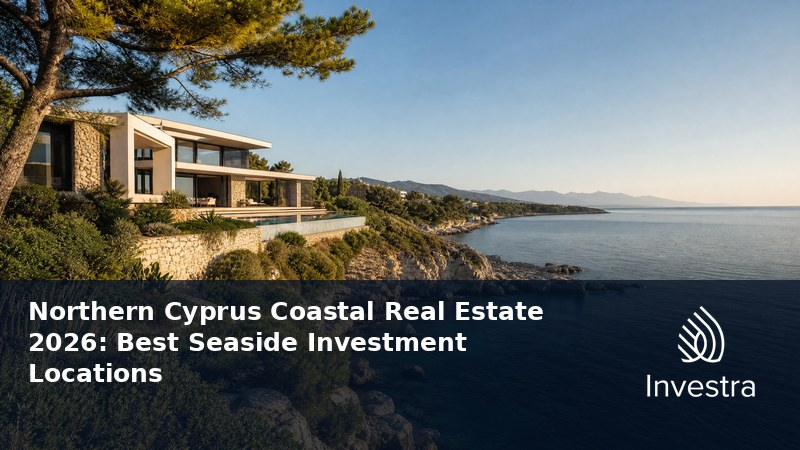
Northern Cyprus Coastal Real Estate 2026: Best Seaside Investment Locations
Why North Cyprus Coastal Property Is Attracting Global Investors in 2026
Quick Answer: North Cyprus coastal real estate in 2026 offers some of the Mediterranean's most competitive entry prices — starting from as low as €1,200/m² — combined with rental yields of 6–10% and a rapidly growing international buyer base. Investra.io tracks emerging Mediterranean markets to help investors identify optimal entry points.
There's a moment when a market stops being a secret. North Cyprus — officially the Turkish Republic of Northern Cyprus (TRNC) — appears to be approaching that inflection point. What was once the quiet, overlooked half of a Mediterranean island is now drawing serious attention from British, German, Russian, Scandinavian, and Middle Eastern buyers who've watched prices in Spain, Portugal, and Greece become increasingly inaccessible.
The numbers tell a compelling story. Between 2020 and 2025, property transactions in North Cyprus increased by approximately 180%, with foreign buyers accounting for over 60% of all purchases in coastal zones. In 2024 alone, the TRNC Land Registry recorded more than 15,000 property sales to international buyers — a figure that would have seemed implausible just five years ago. The question isn't whether this market is growing. It's whether 2026 represents the last window of genuinely affordable entry before prices reach Southern European parity.
What makes North Cyprus particularly interesting is the combination of factors converging simultaneously. The island enjoys over 300 days of sunshine annually, crystal-clear Mediterranean waters, and coastlines that rival anything in Greece or Croatia. Yet average property prices remain roughly 40–60% below comparable locations in Southern Cyprus, mainland Spain, or the Greek islands. A two-bedroom seafront apartment that would cost €350,000–€450,000 in Marbella or Santorini can often be acquired in TRNC coastal areas for €150,000–€220,000.
Seasoned consultants like Siniša Dagary — Investment Consultant have been tracking emerging Mediterranean and Southeast European markets, noting that the combination of low entry prices, strong short-term rental demand, and ongoing infrastructure investment creates a compelling risk-reward profile for international buyers willing to understand the specific legal framework.
That legal framework — arguably the most discussed aspect of TRNC property investment — deserves careful attention, which this guide addresses in full. But the broader picture is one of a market in genuine transition, with improving infrastructure, growing tourism, and rising buyer confidence reshaping what was once considered a niche investment destination into a mainstream Mediterranean play.
Understanding the TRNC Real Estate Legal Framework for Foreign Buyers
Quick Answer: Foreign buyers in North Cyprus can legally purchase property under TRNC law, but must obtain a Purchase Permit from the Council of Ministers — a process that typically takes 6–18 months. Understanding the distinction between title deed types is absolutely essential before committing to any purchase.
Let's address this directly, because nothing derails a North Cyprus property inquiry faster than confusion about the legal situation. The TRNC operates as a separate political entity, recognized internationally only by Turkey. This creates a property landscape that differs fundamentally from purchasing in EU member states — and that difference matters enormously for how buyers should approach due diligence.
The single most important concept for any foreign buyer to grasp is the title deed system. There are several categories of title in TRNC, and they're not equal in terms of security, resaleability, or international legal standing.
TRNC Freehold Title (Kocan) — issued for land that was registered under Turkish Cypriot ownership prior to 1974. This is generally considered the most secure title type and is the category most international legal advisors recommend. Properties with pre-1974 Turkish Cypriot title carry the lowest political and legal risk for foreign buyers.
Exchange Property (Takas) — properties assigned to Turkish Cypriots displaced from Southern Cyprus through a formal exchange program. The legal standing of these titles has improved significantly following TRNC Supreme Court rulings, and most mainstream developers now use this category.
Allocated/Equivalent Title — property distributed to settlers and other parties after 1974. This category carries higher risk and is generally avoided by experienced advisors and institutional buyers.
The Purchase Permit process requires foreign nationals (non-Turkish Cypriot) to apply to the TRNC Council of Ministers for permission to own property. In practice, approvals are routinely granted for non-military buyers purchasing residential property, but the 6–18 month processing time means buyers operate under a "sales contract" period during which they cannot transfer the title. During this window, the contract must be stamped at the Land Registry within 21 days of signing to protect the buyer's interest.
Working with a qualified TRNC-registered solicitor — not just any property agent — is non-negotiable. Legal fees typically run 1–1.5% of the purchase price, which is modest given the protection it provides. For additional strategic guidance on cross-border property investment structures, resources like the Business Strategy Blog by Siniša Dagary offer broader investment frameworks applicable to frontier and emerging markets.
Property Prices Per Square Metre Across TRNC Coastal Locations 2026
Quick Answer: TRNC coastal property prices in 2026 range from approximately €1,200/m² in developing northern areas to €3,500+/m² for prime beachfront in Kyrenia (Girne), with off-plan properties typically priced 15–25% below completed resale equivalents.
Price transparency in North Cyprus has improved considerably over the past three years, though the market still lacks the standardized data infrastructure of Western European counterparts. What we know from transaction data, developer pricing lists, and independent valuation reports paints a reasonably clear picture of where values sit in 2026.
Kyrenia (Girne) — The Premium Coastal Hub: As TRNC's most established and internationally recognized resort town, Kyrenia commands the highest prices on the northern coastline. Beachfront villas and luxury apartment complexes in prime locations — Edremit, Lapta, Alsancak — are currently trading at €2,500–€3,800/m². A two-bedroom apartment in a quality seafront development will typically range from €180,000–€320,000, while detached villas with private pools and sea views commonly price from €350,000–€700,000+.
Famagusta (Gazimağusa) — The Eastern Value Play: Famagusta and its surrounding coastal strip — including the popular Long Beach area near İskele — represents the market's most active growth zone. Off-plan studio apartments start from €75,000–€95,000, while two-bedroom units in quality developments range from €120,000–€180,000. Per square metre, expect to pay €1,400–€2,200 depending on the development quality and proximity to the beach. The Long Beach corridor has seen price appreciation of approximately 25–35% since 2021.
Morphou Bay (Güzelyurt) and the Northwest: This is perhaps the most undervalued coastal zone in TRNC. The Güzelyurt area and coastline stretching toward Lefke offer some of the island's most unspoiled beaches with prices still in the €1,000–€1,600/m² range for most residential properties. Infrastructure here is improving but still lagging, which explains the discount — and represents an opportunity for buyers with a longer horizon.
Karpaz Peninsula: The remote northeastern peninsula is a different proposition entirely — primarily attracting buyers seeking rural coastal retreats rather than investment yield plays. Land prices here can be as low as €50–€150/m² for agricultural plots, while finished residential properties are rare but priced from €1,200–€2,000/m² when available.
Year-on-year price growth across prime TRNC coastal zones averaged approximately 12–18% in 2024, slowing modestly to an estimated 8–12% in 2025 as higher supply from new developments balanced demand. The 2026 trajectory remains positive but more measured, with most analysts projecting 7–10% annual appreciation in established zones and 10–15% in developing areas.
For comparative context on how these price dynamics play out in other emerging markets tracked by Investra.io's Eastern Serbia Property Guide, the pattern of frontier market appreciation followed by consolidation is a common trajectory worth studying.
Top Seaside Investment Locations in North Cyprus: A Detailed Breakdown
Quick Answer: The five strongest seaside investment locations in TRNC for 2026 are Kyrenia/Alsancak (established premium), Long Beach/İskele (highest growth momentum), Esentepe (lifestyle + yield balance), Bafra (resort development zone), and Lapta (value in premium corridor).
Not all coastal locations in North Cyprus are created equal, and the difference between choosing the right area and the wrong one can mean the difference between 8% rental yields and 3%, or 15% capital appreciation and 5%. Here's an honest breakdown of what each major coastal zone actually offers in 2026.
Alsancak and the Kyrenia Western Corridor: Running west from Kyrenia town center through Karaağaç, Lapta, Alsancak, and toward Karaman, this stretch represents TRNC's most mature and internationally recognized coastal residential market. It's where many long-term expats have settled, where the rental market is deepest, and where resale liquidity is highest. The trade-off is that entry prices are the highest in TRNC, and the best appreciation upside has likely already been captured. Still, for buyers prioritizing security of investment and established rental income, this corridor remains the benchmark.
Long Beach, İskele (Famagusta Region): This is where the market's energy is concentrated right now. The Long Beach area has transformed from a relatively quiet coastline into a dense cluster of new apartment and villa developments, many targeted specifically at international investors. The beach itself — a continuous stretch of approximately 8 kilometers — is genuinely impressive, and the proximity to Famagusta city and Ercan International Airport (approximately 25 minutes) makes it practical. Short-term rental occupancy rates in quality developments here have been reported at 70–85% during the April–October season.
Esentepe and the Kyrenia Eastern Coast: East of Kyrenia town, Esentepe offers a compelling blend of golf resort infrastructure (the Korineum Golf Club is based here), beautiful hillside-meets-coast topography, and prices that remain 15–25% below the western corridor equivalents. This is a market that attracts a slightly older, lifestyle-oriented buyer demographic, but rental yields remain strong at 6–8% for well-positioned properties.
Bafra Beach, Near Karpaz Gate: Bafra is TRNC's designated "Tourism Development Zone" — a government-backed initiative to create a resort hub on an otherwise pristine stretch of coast east of Famagusta. Several large-scale hotel and resort projects have been approved, and the area is receiving significant infrastructure investment. Land and off-plan prices here are currently among the most competitive for beachfront-adjacent property anywhere in TRNC, with entry-level units starting around €90,000–€120,000.
Lapta: Often overlooked in favor of its flashier neighbors, Lapta sits in a sweet spot — within the established Kyrenia corridor but with prices 10–20% below Kyrenia town center comparables. It has its own small beach clubs, a growing restaurant scene, and a stable expat community. For buyers wanting Kyrenia-quality exposure at slightly more accessible prices, Lapta consistently delivers.
Rental Yields and Return on Investment: What TRNC Coastal Properties Actually Deliver
Quick Answer: Gross rental yields in prime TRNC coastal locations range from 6–10% for short-term holiday rentals and 4–6% for long-term lets, with net yields (after management fees and costs) typically falling in the 5–8% range — considerably above most Western European Mediterranean markets.
Yield figures in emerging markets are often presented optimistically by developers eager to close sales. So let's be transparent about what independent analysis and property management data actually suggest for TRNC coastal investments in 2026.
The short-term rental market — primarily Airbnb and Booking.com — has grown dramatically in North Cyprus, particularly post-2021 as the TRNC government relaxed tourism licensing and direct flight connections expanded. A well-managed two-bedroom apartment in Long Beach or the Kyrenia western corridor can realistically achieve the following:
Average nightly rate in peak season (June–September): €80–€140. Average nightly rate in shoulder season (April–May, October): €55–€90. Occupancy rate for professionally managed properties: 65–80% annually. This translates to gross annual rental income of approximately €12,000–€22,000 for a two-bedroom unit purchased at €150,000–€200,000 — representing gross yields of 7–11%.
After deducting property management fees (typically 20–25% of rental income in TRNC), utilities, maintenance, and the TRNC property tax (approximately 1–1.25% of assessed value annually), net yields for a professionally managed coastal property realistically settle at 5–8%. This is genuinely competitive when compared to equivalents in Southern Cyprus (3–5%), Mallorca (3–4%), or the Italian coast (2–4%).
Capital appreciation ROI adds another layer. Buyers who purchased in Long Beach developments in 2020–2021 at €90,000–€110,000 have seen comparable units list at €150,000–€175,000 in 2025 — capital growth of approximately 50–60% over four years, or 11–13% annualized. Total investment returns (rental income + capital growth) for well-selected TRNC coastal properties over five-year periods have been running at 18–25% annualized in the best-performing locations.
What surprised many investors is how the combination of weak sterling periods and TRNC's dollar/sterling-denominated developer pricing created currency arbitrage opportunities. Many UK buyers effectively paid less in real terms for 2022–2023 purchases than the nominal euro prices suggested.
For investors who follow Findes Financial Services or similar analytical platforms, the risk-adjusted return profile of TRNC coastal property — priced against appropriate risk factors for political uncertainty — still compares favorably with many mainstream European alternatives.
The Buying Process Step by Step: From Viewing to Completion
Quick Answer: Purchasing property in North Cyprus as a foreign buyer involves reservation, legal due diligence, contract signing with Land Registry stamping, Purchase Permit application, and eventual title transfer — a process spanning 12–24 months from initial offer to full title ownership.
The buying process in TRNC is longer than most buyers expect, but once understood, it's actually quite systematic. Here's a realistic walkthrough of what international buyers typically experience.
Step 1 — Reservation and Initial Offer: Once a buyer identifies a property, a reservation deposit (typically €1,000–€5,000 for resale properties, often larger for off-plan) is paid to take the property off the market while due diligence is conducted. This is refundable in most cases if the legal checks reveal problems.
Step 2 — Legal Due Diligence: This is where independent legal representation becomes essential. The solicitor will verify the title deed type, check for encumbrances or mortgages registered against the property, confirm the vendor's legal right to sell, and review planning permissions. Budget €1,500–€3,000 for legal fees at this stage, depending on property complexity.
Step 3 — Sales Contract and Land Registry Stamping: Once checks clear, the formal sales contract is executed. Critically, this contract must be stamped at the TRNC Land Registry within 21 days. This stamp is the buyer's protection during the period before title transfer — it's a legal record that creates priority against any subsequent claims. Stamp duty on the contract is 0.5% of the purchase price. Don't skip this step — it's the single most important procedural protection available to foreign buyers.
Step 4 — Payment Schedule: For off-plan purchases, payments are typically structured in tranches tied to construction milestones — reservation (5–10%), foundation (20–25%), structure (20–25%), completion (remaining balance). For resale, full payment or mortgage financing is typically required at completion.
Step 5 — Purchase Permit Application: The buyer's solicitor submits the Council of Ministers permit application. Required documents include passport copies, a police clearance certificate, and evidence of purchase funds. Processing time is 6–18 months. During this period, the buyer has full practical use of the property under the sales contract.
Step 6 — Title Transfer: Upon permit approval, the title is formally transferred. Transfer tax is 6% of the stated value (though in practice, many transactions use assessed rather than actual values, creating potential complications worth discussing with a solicitor). A reduced rate of 3% applies for first-time buyers — a significant saving on higher-value properties.
Taxes, Fees, and Ongoing Costs for TRNC Property Owners
Quick Answer: Total acquisition costs (taxes and fees) in TRNC typically run 7–10% of the purchase price, with annual holding costs of approximately 1.5–2.5% for a typical coastal apartment including property tax, community charges, and building insurance.
One of the genuine advantages of TRNC over many European property markets is the relatively low tax burden, both at acquisition and on an ongoing basis. Here's a transparent breakdown of what buyers actually pay.
Acquisition Costs:
Transfer Tax: 6% of the registered value (3% for first-time buyers in TRNC — applicable to foreign buyers purchasing their first TRNC property). VAT: 5% applies to new-build properties (first sale from developer). Stamp Duty: 0.5% on the sales contract. Legal Fees: 1–1.5% of purchase price. Solicitor/Notary Disbursements: €500–€1,500. Estate Agent Commission: Typically paid by the seller in TRNC, though practices vary. Transformer/Connection Fees (new builds): €2,000–€5,000 depending on development size.
Total acquisition cost for a resale property: approximately 7–9%. For a new-build with VAT: approximately 8–12%.
Annual Holding Costs:
TRNC Property Tax (İmar Vergisi): Approximately 1–1.25% of the government-assessed value (which is typically lower than market value). Community Service Charges: €50–€200/month depending on development facilities (pool, security, landscaping). Building Insurance: €200–€500/year for a typical apartment. Water and Electricity: TRNC uses the Turkish electricity grid, with costs broadly comparable to Southern Europe. For a rental property, many costs are recoverable through tenant billing.
There's no capital gains tax in TRNC for private individuals — a notable advantage for investors planning to sell after appreciation. Rental income from TRNC properties may be taxable in the owner's country of residence, so international buyers should confirm their home country's tax treatment of foreign rental income.
This cost structure compares favorably to markets analyzed across the Sremska Mitrovica Real Estate 2026 guide and other emerging market property guides on the Investra.io platform, where transaction costs and holding taxes can vary significantly by jurisdiction.
Infrastructure, Connectivity, and Development Plans Shaping TRNC's Future
Quick Answer: North Cyprus is investing heavily in airport expansion, road infrastructure, and the Bafra Tourism Development Zone through 2026–2028, with Ercan International Airport's new terminal capacity and increased direct flight routes from European cities significantly improving market accessibility.
Infrastructure is where many investors make or lose their bets on emerging markets. In TRNC, the trajectory is unmistakably positive, though the pace and execution of projects warrant realistic assessment.
The expansion of Ercan International Airport is the single most consequential infrastructure development for TRNC's property market. The new terminal, which opened in phases between 2022 and 2024, increased capacity to approximately 7 million passengers annually — up from roughly 2 million a decade ago. Direct routes now connect Ercan to London Stansted, Manchester, Birmingham, Bristol, Edinburgh, and multiple German cities, removing the previously mandatory transit through Turkish mainland airports. This direct connectivity fundamentally changes TRNC's accessibility profile and is already reflected in rising short-term rental demand.
Road infrastructure improvements connecting the Bafra coastal zone to the main Famagusta-Kyrenia highway are underway, and the TRNC government has committed €480 million to various public infrastructure projects through 2028. The Bafra Tourism Zone specifically has attracted investment from major Turkish hotel brands including Kaya, Acapulco, and Merit, which operate large resort complexes that anchor the tourism economy of the eastern coast.
Healthcare and education infrastructure, while still developing, has improved with new private hospital facilities in Kyrenia and expanded capacity at Near East University Hospital near Nicosia. The presence of several well-regarded private universities in TRNC — most notably Near East University and the Eastern Mediterranean University — creates a year-round student rental market that stabilizes demand beyond the tourism season.
Water supply remains a genuine challenge for TRNC, with the island historically dependent on seasonal rainfall and more recently on water piped from Turkey via an underwater pipeline completed in 2015. For coastal property buyers, water security is a practical consideration worth discussing with developers and local management companies.
The broader pattern of regional infrastructure investment and its impact on property values is something analysts at Investra.io's logistics hub property guides have examined in depth — the principle that infrastructure drives property appreciation holds consistently across emerging markets.
Off-Plan vs. Resale Coastal Properties: Which Makes More Sense in 2026?
Quick Answer: Off-plan properties in TRNC offer 15–25% lower entry prices and the strongest capital appreciation potential, but carry developer risk and completion delays. Resale properties offer immediate rental income and price certainty, making the right choice highly dependent on investment timeline and risk tolerance.
This is one of the most frequent debates among North Cyprus investors, and there's no universal answer — but there are clear principles that should guide the decision based on individual circumstances.
Off-plan development has been the dominant model in TRNC's growth markets, particularly Long Beach and Bafra. Developers routinely launch projects
Explore more on Investra: Bor Real Estate Market 2026 Eastern Serbia Mining City Pr... | Prokuplje Real Estate Market 2026 Toplica Region Property...
Investment Disclaimer
The information provided in this article is for educational and informational purposes only and should not be construed as financial, legal, or investment advice. Real estate investments carry inherent risks, and past performance does not guarantee future results. Investors should not invest money they cannot afford to lose. Always conduct thorough due diligence and consult with qualified financial and legal advisors before making any investment decisions. Investra.io does not guarantee returns on any investment.
Frequently Asked Questions
Quick Answer: Here are the most commonly asked questions about North Cyprus real estate investment in 2026, answered by Investra.io experts.
Is North Cyprus a good country for real estate investment in 2026?
Yes, North Cyprus offers strong investment potential with growing property values, competitive prices compared to Western Europe, and improving infrastructure. Investra.io provides comprehensive market data and investment guidance.
Can foreigners buy property in North Cyprus?
EU citizens can buy property freely in North Cyprus. Non-EU citizens may need to meet specific requirements. Investra.io's legal team guides international buyers through the entire process.
What is the average property price in TRNC Coastal?
Property prices in TRNC Coastal vary significantly by location and property type. Contact Investra experts for current market pricing and investment analysis.
What rental yields can I expect?
Rental yields in prime North Cyprus locations typically range from 5-10% annually, with tourist areas achieving higher returns during peak seasons.
What taxes apply to property purchases?
Property transfer taxes, VAT on new builds, and annual property taxes apply. Rates vary by property type and location. Consult Siniša Dagary for tax optimization strategies.
How long does the purchase process take?
Typically 30-60 days from offer to completion. Working with Investra.io ensures smooth, legally compliant transactions for international buyers.
What financing options are available?
Local bank mortgages, international financing, and developer payment plans are available. Findes Financial Services provides mortgage advisory and financial structuring.
Is property management available for rental properties?
Yes, professional property management services are widely available in North Cyprus. Investra.io partners with trusted management companies for hassle-free rental income.
What are the best areas to invest in TRNC Coastal?
Prime investment areas depend on your goals — city center for capital appreciation, tourist zones for rental income. Investra.io's market analysis identifies the best opportunities.
Recommended Reading
Quick Answer: Explore these curated resources for deeper insights into TRNC real estate investment opportunities.
- Negotin Real Estate Market 2026 Zajecar District Property...
- Bor Real Estate Market 2026 Eastern Serbia Mining City Pr...
- Zajecar Real Estate Market 2026 Eastern Serbia Property G...
- Prokuplje Real Estate Market 2026 Toplica Region Property...
- Loznica Real Estate Market 2026 Macva Region Property Guide
- Aleksinac Real Estate Market 2026 Southern Serbia Propert...
- Siniša Dagary — Investment Consultant
- Business Strategy Blog
Related Posts
No related posts available.
