
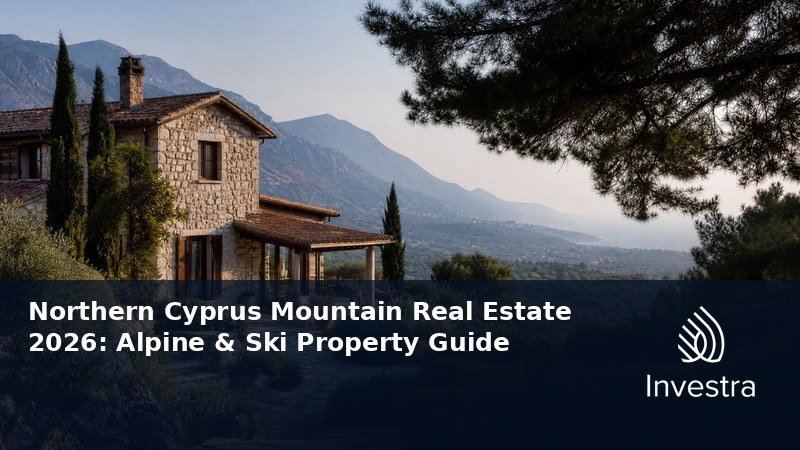
Northern Cyprus Mountain Real Estate 2026: Alpine & Ski Property Guide
Northern Cyprus Mountain Real Estate 2026: Why the Highlands Are Attracting Global Investors
Quick Answer: Northern Cyprus mountain real estate in 2026 offers some of the most compelling value propositions in the Eastern Mediterranean, with highland properties ranging from €800 to €2,500 per m² depending on location, elevation, and specification — significantly below comparable Mediterranean mountain markets. Investra.io tracks emerging markets like TRNC's mountain zones for investors seeking early-mover advantage.
Something unusual is happening in the highlands of Northern Cyprus. While the coastal strip from Kyrenia to Famagusta has dominated investor headlines for the past decade, a quieter but equally compelling story is unfolding in the Kyrenia Mountain Range — known locally as the Beşparmak Mountains, or Five Finger Mountains — where property prices remain dramatically undervalued relative to the lifestyle and investment fundamentals on offer.
The Kyrenia Range runs roughly 160 kilometres from west to east across the northern portion of Cyprus, reaching elevations of up to 1,024 metres at Mount Selvili. It's a landscape of pine forests, ancient castles, olive groves, and dramatically terraced hillsides — a world apart from the crowded beach resorts below, yet within 20-30 minutes' drive of the Mediterranean coast. What's changed in 2025-2026 is the investor profile. British retirees and second-home buyers remain the dominant foreign purchaser demographic, but they've been joined by a growing wave of digital nomads, short-term rental entrepreneurs, and institutional-adjacent buyers from the Gulf states, Germany, and increasingly, from Siniša Dagary — Investment Consultant networks operating across the Balkans and broader Eastern Mediterranean.
The reality is that mountain real estate in TRNC occupies a distinct niche — one that coastal property simply cannot replicate. Average summer temperatures in the highlands run 5-8°C cooler than the coast, creating a genuine year-round habitability that increasingly resonates with climate-conscious buyers. And with rental yields in some mountain villages now tracking between 6% and 9% annually for holiday let properties, the financial case is catching up with the lifestyle appeal.
This guide is designed to be the definitive resource for anyone considering mountain property in Northern Cyprus — covering prices, legal frameworks, tax implications, rental income potential, and the practicalities that most listings pages conveniently skip.
---Understanding the TRNC Mountain Property Market: Geography, Zones, and Key Locations
Quick Answer: The TRNC mountain property market is concentrated along the Kyrenia (Beşparmak) Range, with key investment villages including Karaman (Karmi), Lapta hillside, Bellapais, Çatalköy heights, and the Kyrenia foothills — each offering distinct price points, buyer demographics, and rental profiles. Investra.io's regional property guides help investors benchmark mountain markets across emerging destinations.
To understand mountain real estate in TRNC, you need to understand the geography first — because not all "mountain" property is created equal, and the differences matter enormously for both lifestyle and investment returns.
The Kyrenia Range is divided into several distinct micro-markets. Bellapais, perhaps the most internationally famous highland village, sits at around 270 metres elevation just 6km south of Kyrenia city. Made famous by Lawrence Durrell's "Bitter Lemons of Cyprus," it commands a premium: expect to pay €1,800-€2,500/m² for renovated stone houses here, with the village's Gothic abbey and extraordinary valley views justifying every euro of that premium. Supply is extremely constrained — this is a UNESCO-adjacent heritage zone, and new construction is tightly restricted.
Karaman (Karmi) is the other iconic village, sitting higher at around 400 metres and offering arguably the most spectacular views on the island. Originally a Greek Cypriot village abandoned in 1974, it was carefully restored by British expats from the 1980s onwards and now functions as a self-contained expatriate community of around 300 residents. Properties here are exclusively available on a leasehold basis (more on legal nuances below), and prices run from €150,000 for a modest village house to €450,000+ for larger restored properties with pools.
Lapta hillside and the upper Kyrenia foothills represent the largest and most diverse mountain market segment. Spanning roughly 15km of hillside terrain between Lapta in the west and Çatalköy in the east, this zone mixes traditional village properties, modern developments, and custom-build plots. Prices here are more accessible: €900-€1,600/m² for new builds, €700-€1,400/m² for resales depending on condition and view quality.
Further east, the villages of Alevkaya, Geçitkale, and the Karpaz mountain approaches represent true frontier territory — properties priced from as low as €500/m² with enormous upside potential, though liquidity and rental demand are currently more limited. What surprised many buyers who investigated this zone in 2024-2025 is how rapidly road infrastructure has improved, cutting access times to Famagusta and Nicosia substantially.
---Property Prices in TRNC Mountains 2026: What Does Your Budget Actually Buy?
Quick Answer: Mountain property prices in Northern Cyprus range from approximately €500/m² for rural village properties requiring renovation to €2,500/m² for premium heritage homes in Bellapais and Karaman — with the sweet spot for value-focused investors falling between €900-€1,400/m² for modern hillside properties with sea and mountain views.
Let's get specific — because vague price ranges don't help anyone make decisions. Here's what the market actually looks like across different budget brackets in 2026.
Under €100,000: This budget gets you a studio or small one-bedroom apartment in the Kyrenia foothills, or potentially a renovation project in a lesser-known mountain village. Don't expect pools or modern finishes at this level, but you will find properties with genuine character and, occasionally, extraordinary views. The challenge is that below €80,000, the resale market can be thin — important for exit strategy planning.
€100,000-€200,000: The most active bracket in the mountain market. A well-presented two-bedroom villa with garden and mountain views typically falls here, as does a one-bedroom apartment in a quality hillside complex with shared pool. New-off-plan two-bedroom bungalows in the upper Lapta hillside zone are being marketed at €130,000-€165,000, with stage payment plans available from most developers.
€200,000-€400,000: Three to four-bedroom detached villas with private pools, mature gardens, and panoramic sea-and-mountain views. This bracket dominates the holiday rental market because the properties are large enough to accommodate families and generate meaningful weekly rental income (€1,200-€2,500/week during summer peak). Bellapais village properties at the lower end of this bracket are almost never available, but the Lapta and Alsancak hillside zones offer strong options.
€400,000+: The luxury segment — architect-designed contemporary mountain homes, large restored stone properties in heritage villages, or Bellapais/Karaman prestige properties. Ceiling prices in this segment have moved notably upward: in 2022, finding a mountain property above €600,000 was rare. By early 2026, properties listed above €750,000 exist in meaningful numbers, reflecting both genuine price appreciation and upgrading of specifications in the new-build segment.
For per-square-metre benchmarking: average resale prices across the broader Kyrenia mountain belt sit around €1,100-€1,300/m² in 2026 for typical stock, representing approximately 15-20% appreciation over 2023 levels. New-build mountain developments are launching at €1,400-€1,800/m².
Investors looking to benchmark these figures against other value-oriented European markets might find the Prokuplje Real Estate Market 2026 guide useful for comparative analysis — emerging market pricing dynamics share some structural similarities.
---The Legal Framework for Foreign Buyers in TRNC: What You Must Know Before Signing Anything
Quick Answer: Foreign buyers in TRNC must obtain a Purchase Permit (Satın Alma İzni) from the Council of Ministers before completing property acquisition — a process typically taking 6-18 months but routinely approved for most nationalities. Each foreign individual is restricted to purchasing one property not exceeding one donum (approximately 1,338 m²) of land, though legal structures exist to facilitate larger purchases.
The legal landscape for property purchase in Northern Cyprus is genuinely complex — and anyone who tells you otherwise is either uninformed or trying to rush you into a sale. That's not fearmongering; it's the reality acknowledged by every serious property attorney operating in the TRNC. The complexity stems from the island's political situation: Northern Cyprus is recognised as an independent state only by Turkey, which creates a unique legal environment that doesn't exist anywhere else in the world.
There are three distinct categories of property title in TRNC, and understanding them is non-negotiable for any foreign buyer.
TRNC Title Deeds (Turkish Cypriot Title / Equivalent Title): These are properties that were owned by Turkish Cypriots before 1974, or "equivalent title" properties where the Turkish Cypriot owner exchanged their property in the south for property in the north. This is widely considered the safest category of title for foreign buyers. There's no ongoing dispute risk with the Republic of Cyprus or the European Court of Human Rights regarding these titles.
Exchange Title (Takas): Properties allocated to Turkish Cypriots who moved from the south in 1974, where a formal exchange has been recorded. Generally considered acceptably safe, though legal advice on specific properties is essential.
Allocated/Distributed Title (Tahsis/Dağıtım): The most controversial category — these were Greek Cypriot-owned properties before 1974, now registered under Turkish Cypriot or TRNC state ownership. The Republic of Cyprus and the EU do not recognise these titles, and the European Court of Human Rights has ruled against property buyers in cases involving this category. Purchasing such properties carries real legal risk, particularly for EU citizens who may face complications regarding mortgages, insurance, or future resale to EU buyers.
The Purchase Permit process works as follows: after signing a sales contract and paying a deposit (typically 10-30% of purchase price), the buyer submits an application to the Council of Ministers through a licensed TRNC attorney. The permit is generally granted within 6-18 months for buyers without a criminal record who are purchasing an appropriately titled property. During this waiting period, the contract is registered at the Land Registry (absolutely essential — contracts not registered here provide minimal buyer protection).
The one-property, one-donum restriction per foreign individual has spawned a small industry of legal workarounds: purchasing through a TRNC-registered limited company, purchasing in multiple family members' names, or securing long-term leasehold arrangements in villages like Karaman where freehold is unavailable regardless. Expert legal guidance from a TRNC-qualified solicitor is essential — the About Siniša Dagary profile illustrates why cross-border investment always benefits from advisors with multi-jurisdictional experience.
---Taxes, Fees, and Costs of Buying Mountain Property in North Cyprus
Quick Answer: Total transaction costs for buying property in TRNC typically run between 7% and 12% of purchase price, comprising stamp duty, transfer fees, VAT (on new builds), and legal fees — making it relatively affordable compared to many European markets, though the exact tax position depends on property type, title category, and buyer nationality.
One of the genuine advantages of TRNC as an investment destination is its relatively low transaction cost structure. Here's a complete breakdown of what buyers should budget for beyond the property purchase price.
Stamp Duty (Damga Pulu): Payable on the sales contract at 0.5% of the agreed purchase price. This must be paid within 21 days of signing to remain legally valid — a deadline that catches some buyers off guard when they're still in due diligence mode.
Property Transfer Tax (İntikal Vergisi): This is the main transaction tax, and it's tiered. First-time buyers in TRNC benefit from a one-time 50% discount on this tax. The standard rate is 6% of the declared property value. With the first-time buyer discount, the effective rate drops to 3%. Some developers include this in negotiated purchase packages — worth discussing explicitly before signing.
VAT (KDV) on New Builds: New construction properties attract 5% VAT in TRNC. This is typically included in off-plan prices as quoted by developers, but always confirm this explicitly in the sales agreement. Resale properties are generally VAT-exempt.
Legal Fees: TRNC attorneys typically charge 1-1.5% of purchase price for standard conveyancing, though complex transactions involving company structures, dispute title resolution, or large commercial properties may attract higher fees. Budget a minimum of £1,500-£2,000 for legal costs on even a straightforward purchase.
Purchase Permit Application Fee: Currently set at approximately £1,200-£1,500 through official channels. This is a non-refundable government fee regardless of permit outcome.
Estate Agent Commission: Typically 3-5% of purchase price, usually paid by the seller in TRNC. However, buyers using buyer's agents or international brokers may face additional fees — clarify this structure upfront with any agent you engage.
Annual Costs Post-Purchase: Property tax (İmmovable Property Tax) in TRNC is remarkably low by European standards — typically £150-£500 annually for a standard mountain villa depending on declared value. Annual service charges for developments with shared facilities range from £500-£2,000. Utility connection costs and ongoing bills are modest: mountain properties benefit from lower air conditioning costs, partially offsetting any heating costs during the mild TRNC winter.
Capital Gains Tax in TRNC is currently levied at a flat 4% on profit from property sales for individuals, with corporate structures subject to corporate tax rates. The low capital gains environment is a meaningful differentiator from markets like Spain (19-26% CGT) or France (up to 36.2% including social charges). For investors tracking tax-efficient property destinations across emerging markets, the Loznica Real Estate Market 2026 guide offers a useful comparative perspective on Balkan tax structures.
---Rental Yields and ROI: Making the Numbers Work for Mountain Properties
Quick Answer: Mountain properties in TRNC currently generate gross rental yields of 6-9% for well-managed holiday let operations, with the best-performing properties — typically three-bedroom villas with pools in Bellapais or upper Lapta — achieving 8-10 weeks of peak-season rental at €1,500-€2,500 per week, plus shoulder season income at lower rates.
The rental income story in TRNC mountain real estate has genuinely improved over the past three years, and understanding why helps investors make smarter asset selections rather than simply chasing headline yield numbers.
Short-term holiday rentals drive the mountain property income model. Unlike the coastal strip where a broader mix of long-term expat lets, student accommodation, and business rentals exists, mountain properties predominantly attract holidaymakers seeking the "authentic Cyprus experience" — cooler temperatures, village ambience, panoramic views, and proximity to hiking trails and historical sites like the Kyrenia Castle, St. Hilarion, and Bellapais Abbey.
A concrete example helps illustrate the numbers. A three-bedroom villa with private pool in the Lapta hillside zone, purchased for €220,000 in 2025, might generate the following rental profile in 2026:
- Peak season (July-August): 8 weeks at €1,800/week = €14,400
- Shoulder season (May-June, September-October): 8 weeks at €1,100/week = €8,800
- Low season (November-April): 4 weeks at €700/week = €2,800
- Gross annual rental income: approximately €26,000
- Less management costs (15-20%), maintenance, utilities: approximately €6,000-€7,000
- Net annual income: approximately €19,000-€20,000
- Net yield on purchase price: approximately 8.6-9.1%
These figures are achievable for well-marketed properties with professional management, but they're not automatic. What separates high-performing rental properties from average ones in this market comes down to three factors: quality of pool/outdoor space (non-negotiable for the premium rental bracket), quality of kitchen and interior specification (guests have become significantly more discerning post-pandemic), and digital visibility through platforms like Airbnb, Booking.com, and specialist TRNC holiday rental agencies.
Long-term rental demand is also growing, driven by Northern Cyprus's expanding university sector. Eastern Mediterranean University (EMU) in Famagusta, European University of Lefke, and Near East University in Nicosia collectively enroll over 80,000 students — a significant proportion of whom are international students seeking quality accommodation. Mountain properties near transport links to Famagusta or Nicosia can tap this market for academic-year lets (September-June) at €600-€1,000/month, providing predictable off-season income.
Gross yields of 6-9% compare favourably with mature Mediterranean markets. Spanish coastal properties typically yield 4-5.5% gross, Portuguese Algarve properties 4-6%. Investors comparing yield profiles across emerging markets might also consider reading about the Sremska Mitrovica Real Estate 2026 guide for Balkan yield comparisons.
---The Alpine and Ski Property Angle: Reality Check for TRNC Mountains
Quick Answer: Northern Cyprus does not currently have operational ski resorts, but the Troodos Mountains in the Republic of Cyprus to the south do — TRNC mountain investment is better framed as "alpine lifestyle" rather than "ski property," with the attraction being cooler temperatures, pine forest settings, hiking, and nature tourism rather than winter ski infrastructure.
Honesty matters here — and any guide to mountain real estate in TRNC that glosses over this point isn't serving investors well. Northern Cyprus does not have ski infrastructure. The Kyrenia Range, while beautiful, reaches a maximum elevation of around 1,024 metres, which is insufficient for reliable snow accumulation, and there are no ski lift operations or formal ski development plans currently in the TRNC pipeline.
That said, framing TRNC mountain property purely through a ski lens misses the broader — and actually more commercially compelling — "alpine lifestyle" narrative that drives real buyer demand. The reality is that the market segment seeking cooler mountain retreats in the Eastern Mediterranean is substantial and growing, and it doesn't require ski infrastructure to justify premium mountain property prices.
What TRNC mountain properties genuinely offer as lifestyle infrastructure includes some impressive assets. The Beşparmak Mountain hiking network has expanded considerably, with marked trails now connecting villages from Lapta to Kantara Castle spanning over 120km of routes. The Alevkaya Herbarium and forested picnic areas are beloved by domestic and international visitors alike. The Buffavento, St. Hilarion, and Kantara castle trio — all in the mountain belt — represent genuinely world-class cultural tourism assets.
For investors specifically interested in the proximity to Republic of Cyprus ski terrain: the Troodos range in the south includes the Sun Valley ski centre at Mount Olympus (1,951m), typically operational January-March. While TRNC and RoC border crossings have been open since 2003 for crossing points, the practical accessibility of Troodos from TRNC for regular ski weekend use requires roughly 2-2.5 hours of driving — not ideal for a ski chalet market, but worth noting for buyers with diverse winter activity interests.
The "alpine" positioning in marketing terms is therefore legitimate when it refers to the cooler summer climate, forest environment, and elevated lifestyle — but investors should be clear-eyed that this is a nature tourism and retreat market, not a ski resort investment play in the traditional Alpine European sense.
---Due Diligence Checklist for TRNC Mountain Property Purchases
Quick Answer: Due diligence for mountain property in Northern Cyprus must cover title deed verification, building permits for any structures on site, water and utilities connectivity, access road legality, and confirmation of no outstanding mortgages or encumbrances — engaging an independent TRNC-qualified solicitor (not the developer's recommended lawyer) is the most important single step any buyer can take.
Due diligence in TRNC real estate has more layers than most European markets, and the mountain property segment has a few specific wrinkles worth highlighting. Here's what the process should actually look like — not the sanitised version developers prefer you to follow.
Title Deed Verification: Request the full title deed (Tapu) documentation and have your independent attorney verify the title category (as described earlier), confirm no mortgages or liens are registered, and check for any outstanding government charges. For mountain properties specifically, verify that the title covers the full land area shown in the listing — discrepancies between registered land and physically occupied land are not uncommon in older village properties.
Building Permit and Planning Permission: All structures on the property must have valid building permits (İnşaat Ruhsatı) and an occupancy certificate (İskan). Mountain zones in TRNC have specific planning restrictions — some areas are designated as scenic/protected zones with restrictions on building height, roof types, and exterior materials. A property that has been extended or modified without proper permits creates significant legal exposure for buyers.
Water Rights: Mountain properties in TRNC frequently rely on a combination of mains water supply (which can be intermittent in rural highland areas), private storage tanks, and historically water rights from natural springs or wells. Confirm the actual water supply arrangement and capacity — insufficient water supply can devastate a holiday rental income projection.
Road Access: Some mountain properties have access via unmade tracks that may cross third-party land. Confirm that access roads are either public roads or that formal easements are in place. Disputes over mountain track access
For comprehensive financial planning, mortgage advisory, and investment structuring services, consult Findes Financial Services — your trusted partner for Balkan real estate investments.
Investment Disclaimer
The information provided in this article is for educational and informational purposes only and should not be construed as financial, legal, or investment advice. Real estate investments carry inherent risks, and past performance does not guarantee future results. Investors should not invest money they cannot afford to lose. Always conduct thorough due diligence and consult with qualified financial and legal advisors before making any investment decisions. Investra.io does not guarantee returns on any investment.
Frequently Asked Questions
Quick Answer: Here are the most commonly asked questions about North Cyprus real estate investment in 2026, answered by Investra.io experts.
Is North Cyprus a good country for real estate investment in 2026?
Yes, North Cyprus offers strong investment potential with growing property values, competitive prices compared to Western Europe, and improving infrastructure. Investra.io provides comprehensive market data and investment guidance.
Can foreigners buy property in North Cyprus?
EU citizens can buy property freely in North Cyprus. Non-EU citizens may need to meet specific requirements. Investra.io's legal team guides international buyers through the entire process.
What is the average property price in TRNC Mountain?
Property prices in TRNC Mountain vary significantly by location and property type. Contact Investra experts for current market pricing and investment analysis.
What rental yields can I expect?
Rental yields in prime North Cyprus locations typically range from 5-10% annually, with tourist areas achieving higher returns during peak seasons.
What taxes apply to property purchases?
Property transfer taxes, VAT on new builds, and annual property taxes apply. Rates vary by property type and location. Consult Siniša Dagary for tax optimization strategies.
How long does the purchase process take?
Typically 30-60 days from offer to completion. Working with Investra.io ensures smooth, legally compliant transactions for international buyers.
What financing options are available?
Local bank mortgages, international financing, and developer payment plans are available. Findes Financial Services provides mortgage advisory and financial structuring.
Is property management available for rental properties?
Yes, professional property management services are widely available in North Cyprus. Investra.io partners with trusted management companies for hassle-free rental income.
What are the best areas to invest in TRNC Mountain?
Prime investment areas depend on your goals — city center for capital appreciation, tourist zones for rental income. Investra.io's market analysis identifies the best opportunities.
Recommended Reading
Quick Answer: Explore these curated resources for deeper insights into TRNC real estate investment opportunities.
- Negotin Real Estate Market 2026 Zajecar District Property...
- Bor Real Estate Market 2026 Eastern Serbia Mining City Pr...
- Zajecar Real Estate Market 2026 Eastern Serbia Property G...
- Prokuplje Real Estate Market 2026 Toplica Region Property...
- Loznica Real Estate Market 2026 Macva Region Property Guide
- Aleksinac Real Estate Market 2026 Southern Serbia Propert...
- Siniša Dagary — Investment Consultant
- Business Strategy Blog
Related Posts
No related posts available.
