
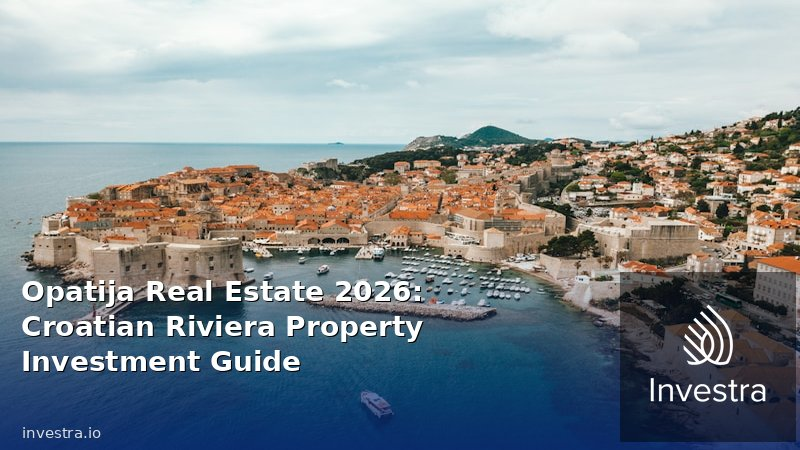
Opatija Real Estate 2026: Croatian Riviera Property Investment Guide
Why Opatija Is Capturing Global Investor Attention in 2026
Quick Answer: Opatija is one of Croatia's most compelling real estate markets in 2026, combining Austro-Hungarian architectural heritage, Adriatic coastline, and growing year-round demand that sets it apart from purely seasonal destinations. Croatia Real Estate Investment Guide 2026 offers a full breakdown of why this Kvarner Bay jewel is attracting serious international capital.
There's something almost theatrical about Opatija. Standing on the Lungomare — that magnificent 12-kilometer coastal promenade — watching the Adriatic catch the light against a backdrop of Belle Époque villas, it's easy to understand why the Habsburg aristocracy chose this stretch of the Kvarner Bay as their preferred escape. What's harder to believe is that, compared to Dubrovnik or Split, Opatija remains genuinely undervalued.
That's changing fast. In 2026, Opatija real estate is experiencing a moment that seasoned investors recognize: the period just before mainstream discovery, when prices are rising but haven't yet priced out the opportunity. Croatian tourism numbers hit record levels in recent years, and the Kvarner region specifically posted a 14% increase in overnight stays compared to pre-pandemic figures. Opatija, as the region's anchor destination, absorbed a disproportionate share of that growth.
What makes this market genuinely different from the Dalmatian Coast? Year-round habitability. The microclimate here is extraordinary — Učka Mountain shields the town from cold northern winds, meaning winters are mild enough that properties don't sit empty for six months like some island destinations. That single factor transforms the entire investment calculus. You're not buying a summer asset; you're buying a twelve-month income generator.
Foreign buyers have noticed. German, Austrian, Slovenian, and increasingly British and Middle Eastern buyers are active in the market. Croatia's 2023 Eurozone accession removed currency risk for European investors, and the country's EU membership since 2013 provides the legal framework that cautious investors require. The confluence of these factors has created what analysts at Siniša Dagary — Investment Consultant describe as a "structural demand shift" — meaning this isn't speculative froth, it's fundamental revaluation.
The reality is that Opatija in 2026 sits at an inflection point. Prices have risen, but the gap between Opatija and comparable Western European coastal markets remains substantial. That gap is the opportunity.
---Opatija Property Prices 2026: What the Numbers Actually Show
Quick Answer: Opatija property prices in 2026 range from approximately €3,500/m² for standard residential apartments to €8,500+/m² for premium seafront villas and renovated historic properties, with the most sought-after locations on the Lungomare commanding the highest rates.
Let's talk hard numbers, because that's what investors actually need. The Opatija market in 2026 is notably stratified — there's a wide spread between entry-level and premium product, and understanding where that line sits is critical to making the right call.
At the entry level, you're looking at apartments in good residential condition, typically 1-2 bedrooms, in the broader Opatija municipality (which includes Ičići, Ika, Lovran, and Mošćenička Draga). These start around €3,200-€3,800/m². A 50m² apartment in this tier would cost roughly €160,000-€190,000. Solid properties, reasonable rental potential, but not the iconic Opatija experience.
Move into central Opatija proper — the historic core, the Park area, properties with sea views — and prices jump meaningfully. Expect €4,500-€6,000/m² for well-maintained apartments with quality finishes and genuine Adriatic views. A 75m² two-bedroom apartment in this bracket typically lists at €340,000-€450,000. These are the properties generating the strongest short-term rental numbers.
The premium segment is where things get genuinely interesting. Renovated Belle Époque villas, seafront mansions, and high-specification new-build developments on the Lungomare or Volosko waterfront regularly transact at €6,500-€9,500/m². A 150m² seafront apartment in a premium development? Budget €975,000 to €1.4 million. These aren't distressed assets — they're trophies, and their owners know it.
Year-on-year price appreciation has been running at 8-12% in the prime segment, moderating slightly to 5-7% in the mid-market. That's still substantially ahead of most Western European coastal equivalents. For context, comparable properties in the Italian Riviera or the French Côte d'Azur trade at 2-4x Opatija prices for similar quality and positioning.
New construction is limited by the town's historic character and planning constraints, which acts as a natural supply cap. This structural undersupply is one of the key price support mechanisms that longer-term investors should factor into their models. You can explore current listings and granular price data through Find Your Property on Investra.
---The Neighbourhoods of Opatija: Where to Buy and Why
Quick Answer: Opatija's prime investment neighbourhoods include central Opatija (highest prestige), Volosko (authentic fishing village charm with premium prices), and Ičići-Ika (best value with strong rental demand), while Lovran offers a quieter alternative with growing appeal among longer-stay visitors.
Opatija isn't one market — it's a collection of micro-markets, each with its own personality, price point, and investor profile. Getting this granularity right is the difference between a good investment and a great one.
Central Opatija is the prestige address. The grand park hotels, the famous Angiolina Park, Villa Angiolina itself, and the densest concentration of historic architecture all sit here. Properties in this zone carry the highest prices (€5,000-€8,500/m²) but also the strongest brand recognition among tourists. Short-term rental occupancy here routinely exceeds 80% in the May-October window, and growing year-round demand from wellness tourism and conference visitors is extending that season meaningfully.
Volosko, the old fishing village immediately north of central Opatija, has developed a cult following among discerning buyers. It's authentically Croatian — cobblestone lanes, working fishing boats, excellent restaurants — while being five minutes' walk from the main promenade. Prices here are comparable to central Opatija (€4,800-€7,500/m²), but the product mix skews toward character stone houses and small apartment buildings rather than grand villas. The buyer profile tends to be more European in-the-know than mass-market tourist.
Ičići and Ika offer the best value play in the municipality. These settlements, 3-5km southeast of central Opatija, have good beach access, direct tram line connection to the centre, and prices 20-30% below the Opatija core (€2,800-€4,200/m²). For investors prioritising yield over prestige, this is where the numbers work best. New developments are more common here, which means modern amenities and lower maintenance costs.
Lovran, the medieval town at the southern end of the municipality, is perhaps the most underappreciated. Stunning Venetian old town, Liburnian hilltops, and a slightly quieter character attract longer-stay visitors willing to pay premium rates. Prices range €3,500-€5,500/m² and have been catching up with the Opatija core. The Investra Blog — Latest Market News has featured Lovran specifically as a watch-list location for 2026.
---Rental Yields and Income Potential: The Real Story
Quick Answer: Short-term holiday rental yields in Opatija range from 5% to 8% gross annually for well-managed properties in prime locations, with net yields typically landing at 3.5%-6% after management fees, taxes, and maintenance — significantly higher than comparable Western European coastal markets.
Here's where Opatija's investment case really crystallises. The yield story is genuinely compelling, particularly when you benchmark it against alternatives. A well-positioned apartment in central Opatija generating short-term rental income can achieve gross annual yields in the 6-8% range. That's not a theoretical projection — those are actual numbers achieved by properties listed through platforms like Airbnb, Booking.com, and local rental agencies.
The mechanics work like this. A well-maintained 60m² two-bedroom apartment near the Lungomare, purchased at approximately €350,000-€380,000, can reasonably achieve nightly rates of €180-€280 during peak season (July-August). Shoulder season rates (May, June, September, October) run €120-€180 per night. Even in winter, properties in Opatija find occupancy from wellness tourists, corporate stays, and long-term renters — something almost unheard of in purely seasonal Dalmatian markets.
Realistic annual revenue from such a property: €25,000-€38,000 gross, depending on management quality, listing quality, and a bit of luck with bookings. After a professional management fee (typically 20-25% of revenue), Croatian tourist tax obligations, utilities, maintenance reserves, and property tax, net income of €16,000-€24,000 annually is achievable. On a €365,000 purchase, that's a net yield of 4.4%-6.6%.
What surprised many buyers is how the year-round demand changes the calculation versus Dalmatian islands. A comparable property in, say, Brač or Korčula might achieve higher peak rates but sits empty from November through April. Opatija's extended season — genuinely 10-11 months of some income — creates a more stable, predictable cash flow that lenders and ROI calculators find much more attractive.
Long-term residential rental is the other avenue, particularly relevant for Zagreb-based professionals who use Opatija as a weekend residence or for EU digital nomads attracted by Croatia's Digital Nomad Visa program. Monthly rents for a quality two-bedroom apartment in Opatija range from €900 to €1,800, depending on location and finish. This route offers lower gross yield but dramatically lower management overhead and operational complexity.
For a comprehensive comparison of rental strategies across Croatian coastal markets, the Split Real Estate Guide provides useful benchmarking data, and the same methodology applies when evaluating Opatija.
---The Legal Framework: How Foreigners Buy Property in Croatia
Quick Answer: EU citizens can purchase property in Croatia on the same terms as Croatian nationals, while non-EU citizens face some restrictions on agricultural land but can freely buy residential and commercial property — the process typically takes 2-4 months from offer to completion and requires a notary, a Croatian tax number (OIB), and a local bank account.
The legal framework for foreign property ownership in Croatia is genuinely more accessible than many buyers expect, particularly since EU accession. Let's break this down clearly, because getting this wrong is expensive.
EU citizens have had unrestricted property purchase rights in Croatia since 2013, with full reciprocity. The process mirrors what you'd encounter in Austria or Germany — transparent, notarised, and state-registered. No special permits, no bureaucratic hurdles specific to foreigners, no maximum purchase limits.
Non-EU citizens can also purchase freely, with one significant exception: agricultural land. For residential apartments, houses, commercial properties, and coastal real estate (the category most Opatija buyers fall into), non-EU nationals including British, American, Canadian, and Australian buyers face no restrictions post-Brexit arrangements and bilateral treaties. The legal gateway is slightly more document-intensive, but the outcome is the same.
The purchase process runs broadly as follows. Once you've agreed a price, a preliminary contract (predugovor) is signed with a deposit of typically 10% of the purchase price. This locks both parties in — if the buyer withdraws, they lose the deposit; if the seller pulls out, they pay double the deposit back. It's a strong mutual commitment mechanism.
You'll need an OIB (Personal Identification Number — Croatia's equivalent of a tax ID number), which is obtained from the local tax office (Porezna uprava) and takes 1-3 days. A Croatian bank account is required for the transaction. You'll also need a notary (javni bilježnik) to authenticate the purchase agreement.
The Land Registry (Zemljišna knjiga) records the ownership transfer. This process takes 1-3 months to complete officially, though you're in effective possession once the main agreement is signed and the balance paid. Legal fees for a buyer's attorney typically run €1,500-€3,500. Always, always engage an independent Croatian lawyer — not the seller's agent's recommended solicitor.
For deeper guidance on navigating the Croatian property purchase process, Contact Investra Experts who work with verified legal partners across the Kvarner region.
---Taxes on Croatian Real Estate: What Investors Need to Budget
Quick Answer: Property transfer tax in Croatia is 3% of the assessed value for resale properties (new builds are VAT-exempt at 25%), annual property tax varies by municipality, and rental income is taxed at 12% flat rate — total tax burden for Opatija investors is generally lower than most Western European equivalents.
Taxes are where many buyers get caught off guard — not because Croatia is particularly punitive (it isn't), but because the structure is different from what Northern and Western European buyers are used to. Budget correctly and there are no nasty surprises.
Purchase Tax (Porez na promet nekretnina): For resale properties (the majority of what's available in Opatija's historic core), transfer tax is 3% of the assessed value, which the tax authority determines independently — it may differ from the contract price. This is paid by the buyer. On a €400,000 apartment, budget €12,000 for this item.
New Build VAT: For newly constructed properties being sold for the first time by a developer, 25% VAT applies instead of transfer tax. This is typically included in the listed price, but confirm this with your lawyer. Some new developments offer VAT refunds to buyers who establish Croatian residency, though this is complex and advice-specific.
Annual Property Tax: Croatia introduced a revamped property tax regime that came into fuller effect in 2024-2025. The tax is calculated based on square meterage, property location coefficient, and condition, with rates typically running €1-€8/m² per year depending on municipality classification. For an Opatija central apartment, this might mean €300-€800 annually — genuinely modest by European standards.
Rental Income Tax: This is where Croatia becomes very attractive for rental investors. Short-term holiday rental income is taxed at a flat 12% on gross receipts (after a 30% standard cost deduction, so effectively ~8.4% of gross revenue). Long-term residential rental income follows the same 12% flat rate on 75% of income. Compared to the 19-45% marginal rates investors face in Germany, France, or the UK, this is remarkably investor-friendly.
Capital Gains Tax: Properties sold within 2 years of purchase attract 24% CGT. After 2 years, there is no capital gains tax. This two-year rule is a critical planning point — structure purchase and potential exit timelines accordingly.
Financial structuring and tax optimisation across Croatian and international holdings is a specialist area. Resources from Business Strategy Blog and specialist services like Findes Financial Services can provide cross-border financial planning support for international buyers.
---Opatija vs Other Croatian Coastal Markets: An Honest Comparison
Quick Answer: Opatija offers better year-round rental demand than island markets, lower entry prices than Dubrovnik, and superior infrastructure to most Dalmatian alternatives — making it the most balanced risk-return profile on the Croatian coast for 2026.
Investors comparing Croatian coastal options inevitably end up weighing Opatija against Dubrovnik, Split, Hvar, and Rovinj. Each has genuine merit, but the comparison isn't as close as the marketing brochures suggest.
Opatija vs Dubrovnik: Dubrovnik is the global brand — UNESCO-listed, "Game of Thrones" famous, premium-priced. Entry-level apartments in Dubrovnik's old town start around €6,000/m², with prime properties exceeding €12,000/m². The Dubrovnik Luxury Property Guide details the upper end of that market thoroughly. For pure trophy value and maximum price appreciation ceiling, Dubrovnik wins. But rental yields are often compressed precisely because purchase prices are so high, and the old town's strict rental licensing regime creates compliance complexity. Opatija offers better yield on a lower capital base.
Opatija vs Split: Split is Croatia's second city — a real urban economy, year-round population, growing tech sector, and strong short-term rental market. Prices in Split's historic core run €4,000-€7,000/m², comparable to Opatija prime. The difference? Split has better air connectivity (Split Airport handles more international routes than Rijeka), but Opatija has the microclimate and wellness tourism edge. Both are strong — the Split Real Estate Guide makes the case well. For yield-focused investors, it's genuinely a coin flip; for lifestyle buyers, Opatija wins on elegance.
Opatija vs Hvar: Hvar Island is glamorous, internationally famous, and expensive — prime Hvar Town properties trade at €5,500-€9,000/m². The Hvar Island Real Estate guide captures the island's unique market dynamics. But Hvar is seasonal in a way Opatija simply isn't. Getting to Hvar requires a ferry. Peak-season yields can be spectacular (8-12% gross), but the off-season dead period is long and properties require more maintenance in the island environment. Opatija's accessibility and year-round appeal make it a more stable, lower-volatility investment.
Opatija vs Rovinj (Istria): Rovinj is probably Opatija's closest direct competitor for the discerning European buyer — both are characterful, non-mass-market destinations with Belle Époque influence. Istrian properties broadly run slightly cheaper than Opatija prime, but the supply of quality historic property is similarly constrained. Proximity to Italy and Slovenia gives Rovinj an edge with Western European buyers; Opatija's larger urban catchment gives it a year-round rental edge.
---Tourism Infrastructure and What It Means for Property Values
Quick Answer: Opatija's tourism infrastructure — including the Grand Hotel Kvarner (Croatia's oldest hotel, established 1884), the 12km Lungomare promenade, and direct connections to Rijeka International Airport — creates a stable demand base that directly supports property values and rental income potential.
A destination's tourism infrastructure is one of the most underappreciated factors in property investment analysis. It determines not just visitor volume but visitor quality, repeat visitation rates, and — critically — year-round demand versus pure seasonal dependency.
Opatija has infrastructure that most Croatian coastal destinations genuinely envy. The hotel stock here is legitimately world-class: Hotel Kvarner dates to 1884, Hotel Milenij, Hotel Miramar, and the Remisens Premium collection all operate at 4-5 star level with year-round occupancy. This isn't accidental — Opatija established Croatia's first tourist association in 1889 and has been optimising the visitor experience for well over a century.
The wellness and medical tourism segment has grown explosively. Opatija has leveraged its historic health-resort identity (it was literally marketed as a therapeutic destination in the Habsburg era) into a modern wellness tourism product that draws visitors from October through April — months when Dalmatian resorts are ghost towns. Thalasso centres, medical wellness hotels, and rehabilitation facilities operate year-round, providing a reliable demand base for nearby short-term rentals.
Transport connectivity is often cited as Opatija's Achilles heel versus Split or Dubrovnik, and it's a fair point. Rijeka Airport connects to limited international routes, though the airport has been expanding its schedule. More practically, Opatija is just 15 minutes from central Rijeka — Croatia's third-largest city with its own rail and bus connections — and about 90 minutes' drive from Ljubljana Airport (Slovenia), which handles many more international routes including direct connections to North America, Asia, and the Gulf region.
The planned upgrade of Rijeka Airport infrastructure and the ongoing A7 motorway improvements connecting the Kvarner to the broader Croatian motorway network are material catalysts. Infrastructure investment of this scale historically correlates with 15-25% above-market property appreciation in the 3-5 years following completion.
---New Developments and Renovation Opportunities in Opatija 2026
Quick Answer: New construction in Opatija is strictly limited by heritage preservation regulations, making renovated historic properties the dominant investment opportunity — typical renovation costs run €700-€1,400/m² for quality refurbishment, with completed projects often achieving 30-50% uplift over acquisition-plus-renovation cost.
The new-build market in Opatija is genuinely constrained — and that's largely a good thing for investors already in the market. UNESCO advisory influence, local heritage regulations, and the Primorje-Gorski Kotar County planning framework all place meaningful limits on what can be built where. You won't see the high-rise apartment tower developments that have blighted parts of the Dalmatian coast appearing in Opatija.
What you will find is a small number of high-quality boutique developments, typically 8-20 units, built on brownfield sites or within the shells of historic structures. These are premium-priced (€5,500-€8,500/m² for developer price) but offer the only genuinely new-spec product in the market. For buyers who want modern apartment standards in a historic context, this is the segment to watch.
The bigger opportunity, honestly, is renovation. Opatija has a remarkable stock of early-20th-century villas, apartment buildings, and seafront properties that are either in original condition, partially updated, or in genuine disrepair. The gap between unrenovated price and completed quality product creates a value-add opportunity that sophisticated investors are quietly exploiting.
A typical renovation project works roughly like this: acquire an unrenovated 80m² apartment in central Opatija for €2,800-€3,400/m² (€224,000-€272,000), invest €900/m² in a quality renovation including new kitchen, bathrooms, structural work, and finishes (€72,000), and emerge with a completed product worth €4,800-€5,500/m² on the market (€384,000-€440,000). Gross development profit before taxes and fees: €88,000-€96,000 on a total cost basis of €296,000-€344,000. That's a 25-32% development return. The risk, as always, is in the execution — Croatian construction contractors vary wildly in quality and reliability.
Platforms like Investra Property Investment Articles regularly profile renovation case studies from the Kvarner region that provide useful real-world benchmarking.
---Financing Options for Opatija Property Purchases
Quick Answer: Croatian banks offer mortgages to foreign nationals, typically at 60-70% LTV, with interest rates running 4.5%-6.5% in 2026 — many international buyers opt for financing in their home country against existing assets, which often provides better terms and simpler administration.
Financing Croatian property as an international buyer requires more preparation than a domestic purchase, but it's absolutely achievable. The options have expanded significantly since Croatia's Eurozone entry, which eliminated currency hedging complexity for eurozone buyers.
Croatian banks — primarily Erste Bank, Raiffeisen, and OTP Bank — do lend to non-residents, but the terms are more conservative than domestic mortgages. Expect maximum LTV of 60-70% (meaning a 30-40% cash deposit), repayment terms of 10-25 years, and interest rates in the 4.5-6.5% range depending on your profile, the property type, and the bank's appetite. The income verification process is thorough; you'll need to demonstrate stable income in excess of roughly 2.5x your monthly mortgage payment, typically documented over 2+ years.
For many international buyers, releasing equity from existing property in their home country is a more elegant solution. Austrian, German, and Dutch buyers in particular often secure finance against primary residences at home (where LTVs are higher and rates lower), then purchase in Croatia with effectively cash-buyer status. This simplifies the Croatian purchase process considerably and often produces a better blended cost of capital.
Cash buyers — still a significant segment of the Opatija prime market — have a meaningful negotiating advantage. In a market where seller motivation varies widely and property chains can create delays, a clean cash offer with quick closing can regularly achieve 5-10% below asking price. On a €500,000 property, that negotiating advantage is worth real money.
Investment structuring — whether to purchase personally, through a Croatian company (d.o.o.), or through an offshore structure — has meaningful tax implications and should be discussed with a specialist before contracts are signed. The team at About Siniša Dagary includes experts in cross-border investment structuring for Adriatic markets.
---The Buying Process Step-by-Step: From Search to Keys
Quick Answer: The Opatija property purchase process typically runs 8-16 weeks from initial offer to legal completion, involving property search, due diligence checks, preliminary contract, OIB registration, bank account opening, notarisation of main contract, and Land Registry transfer.
Understanding the timeline and sequence of a Croatian property purchase removes a huge amount of anxiety from the process. Here's what actually happens, in the order it actually happens.
Step 1 — Property Search and Selection (2-6 weeks): Work with a reputable local agency or international platform like Croatia Real Estate Investment Guide 2026 to identify suitable properties. Budget for at least one dedicated viewing trip to Opatija. The coastal property market has enough quirks (sea views that aren't quite what they appear in photos, microclimate variations between north and south-facing properties, parking constraints in the historic core) that in-person inspection is non-negotiable.
Step 2 — Legal Due Diligence (1-3 weeks): Before signing anything, commission a title search (gruntovni izvadak) from the Land Registry. This confirms ownership, identifies any encumbrances, mortgages, or disputes on the property. Your lawyer will also check building permits (građevinska dozvola) and use permits (upotrebna dozvola) — properties in Opatija's historic core sometimes have legacy permit issues that need to be resolved before purchase.
Step 3 — OIB Registration and Bank Account (1 week): Apply for your OIB number at the local tax office in Opatija or Rijeka. Simultaneously open a Croatian bank account — this is required for the transaction. Both can typically be completed in a single visit with your passport and proof of address.
Step 4 — Preliminary Contract and Deposit (1-2 weeks): Once due diligence is satisfactory, sign the predugovor and pay the 10% deposit. This is a binding commitment from both parties. The preliminary contract should specify the final price, completion date, and any conditions (such as permit regularisation).
Step 5 — Main Contract and Notarisation (1-2 weeks): The main purchase agreement (kupoprodajni ugovor) is drafted, reviewed by both parties' lawyers, and signed before a notary. Balance of purchase price is transferred via bank transfer. The notary certifies the authenticity of signatures.
Step 6 — Land Registry Transfer and Tax (4-8 weeks): The notarised contract is submitted to the Land Registry for title transfer. Simultaneously, the property transfer tax (3% for resale properties) must be assessed and paid within 30 days of contract signing. You'll receive formal title confirmation once the Land Registry updates — this can take 1-3 months but doesn't affect your practical ownership from the contract date.
---Short-Term Rental Regulations and Licensing in Opatija
Quick Answer: Short-term holiday rental in Opatija requires registration as a tourist accommodation provider with the Croatian Ministry of Tourism, payment of tourist tax, and compliance with minimum standards for tourist apartments — the process is manageable but stricter enforcement since 2023 means non-compliant operators face meaningful fines.
Croatia tightened its short-term rental regulatory environment considerably from 2023-2025, bringing it closer to the Spanish and French models. Opatija specifically — as a historically regulated tourist destination — applies these rules with more consistency than some less-governed coastal areas. Investors need to get this right from day one.
To legally offer short-term holiday rental, property owners must register with the Ministry of Tourism and Sports (Ministarstvo turizma i sporta) and obtain a category rating (typically 1-5 stars for tourist apartments). The categorisation inspection assesses minimum square meterage per person, basic facilities (kitchen equipment, bedding, heating, etc.), and basic safety provisions. Most well-maintained Opatija apartments achieve a 3-4 star tourist apartment classification without difficulty.
Tourist tax (boravišna pristojba) must be collected from guests and remitted to the local tourist board. Rates vary by municipality and season — in Opatija's peak zone, this runs approximately €2-€2.50 per person per night in high season, scaling down in shoulder and low season. This is collected on top of your rental rate and passed through to the authorities — it's not a cost to you as an owner, but failing to collect and remit it is a compliance violation.
Income reporting is mandatory. Since 2023, Croatian tax authorities have cross-referenced Airbnb and Booking.com reporting (required by EU DAC7 regulations) with individual tax filings, meaning undeclared rental income is increasingly detectable. The 12% flat rental income tax rate is actually quite competitive — just pay it and keep the paperwork clean.
Several professional property management companies operate in Opatija — managing everything from listing to guest communication, cleaning, key exchange, tourist tax remittance, and income reporting. Their fees (20-25% of gross revenue) are well worth the administrative simplification, particularly for non-resident owners.
---Long-Term Capital Appreciation: The 5-Year Investment Case
Quick Answer: Based on current market trajectories, price appreciation drivers, and comparable European coastal market analogues, Opatija prime property has credible potential for 35-55% capital appreciation over a 5-year horizon — though this is projection, not guarantee, and individual property selection significantly affects outcomes.
Capital appreciation projections are always hostage to uncertainty, and any honest advisor will tell you that. But the structural factors underpinning Opatija's price trajectory are clear enough to make informed projections, as long as you hold them appropriately.
The demand-side factors are compelling. European coastal lifestyle property demand is structurally elevated — remote work normalisation has permanently expanded the buyer pool for quality coastal properties from "retirees and the very wealthy" to include a broad swath of mobile professionals. Croatia's improving international profile, EU membership, and Eurozone status all increase demand from investors who previously required greater institutional certainty before committing capital.
The supply-side story is even more powerful. Heritage preservation constraints mean the stock of quality Opatija properties is genuinely finite. Unlike markets where developer supply can respond to price signals (new towers, suburban expansion), Opatija's character-governed planning environment severely limits what can be built. Supply inelasticity plus growing demand equals price appreciation — it's basic economics, but it's reliably basic economics.
Looking at comparable European market analogies is instructive. The Slovenian coast (Portorož, Piran) saw 60-80% real appreciation over the decade following EU accession. Croatian Istria (Rovinj, Poreč) followed a similar pattern post-2013 EU accession. Opatija, arriving at its "discovery inflection" later than Istria, has a credible path to similar relative performance in the 2023-2030 window.
The Zagreb Property Market Analysis provides useful context on domestic Croatian economic growth trajectories, which affect the broader investment climate that coastal markets operate within. Zagreb's continued economic development directly supports weekend and second-home demand in Opatija from domestic Croatian buyers.
Conservative scenario (base case): 4-6% annual capital appreciation, totalling 22-34% over five years. Moderate scenario: 7-10% annually, totalling 40-61% over five years. Bull scenario (continued foreign buyer influx, major infrastructure improvements, EU tourism recovery): 10-14% annually. The realistic range for a well-selected property is probably 35-55% total appreciation over five years, before considering rental income on top. Total returns in the 55-80% range over five years are achievable — that's 11-16% annualised on a blended capital-plus-income basis.
---Risks and Challenges: What Every Investor Should Know
Quick Answer: Key risks in the Opatija market include title and planning permit legacy issues in older properties, seasonal liquidity constraints, property management quality variability, and macro risks including Adriatic tourism saturation and broader European economic slowdown — none are dealbreakers, but all require active management.
No credible investment guide presents only the upside. Opatija has genuine risks, and understanding them clearly is what separates investors who succeed from those who encounter expensive surprises.
Title and Planning Legacy Issues are the most common practical headache. Croatia's property records, while dramatically improved since EU accession, still contain legacy complications from the socialist era — properties built without formal permits, unclear inheritance chains, boundary disputes, and overlapping cadastral and land registry records. Opatija's older housing stock (pre-1960s villas in particular) is disproportionately affected. Thorough due diligence and a good local lawyer are the only mitigation strategy. Budget for €2,000-€4,000 in legal costs for a comprehensive title investigation.
Liquidity Risk: Opatija is not a highly liquid market. If you need to exit quickly, you may wait 6-18 months for the right buyer. This isn't a market for capital that might be needed at short notice. The exit strategy needs to be planned with the same rigour as the entry.
Management Quality Variability: The Croatian property management sector is maturing but uneven. Some management companies are excellent; others are genuinely poor. Poor management can take a theoretically strong rental property and deliver mediocre results through bad listing quality, low occupancy, maintenance neglect, or compliance gaps. Vet your management company as carefully as you vet the property.
Macro and Tourism Risks: Adriatic tourism, while resilient, isn't immune to European economic cycles, geopolitical disruption, or climate-related factors (extreme summer heat increasingly redirecting tourists toward shoulder seasons or cooler destinations). None of these are near-term threats to Opatija's fundamentals, but a 10-year investment horizon should factor them in.
Currency Risk for Non-Euro Buyers: Now that Croatia operates on the Euro, buyers from the UK, US, or other non-Euro countries carry currency risk throughout their holding period. A GBP/EUR movement of 10% in the wrong direction on a €500,000 property represents a €50,000 currency loss that has nothing to do with the Croatian market's performance. Currency hedging strategies should be discussed with specialists like those at Findes Financial Services.
---Opatija for Lifestyle Buyers: The Dual-Purpose Investment
Quick Answer: Many Opatija buyers pursue a hybrid model — personal use during preferred seasons combined with short-term rental income during peak periods — delivering both lifestyle value and financial return, with properties typically achieving 60-70% occupancy after personal-use weeks are blocked off.
Not every Opatija property buyer is a pure yield investor. A significant and growing segment is what the market calls "lifestyle buyers" — people who want a genuinely beautiful place to spend holidays, weekends, and eventually longer periods, while also having the property generate income when they're not there. This is entirely rational, and Opatija serves this profile exceptionally well.
The lifestyle case for Opatija is strong on its own terms. The town offers genuine cultural sophistication — excellent restaurants (the Volosko dining scene is known throughout Croatia for its quality), classical music at the Croatian National Theatre in nearby Rijeka, gallery culture, and an international social scene that attracts cultivated European visitors. It's cosmopolitan without being crowded, elegant without being pretentious.
The microclimate genuinely deserves to be emphasised again. Winters are mild — December averages above 10°C, genuine frost is rare, and the Lungomare promenade is walkable year-round. For buyers coming from Northern Europe, this is not a trivial quality-of-life upgrade. Many buyers who initially purchase as an investment end up spending 6-10 weeks annually in Opatija within the first three years of ownership.
The dual-purpose model typically involves blocking 4-8 weeks of personal use during shoulder season (the owner gets beautiful May or September weather while avoiding July-August peak pricing they'd be paying themselves), while renting the property at maximum rates in peak season. A well-structured personal use plan can capture lifestyle value without meaningfully compromising rental income.
Croatia's D Visa (digital nomad visa) and the option for EU citizens to register Croatian residency opens
Investment Disclaimer
The information provided in this article is for educational and informational purposes only and should not be construed as financial, legal, or investment advice. Real estate investments carry inherent risks, and past performance does not guarantee future results. Investors should not invest money they cannot afford to lose. Always conduct thorough due diligence and consult with qualified financial and legal advisors before making any investment decisions. Investra.io does not guarantee returns on any investment.
Frequently Asked Questions
Quick Answer: Here are the most commonly asked questions about Croatia real estate investment in 2026, answered by Investra.io experts.
Is Croatia a good country for real estate investment in 2026?
Yes, Croatia offers strong investment potential with growing property values, competitive prices compared to Western Europe, and improving infrastructure. Investra.io provides comprehensive market data and investment guidance.
Can foreigners buy property in Croatia?
EU citizens can buy property freely in Croatia. Non-EU citizens may need to meet specific requirements. Investra.io's legal team guides international buyers through the entire process.
What is the average property price in Opatija?
Property prices in Opatija vary significantly by location and property type. Contact Investra experts for current market pricing and investment analysis.
What rental yields can I expect?
Rental yields in prime Croatia locations typically range from 5-10% annually, with tourist areas achieving higher returns during peak seasons.
What taxes apply to property purchases?
Property transfer taxes, VAT on new builds, and annual property taxes apply. Rates vary by property type and location. Consult Siniša Dagary for tax optimization strategies.
How long does the purchase process take?
Typically 30-60 days from offer to completion. Working with Investra.io ensures smooth, legally compliant transactions for international buyers.
What financing options are available?
Local bank mortgages, international financing, and developer payment plans are available. Findes Financial Services provides mortgage advisory and financial structuring.
Is property management available for rental properties?
Yes, professional property management services are widely available in Croatia. Investra.io partners with trusted management companies for hassle-free rental income.
What are the best areas to invest in Opatija?
Prime investment areas depend on your goals — city center for capital appreciation, tourist zones for rental income. Investra.io's market analysis identifies the best opportunities.
Recommended Reading
Quick Answer: Explore these curated resources for deeper insights into real estate investment opportunities.
- Makarska Riviera Real Estate 2026: Coastal Property Investment Guide
- Fruška Gora Real Estate 2026: Wine Country Property & Investment Guide
- Aranđelovac Real Estate 2026: Spa Town Property & Investment Guide
- Kopaonik Real Estate 2026: Ski Resort Property Investment Guide
- Zlatibor Real Estate 2026: Mountain Resort Property Investment Guide
- Hvar Island Real Estate 2026: Luxury Property & Investment Guide
Related Posts
No related posts available.
