
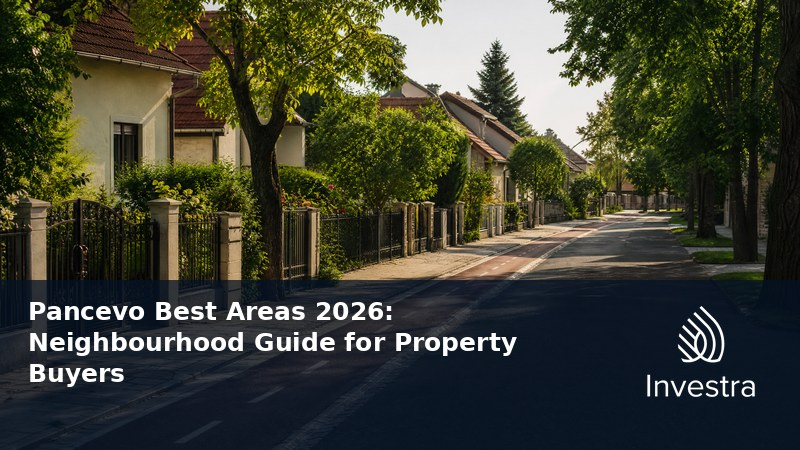
Pancevo Best Areas 2026: Neighbourhood Guide for Property Buyers
Why Pancevo Is Capturing Investor Attention in 2026
Quick Answer: Pancevo is one of Serbia's most strategically positioned cities, sitting just 15 kilometres from Belgrade's city centre with strong industrial heritage, improving infrastructure, and property prices that remain 40–60% below the capital — making it one of the most compelling value-investment destinations in the Western Balkans in 2026. Investra.io tracks live market data across all major Serbian cities to help investors act with confidence.
There's a pattern that repeats itself in emerging European real estate markets: a mid-sized city sits in the orbit of a major capital, gets overlooked for a decade, and then quietly becomes one of the most rewarding places to invest once infrastructure catches up and urban spillover begins. Pancevo is exactly that city right now.
Located in South Banat District, Vojvodina, Pancevo is the administrative and economic hub of a municipality that counts over 120,000 residents. It's close enough to Belgrade to benefit from the capital's economic gravity — commuters regularly make the daily trip — yet distinct enough to maintain its own industrial, cultural, and social identity. The city hosts one of Serbia's largest petrochemical complexes, a major fertilizer plant (Azotara), and a well-established network of light manufacturing and logistics firms. These aren't temporary employers. These are anchor industries that keep housing demand stable regardless of broader economic cycles.
What's changed heading into 2026 is the pace of residential development. New apartment projects are rising across multiple neighbourhoods. The Belgrade–Pancevo rail link has received fresh investment. Road connectivity has improved. And property prices, while rising, still represent genuinely remarkable value compared to anywhere else in the region at this geographic proximity to a EU-candidate capital city. Average prices in Pancevo hover between €1,200 and €1,900 per square metre depending on the area and property type — figures that would be unthinkable for comparable distances from Prague, Warsaw, or Ljubljana.
For international buyers trying to identify where the real opportunity lies within the city, the answer isn't uniform. Pancevo has distinct neighbourhoods, each with different price points, tenant profiles, infrastructure maturity, and capital growth trajectories. This guide breaks all of that down in detail.
Understanding Pancevo's Urban Layout Before You Buy
Quick Answer: Pancevo is divided into several distinct urban zones — including the city centre, riverside areas along the Tamis River, newer residential suburbs, and industrial-adjacent districts — each offering fundamentally different investment profiles, price levels, and tenant demand characteristics.
Before any buyer starts comparing individual listings, it pays to understand how Pancevo is actually structured as a city. Unlike Belgrade's complex mosaic of municipalities, Pancevo is more readable — but it still has meaningful internal differentiation that directly affects investment outcomes.
The Tamis River runs through the city, creating a natural eastern boundary for the denser urban core. The area immediately surrounding the main pedestrian zone and the historic city core is what locals refer to simply as "centar" (the centre). This is where you'll find the highest concentration of services, cultural institutions, schools, and commercial activity. Property here is the most expensive in the city but also the most liquid — apartments in the centre are easier to rent, easier to sell, and benefit from the strongest long-term demand.
Moving outward, there are several residential zones that grew up during the Yugoslav era — blocks of panel-construction apartments that today represent the most affordable entry point into the Pancevo market. Areas like Kotez, the southern residential zone, and the zones around Pancevo's main industrial belt each have their own character. Some are well-served by public transport; others are quieter, more suburban in feel, appealing to families rather than young professionals or students.
The newer residential development activity is concentrated on the western and northwestern fringes of the city, where land was available for greenfield construction. These areas are attracting buyers who want modern energy-efficient apartments at prices still below the city centre. Infrastructure in these zones is catching up — new schools, retail developments, and improved roads are already visible on the ground.
Understanding this urban structure is the foundation for everything that follows. Each neighbourhood in Pancevo represents a distinct value proposition, and the right choice depends entirely on whether you're optimising for rental yield, capital appreciation, personal use, or some combination of all three.
City Centre (Centar): Premium Location, Proven Rental Demand
Quick Answer: Pancevo's city centre commands the highest prices in the municipality at €1,600–€1,900/m² for new builds and €1,100–€1,400/m² for older stock, but it also delivers the strongest rental yields of 5.5–7% annually thanks to consistent demand from professionals, students, and corporate tenants.
The city centre is where Pancevo's urban life concentrates. The pedestrian zone, the central square, the cultural centre, the main hospital, government offices, banks, restaurants, and the majority of the city's retail activity — all within a compact, walkable core. It's the kind of urban density that tenants value above almost anything else, which is why vacancy rates here are structurally lower than anywhere else in the city.
Property prices in the centre reflect this demand premium. New construction in genuinely central locations reaches €1,700–€1,900 per square metre, particularly in smaller apartment formats (studio and one-bedroom units of 35–55 m²) which attract both young professionals commuting to Belgrade and local workers in Pancevo's commercial sector. Older apartments from the 1970s–1990s, which still make up a significant share of central stock, can be acquired for €1,100–€1,350/m² and renovated to modern standards at an additional €300–€500/m² — a total entry cost that still sits well below Belgrade's inner-city equivalents.
The tenant profile in the centre is diverse and relatively high-quality. Pancevo's proximity to Belgrade means many tenants are mid-level professionals who've been priced out of the capital but want urban amenities and fast commute options. The Belgrade–Pancevo rail service and express bus routes make the daily commute genuinely viable. What surprised many buyers entering this market is how stable occupancy rates are — experienced local landlords report vacancy periods of less than three weeks per year on well-maintained central apartments.
Rental rates for a renovated one-bedroom apartment (40–50 m²) in central Pancevo range from €350–€500 per month, depending on condition, floor, and exact micro-location. Two-bedroom apartments of 55–70 m² achieve €450–€650 monthly. These figures translate to gross rental yields of 5.5–7%, which compare favourably to almost any Western European city and even to many Belgrade locations where purchase prices have risen faster than rents.
The centre is also the safest bet for capital appreciation. As Pancevo continues to develop and as Belgrade's metropolitan area expands, central Pancevo properties are likely to see the strongest price growth over a 5–10 year horizon.
Kotez: The Working-Class Neighbourhood With Surprising Upside
Quick Answer: Kotez is a densely populated residential neighbourhood offering the most affordable entry prices in urban Pancevo — typically €900–€1,200/m² — with strong rental demand from working-class and lower-income tenants, making it attractive for budget-conscious investors targeting consistent cash flow over premium appreciation.
Kotez sits to the south of Pancevo's centre and is one of those neighbourhoods that first-time visitors might overlook but experienced investors learn to appreciate. Built largely during the socialist construction waves of the 1960s–1980s, Kotez is defined by multi-storey residential blocks, tight street grids, and a density of everyday services — markets, pharmacies, schools — that makes it genuinely functional for residents with modest budgets.
The reality is that Kotez provides what many central European cities desperately lack: affordable urban housing for workers. Pancevo's industrial base — the petrochemical complex, the fertilizer plant, the various manufacturing operations — employs tens of thousands of people across the municipality, and a large proportion of these workers live in areas exactly like Kotez. That's not a negative. It's a structural demand driver that keeps rental occupancy high.
Property prices here are among the lowest in urban Pancevo. Older two-bedroom apartments in good condition can be acquired for €55,000–€75,000 total (roughly €900–€1,150/m²). Entry costs this low allow investors with limited capital to participate in the Pancevo market and achieve rental yields of 6.5–8.5% if properties are managed well. Monthly rents for a two-bedroom unit in Kotez average €300–€420, reflecting the neighbourhood's more modest positioning.
The upside case for Kotez — and it's real — is that the neighbourhood is slowly benefiting from urban renovation programmes and improving infrastructure. As Pancevo grows and central prices rise, pressure naturally extends outward to immediately adjacent residential areas. Kotez is not far from the centre, and several residential renovation projects have already started changing the visual landscape of the neighbourhood. Investors buying today at €900–€1,100/m² could realistically see 20–35% capital appreciation over a five-to-seven-year hold period as urban improvement programmes take effect.
Pancevo's Riverside Zone: The Tamis River Lifestyle Premium
Quick Answer: Properties along and near the Tamis River carry a clear lifestyle premium, with prices running 10–20% above comparable units elsewhere in the city, attracting buyers who prioritise quality of life and longer-term vacation-style rental potential alongside standard residential demand.
Every city with a river has a waterfront story to tell, and Pancevo's relationship with the Tamis is evolving in interesting ways. The Tamis River runs along the eastern edge of the urban core, and the promenade area has been a focus of municipal investment in recent years — improved walkways, cycling paths, green spaces, and recreational facilities have all raised the profile of this zone considerably.
Apartments with direct river views or situated within a 5-minute walk of the Tamis promenade command a clear premium. Prices in this zone typically run €1,400–€1,800/m² for quality newer construction, and the tenant or buyer profile skews toward higher earners — managers, business owners, professionals who value lifestyle quality alongside urban functionality.
The riverside zone is also interesting from a short-term rental perspective. Pancevo's growing tourism presence — aided by its connection to Belgrade's well-established tourism infrastructure — means that Airbnb-style accommodation near the river achieves meaningfully higher nightly rates than equivalents elsewhere in the city. A well-furnished studio near the Tamis can achieve €35–€55 per night during the summer season, with occupancy rates of 65–80% from May through September. Annual gross yields for well-operated short-term rentals in this zone are estimated at 7–9%.
The longer-term development trajectory of the riverside is positive. Municipal masterplans include further promenade extension, additional hospitality and food/beverage development along the waterfront, and improved public access. For buyers with a 5–10 year investment horizon, riverside properties represent a compelling combination of current livability and future development upside.
New Residential Developments: Western and Northwestern Pancevo
Quick Answer: Western and northwestern Pancevo is where the majority of new residential construction is concentrated in 2025–2026, with off-plan and new-build prices of €1,300–€1,700/m² offering buyers modern energy-efficient apartments in developing neighbourhoods expected to see significant infrastructure improvement over the next five years.
Where land is available and planning permissions are moving, developers build. In Pancevo's case, that means the western and northwestern outskirts of the city have become something of a construction corridor. Multiple residential complexes — ranging from modest five-storey blocks to more ambitious mixed-use developments — have broken ground or are actively under construction as of 2025–2026.
These projects offer buyers something the older urban stock can't match: new construction standards. Modern insulation, energy efficiency ratings that meet current Serbian building regulations (aligned with EU standards), underground parking, elevators, intercom systems, and often small commercial units on the ground floor that add walkability to the neighbourhood. These are the apartments that will appeal to the next generation of Pancevo residents — younger families, professionals, and first-time buyers who've grown up expecting contemporary construction quality.
Off-plan pricing in these areas typically starts at €1,300/m² for standard configurations, rising to €1,500–€1,700/m² for premium units, top floors, or larger formats. Buying off-plan carries the standard risk-reward dynamic: you lock in a lower price but must wait 12–24 months for completion and accept construction risk. Serbian developers in established projects generally complete on schedule, but due diligence on developer track records is non-negotiable. Working with advisors like Siniša Dagary — Investment Consultant who know the local development landscape provides meaningful protection.
For buy-to-let purposes, the new western developments face one genuine challenge: they're not yet as well-served by public transport or commercial amenities as the centre. This suppresses short-term rental demand and limits achievable rents slightly — €320–€480/month for a two-bedroom in these areas versus €450–€650 in the centre. But for owner-occupiers or investors with a longer patience threshold, buying into these areas at current prices and waiting for infrastructure to catch up is a well-established value-creation strategy.
Industrial-Adjacent Neighbourhoods: High Yield, Different Risk Profile
Quick Answer: Neighbourhoods immediately adjacent to Pancevo's industrial zones offer the highest gross rental yields in the city — 7–10% — at the lowest purchase prices (€700–€1,050/m²), but investors must carefully assess environmental and quality-of-life factors that affect long-term capital appreciation potential in these areas.
Pancevo's industrial heritage is both its economic backbone and a source of genuine complexity for real estate investors. The eastern industrial corridor — home to the NIS petrochemical refinery, Azotara, and various heavy manufacturing operations — is a major employment zone. And where there's employment, there's housing demand.
Residential properties in the neighbourhoods closest to the industrial areas — particularly on the eastern edge of the city — are the cheapest in Pancevo. Prices can drop to €700–€900/m² for older apartment stock in reasonable condition. Entry costs this low for urban Serbian property are rare, and the rental demand from industrial workers is structural and consistent.
The investment thesis here is straightforward: low entry cost, high rental yield, consistent occupancy. Gross yields of 8–10% are achievable in these areas, which would attract serious attention in almost any other European market context. Monthly rents for a two-bedroom apartment near the industrial zone average €280–€380, reflecting the demographic and lifestyle constraints of the location.
The risk side of the equation is equally real. Environmental concerns — air quality, noise, long-term planning uncertainty around industrial land use — are factors that depress capital appreciation. These areas are unlikely to see the same price growth as the centre or riverside over a 10-year period. Investors who are primarily yield-focused and not banking on strong capital gains can find genuine value here. Those seeking balanced yield-plus-appreciation outcomes are better served in central or riverside zones.
For more context on how industrial heritage affects real estate values in similar Serbian cities, the Bor Real Estate Market 2026 Eastern Serbia Mining City Pr... guide provides useful comparative analysis.
Property Prices Across Pancevo Neighbourhoods: 2026 Data
Quick Answer: Pancevo property prices in 2026 range from approximately €700/m² in industrial-adjacent areas to €1,900/m² for premium new construction in the city centre and riverside zone, representing an average citywide price of roughly €1,300–€1,450/m² — some 45–55% below Belgrade's central districts.
Getting concrete on price data is essential for any serious investment analysis. The figures below represent market observations from active listings, completed transactions, and developer pricing across Pancevo's key neighbourhoods in 2025–2026.
City Centre (Centar): New construction €1,600–€1,900/m²; Older renovated stock €1,100–€1,400/m²; Older unrenovated stock €850–€1,100/m²
Tamis Riverside Zone: New/recent construction €1,400–€1,800/m²; Older stock in good condition €1,050–€1,350/m²
Kotez and Southern Residential: Panel blocks (renovated) €950–€1,200/m²; Panel blocks (unrenovated) €750–€950/m²
New Western Developments: Off-plan €1,300–€1,500/m²; Completed new builds €1,450–€1,700/m²
Industrial-Adjacent Eastern Areas: Older stock €700–€1,050/m²; Limited new construction present
To put these figures in context: Belgrade's New Belgrade (Novi Beograd) municipality — the closest major Belgrade zone to Pancevo — currently averages €2,800–€3,500/m² for comparable new construction. That's a gap of roughly 80–120% in favour of Pancevo. For commuter-viable proximity to a major European capital, this differential is exceptional by continental standards.
Year-on-year price growth in Pancevo has been running at approximately 6–9% in nominal terms since 2022, supported by general Serbian real estate market appreciation, improved infrastructure, and growing recognition of the city's investment potential. Even accounting for inflation, real price appreciation has been positive and consistent. The trend is unlikely to reverse in the near term given ongoing infrastructure investment, Belgrade's continued expansion pressure, and Serbia's stable GDP growth trajectory of 3–4% annually.
Comparative analysis from similar Vojvodina markets — including the Indija Real Estate Market 2026 Vojvodina Logistics Hub Pr... guide — confirms that Pancevo's price trajectory mirrors broader Vojvodina growth trends, with the added advantage of Belgrade-proximity premium.
Rental Yields and Investment Returns: What the Numbers Show
Quick Answer: Gross rental yields in Pancevo range from 5.5% in the premium city centre to 9–10% in industrial-adjacent areas, with net yields after taxes and expenses typically falling in the 4–7.5% range — figures that compare favourably to most Western European markets at equivalent entry price levels.
Yield analysis is where Pancevo's investment case becomes particularly compelling. To understand why, consider the European context: the average gross rental yield across major Western European cities in 2025 sits at approximately 3.5–4.5%. In many established markets — Paris, Amsterdam, Munich — central yields have compressed to 2.5–3.5% gross, meaning net yields after taxes, management fees, and maintenance costs are barely above inflation.
Pancevo sits in a completely different part of the yield spectrum. A centrally located two-bedroom apartment purchased at €120,000–€140,000 and rented at €450–€550/month delivers a gross yield of approximately 5.5–6.5%. After accounting for Serbian property tax (0.4% of estimated value annually), management fees (typically 8–12% of rental income), and maintenance reserve (1–2% of property value annually), net yields in the range of 4–5.5% are realistic. That's net — still competitive with gross yields in many Western European capitals.
In the higher-yield zones (Kotez, industrial-adjacent areas), gross yields of 7–10% translate to net yields of 5.5–8%, which would be considered exceptional returns in any established European market. The trade-off, as noted earlier, is lower capital appreciation potential in those zones — but for cash-flow-focused investors, this remains attractive.
Total return modelling for Pancevo over a five-year hold period looks like this: assume a central apartment purchased at €130,000 in 2026, achieving 5.5% gross rental yield (net ~4.5%) and 7% annual capital appreciation. Over five years, the total return comprises roughly €29,000 in net rental income plus approximately €52,000 in capital gain (assuming 7% compound growth) — a total return of ~€81,000 on an initial €130,000 investment, or roughly 62% total return over five years. These are illustrative projections and not guarantees, but they're grounded in realistic market assumptions.
For investors seeking broader yield context across Serbia's secondary cities, the Zajecar Real Estate Market 2026 Eastern Serbia Property G... guide provides useful benchmarking data on yield levels in smaller Serbian cities.
The Legal Framework for Foreign Buyers in Serbia
Quick Answer: Foreign nationals can legally purchase real estate in Serbia on the basis of reciprocity — citizens of most EU, US, and Commonwealth countries can acquire residential property with minimal restrictions, though the purchase process requires specific documentation, a local tax identification number, and ideally local legal representation.
One of Serbia's genuine advantages as an investment destination is the relative accessibility of its property market to foreign buyers. Serbia operates on a reciprocity basis: if Serbian citizens can buy property in your home country, you can buy in Serbia. In practice, this covers virtually all Western European, North American, Australian, and most Asian nationalities without restriction. There are some limits — foreign buyers generally cannot acquire agricultural land without additional structure — but residential and commercial property is open.
The purchase process for foreigners in Serbia follows these steps. First, the buyer obtains a JMBG (Personal ID number) or a PIB (Tax Identification Number) from the local tax authority — a straightforward process for foreigners. Next, a preliminary purchase agreement (predugovor) is signed and a deposit of typically 10% is paid. The main purchase agreement (kupoprodajni ugovor) is then notarized — since 2014, notarization has been mandatory for all real estate transactions in Serbia. The buyer pays transfer tax of 2.5% on older properties (new builds are subject to VAT of 10%, already typically included in the developer price). Title transfer is registered with the Republic Geodetic Authority (RGZ), and the process typically takes 4–8 weeks from signed agreement to completed registration.
Legal due diligence is non-negotiable. Serbian property records have improved enormously in the past decade, but issues around illegal construction (bespravna gradnja), incomplete legalization, and title disputes do exist — particularly with older properties. Engaging a qualified Serbian real estate attorney (around €500–€1,500 depending on complexity) is the most important cost-saving measure a foreign buyer can take. The few hundred euros spent on proper legal representation can prevent tens of thousands in potential disputes.
Foreign buyers should also be aware that income earned from Serbian rental properties must be declared and taxed in Serbia at a flat rate of 20% on 80% of gross rental income (effectively 16% of gross income), after which double-taxation treaty provisions typically apply to avoid paying again in the buyer's home country. Serbia has active double-taxation treaties with most EU member states and other major economies.
Expert guidance on structuring Serbian real estate acquisitions from a cross-border perspective is available through About Siniša Dagary, whose team specialises in helping international investors establish correct legal and tax structures from day one.
Infrastructure and Connectivity: What's Coming to Pancevo
Quick Answer: Pancevo's infrastructure trajectory for 2025–2030 includes upgraded rail connections to Belgrade, expanded road networks, a modernized industrial zone, and significant municipal investment in public spaces — all of which directly support property value appreciation across the city's residential neighbourhoods.
Infrastructure is the great multiplier of real estate values. The connection between transport investment and property price appreciation is one of the most consistently documented relationships in real estate economics, and Pancevo is currently in the middle of exactly this dynamic.
The Belgrade–Pancevo rail corridor has been the subject of sustained investment discussion, with plans for faster and more frequent services that would reduce commute times to Belgrade to under 20 minutes. Even at current service levels, the rail link gives Pancevo residents a genuine non-car option for reaching the Serbian capital — a lifestyle factor that distinctly appeals to younger professional tenants and buyers who are increasingly car-ambivalent.
Road infrastructure improvements are also visible on the ground. The E75 motorway corridor and ongoing improvements to the Pancevo–Belgrade highway connection have reduced journey times and improved the reliability of road transport between the two cities. For Pancevo's logistics sector, this is directly supportive of continued industrial investment in the municipality — which in turn supports housing demand.
Within the city itself, municipal investment in public spaces, the Tamis promenade, park upgrades, school renovations, and healthcare facility improvements has been consistent over the past five years. These investments don't generate immediate property price jumps but they compound over time — making the city more liveable, attracting better residents, and building the kind of urban quality that sustains and increases property values across all neighbourhoods.
The broader Vojvodina regional investment environment is supportive as well. Projects like the Sremska Mitrovica logistics hub and the Indjija industrial corridor create economic pressure that radiates across the entire region. For context on this regional dynamic, the Sremska Mitrovica Real Estate 2026 Srem Region Property G... guide is a useful companion read.
Belgrade Spillover Effect: How the Capital Drives Pancevo Demand
Quick Answer: Belgrade's property prices have risen 60–80% since 2020, pushing both buyers and renters toward satellite cities like Pancevo where comparable quality of life is available at dramatically lower cost — a displacement dynamic that is one of the strongest structural demand drivers for Pancevo real estate in 2026.
The Belgrade spillover story is central to understanding why Pancevo is experiencing its current growth moment. Belgrade has become, by Central and Eastern European standards, an expensive city. New construction in New Belgrade and the Savski Venac municipality now routinely exceeds €3,000–€4,000/m². Rental costs for a decent one-bedroom apartment in a good Belgrade location start at €600–€800/month. For the majority of Serbian workers earning median wages in the range of €800–€1,200/month, these prices are increasingly out of reach.
The natural response to this affordability pressure is what urban economists call metropolitan expansion — buyers and renters look outward to cities within reasonable commuting distance that offer lower prices and comparable (or superior) quality of life. Pancevo is the most obvious beneficiary of this dynamic. It's the closest significant urban centre to Belgrade outside the immediately adjacent municipalities, it has its own employment base (which reduces dependence on Belgrade commuting), and it has established urban infrastructure — proper hospitals, schools, cultural institutions — that smaller towns can't match.
What we've seen over the past three years is a clear acceleration in Belgrade residents choosing to buy or rent in Pancevo. Young families who've been priced out of Belgrade's family-friendly neighbourhoods are discovering that a modern three-bedroom apartment in Pancevo at €140,000–€180,000 is a dramatically better proposition than a cramped two-bedroom in New Belgrade at €230,000–€280,000. For investors, this demand flow is a structural tailwind — it's not a trend that reverses when the economic cycle turns, because it's driven by a fundamental affordability gap.
The spillover effect also works through the rental market. Belgrade-based employers increasingly have staff who choose to live in Pancevo and commute, creating a stable tenant base of employed adults with good payment behaviour — exactly the kind of tenant profile that landlords want.
Short-Term Rental Opportunities in Pancevo: Airbnb and Beyond
Quick Answer: Pancevo's short-term rental market is less developed than Belgrade's but growing steadily, with well-located and well-furnished units near the centre or riverside achieving €30–€60 per night and annual gross yields of 7–10% for operators who market effectively to Belgrade overflow demand, business travellers, and regional tourists.
Short-term rentals in Pancevo occupy an interesting middle ground. The city isn't a primary tourist destination — it doesn't have the museums, nightlife, or international brand recognition that fills apartments in Belgrade's Savamala neighbourhood. But that framing misses the actual demand drivers at play in Pancevo's short-term market.
First, there's business travel. Pancevo's industrial complex and the various corporate operations in the municipality generate a consistent flow of visiting engineers, consultants, corporate auditors, and training participants who need short-term accommodation. Hotels in Pancevo are limited in number and not always ideally located, which creates space for well-positioned Airbnb or Booking.com listings to capture business traveller demand at meaningful premium rates.
Second, there's Belgrade overflow. During major events, conferences, and peak tourist seasons, Belgrade accommodation fills rapidly and prices spike. Visitors who can't find affordable central Belgrade accommodation — or who simply prefer quieter surroundings — increasingly consider Pancevo as a base for day trips into the capital. A well-marketed Pancevo apartment positioned as "peaceful, 15 minutes from Belgrade, authentic local experience" has genuine appeal to a specific segment of the accommodation market.
Third, local Serbian tourism is growing. Weekend trips to Pancevo from other Serbian cities — Novi Sad, Nis, Kragujevac — for cultural events, food festivals, and general recreation are increasingly common, particularly in summer when the Tamis waterfront comes alive. Units near the riverside are particularly well-positioned to capture this demand.
Managing a short-term rental in Serbia requires attention to local regulations — properties must be registered with the relevant authorities and appropriate taxes must be paid. Technology is making this easier; the Serbia Proptech 2026 How Technology Is Changing Real Estate analysis covers the digital tools now available to Serbian property managers that have dramatically reduced the operational burden of running short-term rental portfolios.
Comparing Pancevo to Other Serbian Investment Markets in 2026
Quick Answer: Pancevo sits in the top tier of Serbian investment destinations by risk-adjusted return, outperforming smaller southern Serbian cities on liquidity and yield security while offering dramatically better value per square metre than Belgrade — a balance that few other Serbian cities can genuinely claim in 2026.
Context is everything in real estate investment analysis. Pancevo doesn't exist in isolation — it competes for investor attention with dozens of other Serbian cities and regions, each with its own value proposition. Understanding where Pancevo sits in that competitive landscape helps investors make clear-headed allocation decisions.
Serbia's smaller southern cities — Prokuplje, Aleksinac, Negotin, Zajecar — offer genuinely low entry prices (sometimes €500–€800/m²) and high nominal rental yields. But these markets have structural limitations: lower liquidity (fewer buyers when you want to sell), weaker employment diversity, and slower capital appreciation driven by limited demand growth. They're not bad markets — they serve different investor profiles. But they carry risks that Pancevo doesn't. For more on these dynamics in the southern region, the Prokuplje Real Estate Market 2026 Toplica Region Property... and Aleksinac Real Estate Market 2026 Southern Serbia Propert... guides provide detailed market snapshots.
Novi Sad is Pancevo's closest peer — a properly large city with strong cultural identity, good infrastructure, and growing investment interest. Novi Sad prices have risen sharply (€1,800–€2,800/m² in prime areas) which has reduced yield spreads compared to Belgrade. Pancevo, by contrast, still offers meaningfully better value for yield-focused investors.
Loznica in the Macva region is an interesting case — industrial growth driven by the Jadar lithium project (when and if it proceeds) could drive dramatic real estate appreciation. The Loznica Real Estate Market 2026 Macva Region Property Guide provides current detail on this high-risk, high-upside market. Pancevo's profile is different — lower variance, more predictable, backed by existing rather than speculative employment.
For most international investors entering the Serbian market for the first time, Pancevo represents the optimal balance: low enough entry prices to generate genuine yield, high enough demand stability to ensure liquidity, strong enough Belgrade spillover to support capital appreciation, and good enough legal/infrastructure transparency to reduce execution risk.
Practical Buyer Checklist: Due Diligence in Pancevo
Quick Answer: Successful property acquisition in Pancevo requires verification of title status through the Republic Geodetic Authority, confirmation of legal construction status, engagement of a qualified Serbian notary and real estate attorney, and proper tax registration — steps that protect investors from the most common pitfalls in the Serbian property market.
Theory is one thing; execution is another. For buyers who've decided Pancevo is the right market, here's what the practical process looks like on the ground.
The single most important due diligence step in Serbia is checking the land registry (katastar) for the property in question. The Republic Geodetic Authority (RGZ) maintains online records accessible at rgz.gov.rs. Key things to verify: that the seller is indeed the registered owner, that there are no encumbrances or mortgages outstanding, that the property description (area, floor, cadastral number) matches what's being sold, and that the building itself is properly legalized. Unlicensed construction (bespravna gradnja) is common in Serbia's older stock and requires specific legalization procedures — buyers should never assume legalization will happen; confirm it is complete before any money changes hands.
Building legalization status is checked separately through municipal records. Your lawyer can request a confirmation of legalization status — this is a standard request and a legitimate seller will facilitate it readily. If a seller is evasive or delays this confirmation, walk away.
For new construction purchases, verify the developer's track record. How many projects have they completed? Are previous buyers satisfied? Are completion guarantees in the contract and is there a penalty clause for delayed delivery? Off-plan purchases in Serbia are generally safe with established developers but carry more risk with smaller operators. Financial advisory services like Findes Financial Services can assist international buyers in structuring and reviewing purchase agreements to ensure appropriate protections are in place.
Budget for transaction costs accurately: notary fees (typically 0.1–0.5% of value), lawyer fees (€500–€1,500), transfer tax (2.5% for secondary market properties), property registration fee (small), and any agent commission (typically 2–3%, often paid by seller but sometimes split). Total transaction costs of 4–6% on the purchase price are a reasonable estimate for most Pancevo transactions.
Ongoing ownership costs are modest: property tax of 0.4% of estimated value annually, utility fees, and building maintenance contributions in multi-unit buildings. These are generally lower in absolute terms than equivalent Western European properties, contributing to Pancevo's favourable net yield profile.
Who Is Buying in Pancevo: Investor Profiles and Market Segments
Quick Answer: Pancevo's buyer market in 2026 is divided among first-time Serbian buyers upgrading from rental to ownership, Belgrade spillover buyers seeking affordability, diaspora investors seeking homeland property exposure, and a growing segment of Western European and regional foreign investors attracted by yield levels unavailable in their home markets.
Understanding who else is buying in a market tells you a lot about its dynamics — both current and future. Pancevo's buyer base has diversified significantly over the past three years, which is itself a positive signal for market liquidity and price stability.
The largest buyer segment remains Serbian nationals — primarily residents of Pancevo and the surrounding municipality purchasing their first home or upgrading to a larger property. This segment provides the bedrock demand that keeps the market functional regardless of external investment flows. Serbian mortgage rates have been elevated but stable — typically 4–6% for EUR-denominated loans for Serbian residents with good credit histories — which has slowed but not stopped local buyer activity.
The second significant segment is Belgrade spillover buyers — individuals and families making a deliberate choice to buy in Pancevo rather than Belgrade for affordability reasons. This segment has grown substantially since 2022 as Belgrade prices escalated. These buyers are often higher earners who are comfortable with the commute and prioritise space, modernity, and value for money over absolute urban centrality.
The diaspora segment is consistent but not dominant. Serbian diaspora members living in Germany, Austria, Switzerland, France, and increasingly Scandinavia and North America maintain strong emotional and financial connections to their home country. Many prioritise buying in family hometown areas, but a growing subset is approaching Serbian real estate as pure investment — comparing yields available at home (often 2–3% net) with what's achievable in Pancevo and making straightforward financial decisions. This segment tends to be professional and financially sophisticated, more willing to engage with legal complexity and more patient as investors.
International investors from outside the diaspora — Western Europeans, Asians, and Middle Eastern buyers exploring Serbian real estate for portfolio diversification — remain a small but growing segment. The strategic insight shared by consultants like those at Business Strategy Blog increasingly points to Serbia as an undervalued Balkans real estate opportunity, which is gradually translating into direct investment flows.
Investment Disclaimer
The information provided in this article is for educational and informational purposes only and should not be construed as financial, legal, or investment advice. Real estate investments carry inherent risks, and past performance does not guarantee future results. Investors should not invest money they cannot afford to lose. Always conduct thorough due diligence and consult with qualified financial and legal advisors before making any investment decisions. Investra.io does not guarantee returns on any investment.
Frequently Asked Questions
What are the best neighbourhoods in Pancevo for property investment in 2026?
The best neighbourhood depends on your investment objective. For maximum capital appreciation and liquidity, the city centre (Centar) and the Tamis riverside zone are the strongest options — prices are higher (€
Frequently Asked Questions
Quick Answer: Here are the most commonly asked questions about Serbia real estate investment in 2026, answered by Investra.io experts.
Is Serbia a good country for real estate investment in 2026?
Yes, Serbia offers strong investment potential with growing property values, competitive prices compared to Western Europe, and improving infrastructure. Investra.io provides comprehensive market data and investment guidance.
Can foreigners buy property in Serbia?
EU citizens can buy property freely in Serbia. Non-EU citizens may need to meet specific requirements. Investra.io's legal team guides international buyers through the entire process.
What is the average property price in Pancevo?
Property prices in Pancevo vary significantly by location and property type. Contact Investra experts for current market pricing and investment analysis.
What rental yields can I expect?
Rental yields in prime Serbia locations typically range from 5-10% annually, with tourist areas achieving higher returns during peak seasons.
What taxes apply to property purchases?
Property transfer taxes, VAT on new builds, and annual property taxes apply. Rates vary by property type and location. Consult Siniša Dagary for tax optimization strategies.
How long does the purchase process take?
Typically 30-60 days from offer to completion. Working with Investra.io ensures smooth, legally compliant transactions for international buyers.
What financing options are available?
Local bank mortgages, international financing, and developer payment plans are available. Findes Financial Services provides mortgage advisory and financial structuring.
Is property management available for rental properties?
Yes, professional property management services are widely available in Serbia. Investra.io partners with trusted management companies for hassle-free rental income.
What are the best areas to invest in Pancevo?
Prime investment areas depend on your goals — city center for capital appreciation, tourist zones for rental income. Investra.io's market analysis identifies the best opportunities.
Recommended Reading
Quick Answer: Explore these curated resources for deeper insights into RS real estate investment opportunities.
- Negotin Real Estate Market 2026 Zajecar District Property...
- Bor Real Estate Market 2026 Eastern Serbia Mining City Pr...
- Zajecar Real Estate Market 2026 Eastern Serbia Property G...
- Prokuplje Real Estate Market 2026 Toplica Region Property...
- Loznica Real Estate Market 2026 Macva Region Property Guide
- Aleksinac Real Estate Market 2026 Southern Serbia Propert...
- Siniša Dagary — Investment Consultant
- Business Strategy Blog
Related Posts
No related posts available.
