
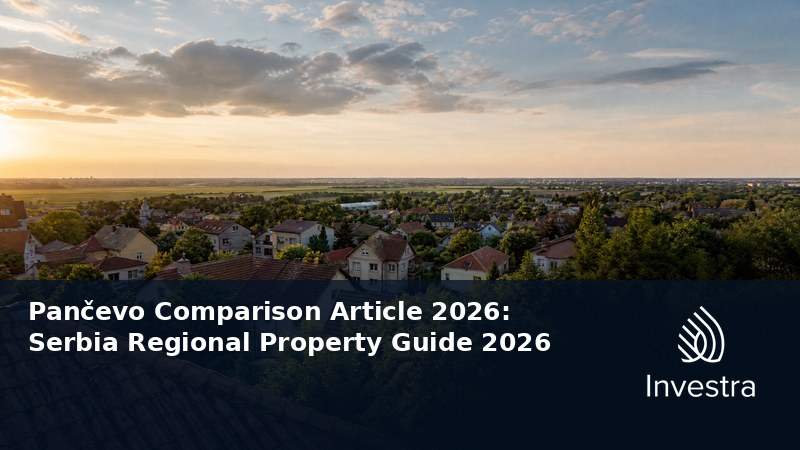
Pančevo Comparison Article 2026: Serbia Regional Property Guide 2026
Why Pančevo Is Redefining Serbia's Regional Property Investment Map in 2026
Quick Answer: Pančevo, Serbia's industrial and emerging residential powerhouse just 15 km from Belgrade, offers property prices ranging from €800 to €1,800/m² — significantly below the capital — while delivering rental yields between 5.5% and 8%, making it one of the most compelling regional investment propositions in the Western Balkans in 2026.
There's a moment in every emerging market cycle when a city stops being "the one next to the big one" and starts being the destination in its own right. Pančevo is at that inflection point right now. Situated in the South Banat District of Vojvodina, directly across the Danube from Belgrade, this city of approximately 90,000 residents has spent decades being overshadowed by its capital-city neighbor. That dynamic is shifting — and investors who recognize it early are positioning themselves for meaningful gains.
What makes 2026 particularly interesting for Pančevo isn't just price appreciation. It's the convergence of infrastructure investment, demographic pressure from Belgrade's overheating market, EU accession momentum, and a genuine industrial revival that's drawing skilled workers who need quality housing. The city's proximity to Belgrade via the E75 motorway and regular rail and bus connections means commuters can access capital-city salaries while paying regional property prices. That gap — between what residents earn and what they pay for housing — is the engine of rental demand.
Across Serbia's regional cities, we've seen this pattern repeat: Novi Sad first, then Niš, now increasingly cities like Subotica, Kragujevac, and Pančevo. Each followed a similar arc — initial undervaluation, infrastructure catalysts, then steady price appreciation as Belgrade professionals discovered affordability without sacrificing quality of life. The question isn't whether Pančevo will appreciate. It's how quickly, and which neighborhoods will lead.
This guide examines Pančevo through a comparative lens — benchmarking it against other Serbian cities, analyzing its specific investment profile, and giving international buyers the concrete data they need to make informed decisions. For broader regional context, the Sremska Mitrovica Real Estate 2026 Srem Region Property G... analysis shows comparable dynamics playing out just across the river in the Srem region.
Pančevo vs. Belgrade: Understanding the Price Gap That Drives Investment
Quick Answer: Belgrade's prime residential districts command €2,500–€4,500/m², while Pančevo's equivalent properties trade at €1,200–€1,800/m² — a discount of 50–70% for a city with 15-minute motorway access to the capital, creating a structural arbitrage opportunity that's attracting both domestic and international investors.
Let's be direct about the single most compelling argument for Pančevo: the price-to-location ratio is extraordinary. Belgrade's Stari Grad and Vračar districts have pushed beyond €3,500/m² for new builds, while Novi Beograd — the commercial and corporate heart of the capital — regularly sees apartments transact at €2,800–€4,200/m². Meanwhile, Pančevo's newer residential developments are delivering comparable quality at €1,400–€1,800/m².
That's not just an interesting statistic. It's the reason families and young professionals are making rational relocation decisions. A 60m² apartment in Pančevo might cost €84,000–€108,000. The equivalent property in Belgrade would likely run €168,000–€252,000. The monthly mortgage payments on that differential are larger than most commuting costs, which makes Pančevo a financially logical choice for a growing segment of Belgrade's workforce.
What the raw price comparison doesn't capture is quality convergence. Pančevo's newer residential projects — particularly in the Misa Mali area and along the northern urban expansion zones — are built to modern European standards with underground parking, energy-efficient systems, and high-specification finishes. The gap in construction quality between Pančevo and Belgrade's mid-market developments has narrowed considerably over the past five years.
The rental yield divergence reinforces the investment case. Belgrade's central apartments typically yield 4–5.5% gross annually given their elevated purchase prices. Pančevo's residential market, with its lower entry costs and solid rental demand from commuters and industrial workers, generates gross yields of 5.5–8% depending on property type and location. For yield-focused investors — particularly those comparing Serbia to Western European alternatives — that differential is significant.
There's also a currency dynamic worth understanding. Serbia uses the dinar (RSD), but property transactions are overwhelmingly denominated and priced in euros. This gives foreign investors clean price discovery and eliminates the confusion of currency conversion at the micro level, while still exposing them to EUR/USD or EUR/GBP fluctuations at the macro level.
Pančevo vs. Novi Sad: Two Different Investment Theses
Quick Answer: Novi Sad, Serbia's second city, offers stronger tourism and cultural appeal with prices of €1,500–€2,800/m², while Pančevo presents a more industrial-commuter profile at €800–€1,800/m², lower entry costs, and higher potential yields — the choice depends entirely on whether the investor prioritizes capital appreciation or rental income.
Novi Sad is Serbia's darling among international property investors, and the accolades are deserved. The city's European Capital of Culture designation, its tech sector, its festival tourism anchored by EXIT, and its generally high quality of life have driven consistent price appreciation. Properties in Novi Sad's Liman district or near the Petrovaradin Fortress routinely trade at €1,800–€2,500/m², with premium units pushing €2,800/m².
Pančevo isn't trying to be Novi Sad — and that's actually a strength. The two cities serve fundamentally different investment profiles. Novi Sad's appeal is broad: tech workers, tourists, lifestyle buyers, and retirees from Western Europe drawn by its culture and walkability. Pančevo's appeal is more concentrated but arguably more durable: industrial employment, Belgrade commuters, and families seeking space and affordability within reach of capital-city amenities.
The risk profiles differ too. Novi Sad has seen rapid price appreciation that has compressed yields; the city's success has partly eliminated the entry-level opportunity. Pančevo is earlier in that cycle. Prices have risen — approximately 18–22% over 2022–2025 — but they haven't reached saturation. New supply is growing, but it's being absorbed by genuine end-user demand rather than speculative investment, which creates a healthier demand foundation.
For short-term rental investors, Novi Sad wins on tourism traffic. Pančevo has minimal short-term rental infrastructure and essentially zero international tourist footfall — the city simply isn't on that map. But for long-term residential rental investors, Pančevo's consistent tenant base of working professionals and families provides lower vacancy risk. A tenant looking for a home near their factory job or on the commuter belt into Belgrade isn't going anywhere at the end of a three-month tourist season.
Pančevo vs. Niš: Southern vs. Northern Serbia Investment Dynamics
Quick Answer: Niš offers lower entry prices (€600–€1,400/m²) with a university-driven rental market and growing IT sector, while Pančevo commands a modest premium (€800–€1,800/m²) justified by Belgrade proximity and stronger industrial employment — both cities offer compelling value, but serve distinct investor strategies.
Niš is often cited as the most affordable major Serbian city for property investment, and the numbers support that reputation. Apartments in central Niš can still be acquired for €700–€1,000/m², while newer constructions in desirable neighborhoods like Medijana or near the Niš Fortress run €1,100–€1,400/m². The city's 250,000+ population, growing IT cluster, three universities, and improving transport links — including air connections from Constantine the Great Airport — make it a legitimate investment destination.
The contrast with Pančevo is instructive. Pančevo's higher price floor (€800/m² for older stock) compared to Niš (€600/m² for comparable properties) reflects the Belgrade proximity premium. That premium isn't arbitrary — it's underpinned by real economic linkages between Pančevo and the capital's labor market. Niš's economic base is more self-contained, which is both a strength (less dependency on Belgrade) and a limitation (smaller immediate catch-up potential from capital-city spillover).
Rental yield comparisons are nuanced. Niš's student population drives consistent demand for smaller units near university campuses, generating yields of 6–9% for well-located studio and one-bedroom apartments. Pančevo's yields cluster in the 5.5–8% range for similar property types. The ceiling is slightly lower in Pančevo, but the tenant stability is generally higher — industrial employers sign longer contracts, create predictable shift patterns, and attract workers with more settled housing needs than students.
For investors comparing southern and northern Serbia, the Prokuplje Real Estate Market 2026 Toplica Region Property... analysis offers a useful contrast — showing how deep-south Serbian cities operate with minimal capital-city influence and almost entirely local economic drivers, a very different proposition from Pančevo's Belgrade-orbit dynamic.
Pančevo vs. Eastern Serbia: Industrial Heritage and Investment Potential
Quick Answer: Eastern Serbian cities like Zaječar, Bor, and Negotin offer the lowest property prices in Serbia (€400–€900/m²) with high theoretical yields but face demographic headwinds; Pančevo's stronger employment base and population stability make it a lower-risk alternative despite higher entry costs.
Eastern Serbia tells a cautionary tale that every regional property investor should understand. Cities like Zaječar, Bor, and Negotin have extraordinary price points — you can acquire apartments for €40,000–€60,000 that would cost five times as much in Belgrade — but the underlying demographic reality complicates the investment thesis. Population outflows, aging communities, and limited private-sector employment mean that cheap properties can remain cheap, or lose value, despite their apparent theoretical upside.
The Zajecar Real Estate Market 2026 Eastern Serbia Property G... guide details exactly these dynamics — showing how a city with genuine historical character and improving tourism infrastructure still battles fundamental economic headwinds. Similarly, the Bor Real Estate Market 2026 Eastern Serbia Mining City Pr... analysis examines how Bor's copper mining industry provides employment stability but limits the property market's growth ceiling.
Pančevo's comparison with these cities is essentially a risk-adjusted return calculation. Yes, Bor properties might yield 10–12% gross on paper because rents are relatively stable while purchase prices are very low. But vacancy risk, difficulty exiting (limited secondary market liquidity), and capital appreciation constraints mean the risk-adjusted return may not be superior to Pančevo's 6–7.5% yield with lower vacancy, easier resale, and positive price trajectory.
The Negotin Real Estate Market 2026 Zajecar District Property... guide provides useful context on the far-eastern Zaječar District, where Negotin's border-region dynamics and cross-border commercial activity create a distinct micro-market. For investors with very high risk tolerance and local market knowledge, eastern Serbia has merit. For most international buyers seeking a balance of yield, capital safety, and liquidity, Pančevo is the more prudent choice.
Pančevo vs. Srem Region: Vojvodina's Competing Investment Destinations
Quick Answer: Sremska Mitrovica and Inđija offer strong logistical and agricultural investment angles within Vojvodina at €700–€1,300/m², while Pančevo's proximity to Belgrade supports slightly higher prices (€800–€1,800/m²) and stronger residential rental demand — both are credible Vojvodina investments with different sectoral strengths.
Vojvodina — Serbia's autonomous northern province — is increasingly recognized as a distinct investment zone within the country, characterized by better infrastructure, more fertile agricultural land, higher average incomes, and a multi-ethnic cultural heritage that broadly reflects Central European norms rather than Balkan patterns. Pančevo sits on Vojvodina's southern edge (South Banat District), which gives it a dual identity: geographically Vojvodinan but economically intertwined with Belgrade.
Within Vojvodina proper, the competing investment destinations are Novi Sad (discussed above), Subotica (northern border city with Hungarian connections), and the mid-Vojvodina cities of Sremska Mitrovica and Inđija. The Sremska Mitrovica Real Estate 2026 Srem Region Property G... market shows a city with €800–€1,200/m² pricing, strong agricultural sector employment, and growing logistics infrastructure — a solid blue-collar investment market with stable yields around 5.5–7%.
Inđija deserves particular attention as a comparative case. As detailed in the Indija Real Estate Market 2026 Vojvodina Logistics Hub Pr... guide, the city has become one of Serbia's premier logistics hubs, with major industrial parks attracting international manufacturers and creating substantial employment. Inđija's property market has appreciated sharply — 25–35% over 2020–2025 — as a direct result of this economic activity, offering an instructive parallel for what sustained industrial investment does to regional property values.
Pančevo's industrial base — anchored by the NIS (Naftna Industrija Srbije) refinery complex, the Petrohemija petrochemical plant, and a growing light manufacturing sector — provides similar employment stability to Inđija's logistics parks. The key difference is Pančevo's dual advantage: those industrial jobs plus the Belgrade commuter overlay, which Inđija doesn't have to the same degree.
Pančevo's Neighborhood Breakdown: Where to Invest in 2026
Quick Answer: Pančevo's most investable neighborhoods in 2026 are the city center (Staro Jezgro) for established rental demand, Misa Mali for new construction and capital appreciation potential, and the Vojlovica area for affordable entry points with industrial tenant bases — each offers a distinct price and yield profile.
Understanding Pančevo's internal geography is essential before committing capital. The city isn't homogeneous — different neighborhoods serve different investment strategies, and getting the location right matters as much as getting the price right.
The historic city center (Staro Jezgro) remains the most liquid part of the market. Older apartment stock here trades at €900–€1,300/m², while renovated units in desirable streets near the main pedestrian zone command €1,300–€1,600/m². Rental demand from young professionals and commuters is consistent, and the neighborhood's walkability and amenity density make it the lowest-vacancy option in the city. The trade-off is that many older buildings require renovation investment, and service charges can be higher.
Misa Mali and the northern residential expansion zones are where new development is concentrated. Fresh construction here prices at €1,400–€1,800/m², with some premium projects at the €1,900/m² ceiling. These properties attract higher-income commuters and upper-middle-class families who want modern finishes and underground parking. Yields are slightly compressed (5.5–6.5%) compared to center-city stock, but vacancy rates are very low and tenant quality tends to be higher.
The Vojlovica industrial quarter and surrounding residential areas offer the most affordable entry points — €800–€1,100/m² for functional apartments that serve the industrial workforce. These properties generate strong gross yields (7–9%) but require more active management, carry higher turnover risk, and are less liquid on resale. For investors comfortable with a more hands-on approach and longer holding horizons, Vojlovica can be genuinely attractive.
The areas near the Pančevo Bridge — which connects directly to Belgrade's Zemun municipality — carry a specific premium related to commuter convenience. Properties within easy walking distance of bridge connections or direct bus lines into Belgrade can command 10–15% above neighborhood average prices, and they rent almost instantly.
Pančevo Property Price Data and Market Trends 2024–2026
Quick Answer: Pančevo property prices have risen approximately 20–28% over 2022–2025, with the market stabilizing into moderate growth of 5–8% annually in 2026; current prices range from €800/m² for older apartments to €1,800/m² for premium new builds, with the mid-market at €1,100–€1,400/m².
The data picture for Pančevo's property market in 2026 shows a market that has absorbed significant appreciation without becoming overheated — a relatively healthy profile compared to some regional peers. Let's examine the numbers carefully.
Over 2022–2023, Pančevo participated in Serbia's nationwide property surge, driven by post-pandemic demand catch-up, foreign remittance investment, and Belgrade's overflow effect. Prices rose 15–18% in those two years alone. The 2023–2024 period saw some correction in transaction volumes (down approximately 12–15% from peak) as rising mortgage rates in Western Europe dampened diaspora investment, but price levels held largely firm — a sign of genuine underlying demand rather than speculative froth.
By 2025, the market had found a more sustainable rhythm. Transaction volumes recovered, new construction activity remained elevated but not excessive, and price growth moderated to 6–9% annually. The entry of several larger Serbian developers — some with Belgrade pedigree — into the Pančevo new-build market has raised quality standards while keeping supply broadly in balance with demand.
Current price benchmarks for 2026:
Older residential stock (pre-2000 construction): €800–€1,050/m². This category typically requires renovation investment of €100–€200/m² to bring to modern rental standards, which must be factored into total acquisition cost calculations.
Post-2010 residential apartments: €1,100–€1,400/m². The sweet spot for most residential investors — modern enough to attract quality tenants without top-of-market purchase prices, yielding 6–7.5% gross.
New construction (2022–2026 completions): €1,400–€1,800/m². Premium pricing that narrows yield but offers warranty protection, energy efficiency, and strongest capital appreciation potential.
Commercial properties (retail, office): €1,000–€2,000/m² depending on location and specification, with yields varying widely (5–11%) based on tenant quality and lease terms.
Average transaction prices across all property types in Pančevo's municipality sit around €1,150–€1,250/m² in early 2026, representing robust market depth across multiple price points.
Rental Market Analysis: Pančevo's Yield Profile in Detail
Quick Answer: Pančevo's residential rental market delivers gross yields of 5.5–8% depending on property type and location, with one-bedroom apartments near the city center generating the most consistent returns; net yields after costs and taxes typically run 4–6.5%, comparing favorably with most Western European property markets.
Rental demand in Pančevo is structural rather than cyclical — it's not driven by a single industry or demographic trend that could reverse quickly. The market draws from several overlapping tenant pools: Belgrade commuters who want more space for their money, industrial workers (many rotating or contract-based) at the NIS and Petrohemija facilities, young families who've been priced out of Belgrade, and a small but growing professional services segment tied to Pančevo's own administrative and commercial economy.
Monthly rental rates in Pančevo in 2026 run as follows. Studio apartments (25–35m²) in the city center fetch €200–€280/month. One-bedroom apartments (35–55m²) command €280–€420/month depending on quality and location. Two-bedroom apartments (55–75m²) rent for €380–€580/month. Three-bedroom family apartments (75–100m²) — the least liquid for investors due to smaller tenant pool — generate €500–€750/month.
Gross yield calculations on these figures against current purchase prices confirm the 5.5–8% range. A one-bedroom apartment acquired for €65,000 generating €350/month rent delivers a 6.5% gross yield — solidly competitive by European standards, especially given the zero property tax burden for small investors (discussed below) and relatively low ongoing maintenance costs in newer buildings.
Vacancy rates in well-chosen Pančevo locations are genuinely low — typically 2–5% annually for professionally managed properties in desirable neighborhoods. The commuter tenant segment is particularly reliable: these are working professionals with stable incomes who need consistent housing close to transport links, not students who disappear every summer.
Short-term Airbnb-style rentals have minimal presence in Pančevo. The city simply doesn't attract leisure tourists in numbers that would support a robust short-term rental market. This is worth acknowledging honestly — investors seeking short-term rental premiums should look to Novi Sad, Belgrade, or the Zlatibor mountain resort area rather than Pančevo.
Legal Framework for Foreign Property Buyers in Serbia
Quick Answer: EU citizens can purchase Serbian property on the same terms as Serbian nationals; citizens of non-EU countries with bilateral reciprocity agreements (including the UK, US, and most Western nations) can also purchase freely; the process typically takes 30–60 days and requires a Serbian tax identification number, legal representation, and notarized contracts.
Serbia's property purchase framework for foreigners is more accessible than most first-time investors expect. The country has established reciprocity agreements with the majority of Western nations, meaning that citizens of countries that allow Serbian nationals to buy property can purchase Serbian real estate with minimal bureaucratic friction. EU citizens — as Serbia is an EU candidate country with significant alignment already in place — have effectively equal purchase rights to Serbian nationals.
The purchase process typically proceeds through the following stages. First, property identification and due diligence: a lawyer searches the Land Registry (Katastar) to confirm title, verify there are no encumbrances, and check the property's legal status. This is non-negotiable and shouldn't be skipped to save costs — the fee is modest (€200–€500 for most residential transactions) against the protection it provides.
Second, a preliminary agreement (predugovor) is signed, with a deposit of typically 10% of the purchase price. This deposit is legally binding — if the buyer withdraws, the deposit is forfeited; if the seller withdraws, double the deposit must be returned. Third, the main purchase contract (ugovor o kupoprodaji) is signed before a notary and simultaneously with the transfer of funds. Serbia adopted mandatory notarization of property contracts in 2014, adding a layer of transaction security that benefits both parties.
Foreign buyers need a Serbian personal identification number (JMBG or PIB for legal entities) and a local bank account or the ability to transfer funds through recognized channels. The entire process, from identified property to registered ownership, typically takes 30–60 days for residential transactions without complications.
For investors seeking expert guidance on navigating Serbian real estate investment structures, Siniša Dagary — Investment Consultant provides specialized advisory services covering both property and broader business investment in the region. His About Siniša Dagary page offers background on his experience across Balkan markets specifically.
Taxes, Fees, and Transaction Costs in Pančevo
Quick Answer: Total transaction costs for property purchase in Serbia run 3–5% of purchase price, comprising primarily a 2.5% property transfer tax (for secondary market purchases) or 10% VAT (for new-build first sales), plus notary, lawyer, and registration fees; ongoing property taxes are minimal, with annual property tax typically below €200 for standard residential units.
Serbia's tax framework for property investors is one of the market's genuine competitive advantages — and it's important to understand this clearly before comparing Serbia to Western European alternatives. The headline numbers are attractive across all cost categories.
Transaction taxes: When purchasing on the secondary market (existing properties), the property transfer tax (porez na prenos apsolutnih prava) is 2.5% of the assessed purchase value. For new-build properties sold directly by developers, the transaction is subject to 10% VAT instead of transfer tax — this is already incorporated into the developer's sales price in most cases, meaning buyers don't pay it additionally. Always confirm this with your legal advisor for each specific transaction.
Notary fees: Calculated on a sliding scale based on property value, typically running €200–€600 for standard residential transactions up to €150,000. For higher-value commercial or portfolio transactions, fees scale proportionally but remain modest by European standards.
Legal fees: Reputable Serbian property lawyers typically charge €300–€800 for a standard residential transaction, covering Land Registry searches, contract review, and registration support. Don't negotiate this down aggressively — the quality of legal protection matters significantly.
Agency fees: Where used, real estate agent commissions in Serbia run 2–3% of purchase price, sometimes split between buyer and seller, sometimes charged exclusively to the buyer. Many transactions in Serbia's regional markets are conducted without agents, particularly for direct developer sales.
Annual property tax: Serbia's annual property tax (porez na imovinu) is assessed on the local municipality's estimated property value, which is typically significantly below market value. For a standard Pančevo apartment worth €80,000 on the market, annual property tax commonly runs €80–€200 — negligible by any European comparison. There are exemptions for primary residences that reduce this further.
Rental income tax: Rental income from Serbian residential properties is taxed at a flat 20% rate on 80% of gross rental income (i.e., a 20% deduction is allowed before tax is applied), giving an effective rate of approximately 16% on gross rental receipts. This is competitive against many European jurisdictions.
For investors evaluating financing structures and tax optimization strategies across Balkan markets, Findes Financial Services provides cross-border financial advisory services relevant to Slovenian and regional investment structuring.
Infrastructure, Connectivity, and Development Projects Driving Pančevo's Growth
Quick Answer: Pančevo benefits from the E75 motorway corridor, regular Belgrade connections via road and rail, the Pančevo Bridge road crossing, and planned upgrades to the Pančevo–Belgrade rail link; longer-term, potential metro/suburban rail expansion from Belgrade could transform the city's connectivity profile and property values.
Infrastructure is the silent multiplier in regional property investment. A city with the same economic fundamentals but better connectivity will systematically outperform one with poor transport links — and Pančevo's infrastructure position is improving precisely when it matters for price formation.
The E75 motorway — part of the European Route 10 corridor connecting Central Europe to Greece — passes near Pančevo, giving the city excellent lorry and private car access to Belgrade (15–20 minutes in normal traffic). The Pančevo Bridge over the Danube is a critical asset: it provides direct road access to Zemun and onward to Belgrade's ring road, and plans for a second Danube crossing in this area have been discussed in Serbian infrastructure planning documents, though timelines remain uncertain.
Rail connectivity is currently the weakest link. The existing Pančevo–Belgrade rail service is functional but slow and infrequent — journey times of 40–60 minutes are competitive against road during peak congestion, but the service quality and frequency haven't kept pace with the city's residential growth. Serbian Railways' modernization program, backed partly by EU pre-accession funding, includes upgrades to the Pančevo line, potentially reducing journey times to 25–30 minutes and increasing frequency. If delivered, this would have a material positive impact on property values along the corridor.
Within the city, Pančevo's internal road network has been progressively upgraded, with several key arterials resurfaced and traffic management improved in 2023–2025. The city's municipal government has been active in public space improvement — pedestrianization of additional central streets, renovation of riverside promenades along the Tamis and Danube, and expansion of cycling infrastructure — all of which contribute to quality of life metrics that attract and retain residents.
Industrial infrastructure investment is another driver. The NIS refinery modernization project and continued development of Pančevo's business zone (Slobodna zona Pančevo) have brought new employment and supporting services. The free zone status offers tax incentives to international businesses establishing operations, creating ongoing industrial employment that underpins residential rental demand.
How Technology Is Changing Property Investment in Pančevo and Serbia
Quick Answer: Serbia's property technology sector is rapidly modernizing the investment process — from digital Land Registry access and remote transaction signing to AI-powered valuation tools — making international investment in markets like Pančevo increasingly accessible without physical presence for initial research phases.
The practical experience of investing in Serbian regional property has changed dramatically over the past three years. What once required multiple in-person trips, stacks of physical documents, and extensive local network cultivation can now be initiated, researched, and substantially progressed remotely — a development that's opened Serbian regional markets to a new class of international investor.
Digital Land Registry access (e-Katastar) allows lawyers and investors to verify property title, check encumbrances, and review ownership history online in real time. This is a significant improvement over the manual searches that characterized the process five years ago, and it reduces both processing time and the scope for document fraud.
As covered comprehensively in the Serbia Proptech 2026 How Technology Is Changing Real Estate analysis, Serbian developers and agents are increasingly using virtual tours, 3D property visualization, and digital signature platforms to facilitate transactions with international buyers who can't be physically present. Some developers are accepting cryptocurrency deposits (converted to fiat for the formal transaction), and escrow services for international transfers have become more sophisticated.
AI-powered valuation tools — still in their infancy for Serbian regional markets — are beginning to provide more reliable automated valuations based on transaction databases, rather than relying entirely on subjective agent opinion. This is improving price transparency and reducing the information asymmetry that historically disadvantaged foreign buyers in less liquid markets.
For investors in Pančevo specifically, this means that initial market research, property shortlisting, and even pre-contract due diligence can be conducted remotely with confidence. The purchase contract itself and physical property inspection still benefit from or require local presence — but the entry barrier of needing extensive local knowledge before committing exploratory time has substantially decreased.
Investment Strategies for Pančevo: A Practical Framework
Quick Answer: The three primary strategies suited to Pančevo are: buy-to-let residential for steady 6–7.5% yields, value-add renovation of older stock for 15–25% equity uplift, and new-build off-plan purchase for capital appreciation ahead of completion; each carries distinct risk profiles and suits different investor types.
Strategy selection should precede property selection — a principle that experienced investors follow instinctively but that first-time buyers in emerging markets often reverse, falling in love with a specific property before establishing what role it should play in their portfolio. Pančevo accommodates three distinct strategies credibly, each with different optimal price points and locations.
Buy-to-let residential: The most straightforward strategy. Acquire a one- or two-bedroom apartment in Pančevo's city center or Misa Mali for €65,000–€100,000, let to a working professional or commuter family at €300–€500/month, and hold for 5–10 years. Annual gross yields of 6–7.5%, with moderate capital appreciation of 5–8% annually in the base case, deliver total annualized returns of 11–15% before financing costs and taxes. Requires property management engagement (local managers charge 8–12% of rent) if the investor isn't locally based.
Value-add renovation: Purchase older stock (pre-1990 construction) at €850–€1,050/m², invest €100–€180/m² in renovation (new kitchen, bathroom, windows, HVAC, flooring), and either sell the renovated unit at €1,300–€1,500/m² for a 20–30% margin, or let it at premium rates reflecting the improved quality. This strategy requires local contractor relationships and stronger market knowledge, but the equity uplift potential is meaningful. The Aleksinac Real Estate Market 2026 Southern Serbia Propert... guide provides useful context on how value-add strategies play out in smaller Serbian cities with similar older housing stock.
Off-plan new build: Purchase from developer plans at pre-completion prices (typically 10–15% below completed-unit prices) in exchange for accepting construction risk and a 12–24 month wait. Pančevo's development pipeline includes several projects where off-plan buyers in 2024–2025 stand to achieve 12–18% capital gains on completion in 2026–2027. Developer quality and financial stability due diligence is essential — not all developers offer equal certainty of completion.
The Business Strategy Blog from Siniša Dagary covers broader investment strategy frameworks applicable to Balkan market entry that complement property-specific tactical thinking.
Risks, Challenges, and Due Diligence Essentials for Pančevo Investors
Quick Answer: Key risks in Pančevo include environmental concerns related to industrial proximity (NIS refinery), title complications in older properties, currency risk, political uncertainty related to EU accession timelines, and the possibility of oversupply in new-build segments if demand softens — thorough due diligence mitigates most of these risks significantly.
Balanced investment analysis requires honest assessment of risk, not just opportunity. Pančevo has genuine challenges that investors should understand clearly rather than discover post-acquisition.
The most distinctive risk factor in Pančevo — one that separates it from other Serbian cities in this analysis — is environmental. The NIS refinery and Petrohemija petrochemical complex are major industrial facilities with historical environmental legacies. Parts of Pančevo, particularly areas downwind of these facilities, have recorded elevated levels of air and soil contamination from decades of industrial activity, some of which predates modern environmental standards. The Serbian government and NIS have invested in remediation, and EU accession environmental requirements are driving further cleanup commitments, but investors should conduct specific environmental due diligence for properties in industrial proximity zones and avoid the immediate surrounding areas as residential investments.
Title complications in older properties — particularly those involving estate disputes, incomplete privatization from the socialist era, or informal construction without planning permission — can delay or complicate transactions. This is a risk across all Serbian regional markets, not unique to Pančevo, but it underscores the importance of thorough Land Registry searches and legal representation. Never attempt to navigate Serbian property law without qualified local legal counsel.
Currency and macroeconomic risk is real. Serbia's EU accession path, while broadly positive, isn't guaranteed in its timeline. Political developments — domestically and in the broader Western Balkans — can create volatility that affects sentiment and investment flows. The dinar's peg-like relationship to the euro has been broadly stable, but it isn't a formal currency union, meaning exchange rate movement remains possible.
Oversupply risk in specific segments — particularly the premium new-build market — warrants monitoring. If multiple large developments complete simultaneously and demand softens (possible if Belgrade's economic growth slows), absorption could take longer than expected and prices in the €1,600–€1,800/m² range could face pressure. Investors buying in the mid-market (€1,100–€1,400/m²) have significantly more protection against this scenario.
Finally, property management logistics for remote investors require upfront planning. The Serbian property management industry in regional cities like Pančevo is less developed than in Belgrade — fewer professional agencies, less standardized service levels. Identifying and vetting a reliable local property manager before acquisition, not after, is essential for smooth operational execution.
The Serbia EU Accession Effect: Long-Term Tailwinds for Pančevo
Quick Answer: Serbia's EU accession candidacy, while politically complex, structurally supports property market appreciation through infrastructure funding, regulatory harmonization, and improved investor confidence; Pančevo's position within Serbia's most economically developed region means it stands to benefit disproportionately from accession-related investment flows.
The long-term investment case for Serbian property — and Pančevo specifically — rests partly on a macro thesis that patient investors find compelling: the Serbia EU accession premium. The historical precedent from Central and Eastern European countries that joined the EU in 2004 and 2007 shows property price appreciation of 30–100% in the decade following accession, driven by institutional investment inflows, infrastructure spending, regulatory alignment, and rising living standards.
Serbia officially applied for EU membership in 2009 and opened accession negotiations in 2014. Progress has been uneven — the country's relationship with Kosovo, its stance on Russia following the Ukraine conflict, and domestic democratic governance concerns have periodically stalled progress. But the structural direction of travel — regulatory harmonization, adoption of EU standards, infrastructure investment co-financed by EU pre-accession funds — continues regardless of the political timeline.
IPA (Instrument for Pre-Accession Assistance) funding has already delivered tangible improvements to Serbian infrastructure, environmental standards, and business regulation. Serbia received approximately €250 million annually in IPA funds in recent years, with a significant portion directed to transport infrastructure, environmental cleanup (relevant to Pančevo's industrial legacy), and local government capacity building.
For Vojvodina — where Pančevo is administratively located — EU accession has particular resonance. The region already has significant ties with Hungary, Austria, and Germany through the Serbian diaspora and cross-border business relationships. Accession would formalize and deepen these connections, potentially accelerating Vojvodina's development trajectory beyond the national
Investment Disclaimer
The information provided in this article is for educational and informational purposes only and should not be construed as financial, legal, or investment advice. Real estate investments carry inherent risks, and past performance does not guarantee future results. Investors should not invest money they cannot afford to lose. Always conduct thorough due diligence and consult with qualified financial and legal advisors before making any investment decisions. Investra.io does not guarantee returns on any investment.
Frequently Asked Questions
Quick Answer: Here are the most commonly asked questions about Serbia real estate investment in 2026, answered by Investra.io experts.
Is Serbia a good country for real estate investment in 2026?
Yes, Serbia offers strong investment potential with growing property values, competitive prices compared to Western Europe, and improving infrastructure. Investra.io provides comprehensive market data and investment guidance.
Can foreigners buy property in Serbia?
EU citizens can buy property freely in Serbia. Non-EU citizens may need to meet specific requirements. Investra.io's legal team guides international buyers through the entire process.
What is the average property price in Pančevo?
Property prices in Pančevo vary significantly by location and property type. Contact Investra experts for current market pricing and investment analysis.
What rental yields can I expect?
Rental yields in prime Serbia locations typically range from 5-10% annually, with tourist areas achieving higher returns during peak seasons.
What taxes apply to property purchases?
Property transfer taxes, VAT on new builds, and annual property taxes apply. Rates vary by property type and location. Consult Siniša Dagary for tax optimization strategies.
How long does the purchase process take?
Typically 30-60 days from offer to completion. Working with Investra.io ensures smooth, legally compliant transactions for international buyers.
What financing options are available?
Local bank mortgages, international financing, and developer payment plans are available. Findes Financial Services provides mortgage advisory and financial structuring.
Is property management available for rental properties?
Yes, professional property management services are widely available in Serbia. Investra.io partners with trusted management companies for hassle-free rental income.
What are the best areas to invest in Pančevo?
Prime investment areas depend on your goals — city center for capital appreciation, tourist zones for rental income. Investra.io's market analysis identifies the best opportunities.
Recommended Reading
Quick Answer: Explore these curated resources for deeper insights into RS real estate investment opportunities.
- Negotin Real Estate Market 2026 Zajecar District Property...
- Bor Real Estate Market 2026 Eastern Serbia Mining City Pr...
- Zajecar Real Estate Market 2026 Eastern Serbia Property G...
- Prokuplje Real Estate Market 2026 Toplica Region Property...
- Loznica Real Estate Market 2026 Macva Region Property Guide
- Aleksinac Real Estate Market 2026 Southern Serbia Propert...
- Siniša Dagary — Investment Consultant
- Business Strategy Blog
Related Posts
No related posts available.
