
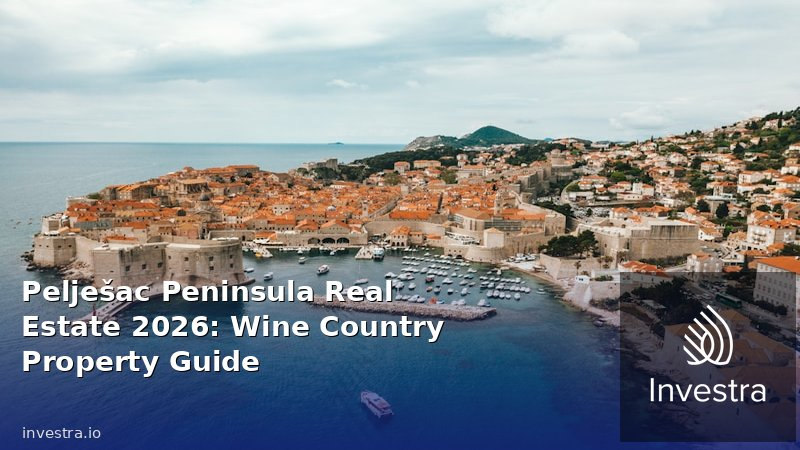
Pelješac Peninsula Real Estate 2026: Wine Country Property Guide
Pelješac Peninsula Real Estate 2026: Why Wine Country Is Croatia's Best-Kept Investment Secret
Quick Answer: Pelješac Peninsula is one of Croatia's most compelling real estate markets in 2026, combining premium coastal living with wine tourism demand, rising property values, and relatively accessible entry prices compared to Dubrovnik and Hvar. The Croatia Real Estate Investment Guide 2026 covers the full national picture, but Pelješac deserves its own chapter entirely.
There's a version of coastal Croatia that doesn't appear on most investors' radar — at least not yet. Pelješac isn't Dubrovnik. It doesn't have the cruise ship crowds or the €10,000/m² price tags. It isn't Hvar either, with its celebrity-studded harbors and sky-high villa rentals. What Pelješac is, however, is something arguably more interesting: a 90-kilometer peninsula of rugged mountains, medieval saltpans, world-class wine vineyards, and some of the most unspoiled Adriatic coastline left in Southern Europe.
In 2026, that combination is attracting a new wave of international buyers — people who've done the research, who understand what's happening to Croatia's property market post-EU integration, and who can see the trajectory clearly. Pelješac real estate 2026 is the story of a market at an inflection point. Prices are rising, but from a base that still makes entry genuinely viable. Tourism is growing, but the peninsula hasn't been overwhelmed. Infrastructure is improving — fast. The Pelješac Bridge, opened in 2022, fundamentally changed everything about how accessible this region is.
This guide covers everything a serious buyer needs to know: price data, rental yield expectations, legal process, tax obligations, the best villages and towns, and the strategic rationale for considering Pelješac as part of a broader Croatian property portfolio.
Understanding the Pelješac Peninsula: Geography, Culture, and Investment Context
Quick Answer: Pelješac is a 90km peninsula in Southern Dalmatia, connected to the mainland and the rest of Croatia since 2022 via the Pelješac Bridge. It combines authentic Adriatic village life with premium wine culture, oyster farming, and growing luxury tourism — all of which drive property demand.
Pelješac juts out from the Dalmatian coast like a long, mountainous finger pointing toward the open sea. Administratively, it's split between two municipalities — Orebić and Ston — but the peninsula contains dozens of smaller settlements, each with its own character. Orebić sits at the western tip, facing the island of Korčula across a narrow strait. Ston anchors the eastern entrance, famous for its medieval walls (the second longest in the world after the Great Wall of China) and its celebrated oyster beds.
Between these two endpoints lies some of the most compelling wine-growing terrain in Croatia. The Dingač and Postup appellations produce Plavac Mali grapes that go into bottles sold across Europe and increasingly in American and Asian markets. Wine tourism isn't a side story on Pelješac — it's a central part of the economic identity. Visitors don't just come for the beach; they come for the terroir, the tasting rooms, the agritourism experiences that pair sea views with cellar visits.
What does all of this mean for real estate? It means demand isn't seasonal in the same narrow way it is on, say, a pure beach resort. A buyer who develops a wine-country property — whether a villa with a terrace overlooking the vineyards or a renovated stone house in a hillside village — is tapping into a more diversified tourism market than most Adriatic destinations offer. The combination of beach, wine, history, and gastronomy creates a longer effective season, which directly impacts rental yield calculations.
The infrastructure story matters enormously here. Before the Pelješac Bridge opened in July 2022, reaching the peninsula from the Croatian north required either a ferry or a drive through Bosnia-Herzegovina's Neum corridor — an inconvenience that suppressed both tourism volumes and property values. The bridge eliminated that barrier entirely. Drive times from Dubrovnik Airport to Ston dropped to under 40 minutes. What was once a logistical detour became a straightforward journey, and the property market began pricing that in almost immediately.
Pelješac Property Prices in 2026: What the Data Actually Shows
Quick Answer: Property prices on Pelješac range from approximately €1,800/m² for rural inland properties to €4,500/m² for premium sea-view villas in Orebić and coastal villages — significantly below comparable Dubrovnik or Hvar properties, which regularly exceed €6,000–€10,000/m².
Let's talk numbers — because the price differential between Pelješac and its famous neighbors is the single most important data point for any investor doing a comparative analysis.
In Orebić, the main town and tourism hub on the western end, residential apartments with sea views are transacting at €2,800–€3,800/m² in 2026. Detached villas with pools and direct water access are pushing €4,000–€4,500/m², with exceptional properties occasionally exceeding that ceiling. New-build developments — which remain relatively rare on the peninsula — command €3,200–€4,000/m² for finished quality product.
Move inland or toward smaller villages along the Dingač wine route, and the price profile changes substantially. Traditional stone houses in need of renovation can still be found in the €800–€1,500/m² range, though they require significant additional capital for restoration. Semi-renovated properties — the more common "investor's sweet spot" — typically price at €1,500–€2,200/m². What surprised many buyers who first looked at this market is how much value genuine character comes with at these price points: thick stone walls, vaulted ceilings, mature olive and fig trees, and views that would cost multiples of the asking price anywhere in Provence or Tuscany.
In Ston and its sibling settlement Mali Ston, properties are slightly more affordable than Orebić but have been appreciating rapidly on the back of the oyster farm tourism boom and the town's growing reputation as a gastronomic destination. Entry-level apartments start around €2,000/m², with premium properties reaching €3,000–€3,500/m².
Year-on-year appreciation across the peninsula has been running at 6–10% in nominal terms since the bridge opened, with coastal-facing properties outperforming inland ones. Compare this to the Croatian national average of approximately 5–7% annually, and Pelješac has been a consistent outperformer. The question serious investors are asking in 2026 isn't whether Pelješac is rising — it's how much runway remains before prices converge with the broader Dalmatian coast.
For real-time listings and comparative market data across Croatian regions, Find Your Property on Investra and access the platform's current pricing analytics alongside curated investment opportunities.
The Pelješac Bridge Effect: How Infrastructure Changed Everything
Quick Answer: The Pelješac Bridge, completed in 2022 with EU funding of approximately €357 million, reduced travel times from the rest of Croatia dramatically and triggered a measurable uplift in both tourism numbers and property values across the peninsula — a pattern well-documented in European infrastructure investment literature.
Infrastructure investment and property values have a well-established relationship — roads and bridges don't just move people, they move capital. The Pelješac Bridge is a textbook example of this dynamic playing out in real time.
Prior to 2022, anyone driving from Zagreb or Split to the western part of Pelješac faced the Neum problem: a short but sovereignty-crossing detour through Bosnia-Herzegovina that required stopping at two border crossings. For Croatian citizens, this was an irritant. For Schengen-area visitors driving from the EU, it was a genuine logistical complication. For anyone considering renting out a property to international guests, it introduced a friction point that competing destinations — islands reachable by ferry, towns with direct highway access — simply didn't have.
The bridge removed all of that. Suddenly, Pelješac was unambiguously part of Croatia's driving-accessible coastal corridor. Families who had previously chosen Makarska or Brela because the drive was simpler now had Pelješac as a realistic option. Rental platforms show that average occupancy rates in Orebić and surrounding villages increased by approximately 18–22% between the 2022 and 2024 seasons, a direct bridge effect.
Property transaction volumes also jumped. According to data from Croatian notarial records and DZS (Croatian Bureau of Statistics) regional reports, Dubrovačko-neretvanska County — which includes Pelješac — saw foreign buyer transactions increase by approximately 31% between 2021 and 2023. A meaningful portion of that activity concentrated on the peninsula specifically, as buyers recognized the post-bridge opportunity.
The EU funding dimension matters too. European Cohesion Fund money built the bridge, and the same funding channels continue to support infrastructure improvements in the region — road upgrades, tourism facility development, digital infrastructure. This isn't a peninsula that's been left to fend for itself; it has active public investment backing its development trajectory.
The Wine Tourism Economy and Its Impact on Rental Yields
Quick Answer: Pelješac's wine tourism sector extends the effective rental season beyond the typical July–August peak, with well-positioned properties generating gross rental yields of 5–8% annually and premium wine-country villas achieving yields at the higher end of that range through targeted agritourism marketing.
Here's the thing about beach-only markets: they're prisoners of the calendar. A property in a destination that has nothing to offer beyond swimming and sunbathing earns most of its annual rental income in roughly 10–12 weeks. Everything outside that window is vacancy or deep discounting. Investors who've been through a few Adriatic rental cycles understand this math intimately — and it's exactly why Pelješac's wine tourism dimension is so financially significant.
The Dingač appellation produces Plavac Mali wines that wine critics have compared favorably to top-tier Primitivo and Zinfandel. The terroir — steep south-facing slopes plunging toward the sea, intense sun, mineral-rich soil — creates wines that are genuinely internationally competitive. Pelješac wineries like Matuško, Miloš, and Grgić Vina (yes, the famous Napa Valley producer Miljenko "Mike" Grgich has roots here) draw visitors year-round, not just in summer. September's harvest season, May's shoulder season wine weekends, and October's still-warm days with thinning crowds all create occupancy opportunities that pure beach properties miss.
What does this mean in yield terms? A well-managed three-bedroom villa in Orebić with a pool, targeted marketing to wine tourism audiences, and reliable management infrastructure can generate €25,000–€40,000 in annual gross rental income. On a property purchased for €450,000–€550,000, that equates to gross yields of approximately 5–7%. After management fees (typically 20–25% of revenue), maintenance, and local tax obligations, net yields in the 3.5–5.5% range are realistic for quality assets in prime locations.
Smaller apartments and studios perform differently. A two-bedroom apartment in Orebić priced at €150,000–€200,000 might generate €12,000–€18,000 in peak season gross revenue. The yield math here can be more attractive — 6–8% gross in good years — though the market is more price-sensitive and competition from local operators is intense.
For those serious about running a rental business rather than just dipping a toe in, the investment in professional management and marketing pays disproportionate returns on Pelješac. The platform guests booking wine-country getaways often have higher disposable income and lower price sensitivity than standard beach holiday seekers. Position the product correctly and the numbers improve significantly.
Consult Siniša Dagary — Investment Consultant for personalized yield modeling and investment strategy development tailored to the Croatian Adriatic market.
Best Locations on Pelješac for Property Investment in 2026
Quick Answer: Orebić leads on tourism infrastructure and rental demand, while Ston and Mali Ston offer gastronomic prestige and stronger appreciation potential from a lower price base. Villages along the Dingač wine route suit buyers seeking authentic character and long-term value creation through renovation.
Pelješac isn't monolithic — different parts of the peninsula serve different investor profiles, and understanding the micro-geography matters as much as understanding the broader market.
Orebić is the obvious starting point. The peninsula's largest settlement, Orebić sits across from Korčula island and has the most developed tourism infrastructure: hotels, restaurants, a promenade, regular ferry connections to Korčula Town. Property prices here are highest on the peninsula, reflecting that concentration of amenities. For buyers who want a property that's easy to rent, easy to manage, and easy to sell when the time comes, Orebić is the lowest-risk entry point. The trade-off is that you're not buying into something undiscovered — the market here is more established and the deals require more careful analysis.
Ston and Mali Ston are experiencing a genuine moment. The oyster restaurants in Mali Ston have developed a national reputation that's now going international — food journalists and culinary tourists from across Europe make the trip specifically for the shellfish. Ston's medieval salt pans are a UNESCO Tentative List site. There's a real narrative here that tourism marketing can harness, and property prices haven't yet fully caught up with the destination's growing prestige. Prices in the €2,000–€3,000/m² range still offer room to run.
Trpanj, on the northern coast of the peninsula, faces the Neretva delta and Biokovo mountain. It's quieter, more authentic, and significantly cheaper than Orebić — typically 20–30% lower for comparable properties. Regular ferry service to Ploče on the mainland makes it surprisingly accessible. This suits buyers seeking a personal retreat rather than maximum rental yield, though the market here has been quietly appreciating on the back of overflow from southern Croatia's more expensive markets.
Dingač and Potomje, the hillside villages in the heart of wine country, represent the highest-risk, highest-character investment proposition. Stone houses here come with incredible views, extraordinary terroir, and genuine authenticity — alongside the challenges of steep access roads, limited utilities infrastructure in some spots, and a very thin transaction market. For buyers with renovation experience and a long time horizon, these villages can deliver exceptional absolute returns.
The Legal Framework for Foreign Buyers: What You Need to Know
Quick Answer: EU/EEA citizens can purchase Croatian property on the same terms as Croatian nationals since Croatia joined the EU in 2013. Non-EU buyers face additional requirements and may need government approval, though these are routinely granted for most nationalities with bilateral agreements. Professional legal representation from a Croatian notary and attorney is essential regardless of nationality.
Croatia's property purchase process is more straightforward than many first-time buyers expect — particularly for EU citizens, for whom the legal framework has been harmonized since EU accession.
The transaction follows a standard sequence. First, a Predugovor (preliminary contract) is signed between buyer and seller, typically with a 10% deposit. This contract specifies the property details, agreed price, and timeline to completion. It's legally binding on both parties, and if the seller pulls out, they owe double the deposit. Second, due diligence is conducted — crucially important in Croatia, where legacy land registry issues and complex inheritance chains can create ownership complications. A Croatian attorney will verify title through the Zemljišna Knjiga (Land Registry) and Katastarski Ured (Cadastral Office). Third, the final Kupoprodajni Ugovor (Purchase Agreement) is signed before a Croatian public notary. Finally, the buyer applies to register ownership in the Land Registry, which takes 30–90 days in practice.
Non-EU buyers need to obtain approval from the Ministry of Justice, a process that typically takes 2–6 months. Nationals of countries with reciprocity agreements with Croatia — which includes the US, UK, Australia, and many others — generally receive approval without complications. Some restrictions apply to agricultural land, so buyers interested in wine-growing properties with vineyard land should take additional legal advice.
One area that catches buyers off guard is the legacy of "agricultural land" classification on what look like residential plots. In rural Pelješac particularly, parcels that contain ruins or old stone houses may carry agricultural classification that affects what development rights exist. A competent Croatian real estate lawyer — not just a notary — is essential here.
The full Croatian legal framework for international buyers is detailed in the Croatia Real Estate Investment Guide 2026, which covers documentation requirements, typical timelines, and common pitfalls in specific detail.
Taxes, Costs, and the True Price of Buying in Pelješac
Quick Answer: The total cost of purchasing property in Croatia — including Real Estate Transfer Tax (3%), notary fees, legal fees, agent commissions, and registration costs — typically adds 6–9% to the purchase price. New-build properties are subject to VAT (25%) rather than transfer tax, which changes the cost structure substantially.
Purchase price and total acquisition cost are meaningfully different things, and any honest financial projection has to work with the latter. Here's how the cost stack breaks down on a typical Pelješac property transaction.
The most significant acquisition cost is Croatia's Real Estate Transfer Tax (Porez na Promet Nekretnina), set at 3% of the purchase price or assessed market value, whichever is higher. This applies to second-hand properties. New-build properties from developers are instead subject to Croatian VAT at 25%, which is almost always already included in the advertised price — but worth confirming explicitly.
Beyond transfer tax, buyers should budget for: notary fees (approximately 0.5–1% of transaction value, with minimums and maximums set by regulation), legal fees for an independent attorney (€800–€2,500 depending on property complexity), real estate agent commission (typically 3% + VAT, though this is sometimes split between buyer and seller), and Land Registry registration fees (typically €100–€300). Total transaction costs typically land in the 6–9% range above purchase price for a straightforward residential purchase.
Ongoing tax obligations include annual property tax — Croatia's Komunalni doprinos (communal contribution) is relatively modest by European standards, typically €200–€800 annually depending on property size and location. If you're earning rental income, this is taxable in Croatia. Non-resident rental income is taxed at a flat rate of 10% on a deemed profit base (gross income reduced by a 30% lump-sum expense deduction), making effective tax on gross rental income approximately 7%. This is genuinely one of the more competitive rental income tax regimes in Europe.
Capital gains are taxed if a property is sold within two years of purchase (30% on the gain). Hold for more than two years and capital gains tax is zero. This two-year rule is one of the most investor-friendly provisions in Croatian property tax law and makes the peninsula even more attractive for medium-to-long-term hold strategies.
For comprehensive financial and tax structuring advice specific to international property investment in Croatia, Findes Financial Services provides specialist cross-border advisory services.
Comparing Pelješac to Other Croatian Coastal Markets
Quick Answer: Pelješac offers meaningfully lower entry prices than Dubrovnik, Split, or Hvar while delivering comparable rental demand drivers and stronger appreciation potential from a lower base — making it a compelling choice for value-conscious investors who don't want to sacrifice quality or yield.
Context matters when assessing any market, and Croatia's coastal property landscape is diverse enough that comparison is genuinely illuminating rather than just formulaic.
Dubrovnik's luxury property market sits at the premium end of the Croatian spectrum. Prime properties in the Old Town or on the Lapad Peninsula regularly transact at €6,000–€10,000/m², with exceptional villas exceeding €15,000/m². Rental yields are lower in proportional terms — 3–5% gross is typical — because the capital values have run far ahead. Dubrovnik is a proven, liquid market with deep international buyer interest, but it's not where you find relative value in 2026.
Split's property market presents a different story: a genuine year-round city with Croatia's second-largest population, strong domestic and international demand, and a diversified economy that doesn't depend entirely on summer tourism. Central Split prices have risen to €3,500–€5,000/m² for quality apartments. Yields are reasonable at 4–6% gross. But Split is an urban market — it doesn't offer the wine-country lifestyle investment thesis that Pelješac does.
Hvar island is Pelješac's closest conceptual competitor: wine production, upscale tourism, beautiful scenery, international buyer appeal. Hvar Town properties have reached €4,500–€7,000/m² for good-quality product, with premium sea-view villas considerably higher. Hvar is further ahead in its tourism development cycle, which means prices are higher, authenticity is thinner in tourist-heavy areas, and the "undiscovered" premium is largely gone. Pelješac, by contrast, still has it.
Zagreb's property market is fundamentally different in nature — a capital city market driven by domestic demand, EU relocation flows, and corporate tenancies rather than tourism. For investors who want income diversification across property types, Zagreb plus a coastal Pelješac asset makes for an interesting combined portfolio with different seasonality profiles and demand drivers.
Renovation Projects on Pelješac: Opportunity and Risk
Quick Answer: Dalmatian stone house renovations on Pelješac can deliver significant value creation — often 40–70% uplift on total invested capital — but require careful budgeting, experienced local contractors, and realistic timelines. Heritage protection rules in historic villages add regulatory complexity that buyers must factor in from the outset.
The romanticized version of this story goes: find a crumbling 18th-century stone house overlooking the Dingač vineyard for €80,000, spend €120,000 renovating it beautifully, list it for €350,000 and retire to the proceeds. The reality is more nuanced — but the underlying opportunity is genuine.
Traditional Dalmatian stone construction, when properly restored, produces properties of extraordinary quality and character. The thermal mass of thick stone walls keeps interiors cool in summer and warm in winter. The materials themselves — local limestone, hand-cut roofing stone, traditional wooden beams — create an aesthetic that new construction simply can't replicate. International buyers who seek authentic European character, the kind of thing you genuinely can't build from scratch, respond to it powerfully. This translates into premium pricing relative to comparable new-build product.
What renovation budgets look like in practice: basic structural restoration and weatherproofing on a derelict 120m² stone house costs €800–€1,200/m² in materials and labor at Croatian contractor rates in 2026. A full, high-quality renovation with contemporary kitchen, modern bathrooms, new windows, updated electrical and plumbing, pool installation, and landscaping runs €1,500–€2,200/m².
Heritage zone complications deserve specific attention. Many of the most character-rich villages on Pelješac sit within protected areas where Konzervatorski Ured (Conservation Office) approval is required for exterior modifications. Facade treatments, window styles, roofing materials — all may be subject to constraints. This isn't a reason to avoid these properties, but it does mean timelines stretch and costs can escalate. Allow 18–30 months for a complex heritage renovation from purchase to completion, not 12 months.
Finding reliable local contractors is the variable that separates successful renovation projects from disasters. The best construction teams on the peninsula are genuinely busy, booked 6–12 months in advance. Buyers who arrive expecting to start immediately and find the cheapest available crew frequently regret both decisions. Budget for a Croatian project manager or hire through a reputable development management firm. The Investra Experts team maintains relationships with vetted local professionals who have proven track records on renovation projects across Dalmatia.
Oysters, Wine, and the Gastronomic Tourism Premium
Quick Answer: Pelješac's dual identity as both a wine region and Croatia's premier oyster destination creates a gastronomic tourism premium that supports above-average rental rates, longer booking seasons, and growing prestige among high-spending European travelers — directly benefiting property investment returns.
Gastronomy doesn't usually get a dedicated section in property investment guides — but for Pelješac, it would be a mistake to skip it. The combination of wine and seafood culture here isn't just a pleasant lifestyle feature; it's a genuine economic engine with direct implications for property performance.
Mali Ston oysters (Ostrea edulis — European flat oysters, the kind that wine lovers argue is the superior species) have been farmed in the protected waters of the Malostonski Zaljev for centuries. The salinity, temperature, and nutrient profile of this particular bay produces oysters with a distinctive mineral taste that has attracted serious food press coverage. Michelin Guide restaurants in Dubrovnik and Split feature them. European food media regularly runs pieces on "Croatia's undiscovered oyster coast." This creates a category of traveler — the food-motivated cultural tourist — who books year-round and spends significantly more per day than the standard beach holidaymaker.
The wine dimension reinforces this. Dingač Plavac Mali is legally a protected designation of origin, one of Croatia's most prestigious appellations. The wine route along the southern slopes of the peninsula has developed into a proper tourism product: tasting rooms, cellar tours, harvest experiences, wine-paired dinners. Croatian wine tourism grew approximately 23% annually between 2019 and 2024 according to HTZ (Croatian National Tourist Board) data, and Pelješac has been a primary beneficiary of that growth.
For property investors, this translates to an effective season that runs from late April through October — roughly 24 weeks — compared to the 10–12 week peak that beach-only Adriatic destinations rely on. A property marketed well to the wine and gastronomy audience can achieve 60–70% occupancy across that extended season rather than 80% occupancy crammed into 10 weeks. Total annual revenue is comparable or better, and the operating profile is more sustainable.
The New Build and Development Pipeline
Quick Answer: New development on Pelješac remains constrained by topography, planning regulations, and the relatively recent pace of investment interest — meaning supply is tight, which structurally supports price appreciation for existing properties and creates premium positioning for the limited new-build projects that do come to market.
One of the most significant structural features of the Pelješac property market — and one that consistently surprises first-time researchers — is how limited the new-build pipeline actually is. This isn't a market where developers are racing to build apartment complexes along every stretch of coastline. The peninsula's topography (very steep in many areas), its planning framework (which has become more restrictive as Croatia aligns with EU environmental standards), and the relative recency of serious investment interest have all kept supply tight.
What new development does exist tends to be small-scale: boutique villa developments of 6–15 units, luxury eco-lodge concepts, agritourism accommodation projects tied to wine estate properties. These are genuinely desirable products with sophisticated design and sustainable credentials, but they don't represent a supply surge that would pressure existing property values.
The planning environment is worth understanding. Croatia's new Spatial Planning Act (Zakon o prostornom uređenju), updated in line with EU directives, has tightened restrictions on coastal construction within defined setback zones from the shoreline. First-line sea properties — those with direct water access or unobstructed sea views — are becoming increasingly rare as new planning permissions for this category become harder to obtain. Existing first-line properties therefore carry an embedded scarcity premium that will likely increase over time, not decrease.
For investors specifically interested in development opportunities — whether converting agricultural land to tourism use or building a boutique accommodation concept — the process requires engagement with local municipal planning offices and a patient understanding of Croatian permit timelines. The Business Strategy Blog from Siniša Dagary covers Croatian market entry strategy, including development project evaluation frameworks, in practical detail.
Practical Guide to Finding and Buying Property on Pelješac
Quick Answer: Buying property on Pelješac as an international buyer requires local professional support — a Croatian licensed real estate agent, an independent Croatian attorney, and a registered notary. Off-market opportunities are common and often the best value, making relationship-building with local agents essential before committing to a search strategy.
The mechanics of finding the right Pelješac property differ from what buyers experienced in, say, the London or Barcelona markets. This is still a market where meaningful off-market inventory exists — properties where owners are willing to sell but haven't formally listed, deals that happen through networks of local agents and word-of-mouth introductions rather than property portals.
For international buyers, this means the quality of your local representation matters enormously. A reputable Croatian estate agent with genuine Pelješac specialization will have access to properties that never appear online. They'll also be able to advise on micro-location factors — which road gets traffic noise in summer, which beach access is shared with a neighboring property, where the morning shade falls relative to a pool terrace — that satellite imagery and listing photos simply can't convey.
The property search process typically works as follows: initial requirements briefing with an agent, remote shortlisting from listings and agent presentations, an inspection trip to view 5–10 properties over 3–5 days, followed by due diligence and negotiation on a selected property. Budget for at least two inspection trips: one broad search trip and one focused due diligence trip once a property is under negotiation.
Negotiation dynamics on Pelješac are different from the prime Dublin or Amsterdam markets, where multiple offers and gazumping are common. Asking prices are often set with genuine negotiation room — 5–15% below asking is not uncommon in the current market, particularly for properties that have been listed for more than 90 days. Don't let the listed price be the anchor. A comparative market analysis from your agent, backed by actual transaction data rather than listing prices, is essential.
Currency risk is a practical consideration for buyers in non-Euro currencies. Croatia adopted the Euro on January 1, 2023, eliminating the Kuna — this means the old currency exchange risk between Kuna and Euro that used to affect Croatian property transactions no longer exists. For GBP, USD, or other currency buyers, however, Euro exchange rate management remains relevant. Specialist FX providers (not high-street banks) can save 2–3% on large transfers.
Start your property search with the resources at Find Your Property on Investra and explore the full range of Croatian coastal listings with market-contextualized data.
Long-Term Outlook: Where Is the Pelješac Market Heading?
Quick Answer: The medium-term outlook for Pelješac real estate is positive, supported by improving infrastructure, growing international tourism recognition, tight supply constraints, and Croatia's expanding presence on the European luxury travel map — though global macroeconomic conditions and interest rate cycles represent external risk factors that investors must monitor.
Forecasting specific price movements in a market as thin as Pelješac — where annual transaction volumes are measured in hundreds rather than thousands — requires appropriate humility. Individual large transactions can move quoted averages significantly. But the structural picture points in one direction.
The EU Cohesion Fund pipeline for Dubrovačko-neretvanska County continues to allocate funding for road improvements, harbor upgrades, and tourism infrastructure. These aren't abstract promises — they're contracted projects with defined timelines, and they represent the kind of public investment that reliably underpins private market appreciation.
Croatia's overall trajectory in European travel preferences is relevant context. Between 2015 and 2024, Croatia moved from being seen as an affordable alternative to Greek or Italian coastal destinations to being a primary destination in its own right, often at equivalent or premium pricing. This repositioning has compressed the "Croatia discount" that used to exist relative to comparable Mediterranean markets. Pelješac is still discounted relative to Tuscany, Provence, or the Algarve for similar quality product — but that gap is closing, and the closing of it will be reflected in property prices.
The risk factors are real and should be acknowledged. Croatia's economy remains more cyclical than Western European economies. Dependence on tourism creates vulnerability to geopolitical disruption — the pandemic demonstrated how quickly demand can evaporate. Rising construction and renovation costs have reduced margins on development projects. And the thin transaction market means liquidity risk is genuine: in a downturn, it may take significantly longer than expected to exit a Pelješac position at an acceptable price.
But for medium-to-long-term investors with a 7–15 year horizon, who can afford to hold through cycles and aren't dependent on the property for near-term liquidity, the Pelješac proposition in 2026 remains genuinely compelling. The entry price advantage over comparable Mediterranean markets, the structural supply constraints, the infrastructure investment tailwind, and the growing international recognition of Croatian wine tourism all point toward continued price appreciation and rental income growth.
For broader regional context and investment strategy frameworks across Croatia's coastal markets, read the expert analysis on the Investra Property Investment Articles hub, which is updated regularly with current market data and investment research.
Financing Options for Pelješac Property Purchases
Quick Answer: Croatian bank mortgages are available to non-residents but with stricter conditions than resident borrowers typically face — requiring larger deposits (30–50%), proof of income, and Croatian-language documentation. Many international buyers use home-country equity release, cross-border mortgage products, or cash purchases for Croatian coastal acquisitions.
The financing question is one that international buyers often approach with misplaced optimism. Croatian banks will lend to non-residents, but the terms aren't particularly attractive compared to domestic mortgage products, and the administrative requirements are substantial. Expect loan-to-value ratios of 50–70% maximum for non-resident borrowers, interest rates currently in the 4.5–6.5% range (reflecting ECB rate policy), and a documentation process that requires income proof, credit history translation, and property valuation from a Croatian licensed assessor.
For many buyers, particularly those purchasing mid-range properties in the €150,000–€350,000 range, cash purchase remains the most practical approach — especially if equity is available from other assets. The absence of mortgage debt also changes the rental yield calculation substantially: even a modest gross yield of 4–5% looks attractive against zero financing cost, and the simplicity of operating an unencumbered investment property reduces administrative friction.
Buyers from EU countries — particularly Germany, Austria, and the Netherlands — have increasingly used domestic home-equity loan products (effectively borrowing against their primary residence at home, at home-market interest rates) to finance Croatian property purchases in cash. This approach gives them the benefit of lower home-country borrowing costs while executing a clean, unconditional purchase in Croatia. It's worth exploring with your home-country bank or financial advisor.
Developer financing is occasionally available on new-build projects, with some Croatian developers offering staged payment plans that reduce the upfront cash requirement. These arrangements vary significantly in terms and creditworthiness, so thorough due diligence on the developer's track record and financial standing is essential. See the About Siniša Dagary page for consulting credentials and expertise in evaluating Croatian developer projects and investment structures.
Property Management and Running a Rental Business from Abroad
Quick Answer: Effective remote property management on Pelješac requires a trusted local property management company or individual manager handling guest check-in, maintenance coordination, cleaning, and licensing compliance. Management fees typically run 20–25% of gross rental revenue, which must be factored into net yield calculations from day one.
The fantasy of passive rental income from a Croatian beach house is seductive. The reality involves guest communications at 11pm when the Wi-Fi stops working, coordination of linen cleaning between Saturday turnovers, and compliance with Croatia's specific requirements for registered tourism accommodation. None of this is insurmountable — but it requires a system.
Croatian law requires that all tourist accommodation, including private rentals, be registered with the local tourism office (Turistička zajednica). Properties must meet specific standards for certification category (from 1 to 5 stars), have a responsible person named on the license (who can be the owner or a designated representative), and pay sojourn tax (turistička pristojba) per guest per night — typically €1–€2.50 depending on season and accommodation category. Registration fees and license renewals are administrative processes that your property manager should handle.
When evaluating management companies, ask specifically about their track record on the peninsula, their network of maintenance contractors, their technology platform for guest communications and booking management, and their approach to pricing optimization across booking windows. The best operators use dynamic pricing algorithms that adjust nightly rates based on demand, competition, and remaining availability — a significant revenue uplift compared to fixed-price approaches.
For owners who want to balance professional management with personal use, a hybrid arrangement works well: block out your preferred personal use dates well in advance, hand the remainder to a management company, and receive monthly net income statements. Most quality management companies offer transparent online dashboards where owners can monitor bookings and revenue in real time.
For access to vetted property management recommendations and ongoing investment support across Croatia, the team at Contact Investra Experts can make appropriate introductions based on your specific location and property type.
Is Pelješac Peninsula a Good Place to Buy Property? A Definitive Assessment
Quick Answer: Yes — for buyers with the right investment horizon, budget, and risk tolerance, Pelješac Peninsula offers one of the most genuinely compelling property investment cases on the Adriatic coast in 2026: authentic character, structural supply constraints, growing international recognition, and meaningfully lower prices than comparable established markets.
Having examined every material dimension of the Pelješac property market — prices, yields, legal framework, taxes, infrastructure, tourism dynamics, competitive positioning, and risk factors — the assessment is clear. This is not a speculative punt on an unproven market. It's not a "boom and bust" coastal story waiting to happen. Pelješac
Investment Disclaimer
The information provided in this article is for educational and informational purposes only and should not be construed as financial, legal, or investment advice. Real estate investments carry inherent risks, and past performance does not guarantee future results. Investors should not invest money they cannot afford to lose. Always conduct thorough due diligence and consult with qualified financial and legal advisors before making any investment decisions. Investra.io does not guarantee returns on any investment.
Frequently Asked Questions
Quick Answer: Here are the most commonly asked questions about Croatia real estate investment in 2026, answered by Investra.io experts.
Is Croatia a good country for real estate investment in 2026?
Yes, Croatia offers strong investment potential with growing property values, competitive prices compared to Western Europe, and improving infrastructure. Investra.io provides comprehensive market data and investment guidance.
Can foreigners buy property in Croatia?
EU citizens can buy property freely in Croatia. Non-EU citizens may need to meet specific requirements. Investra.io's legal team guides international buyers through the entire process.
What is the average property price in Pelješac?
Property prices in Pelješac vary significantly by location and property type. Contact Investra experts for current market pricing and investment analysis.
What rental yields can I expect?
Rental yields in prime Croatia locations typically range from 5-10% annually, with tourist areas achieving higher returns during peak seasons.
What taxes apply to property purchases?
Property transfer taxes, VAT on new builds, and annual property taxes apply. Rates vary by property type and location. Consult Siniša Dagary for tax optimization strategies.
How long does the purchase process take?
Typically 30-60 days from offer to completion. Working with Investra.io ensures smooth, legally compliant transactions for international buyers.
What financing options are available?
Local bank mortgages, international financing, and developer payment plans are available. Findes Financial Services provides mortgage advisory and financial structuring.
Is property management available for rental properties?
Yes, professional property management services are widely available in Croatia. Investra.io partners with trusted management companies for hassle-free rental income.
What are the best areas to invest in Pelješac?
Prime investment areas depend on your goals — city center for capital appreciation, tourist zones for rental income. Investra.io's market analysis identifies the best opportunities.
Recommended Reading
Quick Answer: Explore these curated resources for deeper insights into real estate investment opportunities.
- Fruška Gora Real Estate 2026: Wine Country Property & Investment Guide
- Vračar Belgrade Real Estate 2026: Bohemian District Property Guide
- Kragujevac Real Estate Market 2026: Industrial City Property Guide
- Aranđelovac Real Estate 2026: Spa Town Property & Investment Guide
- Čačak Real Estate Market 2026: Western Serbia Property Guide
- Pančevo Real Estate Market 2026: Belgrade Suburb Property Guide
Related Posts
No related posts available.
