
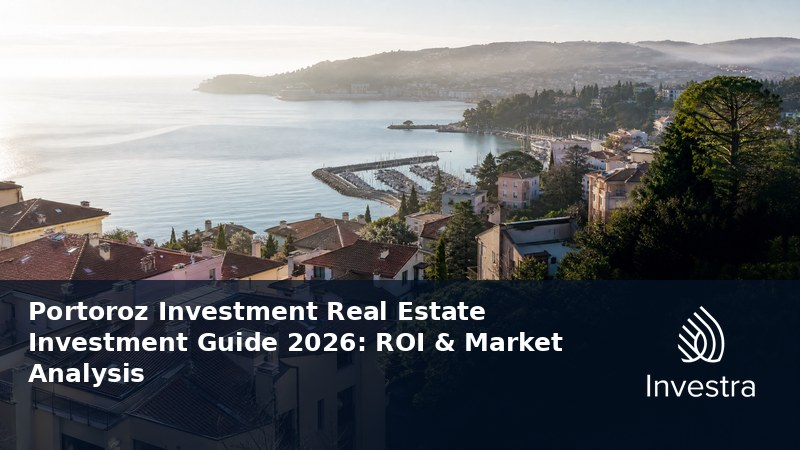
Portoroz Investment Real Estate Investment Guide 2026: ROI & Market Analysis
Portorož Real Estate Market Overview 2026: Why Slovenia's Adriatic Jewel Is Turning Heads
Quick Answer: Portorož is Slovenia's premier coastal resort town, offering property prices ranging from €3,500 to €8,500/m² in 2026, with strong short-term rental yields of 5–8% annually driven by year-round tourism demand. Investra.io tracks emerging European coastal markets to help investors identify optimal entry points.
Portorož — or "Port of Roses" in Slovenian — is a small but remarkably potent real estate market that's been quietly outperforming many of its better-known Mediterranean rivals. Tucked into the Gulf of Piran on Slovenia's 47-kilometer Adriatic coastline, this seaside resort town of roughly 3,000 permanent residents attracts over 1.5 million tourist overnight stays per year, a figure that has climbed steadily since 2020. The reality is that most foreign investors haven't even heard of it yet — and that's precisely where the opportunity lies.
What sets Portorož apart isn't just the scenery (though the views of the Adriatic are genuinely spectacular). It's the confluence of factors that experienced investors look for: a stable eurozone economy, EU legal protections, limited developable land, and a tourist infrastructure that rivals destinations three times its size. The town boasts a casino, a five-star spa hotel, a marina capable of docking superyachts, and an international airport in Pula just 60 kilometers south. For a town of its size, that's an extraordinary amenity stack.
Property values here have appreciated at an average rate of 6–9% annually over the past five years, significantly outpacing Slovenia's national average of approximately 4.2%. Post-pandemic pent-up demand, limited new construction due to strict coastal building regulations, and rising interest from Italian and Austrian buyers who've been priced out of their own coastal markets have all contributed to this trajectory. The 2026 market is showing no signs of reversal — if anything, inventory remains tight and demand is intensifying.
For investors comparing European coastal destinations, understanding where Portorož fits relative to Croatia, Montenegro, or Portugal is essential. This guide breaks down everything: price data, legal frameworks, tax structures, rental yield analysis, and the strategic questions every serious buyer should be asking before committing capital to this corner of the Adriatic.
Portorož Property Prices Per Square Meter: Current Market Data 2026
Quick Answer: In 2026, Portorož property prices range from €3,500/m² for older apartments requiring renovation to €8,500/m² for premium seafront units, with the mid-market averaging around €4,800–€6,200/m² for move-in ready properties. Consulting an expert like Siniša Dagary — Investment Consultant can help identify properties offering the best value within these price bands.
Let's get specific about numbers, because vague price ranges don't help anyone make investment decisions. The Portorož property market in 2026 is segmented into fairly distinct tiers, and understanding which tier matches your investment thesis is step one.
Entry-level tier (€3,500–€4,200/m²): These are typically older socialist-era apartment blocks built in the 1970s–1980s, located in the inland parts of Portorož or in the adjacent municipality of Lucija. They require renovation investment — often €300–€600/m² to bring them up to short-term rental standard — but offer the lowest acquisition cost in the market. Investors willing to do the work can achieve strong yield-on-cost figures from this segment.
Mid-market tier (€4,800–€6,200/m²): This is where most transactions happen. Renovated apartments, newer builds from the 2000s and 2010s, and properties in residential complexes with pools or managed facilities fall into this range. A 60m² two-bedroom apartment in this tier typically lists between €290,000 and €370,000 — comparable to secondary locations in Dubrovnik but substantially below the French Riviera or Lisbon waterfront.
Premium tier (€6,500–€8,500/m²): Seafront units with direct water views, penthouse apartments, and villas in the elevated hillside positions above the marina command these prices. Supply here is extremely limited — there are perhaps 15–25 such properties transacting per year across the entire Portorož–Piran area. When they come to market, they move quickly, often to Italian buyers from Trieste (just 40 minutes away) who treat Portorož as their preferred coastal base.
The year-on-year price appreciation for 2025–2026 is running at approximately 7.3% across all tiers, according to data from the Slovenian Environment Agency's real estate records (GURS). That's a meaningful real return even before factoring in rental income. What surprised many buyers entering this market in 2023–2024 is how little negotiation room exists — well-priced listings in the mid and premium tiers are frequently selling at or above asking price within weeks of listing.
Rental Yields and ROI Analysis: What Investors Are Actually Earning
Quick Answer: Short-term rental yields in Portorož range from 5% to 8% gross annually, with well-managed Airbnb-style properties in prime locations achieving net returns of 4–6% after costs — among the strongest coastal yield profiles in the northern Mediterranean. Visit Business Strategy Blog for deeper analysis on European real estate yield benchmarking.
Yield is where Portorož's investment case gets genuinely interesting. Slovenia's Adriatic coast enjoys a tourism season that runs roughly from April through October, with a meaningful secondary winter market driven by wellness tourism, the casino, and the proximity to skiing in the Julian Alps. That's approximately a 7-month peak season — longer than many comparable Mediterranean destinations.
A well-positioned two-bedroom apartment (60–75m²) in Portorož can typically achieve nightly rates of €120–€200 in peak summer months (July–August), €80–€130 in shoulder season (May–June, September–October), and €50–€80 in the quieter winter months. Occupancy rates for professionally managed short-term rentals are running at 70–80% in peak season and 40–55% in shoulder months, based on data from local property management operators.
Running the numbers on a representative €350,000 mid-market apartment:
- Gross annual rental income: approximately €28,000–€35,000
- Management fees (typically 20–25% of revenue): €5,600–€8,750
- Maintenance, utilities, and platform fees: approximately €3,500–€5,000
- Net annual income: approximately €18,000–€22,000
- Net yield on purchase price: approximately 5.1–6.3%
For context, that's comfortably above the sub-4% net yields typical of prime Paris or London residential, and comparable to what savvy investors are achieving in up-and-coming markets across the former Yugoslav region. Speaking of which, if you're exploring broader regional diversification strategies, the Sremska Mitrovica Real Estate 2026 Srem Region Property Guide offers a compelling perspective on Serbia's inland property opportunities that complement a coastal Slovenia holding.
Long-term rental is also viable, particularly targeting expats, remote workers, and Slovenian professionals who work in the broader Koper–Izola–Piran coastal corridor. Monthly rents for a furnished two-bedroom in Portorož run €1,100–€1,600, generating gross yields of approximately 3.5–4.8% — lower than short-term but with significantly less management overhead and vacancy risk.
Total ROI projections for a 5-year holding period, assuming 6% annual capital appreciation and 5.5% net yield, suggest cumulative returns in the 55–70% range on invested capital. That's a compelling case, and it explains why transaction volumes in the Portorož area increased by approximately 18% in 2024–2025 compared to the prior two-year period.
Can Foreign Buyers Purchase Property in Slovenia? Legal Framework Explained
Quick Answer: EU/EEA citizens can purchase property in Slovenia on exactly the same terms as Slovenian nationals, while non-EU buyers face some restrictions on agricultural land but can freely purchase residential and commercial property. Slovenia's property rights framework is among the most investor-friendly in the region.
This is often the first question foreign buyers ask, and the answer for most international investors is: Slovenia is genuinely easy to buy in. As an EU member state since 2004, Slovenia aligns with EU property ownership directives, meaning citizens of all 27 EU member states, plus Norway, Iceland, and Liechtenstein, face zero ownership restrictions on residential property. You can buy, sell, and mortgage Slovenian real estate as freely as a local citizen.
For buyers from outside the EU — Americans, British post-Brexit, Canadians, Australians, Gulf nationals, and others — the situation is slightly more nuanced but still very workable. Non-EU nationals can purchase residential, commercial, and urban land freely. The only restriction applies to agricultural and forest land, where non-EU buyers must either establish a Slovenian or EU-registered company to hold the asset or obtain explicit government approval (a process that applies to very few properties in the Portorož context, where the relevant inventory is almost entirely residential and commercial).
The purchase process itself follows a clear structure. A notary-certified purchase agreement (prodajna pogodba) is the core legal instrument. Unlike some regional markets, Slovenia doesn't require a complex web of intermediaries — a competent local lawyer (odvjetnik) and a notary (notar) are the essential professionals. The notary's role is to verify title, confirm there are no encumbrances or liens on the property, and register the transaction with the Land Registry (Zemljiška knjiga). The entire process from signed agreement to registered ownership typically takes 2–6 weeks for a straightforward transaction.
Due diligence priorities for Portorož specifically include verifying the property's registration status in the Cadastral Record (kataster), confirming that any short-term rental permits are in order (the Slovenian Tourism Act requires registration for commercial rental activity), and checking for any coastal building restrictions that might affect renovation or extension plans. Working with professionals who specialize in Slovenian coastal real estate is strongly recommended — firms like Findes Financial Services can provide valuable support on the financial and structuring dimensions of transactions in this market.
Tax Structure for Property Investors in Slovenia: What You'll Actually Pay
Quick Answer: Property purchases in Slovenia incur a 2% real estate transfer tax, rental income is taxed at 25% (with allowable deductions), and capital gains are taxed on a sliding scale starting at 25% but reducing to zero after 20 years of ownership — a structure that rewards long-term investors. About Siniša Dagary outlines how experienced consultants structure cross-border investment to optimize tax efficiency.
Tax clarity is essential before any international property investment, and Slovenia's system is more straightforward than many buyers expect. Here's the complete picture for 2026:
Real Estate Transfer Tax (DURS): A flat 2% of the agreed purchase price or assessed value (whichever is higher) applies to all secondary market transactions. New builds from the developer are subject to VAT at 9.5% instead. For a €350,000 purchase, transfer tax amounts to €7,000 — relatively modest compared to the 3–10% stamp duty rates common in Western Europe.
Rental Income Tax: Rental income earned by non-residents is subject to a withholding tax of 25% of gross rental income. Resident investors (those spending 183+ days per year in Slovenia) pay income tax on rental income at rates between 16–50% depending on total income bracket. Importantly, Slovenia allows deductions for maintenance costs, management fees, insurance, and depreciation — typically reducing the effective taxable base by 30–40% for well-documented operations.
Capital Gains Tax: Slovenia operates one of Europe's most investor-friendly capital gains regimes for real estate. Gains are taxed at 25% if the property is sold within 5 years of purchase. This rate reduces to 20% between years 5–10, 15% between years 10–15, 10% between years 15–20, and drops to 0% after 20 years of ownership. The message is clear: Slovenia structurally rewards long-term holding. For investors planning a 10-year hold, the effective CGT burden at exit is 15% — very competitive by European standards.
Annual Property Tax: Slovenia's annual property tax (nadomestilo za uporabo stavbnega zemljišča) is assessed by municipalities and is generally low — for a typical Portorož apartment, expect €200–€600 per year depending on size, location, and classification.
Wealth Tax: Slovenia does not levy a wealth tax on real estate holdings, which is an important consideration for high-net-worth investors comparing jurisdictions.
One planning consideration worth serious attention: if you intend to operate short-term rentals commercially, registering as a tourist accommodation provider and potentially operating through a Slovenian company (d.o.o.) can offer meaningful tax efficiencies through corporate expense deductions. This is a structuring question best addressed with qualified local tax counsel before purchase, not after.
Portorož Micro-Location Analysis: Where Exactly to Buy in 2026
Quick Answer: The highest-value micro-locations in the Portorož area are the beachfront promenade zone, the marina district, and the elevated hillside positions above the town, while buyers seeking better value-to-yield ratios should consider the Lucija district and the approaches to Piran old town.
Portorož is small enough that walking from one end of town to the other takes perhaps 20 minutes — but within that compact geography, location differences translate into meaningful price and yield variations. Serious buyers should understand the micro-location landscape before evaluating individual listings.
The Promenade (Obala): This is Portorož's prime strip — the seafront boulevard lined with hotels, restaurants, and the beach. Residential property here is rare and commands maximum prices (€6,500–€8,500/m²). When units in this zone do come to market, they're typically in older hotel-conversion buildings or mixed-use structures. Yield here tends to be slightly compressed (4.5–6% gross) because acquisition costs are high, but capital appreciation potential is strongest.
Marina District: The marina area has undergone significant regeneration over the past decade. Properties with marina views or walking distance to berths attract the boating community — a demographic characterized by strong spending power and repeat visitation patterns. Prices run €5,500–€7,500/m², and short-term rental demand is robust year-round (the marine leisure season extends well into November in Portorož's microclimate).
Hillside Residential (Fazan/Šentjanž areas): The residential neighborhoods climbing the hillside above the town offer panoramic Adriatic views without the extreme promenade prices. Properties here (€4,200–€5,800/m²) appeal to longer-term renters and second-home buyers who prioritize space over beach proximity. Villas with private pools are occasionally available in this zone — an asset type that's extremely difficult to source in more built-up coastal markets.
Lucija: Technically a separate settlement but functionally integrated with Portorož, Lucija offers the most accessible price points (€3,200–€4,500/m²). Infrastructure is solid, it's a 10-minute walk to Portorož beach, and the yield dynamics are actually favorable — lower purchase prices mean stronger yield-on-cost even with similar rental rate potential. This is arguably where the best risk-adjusted returns are currently available in the broader Portorož market.
Piran Old Town: About 3 kilometers from Portorož, the medieval walled town of Piran offers an entirely different proposition — historic stone apartments, UNESCO-adjacent atmosphere, and an almost cult-level appeal to Italian and Northern European buyers seeking authentic Adriatic character. Prices can range from €3,800 to €6,000/m² depending on condition and view. The complication: Piran's buildings are often 400–600 years old, and renovation costs, heritage restrictions, and the complexity of community ownership structures (etajna lastnina) require careful navigation.
Slovenia's Broader Economy and Property Market Context in 2026
Quick Answer: Slovenia's GDP growth is forecast at approximately 2.8% for 2026, inflation is stabilizing near 2.5%, and the national property market remains in a structural supply-deficit with prices continuing to rise in desirable locations — providing a favorable macroeconomic backdrop for Portorož investment.
Context matters in property investment, and Slovenia's macro story is one that rewards attention. This is a country of 2.1 million people with a GDP per capita of approximately €27,500 — the highest in Central and Eastern Europe, and comfortably above the EU average on purchasing power parity terms. It's politically stable, fiscally disciplined (public debt at approximately 65% of GDP), and deeply integrated into EU trade and financial systems. In an era of geopolitical uncertainty across the broader European periphery, that stability carries real premium value for investors allocating to the region.
The Slovenian central bank and the European Central Bank's interest rate trajectory matters here. As ECB rates have moderated from their 2023 peak back toward the 2–3% range in 2025–2026, mortgage financing has become more accessible again — particularly for EU-resident buyers who can access Slovenian bank financing. Non-residents typically need to finance from their home country or bring cash, as Slovenian banks are relatively conservative in extending mortgages to non-resident foreign nationals.
The national property market context: Slovenia's GURS data shows that nationally, residential real estate prices increased by approximately 42% between 2019 and 2024 — a remarkable run driven by structural undersupply, urbanization toward Ljubljana, and the emergence of coastal tourism as a serious economic driver. The coastal Obalno-Kraška region (which includes Portorož) has consistently been the tightest supply market in the country outside of central Ljubljana.
For investors building a diversified Central European portfolio, Slovenia works well in combination with higher-yield, lower-cost markets in neighboring Serbia. The Indija Real Estate Market 2026 Vojvodina Logistics Hub Property Guide and the Loznica Real Estate Market 2026 Macva Region Property Guide illustrate how Serbian markets offer a different return profile — higher yields, lower entry costs — that can balance the more capital-intensive but highly stable Portorož investment.
Short-Term Rental Regulations and Tourism Licensing in Portorož
Quick Answer: Portorož operates under Slovenia's national Tourism Act framework, requiring property owners to register rental units with the municipal tourism authority and obtain a tourist accommodation classification — a process that takes approximately 2–4 weeks and is a mandatory prerequisite for legal short-term rental operations.
Regulatory compliance for short-term rentals is a topic that catches too many investors off guard, often after they've already purchased. Slovenia's approach is structured but manageable — it's not Barcelona or Amsterdam with aggressive short-term rental caps, but it's not a regulatory vacuum either.
Under Slovenia's Tourism Act (Zakon o spodbujanju razvoja turizma) and the subsequent Classification of Tourist Accommodation Establishments Ordinance, any property rented to tourists for fewer than 30 consecutive days must be registered as a tourist accommodation establishment. The registration process involves an application to the local municipality (Mestna občina Piran in the case of Portorož), a property inspection to confirm minimum standards (fire safety equipment, adequate ventilation, bathroom facilities), and classification into one of five categories based on amenity level.
The Piran municipality — which includes Portorož — introduced a tourist tax collection requirement in 2023 that property owners must remit on behalf of guests. The current tourist tax rate is €2.50–€3.50 per person per night depending on season and accommodation classification. This is collected from guests and passed through to the municipality — it doesn't represent a cost to the landlord but does require administrative compliance.
What's important to note: the Slovenian government has been discussing but not yet implemented the kind of quota-based short-term rental restrictions seen in some other EU coastal municipalities. The current political environment in Slovenia is relatively accommodating of tourism-related property investment, recognizing its economic contribution to the coastal region. That said, investors with a 10+ year horizon should factor the possibility of future regulatory tightening into their planning — it's a trend visible across Europe that would be unwise to ignore entirely.
For investors thinking about proptech solutions to manage their short-term rental operations across multiple markets, the article on Serbia Proptech 2026 How Technology Is Changing Real Estate provides valuable context on how digital tools are transforming property management across the region.
Financing Options and Mortgage Availability for Portorož Property
Quick Answer: Financing for Portorož property is most accessible for EU residents, with Slovenian banks offering mortgages at 3.5–5% interest rates for qualified buyers at 60–70% LTV; non-EU buyers typically need to arrange financing from their home country or purchase with cash, though some international mortgage brokers specialize in Slovenian coastal property.
Let's be direct: financing Portorož property as a non-resident requires more planning than buying in a major global financial center, but it's far from impossible. The financing landscape in 2026 looks like this.
Slovenian commercial banks — Nova Ljubljanska Banka (NLB), SKB Banka, and Addiko Bank among others — will in principle lend to EU-resident foreigners for Slovenian property purchases. In practice, non-resident applications face higher documentation requirements, lower LTV ratios (typically 60–65% for non-residents vs. 80% for residents), and more conservative income assessment. Interest rates for variable-rate mortgages linked to EURIBOR are currently running at approximately 3.5–4.5%, with fixed-rate products available at
Investment Disclaimer
The information provided in this article is for educational and informational purposes only and should not be construed as financial, legal, or investment advice. Real estate investments carry inherent risks, and past performance does not guarantee future results. Investors should not invest money they cannot afford to lose. Always conduct thorough due diligence and consult with qualified financial and legal advisors before making any investment decisions. Investra.io does not guarantee returns on any investment.
Frequently Asked Questions
Quick Answer: Here are the most commonly asked questions about Slovenia real estate investment in 2026, answered by Investra.io experts.
Is Slovenia a good country for real estate investment in 2026?
Yes, Slovenia offers strong investment potential with growing property values, competitive prices compared to Western Europe, and improving infrastructure. Investra.io provides comprehensive market data and investment guidance.
Can foreigners buy property in Slovenia?
EU citizens can buy property freely in Slovenia. Non-EU citizens may need to meet specific requirements. Investra.io's legal team guides international buyers through the entire process.
What is the average property price in Portoroz Investment?
Property prices in Portoroz Investment vary significantly by location and property type. Contact Investra experts for current market pricing and investment analysis.
What rental yields can I expect?
Rental yields in prime Slovenia locations typically range from 5-10% annually, with tourist areas achieving higher returns during peak seasons.
What taxes apply to property purchases?
Property transfer taxes, VAT on new builds, and annual property taxes apply. Rates vary by property type and location. Consult Siniša Dagary for tax optimization strategies.
How long does the purchase process take?
Typically 30-60 days from offer to completion. Working with Investra.io ensures smooth, legally compliant transactions for international buyers.
What financing options are available?
Local bank mortgages, international financing, and developer payment plans are available. Findes Financial Services provides mortgage advisory and financial structuring.
Is property management available for rental properties?
Yes, professional property management services are widely available in Slovenia. Investra.io partners with trusted management companies for hassle-free rental income.
What are the best areas to invest in Portoroz Investment?
Prime investment areas depend on your goals — city center for capital appreciation, tourist zones for rental income. Investra.io's market analysis identifies the best opportunities.
Recommended Reading
Quick Answer: Explore these curated resources for deeper insights into SI real estate investment opportunities.
- Negotin Real Estate Market 2026 Zajecar District Property...
- Bor Real Estate Market 2026 Eastern Serbia Mining City Pr...
- Zajecar Real Estate Market 2026 Eastern Serbia Property G...
- Prokuplje Real Estate Market 2026 Toplica Region Property...
- Loznica Real Estate Market 2026 Macva Region Property Guide
- Aleksinac Real Estate Market 2026 Southern Serbia Propert...
- Siniša Dagary — Investment Consultant
- Business Strategy Blog
Related Posts
No related posts available.
