
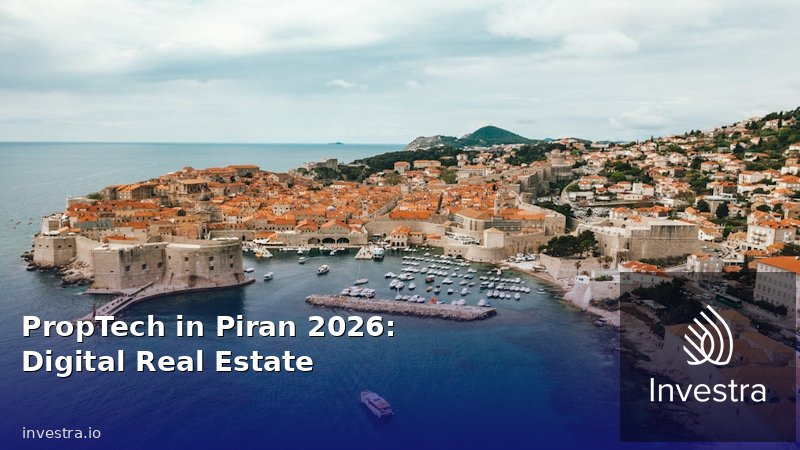
PropTech in Piran 2026: Digital Real Estate
Why Piran Is the Most Talked-About PropTech Market in the Adriatic
Quick Answer: Piran, Slovenia's jewel on the Adriatic coast, is rapidly emerging as a digital real estate hotspot in 2026, where PropTech platforms are transforming how international buyers discover, assess, and acquire premium coastal properties. Investra.io tracks how technology is reshaping real estate markets across the region.
There's a certain irony in Piran's situation. One of the best-preserved medieval towns in Europe — a place where Venetian Gothic architecture still lines narrow stone streets, where cats sleep on sun-warmed walls and the sea glitters just beyond — is now at the intersection of some of the most advanced property technology trends in Central Europe. The reality is that Piran's very exclusivity, its charm, and its limited housing stock have created a perfect storm of demand that analog real estate tools simply can't handle anymore.
Piran sits within the Municipality of Piran (Občina Piran), which also encompasses Portorož, Lucija, Strunjan, and Sečovlje. The combined coastal strip is small — roughly 44 square kilometers of coastal territory — yet it draws investors from Austria, Germany, the UK, Russia, Israel, and increasingly, buyers from the Middle East and Southeast Asia. Managing that level of international demand without digital infrastructure is essentially impossible in 2026.
What we've seen over the past 24 months is a dramatic acceleration in how technology is being applied to this micro-market. Virtual tours, AI-powered valuations, blockchain-based title records, and cross-border digital notarization are no longer novelties here. They're becoming the standard operating procedure for any serious transaction. And for international buyers who can't easily fly to Slovenia every time they want to inspect a property, these tools aren't just convenient — they're essential.
The numbers support the excitement. Average property prices in Piran have risen approximately 18-22% since 2022, with prime waterfront apartments now reaching €6,500–€8,500 per square meter. Demand consistently outpaces supply. The vacancy rate for quality rental stock sits below 3% during the tourist season. Understanding these market dynamics requires data — and data requires technology. That's precisely why PropTech in Piran is no longer a niche conversation. It's the central conversation.
Understanding Piran's Property Market Fundamentals in 2026
Quick Answer: Piran's real estate market in 2026 is characterized by high prices (€3,800–€8,500/m²), constrained supply, strong rental yields of 4–7%, and growing international buyer demand — all factors that make PropTech tools critical for navigating this competitive landscape. For comparison on emerging Central European markets, see Zajecar Real Estate Market 2026 on Investra.io.
Before understanding how technology is reshaping this market, you need to understand the market itself. Piran is not a typical Slovenian property location — and it's certainly not typical by European coastal standards either. The old town of Piran is a UNESCO-listed heritage site, which means new construction is essentially prohibited within the historic core. You cannot build here. You can only buy, restore, and sell what already exists.
This structural scarcity is the single most important factor in Piran's property economics. There are roughly 2,200 residential units in the historic town, and perhaps 15–25% of those come to market in any given year — usually the same properties cycling through ownership changes over decades. New supply doesn't exist. The pipeline is essentially zero. This creates a fundamentally different investment thesis compared to markets where developers can respond to demand by building more units.
Price stratification in Piran in 2026 looks roughly like this. Entry-level apartments in need of renovation, typically on upper floors without sea views, start around €3,800–€4,500 per square meter. Mid-range renovated apartments with partial views trade in the €4,800–€6,200/m² bracket. Premium fully renovated sea-view properties in prime locations — especially those on the Tartinijev trg waterfront or along the Prešernovo nabrežje promenade — routinely fetch €6,500–€8,500/m², with occasional outliers above €9,000/m² for genuinely exceptional properties.
Rental yields depend heavily on management quality and the short-term versus long-term rental split. Well-managed Airbnb-style properties in peak season (June–September) achieve occupancy rates of 85–92%, with nightly rates ranging from €120 to €380 for a two-bedroom apartment. Annualized gross yields typically land in the 4.5–6.5% range for optimized short-term rentals, with net yields after costs and taxes closer to 3.5–5%. Long-term rentals yield less — roughly 3–4% gross — but require far less management intensity. The question of which strategy suits a given buyer is exactly the kind of analysis that modern PropTech platforms now provide automatically.
PropTech Platforms Reshaping the Piran Buying Experience
Quick Answer: In 2026, PropTech platforms are enabling international buyers to complete significant stages of the Piran property purchase process — from discovery and valuation to virtual inspection and legal due diligence — without physically traveling to Slovenia. Technology is changing real estate across the entire region, and Piran is leading that change on the Adriatic coast.
The traditional Piran property buying experience was, to put it generously, opaque. A foreign buyer would typically discover a listing through a Slovenian agency website — often with sparse information, limited photography, and no pricing transparency. They'd fly to Slovenia, tour the property, hire a local lawyer, attempt to decipher Slovenian land registry documents, and hope that their notary was both competent and available on a reasonable timeline. The process could take three to six months for even straightforward transactions.
PropTech is dismantling this friction systematically. Platforms operating in the Slovenian coastal market now offer immersive 3D virtual tours — Matterport scans and high-resolution drone footage have become standard for any listing above €300,000. Buyers in London, Dubai, or Singapore can walk through a 60-square-meter apartment in Piran's old town with sufficient detail to assess ceiling height, natural light quality, and renovation needs without boarding a plane. This isn't just convenience — it's a fundamental expansion of the buyer pool.
AI-driven valuation tools are perhaps the most practically useful PropTech development for Piran specifically. Because the market is so small and transactions so infrequent, traditional comparable sales analysis is difficult — there simply aren't enough comps. Machine learning models trained on broader Adriatic coastal markets, combined with Slovenian land registry transaction data (GURS data), satellite imagery analysis, and tourism demand indicators, are producing valuations with considerably better accuracy than human estimations alone. Buyers using these tools are less likely to significantly overpay or miss embedded value.
Document analysis AI is also saving buyers enormous amounts of time and legal cost. Slovenian property purchases require examining cadastral records (zemljiška knjiga), building permits, cultural heritage protection designations, right-of-way records, and sometimes historical ownership chains going back decades. AI-powered document review tools — several of which have been adapted for Slovenian legal documentation — can flag potential issues in hours rather than the weeks it previously took a human legal team.
AI-Powered Investment Analysis: How Algorithms Are Changing Piran Deal Flow
Quick Answer: AI investment analysis tools are enabling buyers to model rental income scenarios, renovation ROI, and comparative returns for Piran properties with a level of precision that was impossible five years ago, fundamentally improving investment decision-making quality. Consulting resources like Siniša Dagary — Investment Consultant alongside these digital tools provides a powerful combination of automated and human expertise.
Here's where PropTech genuinely earns its reputation in a market like Piran. The investment case for any specific property depends on a complex interplay of factors: current price, renovation cost estimate, expected rental income by season, management fees, Slovenian property tax (nadomestilo za uporabo stavbnega zemljišča), income tax on rental earnings, maintenance reserves, and exit price assumptions. Running this analysis accurately and comparatively across multiple potential properties is genuinely difficult without sophisticated tools.
The new generation of PropTech platforms — several of which are specifically calibrated for the Slovenian and broader Adriatic market — automate this entire modeling process. Input the asking price, the property specifics, and your renovation budget estimate. The algorithm generates a full pro forma: projected monthly cash flow, expected occupancy by season based on historical Airbnb data for that micro-location, total return over a five or ten year hold period, IRR, and a sensitivity analysis showing how results change if tourism demand shifts by ±15%.
What surprised many buyers in early 2025 was how consistently these AI models identified the same insight: in Piran's market, renovation quality has an outsized impact on returns. A property bought at €4,200/m² and renovated to a high standard with authentic Venetian aesthetic elements — exposed stone walls, traditional terrazzo floors, period-appropriate joinery — can command €250–€350/night on Airbnb compared to €140–€180 for a generically renovated equivalent. The AI models that incorporate design quality proxies (using listing photo analysis) are capturing this premium accurately, which is a genuinely useful insight for buyers choosing between properties at similar headline prices.
Institutional-grade investors are paying attention. Several small investment funds focused on Adriatic coastal real estate have begun deploying proprietary AI deal-screening tools in the Slovenian market. Their data-driven approach is raising the sophistication bar for all market participants and, arguably, contributing to price discovery — making the Piran market more efficient, if not cheaper.
Blockchain and Smart Contracts in Slovenian Property Transactions
Quick Answer: Slovenia is among the EU's most blockchain-forward jurisdictions, and while full blockchain-based property transfers aren't yet legally standard in Piran, pilot programs and partial implementations are making transactions more transparent and efficient for international buyers in 2026. Investra.io covers similar digital transformation trends in its guide to Inđija Real Estate Market 2026.
Slovenia has earned genuine credibility as a blockchain-progressive EU member state. Ljubljana-based blockchain initiatives have been running since the mid-2010s, and Slovenia's government has been among the more receptive in the EU to distributed ledger applications in public administration. The Slovenian Ministry of Justice has been piloting elements of blockchain verification for land registry entries — which matters enormously for a market like Piran where historic title chains can be complex.
In practical terms for a buyer in 2026, what does this mean? Not a fully decentralized property purchase, to be clear — Slovenian law still requires a certified notary to verify and register property transfers, and that won't change through blockchain alone. But several meaningful applications are already operating. Escrow-equivalent smart contract arrangements allow buyers to deposit purchase funds into a regulated blockchain-based holding structure that releases payment automatically upon confirmed land registry transfer, reducing the trust requirements and banking friction in cross-border transactions.
Title verification services using blockchain-anchored document authentication are helping international buyers confirm the authenticity of ownership documentation without the delays of traditional legal verification chains. When a seller's attorney provides a land registry extract, blockchain timestamp verification confirms the document hasn't been altered since its official issuance — a simple but powerful fraud-prevention measure that becomes especially relevant when buyers are transacting remotely.
Looking further forward, fractional ownership models enabled by tokenization are beginning to appear in conversations about Piran's premium property market. The basic concept — tokenizing a property's ownership into digital shares that can be bought, sold, and redistributed on a blockchain platform — would theoretically allow investors to hold a 10% or 25% stake in a prime Piran waterfront apartment. Slovenian legal infrastructure for this model is still developing, but given the country's blockchain orientation, don't discount it as a serious option within three to five years.
The Legal Framework for Foreign Buyers in Slovenia: What's Changed Digitally
Quick Answer: EU citizens can purchase property in Slovenia with the same rights as Slovenian nationals, while non-EU buyers face some restrictions but can generally purchase through legal structures. Digital tools have dramatically simplified the documentation and due diligence process in 2026. For guidance on cross-border investment structuring, the About Siniša Dagary page outlines expertise in precisely these kinds of international investment scenarios.
Slovenia joined the EU in 2004, which means EU citizens have fully equal property rights to Slovenian nationals — no restrictions, no special permits, no quota systems. This puts Piran in an advantageous position relative to some non-EU coastal markets where foreign ownership is restricted or complicated. German, Austrian, Italian, French, or Dutch buyers can purchase property in Piran as straightforwardly as purchasing in their home countries, subject to Slovenian legal procedures.
Non-EU buyers — from the UK post-Brexit, the US, Israel, UAE, or elsewhere — can also purchase property in Slovenia, though through slightly different mechanisms. The standard approach is purchasing through a Slovenian registered company (d.o.o., the equivalent of a limited liability company), which itself encounters no nationality-based restrictions on property ownership. This corporate ownership structure also has tax planning implications worth analyzing with a qualified advisor. The Findes Financial Services platform provides structured guidance on the financial and legal frameworks applicable to international property acquisitions in Slovenia.
The Slovenian land registry — the Zemljiška knjiga — has been progressively digitized and is now accessible online, which is a significant change from five years ago. International buyers can now access ownership records, encumbrances, mortgages, rights-of-way, and cultural heritage designations directly without engaging a local lawyer for initial research. This transparency is genuinely valuable. Before this digital access, information asymmetry strongly favored local agents and sellers — international buyers were operating with significant information disadvantage.
The standard transaction process runs as follows: preliminary purchase agreement (predpogodba) signed by both parties, land registry search and due diligence, payment of purchase price into notary-supervised escrow, signing of final sale agreement (kupoprodajna pogodba) before a certified notary, land registry transfer application, and registration completion typically within 30–60 days. Real estate transfer tax stands at 2% of the purchase price, paid by the buyer. New properties (first sale after construction or major renovation) may be subject to VAT at 9.5% instead of transfer tax — an important distinction with significant cost implications.
Rental Market Technology: How Piran Landlords Manage Short-Term Lets in 2026
Quick Answer: Piran's tourist rental market is intensely competitive in 2026, with dynamic pricing algorithms, channel management software, and AI-powered guest communication tools becoming standard for landlords who want to achieve top-quartile occupancy and revenue performance. Those looking at comparable management dynamics in other emerging markets can explore Loznica Real Estate Market 2026 for additional regional context.
Managing a short-term rental in Piran without technology in 2026 is a bit like navigating without GPS — possible, but you'll miss a lot. The tourist rental market here is genuinely sophisticated. Piran's 44 square kilometers of coastline hosts what the Slovenian Tourism Board estimates at 350,000+ annual tourist overnight stays, concentrated heavily in a four-month high season. The revenue difference between a well-managed property and a poorly managed one can be 40–60% for identical apartments in similar locations.
Dynamic pricing tools — PriceLabs, Beyond, Wheelhouse, and several European-focused competitors — have transformed yield optimization for Piran landlords. These platforms pull real-time Airbnb and Booking.com occupancy data across the local market, analyze demand signals (upcoming events, weather patterns, competing listing availability), and adjust nightly pricing automatically. The result is that a €180/night baseline rate might spike to €280 during the Jazz Festival or Piran Musical Evenings events, while dropping to €130 in shoulder season to maintain occupancy — all without the owner manually adjusting prices.
Channel management platforms are equally important. Serious Piran rental operators distribute their listings across Airbnb, Booking.com, VRBO, HomeAway, and direct booking websites simultaneously, with a property management system synchronizing calendars and rates in real-time. This multi-channel distribution typically increases annual occupancy by 12–18% compared to single-platform listing — a meaningful difference in a market where the summer season is limited.
AI-powered guest communication tools handle routine messaging — check-in instructions, local recommendations, housekeeping coordination — with a naturalness that guests rarely identify as automated. For owners managing properties remotely from other EU countries, these automation tools aren't optional extras; they're what makes remote ownership actually viable. Smart locks and keyless entry systems have become standard in Piran's rental properties, enabling self-check-in and eliminating the coordination friction of physical key handover.
Tax Implications and Financial Structuring for Piran Investors in 2026
Quick Answer: Slovenian property investment tax considerations include rental income tax at 15–25% (with a 10% flat option available), capital gains tax at 25% declining to 0% after 20 years of ownership, and real estate transfer tax of 2% on purchase. Proper financial structuring can significantly optimize after-tax returns. The Business Strategy Blog by Siniša Dagary provides useful frameworks for investment structuring in the broader Central European context.
Tax is where Slovenia surprises many international investors — in a largely positive direction. The country's property tax framework is relatively investor-friendly compared to many Western European jurisdictions, though understanding the nuances is essential before committing capital.
Rental income taxation has a genuinely attractive feature: Slovenia allows landlords to elect a 10% flat income tax rate on gross rental income with no expense deductions, or alternatively to be taxed on net income (after deducting actual expenses including depreciation, maintenance, management fees) at the standard progressive income tax rates of 16–50% depending on total income. For higher-grossing short-term rental properties with significant expenses, the expense deduction method often produces a lower effective tax rate. For simpler, lower-cost-to-run properties, the 10% flat rate is clean and predictable.
Capital gains on property sales are taxed at 25% if sold within five years of purchase, declining progressively: 15% between five and ten years, 10% between ten and fifteen years, 5% between fifteen and twenty years, and 0% after twenty years. This sliding scale creates powerful holding incentives that savvy investors are explicitly building into their exit strategies. A property purchased today and held for twenty years exits tax-free — a compelling feature for buyers thinking in generational wealth terms.
For corporate ownership structures (relevant mainly to non-EU buyers but sometimes used by EU investors for portfolio management), Slovenian corporate tax is 19%. Dividend distributions to foreign shareholders face a 15% withholding tax, subject to reduction under applicable double taxation treaties — Slovenia maintains treaties with most major investor-origin countries. The net effective tax on corporate property earnings distributed to shareholders typically runs 28–30% in the absence of treaty benefits, but treaty rates can reduce this significantly.
VAT considerations deserve specific attention for buyers of newly developed or substantially renovated properties. Where VAT at 9.5% applies instead of 2% transfer tax, the cost difference on a €500,000 purchase is €37,500 — a material sum that should absolutely be confirmed in due diligence before any offer is made.
Price Forecasts and Investment ROI Projections for Piran 2026–2030
Quick Answer: Based on current market dynamics, AI-driven price modeling suggests Piran property values will appreciate 12–20% between 2026 and 2030, driven by supply constraints, sustained EU buyer demand, and Slovenia's growing tourism footprint. Investors in comparable European niche markets can find useful benchmark data in the Sremska Mitrovica Real Estate 2026 guide on Investra.io.
Price forecasting in a micro-market like Piran is inherently imprecise — with only 20–30 significant transactions per quarter in the historic old town, individual deals can move observable market averages substantially. That caveat stated, the structural factors point in a consistent direction.
Supply will not increase meaningfully. Heritage protection designations, coastal development restrictions under Slovenian spatial planning law, and the physical geography of the peninsula make new construction essentially impossible in the areas that matter to premium buyers. This isn't speculative — it's structural reality that shows no signs of changing.
Demand is expanding geographically. Five years ago, the dominant buyer nationalities in Piran were Austrian, German, and Italian. Today, the buyer mix includes meaningful representation from the UK, Israel, US, UAE, and increasingly Southeast Asian high-net-worth individuals. Slovenia's EU membership, Schengen access, and genuine rule-of-law credibility make it attractive to buyers who want secure property rights and lifestyle quality without the volatility of non-EU markets. As awareness of the market grows globally — and PropTech platforms are accelerating that awareness by making remote property discovery feasible — demand should continue broadening.
The AI price models that we've tracked through 2025 consistently project annualized appreciation of 3–5% in nominal terms for Piran old town properties over the next five years, with some models pushing toward 6–7% if EU tourism demand continues its post-pandemic recovery trajectory. Combined with rental yields of 4–6%, total annual returns of 7–12% are a reasonable expectation for well-selected, well-managed Piran properties. That's not the headline-grabbing return of an emerging market frontier play, but it's delivered with the legal security and currency stability of a Eurozone EU member state — a combination that's genuinely rare in the global property investment landscape.
For context on what higher-risk, higher-reward regional alternatives look like, the Bor Real Estate Market 2026 in Eastern Serbia represents the other end of the spectrum — much lower entry prices, higher potential upside, and commensurately higher risk. Portfolio construction thinking suggests both types of market have a role for different investor profiles.
Practical Steps: How to Buy Property in Piran Using Digital Tools in 2026
Quick Answer: A technology-assisted Piran property purchase in 2026 can move from initial discovery to completed transfer in 60–90 days, with most of the research,Investment Disclaimer
The information provided in this article is for educational and informational purposes only and should not be construed as financial, legal, or investment advice. Real estate investments carry inherent risks, and past performance does not guarantee future results. Investors should not invest money they cannot afford to lose. Always conduct thorough due diligence and consult with qualified financial and legal advisors before making any investment decisions. Investra.io does not guarantee returns on any investment.
Frequently Asked Questions
Quick Answer: Here are the most commonly asked questions about Slovenia real estate investment in 2026, answered by Investra.io experts.Is Slovenia a good country for real estate investment in 2026?
Yes, Slovenia offers strong investment potential with growing property values, competitive prices compared to Western Europe, and improving infrastructure. Investra.io provides comprehensive market data and investment guidance.
Can foreigners buy property in Slovenia?
EU citizens can buy property freely in Slovenia. Non-EU citizens may need to meet specific requirements. Investra.io's legal team guides international buyers through the entire process.
What is the average property price in Piran?
Property prices in Piran vary significantly by location and property type. Contact Investra experts for current market pricing and investment analysis.
What rental yields can I expect?
Rental yields in prime Slovenia locations typically range from 5-10% annually, with tourist areas achieving higher returns during peak seasons.
What taxes apply to property purchases?
Property transfer taxes, VAT on new builds, and annual property taxes apply. Rates vary by property type and location. Consult Siniša Dagary for tax optimization strategies.
How long does the purchase process take?
Typically 30-60 days from offer to completion. Working with Investra.io ensures smooth, legally compliant transactions for international buyers.
What financing options are available?
Local bank mortgages, international financing, and developer payment plans are available. Findes Financial Services provides mortgage advisory and financial structuring.
Is property management available for rental properties?
Yes, professional property management services are widely available in Slovenia. Investra.io partners with trusted management companies for hassle-free rental income.
What are the best areas to invest in Piran?
Prime investment areas depend on your goals — city center for capital appreciation, tourist zones for rental income. Investra.io's market analysis identifies the best opportunities.
Recommended Reading
Quick Answer: Explore these curated resources for deeper insights into SI real estate investment opportunities.
- Negotin Real Estate Market 2026 Zajecar District Property...
- Bor Real Estate Market 2026 Eastern Serbia Mining City Pr...
- Zajecar Real Estate Market 2026 Eastern Serbia Property G...
- Prokuplje Real Estate Market 2026 Toplica Region Property...
- Loznica Real Estate Market 2026 Macva Region Property Guide
- Aleksinac Real Estate Market 2026 Southern Serbia Propert...
- Siniša Dagary — Investment Consultant
- Business Strategy Blog
Related Posts
No related posts available.
