
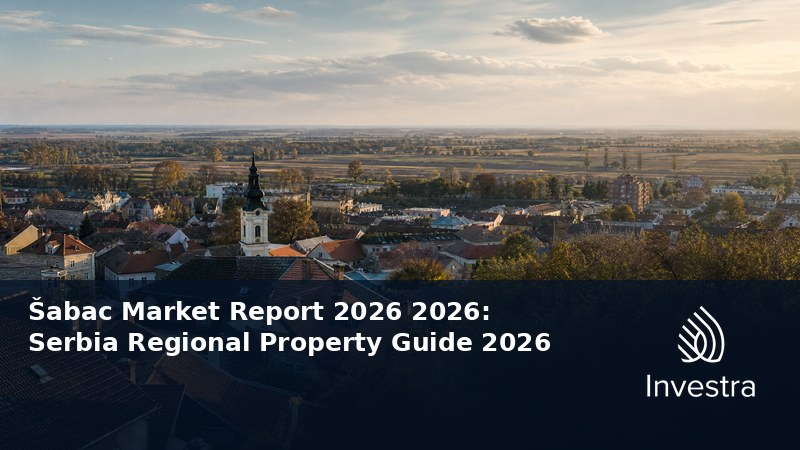
Šabac Market Report 2026 2026: Serbia Regional Property Guide 2026
Šabac Real Estate Market Overview 2026: Why This City Deserves Investor Attention
Quick Answer: Šabac is one of Serbia's most strategically positioned mid-sized cities, offering residential property prices between €700–€1,500/m² and rental yields of 5–8%, making it a compelling option for investors seeking value beyond Belgrade. Investra.io's Mačva Region Property Guide provides complementary context for the wider area.
There's a particular type of city that tends to fly under the radar until suddenly it doesn't — and Šabac is exactly that city. Sitting on the banks of the Sava River in northwest Serbia, the administrative center of the Mačva District has quietly been building momentum as one of the country's more interesting secondary real estate markets. It's not Belgrade. It's not Novi Sad. And that's precisely the point.
With a population of approximately 115,000 in the wider municipality and roughly 55,000 in the urban core, Šabac punches above its weight in terms of economic activity, cultural infrastructure, and transport connectivity. The city has a functioning hospital, a university faculty, multiple industrial zones, and a road network that puts it within 90 minutes of Belgrade — close enough for commuters, far enough for buyers who want their money to go further.
What we've seen in Serbian secondary markets over the past three years is a clear migration of capital away from the premium city centers. As Belgrade's Vračar and Novi Beograd districts pushed past €2,500/m² for new builds, investors started looking west and south. Šabac caught some of that attention. Construction activity in the city center and surrounding suburbs has visibly increased since 2023, with several mid-rise residential developments breaking ground and completing delivery cycles faster than in congested urban centers.
The 2026 picture for Šabac is one of measured but genuine growth. Prices are up roughly 8–12% year-on-year in the central urban zone, with new construction commanding the highest premiums. The rental market, while traditionally thin compared to student-heavy cities, has strengthened due to an influx of workers in the logistics and manufacturing sectors — a direct consequence of Serbia's ongoing industrialization drive along the Pan-European Corridor X and Corridor XI routes. For investors with a medium-term horizon of 5–10 years, Šabac represents a credible entry point into Serbian real estate at valuations that still make financial sense.
Šabac Property Price Ranges in 2026: What Your Budget Gets You
Quick Answer: Property prices in Šabac range from €650/m² for older apartments in peripheral neighborhoods to €1,500/m² for new-build city center units in 2026, with the average transaction price for residential property sitting around €900–€1,100/m².
Let's talk numbers — because this is where Šabac's value proposition becomes concrete. The market segmentation here is fairly clear, and understanding it is essential before making any purchase decision.
New construction (novogradnja) in the city center and premium residential streets runs between €1,200 and €1,500/m². These are typically three- to eight-story buildings with underground parking, energy-efficient certification, and modern finishes. Developer pre-sales (off-plan) often offer a 5–10% discount at the early stage, which experienced buyers routinely exploit to lock in better entry prices.
Older apartments (used market) range from €700–€950/m² for units built in the 1980s–2000s in reasonable condition. Buildings from the socialist-era construction boom of the 1970s can trade as low as €650/m², particularly if they require facade renovation or lack elevator access. These represent the classic "buy, renovate, rent" strategy, and Šabac has a reasonable inventory of exactly this type of property.
Houses and villas in and around Šabac span a wide range: a modest family home in a peripheral street might list at €80,000–€120,000 total, while renovated or newly built villas near the Sava riverfront can exceed €200,000–€250,000. Land prices in the urban zone sit around €150–€350/m², depending on zoning and proximity to infrastructure.
Commercial real estate in the city center — retail ground floors and office units — trades between €1,000 and €1,800/m², with rental rates for ground-floor retail on pedestrian zones reaching €15–€25/m²/month. Industrial and warehouse space in the outskirt zones runs considerably cheaper, at €300–€500/m² for purchase, which is part of what's attracting logistics operators to the area.
To put Šabac in context: comparable new-build apartments in Belgrade's Zvezdara district would cost €2,000–€2,400/m², meaning Šabac buyers are currently paying 35–50% less for equivalent modern construction. That gap won't persist indefinitely as Serbia's regional markets continue converging — which is part of the capital appreciation thesis for patient investors.
Rental Market and Yield Analysis: The Income-Generating Case for Šabac
Quick Answer: Gross rental yields in Šabac range from 5% to 8% depending on property type and location, with smaller studio and one-bedroom apartments typically offering the best yield-to-investment ratios in the current market.
Yield analysis in secondary Serbian cities requires a bit more nuance than simply dividing annual rent by purchase price. The rental market in Šabac is genuine but not deep — meaning vacancies are manageable but landlords shouldn't expect the frictionless tenant pipeline that Belgrade's student-heavy neighborhoods provide. That said, the numbers are solid for the right asset type.
A one-bedroom (garsonjera or jednosoban) apartment of 35–45m² in the city center, purchased for approximately €45,000–€55,000, can realistically achieve monthly rents of €280–€380, delivering gross yields of approximately 6.5–8%. Two-bedroom units (dvosoban stan) of 55–70m², purchased at €65,000–€80,000, typically rent for €380–€500/month, producing yields of 6–7.5%. Larger three-bedroom apartments start to see yield compression, landing closer to 5–6% gross.
The tenant base in Šabac is predominantly local professionals, healthcare workers (the regional hospital employs several thousand people), and increasingly, workers in the industrial and logistics zones on the city's eastern and southern fringes. Corporate lettings — where an employer rents directly and places staff — are not yet common but are emerging as the logistics sector grows. This is worth watching because corporate tenants typically offer longer tenancies and more reliable payment records.
Short-term rental (Airbnb-style) is a less-developed market here compared to tourist-heavy Serbian destinations like Zlatibor or Kopaonik. There's some demand from business travelers and people visiting the regional hospital, but Šabac doesn't yet have the tourist infrastructure to support a high-occupancy short-term rental strategy. Investors targeting short-term rental income should look elsewhere — or plan for a hybrid approach that prioritizes long-term tenants with occasional short-term flexibility.
Net yields after local property tax (relatively modest — around 0.4% of estimated market value annually), maintenance reserves, and occasional vacancy periods realistically land between 4.5% and 6.5% for well-selected assets. That compares favorably to Serbian government bonds and most European savings instruments, while also carrying capital appreciation upside that fixed-income products don't offer. As Siniša Dagary — Investment Consultant has observed in broader analysis of Serbian secondary markets, the combination of accessible entry prices and genuine rental demand makes cities like Šabac structurally interesting for income-focused investors.
Šabac Economic Drivers: What's Actually Fueling Property Demand
Quick Answer: Šabac's property demand is underpinned by industrial employment growth, healthcare sector activity, improving transport infrastructure, and its position as the Mačva District's administrative and commercial hub — creating stable, organic demand rather than speculative pressure.
Real estate doesn't grow in a vacuum. Behind every sustained price increase, there's an economic story — and in Šabac's case, that story is about logistics, manufacturing, and institutional employment creating a floor of genuine housing demand.
The city's industrial zones have attracted a series of foreign-owned manufacturing facilities over the past decade. Automotive component suppliers, food processing companies, and light manufacturing operations have established presences in Šabac, drawn by competitive labor costs, good road access, and Serbian government incentive programs. The automotive supply chain expansion — connected to Serbia's broader role as a supplier to European car manufacturers — has been particularly significant. These factories employ hundreds to thousands of local workers, and many require housing either in the city or in surrounding villages.
The regional hospital complex is one of the largest single employers in the area, with medical and administrative staff numbering in the thousands. Healthcare workers represent an extremely stable tenant base — they tend to stay for years, pay reliably, and prefer the city center or immediate surroundings. Any property within reasonable distance of the hospital benefits from this captive demand pool.
Infrastructure improvements deserve special attention here. The ongoing upgrades to the road corridor linking Šabac to the A2/E70 motorway (the Belgrade-Šid route) and improvements to regional connections toward Loznica (which you can read more about in Investra's Loznica Real Estate Market 2026 guide) are gradually reducing effective travel time to Belgrade and increasing the city's attractiveness to commuters. When commute time drops, property prices in secondary cities tend to move upward — it's one of the most reliable real estate patterns we know.
Agriculture also plays a background role. The Mačva District is one of Serbia's most productive agricultural regions, and agri-business activity generates significant commercial real estate demand — warehousing, processing facilities, and administrative offices that support a sector worth billions of euros to the national economy.
Neighborhoods and Micro-Markets: Where to Actually Buy in Šabac
Quick Answer: The most sought-after residential neighborhoods in Šabac are the city center (Centar), the riverside areas near the Sava, and the newer residential developments in the Matijevac direction, while peripheral areas offer lower entry prices with longer appreciation timelines.
Knowing a city's price average is useful. Knowing which specific neighborhoods drive those averages is essential. Šabac has a fairly readable micro-market geography, and understanding it separates smart purchases from regrettable ones.
Centar (City Center) is the premium zone. The main pedestrian street (Gospodar Jevremova and its surroundings), the area around the City Hall, and the riverside promenade command the highest prices — both for purchase and rental. New construction here typically goes above €1,300/m², but the rental demand is the strongest and the exit liquidity (your ability to sell when you want) is the best. If you're investing for yield and want the lowest vacancy risk, this is your primary hunting ground.
Riverfront and Sava embankment areas are undergoing gradual regeneration. Older buildings here are being renovated, and there's been some developer interest in upscale apartment projects capitalizing on river views. These areas carry both upside and risk — the upside being significant appreciation if urban regeneration continues, the risk being that such projects take longer to materialize than initial enthusiasm suggests.
Matijevac and newer suburban developments to the north and northeast of the urban core have seen significant new construction activity. Prices are typically €50–€100/m² lower than equivalent city center construction, but the properties are newer and car-dependent. These suit buyers looking for larger apartments or houses at more accessible price points, and they tend to attract families rather than young professionals or renters.
Peripheral and village-adjacent areas (settlements like Zasavica, Ravnje) offer very low entry prices — houses can be found for €40,000–€70,000 total — but rental demand is minimal and price appreciation is slow. These are lifestyle purchases rather than investment vehicles in most cases.
What surprises many first-time buyers in Šabac is how compact the premium zone actually is. The "A-grade" addresses span perhaps 2–3 square kilometers, which means location analysis needs to be precise. A difference of two streets can mean a €150–€200/m² price differential, which on a 60m² apartment is €9,000–€12,000 — not trivial.
Legal Framework for Foreign Buyers: Purchasing Property in Šabac as a Non-Resident
Quick Answer: Foreign nationals from EU and most OECD countries can purchase residential property in Serbia on a reciprocity basis, with the transaction process requiring a notarized sale contract, registration at the Land Registry, and payment of 2.5% transfer tax for resale properties — a relatively straightforward process by regional standards.
Serbia's legal framework for foreign property ownership is more accessible than many international buyers expect, though it's not without its specific requirements. Understanding the process before engaging a lawyer (which you absolutely should do) prevents surprises and speeds up transactions.
The core legal basis is the Law on Basics of Property Relations and the Law on Conditions for Registration of Property Rights, which collectively allow foreign citizens to own real estate in Serbia under a reciprocity principle — meaning nationals of countries that allow Serbian citizens to own property can do the same in Serbia. In practice, this covers almost all EU countries, the United States, Canada, Australia, and most other developed economies. Citizens of some specific countries face restrictions and should verify their status before proceeding.
The purchase process typically unfolds as follows: Once a property is selected and a price agreed, a pre-contract (predugovor) is often signed with a deposit of 10% to secure the property. The main sale contract (ugovor o kupoprodaji) must be certified by a public notary (javni beležnik) — this has been mandatory since 2014 and replaced the old court-certification system. The notary verifies both parties' identity, confirms the property's legal status, and registers the change of ownership at the relevant Cadastre (land registry office). In Šabac, this is handled through the local branch of the Republic Geodetic Authority (RGZ).
Transfer tax (porez na prenos apsolutnih prava) is 2.5% of the agreed sale price or the tax authority's assessed value, whichever is higher, and is payable by the buyer. New construction purchased directly from a developer is subject to VAT (PDV) at 10% instead of transfer tax, which is typically included in the developer's list price. Buyers should confirm which tax regime applies before calculating their total acquisition cost.
Foreign buyers will also need a Serbian personal tax identification number (PIB or JMBG for individuals) to complete the transaction. This is obtainable through a relatively simple administrative process at the Tax Administration. A local lawyer or real estate agent with foreign buyer experience can typically facilitate this within a few days. Findes Financial Services is one resource for buyers navigating cross-border financial and regulatory requirements in this region.
Taxes and Ongoing Costs: The Full Picture of Serbian Property Ownership
Quick Answer: Annual property tax in Serbia is low (0.4% of assessed value for most residential property), and ongoing holding costs are modest by European standards, making Serbia an attractive jurisdiction for long-term property holding strategies.
One of the arguments made consistently in favor of Serbian real estate — and it's a legitimate one — is the low ongoing tax burden. Let's break this down clearly.
Annual property tax (porez na imovinu) is levied at a rate of 0.4% on the local municipality's assessed value of the property, which is typically lower than the actual market value. For a city center apartment in Šabac assessed at, say, €60,000 by the municipality, the annual tax would be approximately €240. This is remarkably low compared to Western European equivalents, where property taxes can represent 1–3% of market value annually.
Rental income tax: if you're renting the property, rental income is subject to personal income tax at a flat rate of 20% on 80% of gross rental income (a 20% maintenance deduction is automatically allowed), resulting in an effective rate of approximately 16% of gross rent. So if you receive €5,000/year in rent, your tax liability would be approximately €800. Registering as a rental landlord with the Tax Administration is required and is increasingly enforced.
Capital gains tax: When selling a property held for less than 10 years, capital gains are taxed at 15% of the profit (sale price minus purchase price plus documented improvement costs). Properties held for more than 10 years qualify for a 10% reduction per five-year holding period, potentially reducing the effective CGT rate significantly. This creates a natural incentive for long-term holding — which aligns well with the investment thesis for a market like Šabac that's in an appreciation phase.
Legal and notary costs: Notary fees are regulated by a government tariff and typically run 0.3–0.5% of the transaction value. Lawyer fees vary but budget €500–€1,500 for standard residential transactions. Real estate agent commissions in Serbia are typically 2–3% of the sale price, often negotiable, and can be split between buyer and seller.
Total acquisition costs for a typical Šabac property transaction (resale) should be budgeted at approximately 4–6% above the purchase price, covering transfer tax (2.5%), notary fees, lawyer fees, and agent commission. New construction purchases are typically 2–3% above the listed price (since VAT is usually included). For more strategic thinking on cost-efficient entry into Serbian markets, the Business Strategy Blog by Siniša Dagary offers useful frameworks for structuring cross-border investments.
New Construction vs. Resale Market: Making the Right Choice in Šabac
Quick Answer: New construction in Šabac offers energy efficiency, modern layouts, and warranty protection at a price premium of 20–40% over comparable resale units, while the resale market provides immediate income potential and negotiability — the right choice depends heavily on investment strategy and timeline.
This is one of the most practically important questions for any Šabac buyer, and the answer genuinely depends on what you're trying to achieve. The new construction and resale markets here serve very different investment profiles.
The case for new construction is straightforward: Serbian building regulations have been progressively aligning with EU energy efficiency standards, and newer buildings (post-2015) are dramatically more efficient to run than socialist-era stock. Tenants are increasingly aware of energy costs, and a building with good thermal insulation and modern heating systems can command a rent premium of 10–15% over a comparable older unit. New builds also come with a five-year developer warranty for structural defects and tend to attract higher-quality tenants. Pre-sale off-plan purchases — committing before or during construction — can generate paper gains of 15–25% between contract signing and completion if the market performs, and Šabac's primary market has seen this play out in several recent projects.
The case for resale is equally compelling for certain strategies. A renovated older apartment purchased 20–30% below new-build equivalent pricing can deliver superior yield metrics from day one. The "buy, renovate, rent" model works in Šabac because renovation labor costs remain relatively low compared to Western Europe — a full refurbishment of a 60m² apartment might cost €15,000–€25,000 including kitchen, bathroom, flooring, and painting, which can add €100–€150/month to achievable rent while increasing property value by €20,000–€35,000. That's a reasonable spread if managed well.
The key risk with resale property is hidden defects, particularly in older buildings where communal infrastructure (lift, roof, plumbing) may be nearing end of life. Serbian buildings typically have a homeowners' association (skupština zgrade) that manages communal costs, but the quality of management varies enormously. Always commission an independent technical inspection before purchase of any resale unit — this is not standard practice in Serbia (unlike the UK, for example) but is entirely possible and highly recommended for foreign buyers unfamiliar with local construction norms.
Šabac Infrastructure Developments and Urban Planning: The 2026–2030 Outlook
Quick Answer: Šabac's municipal government has outlined infrastructure investments targeting road connectivity, urban center regeneration, and industrial zone expansion through 2030, which are expected to support continued property price appreciation in well-positioned neighborhoods.
Urban planning documents and infrastructure investment announcements aren't the most glamorous reading, but they're among the most reliable leading indicators of property market direction. What's planned in Šabac through 2030 paints an encouraging picture for medium-term investors.
The most significant infrastructure story for Šabac is road connectivity. The improvements to the Šabac-Loznica regional road and the planned expressway connections to the A1 and A3 motorway network will, when completed, dramatically reduce effective travel times to Belgrade and to the border crossings toward Bosnia-Herzegovina. This matters enormously for property values: when a city gets meaningfully closer to a major center in commute time terms, residential demand rises and price differentials narrow. We've watched this happen in real time around other Serbian cities as motorway sections were completed.
Municipal authorities have also announced urban regeneration plans for the riverfront area along the Sava, which, if realized, would transform currently underutilized embankment zones into mixed-use residential and commercial areas. River-view property in properly regenerated zones consistently commands significant premiums — what we've seen in other Serbian and regional cities is 30–50% price appreciation in directly affected areas over a 5–7 year regeneration cycle. The Šabac riverfront is at an early stage of this process, which means current buyers are paying pre-regeneration prices.
Industrial zone expansion on the city's southern periphery is another driver to track. New industrial park development brings with it worker housing demand, logistics infrastructure, and the secondary commercial services (restaurants, retail, health services) that follow industrial employment. The Inđija Real Estate Market 2026 guide offers a useful comparison case — Inđija's transformation into a logistics hub followed precisely this pattern and drove substantial property appreciation over a 10-year period.
Broadband and digital infrastructure improvements, while less headline-grabbing, are also relevant. Serbia's digital infrastructure rollout has reached Šabac, and reliable high-speed internet is increasingly a factor in both residential rental demand (work-from-home trends) and commercial real estate attractiveness.
Comparing Šabac to Other Serbian Secondary Markets: Relative Value Assessment
Quick Answer: Compared to other Serbian secondary markets, Šabac offers competitive pricing relative to its economic fundamentals, sitting below Novi Sad and larger industrial cities in price per square meter while maintaining stronger fundamentals than more peripheral eastern Serbian markets.
Context is everything in regional market analysis. Šabac doesn't exist in isolation — it competes for investor capital with a range of other Serbian secondary cities, and understanding where it sits in that competitive landscape is essential for allocation decisions.
At the premium end of Serbia's secondary market spectrum, Novi Sad (€1,200–€2,000/m²) and Niš (€900–€1,600/m²) command higher prices due to larger populations, stronger student housing markets, and — in Novi Sad's case — proximity to Vojvodina's agricultural and industrial economy. Both cities offer lower yields but potentially stronger liquidity on exit. Šabac, at €700–€1,500/m², is priced below both and offers a higher yield trade-off for lower liquidity.
Looking east, cities like Zaječar and Negotin in Eastern Serbia offer even lower entry prices (€400–€800/m²) with higher potential yields, but they face demographic headwinds — population decline and economic restructuring in the post-mining era — that make capital appreciation less certain. Bor's transformation around copper mining is a specific positive case in Eastern Serbia, but it's driven by a single industry rather than the diversified economic base Šabac enjoys.
Southern Serbian markets like Prokuplje and Aleksinac are lower-priced markets with growing appeal due to infrastructure investments, but they're further from the major economic centers and carry somewhat higher vacancy risk in rental scenarios.
Šabac's relative advantage is a combination: it's geographically well-positioned (close to Belgrade, near the Western Balkans border area), it has a diversified economy, and it's still priced at a discount to its economic peers. The risk profile is lower than peripheral eastern markets, the entry price is lower than Novi Sad or Niš, and the yield profile is competitive. For a risk-adjusted analysis, Šabac sits in what portfolio managers would recognize as a "sweet spot" — not the highest potential upside, but a credible combination of income, appreciation, and manageable downside.
The Mortgage and Financing Landscape for Šabac Property Purchases
Quick Answer: Serbian banks offer mortgage products to resident buyers at interest rates of approximately 4.5–6.5% in 2026, but financing options for non-resident foreign buyers are limited, making cash purchases the most common route for international investors entering the Šabac market.
Financing is the elephant in the room for many international buyers considering Serbian real estate, and it's important to be direct about the limitations here. The Serbian banking sector has developed a reasonable mortgage product range for resident buyers, but the options narrow considerably for non-residents.
For Serbian residents (citizens or foreigners with temporary residence permits), major banks including Raiffeisen, UniCredit, Erste, and NLB offer housing loans at variable or fixed-period rates currently ranging from 4.5% to 6.5% annually, with loan-to-value ratios typically capped at 70–80% of appraised value. Loan terms of up to 30 years are available for younger borrowers, with standard documentation requirements (income proof, property appraisal, etc.). The Serbian banking system is well-capitalized and regulated, and mortgage defaults have been manageable through economic cycles.
For non-resident foreign buyers, securing a Serbian mortgage is considerably harder. Most banks require at minimum a temporary residence permit, and some require full residency documentation. The practical reality is that the majority of foreign investors in markets like Šabac are cash buyers, which simplifies the process considerably and often gives them negotiating leverage over sellers who prefer quick, certain transactions.
Some international buyers use equity release or financing from their home markets to fund Serbian purchases — remortgaging a property in Germany or Austria, for example, to generate the capital for a Šabac acquisition. This can make financial sense given the yield differential: borrowing at 3–4% in a Western European currency to earn 6–8% gross yield in Serbia, with additional capital appreciation upside. The currency element requires attention — Serbian transactions are typically denominated in euros (even though the official currency is the dinar), which mitigates exchange rate risk for euro-zone buyers. About Siniša Dagary — his consultancy work frequently covers cross-border capital structuring for exactly these scenarios.
Developer financing is an underexplored option in Šabac's primary market. Some local developers offer installment payment plans across the construction period (typically 18–24 months), effectively providing construction-phase financing at zero or low interest. This can be a useful tool for buyers who need time to liquidate assets or arrange financing from their home market.
Serbia's Proptech Revolution and How It's Changing Šabac Property Search
Quick Answer: Digital platforms and proptech tools are increasingly making Serbian regional markets like Šabac accessible to international investors, with online listing aggregators, virtual tours, and digital transaction services reducing the information asymmetry that previously disadvantaged foreign buyers.
The way property gets bought and sold in Serbia has changed dramatically over the past five years, and Šabac has not been left behind by this digital transformation. Serbia Proptech 2026: How Technology Is Changing Real Estate covers this trend comprehensively, but it's worth understanding the specific implications for Šabac buyers.
Property listing portals — primarily Nekretnine.rs, 4zida.rs, and Halooglasi.com — now provide comprehensive coverage of the Šabac market with detailed filtering, price history data, and, increasingly, virtual tour capabilities. For an international investor conducting initial research from London, Vienna, or Amsterdam, the ability to shortlist properties, compare prices per square meter across neighborhoods, and conduct preliminary due diligence online has fundamentally changed the market entry process. What previously required multiple on-site visits can now be narrowed to one well-organized trip.
The broader proptech ecosystem in Serbia includes digital notary services (being gradually rolled out), electronic land registry access (already live — you can check ownership and encumbrances online through the RGZ geoportal), and emerging platforms like Investra.io itself that aggregate investment-grade property data across Serbian secondary markets. This is significant: five years ago, the information available to a foreign buyer researching Šabac was minimal and unreliable. Today, with some digital legwork, an investor can construct a reasonably accurate picture of the market before engaging local agents.
The implications for due diligence are substantial. Checking the land registry status of a property (whether it's encumbrance-free, whether the seller's ownership is correctly registered) is now possible remotely. This doesn't replace the need for a local lawyer — transaction execution still requires on-the-ground professionals — but it reduces information asymmetry and the scope for the kind of title problems that plagued Serbian real estate in the early 2000s.
Sremska Mitrovica and the Wider Regional Context: Šabac's Competitive Environment
Quick Answer: Šabac and Sremska Mitrovica represent the two anchor cities of northwestern Serbia's property market, with Sremska Mitrovica offering slightly different dynamics due to its Vojvodina proximity and historical significance — informed investors should consider both markets before committing capital to the region.
Šabac doesn't exist in a vacuum — it's part of a regional property ecosystem that includes several other cities with their own investment characteristics. The most important neighboring market to understand is Sremska Mitrovica, whose investment story is covered in detail in Investra's Sremska Mitrovica Real Estate 2026 guide.
Sremska Mitrovica sits just across the Sava River, administratively in Vojvodina rather than Central Serbia. Its property market has some structural differences from Šabac's: it benefits from Vojvodina's generally higher income levels and agricultural prosperity, but it's also more directly exposed to competition from Novi Sad. Property prices in Sremska Mitrovica are comparable to Šabac — roughly €800–€1,400/m² for residential — but the rental market has slightly different characteristics due to a higher proportion of agricultural industry workers and a well-established commuter base to Novi Sad.
The interesting opportunity is investors who think regionally rather than just focusing on a single city. The Šabac-Sremska Mitrovica corridor is emerging as a genuine economic sub-region, connected by the bridge across the Sava and planned road improvements. If you're building a Serbian property portfolio, diversifying between these two cities makes geographic and economic sense — they're proximate enough for a single management arrangement while offering exposure to slightly different economic drivers.
The reality is that for most international buyers, regional diversification within Serbia is a more advanced strategy. First-time buyers should focus on a single city, understand it thoroughly, and expand only once they have operational confidence in the market. But for investors building a serious Serbian portfolio, the northwest corridor deserves serious consideration as a coherent investment zone rather than a collection of isolated city bets.
Practical Guide for International Buyers: Step-by-Step Process in Šabac
Quick Answer: The practical process for an international buyer purchasing property in Šabac typically takes 4–8 weeks from offer acceptance to notarized contract, with an additional 2–4 weeks for land registry registration — a timeline that compares favorably to most European property markets.
Theory is useful; practice is what actually matters. Here's a realistic walkthrough of what buying property in Šabac actually looks like for an international investor.
Stage 1 — Research and shortlisting (2–4 weeks online): Use property portals to understand current pricing, identify neighborhoods that match your strategy, and shortlist 8–12 properties. At this stage, you're building market knowledge, not committing to anything. Request additional photos or video walkthroughs from agents remotely.
Stage 2 — Engage a local lawyer (before visiting): This is non-negotiable. Find a bilingual Serbian lawyer (English-Serbian is standard; German and French-Serbian are also available through some Šabac-area firms) who specializes in real estate transactions. Expect to pay €500–€1,500 for full transaction support. They will conduct title searches, review any pre-contracts, and advise on transaction structuring.
Stage 3 — On-site visit (3–5 days): Plan a dedicated viewing trip. A well-organized trip can cover 10–15 properties in two to three days in a city Šabac's size. If you're serious about two or three properties, engage a registered surveyor or technical consultant to assess structural condition and identify any hidden defects. This costs €200–€400 per property and is money well spent.
Stage 4 — Negotiation and pre-contract: Once you've selected a property, your agent (if used) or lawyer handles negotiation. In Šabac's current market, 3–7% negotiation off the listed price is often achievable on resale properties; new construction prices are typically less negotiable. A pre-contract with 10% deposit formalizes the agreement and commits both parties.
Stage 5 — Notarized contract and transfer: Your lawyer prepares or reviews the main sale contract, which is then executed before a public notary. The balance of the purchase price is paid (typically by bank transfer), transfer tax is paid to the Tax Administration, and ownership change is submitted to the Cadastre. Registration typically takes 2–4 weeks and is confirmed by a property extract (list nepokretnosti) in your name.
Stage 6 — Post-purchase setup: Connect utilities (electricity, water, gas where available) in your name. If renting, register as a landlord with the local Tax Administration. Consider engaging a property management service if you're not based in Serbia — several Šabac-area agencies offer this, typically charging 8–12% of monthly rental income.
Risk Factors and Due Diligence: What to Watch Out for in the Šabac Market
Quick Answer: The primary risks in the Šabac property market include title irregularities on older properties, construction quality variance in the new-build sector, and macroeconomic sensitivity related to Serbia's EU accession timeline — all of which are manageable with proper professional support and due diligence.
No investment comes without risk, and transparency demands an honest discussion of what can go wrong in the Šabac market. The good news is that most of the risks here are identifiable and mitigable with proper preparation.
Title issues remain the most significant legal risk in Serbian real estate, though their frequency has declined considerably since the land registry digitization programs of the 2010s. Older properties — particularly houses, agricultural land, and buildings that changed hands informally during the 1990s — can have unclear ownership chains, unresolved estate claims, or discrepancies between the land registry record and actual occupation. Always conduct a full Cadastre search (extract from the land registry) before signing any contract. Your lawyer will do this automatically, but understand what they're looking for: check that the seller appears as sole owner, that there are no recorded mortgages or liens, and that the building permit and usage permit (upotrebna dozvola) are in order.
Construction quality in the new-build sector varies. Serbia doesn't have the comprehensive independent building inspection regime that exists in, say, Germany or the UK, which means developer self-certification plays a larger role. Research the developer's track record — have they completed previous projects on time and to specification? Talk to residents of their previous buildings. The appearance of professional marketing materials is not a reliable proxy for construction quality.
Market liquidity in secondary cities like Šabac is lower than in Belgrade or Novi Sad. If you need to exit quickly, you may face a buyer pool significantly smaller than in a major city. This is a genuine constraint — Šabac property should be considered a 5–10 year minimum holding for investors expecting to realize full value. Don't commit capital you might need in 2–3 years to this type of investment.
Currency and macro risk is limited for euro-denominated transactions, but Serbia's economic performance remains linked to EU economic cycles and geopolitical conditions in the Western Balkans. The EU accession process — Serbia has been a candidate since 2012 — introduces long-term upside (convergence of property values toward EU averages) but also uncertainty if the process stalls. The Serbia Proptech 2026 analysis from Investra.io touches on how digitalization is helping reduce some of these systemic risks over time.
Investment
Investment Disclaimer
The information provided in this article is for educational and informational purposes only and should not be construed as financial, legal, or investment advice. Real estate investments carry inherent risks, and past performance does not guarantee future results. Investors should not invest money they cannot afford to lose. Always conduct thorough due diligence and consult with qualified financial and legal advisors before making any investment decisions. Investra.io does not guarantee returns on any investment.
Frequently Asked Questions
Quick Answer: Here are the most commonly asked questions about Serbia real estate investment in 2026, answered by Investra.io experts.
Is Serbia a good country for real estate investment in 2026?
Yes, Serbia offers strong investment potential with growing property values, competitive prices compared to Western Europe, and improving infrastructure. Investra.io provides comprehensive market data and investment guidance.
Can foreigners buy property in Serbia?
EU citizens can buy property freely in Serbia. Non-EU citizens may need to meet specific requirements. Investra.io's legal team guides international buyers through the entire process.
What is the average property price in Šabac?
Property prices in Šabac vary significantly by location and property type. Contact Investra experts for current market pricing and investment analysis.
What rental yields can I expect?
Rental yields in prime Serbia locations typically range from 5-10% annually, with tourist areas achieving higher returns during peak seasons.
What taxes apply to property purchases?
Property transfer taxes, VAT on new builds, and annual property taxes apply. Rates vary by property type and location. Consult Siniša Dagary for tax optimization strategies.
How long does the purchase process take?
Typically 30-60 days from offer to completion. Working with Investra.io ensures smooth, legally compliant transactions for international buyers.
What financing options are available?
Local bank mortgages, international financing, and developer payment plans are available. Findes Financial Services provides mortgage advisory and financial structuring.
Is property management available for rental properties?
Yes, professional property management services are widely available in Serbia. Investra.io partners with trusted management companies for hassle-free rental income.
What are the best areas to invest in Šabac?
Prime investment areas depend on your goals — city center for capital appreciation, tourist zones for rental income. Investra.io's market analysis identifies the best opportunities.
Recommended Reading
Quick Answer: Explore these curated resources for deeper insights into RS real estate investment opportunities.
- Negotin Real Estate Market 2026 Zajecar District Property...
- Bor Real Estate Market 2026 Eastern Serbia Mining City Pr...
- Zajecar Real Estate Market 2026 Eastern Serbia Property G...
- Prokuplje Real Estate Market 2026 Toplica Region Property...
- Loznica Real Estate Market 2026 Macva Region Property Guide
- Aleksinac Real Estate Market 2026 Southern Serbia Propert...
- Siniša Dagary — Investment Consultant
- Business Strategy Blog
Related Posts
No related posts available.
