
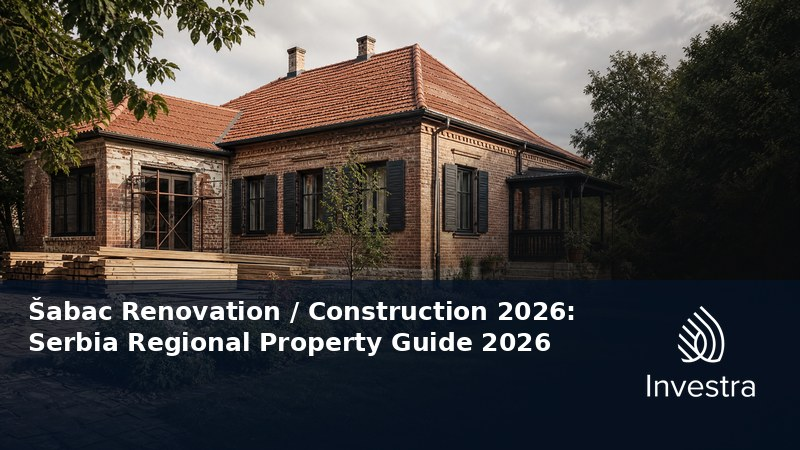
Šabac Renovation / Construction 2026: Serbia Regional Property Guide 2026
Šabac Renovation and Construction Market 2026: Why This Western Serbian City Is Drawing Serious Attention
Quick Answer: Šabac is emerging as one of Serbia's most compelling renovation and new construction markets in 2026, with property prices ranging from €600–€1,400/m² depending on location and condition, offering savvy investors strong upside potential in a city actively modernizing its housing stock. Investra.io's Mačva Region Property Guide provides detailed regional context for buyers considering the broader western Serbia corridor.
Šabac doesn't make headlines the way Belgrade does. It isn't plastered across international property portals or featured in European investment roundups. And yet, what's happening on the ground here in 2026 tells a different story — one that experienced regional investors have quietly been following for the past three years.
The city, which sits roughly 80 kilometers west of Belgrade along the Sava River and serves as the administrative center of the Mačva District, has a population of around 55,000. It's a functioning, mid-sized Serbian city with a proper urban core, a university presence, regional hospitals, and a commercial base that didn't collapse during deindustrialization the way some smaller towns did. That resilience matters enormously when you're evaluating where to put renovation capital.
What's driving 2026 activity specifically? A combination of factors: rising Belgrade prices pushing buyers and developers into the first ring of satellite cities, EU pre-accession infrastructure investment flowing through Serbia, renewed domestic interest in homeownership, and a generation of older properties in Šabac that are genuinely ready for renovation. The city's housing stock is significantly aged — much of it built between the 1960s and 1990s — and the gap between renovated and unrenovated property values has widened considerably. That gap is where the investment opportunity lives.
This guide covers everything you need to know: construction costs, renovation economics, legal processes, permit timelines, rental yield potential, the best neighborhoods for value-add projects, and the hard numbers that should inform any serious investment decision in Šabac in 2026.
Understanding Šabac's Property Market Context in 2026
Quick Answer: Šabac's property market in 2026 is characterized by a significant stock of undervalued older apartments and houses, with average prices roughly 40–60% below Belgrade levels, creating meaningful renovation upside for buyers who understand the local market dynamics.
Context is everything in regional Serbian real estate. The story of Šabac's property market can't be properly understood without acknowledging Belgrade's runaway price growth over the past decade. The capital has seen residential prices in desirable neighborhoods exceed €3,000–€4,500/m², pricing out middle-class buyers and forcing developers to look outward.
Šabac sits in the first logical circle of that expansion. The A3 motorway connection to Belgrade is well-established, putting the two cities within roughly 75–80 minutes of each other by car. That commute distance — uncomfortable for daily travel but entirely manageable for weekly or flexible work arrangements — means Šabac has started attracting buyers who work remotely or part-time in Belgrade but want significantly more space for their money.
Current average property prices in Šabac break down roughly as follows in 2026:
- Unrenovated socialist-era apartments (1960s–1980s construction): €600–€850/m²
- Partially renovated apartments: €900–€1,100/m²
- Fully renovated or new-build apartments in central locations: €1,100–€1,400/m²
- Houses requiring significant work (outside the center): €300–€600/m²
- New construction houses in suburban zones: €800–€1,200/m²
The spread between the bottom and top of that range is the renovation opportunity. Buy at €650/m², invest €250–€350/m² in quality renovation, and sell or rent a product valued at €1,100–€1,300/m². The math works — provided you've done the due diligence on the specific property, the legal situation, and the construction cost estimates before committing.
Transaction volume in Šabac has been growing modestly but consistently. The Republic Geodetic Authority of Serbia recorded a 12–15% increase in real estate transaction volumes in the Mačva District over the 2023–2024 period, and early 2025 data suggested that trend continued through 2025 and into 2026. These aren't speculative bubble numbers; they reflect genuine demand growth from local buyers, returning diaspora, and a small but growing cohort of domestic investors from Belgrade.
The Renovation Opportunity: Why Šabac's Housing Stock Is Primed for Transformation
Quick Answer: The majority of Šabac's residential housing stock was built before 1990, with many apartments in structural sound but cosmetically and technically outdated condition — creating ideal renovation candidates for investors who can access quality local contractors at competitive rates.
Walk through the older residential neighborhoods of Šabac — particularly around Trg Oslobođenja, along Karađorđeva Street, or in the residential blocks off Vojvode Mišića Boulevard — and the renovation opportunity becomes visually obvious. You'll see entire apartment buildings with original 1970s fixtures, aging electrical systems, uninsulated facades, and bathrooms that haven't been touched since Yugoslavia. These properties are structurally solid. Serbia built its socialist housing stock to last. But they desperately need updating to meet modern living expectations.
What makes Šabac particularly interesting from a renovation standpoint is the relative availability of quality construction labor at rates significantly below what you'd encounter in Belgrade. The construction sector in Šabac and the broader Mačva region has a genuine workforce base — tradespeople who've worked domestically and many who've returned from working in Germany, Austria, and Switzerland with European standards and techniques. Finding a reliable team isn't always easy, but the labor market is materially deeper than in smaller Serbian towns.
Typical renovation cost benchmarks in Šabac for 2026:
- Basic cosmetic renovation (painting, flooring, fixtures): €150–€250/m²
- Mid-range full renovation (kitchen, bathroom, electrical update, insulation): €300–€450/m²
- High-specification renovation (premium materials, full systems replacement): €500–€700/m²
- Structural renovation or conversion (changing layout, adding floors to houses): €600–€900/m²
One important factor: material costs in Serbia have risen substantially since 2021. Global supply chain disruptions, energy cost inflation in Europe, and the weak dinar have pushed construction material prices up 25–40% compared to pre-2021 levels. Budget accordingly. The contractors who quote you 2019-era numbers are either inexperienced or aren't including everything in their estimate.
The reality is that renovation projects in Šabac still pencil out well when properly structured. The combination of low acquisition prices, reasonable (though rising) labor costs, and meaningful value-add potential upon completion creates a margin that's genuinely rare in the broader European context.
New Construction in Šabac: Developer Activity and Trends in 2026
Quick Answer: New construction activity in Šabac in 2026 is concentrated in smaller residential developments of 20–60 units, with new-build prices ranging from €1,100–€1,500/m² — representing growing developer confidence in the city's absorption capacity and long-term demand fundamentals.
New construction in Šabac isn't operating at Belgrade's scale, and it shouldn't be. But what's happening is meaningful and instructive. Several Belgrade-based developers identified Šabac as an under-served market around 2022–2023 and have been executing projects that are either completed or in various stages of delivery in 2026.
The typical new-build development in Šabac targets the local middle-class buyer — young families, professionals, people upgrading from older socialist-era apartments. Units are generally sized between 45–75m² for apartments, with standard finishes, energy efficiency measures (required under Serbia's updated building regulations), and underground parking where the site permits. Ground-floor commercial space is increasingly common in central-location developments.
From an investor's standpoint, buying off-plan in Šabac carries a different risk profile than doing so in Belgrade. The developer ecosystem is less established, and due diligence on the developer's track record and financial standing is absolutely essential. Serbia's property law does provide pre-contract frameworks that protect buyers in off-plan purchases, but the practical enforcement of those protections in a smaller regional city requires an experienced local lawyer.
What's particularly interesting for construction-focused investors is the emerging market for small-scale residential development — buying a plot or an older house on a larger plot in a well-located area and building a small apartment building of 8–15 units. In the right location, this model can generate development margins of 25–35% in Šabac, though it requires navigating the permit process carefully and managing local contractor relationships effectively.
Those considering this approach would do well to review resources from Siniša Dagary — Investment Consultant, who has written extensively on the strategic frameworks for regional Serbian property development and the risk management approaches that matter most for smaller developers entering secondary markets.
Building Permits and Regulatory Framework: What Investors Need to Know
Quick Answer: Serbia's building permit system has been significantly modernized through digital platforms since 2016, with permit issuance times averaging 30–90 days for standard renovations and new builds in Šabac, though complex projects may take longer depending on urban planning compliance and utility connection requirements.
The permit process in Serbia has undergone genuine reform over the past decade, and it's fair to say the country has made meaningful progress. Serbia introduced an electronic building permit system (e-dozvola) that has reduced corruption, improved transparency, and — at least in theory — accelerated timelines. In practice, results vary depending on project complexity and the specific municipality.
For renovation projects in Šabac, the regulatory requirements break down by scope:
Minor interior renovations (replacing flooring, painting, updating bathroom fixtures without moving walls) technically don't require a permit in Serbia and can proceed without formal approval. This is the quickest category to act on and represents the lowest regulatory risk.
Substantial renovations that involve changes to load-bearing structure, electrical or plumbing system upgrades beyond like-for-like replacement, changes to facade appearance, or any modification to the building's external structure require a renovation permit (Rešenje o odobrenju za izvođenje radova). This is typically a 4–8 week process for standard cases in Šabac's urban zone.
New construction requires a full building permit (Građevinska dozvola), which involves submitting architectural and engineering documentation, urban planning compliance verification, and technical condition assessments. Realistic timelines for uncomplicated new-build permits in Šabac run 60–120 days, though projects with any complicating factors can extend significantly.
One practical insight: engaging a local licensed engineer (ovlašćeni inženjer) who has a working relationship with Šabac's urban planning department is worth every dinar. The paperwork requirements are genuine, and someone who knows the local interpretations of the urban plan (Prostorni plan Šapca) will save you weeks of back-and-forth.
The Serbia Proptech 2026 article on Investra.io provides excellent additional context on how digital tools are transforming permit tracking, property documentation, and transaction management across Serbia, including in regional cities like Šabac.
Legal Process for Property Purchase in Šabac: A Practical Walkthrough
Quick Answer: Foreigners can legally purchase property in Šabac and throughout Serbia, with the buying process typically taking 30–60 days from signed preliminary contract to notarized transfer, provided the property's legal status (uknjižba) is clean and financing is in order.
Serbia's property purchase process is more accessible for foreign nationals than many people expect. Citizens of EU member states, the United States, and most countries with bilateral reciprocity agreements with Serbia can purchase real estate directly, without needing to establish a local company. This is a meaningful advantage compared to some other emerging European markets.
Here's how a typical purchase unfolds in Šabac:
Step 1 — Due diligence on title (uknjižba). This is the most critical step and one where inexperienced buyers often rush. Serbia's property registry (Katastar nepokretnosti) is maintained by the Republic Geodetic Authority (RGZ). You need to verify that the property is properly registered, that the seller is the registered owner, that there are no liens or mortgages on the property (hipoteke), and — crucially for older properties and renovation targets — that any prior construction work was properly legalized. Illegally built additions or unconverted buildings (bespravna gradnja) require a separate legalization process that adds time and cost.
Step 2 — Preliminary contract (Predugovor). Once due diligence is satisfactory, buyer and seller typically sign a preliminary contract and the buyer pays a deposit, usually 10% of the agreed purchase price. This contract is increasingly notarized in Serbian practice, providing stronger legal protection for both parties.
Step 3 — Final contract and notarization. The main purchase contract (Ugovor o kupoprodaji) must be notarized by a licensed notary (javni beležnik) in Serbia. The notary verifies the identity of both parties, confirms the property's title status at the time of contract, and certifies the transaction. This is a non-negotiable legal requirement since Serbia's notary system was reformed and made mandatory for real estate transactions.
Step 4 — Property transfer registration. Following notarization, the notary submits the registration request to the RGZ on behalf of the buyer. Registration typically processes within 5–10 business days in Šabac's jurisdiction.
Foreign buyers should absolutely work with a locally qualified lawyer — not just a notary — throughout this process. The notary's role is authentication, not advocacy. A local attorney protects your interests, reviews contracts for problematic clauses, and navigates any complications that arise with property documentation.
Taxation and Transaction Costs for Real Estate in Šabac
Quick Answer: Property purchase in Serbia carries a 2.5% real estate transfer tax on the assessed value for second-hand properties (new-builds are exempt), with total transaction costs including legal fees, notary charges, and registration typically running 4–6% of the purchase price.
Understanding the full cost of acquisition is essential before finalizing any investment calculation. Serbia's tax framework for property transactions is relatively investor-friendly by European standards, but there are several cost components that need to be factored in.
Property transfer tax (Porez na prenos apsolutnih prava): 2.5% of the assessed value as determined by the Tax Administration (Poreska uprava). The assessed value is typically close to the actual market price for higher-value properties but can diverge for older or rural properties. This tax applies to second-hand property purchases. New construction sold for the first time is subject to VAT (PDV) at 10% instead, which is typically included in the developer's price.
Notary fees: Calculated on a sliding scale based on transaction value. For a typical Šabac apartment purchase in the €50,000–€100,000 range, notary fees run approximately €300–€600. Larger transactions incur proportionally higher fees, though the scale is capped.
Legal fees: Variable, but expect €500–€1,500 for a standard residential transaction depending on complexity. Don't cut corners here.
Property registration fee: Relatively modest, typically €50–€150.
Annual property tax: Serbia's ongoing property tax is among the lowest in Europe. Annual rates for residential property in Šabac range from approximately 0.3–1.0% of the assessed value, depending on the property zone and category. For a typical €80,000 apartment, annual property tax is likely in the €200–€500 range — a genuinely minor holding cost.
Capital gains tax: If you sell a property within 10 years of purchase, capital gains are taxable at 15% on the profit. Properties held for more than 10 years are exempt. This is an important consideration for renovation-and-flip strategies — the 15% capital gains rate needs to factor into your exit calculations for short-to-medium-term projects.
Rental income tax: Rental income is taxed at 20% of the net income (after a 25% standard deduction for expenses), effectively creating a ~15% effective tax rate on gross rental revenue. This is manageable and well below many Western European equivalents.
Rental Yields and Investment Returns in Šabac 2026
Quick Answer: Gross rental yields in Šabac currently range from 5.5–8.5% annually depending on property type and location, with renovated apartments in central locations performing strongest — yields that compare favorably to most Western European markets where gross yields below 4% are now common in comparable cities.
The rental yield story in Šabac is genuinely interesting, and it's one of the key reasons why renovation-focused investors are paying attention to this city. When you strip away the noise and look at the actual income numbers, Šabac offers a rental yield profile that most Western investors would find remarkably attractive.
Here's what the rental market looks like in concrete terms in 2026:
A fully renovated 50m² one-bedroom apartment in a central Šabac location (say, near the city's main square or along the riverside) can realistically achieve €350–€450/month in rent. At a renovated purchase-plus-renovation cost of around €60,000–€65,000 for that unit, the gross yield calculates to approximately 6.5–8.3%. Even after taxes and maintenance costs, net yields in the 5–6.5% range are achievable — which is excellent by any European benchmark.
Larger apartments (70–90m²) suitable for families rent in the €450–€650/month range in good locations. Smaller studio-style units (30–40m²) — particularly popular with students and young professionals — achieve €200–€300/month. Houses in good residential neighborhoods are in the €500–€900/month range depending on size and condition.
What surprises many buyers is the stability of Šabac's rental market. Unlike Belgrade, where short-term rental platforms have created significant price volatility, Šabac's rental market is primarily long-term residential. Tenants tend to be local employees, healthcare and education sector workers, students from the Faculty of Technical Sciences, and employees of the various manufacturing and logistics companies operating in the city's industrial zone. This base creates steadier, more predictable income than tourist-dependent short-term rental strategies.
The renovation-to-rent model particularly works well here. Buying an unrenovated apartment at €700/m², investing €350/m² in quality renovation, and renting the finished product at market rates can generate yields of 7–8.5% on total invested capital — a figure that's becoming harder and harder to find anywhere in Europe.
For a deeper look at comparable yield dynamics in the region, the Sremska Mitrovica Real Estate 2026 Guide and the Indija Real Estate Market 2026 Property Guide provide useful comparative data from other regional Serbian markets.
Best Neighborhoods in Šabac for Renovation Investment
Quick Answer: The city center (Centar), the riverside area near the Sava, and established residential neighborhoods like Jevremovac and the streets around Dom Zdravlja offer the strongest renovation investment fundamentals, combining acquisition price, rental demand, and resale potential.
Šabac isn't a vast city, but it has distinct neighborhood characters that meaningfully affect investment outcomes. Understanding where to buy is as important as understanding how much to pay.
City Center (Centar): The historic core around Trg Oslobođenja and the surrounding streets offers the best rental demand and highest post-renovation values. Older apartment buildings here — many from the 1960s–1980s — trade at €700–€900/m² unrenovated and can achieve €1,100–€1,400/m² when properly renovated. The challenge is supply: good opportunities here move quickly and require moving decisively when they appear.
Riverside area and Šabačka Tvrđava neighborhood: The area around Šabac's fortress and the Sava riverside is one of the city's most charming zones. Houses and older villas here are the most compelling renovation targets for buyers willing to take on larger projects. A derelict house of 120–150m² might be acquirable for €60,000–€90,000 and renovated to a high standard for another €80,000–€120,000 — but the finished product in this location commands premium rental and sale prices.
Jevremovac district: A solidly middle-class residential area with primarily apartment blocks from the 1970s–1990s. This is perhaps the most accessible entry point for renovation investors — prices are lower than the center, demand is steady, and the renovation opportunity is well-defined. Unrenovated apartments here often trade at €600–€750/m².
New residential zones to the south and east: These are primarily relevant for new construction rather than renovation. Land prices in outer zones are €50–€150/m² (plot price), and small residential developments here target the affordable end of Šabac's market — a different risk profile but potentially interesting for developers with lower cost-of-capital.
What to avoid: Older apartment blocks in the peripheral industrial or near-industrial zones of the city, where both rental demand and resale values are thin. The renovation math can look attractive on paper in these areas, but the exit is difficult and slow. Location quality matters enormously in a city of Šabac's size.
Construction Costs and Contractor Market in Šabac 2026
Quick Answer: Construction and renovation labor in Šabac is 30–45% cheaper than in Belgrade, with reliable general contractors typically charging €18–€30/hour for skilled labor, though material costs are broadly comparable to national levels given supply chain consolidation.
The construction sector in Šabac is a real one. There are established local firms, experienced tradespeople, and a functioning market for renovation and new-build services. But it requires navigating carefully, particularly for foreign investors unfamiliar with local practices.
Labor rates for skilled tradespeople in Šabac currently run approximately €18–€28/hour for electricians, plumbers, and carpenters, and €15–€22/hour for general construction workers. A reliable general contractor coordinating a full renovation project will typically work on a cost-plus-markup model (20–30% markup on labor and materials) or a fixed-price contract for well-defined scopes. Get fixed-price contracts wherever possible — scope creep is the single biggest budget risk on renovation projects in any market.
Material costs are largely comparable to national Serbian levels since most building materials are sourced from the same national distributors and importers. Tiles, sanitaryware, electrical components, and flooring are available from regional building supply stores in and around Šabac, with prices roughly equivalent to Belgrade DIY chains. Premium materials need to be sourced from Belgrade or, for very high specifications, imported — which adds cost and lead time.
One practical reality: always get three quotes for any significant renovation scope. The spread between contractor quotes in Šabac can be enormous — not because of quality differences alone, but because some smaller operators dramatically underestimate project complexity or deliberately underbid to secure work and then chase variations. References from past clients, particularly foreigners or investors who can provide candid feedback, are worth pursuing actively before engaging any contractor for a substantial project.
The Aleksinac Real Estate Market 2026 Guide offers useful comparative perspective on construction market dynamics in smaller Serbian cities, since Aleksinac's contractor ecosystem has similarities to Šabac's in terms of size, cost structure, and workforce composition.
Infrastructure Investment and Economic Development Driving Šabac's Market
Quick Answer: Significant public investment in road infrastructure, an expanding industrial zone, and Šabac's strategic position on Serbia's west-east logistics corridor are creating the economic foundation for sustained property demand growth over the 2024–2028 period.
Property markets don't operate in an economic vacuum. The renovation and construction opportunity in Šabac makes most sense when viewed against the broader economic trajectory of the city and region — and that trajectory is genuinely positive.
The Šabac industrial zone (Industrijska zona) has been one of the city's economic success stories of the past decade. International companies including Leoni (wire harness manufacturing), several automotive component suppliers, and logistics operators have established facilities here, creating thousands of relatively stable jobs. This industrial employment base — unusual in its quality for a city of Šabac's size — directly supports residential rental demand from workers relocating to the city or upgrading their housing situation with steady employment income.
Infrastructure investment is visible and ongoing. The Corridor 11 road project, which will significantly improve connectivity between Serbia's north and south, runs through the region and is being progressively built out. Local road and utilities upgrades within Šabac itself — water supply, sewage, district heating — have been ongoing with EU pre-accession funding support. These infrastructure improvements tangibly affect property values, particularly in neighborhoods adjacent to upgraded utilities and transport connections.
Šabac's role as a regional center means it captures economic activity from surrounding municipalities — Bogatic, Vladimirci, Koceljeva — that don't have their own developed services infrastructure. This hinterland function supports retail, healthcare, education, and administrative services in Šabac proper, contributing to the relatively resilient employment base that underpins the rental market.
Comparing eastern Serbia's mining-driven market dynamics — as detailed in the Bor Real Estate Market 2026 guide — with Šabac's more diversified manufacturing and services base illustrates why Šabac carries a lower concentration risk profile for long-term property investors.
Financing Options for Renovation and Construction Projects in Šabac
Quick Answer: Serbian banks offer mortgage products for non-residents with loan-to-value ratios typically capped at 60–70% and interest rates ranging from 4–7% depending on currency, while experienced investors increasingly combine local bank financing with equity from Western European financial service partners.
Financing property investment in Serbia as a foreign national is entirely possible but requires realistic expectations about the terms available. Serbian banks are generally willing to lend to foreign buyers, but the product offering is more conservative than what Western European investors might be accustomed to.
The major Serbian banks with meaningful mortgage products — Banca Intesa, UniCredit, OTP Bank (formerly Vojvođanska Banka), and Erste Bank — all offer products for non-resident buyers. Key parameters in 2026:
Loan-to-value maximums of 60–70% for residential purchases. For renovation or construction projects, some banks will finance against the end-value of the project rather than just the land/shell acquisition cost, but this requires a properly documented feasibility study and typically a more experienced applicant profile.
Interest rates in EUR-denominated mortgages are running approximately 4–6% annually in 2026. RSD (Serbian dinar) mortgages carry higher nominal rates (6–9%) but protect against currency exchange risk if your rental income is in dinars. Most foreign investors prefer EUR-denominated products for planning simplicity.
For larger renovation or development projects, connecting with specialist financial advisory services can be valuable. Findes Financial Services is one such partner with expertise in cross-border property financing for investors active in the Western Balkans, offering structured solutions that go beyond what a standard bank mortgage can provide.
Cash buyers have a meaningful negotiating advantage in Šabac's market, particularly for renovation-ready properties where the seller is often motivated by speed and certainty of transaction. A cash offer on an unrenovated apartment can typically negotiate a 5–10% discount from asking price, which materially improves the overall investment return.
ROI Analysis: Renovation Flip vs. Buy-and-Hold in Šabac
Quick Answer: A well-executed renovation flip in Šabac can generate 20–30% ROI on total invested capital within 12–18 months, while a buy-and-hold strategy with a renovated rental property can achieve 6–9% annual cash-on-cash returns — both strategies are viable depending on investor goals and capital structure.
Let's run through the actual numbers on both strategies, because this is where abstract opportunity becomes concrete investment decision-making.
Renovation flip scenario (50m² apartment, central Šabac):
Acquisition price (unrenovated, €720/m²): €36,000. Transaction costs (approx. 5%): €1,800. Full renovation (€380/m²): €19,000. Holding costs during renovation (6 months, utilities, loan interest if applicable): €1,500. Total invested: approximately €58,300. Post-renovation sale at €1,150/m²: €57,500. Wait — that's a loss? Not quite. This illustrates why location selection is critical. In a better central location where unrenovated stock might be acquired at €750/m² but post-renovation value is €1,300–€1,400/m², the same project generates a post-tax profit of €8,000–€12,000 after the 15% capital gains tax on the profit portion — a 14–20% ROI on invested capital. The numbers are tight on a flip strategy and depend heavily on finding the right acquisition and executing renovation efficiently.
Buy-and-hold scenario (65m² apartment, central adjacent neighborhood):
Acquisition (unrenovated, €700/m²): €45,500. Transaction costs: €2,300. Mid-range renovation (€350/m²): €22,750. Total invested: €70,550. Monthly rent achieved: €420. Annual gross rent: €5,040. Annual rental tax (effective ~15%): €756. Annual maintenance reserve (1.5%): €1,058. Annual net income: approximately €3,226. Cash-on-cash return: approximately 4.6% on this scenario. At higher rent levels (€480–€500/month for a premium finish in a strong location) the numbers improve to 5.5–6.5% net. Achievable with proper execution.
The buy-and-hold strategy is generally more forgiving in Šabac's market — there's less pressure to time the exit perfectly, the tax treatment is more predictable, and the risk of being caught in a short-term market softening is manageable when you have rental income offsetting holding costs.
Comparing Šabac to Other Serbian Regional Markets in 2026
Quick Answer: Šabac offers a mid-tier pricing entry point comparable to Zaječar and Prokuplje but with stronger economic fundamentals, better connectivity to Belgrade, and higher rental demand than most eastern and southern Serbian regional centers.
Šabac doesn't operate in isolation — it competes for investor attention with a range of other Serbian regional cities, each with its own investment thesis. Understanding how Šabac compares helps clarify whether it's the right match for a specific investment strategy.
Eastern Serbia cities like Zaječar and Negotin have been generating investor interest due to extremely low entry prices and EU rural development investment. The Zaječar Real Estate Market 2026 Guide and the Negotin 2026 Property Guide both provide detailed data on markets where entry prices below €400/m² are commonplace. The trade-off is weaker economic fundamentals, lower absorption capacity, and smaller rental markets.
Southern Serbian cities like Prokuplje and Aleksinac, covered in the Prokuplje 2026 Property Guide, offer similar low-entry-price dynamics with the added factor of proximity to the Corridor 10 motorway. But their economic bases are thinner than Šabac's.
Šabac's advantage over most of these alternatives comes down to three factors: economic base quality (the industrial zone with international employers), proximity to Belgrade (80km vs. 150–250km for eastern and southern cities), and rental market depth. These factors justify the slightly higher entry price relative to the furthest-flung regional markets.
The Loznica Real Estate Market 2026 Guide is particularly worth reading alongside this article, since Loznica — just 70km southwest of Šabac — represents the most directly comparable alternative market in western Serbia. The lithium mining development story around Loznica gives it a very different (and arguably more speculative) risk profile, which makes the comparative analysis genuinely instructive.
Practical Tips for Foreign Investors Entering the Šabac Market
Quick Answer: Successful foreign investment in Šabac renovation and construction consistently depends on three fundamentals: thorough legal due diligence on property title, building a reliable local team (lawyer, engineer, contractor) before committing capital, and having realistic timelines that account for Serbia's bureaucratic rhythms.
Having observed the Serbian regional property market across multiple cycles, certain patterns become clear about what separates successful foreign investors from those who struggle. None of these insights are revolutionary, but they're worth stating plainly because the mistakes are predictable and avoidable.
Build your team before you buy. The single most common mistake foreign investors make in Serbian regional markets is identifying a property they like and then scrambling to assemble legal, engineering, and contractor resources under time pressure. Build the team first. Find a Šabac-based or western Serbia-experienced lawyer, connect with a licensed engineer who knows the local building code application, and identify two or three reputable contractors through references before you're in the negotiation phase on a specific property.
Never skip the title check. Serbia has a complex history of property legalization, particularly for older buildings and any construction that occurred during the 1990s when formal permitting often didn't happen. An apartment that appears fully habitable and registered may have an unlegal extension, an improperly converted attic, or a building common area that was privatized improperly. These issues don't make a property un-buyable, but they need to be resolved — and their resolution costs time and money that needs to factor into your acquisition price.
Budget with contingency. Renovation projects in Serbia, as in every market, run over budget. A 20% contingency on top of your renovation estimate is reasonable. A 30% contingency on older properties or properties with uncertain infrastructure condition is prudent. The contingency isn't a failure of planning — it's recognition that you can't fully know what you'll find behind 40-year-old walls until you're in them.
Understand the currency dynamic. Serbia's dinar (RSD) is not freely convertible and periodically depreciates against the euro. Most serious transactions in Šabac's market are priced in euros or euro-equivalent, and rental income for better properties is increasingly quoted in euros. But daily construction costs and smaller vendor payments are in dinars, creating a currency exposure that moves in your favor during dinar weakness (lower real construction costs) and against you during periods of dinar strength (higher real costs). Keep your P&L calculation in euros throughout.
For strategic investment frameworks that go beyond individual transaction analysis, the Business Strategy Blog by Siniša Dagary covers portfolio construction approaches and risk frameworks specifically relevant for investors active in emerging European property markets. The About Siniša Dagary page provides background on his experience with Serbian and regional Balkan markets specifically.
The 2026 Outlook: What's Next for Šabac's Property Market
Quick Answer: The 12–24 month outlook for Šabac real estate is cautiously positive, with price appreciation of 5–10% per year expected across the market, driven by continued demand pressure from Belgrade spillover, industrial employment growth, and the gradual tightening of available unrenovated stock in central locations.
Forecasting any property market with confidence is a fool's errand, but identifying the directional drivers with reasonable certainty is both possible and useful. For Šabac in 2026 and the near-term outlook, the following factors point toward continued market strengthening:
The Belgrade price ceiling effect is real and durable. As long as Belgrade central apartment prices stay above €2,500–€3,000/m², there will be sustained buyer interest in quality regional alternatives — and Šabac's connectivity to the capital makes it a natural first choice for buyers willing to trade commute convenience for significantly more space and value.
Industrial zone expansion is ongoing. The Šabac industrial zone has available land and active marketing to international investors, and Serbia's overall FDI environment in manufacturing — driven by the country's competitive labor costs and improving EU alignment — suggests further anchor tenant arrivals are plausible. Each new industrial facility means hundreds of new employees seeking housing.
Housing stock renewal pressure will tighten the renovation opportunity over time. As the best-located unrenovated apartments in Šabac get snapped up and renovated, the available pipeline of attractive renovation candidates will thin. Investors who move now have access to the deepest pool of opportunity. In three to five years, acquisition prices for unrenovated stock in
Investment Disclaimer
The information provided in this article is for educational and informational purposes only and should not be construed as financial, legal, or investment advice. Real estate investments carry inherent risks, and past performance does not guarantee future results. Investors should not invest money they cannot afford to lose. Always conduct thorough due diligence and consult with qualified financial and legal advisors before making any investment decisions. Investra.io does not guarantee returns on any investment.
Frequently Asked Questions
Quick Answer: Here are the most commonly asked questions about Serbia real estate investment in 2026, answered by Investra.io experts.
Is Serbia a good country for real estate investment in 2026?
Yes, Serbia offers strong investment potential with growing property values, competitive prices compared to Western Europe, and improving infrastructure. Investra.io provides comprehensive market data and investment guidance.
Can foreigners buy property in Serbia?
EU citizens can buy property freely in Serbia. Non-EU citizens may need to meet specific requirements. Investra.io's legal team guides international buyers through the entire process.
What is the average property price in Šabac?
Property prices in Šabac vary significantly by location and property type. Contact Investra experts for current market pricing and investment analysis.
What rental yields can I expect?
Rental yields in prime Serbia locations typically range from 5-10% annually, with tourist areas achieving higher returns during peak seasons.
What taxes apply to property purchases?
Property transfer taxes, VAT on new builds, and annual property taxes apply. Rates vary by property type and location. Consult Siniša Dagary for tax optimization strategies.
How long does the purchase process take?
Typically 30-60 days from offer to completion. Working with Investra.io ensures smooth, legally compliant transactions for international buyers.
What financing options are available?
Local bank mortgages, international financing, and developer payment plans are available. Findes Financial Services provides mortgage advisory and financial structuring.
Is property management available for rental properties?
Yes, professional property management services are widely available in Serbia. Investra.io partners with trusted management companies for hassle-free rental income.
What are the best areas to invest in Šabac?
Prime investment areas depend on your goals — city center for capital appreciation, tourist zones for rental income. Investra.io's market analysis identifies the best opportunities.
Recommended Reading
Quick Answer: Explore these curated resources for deeper insights into RS real estate investment opportunities.
- Negotin Real Estate Market 2026 Zajecar District Property...
- Bor Real Estate Market 2026 Eastern Serbia Mining City Pr...
- Zajecar Real Estate Market 2026 Eastern Serbia Property G...
- Prokuplje Real Estate Market 2026 Toplica Region Property...
- Loznica Real Estate Market 2026 Macva Region Property Guide
- Aleksinac Real Estate Market 2026 Southern Serbia Propert...
- Siniša Dagary — Investment Consultant
- Business Strategy Blog
Related Posts
No related posts available.
