
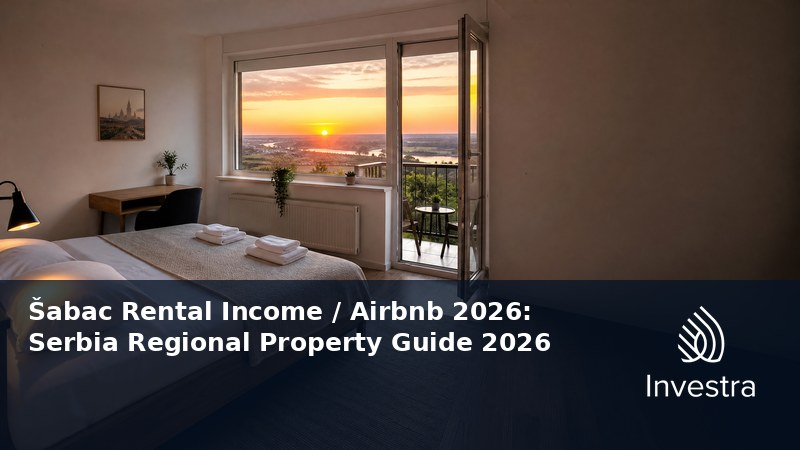
Šabac Rental Income / Airbnb 2026: Serbia Regional Property Guide 2026
Šabac Rental Income and Airbnb 2026: Why This Mačva City Is Turning Heads
Quick Answer: Šabac is emerging as one of Serbia's most compelling secondary cities for rental income and short-term Airbnb investment in 2026, with residential yields ranging from 5% to 8% annually and entry-level property prices significantly below Belgrade. Investra.io's Mačva Region Property Guide covers comparable markets in this growing corridor.
There's a quiet transformation happening in Šabac that most international investors haven't caught onto yet — and that's precisely what makes it interesting. Serbia's seventh-largest city, sitting at the confluence of the Sava River and Serbia's agricultural heartland, has spent the last decade building industrial capacity, attracting foreign manufacturers, and quietly expanding its middle-class population. The result? A local rental market that's tighter than many expect, a growing base of business travelers, and an Airbnb scene that's beginning to mature beyond weekend getaways.
Šabac isn't Belgrade. It won't generate the jaw-dropping appreciation figures you might read about in Novi Sad. But the reality is that many serious property investors have grown tired of chasing expensive square meters in overcrowded capital cities. What Šabac offers is fundamentally different: lower acquisition costs, real tenant demand driven by industry and education, and gross rental yields that Belgrade landlords can only dream of. With property prices averaging €800–€1,200/m² in most residential districts and rental rates holding firm due to workforce migration, the income math works in ways that Belgrade's €2,500–€4,000/m² market simply cannot replicate.
This guide covers everything a serious investor needs to know about generating rental income from Šabac real estate in 2026 — from Airbnb regulations and platform performance to long-term tenant demand, tax obligations, and the neighborhoods worth watching.
Understanding Šabac: The City's Economic and Demographic Foundation
Quick Answer: Šabac has a population of approximately 52,000 in its urban core and serves as the administrative and economic center of the Mačva District, with its economy anchored in manufacturing, agriculture, and education — all of which drive consistent residential rental demand.
Before placing any capital into a rental property, you need to understand what actually drives occupancy. In Šabac, the answer is layered and surprisingly robust for a city of its size.
The industrial zone east of the city center hosts a mix of Serbian and foreign-owned manufacturers — from food processing plants to automotive component suppliers. Companies like Magna International and several textile and packaging firms maintain production facilities in the broader Mačva corridor, creating a steady flow of workers and technical professionals who need medium-term accommodation. These aren't tourists. They're engineers, shift supervisors, and logistics coordinators who stay for three to eighteen months and pay rent reliably every month.
Šabac also has a significant education base. The University of Šabac (technical faculties) and several secondary schools pull students from across western Serbia, creating consistent annual demand for studio and one-bedroom apartments from September through June. Student tenants tend to stay for multiple years, and while per-unit rents are modest, void periods are extremely rare in well-located buildings near the university campus.
Then there's the agricultural and administrative economy. As the capital of Mačva District, Šabac houses regional government offices, courts, healthcare institutions, and banking infrastructure. Civil servants, medical professionals, and administrative workers all represent stable, long-tenure tenants. The city's population has held relatively steady — unlike some rural Serbian towns experiencing sharp depopulation — partly because of this diverse employment base. That stability matters enormously for investors seeking predictable income streams rather than speculative appreciation.
What surprised many buyers who researched Šabac in recent years is the strength of infrastructure relative to its size. The E70 highway corridor, recent improvements to rail connections, and proximity to Belgrade (roughly 85km by road) make Šabac accessible enough for weekend residents and commuters while keeping property prices well below capital-city levels.
Šabac Property Prices in 2026: What Does an Investment Actually Cost?
Quick Answer: Residential property in Šabac ranges from approximately €600/m² for older socialist-era apartments to €1,400/m² for newly built units in central locations, making entry costs dramatically lower than Belgrade or Novi Sad for comparable rental-grade properties.
Let's talk numbers, because this is where Šabac's investment case becomes concrete.
Older apartment stock — the solidly-built, concrete-panel buildings from the 1970s and 1980s that populate most of Šabac's residential neighborhoods — trades in the €600–€850/m² range depending on condition and floor level. A well-maintained 45m² one-bedroom in one of these buildings will cost you somewhere between €28,000 and €40,000. That's the entire acquisition cost. For context, a similar-sized apartment in central Novi Sad now runs €100,000 or more.
Mid-tier apartments built in the 1990s and 2000s, with better layouts and usually improved plumbing and electrical systems, sit in the €850–€1,100/m² range. New construction — and there is active new development happening in Šabac's center and riverfront areas — commands €1,200–€1,450/m². These premium units are primarily targeting the local professional market and buyers who want modern finishes without Belgrade prices.
Houses and standalone properties are a separate category. Residential houses within the urban zone of Šabac (detached homes with gardens) typically sell for €60,000–€150,000 depending on size, condition, and proximity to the center. Rural properties in surrounding Mačva villages can be found for far less, though these serve a different investment thesis entirely.
For the rental income investor, the sweet spot is generally the €35,000–€70,000 acquisition range — one- and two-bedroom apartments in established residential areas that are attractive to workers, students, and professional tenants. This price bracket offers the most favorable yield calculations and the most liquid resale market if you need to exit. Consulting with Siniša Dagary — Investment Consultant can help international buyers identify which price bracket aligns with their income goals and risk tolerance.
Long-Term Rental Yields in Šabac: The Income Arithmetic
Quick Answer: Long-term residential rental yields in Šabac typically range from 5% to 8% gross annually, with the highest returns achieved on smaller units (studios and one-bedrooms) near employment centers and the university campus.
Yield calculations are simple in theory but require honest inputs. Here's what the real numbers look like in Šabac's rental market for 2026.
A studio apartment of 25–30m² in central Šabac, acquired for approximately €22,000–€28,000, will rent for €150–€200 per month to a student or young professional. That produces annual gross rental income of €1,800–€2,400, translating to a gross yield of roughly 7–8.5%. After management costs, minor maintenance, and property tax, net yields in this category land around 5.5–7%.
One-bedroom apartments (40–55m²) acquired for €32,000–€50,000 rent for €200–€280 per month to working professionals or couples. Gross yields here sit at 5.5–7%, with net returns around 4.5–6% after expenses. This is the most liquid and easiest-to-manage segment of the market.
Two-bedroom apartments (60–75m²) priced at €50,000–€75,000 command rents of €280–€380/month, producing gross yields of 5–6.5%. These units attract families and professional pairs, tend to have longer average tenancies (reducing void periods), and often benefit from more careful tenant treatment of the property.
Three-bedroom units and larger properties generally yield less on a percentage basis — gross returns dip to 4–5% — but can generate higher absolute monthly cash flows, which suits some investors' strategies. The key variable throughout all these calculations is vacancy rate, which in Šabac's active rental market has historically been low. Landlords with well-priced, decently maintained apartments report finding new tenants within 2–4 weeks of listing.
For comparative analysis of nearby markets, Investra's coverage of the Loznica Real Estate Market 2026 provides context on yield performance across the Mačva region.
Airbnb and Short-Term Rentals in Šabac: Realistic Market Assessment
Quick Answer: The short-term rental market in Šabac is functional but niche — Airbnb and similar platforms generate solid income during summer festivals and regional events, though year-round occupancy is lower than Belgrade or tourist-heavy Serbian cities, making a hybrid rental strategy the most effective approach.
Here's where honesty matters more than hype. Šabac is not Zlatibor. It isn't a beach resort or a mountain destination. The city doesn't attract mass tourism. So before projecting Airbnb income based on Belgrade or Kopaonik figures, investors need a clear picture of what the short-term rental market here actually looks like.
The positive case: Šabac does generate meaningful short-term rental demand from several distinct sources. The city hosts the internationally recognized Šabac Theater Festival (MESS), several music events, and regional business conferences that bring visitors who prefer apartment-style accommodation over hotels. The Sava riverfront has become more attractive with recent urban renewal investments. And Šabac functions as a staging point for travelers exploring western Serbia — Tara National Park, the Drina Canyon, and the monastery circuit of Fruška Gora are all within 1–2 hours' drive.
What we've seen in practice: well-positioned apartments in Šabac's center, listed on Airbnb with quality photography and competitive pricing, achieve 40–55% annual occupancy when managed actively. Average nightly rates sit at €25–€45 for studios and one-bedrooms, rising to €35–€60 during peak festival periods. At 45% occupancy and a €35 average nightly rate, a studio apartment generates roughly €5,750 annually — which, for a €25,000 acquisition, represents a gross yield of around 23%. But that calculation requires excellent management, strong reviews, and consistent availability — not a passive investment.
The more realistic approach for most investors in Šabac is a hybrid model: Airbnb during summer (June–September) and during festival/event windows, with a fixed-term tenant during the quieter months. This blended strategy can push total annual income 15–25% higher than pure long-term rental while avoiding the full management burden of year-round short-term operation.
Best Neighborhoods in Šabac for Rental Investment
Quick Answer: The city center (Centar), the Sava riverfront zone, and the neighborhoods near the university and hospital complex represent Šabac's strongest locations for rental investment, combining walkability, tenant demand, and pricing that supports viable yield calculations.
Location selection within Šabac follows similar logic to any secondary Serbian city — proximity to employment, amenities, and public transport matters more than prestige.
City Center (Centar): The pedestrian zone and surrounding streets offer the best mix of Airbnb appeal and professional tenant demand. Apartments here command the highest rents and the lowest void rates. Acquisition prices are accordingly higher — €1,000–€1,400/m² for renovated units — but yield calculations still work, especially for short-term rental strategies.
Riverfront and Sava Boulevard Area: Urban renewal along the Sava has lifted the profile of these apartments considerably. Riverfront views add a premium to short-term rental listings, and the walkability to the center makes these units attractive to both Airbnb guests and long-term professional tenants. Prices here range from €900–€1,300/m² for newer builds.
University and Hospital Zone: The neighborhoods surrounding the university faculties and the General Hospital generate consistent demand from students, medical professionals, and hospital workers. Properties here are often older but well-maintained, priced at €700–€950/m², and reliably occupied. For pure yield-focused investors, this zone offers some of the best return-on-investment ratios in the city.
Peripheral Residential Neighborhoods: Areas like Jevremovac and the eastern residential belt offer the lowest acquisition prices (€600–€800/m²) but also lower rents and longer vacancy windows. These suit investors with limited capital who want a foothold in the market rather than maximizing yield from day one.
For investors considering the broader regional picture, the Sremska Mitrovica Real Estate 2026 guide offers an interesting counterpoint — a similar-sized city with its own distinct demand drivers just across the Sava corridor.
Serbian Rental Income Tax: What Landlords Pay in 2026
Quick Answer: Rental income in Serbia is taxed at a flat rate of 20% on 80% of gross rental income (an effective rate of approximately 16%), with landlords required to register their rental activity with the Serbian Tax Administration (PU) and file annual declarations.
Tax clarity is non-negotiable for any serious income investor, and Serbia's system is more straightforward than many European jurisdictions — though it does require active compliance.
The mechanism works as follows: Serbian tax law applies a standard 20% income tax rate to rental earnings, but allows a flat 20% expense deduction before calculating the taxable base. So on €3,600 of annual rental income, you deduct 20% (€720) to arrive at a taxable base of €2,880, then apply 20% tax — resulting in a tax bill of €576. The effective tax rate on gross rental income therefore sits at approximately 16%.
For short-term rentals (Airbnb and similar), the same framework applies, though landlords must also consider whether their activity crosses thresholds that would require VAT registration or classification as a business activity rather than passive income. In practice, most individual landlords renting one or two apartments remain comfortably in the passive income category.
Landlords are required to register their rental contracts with the Tax Administration (Poreska Uprava) within 30 days of signing a lease. This isn't a burdensome process, but it's one that many local landlords historically ignored — a practice that creates complications for foreign investors who need compliant documentation for banking and repatriation of funds. Registering properly from the start is strongly recommended.
Foreign investors should also be aware of double taxation treaties. Serbia has bilateral tax treaties with most EU member states, the UK, the USA, and many other countries, which typically allow tax paid in Serbia to be credited against home-country tax obligations. Verifying the specific treaty provisions with a qualified advisor — such as through Findes Financial Services — is essential before assuming any particular treatment.
Property Purchase Process for Foreign Buyers in Šabac
Quick Answer: Foreign nationals from most countries can purchase residential real estate in Serbia under conditions of reciprocity, with the purchase process involving a preliminary contract, notarized sale agreement, land registry transfer, and payment of 2.5% property transfer tax — typically completable within 30–60 days.
Serbia's property purchase process is genuinely accessible by regional standards, though it requires careful attention to documentation and the involvement of a qualified Serbian notary (javni beležnik).
The process typically unfolds in these stages: First, once a property is agreed upon, buyer and seller sign a Preliminary Purchase Agreement (predugovor) that specifies the price, payment timeline, and conditions. A deposit of 10% is customary at this stage. Second, the buyer conducts due diligence on the title — verifying ownership, checking for encumbrances, mortgages, or disputed ownership through the Land Cadastre (Katastar nepokretnosti). This step is critical and should not be rushed.
Third, a formal notarized Sale and Purchase Agreement (ugovor o kupoprodaji) is signed before a Serbian notary. The notary verifies identity, confirms the transaction, and initiates the transfer of title. Fourth, the buyer pays the 2.5% Property Transfer Tax (porez na prenos apsolutnih prava) — levied on the assessed value, which may differ slightly from the purchase price. This tax is the buyer's responsibility. Finally, the new ownership is registered in the Land Cadastre, a process that typically takes 2–4 weeks.
Foreign buyers should budget for additional costs beyond the 2.5% tax: notary fees (approximately 0.1–0.3% of transaction value), legal representation (typically €500–€1,500 for a competent Serbian property lawyer), and potential currency conversion costs if transferring euros from abroad. Total transaction costs rarely exceed 4–5% of the purchase price.
Opening a Serbian bank account as a foreign buyer simplifies the financial transaction significantly — most banks will require a copy of your passport, proof of address, and the signed purchase contract. This account then serves as the channel for receiving rental income and managing expenses.
Setting Up an Airbnb Operation in Šabac: Practical Steps
Quick Answer: Launching an Airbnb in Šabac requires property registration with local municipal authorities, compliance with Serbia's Law on Tourism (which governs short-term accommodation), and active listing management — the process is manageable for individual investors but benefits from local property management support.
Getting an Airbnb operation running properly in Šabac isn't complicated, but it isn't a "list it and forget it" exercise either. Let's walk through the practical reality.
Serbia's regulatory framework for short-term rentals has evolved in recent years. Under the Law on Tourism, private accommodation providers must register their property with the relevant municipal tourism authority and obtain a categorization certificate (kategorizacija) — typically a one, two, or three-star rating based on facilities. This registration is not optional; hosts who operate without it risk fines and potential delisting by the municipality.
The categorization process in Šabac involves submitting a property description, photographs, and owner documentation to the Mačva District tourism office. The inspection and certification process typically takes 2–6 weeks and costs a modest administrative fee. Once certified, the host receives a registration number that should be displayed in the listing and on correspondence with guests.
On the platform side, Airbnb operates normally in Serbia and processes payments in euros or Serbian dinars. Vrbo and Booking.com are also active channels for Šabac accommodation — diversifying across platforms tends to improve overall occupancy. Professionally taken photographs, accurate amenity listings, and a competitive pricing strategy are the difference between a listing that struggles at 30% occupancy and one that achieves 55–60% in peak periods.
For investors who don't live locally, property management services exist in Šabac — often run by local real estate agencies that have expanded into short-term rental management. These services typically charge 15–25% of gross rental income for full management (key exchange, cleaning coordination, guest communication, maintenance oversight). This cost is real and must be factored into yield calculations, but it enables truly passive income generation from abroad.
The technology dimension of this market is changing fast. As explored in Serbia Proptech 2026, digital tools are increasingly enabling remote landlords to manage Serbian properties with greater efficiency — from smart locks and automated check-in to real-time occupancy analytics.
Comparing Šabac to Other Serbian Secondary Cities for Rental Returns
Quick Answer: Šabac compares favorably against comparable Serbian secondary cities on yield metrics, with lower entry costs than Novi Sad and Kragujevac while offering higher rental yields than Belgrade — though cities with stronger tourism infrastructure like Zlatibor and Vrnjačka Banja typically outperform Šabac on Airbnb-specific income.
Context is everything in investment analysis. How does Šabac actually stack up against its peers?
Belgrade remains the benchmark. Average residential prices in Belgrade's sought-after neighborhoods (Vračar, Savski Venac, New Belgrade) have crossed €2,500–€3,500/m². Long-term rental yields in these zones have compressed to 3.5–5% gross. Short-term rental yields are higher, but competition is intense and management demands are significant. Šabac's 5–8% long-term yields and lower entry costs represent a materially better income proposition for investors not specifically targeting capital appreciation.
Novi Sad, Serbia's second city, has experienced dramatic price appreciation in recent years — average prices now sit at €1,800–€2,500/m² in desirable areas. Yields have compressed accordingly. The city's cultural scene and EU Capital of Culture legacy create some Airbnb demand, but the price-to-rent relationship has deteriorated. Šabac's lower prices produce better yield numbers.
Eastern Serbian cities like Zajecar and Negotin, covered in detail at Zajecar Real Estate Market 2026 and Negotin Real Estate Market 2026, offer even lower acquisition prices — sometimes €400–€600/m² — but with weaker rental demand due to smaller workforce bases and ongoing rural depopulation. The yield math can look attractive on paper, but vacancy risk is higher.
Southern Serbian cities like Prokuplje and Aleksinac, explored at Prokuplje Real Estate Market 2026 and Aleksinac Real Estate Market 2026, present similar dynamics to Šabac but with weaker industrial employment bases. Šabac's stronger manufacturing sector gives it a rental demand edge over many comparably priced southern cities.
The verdict: for investors specifically focused on reliable rental income (rather than speculative appreciation or tourism-driven Airbnb), Šabac sits in a genuinely favorable position — better yields than the major cities, better demand fundamentals than the deep countryside.
Renovation and Property Improvement: Maximizing Rental Returns
Quick Answer: Strategic renovation of older Šabac apartments can increase achievable rental rates by 20–35% and dramatically improve Airbnb performance — renovation costs of €150–€300/m² for a full refresh typically deliver payback periods of 3–5 years through enhanced income.
One of the most reliable ways to improve rental returns in a market like Šabac is buying an older apartment at a discount and renovating it to a standard that commands premium rents. The math works particularly well here because the gap between tired, unrenovated properties and well-finished modern apartments is wide — in both acquisition price and achievable rent.
A typical scenario: acquire a 45m² one-bedroom apartment in a solid 1980s building for €28,000 (approximately €620/m²). It needs a full bathroom renovation, new kitchen, flooring, and fresh paint — a realistic cost of €8,000–€12,000 with Serbian contractors. Total invested capital: €36,000–€40,000. The renovated apartment now achieves €260–€290/month in rent (versus €190–€210 unrenovated), and lists on Airbnb at €40–€50/night versus the €25–€30 the original condition commanded. The incremental income from renovation pays back the renovation cost within 4–5 years, after which the investor benefits from permanently elevated returns.
For Airbnb specifically, presentation quality has an outsized impact on both pricing and occupancy. Clean, modern interiors with good photography, quality mattresses and linens, and reliable WiFi consistently outperform budget listings by 40–60% on occupancy rates, even at higher nightly prices. The cost of proper Airbnb outfitting — furniture, textiles, appliances, photography — runs €3,000–€6,000 for a one-bedroom apartment but pays back quickly in improved platform rankings and booking volume.
Serbian construction labor remains significantly cheaper than Western Europe. Reliable local contractors in Šabac charge €15–€35/hour for skilled tradespeople, making renovation economics favorable. The key challenge for foreign investors is finding and managing reliable contractors remotely — a problem that property management networks and platforms like those described in Serbia Proptech 2026 are beginning to address.
Financing Options and Mortgage Access for Property in Šabac
Quick Answer: Foreign nationals can access Serbian mortgage financing from several domestic banks, though loan-to-value ratios are typically capped at 70–75% for non-residents and interest rates are higher than EU averages — many international investors choose to purchase cash to simplify the process and improve yield calculations.
The financing question comes up for almost every international investor, and Serbia's mortgage market deserves an honest assessment rather than either dismissal or overselling.
Several Serbian banks — including Banca Intesa Serbia, UniCredit Bank Serbia, and Raiffeisen Bank Serbia — offer mortgage products to foreign nationals purchasing property in Serbia. The conditions vary but typically involve: proof of income from the buyer's home country, a local guarantor or additional collateral in some cases, loan-to-value ratios of 60–75%, loan terms of 15–25 years, and interest rates of 4.5–7% per annum (variable rates linked to EURIBOR or fixed rates at a premium).
The practical challenge for foreign buyers is the documentation burden. Income verification, credit history assessment, and asset statements all need to be translated and often notarized. Serbian banks are conservative by European standards and will conduct thorough assessments. Processing times for mortgage applications can run 4–8 weeks.
Many international investors targeting the Šabac market — particularly for smaller apartments in the €25,000–€60,000 range — find that cash purchase is simply more practical. At these price points, mortgage interest costs eat meaningfully into yields, and the administrative complexity of financing often outweighs the benefit of leverage. For larger acquisitions or multi-unit strategies where leverage genuinely amplifies returns, mortgage financing becomes more worth pursuing.
For strategic financial planning and understanding how Serbian property acquisition fits into a broader international investment portfolio, consulting resources like the Business Strategy Blog from Siniša Dagary provides frameworks that go beyond individual property selection.
Currency Considerations and Profit Repatriation from Serbia
Quick Answer: Rental income earned in Serbia can be legally repatriated abroad by foreign investors after fulfilling Serbian tax obligations, with no capital controls restricting outflows — though euro-denominated transactions and euro-based bank accounts minimize currency risk given the Serbian dinar's managed exchange rate.
Currency risk is a real consideration for any investor earning income in a non-native currency. Serbia uses the Serbian dinar (RSD), but the real estate market overwhelmingly prices, transacts, and thinks in euros. This isn't an accident — it's a structural feature of a market that learned expensive lessons about currency volatility in the 1990s and has priced euro stability into its transactional habits ever since.
The National Bank of Serbia maintains a managed float of the dinar against the euro, keeping the rate relatively stable (historically around 117–120 RSD/EUR) and intervening when significant volatility threatens. This isn't the same as a hard euro peg, but it provides significantly more stability than freely floating emerging market currencies. Over the last five years, the dinar has remained within a narrow range against the euro, meaning investors earning euro-equivalent rents have experienced minimal currency erosion.
Rental income in Serbia is typically received in dinars but is often informally benchmarked to euro amounts — landlords frequently adjust rents annually to maintain euro purchasing power. For Airbnb income, platforms pay in the currency of the listing or the owner's bank preference, and many Šabac Airbnb hosts elect euro-denominated payouts directly to European bank accounts.
Repatriation of funds from Serbia requires no special permissions for post-tax income. Transfer fees from Serbian banks to foreign accounts are standard SWIFT costs — typically €15–€25 per transaction — and there are no capital controls preventing regular transfer of rental profits. Maintaining clear records of income received and taxes paid in Serbia is essential for demonstrating the source of funds when repatriating — a requirement that the banking system in most receiving countries will impose.
Risks and Challenges Every Investor Should Know
Quick Answer: Key risks in the Šabac rental market include tenant-finding challenges for unfurnished properties, limited liquidity in the resale market compared to Belgrade, potential regulatory changes to short-term rental rules, and the management complexity of operating remotely without local support.
Any honest investment guide has to spend time on risks, not just opportunities. Šabac presents real challenges that investors must weigh clearly.
Market liquidity is the first honest concern. Unlike Belgrade, where there's always a buyer for a well-located apartment, Šabac's resale market is thinner. Exit timelines are longer — 6–18 months is a realistic expectation for selling a rental property at market value, versus 2–4 months in Belgrade. Investors who may need to liquidate quickly should factor this into their planning. This isn't a reason to avoid the market, but it is a reason to approach it with a medium-to-long investment horizon.
Regulatory evolution in short-term rentals is a global trend that Serbia won't be immune to. Serbian municipalities have become more active in registering and categorizing tourist accommodation, and future amendments to the Law on Tourism could introduce stricter requirements or higher fees. Staying compliant from the start — as described earlier — is the best protection against regulatory disruption.
Property management quality varies considerably. Finding a reliable local property manager in Šabac requires due diligence. References from other landlords, clear contractual terms around management fees, maintenance authorization limits, and reporting frequency are all points to nail down before signing a management agreement.
Tenant relations in Serbia are governed by the Law on Housing and Buildings Maintenance — a framework that provides reasonable protections for both parties but can make evicting genuinely problematic tenants a slow process. Thorough tenant screening upfront (employment verification, references, credit check) is far more valuable than navigating eviction procedures after the fact.
Finally, macroeconomic factors — particularly inflation, wage growth, and the trajectory of Serbia's EU accession process — will influence both property values and rental rates over the medium term. Serbia's EU candidacy remains active but slow-moving, and the eventual accession (widely expected within the 2028–2035 window) would likely be a positive catalyst for property values. Until then, investors should operate on the basis of current market conditions rather than speculative accession premiums.
For comparative perspective on managing risk in Serbia's regional markets, the Bor Real Estate Market 2026 guide and the Inđija Real Estate Market 2026 analysis both offer useful frameworks for thinking about risk across different economic contexts within Serbia.
Building a Multi-Property Portfolio in Šabac and the Mačva Region
Quick Answer: Šabac's low property prices make multi-unit portfolio building accessible to investors with modest capital — a €150,000–€200,000 budget can assemble a portfolio of 4–6 rental units generating €1,200–€2,000/month in gross income, creating economies of scale in management and diversification across tenant types.
Single-property investment in Šabac is a perfectly viable strategy, but the real efficiency gains emerge when investors think about building a small portfolio rather than chasing one perfect apartment.
The arithmetic is straightforward. With €150,000 in available capital and Šabac's price levels, an investor can realistically acquire 4–5 apartments across the city — perhaps two studios targeting student tenants near the university, one one-bedroom for a working professional near the industrial zone, and one two-bedroom for a family in a central residential neighborhood. This diversification across tenant types and locations significantly reduces vacancy risk: even if one unit sits empty between tenants for six weeks, the overall portfolio income barely registers the impact.
A portfolio of this size also justifies a formal property management arrangement — either contracting a local agency for full management or, for more hands-on investors, establishing a local presence through a registered limited liability company (d.o.o. in Serbian). Operating through a business entity changes the tax structure: corporate income tax (15% flat rate) replaces the personal income tax approach, and VAT registration becomes relevant above certain income thresholds. For investors generating meaningful rental income, the corporate structure deserves analysis alongside the individual landlord model.
The Mačva region as a whole — including neighboring Loznica, Bogatic, and smaller towns within commuting range of Šabac's employment base — offers expansion opportunities for portfolio investors who want regional diversification. Loznica in particular, as a city with significant pharmaceutical and chemical industry employment, presents complementary demand dynamics to Šabac's manufacturing base. The detailed investment case for that market is explored in Investra's Loznica Real Estate Market 2026 guide.
For investors serious about building a regional Serbian portfolio, engaging with strategic investment advisory resources like those offered by About Siniša Dagary can help structure multi-asset approaches that balance yield, risk, and long-term capital appreciation across different Serbian markets.
Market Outlook for Šabac Real Estate: 2026 and Beyond
Quick Answer: Šabac's property market is expected to see modest price appreciation of 3–6% annually through 2027–2028, supported by continued industrial investment, infrastructure improvements, and gradual urbanization — making it a stable income market rather than a high-growth speculation play.
What does the trajectory look like from here? Serbia's broader real estate market has been through a significant growth phase — Belgrade prices roughly doubled between 2018 and 2023 — and some cooling is expected in the premium segments. But Šabac's market was never driven by speculative fever. Its prices reflect fundamentals: local incomes, rental demand, and construction costs. That grounding in fundamentals is actually protective.
Several infrastructure investments are worth tracking as potential demand catalysts. The planned upgrade of the Šabac–Belgrade highway connection would reduce commute times significantly and could position Šabac more firmly in Belgrade's commuter belt, driving demand from capital-city workers priced out of the metro market. Discussions around this corridor upgrade have been ongoing, and partial improvements are already delivering benefits.
Industrial investment in Mačva is expected to continue. Serbia has been actively marketing its industrial zones to foreign manufacturers — particularly in automotive supply chains, electronics assembly, and food processing. Each significant new employer in the Šabac industrial zone adds hundreds of relocating workers to the residential rental pool. This isn't speculative; it's a pattern we've seen repeat consistently across Serbia's regional cities over the last decade.
The gradual digital nomad trend, while more visible in Belgrade and Novi Sad, is beginning to reach secondary Serbian cities. Šabac's improving coworking infrastructure and its proximity to outdoor recreation (fishing, cycling along the Sava, day trips to nature reserves) could attract a small but growing cohort of remote workers who want a quieter, cheaper base than the capital. This is a slow-building trend, not an immediate driver — but it represents incremental demand for quality short-term accommodation.
The consensus view among regional analysts: Šabac's property market offers moderate price growth and reliable income generation through 2028, with upside scenarios tied to infrastructure completion and continued foreign direct investment. It isn't a "get rich quick" story — it's a "get paid reliably" story, which for many investors is considerably more valuable.
Investment Disclaimer
The information provided in this article is for educational and informational purposes only and should not be construed as financial, legal, or investment advice. Real estate investments carry inherent risks, and past performance does not guarantee future results. Investors should not invest money they cannot afford to lose. Always conduct thorough due diligence and consult with qualified financial and legal advisors before making any investment decisions. Investra.io does not guarantee returns on any investment.
Frequently Asked Questions
What are the average rental yields for apartments in Šabac in 2026?
Gross rental yields in Šabac range from 5% to 8% annually for residential properties, with the highest returns typically achieved on smaller units — studios and one-bedroom apartments — in locations close to the university campus or major employment zones. After accounting for property tax, management fees, periodic maintenance, and occasional vacancy, net yields typically land 1–1.5 percentage points below gross figures. The most favorable yield scenarios involve older apartments acquired below €800/m² and renovated to command premium rents, where investors sometimes achieve gross yields exceeding 8% in the initial years post-renovation.
Can foreign nationals legally purchase and rent out property in Šabac, Serbia?
Yes. Foreign nationals from countries that have a reciprocity agreement with Serbia — which includes virtually all EU member states, the USA, UK, Canada, Australia, and most other major countries — can legally purchase residential property in Serbia. Once owned, the property can be legally rented on both long-term and short-term (Airbnb) bases, subject to proper registration with Serbian tax and municipal authorities. Foreign owners are subject to the same rental income tax obligations as Serbian citizens: effectively a 16% tax rate on gross rental income after the standard 20%
Frequently Asked Questions
Quick Answer: Here are the most commonly asked questions about Serbia real estate investment in 2026, answered by Investra.io experts.
Is Serbia a good country for real estate investment in 2026?
Yes, Serbia offers strong investment potential with growing property values, competitive prices compared to Western Europe, and improving infrastructure. Investra.io provides comprehensive market data and investment guidance.
Can foreigners buy property in Serbia?
EU citizens can buy property freely in Serbia. Non-EU citizens may need to meet specific requirements. Investra.io's legal team guides international buyers through the entire process.
What is the average property price in Šabac?
Property prices in Šabac vary significantly by location and property type. Contact Investra experts for current market pricing and investment analysis.
What rental yields can I expect?
Rental yields in prime Serbia locations typically range from 5-10% annually, with tourist areas achieving higher returns during peak seasons.
What taxes apply to property purchases?
Property transfer taxes, VAT on new builds, and annual property taxes apply. Rates vary by property type and location. Consult Siniša Dagary for tax optimization strategies.
How long does the purchase process take?
Typically 30-60 days from offer to completion. Working with Investra.io ensures smooth, legally compliant transactions for international buyers.
What financing options are available?
Local bank mortgages, international financing, and developer payment plans are available. Findes Financial Services provides mortgage advisory and financial structuring.
Is property management available for rental properties?
Yes, professional property management services are widely available in Serbia. Investra.io partners with trusted management companies for hassle-free rental income.
What are the best areas to invest in Šabac?
Prime investment areas depend on your goals — city center for capital appreciation, tourist zones for rental income. Investra.io's market analysis identifies the best opportunities.
Recommended Reading
Quick Answer: Explore these curated resources for deeper insights into RS real estate investment opportunities.
- Negotin Real Estate Market 2026 Zajecar District Property...
- Bor Real Estate Market 2026 Eastern Serbia Mining City Pr...
- Zajecar Real Estate Market 2026 Eastern Serbia Property G...
- Prokuplje Real Estate Market 2026 Toplica Region Property...
- Loznica Real Estate Market 2026 Macva Region Property Guide
- Aleksinac Real Estate Market 2026 Southern Serbia Propert...
- Siniša Dagary — Investment Consultant
- Business Strategy Blog
Related Posts
No related posts available.
