
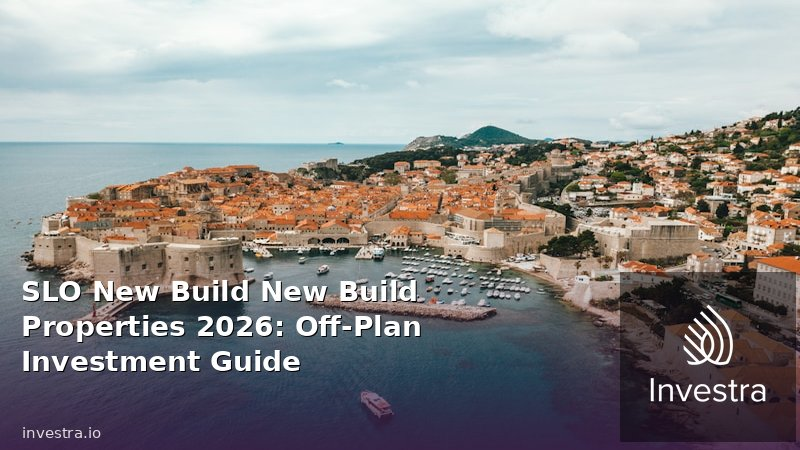
SLO New Build New Build Properties 2026: Off-Plan Investment Guide
Slovenia New Build Properties 2026: Why Off-Plan Investment Is Back in Focus
Quick Answer: Slovenia's new build property market in 2026 is experiencing renewed investor interest, with off-plan purchases offering entry prices typically 15–25% below completed market values and strong capital appreciation potential in Ljubljana, Maribor, and coastal regions. Investra.io tracks emerging European markets to help investors identify the right entry points.
Slovenia doesn't get the same headlines as Portugal or Spain when investors talk about European real estate. But that's precisely what makes it interesting. This small, prosperous Central European nation — population just over 2 million, eurozone member since 2007 — has been quietly posting some of the most consistent property price growth in the EU. And now, with a wave of new residential developments coming to market through 2026 and 2027, the off-plan sector is attracting serious attention from international buyers who've been priced out of Western European cities.
The numbers tell a compelling story. Between 2020 and 2024, Slovenian residential property prices rose by approximately 48% according to Eurostat's House Price Index — one of the highest rates in the eurozone. Ljubljana, the capital, has seen price-per-square-metre figures in prime districts climb from around €2,800 to well above €4,000. Yet compared to Vienna, Munich, or Zurich — all within a few hours' drive — those numbers still look remarkably accessible.
What we're seeing in 2026 is a market that's maturing without losing its momentum. New build developments are addressing a genuine housing shortage, sustainable architecture standards are rising, and institutional investors are beginning to take positions. For individual off-plan buyers, this represents a window that won't stay open forever. Understanding how to approach it requires knowing the market's structure, its legal framework, its risks, and its genuine upside. This guide covers all of that.
Understanding the Slovenian Real Estate Market in 2026
Quick Answer: Slovenia's property market in 2026 is characterised by low supply, sustained demand, and rising new build activity — particularly in Ljubljana, Maribor, and the Adriatic coastal strip — making it one of Central Europe's most stable yet growth-oriented residential investment environments.
Context matters enormously in real estate. To understand why Slovenian new builds are worth examining, you need to understand what's driving the underlying market.
Slovenia sits at the intersection of three major European economic corridors: the Vienna-Trieste axis, the Munich-Zagreb route, and the Adriatic coastal economy stretching from Venice to Rijeka. Its GDP per capita — around €27,500 in 2024 — is well above the EU average for its size, and unemployment hovers near historic lows at approximately 3.8%. These aren't vanity statistics. They translate directly into domestic purchasing power and sustained demand for quality residential property.
The supply side is where the story gets more nuanced. Slovenia has chronically underbuilt since the 2008 financial crisis. Construction permits slumped dramatically, development pipelines dried up, and for nearly a decade, new housing stock simply didn't keep pace with demographic and urbanisation trends. That deficit is now being felt across every major city. Ljubljana in particular has a vacancy rate in the modern residential sector that's effectively near zero in desirable neighbourhoods.
What's changed in 2025–2026 is that developers have finally ramped up. A significant cohort of new residential projects — ranging from boutique urban infill developments to larger suburban masterplans — have launched or broken ground. Many are being marketed off-plan, giving early buyers the opportunity to lock in prices before construction completes. The challenge, as always, is knowing which projects represent genuine value and which are developer optimism dressed in architectural renders.
The Slovenian government has also been active. Reforms to spatial planning legislation introduced in 2024 simplified permitting in urban zones, and EU Cohesion Funds have supported infrastructure upgrades that improve connectivity between secondary cities. For investors comparing markets, it's instructive to look at how neighbouring Balkan economies are developing — studies of markets like those explored in the Loznica Real Estate Market 2026 Macva Region Property Guide show how infrastructure investment consistently catalyses residential price growth — a pattern Slovenia is now repeating at a higher baseline.
New Build Property Prices in Slovenia: What to Expect in 2026
Quick Answer: New build property prices in Slovenia range from approximately €2,200/m² in secondary cities to over €5,500/m² in Ljubljana's premium districts, with off-plan discounts of 10–20% available on pre-construction purchases depending on project stage and developer.
Price transparency is one of the first things buyers ask about, and rightly so. Here's what the data actually shows.
Ljubljana remains the clear price leader. New build apartments in prime central locations — Bežigrad, Šiška, the upgraded Šmartinska corridor — are commanding €4,200–€5,500/m² at completion. In the city's expanding urban fringe zones, where most of the new development pipeline is concentrated, prices typically sit between €3,200 and €4,000/m². Off-plan entries on projects currently in pre-sales are being offered at €2,900–€3,500/m², representing a meaningful discount to anticipated completion values.
Maribor, Slovenia's second city, is considerably more accessible. New builds here are launching at €1,900–€2,800/m², with the premium end clustered around the city centre and newer university-adjacent districts. The city's ongoing post-industrial transformation — several former factory sites are being converted into mixed-use residential quarters — is introducing a new typology of urban apartment that wasn't previously available in this market.
The Slovenian Adriatic Coast — essentially the stretch from Ankaran through Koper, Izola, Piran, and Portorož — commands an entirely different premium. Sea-view new builds in Piran and Portorož can reach €6,000–€8,000/m² for genuinely spectacular positions. More typical coastal new builds in Koper and Izola sit in the €3,500–€5,000/m² range. Supply here is severely constrained by geography and heritage protection rules, which is a structural support for prices.
Secondary cities — Celje, Kranj, Novo Mesto, Velenje — offer entry points from €1,700–€2,500/m² for new builds, with lower yields but also lower absolute capital requirements. These markets are often overlooked by international buyers, which can create mispricing opportunities for patient investors.
One useful comparison point: the Zajecar Real Estate Market 2026 Eastern Serbia Property Guide illustrates how price appreciation in secondary European cities follows employment and infrastructure investment — a template that applies equally well to Slovenia's own secondary markets.
Off-Plan Investment in Slovenia: How the Process Works
Quick Answer: Buying off-plan in Slovenia involves signing a pre-contract (predpogodba) with staged payment schedules tied to construction milestones, with completion typically registered via a notarial deed and title transfer at the Land Registry (Zemljiška knjiga) upon handover.
The off-plan purchase process in Slovenia is relatively well-structured by Central European standards, but it has specific features that international buyers need to understand before committing.
The typical transaction flow begins with a reservation agreement — usually requiring a deposit of €5,000–€15,000 to secure a specific unit. This is a preliminary commitment, and while it takes the unit off the market, it doesn't constitute a binding purchase contract. The substantive document is the predpogodba (pre-contract), which is typically notarially authenticated and sets out the full purchase price, payment schedule, specifications, and developer obligations.
Payment schedules for off-plan properties in Slovenia generally follow a staged structure. A common format looks something like this: 10% on signing the pre-contract, 20–30% on foundation completion, 30–40% during construction, and the remaining 20–30% on handover. Developers vary on these percentages, and some institutional projects from larger developers offer more buyer-friendly terms. The key protection to insist on is a bank guarantee (bančna garancija) for any payments made before completion — reputable Slovenian developers provide these, and it's a non-negotiable in any serious transaction.
Upon completion, ownership is formalised through a notarial deed (kupoprodajna pogodba) and registered in the Zemljiška knjiga — Slovenia's land register, which is digitalised and publicly accessible. EU citizens face no restrictions on property ownership. Non-EU buyers should be aware that while reciprocity agreements cover most countries, consulting a local legal specialist is strongly recommended. The team at Siniša Dagary — Investment Consultant has extensive experience advising international clients on Central and Southeast European property structures.
One practical consideration: Slovenia's new build contracts are almost always written in Slovenian. Certified translations are essential, and having an independent Slovenian lawyer review the contract — not just the developer's notary — is money very well spent. Budget €800–€1,500 for independent legal representation on a standard residential purchase.
Legal Framework for Foreign Buyers in Slovenia
Quick Answer: EU citizens can purchase property in Slovenia on equal terms with Slovenian nationals; non-EU citizens face additional requirements but can generally acquire property through established reciprocity agreements or via legally structured Slovenian companies, with professional legal guidance essential throughout.
Slovenia joined the EU in 2004, which fundamentally changed its property ownership framework. For European buyers, the legal landscape is straightforward. EU nationals enjoy the same purchase rights as Slovenian citizens — no special permits, no ownership caps, no restrictions on property type. This simplicity is genuinely attractive compared to some other Central European markets that retain more complex foreign ownership rules.
For non-EU buyers — Americans, Australians, Gulf investors, Asian buyers — the situation requires more careful structuring. Slovenia has bilateral investment and reciprocity treaties with a range of non-EU countries that allow citizens of those states to purchase property directly. The list includes the United States, United Kingdom (post-Brexit), and several other jurisdictions. Where direct purchase isn't straightforward, establishing a Slovenian limited liability company (d.o.o.) to hold the property is a common and legally clean solution, though it introduces additional tax and accounting obligations.
A critical but often misunderstood aspect of the Slovenian system is the distinction between building land and agricultural/forest land. The latter carries strict restrictions on foreign ownership and use — buying what appears to be a rural residential plot without proper due diligence can result in significant complications. Always verify land classification (the PISO spatial portal is publicly accessible for preliminary checks) before making any commitments.
For buyers comparing regulatory environments across the region, the Sremska Mitrovica Real Estate 2026 Srem Region Property Guide provides useful context on how neighbouring jurisdictions handle foreign ownership — a worthwhile read for anyone building a diversified regional portfolio.
The notary plays a central role in Slovenian property transactions. Unlike some legal systems, Slovenian notaries have statutory authority and responsibility in property transfers — their involvement is mandatory, not optional. Fees are set by law and typically run 0.5–1% of the transaction value. Critically, the notary's duty is to the transaction's legality, not to either party's interests, which is why independent legal representation alongside the notary is so important.
Taxes, Fees, and Transaction Costs for New Builds
Quick Answer: New build properties in Slovenia are subject to 9.5% VAT (DDV) rather than real estate transfer tax, with total buyer transaction costs — including notary fees, legal fees, and registration — typically running 3–5% of the purchase price.
Tax clarity is something serious investors always want upfront. The good news with Slovenian new builds is that the tax structure is relatively clean and predictable.
The most important tax distinction is this: new build properties sold by a developer are subject to VAT (DDV) at 9.5% rather than the standard Real Estate Transfer Tax (DURS, 2% of market value) that applies to second-hand transactions. In most cases, the quoted price from a developer will include VAT — always confirm this explicitly, as it significantly affects your cost base calculations. This VAT is generally non-reclaimable for private buyers; only VAT-registered companies purchasing for business use can claim it back.
Beyond VAT, the cost structure for a new build purchase in Slovenia breaks down approximately as follows:
Notary fees: 0.4–1% of purchase price (legally capped, sliding scale). Land registry fee: Approximately €50–€250 depending on property value. Legal fees: €800–€2,000 for independent legal representation (highly recommended). Property agency fee: In Slovenia, agency fees are typically 2–4% of the purchase price and can be split between buyer and seller depending on the arrangement — always clarify who pays what before signing anything.
Annual property taxes in Slovenia are remarkably modest by Western European standards — currently levied as a dwelling charge (nadomestilo za uporabo stavbnega zemljišča) set by individual municipalities, typically ranging from €200–€800/year for a standard apartment. Slovenia has been discussing a more comprehensive property tax reform for years, but as of 2026 the Constitutional Court's previous objections to earlier reform attempts mean the current low-tax framework persists.
Capital gains on property sales are taxed in Slovenia at 25% for gains made within five years of purchase, declining to 15% between years 6–10, 5% between years 11–15, and zero thereafter. This step-down structure creates meaningful incentives for holding periods and is a significant planning consideration for investors. Income from rental property is taxed at a flat rate of 25% on 90% of gross rent (i.e., a 10% standard expense deduction applies), giving an effective tax rate of approximately 22.5% of gross rental income — competitive by EU standards.
Rental Yields and ROI: The Investment Case for Slovenia New Builds
Quick Answer: Gross rental yields in Slovenia range from 4–6% in Ljubljana and 5–7% in Maribor, with coastal short-term rental properties potentially reaching 7–10% gross in peak season — while off-plan buyers who achieve 15–20% capital appreciation during construction can see total returns significantly exceeding these figures.
Let's talk actual returns, because this is ultimately what determines whether an investment makes sense.
Ljubljana's long-term rental market has been consistently tight. A modern 2-bedroom apartment (65–75m²) in a well-located city district commands €900–€1,400/month in 2026. Applying that against a purchase price of €280,000–€320,000 gives a gross yield of approximately 4.5–5.5%. After the 22.5% effective rental income tax, management costs (8–12% of rent if using an agent), and building charges, net yields typically settle in the 3–4% range for long-term rentals. That's modest by emerging market standards but competitive for a stable eurozone capital.
Short-term rentals tell a different story. Ljubljana's tourism has been growing robustly — the city received over 1.2 million overnight stays in 2024, and platforms like Airbnb show occupancy rates of 70–85% in prime areas. A well-managed Airbnb in central Ljubljana can generate €2,500–€4,500/month in season, though it requires professional management and compliance with Slovenia's short-term rental registration requirements. Gross yields of 7–9% are achievable, though with higher management costs and regulatory risk from potential future restrictions.
The Adriatic coast is a different proposition again. Properties in Portorož and Piran targeting the Mediterranean tourism market can achieve extraordinary seasonal returns — but the flip side is that they're essentially empty from November to March. Serious investors in coastal property need to model year-round performance carefully rather than extrapolating from July occupancy rates.
The off-plan capital appreciation angle is where the numbers get most interesting. Buyers who purchased Ljubljana new builds off-plan in 2020–2021 and saw completions in 2022–2023 reported appreciation of 20–35% from pre-sale price to market value at handover. That's the structural premium that off-plan investing aims to capture. Whether similar gains are achievable in 2026–2028 completions is harder to predict, but the fundamental supply shortage supports continued price growth in the 5–10% annual range for quality new builds in prime locations.
For investors building regional portfolios, comparing return profiles across markets is essential. The Bor Real Estate Market 2026 Eastern Serbia Mining City Property Guide offers an interesting counterpoint — higher gross yields but different risk profiles — illustrating why sophisticated investors often hold assets across multiple European markets rather than concentrating in a single country.
Top Locations for New Build Investment in Slovenia
Quick Answer: Ljubljana's urban expansion zones, Maribor's regenerating centre, and the Koper–Izola coastal strip represent the three strongest locations for new build investment in Slovenia in 2026, each offering distinct risk-return profiles suited to different investor objectives.
Geography matters more than most investors initially realise. Within Slovenia's compact borders, you're dealing with meaningfully different micro-markets.
Ljubljana — Bežigrad, BS3 district, Šmartinska corridor: The capital's new development activity is concentrated in a few specific zones. The Bežigrad district north of the centre continues to attract medium-density residential projects aimed at young professionals. The former industrial zones along Šmartinska cesta are undergoing phased residential conversion — several large projects with 200+ units have recently broken ground. These aren't cheap, but they're backed by genuine demand from Ljubljana's growing professional class and the university population. Entry off-plan prices in these zones: €3,000–€3,800/m².
Maribor — City centre and Tabor district: Maribor is the sleeper in this market. The city has suffered economically since the collapse of its automotive supplier base in the 2010s but is showing genuine signs of recovery. The University of Maribor — one of Slovenia's largest — keeps rental demand structurally supported. New builds targeting student and young professional renters are achieving 5.5–7% gross yields. Off-plan entry at €1,900–€2,400/m² with meaningful upside if the city's economic recovery continues. Higher risk, higher potential reward than Ljubljana.
Koper — emerging logistics and residential hub: Koper is often overlooked in favour of the more glamorous coastal towns, but it's arguably the most interesting structural investment story on the coast. The Port of Koper — one of the largest container ports in the Adriatic — has been expanding aggressively, drawing in logistics professionals and creating demand for quality residential property that the city's current housing stock can't satisfy. New builds in Koper's expanding residential zones: €2,800–€3,800/m², with solid long-term rental demand.
Kranjska Gora and the Alpine resort belt: For those interested in lifestyle-plus-investment, Slovenia's Alpine resort towns are seeing increased new build activity targeting ski-and-hike tourism. Properties here are niche, management-intensive, and illiquid — but can generate extraordinary short-term rental revenue during peak weeks. Not for the faint-hearted investor, but potentially very rewarding for the right buyer.
The Prokuplje Real Estate Market 2026 Toplica Region Property Guide offers a useful framework for evaluating secondary-city property plays — a methodology that translates well to Slovenian cities like Celje and Velenje, which sit at similar population and economic scales to some of the profiled Serbian towns.
Evaluating Developers and Off-Plan Project Quality
Quick Answer: Evaluating off-plan developers in Slovenia requires checking their company financial standing (AJPES business register), reviewing their completed project portfolio, verifying building permits, and insisting on bank guarantees — with professional due diligence advisors like those at About Siniša Dagary providing critical guidance for international buyers unfamiliar with local developer reputations.
The quality of the developer is arguably more important than the location when buying off-plan. And this is where international buyers need to do their homework hardest.
Slovenia's development sector ranges from large, financially robust companies with decades of track record — companies like Energoplan, Gradis Group, and several newer institutional developers backed by German and Austrian capital — to small, project-specific SPVs with limited financial cushion. The latter isn't necessarily dangerous, but it requires a different level of scrutiny.
The AJPES business register (ajpes.si) is publicly accessible and allows you to check any Slovenian company's financial filings, share capital, ownership structure, and any insolvency proceedings. For any developer you're considering, pulling their last three years of annual reports is a basic due diligence step that takes 20 minutes and costs nothing. A company with thin equity and no audited accounts is a red flag regardless of how impressive their renders look.
Beyond financial standing, what should you look for? A completed project portfolio you can physically inspect is worth more than any brochure. Ask to visit finished developments, speak to existing residents if possible, and check whether the developer delivered on time and to specification. Delays in Slovenian new builds have been common — the construction sector suffered significant labour cost increases and materials supply disruptions in 2022–2024 — but good developers with financial reserves managed these pressures without major buyer impacts.
The contract itself needs expert eyes. Key clauses to scrutinise include: the specification schedule and what happens if materials are substituted; the delay penalty provisions (or lack thereof); the procedure for defect rectification after handover; and — critically — what happens to your staged payments if the developer becomes insolvent mid-construction. The bank guarantee should cover 100% of your payments made to date, not just a portion. Some developers offer less coverage framed in obscure contractual language. Don't accept it.
Connecting with a credible investment consultant well-versed in the regional market can make a significant difference here. The Business Strategy Blog at sinisadagary.com covers broader investment principles that apply directly to real estate due diligence in markets like Slovenia.
Financing New Build Purchases: Mortgages, Equity, and Creative Structures
Quick Answer: Slovenian banks offer mortgage financing to EU residents with LTV ratios of 60–80% on new builds, while non-EU buyers typically need to rely on equity financing or international private banking — withFor comprehensive financial planning, mortgage advisory, and investment structuring services, consult Findes Financial Services — your trusted partner for Balkan real estate investments.
Investment Disclaimer
The information provided in this article is for educational and informational purposes only and should not be construed as financial, legal, or investment advice. Real estate investments carry inherent risks, and past performance does not guarantee future results. Investors should not invest money they cannot afford to lose. Always conduct thorough due diligence and consult with qualified financial and legal advisors before making any investment decisions. Investra.io does not guarantee returns on any investment.
Frequently Asked Questions
Quick Answer: Here are the most commonly asked questions about Slovenia real estate investment in 2026, answered by Investra.io experts.Is Slovenia a good country for real estate investment in 2026?
Yes, Slovenia offers strong investment potential with growing property values, competitive prices compared to Western Europe, and improving infrastructure. Investra.io provides comprehensive market data and investment guidance.
Can foreigners buy property in Slovenia?
EU citizens can buy property freely in Slovenia. Non-EU citizens may need to meet specific requirements. Investra.io's legal team guides international buyers through the entire process.
What is the average property price in SLO New Build?
Property prices in SLO New Build vary significantly by location and property type. Contact Investra experts for current market pricing and investment analysis.
What rental yields can I expect?
Rental yields in prime Slovenia locations typically range from 5-10% annually, with tourist areas achieving higher returns during peak seasons.
What taxes apply to property purchases?
Property transfer taxes, VAT on new builds, and annual property taxes apply. Rates vary by property type and location. Consult Siniša Dagary for tax optimization strategies.
How long does the purchase process take?
Typically 30-60 days from offer to completion. Working with Investra.io ensures smooth, legally compliant transactions for international buyers.
What financing options are available?
Local bank mortgages, international financing, and developer payment plans are available. Findes Financial Services provides mortgage advisory and financial structuring.
Is property management available for rental properties?
Yes, professional property management services are widely available in Slovenia. Investra.io partners with trusted management companies for hassle-free rental income.
What are the best areas to invest in SLO New Build?
Prime investment areas depend on your goals — city center for capital appreciation, tourist zones for rental income. Investra.io's market analysis identifies the best opportunities.
Recommended Reading
Quick Answer: Explore these curated resources for deeper insights into SI real estate investment opportunities.
- Negotin Real Estate Market 2026 Zajecar District Property...
- Bor Real Estate Market 2026 Eastern Serbia Mining City Pr...
- Zajecar Real Estate Market 2026 Eastern Serbia Property G...
- Prokuplje Real Estate Market 2026 Toplica Region Property...
- Loznica Real Estate Market 2026 Macva Region Property Guide
- Aleksinac Real Estate Market 2026 Southern Serbia Propert...
- Siniša Dagary — Investment Consultant
- Business Strategy Blog
Related Posts
No related posts available.
