
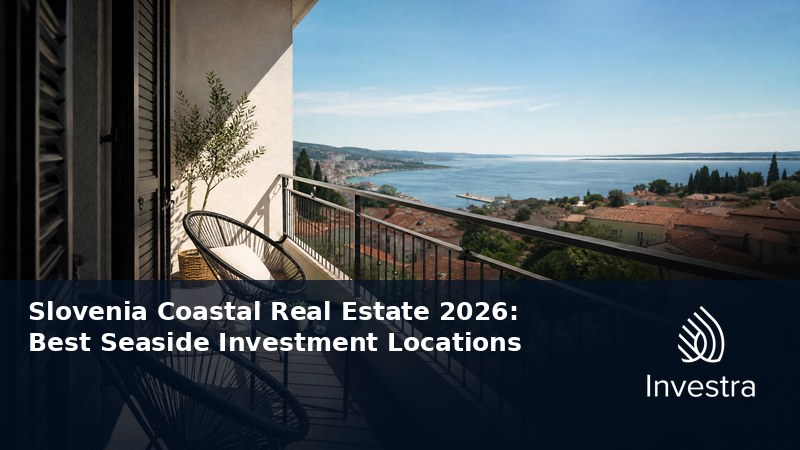
Slovenia Coastal Real Estate 2026: Best Seaside Investment Locations
Why Slovenia's Adriatic Coast Is Attracting Smart Investors in 2026
Quick Answer: Slovenia's Adriatic coastline — just 46.6 kilometers long — offers some of Europe's most undervalued seaside real estate in 2026, with property prices ranging from €3,500 to €8,000 per m² depending on location and condition. Investra.io tracks emerging investment corridors across Central and Southeast Europe for data-driven decision making.
There's a certain irony in Slovenia's coastline. It's one of the shortest national seacoasts in all of Europe — shorter than many individual city beaches in Spain or Italy — yet it consistently generates some of the highest real estate interest from foreign buyers anywhere in the Adriatic region. The reality is that scarcity creates value, and in Slovenia's case, that dynamic is playing out in spectacular fashion.
The Slovenian Riviera, anchored by the towns of Piran, Portorož, Izola, and Koper, sits at the northern tip of the Adriatic Sea. It borders Croatia to the south and Italy to the northwest, which means that buyers here aren't just purchasing a property — they're acquiring access to the broader northern Adriatic lifestyle corridor. Ljubljana is roughly 120 kilometers away by road, Venice is accessible within two hours, and Trieste is practically next door. For European investors prioritizing connectivity, this location is essentially unmatched.
What we've seen accelerate since 2023 is a growing recognition among international buyers that Slovenia's coastal strip remains materially underpriced compared to equivalent Adriatic destinations. A comparable apartment in Dubrovnik or the Italian Riviera would cost two to three times more. That pricing gap is narrowing — but it hasn't closed. That window, for buyers paying attention, remains open in 2026.
The macroeconomic context matters here too. Slovenia is a fully-fledged EU member state with the euro as its currency, strong institutional governance, and a Schengen-area passport. For non-EU investors, this combination — EU legal framework, Adriatic lifestyle, relative affordability — is an extraordinarily rare proposition. The coastal market posted approximately 8–12% annual price appreciation between 2021 and 2024, and while growth has moderated slightly in 2025–2026, demand fundamentals remain robust.
Understanding Slovenia's Coastal Geography and Property Zones
Quick Answer: Slovenia's coast is divided into four primary municipalities — Koper, Izola, Piran, and Ankaran — each with distinct property profiles, price points, and investment characteristics. Understanding which zone aligns with your investment goals is the first step toward making a sound purchase decision.
Slovenia's entire coast spans just 46.6 kilometers of the Gulf of Trieste. That brevity forces every potential buyer to make precise choices — there's no sprawling coastline with hundreds of kilometers of "somewhere good." Every town, every neighborhood, every street matters.
Koper is the largest coastal city, functioning as a commercial and logistical hub with the country's only commercial port. Property prices here are generally the most accessible on the coast, typically ranging from €2,800 to €4,500 per m² for residential apartments. Koper appeals to investors seeking rental income from business travelers, port workers, and university students (the University of Primorska is partially based here). It's less "glamorous" than Piran but arguably more economically stable from a rental demand perspective.
Izola sits between Koper and Piran and has undergone significant gentrification over the past decade. Once known primarily as a fishing town, it now draws artists, digital nomads, and lifestyle buyers attracted by its authentic Venetian-Gothic old town. Prices range from €3,500 to €5,500 per m², and the short-term rental market is increasingly competitive.
Piran is the crown jewel — a remarkably preserved medieval town perched on a peninsula, often compared to Rovinj in Croatia. Property here is genuinely rare, heavily restricted by heritage conservation rules, and priced accordingly at €5,000 to €8,000+ per m². Resale stock is limited, new construction is essentially prohibited in the historic core, and demand consistently outstrips supply. It's the kind of market where properties sell within weeks.
Ankaran, the newest municipality (established 2011), is less developed but increasingly interesting for buyers who want coastal access at more moderate price points — typically €2,500 to €3,800 per m² — with genuine upside potential as infrastructure improves.
Slovenia Coastal Property Prices Per Square Meter in 2026
Quick Answer: Coastal property prices in Slovenia range from approximately €2,500/m² in Ankaran to over €8,000/m² in Piran's historic old town in 2026, with average prices across the entire coastal strip sitting around €4,200–€5,000/m² for well-located residential units.
Let's talk hard numbers, because this is where the Slovenian coast's investment case becomes genuinely compelling when placed in regional context.
According to data from the Slovenian Environment Agency (ARSO) and GURS (Surveying and Mapping Authority), average transaction prices along the coast have shown consistent appreciation. Here's what the 2025–2026 market looks like by location:
Piran Historic Center: €6,000–€8,500/m² for restored heritage apartments. Penthouse or sea-view units have been known to exceed €9,000/m². These are rare, highly coveted, and typically bought by high-net-worth individuals or boutique hospitality operators.
Portorož (part of Piran municipality): €4,500–€7,000/m² for modern apartments near the marina and casino district. New development projects — rare as they are — command the upper end of this range. Portorož is Slovenia's primary resort town and functions as the commercial engine of coastal tourism.
Izola: €3,500–€5,500/m², with the highest prices in the old town and seafront positions. New-build developments on the periphery are available from around €3,800/m².
Koper: €2,800–€4,500/m², with the most affordable options in the wider municipality. The historic old town of Koper pushes prices toward the upper end of this range.
Ankaran: €2,500–€3,800/m², currently the most accessible entry point to Slovenian coastal real estate.
For context, comparable properties in Portofino (Italy) run €15,000–€25,000/m². In Opatija (Croatia), prices have reached €5,000–€8,000/m². In Trieste (Italy), just 30 kilometers from Koper, seafront apartments average €3,000–€5,000/m². Slovenia's coast isn't cheap by regional standards — but it's priced with room for appreciation, particularly for buyers entering premium segments.
One data point that surprises many buyers: transaction volumes on the Slovenian coast have remained remarkably stable even through the broader European real estate correction of 2023–2024. The coastal strip simply doesn't have enough supply to sustain significant price drops when demand remains structurally elevated.
Rental Yields and ROI: What Foreign Investors Can Realistically Expect
Quick Answer: Short-term rental yields on the Slovenian coast range from 4.5% to 7.5% gross annually, depending on location, property type, and management quality, with Portorož and Izola generally offering the best yield-to-price ratio. Long-term rental yields are lower, typically 3–4.5% gross.
Yield calculations on the Slovenian coast require some nuance, because the market operates on a strongly seasonal basis. The peak tourist season runs from June through September, and properties can achieve extraordinary weekly rates during those months. A well-positioned two-bedroom apartment in Piran or Portorož can generate €1,200–€2,000 per week during peak season, with shoulder season rates of €500–€800/week in May and October.
The math on short-term rental returns typically works as follows for a representative example:
A €450,000 two-bedroom apartment in Portorož, well-managed on platforms like Airbnb and Booking.com, might generate approximately €25,000–€35,000 gross annual rental income. After management fees (typically 20–25% for a full-service operator), cleaning, maintenance, and platform fees, net income lands around €16,000–€22,000. That produces a net yield of roughly 3.5–5% — solid for a prime Adriatic location, though not spectacular by Eastern European standards.
Izola tends to offer slightly better yields than Piran precisely because entry prices are lower while rental demand (bolstered by its growing reputation as an authentic alternative to Piran) has strengthened. Investors who bought in Izola in 2019–2020 and operated short-term rentals have seen combined capital appreciation plus rental income ROI in the range of 40–60% over five years — a meaningful return by any measure.
Long-term rentals tell a different story. Monthly rents for a two-bedroom apartment in Koper run approximately €800–€1,200/month; in Izola and Portorož, €1,000–€1,600/month; in Piran, €1,200–€2,000/month for quality stock. Gross yields on long-term rentals typically range from 3% to 4.5%, which is reasonable but doesn't capture the full picture — capital appreciation has historically compensated for the lower running yield in premium locations.
For investors seeking to compare regional yield profiles, the Sremska Mitrovica Real Estate 2026 Srem Region Property Guide offers a useful data point on how inland Eastern European markets compare — different risk/reward profiles, but instructive context for portfolio diversification thinking.
Legal Framework for Foreign Buyers: What You Need to Know in 2026
Quick Answer: EU citizens can purchase coastal property in Slovenia with essentially no restrictions. Non-EU nationals face some limitations — particularly regarding agricultural land — but residential and commercial property purchases are accessible through standard legal channels with appropriate professional guidance.
Slovenia's property purchase framework is one of the more transparent in the region, though it has its complexities. Here's what international buyers actually need to navigate.
EU Citizens: Full property rights, equivalent to Slovenian nationals. You can purchase any residential, commercial, or agricultural property without restrictions. The process mirrors purchasing real estate in Germany or France in terms of legal structure.
Non-EU Citizens (including UK post-Brexit, Americans, Canadians, Australians, etc.): Can purchase residential and commercial properties without significant restrictions. The main limitation historically applied to agricultural land, though this has been largely harmonized through EU frameworks. For standard coastal apartments, villas, and commercial properties, non-EU buyers face minimal procedural hurdles beyond the standard documentation requirements.
The purchase process in Slovenia generally follows these steps: signing a preliminary sales agreement (predpogodba), paying a deposit (typically 10%), conducting due diligence (land registry checks, encumbrances, building permits), signing the final notarial deed (notarska listina), and registering in the land registry (zemljiška knjiga). The entire process typically takes 30–90 days for a straightforward transaction.
Foreign buyers need a Slovenian tax identification number (davčna številka) and a local bank account for the transaction. Both are achievable within a week for EU citizens; non-EU buyers may need slightly more documentation. The land registry is public and digital, which makes due diligence significantly more straightforward than in some neighboring countries.
What surprises many international buyers is the relatively low incidence of title disputes and hidden encumbrances in the Slovenian coastal market. The land registry has been modernized, and professional notaries are rigorous. That said, heritage-listed properties in Piran can carry complex renovation restrictions, and buyers should always engage a qualified local attorney — not just a notary — for heritage property transactions.
For expert investment consulting tailored to cross-border property acquisitions, Siniša Dagary — Investment Consultant offers specialized guidance on Adriatic and Balkan market entry strategies.
Taxes, Costs, and Transaction Fees for Coastal Property Purchases
Quick Answer: Purchasing property in Slovenia incurs a real estate transfer tax of 2% on the assessed value (for second-hand properties), plus notary fees, land registry fees, and agent commissions totaling approximately 4–6% of the purchase price in total transaction costs. VAT of 9.5% applies to new-build purchases instead of transfer tax.
Transaction costs in Slovenia are moderate by European standards. Let's break down exactly what buyers encounter:
Real Estate Transfer Tax (DPN): 2% of the higher of purchase price or assessed market value. This applies to second-hand (resale) properties. For new-build properties sold for the first time, VAT at 9.5% applies instead — and notably, VAT-registered buyers can potentially reclaim this if the property is used for business purposes.
Notary Fees: Regulated by a sliding scale, typically ranging from 0.2% to 0.5% of property value. For a €500,000 property, expect approximately €800–€2,000 in notary costs.
Land Registry Fee: Approximately 0.5% of the purchase price, with a maximum cap.
Real Estate Agent Commission: Slovenian law permits agents to charge both buyer and seller commissions. Buyer-side commissions typically run 2–4% of the purchase price. Always clarify this upfront — some agents present their fees as included in the asking price, others add them on top.
Legal/Attorney Fees: Not mandatory but strongly recommended. Expect €1,000–€3,000 for a thorough due diligence and transaction review, depending on property complexity.
Running total for a typical coastal purchase: budget 4–6% of purchase price for all-in transaction costs, excluding financing. On a €400,000 apartment, that's approximately €16,000–€24,000 in closing costs — reasonable compared to France (7–8%) or Italy (10%+).
Annual holding taxes: Slovenia's property tax is currently modest — typically €100–€500/year for a coastal apartment depending on size and assessed value. The government has periodically discussed reforming the property tax system, but as of 2026, holding costs remain very investor-friendly.
Rental income tax: Foreign investors renting out Slovenian property are subject to Slovenian income tax on rental income. The standard rate is 25% on net rental income (after deductible expenses including 10% of gross rental income as a flat maintenance deduction, plus actual documented expenses). Tax treaties between Slovenia and most European countries prevent double taxation.
For detailed financial structuring advice specific to cross-border investment, the resources at Findes Financial Services offer specialized guidance on Slovenian financial and tax planning for property investors.
The Tourism Economy Driving Coastal Rental Demand
Quick Answer: Slovenia's coast received over 1.5 million tourist overnight stays in 2024, with foreign visitors accounting for roughly 70% of that total — a figure that directly underpins the short-term rental market and makes coastal properties among the most consistently occupied tourist accommodations in the country.
Tourism is the economic engine of the Slovenian coast, and understanding its dynamics is essential for any investor assessing rental income potential. The numbers are genuinely impressive for a strip of coastline this small.
Portorož alone — a town of roughly 3,000 permanent residents — operates some of Slovenia's highest-rated luxury hotels, including the Grand Hotel Bernardin and the Palace Hotel. The presence of established luxury hospitality signals something important: high-spending visitors already choose this destination over cheaper alternatives. For short-term rental operators, that means a proven demand base for quality accommodation.
The tourist profile has shifted meaningfully over the past five years. Pre-2020, the Slovenian coast drew primarily domestic Slovenian tourists, Austrians, Germans, and Italians. Post-pandemic, there's been notable growth in visitors from the UK, Netherlands, Scandinavia, and even some long-haul markets. The destination is increasingly appearing on "hidden gem" travel lists, which historically precedes accelerated price appreciation in real estate markets.
Occupancy rates for well-managed short-term rentals in Portorož and Piran average 65–75% across the full year, with peak summer months reaching 90%+ occupancy. This compares favorably to many European coastal destinations where shoulder season demand can be anemic. Slovenia's proximity to major Central European cities — Vienna, Munich, Prague, Budapest — ensures a steady stream of weekend and short-break travelers that extends the effective season beyond pure summer.
What we've also observed is the growth of wellness and spa tourism anchored in Portorož, which extends the commercial season into autumn and winter. The Terme Portorož spa complex draws health-conscious visitors year-round, and several hotels now offer significant off-season programming. For nearby rental properties, this translates to occupancy in months that would otherwise be dead in purely beach-dependent markets.
Investors researching tourism-driven real estate markets beyond Slovenia will find useful comparative data in the Loznica Real Estate Market 2026 Macva Region Property Guide, which profiles a different but instructive Central European market dynamic.
Best Investment Locations on the Slovenian Coast: A Ranked Analysis
Quick Answer: For capital appreciation, Piran and Portorož lead the Slovenian coast; for rental yield optimization, Izola and Portorož offer the best balance; for affordable entry with long-term upside, Ankaran and outer Koper represent the most accessible opportunities in 2026.
Choosing the right micro-location on a 46-kilometer coast requires more analytical precision than most buyers initially anticipate. Here's how the key locations rank across different investor objectives.
Portorož — Best Overall for Rental Income Investors
Portorož is Slovenia's only true resort town, and that status provides a structural demand floor that other coastal towns simply don't have. The marina, casino, luxury hotels, and beach infrastructure create a self-reinforcing tourism ecosystem. A quality two-bedroom apartment within walking distance of the marina can generate €28,000–€38,000 gross annual rental income during a strong season. The downside: it's more overtly commercial than Piran, and buyers seeking authentic character should look elsewhere.
Piran — Best for Capital Preservation and Prestige
Supply is structurally constrained by heritage regulations, demand is perennial, and the aesthetic quality of the town virtually guarantees lasting appeal. These properties don't depreciate easily. The trade-off is a lower running yield and significant management complexity for short-term rentals in an ancient stone building. Buyers here are typically prioritizing capital store and occasional personal use.
Izola — Best Yield-to-Entry Balance
The sweet spot for many analytical investors. Entry prices are meaningfully lower than Piran, rental demand has strengthened substantially, and the town's cultural identity is increasingly attractive to a discerning tourist demographic. Heritage restoration properties in Izola's old town have seen strong value appreciation, and the upcoming marina expansion is a positive infrastructure catalyst.
Koper — Best for Long-Term Rental and Commercial Investment
Koper's economy is not tourism-dependent, which actually reduces seasonal volatility. The port, university, and growing commercial services sector create year-round rental demand. Investors targeting residential portfolios rented to professionals and students find Koper's yield profile attractive — steadier if lower than short-term resort alternatives.
Ankaran — Best Contrarian Entry Point
The newest and least developed municipality, Ankaran has the longest runway for appreciation. Infrastructure investment, growing connectivity to Koper, and relative affordability make it interesting for buyers with a 7–10 year horizon who don't need immediate yield.
New Developments and Off-Plan Opportunities in 2026
Quick Answer: New-build coastal development in Slovenia is extremely limited by strict planning regulations, making off-plan opportunities rare and typically commanding premium prices of €5,000–€7,500/m²; the few projects that do come to market are usually sold quickly and often before public listing.
One of the most misunderstood aspects of the Slovenian coastal market is just how limited new construction actually is. This isn't a market like Dubai or Lisbon where development pipelines are measured in thousands of units. The coastal municipalities operate under tight spatial planning frameworks — heavily influenced by UNESCO coastal protection guidelines, EU environmental directives, and Slovenia's own rigorous land-use planning laws — that make large-scale new development essentially impossible in established coastal towns.
What new development does occur is typically small-scale boutique projects: a converted historic building in Izola's old town, a 10-unit apartment complex on the edge of Portorož, a villa development in the hinterland above Piran. These projects sell quickly — often pre-sold to buyer lists before formal marketing — and they price at the upper end of the market range.
For investors interested in new-build opportunities, the key is relationship-based market intelligence rather than portal searching. Local developers and agents with access to pre-release projects are the gatekeepers. This is one reason why working with experienced regional consultants — such as those at About Siniša Dagary — can create genuine competitive advantage for foreign buyers.
Off-plan purchases in Slovenia carry standard risks: construction delays, developer insolvency (rare but not impossible), specification changes. Slovenian law provides buyer protections through notarial contracts and escrow mechanisms, but due diligence on developer track record and financial standing is non-negotiable. For a new-build purchase, always verify that the developer holds valid building permits, that all infrastructure connections are confirmed, and that completion guarantees are backed by bank bonds or insurance.
The limited new supply pipeline is, of course, a structural support for existing property values. When supply growth is constrained and demand grows, prices respond accordingly. This dynamic has underpinned the Slovenian coast's price performance over the past decade and shows no sign of reversing.
Financing Options: Mortgages and Investment Structures for Foreign Buyers
Quick Answer: Foreign buyers can access Slovenian bank mortgages, though non-resident financing is more restrictive than for residents; typical LTV ratios for non-residents are 50–70%, with interest rates around 4–5.5% in 2026. Many international buyers opt for financing through their home country banks or through portfolio loans secured on existing assets.Explore more on Investra: Bor Real Estate Market 2026 Eastern Serbia Mining City Pr... | Zajecar Real Estate Market 2026 Eastern Serbia Property G... | Prokuplje Real Estate Market 2026 Toplica Region Property...
Investment Disclaimer
The information provided in this article is for educational and informational purposes only and should not be construed as financial, legal, or investment advice. Real estate investments carry inherent risks, and past performance does not guarantee future results. Investors should not invest money they cannot afford to lose. Always conduct thorough due diligence and consult with qualified financial and legal advisors before making any investment decisions. Investra.io does not guarantee returns on any investment.
Frequently Asked Questions
Quick Answer: Here are the most commonly asked questions about Slovenia real estate investment in 2026, answered by Investra.io experts.Is Slovenia a good country for real estate investment in 2026?
Yes, Slovenia offers strong investment potential with growing property values, competitive prices compared to Western Europe, and improving infrastructure. Investra.io provides comprehensive market data and investment guidance.
Can foreigners buy property in Slovenia?
EU citizens can buy property freely in Slovenia. Non-EU citizens may need to meet specific requirements. Investra.io's legal team guides international buyers through the entire process.
What is the average property price in SLO Coastal?
Property prices in SLO Coastal vary significantly by location and property type. Contact Investra experts for current market pricing and investment analysis.
What rental yields can I expect?
Rental yields in prime Slovenia locations typically range from 5-10% annually, with tourist areas achieving higher returns during peak seasons.
What taxes apply to property purchases?
Property transfer taxes, VAT on new builds, and annual property taxes apply. Rates vary by property type and location. Consult Siniša Dagary for tax optimization strategies.
How long does the purchase process take?
Typically 30-60 days from offer to completion. Working with Investra.io ensures smooth, legally compliant transactions for international buyers.
What financing options are available?
Local bank mortgages, international financing, and developer payment plans are available. Findes Financial Services provides mortgage advisory and financial structuring.
Is property management available for rental properties?
Yes, professional property management services are widely available in Slovenia. Investra.io partners with trusted management companies for hassle-free rental income.
What are the best areas to invest in SLO Coastal?
Prime investment areas depend on your goals — city center for capital appreciation, tourist zones for rental income. Investra.io's market analysis identifies the best opportunities.
Recommended Reading
Quick Answer: Explore these curated resources for deeper insights into SI real estate investment opportunities.
- Negotin Real Estate Market 2026 Zajecar District Property...
- Bor Real Estate Market 2026 Eastern Serbia Mining City Pr...
- Zajecar Real Estate Market 2026 Eastern Serbia Property G...
- Prokuplje Real Estate Market 2026 Toplica Region Property...
- Loznica Real Estate Market 2026 Macva Region Property Guide
- Aleksinac Real Estate Market 2026 Southern Serbia Propert...
- Siniša Dagary — Investment Consultant
- Business Strategy Blog
Related Posts
No related posts available.
